 Скачать презентацию 1 -to-Many Distribution Vehicle Routing Part 2 John
8b285408a562a34d0f8c0a0654075ed8.ppt
- Количество слайдов: 20



1 -to-Many Distribution Vehicle Routing Part 2 John H. Vande Vate Spring, 2001 12/27/00 1
Spacefilling Curves z. There are no more points in the unit square than in the interval from 0 to 1!? 2
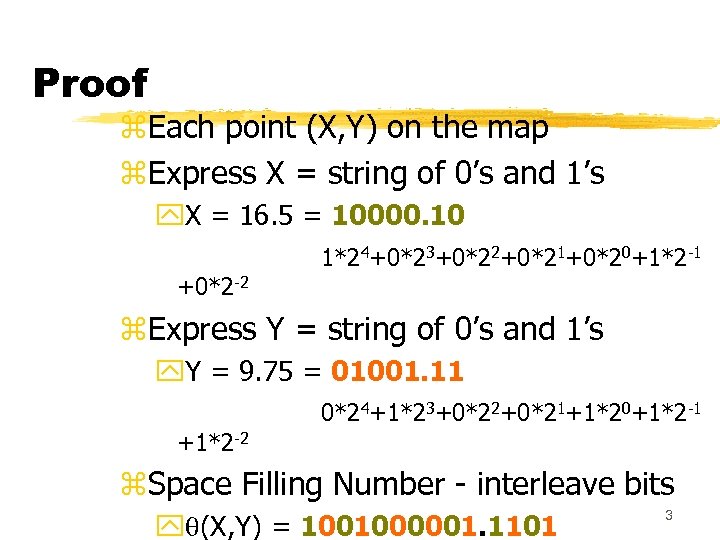
Proof z. Each point (X, Y) on the map z. Express X = string of 0’s and 1’s y. X = 16. 5 = 10000. 10 1*24+0*23+0*22+0*21+0*20+1*2 -1 +0*2 -2 z. Express Y = string of 0’s and 1’s y. Y = 9. 75 = 01001. 11 0*24+1*23+0*22+0*21+1*20+1*2 -1 +1*2 -2 z. Space Filling Number - interleave bits y (X, Y) = 1001000001. 1101 3
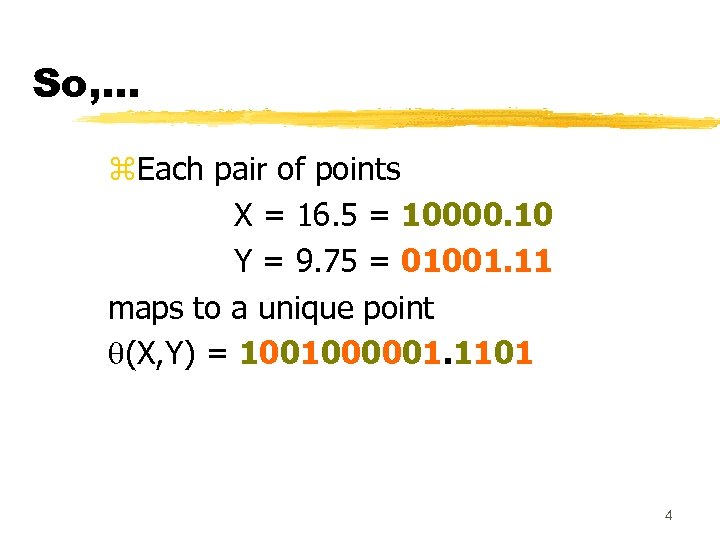
So, . . . z. Each pair of points X = 16. 5 = 10000. 10 Y = 9. 75 = 01001. 11 maps to a unique point (X, Y) = 1001000001. 1101 4
An obsessive travelling salesman ! z. We can visualize the spacefilling curve as a route of a travelling salesman who wants to visit every point in the unit square ! 5
How to Use this? z. A mapping of (X, Y) into the unit interval z. Think of this as the inverse mapping of the unit interval onto the square (our super tour) z. For a given customer (X, Y) is the fraction of the way along the super tour where it lies z. Visit the customers in the order of (X, Y) (short cut the super tour to visit our customers) 6
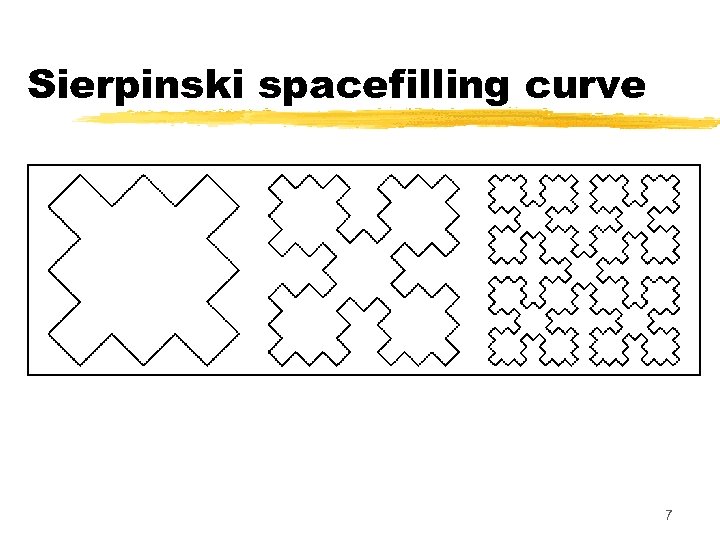
Sierpinski spacefilling curve 7
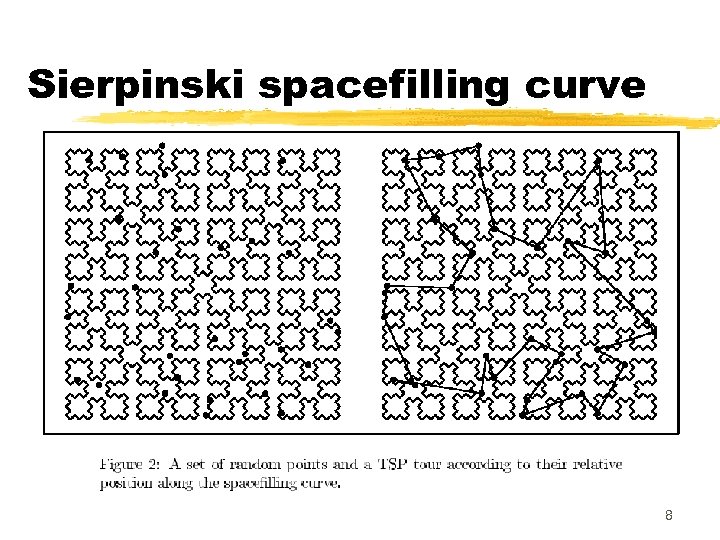
Sierpinski spacefilling curve 8
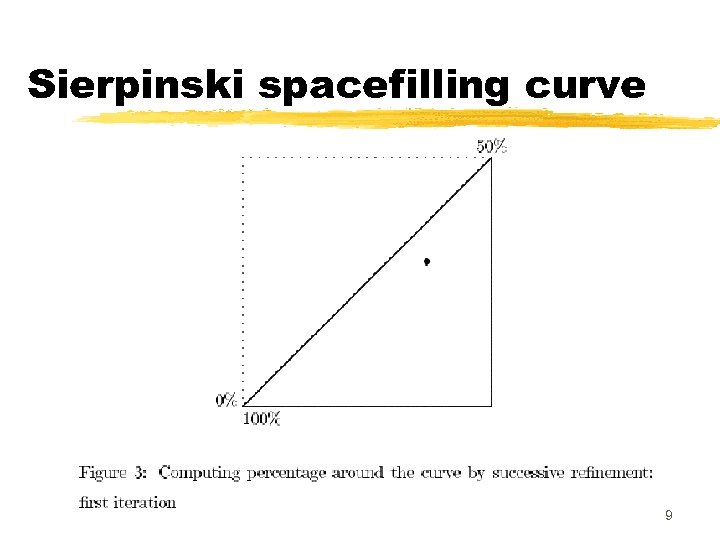
Sierpinski spacefilling curve 9
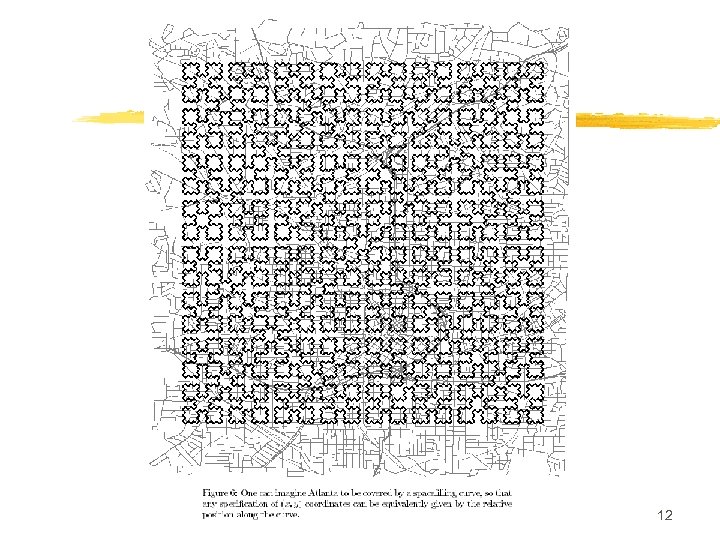
“Meals on Wheels” z. Senior Citizen Services, Inc. is a private, nonprofit corporation in Atlanta, Georgia whose purpose is to provide social services for the elderly, especially the elderly poor, in Fulton County. z. Need to deliver meals to these people between 10 am and 2 pm everyday. z. Normally use 4 drivers, each delivers 40 -50 meals to 30 -40 locations. 10
“Meals on Wheels” z. As for most charitable organizations, they have unstable, almost always insufficient, sometimes desparate funding. z. Can’t afford computing resources z. Need bare-bones administrative costs - any extra funds are required for meals and other services. The manager is too busy with more important issues z. List of clients is quite volatile 11
12
Why Spacefilling Curves ? z The spacefilling curve heuristic (SFC) has many advantages, if you are willing to accept solutions that are about 25% longer than optimum (expected, for random point sets). These advantages include: · The SFC algorithm is fast: Only O(n log n) effort to construct a tour of n points and only O(log n) effort to update the solution by adding or removing points. · The SFC heuristic does not need explicit distances between points and so there is no need to compute these, as most other heuristics must. · The algorithm is parallelizable. (A comparable algorithm, Nearest Neighbor, is apparently not parallelizable. ) · The length of links in the SFC tour of random points is expected to be small and so (1/k)-th of the stops account for about (1/k)-th of the travel time. This means that an SFC tour can easily be converted to tours for k vehicles simply by partitioning the SFC route into k contiguous pieces. 13
Some applications · To build a routing system for Meals-on-Wheels in Fulton County (Atlanta, GA), which delivers hundreds of meals daily to those too ill or old to shop for themselves. Built on two rolodex card files. · To route blood delivery to hospitals in the Atlanta metropolitan area by the American Red Cross. · To target a space-based laser (part of the Strategic Defense Iniative, or "Star Wars" program). · To control a pen-plotter for the drawing of maps. M. Iri and co-workers at the University of Tokyo showed how it could be used to reduce drawing time for large road maps by routing the pen efficiently. 14
The TSP z. For More on Space. Filling Curves visit http: //www. isye. gatech. edu/faculty/John_Bartholdi/mow. html z. There are several books on the TSP z……… 15
Our Approach z. Minimize Transportation Cost (Distance) y. Traveling Salesman Problem z. Respect the capacity of the Vehicle y. Multiple Traveling Salesmen z. Consider Inventory Costs y. Estimate the Transportation Cost y. Estimate the Inventory Cost y. Trade off these two costs. 16
Idea z. Increasing Service to the Stores y. More frequent deliveries x. Reduce inventory x. Increase transportation y. How often should we deliver? z. High level approach y. Estimate Transportation Cost as function of frequency of delivery y. Estimate Inventory cost as function of frequency of delivery 17 y. Trade off the two
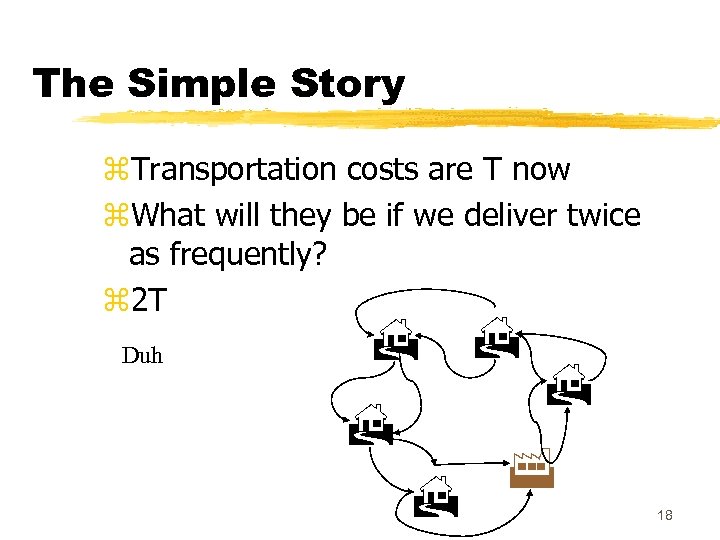
The Simple Story z. Transportation costs are T now z. What will they be if we deliver twice as frequently? z 2 T Duh 18
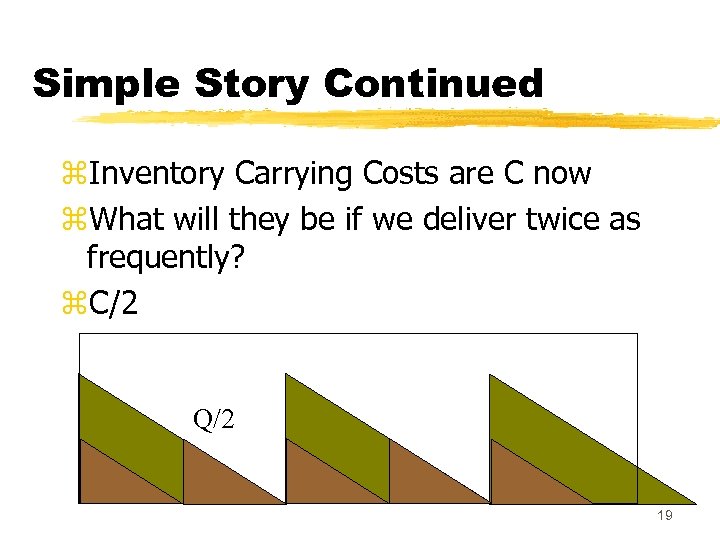
Simple Story Continued z. Inventory Carrying Costs are C now z. What will they be if we deliver twice as frequently? z. C/2 Q/2 19
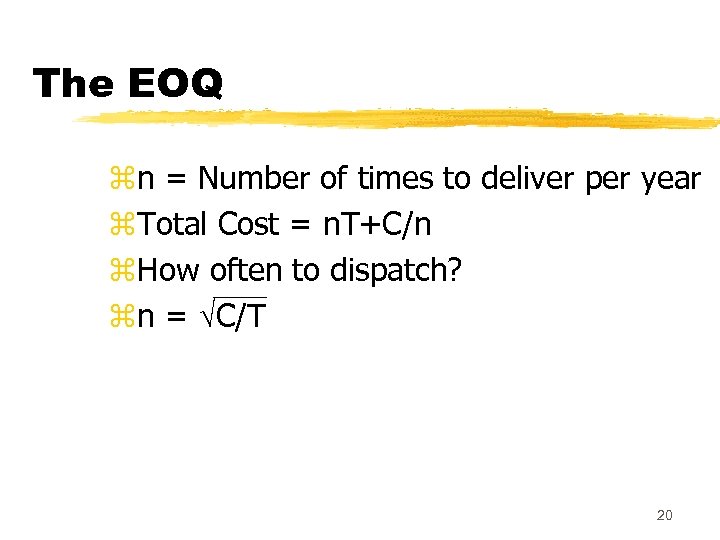
The EOQ zn = Number of times to deliver per year z. Total Cost = n. T+C/n z. How often to dispatch? zn = C/T 20
Скачать презентацию 1 -to-Many Distribution Vehicle Routing Part 2 John
8b285408a562a34d0f8c0a0654075ed8.ppt