


 Скачать презентацию 1 Theory and Application of Artificial Neural Networks
6ed4ede034075646041a5f57871e6227.ppt
- Количество слайдов: 101
 1 Theory and Application of Artificial Neural Networks with Daniel L. Silver, Ph. D Copyright (c), 2014 All Rights Reserved Cog. Nova Technologies
 2 Seminar Outline DAY 1 v v v v ANN Background and Motivation Classification Systems and Inductive Learning From Biological to Artificial Neurons Learning in a Simple Neuron Limitations of Simple Neural Networks Visualizing the Learning Process Multi-layer Feed-forward ANNs The Back-propagation Algorithm DAY 2 v v v v Generalization in ANNs How to Design a Network How to Train a Network Mastering ANN Parameters The Training Data Post-Training Analysis Pros and Cons of Back-prop Advanced issues and networks Cog. Nova Technologies
 3 ANN Background and Motivation Cog. Nova Technologies
 4 Background and Motivation v Growth has been explosive since 1987 – – education institutions, industry, military > 500 books on subject > 20 journals dedicated to ANNs numerous popular, industry, academic articles v Truly inter-disciplinary area of study v No longer a flash in the pan technology Cog. Nova Technologies
 5 Background and Motivation v Computers and the Brain: A Contrast – Arithmetic: 1 brain = 1/10 pocket calculator – Vision: 1 brain = 1000 super computers – – Memory of arbitrary details: computer wins Memory of real-world facts: brain wins A computer must be programmed explicitly The brain can learn by experiencing the world Cog. Nova Technologies
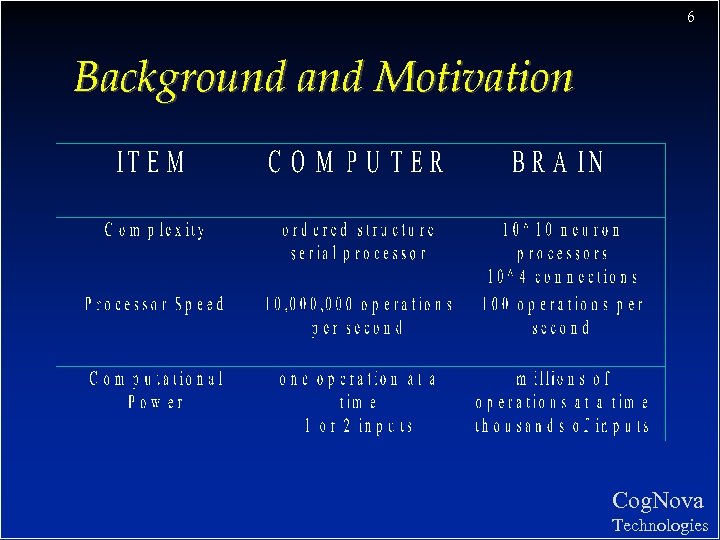 6 Background and Motivation Cog. Nova Technologies
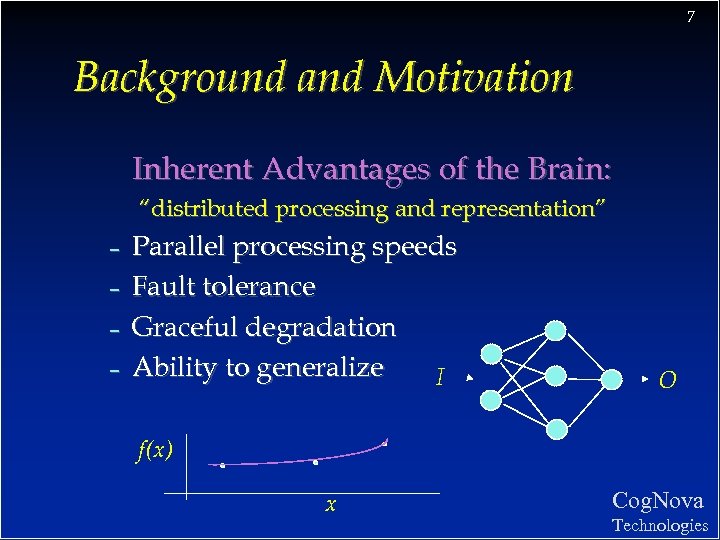 7 Background and Motivation Inherent Advantages of the Brain: “distributed processing and representation” – – Parallel processing speeds Fault tolerance Graceful degradation Ability to generalize I O f(x) x Cog. Nova Technologies
 8 Background and Motivation History of Artificial Neural Networks v v Creation: 1890: William James - defined a neuronal process of learning Promising Technology: 1943: Mc. Culloch and Pitts - earliest mathematical models 1954: Donald Hebb and IBM research group - earliest simulations 1958: Frank Rosenblatt - The Perceptron Disenchantment: 1969: Minsky and Papert - perceptrons have severe limitations Re-emergence: 1985: Multi-layer nets that use back-propagation 1986: PDP Research Group - multi-disciplined approach Cog. Nova Technologies
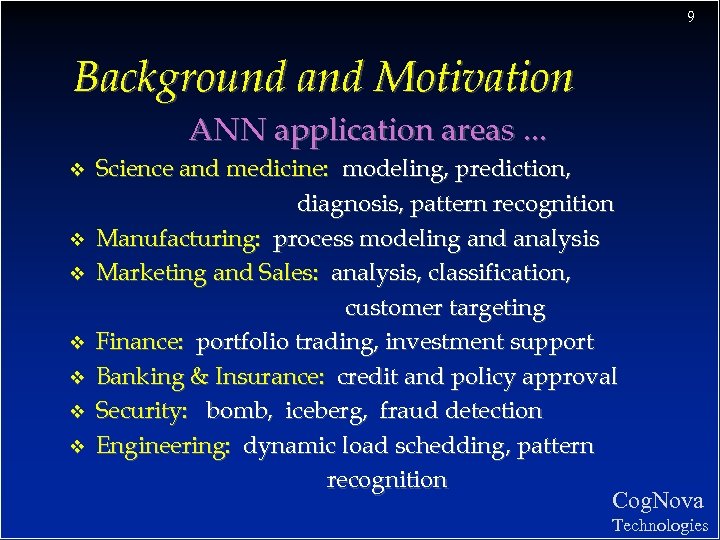 9 Background and Motivation ANN application areas. . . v v v v Science and medicine: modeling, prediction, diagnosis, pattern recognition Manufacturing: process modeling and analysis Marketing and Sales: analysis, classification, customer targeting Finance: portfolio trading, investment support Banking & Insurance: credit and policy approval Security: bomb, iceberg, fraud detection Engineering: dynamic load schedding, pattern recognition Cog. Nova Technologies
 10 Classification Systems and Inductive Learning Cog. Nova Technologies
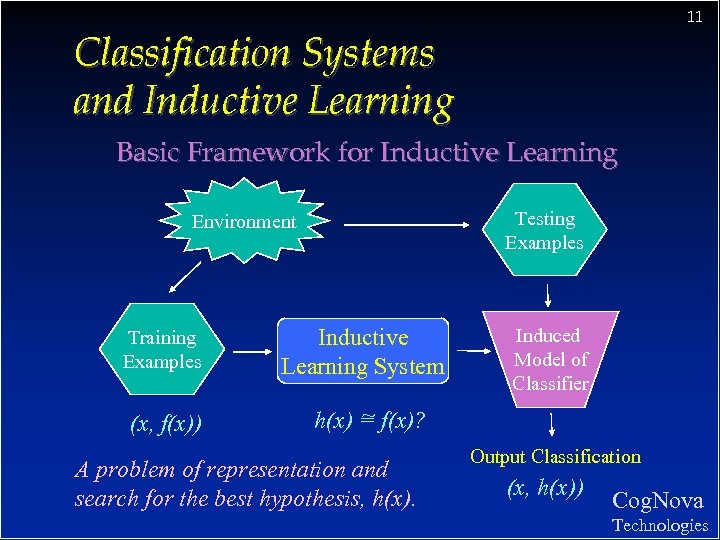 11 Classification Systems and Inductive Learning Basic Framework for Inductive Learning Testing Examples Environment Training Examples (x, f(x)) Inductive Learning System Induced Model of Classifier ~ h(x) = f(x)? A problem of representation and search for the best hypothesis, h(x). Output Classification (x, h(x)) Cog. Nova Technologies
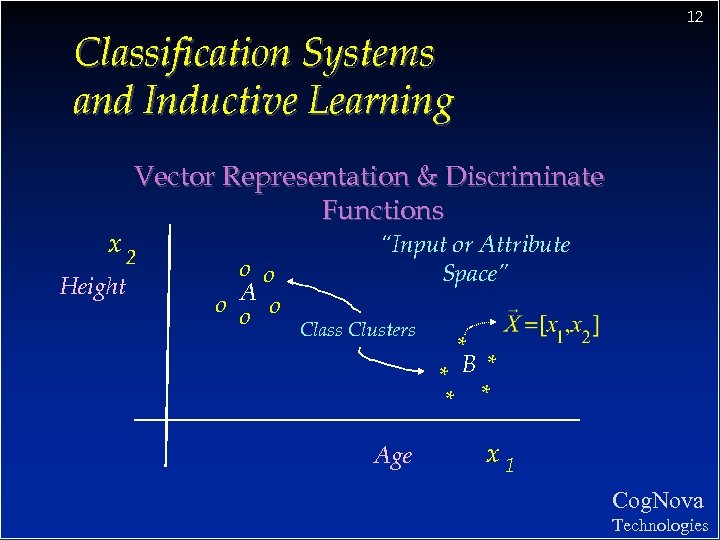 12 Classification Systems and Inductive Learning Vector Representation & Discriminate Functions x 2 Height “Input or Attribute Space” o o o A o o Class Clusters Age * * B* * * x 1 Cog. Nova Technologies
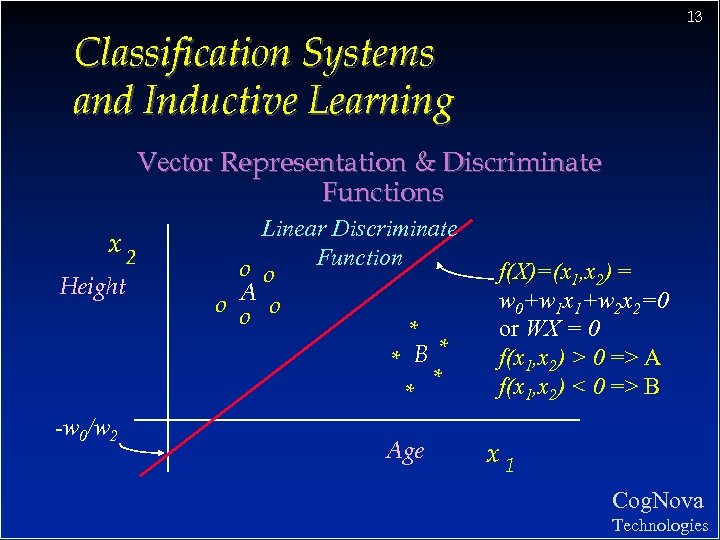 13 Classification Systems and Inductive Learning Vector Representation & Discriminate Functions x 2 Height -w 0/w 2 Linear Discriminate Function o o o A o o * * B* * * Age f(X)=(x 1, x 2) = w 0+w 1 x 1+w 2 x 2=0 or WX = 0 f(x 1, x 2) > 0 => A f(x 1, x 2) < 0 => B x 1 Cog. Nova Technologies
 14 Classification Systems and Inductive Learning vf(X) = WX =0 will discriminate class A from B, v BUT. . . we do not know the appropriate values for : w 0, w 1, w 2 Cog. Nova Technologies
 15 Classification Systems and Inductive Learning We will consider one family of neural network classifiers: v continuous valued input v feed-forward v supervised learning v global error Cog. Nova Technologies
 16 From Biological to Artificial Neurons Cog. Nova Technologies
 17 From Biological to Artificial Neurons The Neuron - A Biological Information Processor v dentrites - the receivers v soma - neuron cell body (sums input signals) v axon - the transmitter v synapse - point of transmission v neuron activates after a certain threshold is met Learning occurs via electro-chemical changes in effectiveness of synaptic junction. Cog. Nova Technologies
 18 From Biological to Artificial Neurons An Artificial Neuron - The Perceptron simulated on hardware or by software v input connections - the receivers v node, unit, or PE simulates neuron body v output connection - the transmitter v activation function employs a threshold or bias v connection weights act as synaptic junctions Learning occurs via changes in value of the connection weights. Cog. Nova v Technologies
 19 From Biological to Artificial Neurons An Artificial Neuron - The Perceptron v v Basic function of neuron is to sum inputs, and produce output given sum is greater than threshold ANN node produces an output as follows: 1. Multiplies each component of the input pattern by the weight of its connection 2. Sums all weighted inputs and subtracts the threshold value => total weighted input 3. Transforms the total weighted input into the output using the activation function Cog. Nova Technologies
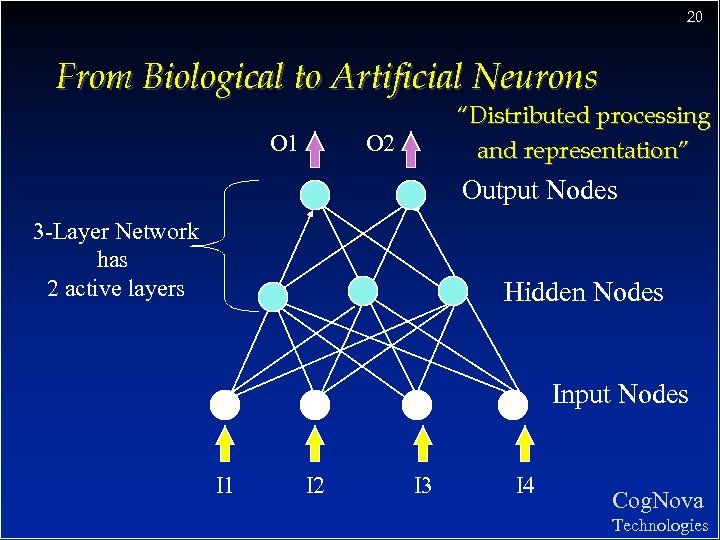 20 From Biological to Artificial Neurons O 1 “Distributed processing and representation” O 2 Output Nodes 3 -Layer Network has 2 active layers Hidden Nodes Input Nodes I 1 I 2 I 3 I 4 Cog. Nova Technologies
 21 From Biological to Artificial Neurons Behaviour of an artificial neural network to any particular input depends upon: structure of each node (activation function) v structure of the network (architecture) v weights on each of the connections. . these must be learned ! v Cog. Nova Technologies
 22 Learning in a Simple Neuron Cog. Nova Technologies
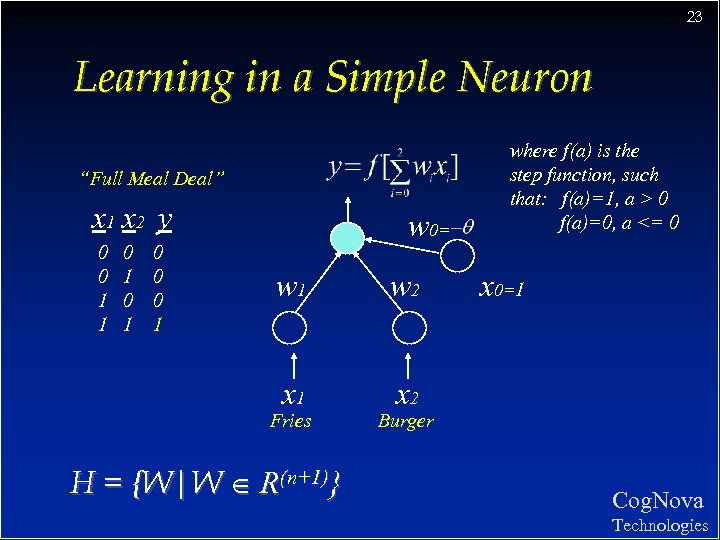 23 Learning in a Simple Neuron “Full Meal Deal” x 1 x 2 y 0 0 1 1 0 0 0 1 1 w 0= w 1 w 2 x 1 where f(a) is the step function, such that: f(a)=1, a > 0 f(a)=0, a <= 0 x 2 Fries H = {W|W R(n+1)} x 0=1 Burger Cog. Nova Technologies
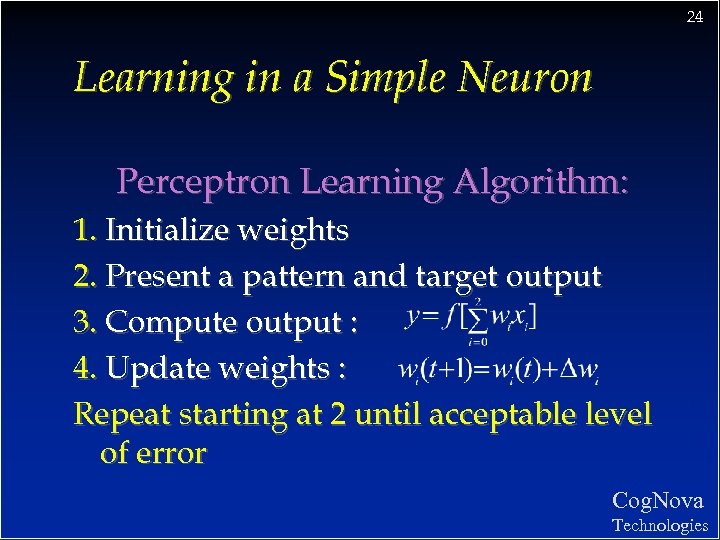 24 Learning in a Simple Neuron Perceptron Learning Algorithm: 1. Initialize weights 2. Present a pattern and target output 3. Compute output : 4. Update weights : Repeat starting at 2 until acceptable level of error Cog. Nova Technologies
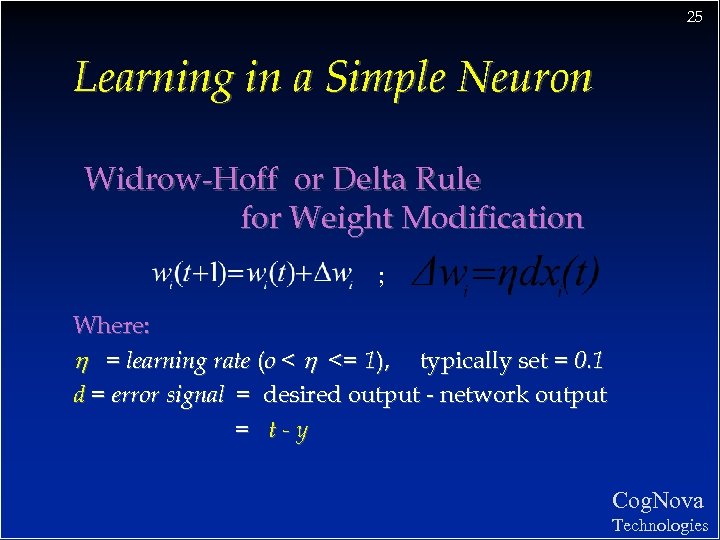 25 Learning in a Simple Neuron Widrow-Hoff or Delta Rule for Weight Modification ; Where: h = learning rate (o < h <= 1), typically set = 0. 1 d = error signal = desired output - network output = t-y Cog. Nova Technologies
 26 Learning in a Simple Neuron Perceptron Learning - A Walk Through The PERCEPT. XLS table represents 4 iterations through training data for “full meal deal” network v On-line weight updates v Varying learning rate, h , will vary training time v Cog. Nova Technologies
 27 TUTORIAL #1 v Your ANN software package: A Primer v Develop and train a simple neural network to learn the OR function Cog. Nova Technologies
 28 Limitations of Simple Neural Networks Cog. Nova Technologies
 29 Limitations of Simple Neural Networks What is a Perceptron doing when it learns? We will see it is often good to visualize network activity v A discriminate function is generated v Has the power to map input patterns to output class values v For 3 -dimensional input, must visualize 3 -D space and 2 -D hyper-planes v Cog. Nova Technologies
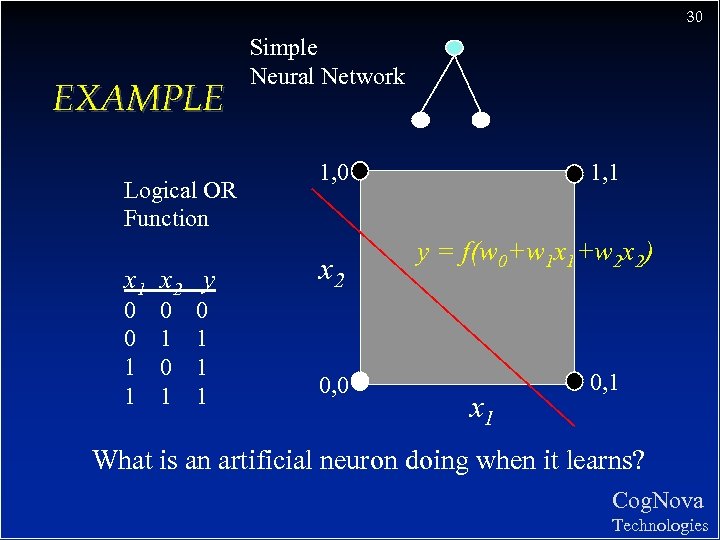 30 EXAMPLE Logical OR Function x 1 x 2 y 0 0 1 1 0 1 0 1 1 1 Simple Neural Network 1, 0 x 2 0, 0 1, 1 y = f(w 0+w 1 x 1+w 2 x 2) x 1 0, 1 What is an artificial neuron doing when it learns? Cog. Nova Technologies
 31 Limitations of Simple Neural Networks The Limitations of Perceptrons (Minsky and Papert, 1969) Able to form only linear discriminate functions; i. e. classes which can be divided by a line or hyper-plane v Most functions are more complex; i. e. they are non-linear or not linearly separable v This crippled research in neural net theory for 15 years. . v Cog. Nova Technologies
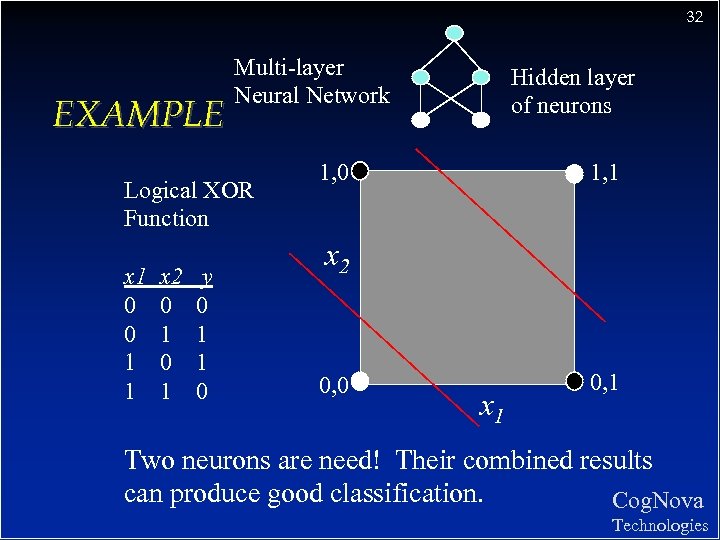 32 EXAMPLE Multi-layer Neural Network Logical XOR Function x 1 0 0 1 1 x 2 0 1 y 0 1 1 0 Hidden layer of neurons 1, 0 1, 1 x 2 0, 0 x 1 0, 1 Two neurons are need! Their combined results can produce good classification. Cog. Nova Technologies
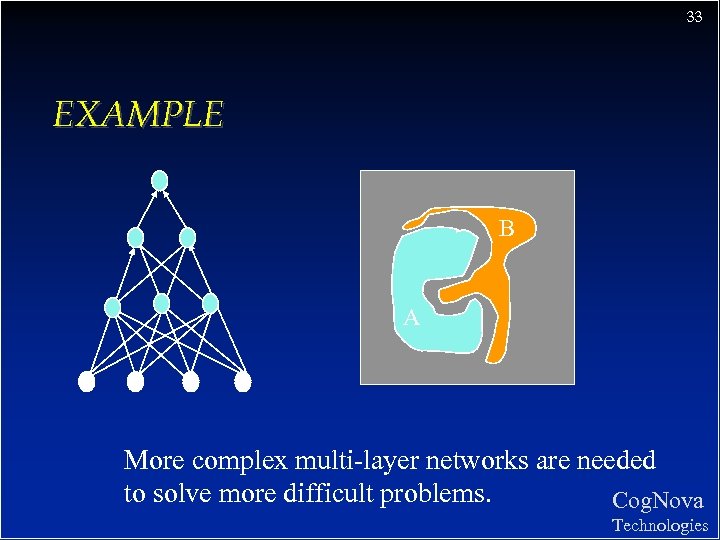 33 EXAMPLE B A More complex multi-layer networks are needed to solve more difficult problems. Cog. Nova Technologies
 34 TUTORIAL #2 v Develop and train a simple neural network to learn the XOR function v Also see: http: //www. neuro. sfc. keio. ac. jp/~masato/jv/sl/BP. html Cog. Nova Technologies
 35 Multi-layer Feed-forward ANNs Cog. Nova Technologies
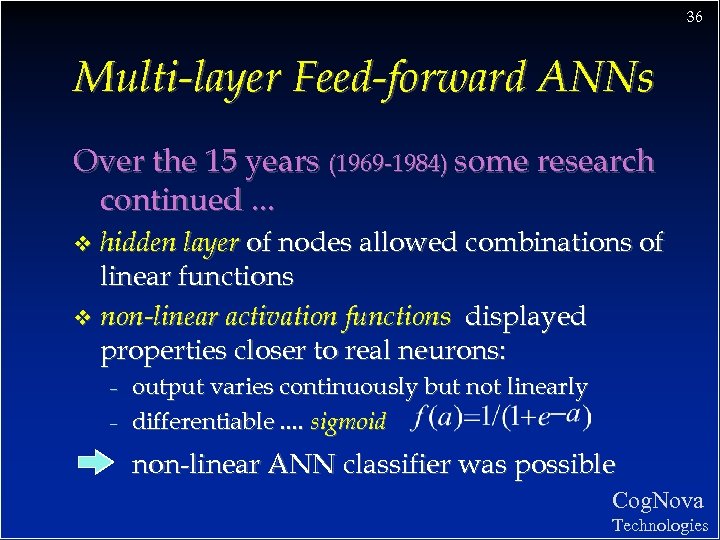 36 Multi-layer Feed-forward ANNs Over the 15 years (1969 -1984) some research continued. . . hidden layer of nodes allowed combinations of linear functions v non-linear activation functions displayed properties closer to real neurons: v – – output varies continuously but not linearly differentiable. . sigmoid non-linear ANN classifier was possible Cog. Nova Technologies
 37 Multi-layer Feed-forward ANNs v However. . . there was no learning algorithm to adjust the weights of a multi-layer network - weights had to be set by hand. v How could the weights below the hidden layer be updated? Cog. Nova Technologies
 38 Visualizing Network Behaviour Cog. Nova Technologies
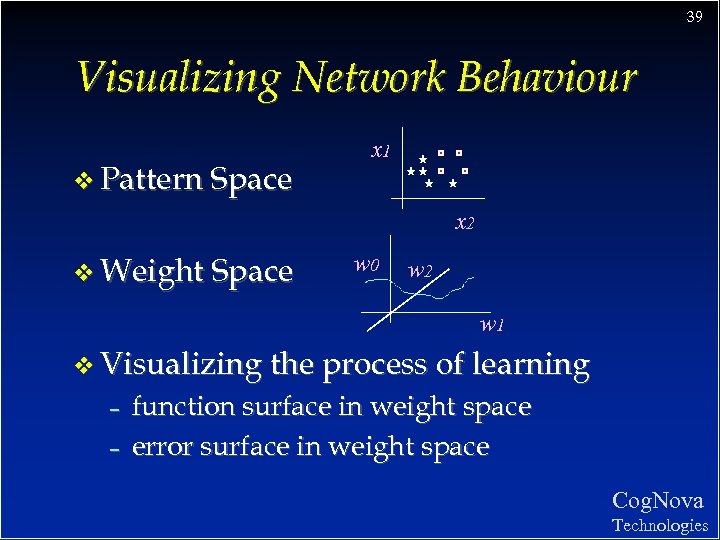 39 Visualizing Network Behaviour v Pattern Space x 1 x 2 v Weight Space w 0 w 2 w 1 v Visualizing the process of learning – – function surface in weight space error surface in weight space Cog. Nova Technologies
 40 The Back-propagation Algorithm Cog. Nova Technologies
 41 The Back-propagation Algorithm v 1986: the solution to multi-layer ANN weight update rediscovered v Conceptually simple - the global error is backward propagated to network nodes, weights are modified proportional to their contribution Most important ANN learning algorithm v Become known as back-propagation because the error is send back through the network to correct all weights v Cog. Nova Technologies
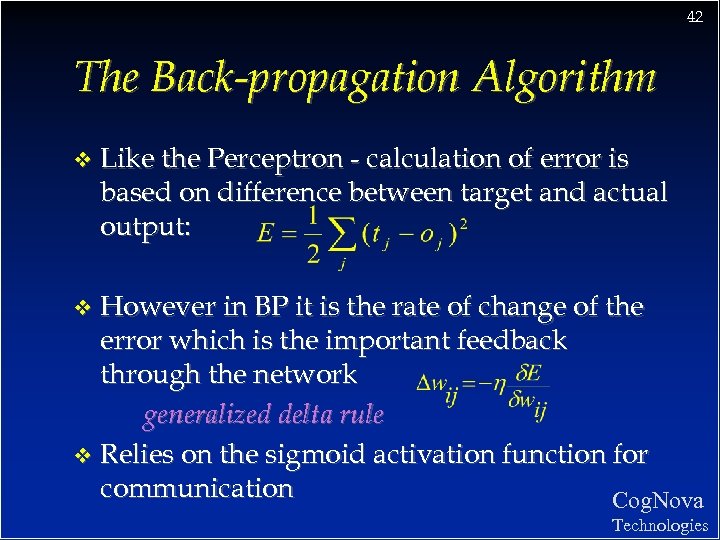 42 The Back-propagation Algorithm v Like the Perceptron - calculation of error is based on difference between target and actual output: However in BP it is the rate of change of the error which is the important feedback through the network generalized delta rule v Relies on the sigmoid activation function for communication Cog. Nova v Technologies
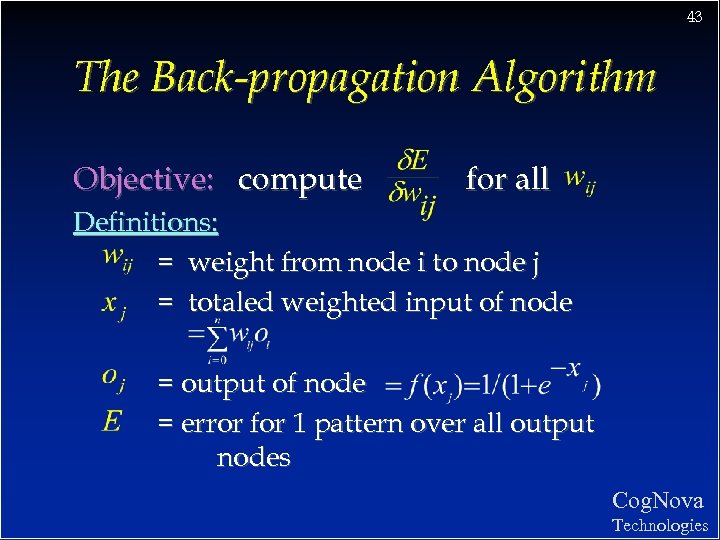 43 The Back-propagation Algorithm Objective: compute for all Definitions: = weight from node i to node j = totaled weighted input of node = output of node = error for 1 pattern over all output nodes Cog. Nova Technologies
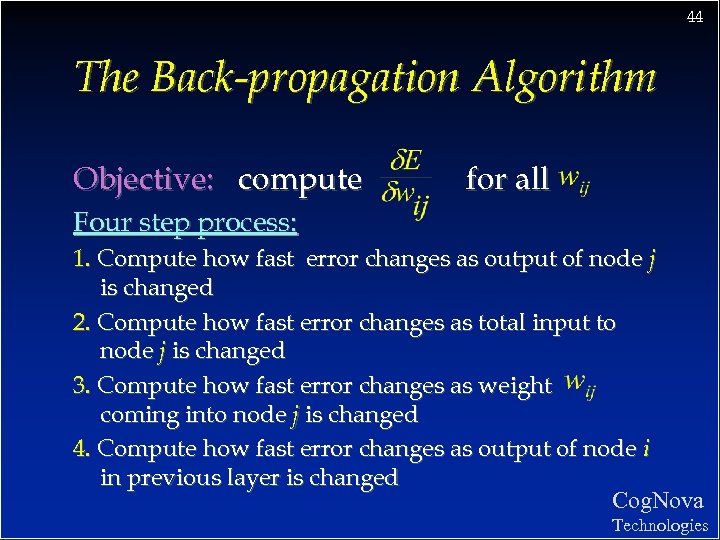 44 The Back-propagation Algorithm Objective: compute for all Four step process: 1. Compute how fast error changes as output of node j is changed 2. Compute how fast error changes as total input to node j is changed 3. Compute how fast error changes as weight coming into node j is changed 4. Compute how fast error changes as output of node i in previous layer is changed Cog. Nova Technologies
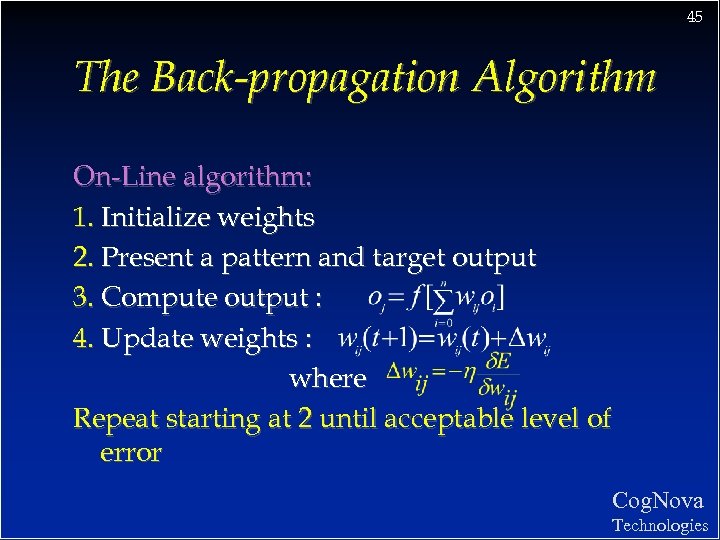 45 The Back-propagation Algorithm On-Line algorithm: 1. Initialize weights 2. Present a pattern and target output 3. Compute output : 4. Update weights : where Repeat starting at 2 until acceptable level of error Cog. Nova Technologies
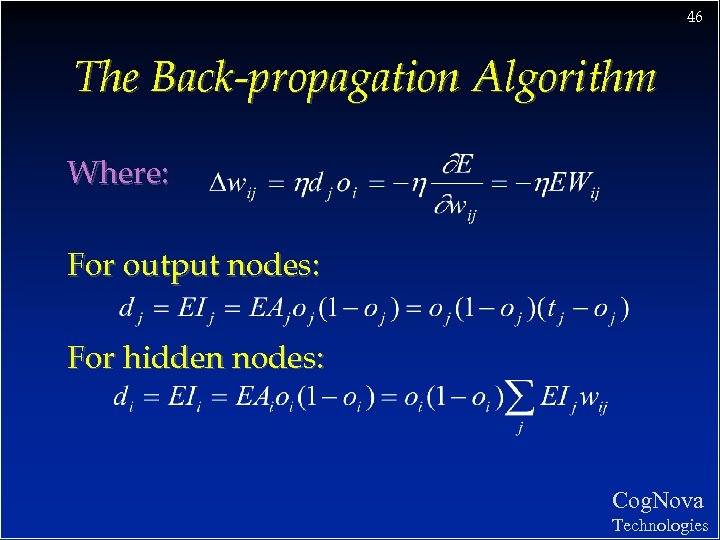 46 The Back-propagation Algorithm Where: For output nodes: For hidden nodes: Cog. Nova Technologies
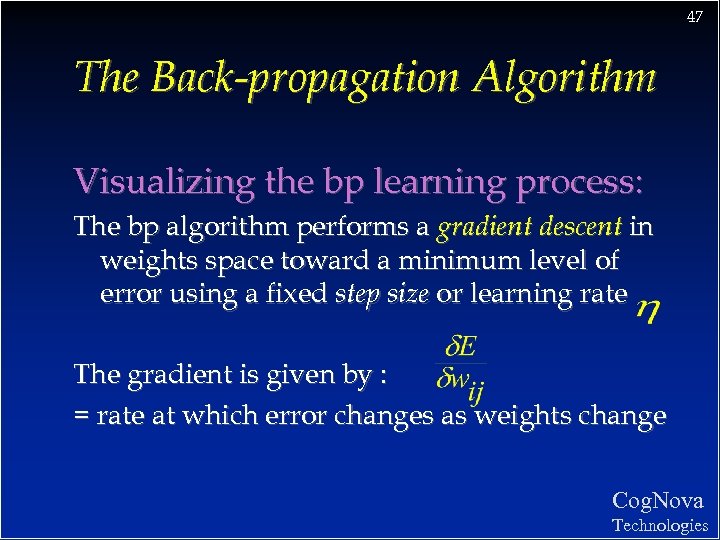 47 The Back-propagation Algorithm Visualizing the bp learning process: The bp algorithm performs a gradient descent in weights space toward a minimum level of error using a fixed step size or learning rate The gradient is given by : = rate at which error changes as weights change Cog. Nova Technologies
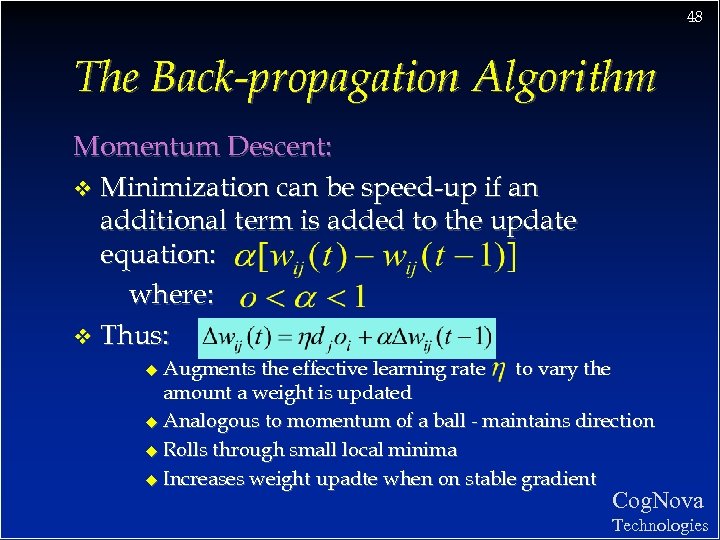 48 The Back-propagation Algorithm Momentum Descent: v Minimization can be speed-up if an additional term is added to the update equation: where: v Thus: Augments the effective learning rate to vary the amount a weight is updated u Analogous to momentum of a ball - maintains direction u Rolls through small local minima u Increases weight upadte when on stable gradient u Cog. Nova Technologies
 49 The Back-propagation Algorithm Line Search Techniques: v Steepest and momentum descent use only gradient of error surface v More advanced techniques explore the weight space using various heuristics v Most common is to search ahead in the direction defined by the gradient Cog. Nova Technologies
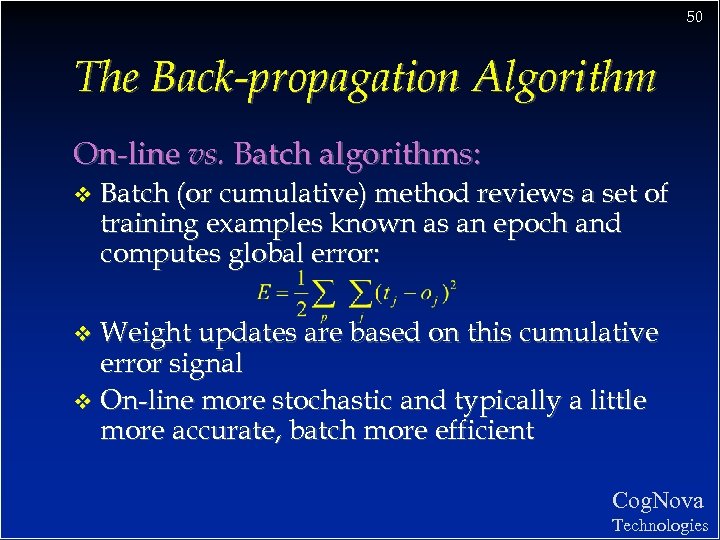 50 The Back-propagation Algorithm On-line vs. Batch algorithms: v Batch (or cumulative) method reviews a set of training examples known as an epoch and computes global error: Weight updates are based on this cumulative error signal v On-line more stochastic and typically a little more accurate, batch more efficient v Cog. Nova Technologies
 51 The Back-propagation Algorithm Several Interesting Questions: What is BP’s inductive bias? v Can BP get stuck in local minimum? v How does learning time scale with size of the network & number of training examples? v Is it biologically plausible? v Do we have to use the sigmoid activation function? v How well does a trained network generalize to unseen test cases? v Cog. Nova Technologies
 52 TUTORIAL #3 v The XOR function revisited v Software package tutorial : Electric Cost Prediction Cog. Nova Technologies
 53 Generalization Cog. Nova Technologies
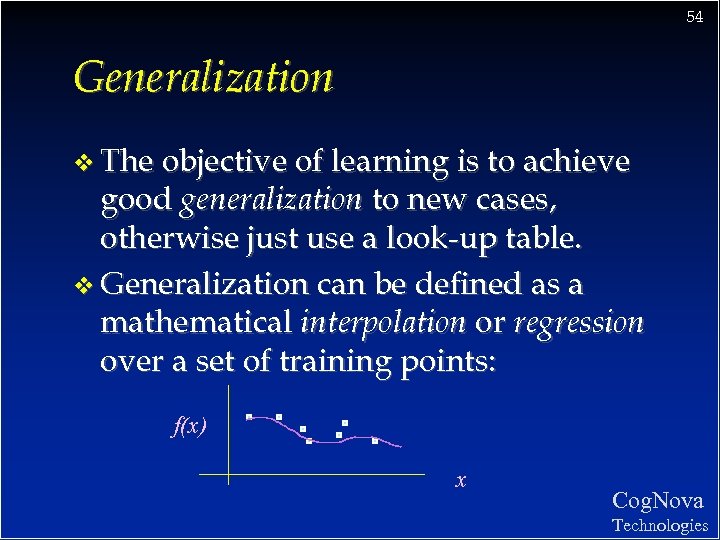 54 Generalization v The objective of learning is to achieve good generalization to new cases, otherwise just use a look-up table. v Generalization can be defined as a mathematical interpolation or regression over a set of training points: f(x) x Cog. Nova Technologies
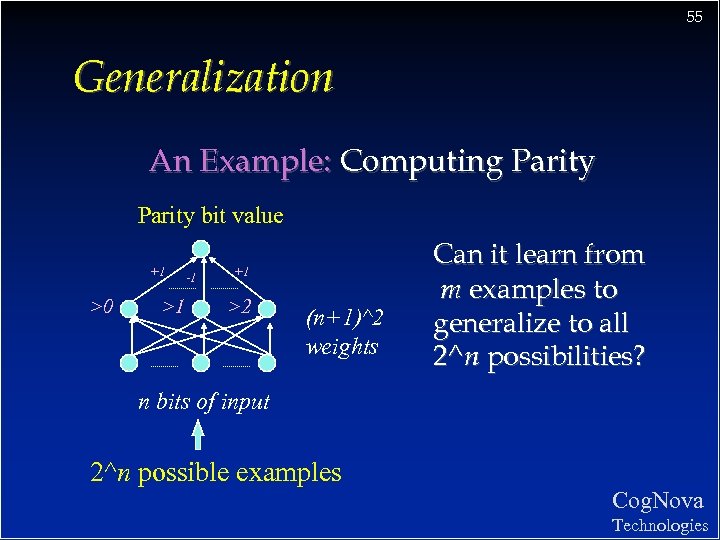 55 Generalization An Example: Computing Parity bit value +1 >0 >1 -1 +1 >2 (n+1)^2 weights Can it learn from m examples to generalize to all 2^n possibilities? n bits of input 2^n possible examples Cog. Nova Technologies
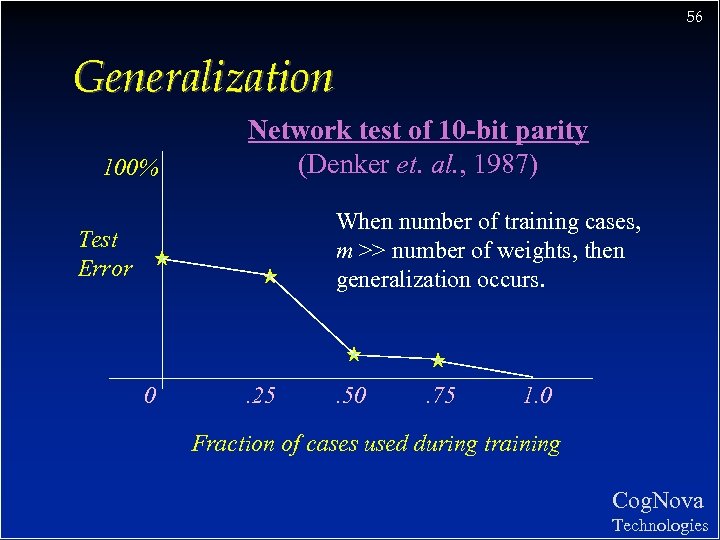 56 Generalization 100% Network test of 10 -bit parity (Denker et. al. , 1987) When number of training cases, m >> number of weights, then generalization occurs. Test Error 0 . 25 . 50 . 75 1. 0 Fraction of cases used during training Cog. Nova Technologies
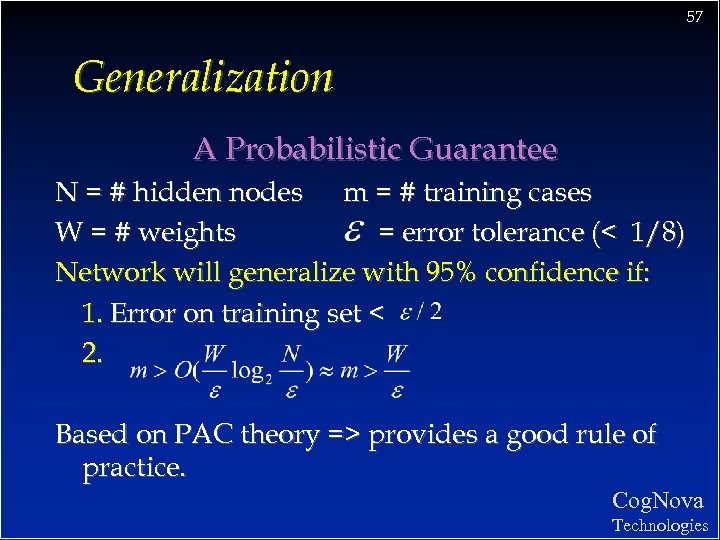 57 Generalization A Probabilistic Guarantee N = # hidden nodes m = # training cases W = # weights = error tolerance (< 1/8) Network will generalize with 95% confidence if: 1. Error on training set < 2. Based on PAC theory => provides a good rule of practice. Cog. Nova Technologies
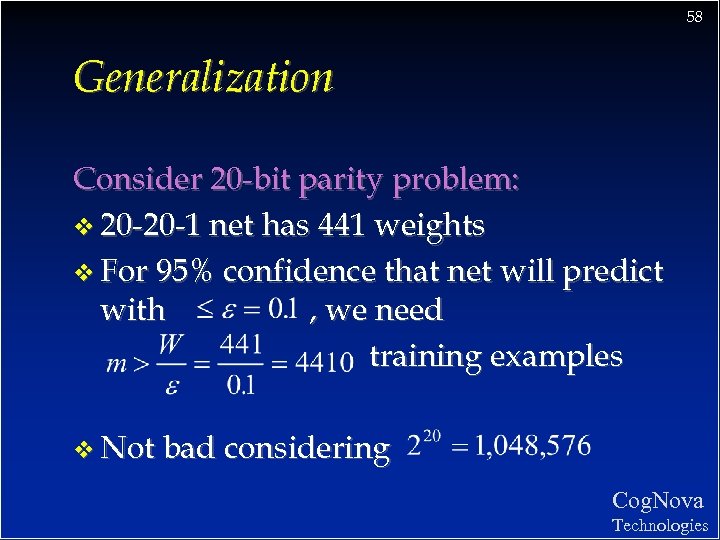 58 Generalization Consider 20 -bit parity problem: v 20 -20 -1 net has 441 weights v For 95% confidence that net will predict with , we need training examples v Not bad considering Cog. Nova Technologies
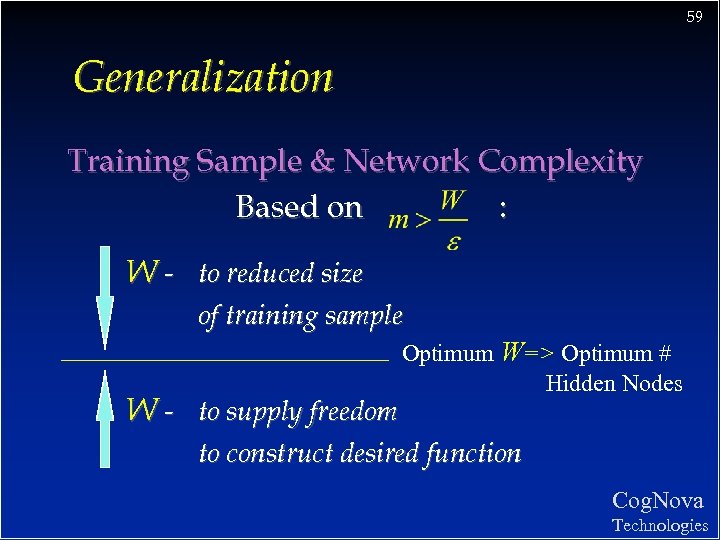 59 Generalization Training Sample & Network Complexity Based on : W - to reduced size of training sample W - to supply freedom Optimum W=> Optimum # Hidden Nodes to construct desired function Cog. Nova Technologies
 60 Generalization How can we control number of effective weights? Manually or automatically select optimum number of hidden nodes and connections v Prevent over-fitting = over-training v Add a weight-cost term to the bp error equation v Cog. Nova Technologies
 61 Generalization Over-Training Is the equivalent of over-fitting a set of data points to a curve which is too complex v Occam’s Razor (1300 s) : “plurality should not be assumed without necessity” v The simplest model which explains the majority of the data is usually the best v Cog. Nova Technologies
 62 Generalization Preventing Over-training: Use a separate test or tuning set of examples v Monitor error on the test set as network trains v Stop network training just prior to over-fit error occurring - early stopping or tuning v Number of effective weights is reduced v Most new systems have automated early stopping methods v Cog. Nova Technologies
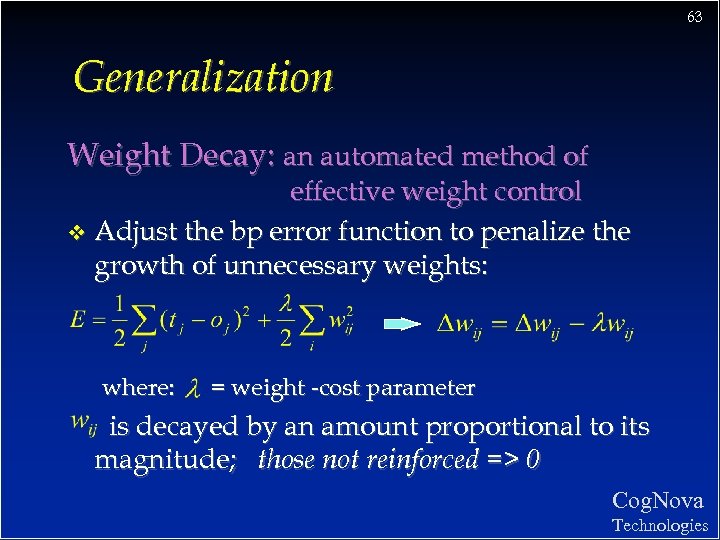 63 Generalization Weight Decay: an automated method of effective weight control v Adjust the bp error function to penalize the growth of unnecessary weights: where: = weight -cost parameter is decayed by an amount proportional to its magnitude; those not reinforced => 0 Cog. Nova Technologies
 64 TUTORIAL #4 v Generalization: Develop and train a BP network to learn the OVT function Cog. Nova Technologies
 65 Network Design & Training Cog. Nova Technologies
 66 Network Design & Training Issues Design: Architecture of network v Structure of artificial neurons v Learning rules v Training: Ensuring optimum training v Learning parameters v Data preparation v and more. . v Cog. Nova Technologies
 67 Network Design Cog. Nova Technologies
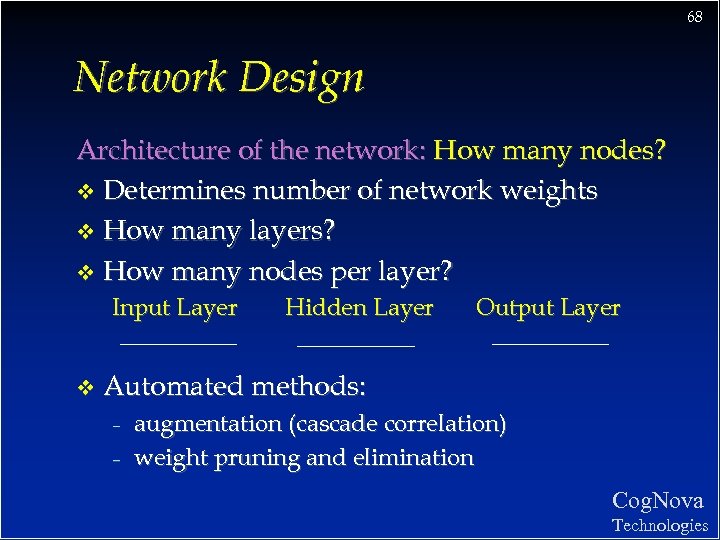 68 Network Design Architecture of the network: How many nodes? v Determines number of network weights v How many layers? v How many nodes per layer? Input Layer v Hidden Layer Output Layer Automated methods: – – augmentation (cascade correlation) weight pruning and elimination Cog. Nova Technologies
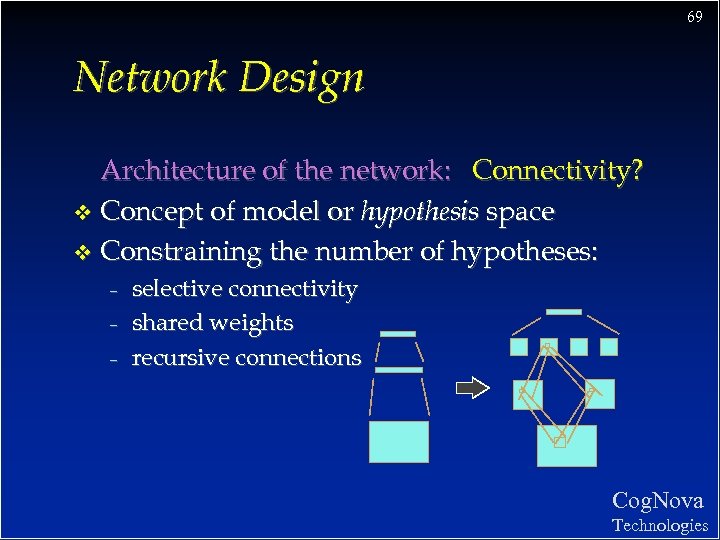 69 Network Design Architecture of the network: Connectivity? v Concept of model or hypothesis space v Constraining the number of hypotheses: – – – selective connectivity shared weights recursive connections Cog. Nova Technologies
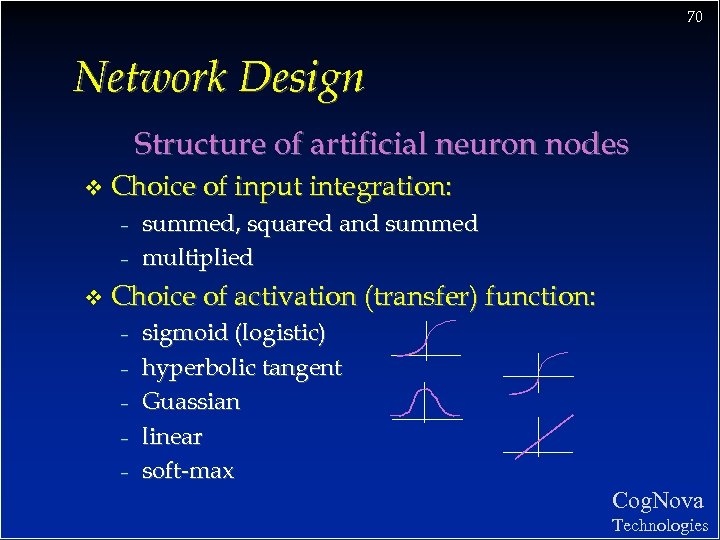 70 Network Design Structure of artificial neuron nodes v Choice of input integration: – – v summed, squared and summed multiplied Choice of activation (transfer) function: – – – sigmoid (logistic) hyperbolic tangent Guassian linear soft-max Cog. Nova Technologies
 71 Network Design Selecting a Learning Rule v Generalized delta rule (steepest descent) v Momentum descent v Advanced weight space search techniques v Global Error function can also vary - normal - quadratic - cubic Cog. Nova Technologies
 72 Network Training Cog. Nova Technologies
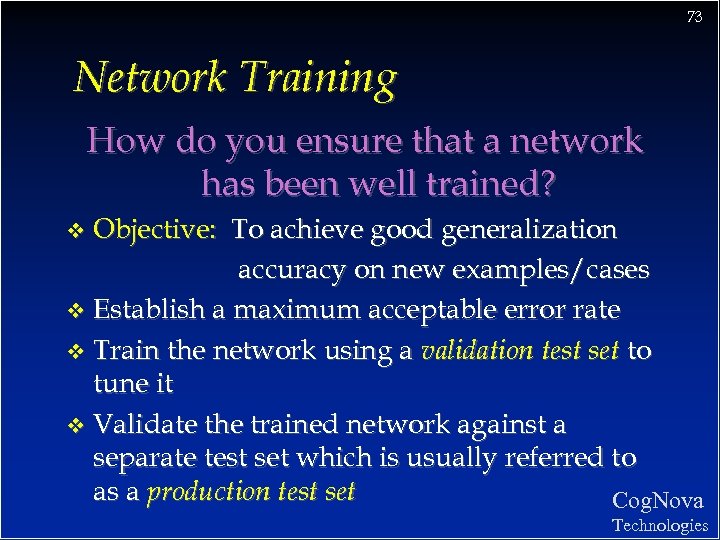 73 Network Training How do you ensure that a network has been well trained? Objective: To achieve good generalization accuracy on new examples/cases v Establish a maximum acceptable error rate v Train the network using a validation test set to tune it v Validate the trained network against a separate test set which is usually referred to as a production test set Cog. Nova v Technologies
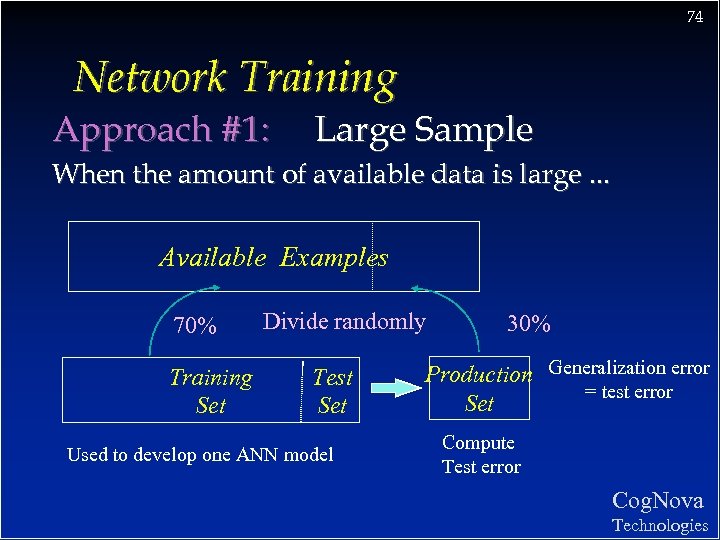 74 Network Training Approach #1: Large Sample When the amount of available data is large. . . Available Examples 70% Training Set Divide randomly Test Set Used to develop one ANN model 30% Production Generalization error = test error Set Compute Test error Cog. Nova Technologies
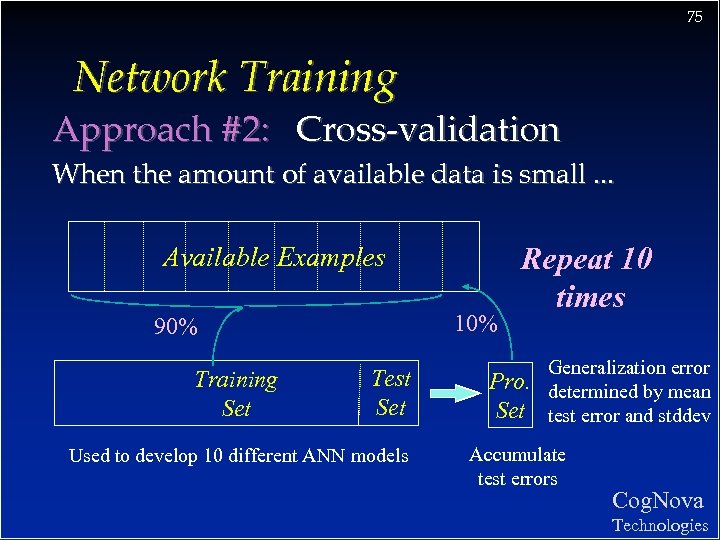 75 Network Training Approach #2: Cross-validation When the amount of available data is small. . . Available Examples 10% 90% Training Set Test Set Used to develop 10 different ANN models Repeat 10 times Pro. Set Generalization error determined by mean test error and stddev Accumulate test errors Cog. Nova Technologies
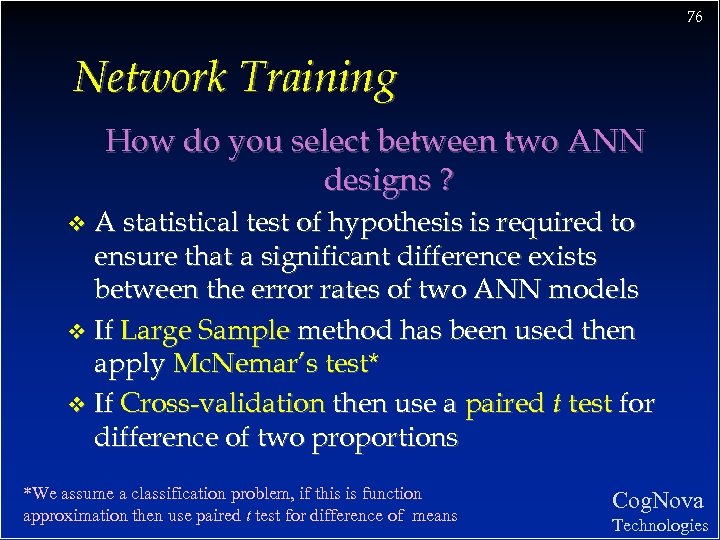 76 Network Training How do you select between two ANN designs ? A statistical test of hypothesis is required to ensure that a significant difference exists between the error rates of two ANN models v If Large Sample method has been used then apply Mc. Nemar’s test* v If Cross-validation then use a paired t test for difference of two proportions v *We assume a classification problem, if this is function approximation then use paired t test for difference of means Cog. Nova Technologies
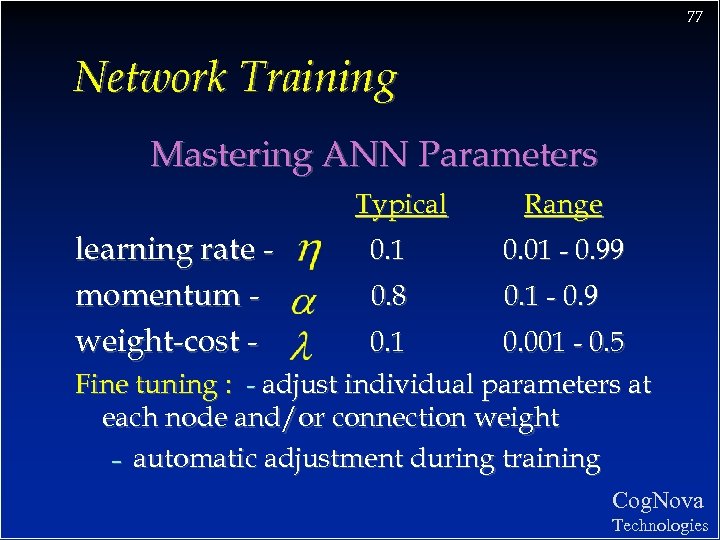 77 Network Training Mastering ANN Parameters Typical learning rate momentum weight-cost - Range 0. 1 0. 01 - 0. 99 0. 8 0. 1 - 0. 9 0. 1 0. 001 - 0. 5 Fine tuning : - adjust individual parameters at each node and/or connection weight – automatic adjustment during training Cog. Nova Technologies
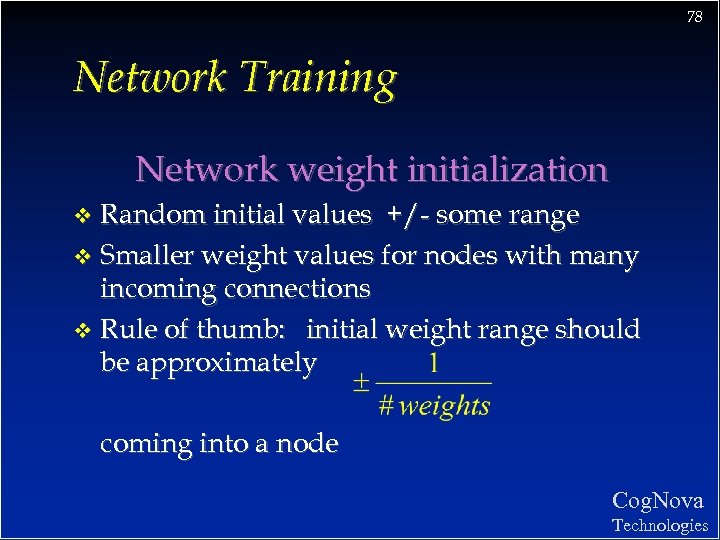 78 Network Training Network weight initialization Random initial values +/- some range v Smaller weight values for nodes with many incoming connections v Rule of thumb: initial weight range should be approximately v coming into a node Cog. Nova Technologies
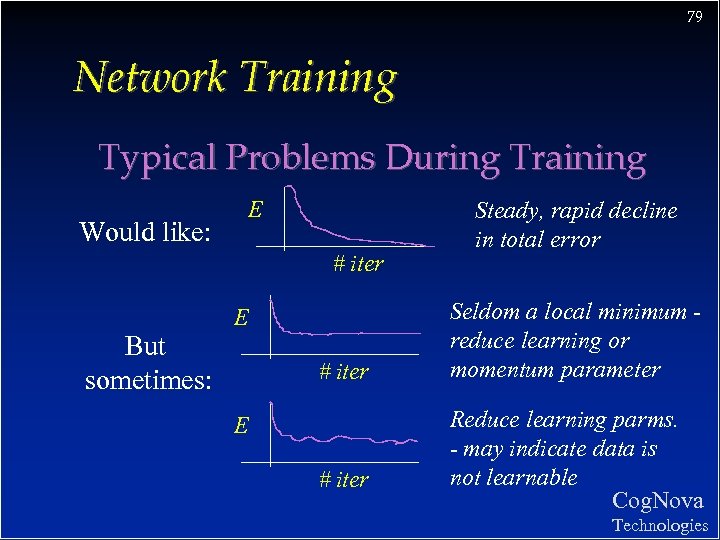 79 Network Training Typical Problems During Training E Would like: # iter E But sometimes: # iter E # iter Steady, rapid decline in total error Seldom a local minimum reduce learning or momentum parameter Reduce learning parms. - may indicate data is not learnable Cog. Nova Technologies
 80 Data Preparation Cog. Nova Technologies
 81 Data Preparation Garbage in Garbage out The quality of results relates directly to quality of the data v 50%-70% of ANN development time will be spent on data preparation v The three steps of data preparation: – Consolidation and Cleaning – Selection and Preprocessing – Transformation and Encoding v Cog. Nova Technologies
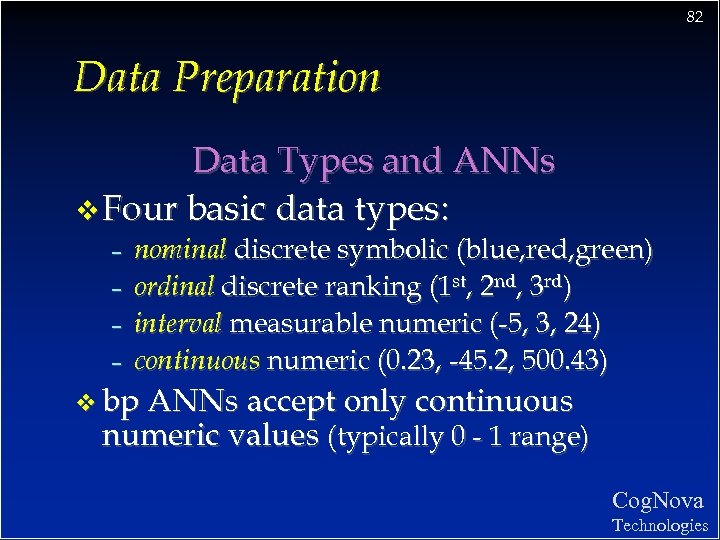 82 Data Preparation Data Types and ANNs v Four basic data types: – – nominal discrete symbolic (blue, red, green) ordinal discrete ranking (1 st, 2 nd, 3 rd) interval measurable numeric (-5, 3, 24) continuous numeric (0. 23, -45. 2, 500. 43) v bp ANNs accept only continuous numeric values (typically 0 - 1 range) Cog. Nova Technologies
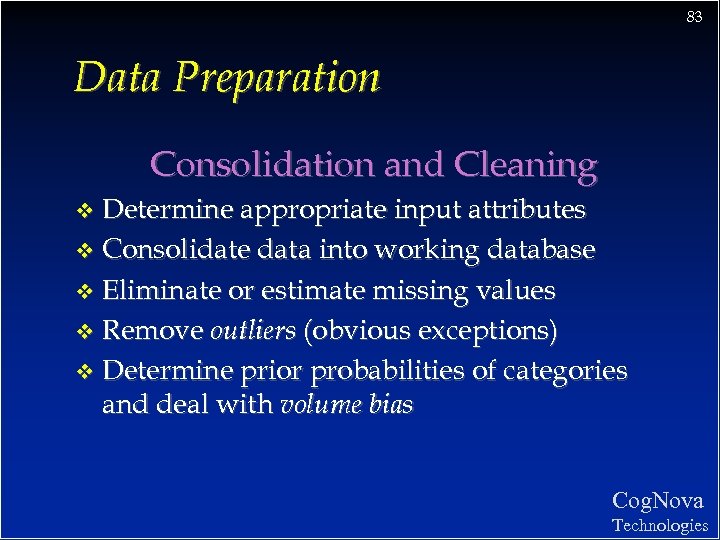 83 Data Preparation Consolidation and Cleaning Determine appropriate input attributes v Consolidate data into working database v Eliminate or estimate missing values v Remove outliers (obvious exceptions) v Determine prior probabilities of categories and deal with volume bias v Cog. Nova Technologies
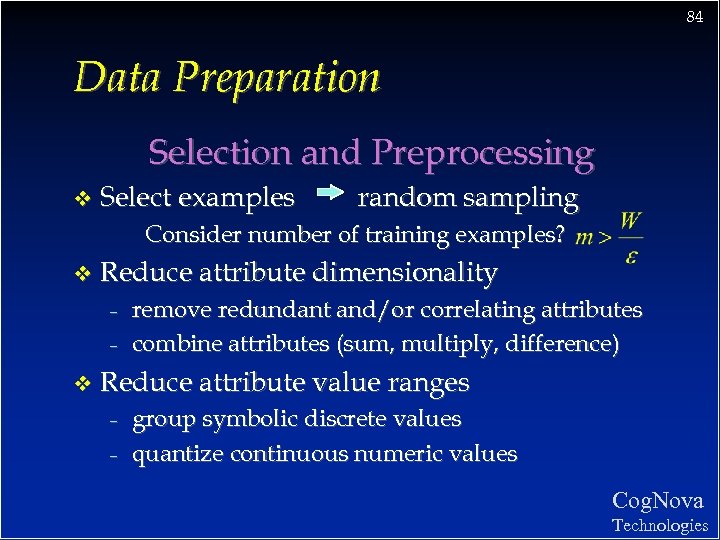 84 Data Preparation Selection and Preprocessing v Select examples random sampling Consider number of training examples? v Reduce attribute dimensionality – – v remove redundant and/or correlating attributes combine attributes (sum, multiply, difference) Reduce attribute value ranges – – group symbolic discrete values quantize continuous numeric values Cog. Nova Technologies
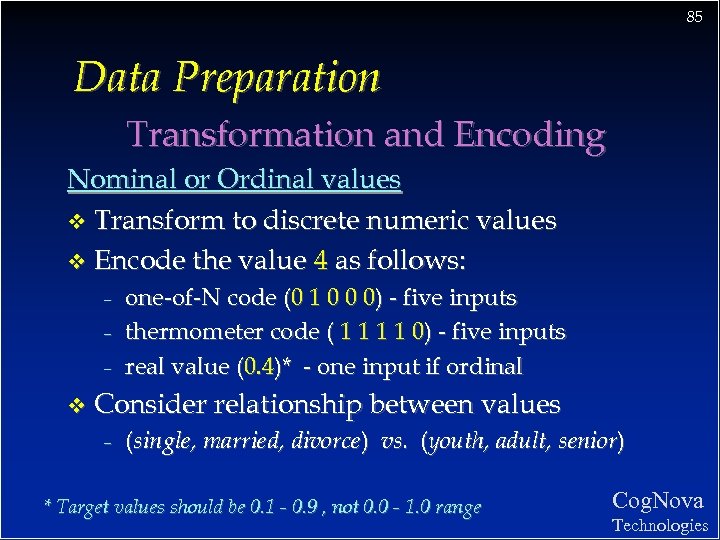 85 Data Preparation Transformation and Encoding Nominal or Ordinal values v Transform to discrete numeric values v Encode the value 4 as follows: – – – v one-of-N code (0 1 0 0 0) - five inputs thermometer code ( 1 1 0) - five inputs real value (0. 4)* - one input if ordinal Consider relationship between values – (single, married, divorce) vs. (youth, adult, senior) * Target values should be 0. 1 - 0. 9 , not 0. 0 - 1. 0 range Cog. Nova Technologies
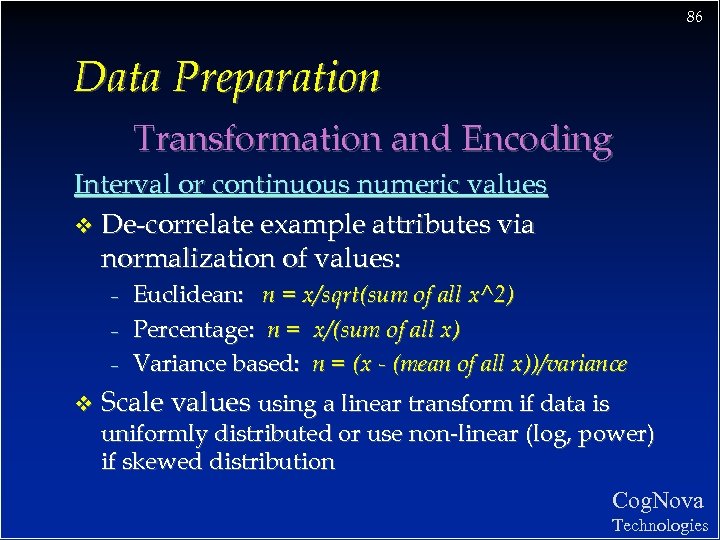 86 Data Preparation Transformation and Encoding Interval or continuous numeric values v De-correlate example attributes via normalization of values: – – – v Euclidean: n = x/sqrt(sum of all x^2) Percentage: n = x/(sum of all x) Variance based: n = (x - (mean of all x))/variance Scale values using a linear transform if data is uniformly distributed or use non-linear (log, power) if skewed distribution Cog. Nova Technologies
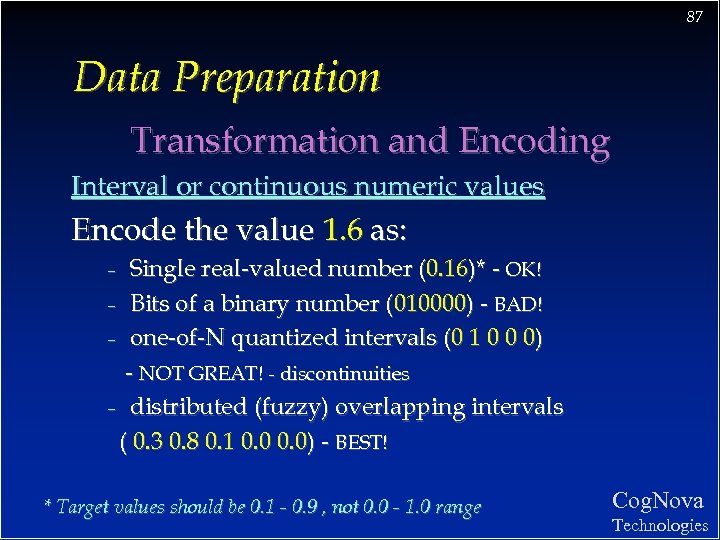 87 Data Preparation Transformation and Encoding Interval or continuous numeric values Encode the value 1. 6 as: Single real-valued number (0. 16)* - OK! – Bits of a binary number (010000) - BAD! – one-of-N quantized intervals (0 1 0 0 0) - NOT GREAT! - discontinuities – distributed (fuzzy) overlapping intervals ( 0. 3 0. 8 0. 1 0. 0) - BEST! – * Target values should be 0. 1 - 0. 9 , not 0. 0 - 1. 0 range Cog. Nova Technologies
 88 TUTORIAL #5 v Develop and train a BP network on real- world data v Also see slides covering Mitchell’s Face Recognition example Cog. Nova Technologies
 89 Post-Training Analysis Cog. Nova Technologies
 90 Post-Training Analysis Examining the neural net model: v Visualizing the constructed model v Detailed network analysis Sensitivity analysis of input attributes: v Analytical techniques v Attribute elimination Cog. Nova Technologies
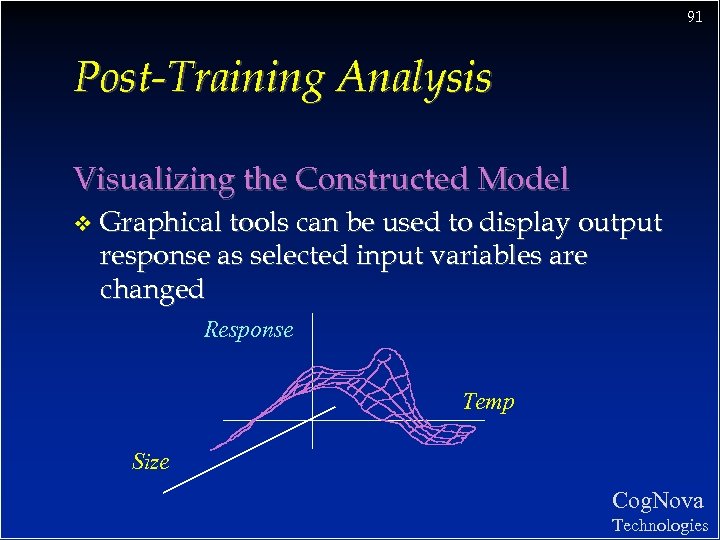 91 Post-Training Analysis Visualizing the Constructed Model v Graphical tools can be used to display output response as selected input variables are changed Response Temp Size Cog. Nova Technologies
 92 Post-Training Analysis Detailed network analysis Hidden nodes form internal representation v Manual analysis of weight values often difficult - graphics very helpful v Conversion to equation, executable code v Automated ANN to symbolic logic conversion is a hot area of research v Cog. Nova Technologies
 93 Post-Training Analysis Sensitivity analysis of input attributes v Analytical techniques – – factor analysis network weight analysis v Feature (attribute) elimination – – forward feature elimination backward feature elimination Cog. Nova Technologies
 94 The ANN Application Development Process Guidelines for using neural networks 1. Try the best existing method first 2. Get a big training set 3. Try a net without hidden units 4. Use a sensible coding for input variables 5. Consider methods of constraining network 6. Use a test set to prevent over-training 7. Determine confidence in generalization through cross-validation Cog. Nova Technologies
 95 Example Applications Pattern Recognition (reading zip codes) v Signal Filtering (reduction of radio noise) v Data Segmentation (detection of seismic onsets) v Data Compression (TV image transmission) v Database Mining (marketing, finance analysis) v Adaptive Control (vehicle guidance) v Cog. Nova Technologies
 96 Pros and Cons of Back-Prop Cog. Nova Technologies
 97 Pros and Cons of Back-Prop Cons: Local minimum - but not generally a concern v Seems biologically implausible v Space and time complexity: v training times lengthy It’s a black box! I can’t see how it’s making decisions? v Best suited for supervised learning v Works poorly on dense data with few input Cog. Nova variables v Technologies
 98 Pros and Cons of Back-Prop Pros: Proven training method for multi-layer nets v Able to learn any arbitrary function (XOR) v Most useful for non-linear mappings v Works well with noisy data v Generalizes well given sufficient examples v Rapid recognition speed v Has inspired many new learning algorithms v Cog. Nova Technologies
 99 Other Networks and Advanced Issues Cog. Nova Technologies
 10 0 Other Networks and Advanced Issues v Variations in feed-forward architecture – – jump connections to output nodes hidden nodes that vary in structure v Recurrent networks with feedback connections v Probabilistic networks v General Regression networks v Unsupervised self-organizing networks Cog. Nova Technologies
 10 1 THE END Thanks for your participation! Cog. Nova Technologies