 Скачать презентацию 1 THE USA and the world Before
Презентация USA and the WORLD.pptx
- Количество слайдов: 34



1. THE USA and the world • Before 1914 the main objective of most Americans was to have as little as possible to do with the troubles of the world outside. • One motive of going to America was to escape from the effects of the international conflicts and revolutions in Europe. During the period when European countries were competing for colonies, the USA stayed out of the contest. Its own colonial past, war of independence and liberation had a lasting influence on policy. • American opinion has always tended to disapprove of colonial operations, and has welcomed the processes by which the European colonial powers have handed over independence to their former overseas territories.
• In 1900, after a war with Spain, the USA was itself a colonial power, with ownership and control over the Philippines, Cuba and Panama as well as Puerto Rico and some islands in the Pacific. • Except for Puerto Rico and some Pacific islands they are all independent states, and Hawaii a state with full membership of the Union.
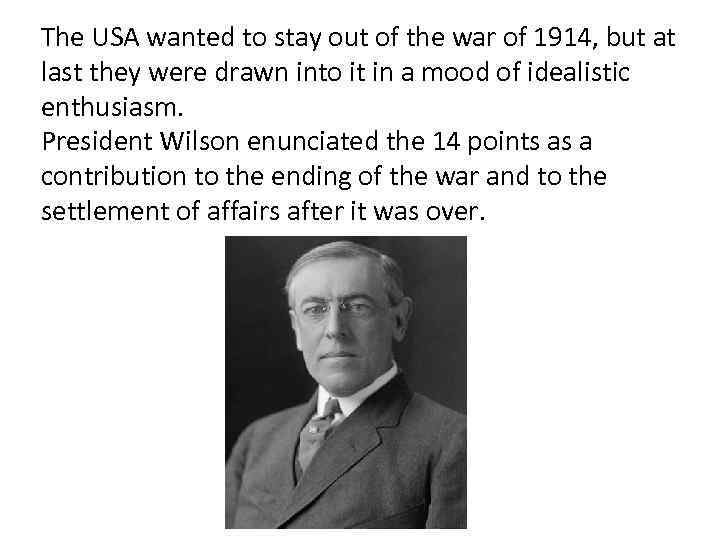
The USA wanted to stay out of the war of 1914, but at last they were drawn into it in a mood of idealistic enthusiasm. President Wilson enunciated the 14 points as a contribution to the ending of the war and to the settlement of affairs after it was over.
• Wilson did not plan to use victory for national gain, and the idea of forming a League of Nations was in part to be attributed to his ideals. • He was supported in seeking no reward for victory, but when the war was over, a new mood of isolationism soon gained strength, so that most Americans wanted to return to their former role without foreign commitments. • The Senate gave expression to this mood when it failed to give its approval by the necessary majority to the signing of the Treaty of Versailles and American participation in the League.
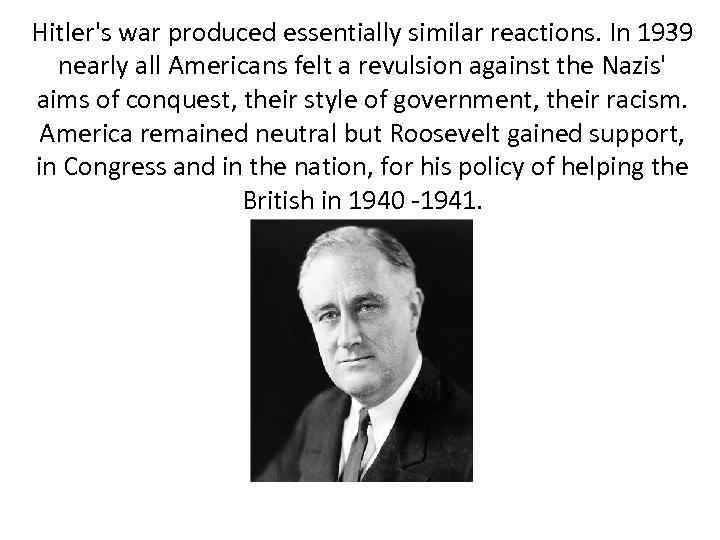
Hitler's war produced essentially similar reactions. In 1939 nearly all Americans felt a revulsion against the Nazis' aims of conquest, their style of government, their racism. America remained neutral but Roosevelt gained support, in Congress and in the nation, for his policy of helping the British in 1940 -1941.
• Then in 1941 the Japanese destroyed part of the US' navy in Pearl Harbour, Hawaii, in an unprovoked attack. America was in the war, and with its allies succeeded in destroying the aggressive German and Japanese regimes. • The aim was not conquest but liberation. In western countries from which the Americans and British drove out the German invaders and in Western Germany itself, they hurried to create conditions in which the people could set up their own governments based on free elections.
• American attitudes have always been against ideologies of every kind, and both fascism and communism have been rejected by the great majority of American people at all stages of history. • So too in 1945, American opinion was in favour of a settlement which would secure peace rather than American domination. For the first year after the ending of the war, the American government was supported by public opinion in the hope that reasonable arrangements could be made, and that these arrangements should include cooperation with all former allies, including Russia, in rebuilding a peaceful world.
• When it became clear that Russians were intent upon extending their own power, especially in Eastern Europe, America's idealistic wartime mood soon gave way to one of suspicion and resentment towards them after 1946. • But these were also years of generous actions towards the rest of the world. The Marshall Plan offered assistance to countries devastated by the war, but in Eastern Europe under Russian domination it was rejected.
• So the assistance was concentrated on Western Europe, and linked with the scheme for cooperation among the nations of the noncommunist world, including West Germany, in rehabilitating themselves. • Americans think that it was the Russians who created the Iron Curtain in Europe at that time, and Americans responded with a determination that the Iron Curtain, though regretfully accepted should not move further westwards.
• Through the North Atlantic Treaty Organisation (NATO- северо-атлантический союз) the US and the Western countries of Europe agreed to cooperate in international affairs. • • This plan won large consent in the US and was accepted by the majority opinion among all sections of society.
• When nuclear weapons gave the Soviet Union the power to destroy the USA as effectively as the USA could destroy the Soviet Union, American opinion was ready to find ways of co-existence with communists under a precarious balance. • • The best hope for peace seemed to lie in the maintenance of the established spheres of influence of the two great powers, together with avoidance of extensions of influence by either.
• Because of this, Americans were ready to accept the acts of the Russians in Hungary in 1956 and in Czechoslovakia in 1968. • Because of this too, there has been a special insistence that the Russians should keep out of the whole American continent.
• American attitudes to Africa and Asia have been influenced by two contrary emotions. There has been sympathy for the moves towards independence of the peoples who were formerly under colonial rule. Such sympathy arises out the whole American experience and system of values. • The USA itself, long ago led the way in liberation from colonial power, and the nation's whole history is tied up with the defence of independence. • But sympathy with African and Asian aspirations, and readiness to spend resources in helping economic development, are mixed with fear of the spread of communism.
• In China the USA had cooperated with Chiang. Kai-Shek's nationalist regime in the fight against the Japanese invasion, and failed to understand the forces that led to its eventual overthrow by communists in 1949. • When in 1950 the army of the North Korean Communist Government invaded South Korea, the USA was the main contributor to the United Nations force which helped to push the invaders back across the border.
The Vietnam War • Vietnam war was a cold war was a Cold War military conflict which occurred in Vietnam, Laos, Cambodia in 1955 - 1975. • The southern part of the country had a regime based on democratic electoral system. The communists tried to subvert the regime in the southern part of the country, and when the South Vietnamese government appealed to the Americans for help in dealing with what they regarded as communist insurrection within their territory, the American government was ready to give that help.
• It was assumed that if the whole of Vietnam including the South became communist, communism would move on to take control in the next country and then the next. • The US government viewed involvement in the war as a way to prevent a communist takeover of South Vietnam.
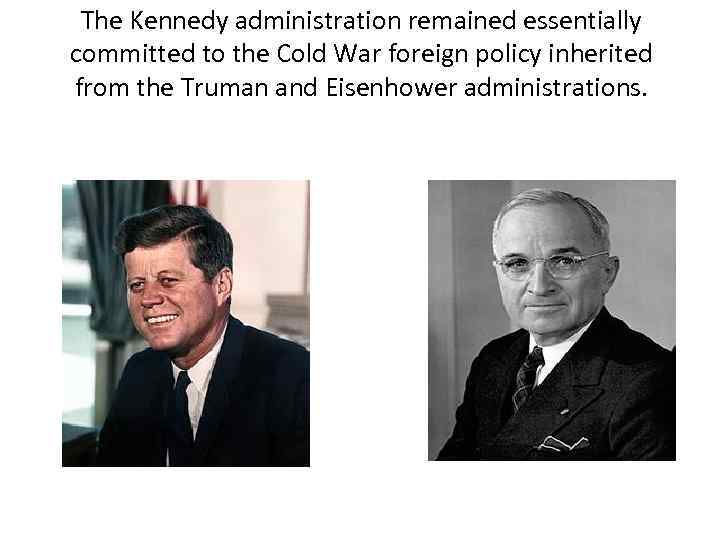
The Kennedy administration remained essentially committed to the Cold War foreign policy inherited from the Truman and Eisenhower administrations.
• Kennedy determined to prevent a communist victory in Vietnam. The American involvement increased steadily until by 1964 the operations had assumed the proportions of a regular war. • The participation of forces sent from North Vietnam produced an actual confrontation between forces of a communist regime and American forces. In their attempt to make the intervention effective the American forces made extensive use of terrible weapons of destruction.
• The world came to identify American policy with the burning and destruction of people and villages. The world's journalists and television teams described and depicted the cruelties involved in the military operations. • The world hated America for these horrors. So, America's hope of keeping the friendship and general support of the newly independent third-world states was damaged. • In America itself the war divided opinion, so that many Americans hated their own government because of it, and these in their turn were hated by the rigid patriots.
• The Vietnam war was the most disastrous foreign military operation in the history of the USA, culminating in the final victory of communists in Vietnam and Kampuchea. • Meanwhile, the signs of liberalisation in China itself, and the opening of constructive relations between the USA and the post-Mao regime, have brought some consolation and with it some hope of improved relations with a less rigid regime in the Soviet Union.
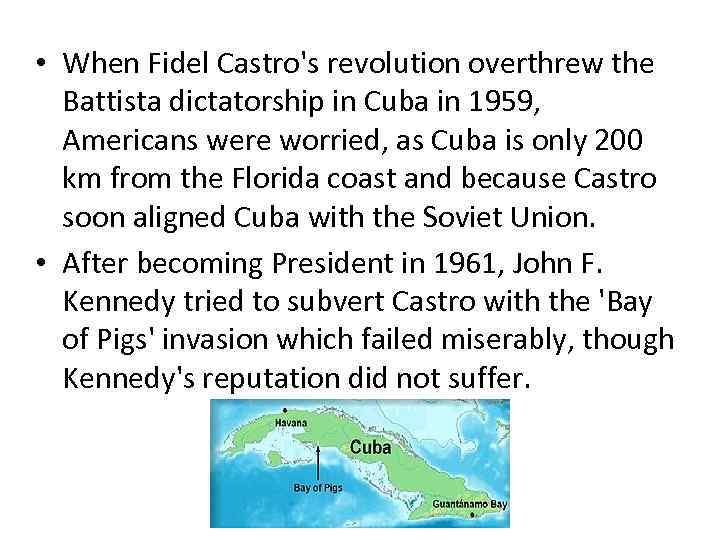
• When Fidel Castro's revolution overthrew the Battista dictatorship in Cuba in 1959, Americans were worried, as Cuba is only 200 km from the Florida coast and because Castro soon aligned Cuba with the Soviet Union. • After becoming President in 1961, John F. Kennedy tried to subvert Castro with the 'Bay of Pigs' invasion which failed miserably, though Kennedy's reputation did not suffer.
The Bay of Pigs Invasion • An unsuccessful action by a CIA-trained force of Cuban exiles to invade southern Cuba, with support of the US government in an attempt to overthrow the Cuban government of Fidel Castro. The invasion started in April, 1961. • The Cuban armed forces, trained and equipped by the Eastern block of nations defeated them.
• In 1962, Kennedy was generally praised for his success in using threats of force to prevent the Soviet Union from putting nuclear missiles on Cuba. • But since then, successive American governments have accepted the Cuban situation.
• In 1990 Americans could not help getting involved in the Persian Gulf War. The war was also referred to as Operation Desert Storm. • It was a war waged by a UN-authorized coalition force from 34 nations led by Britain and the USA, against Iraq. The invasion of Kuwait by Iraqi troops began August 2, 1990. • It was met with international condemnation and brought immediate economic sanctions against Iraq by members of the UN security Council. US President George Bush deployed American forces to Saudi Arabia almost six months afterwards and urged other countries to send their own forces to the scene.
• It would now be difficult for America to return to the isolationism of the past. Cultural links with Europe, and with Britain in particular, are growing stronger all the time. • Many Americans wish that the vitality of the European Community would grow more quickly, and that its members would increase their contribution to common defence. For example, when NATO got involved in the Yugoslav war conflict in the 1990 s America was the main contributor.
• The war campaign demonstrated how much NATO European partners depended on the USA, and that the Americans were the main forces of the aggressor. More than 95 percent of missiles, 80 percent of bombs, 55 percent military airplanes belonged to the USA. The NATO administration admitted that the European NATO members were far behind their distant partner.
• The 20 th century has brought about a new element into the foundations of American life. The USA has become a great power, unable to avoid involvement and responsibility in international affairs. • America's involvement in the world was symbolised by the placing of the United Nations Building on Manhattan Island, and of the World Bank in Washington. •
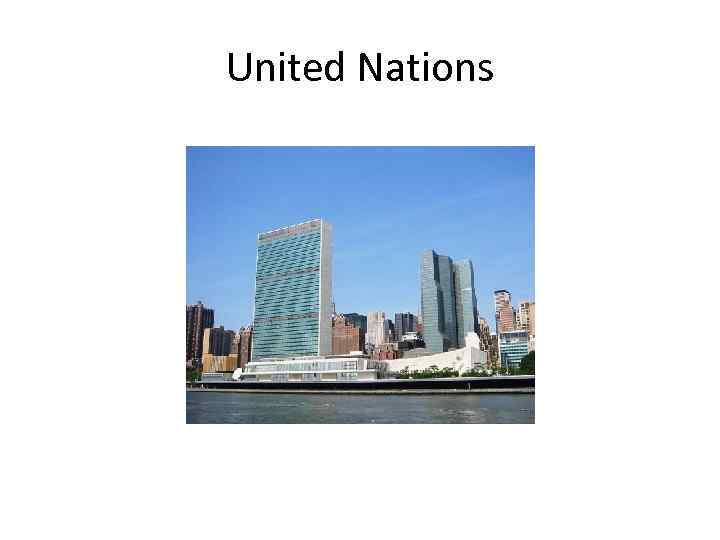
United Nations
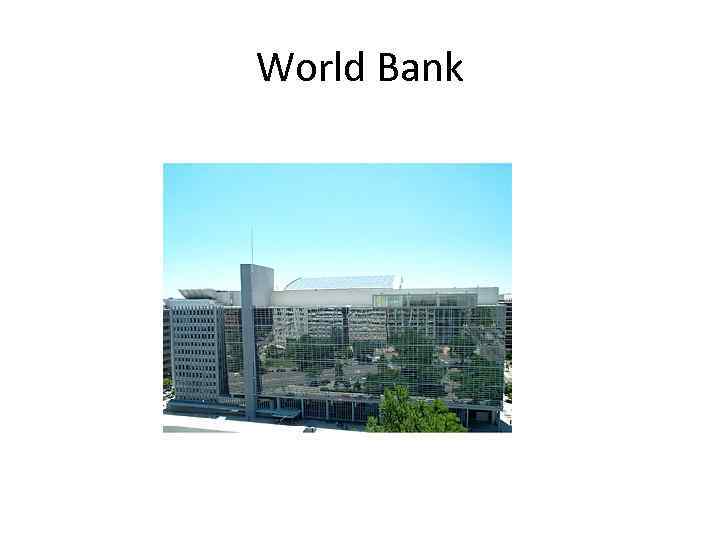
World Bank
US-British relationship • The relations started very badly with the war of Independence at the end of the 18 th century, when the Americans defeated Britain. • But in the 20 th century both countries have been close allies, first of all in both World Wars, then in the Cold War, and finally in the sort of international policing role.
• It has often been called a special relationship, though generall y this has meant Britain doing whatever the USA wanted it to. • Britain has given military support on several occasions, and has given more often moral support. Britain was the only country to allow American planes to use its airports on their way to bomb Libya in 1986, and the only country to support the American invasion of Panama in 1989.
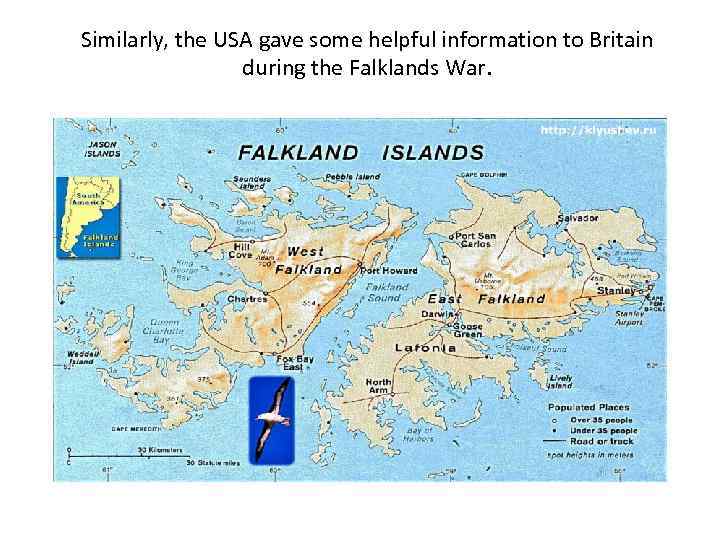
Similarly, the USA gave some helpful information to Britain during the Falklands War.
• The relationship is not always special. The British did not really share the Americans’ bitter anti-Communist feeling during the Cold War. • The British have resented American attempts to get involved in Northern Ireland, and been angry when Irish Americans have sent money to the IRA.
• There was a difficult moment in 1983 when the USA invaded the Caribbean island of Grenada to remove a left-wing government. • This was an ex-British colony, but the Americans didn’t even tell the British that they were invading. • Then Britain opened up commercial and tourist links with Cuba, in defiance of the American blockade.
Скачать презентацию 1 THE USA and the world Before
Презентация USA and the WORLD.pptx