


 Скачать презентацию 1 The Psychology of Selling Why People
615526c87d9ce446f31910e26860486d.ppt
- Количество слайдов: 66
 1
1
 The Psychology of Selling: Why People Buy Mc. Graw-Hill/Irwin Chapter 4 Copyright © 2006 by The Mc. Graw-Hill Companies, Inc. All rights reserved.
 Chapter 4 4 -
 Main Topics The Tree of Business Life: Benefits Why People Buy–The Black Box Approach Psychological Influences on Buying A FABulous Approach to Buyer Need Satisfaction How to Determine Important Buying Needs–a Key to Success The Trial Close–a Great Way to Uncover Needs and SELL Sequence Your Buyer’s Perception Chapter 4 4 -
 Main Topics Perceptions, Attitudes, and Beliefs The Buyer’s Personality Should Be Considered Adaptive Selling Based on Buyer’s Style You Can Classify Buying Situations Technology Provides Information Viewing Buyers as Decision Makers Satisfied Customers Are Easier to Sell to To Buy or Not To Buy–a Choice Decision Chapter 4 4 -
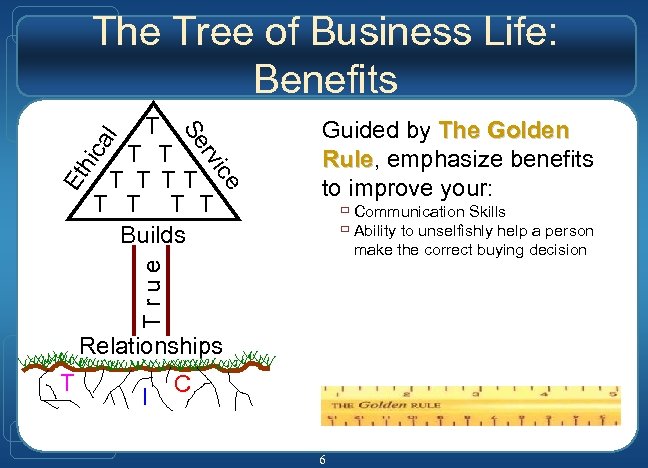 The Tree of Business Life: Benefits Guided by The Golden Rule, emphasize benefits Rule to improve your: ù Communication Skills ù Ability to unselfishly help a person make the correct buying decision True ice Et hi rv ca l Se T T TT T T Builds Relationships T I C 6
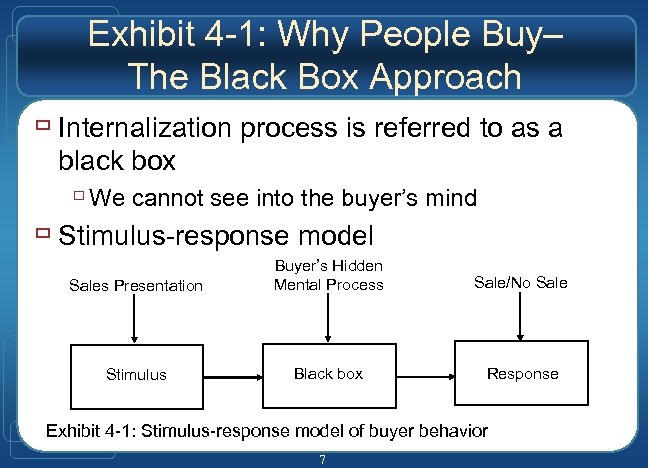 Exhibit 4 -1: Why People Buy– The Black Box Approach ù Internalization process is referred to as a black box ù We cannot see into the buyer’s mind ù Stimulus-response model Sales Presentation Buyer’s Hidden Mental Process Sale/No Sale Stimulus Black box Response Exhibit 4 -1: Stimulus-response model of buyer behavior 7
 What’s Known About Mental Process ù People buy for practical and emotional ù ù reasons Some of a person’s thoughts can be determined Buyers consider certain factors in making purchase decisions 8
 Psychological Influences on Buying ù Motivation to buy must be there ù Needs result from a lack of something desirable ù Wants are needs learned by the person ù Economic needs: The best value for the money ù The buyer’s need to purchase the most satisfying product for the money 9
 Psychological Influences on Buying, cont… ù Awareness of needs: Some buyers are unsure ù Conscious need level ù Preconscious need level ù Unconscious need level 10
 A FABulous Approach to Buyer Need Satisfaction ù Stressing benefits is a very powerful selling ù technique FAB selling technique helps emphasize benefit ù Feature ù Advantage ù Benefit 11
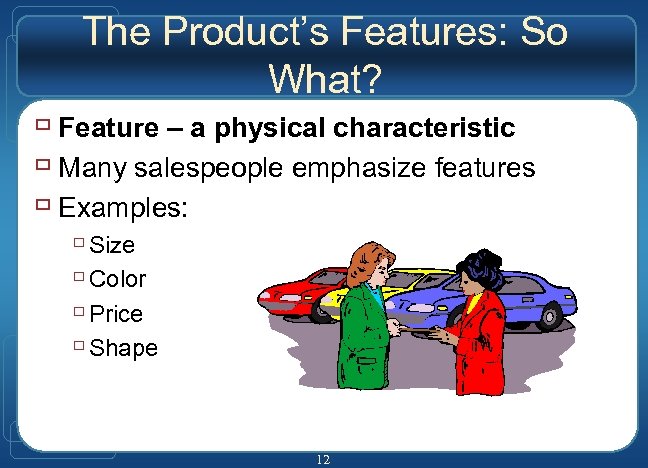 The Product’s Features: So What? ù Feature – a physical characteristic ù Many salespeople emphasize features ù Examples: ù Size ù Color ù Price ù Shape 12
 The Product’s Advantages: Prove It! ù Advantage - a performance characteristic ù The chances of making a sale are increased by describing the product’s advantages ù How a product can be used ù How a product will help the buyer ù Examples: ù Fastest-selling ù Store more information ù Copy on both sides of the paper 13
 The Product’s Benefits: What’s in it for Me? ù Benefit – a result of advantage ù People are interested in what the product will do for them ù Benefits can be both practical and psychological ù Benefits should be specific statements, not generalizations ù Emphasizing benefits increases sales 14
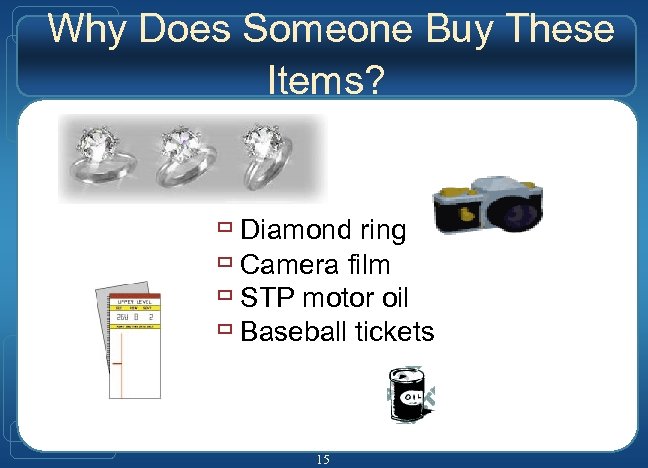 Why Does Someone Buy These Items? ù Diamond ring ù Camera film ù STP motor oil ù Baseball tickets 15
 People Buy the Product’s Benefits, Such as: ù Diamond ring – images of success, ù ù ù investment, to please a loved one Camera film – memories of places, friends, and family STP motor oil – engine protection, car investment, or peace of mind Baseball tickets – entertainment, escape from reality, or relaxation 16
 People Buy Benefit(s) ù Not a product’s feature(s) ù Not a product’s advantage(s) 17
 People Buy Benefit(s) ù Notice national television commercials ù They stress benefits ù Advertisers know this helps sell the product 18
 People Buy Benefit(s) ù High performing salespeople stress benefits ù They know this increases their chances of making the sale and helping someone 19
 What’s In It For Me? ù Stressing benefits in the sales presentation answers the prospect’s question ù “What’s in it for me? ” 20
 Can Not Leave Out Features and Advantages ù In the sales presentation it is also important to mention features and advantages ù Here is an example of how to stress a benefit while including a feature and an advantage: 21
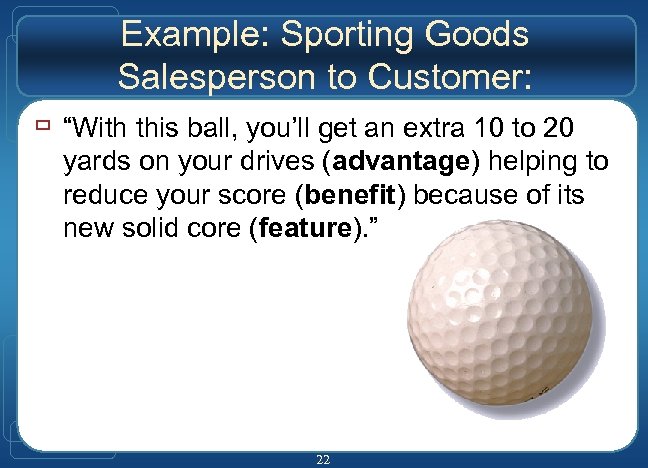 Example: Sporting Goods Salesperson to Customer: ù “With this ball, you’ll get an extra 10 to 20 yards on your drives (advantage) helping to reduce your score (benefit) because of its new solid core (feature). ” 22
 FABs Can Be Awkward at First ù New salespeople are frequently not accustomed to using feature, advantage, and benefit phrases ù It may seem awkward at first 23
 Use Your FABs ù Feature – Physical Characteristic ù Buyer thinks “So What? ” ù Advantage – Performance Characteristic ù Buyer thinks “Prove It!” ù Benefit – Favorable result from advantage ù Benefits are what people buy! ù You can have a benefit of a benefit or a FABB 24
 Use the FAB Sequence ù The standardized FAB Sequence can be used as follows: ù The…(feature)…means you…(advantage)…with the real benefit to you being…(benefit)…. ù Note how a benefit is emphasized ù Pick a product. Insert a FAB of the product into the above sequence ù Put in your own words ù Try it. It works! 25
 Let’s Review FABs ù Which of the following is a feature, advantage, or benefit? 1. F “Made of pure vinyl” 2. B “Gives 20% more miles to the gallon” 3. F “New” 4. A “Lasts twice as long” 5. B “Saves, time, work, and money” 26
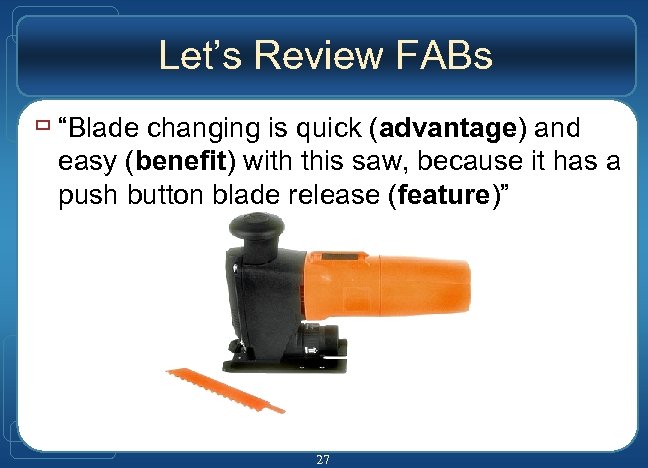 Let’s Review FABs ù “Blade changing is quick (advantage) and easy (benefit) with this saw, because it has a push button blade release (feature)” 27
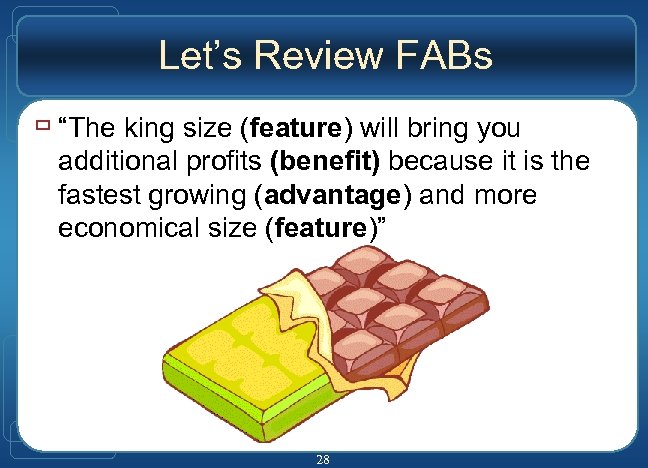 Let’s Review FABs ù “The king size (feature) will bring you additional profits (benefit) because it is the fastest growing (advantage) and more economical size (feature)” 28
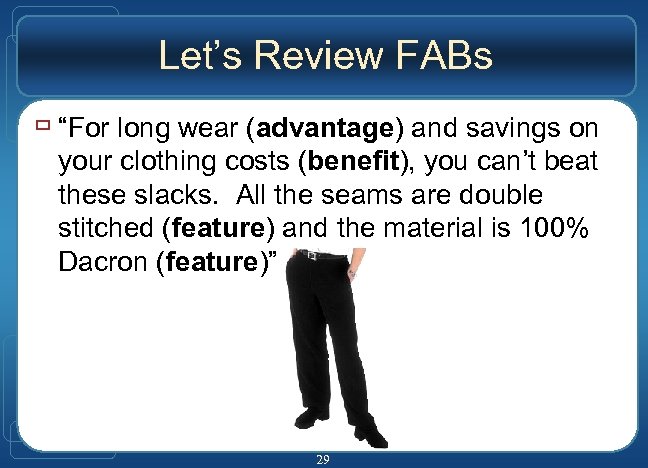 Let’s Review FABs ù “For long wear (advantage) and savings on your clothing costs (benefit), you can’t beat these slacks. All the seams are double stitched (feature) and the material is 100% Dacron (feature)” 29
 The Salesperson Needs to be a Detective ù Given that people make a buying decision based on whether they believe a product’s benefits will satisfy their needs, how can you uncover a buyer’s needs? 30
 How to Determine Important Buying Needs–A Key to Success ù L-O-C-A-T-E ù Listen ù Observe ù Combine ù Ask questions ù T alk to others ù Empathize 31
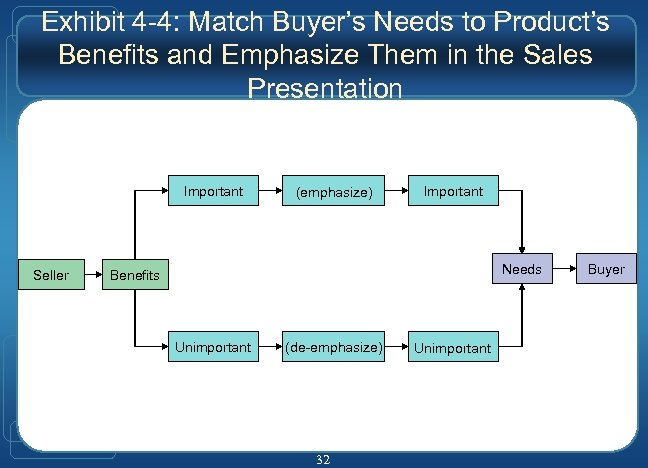 Exhibit 4 -4: Match Buyer’s Needs to Product’s Benefits and Emphasize Them in the Sales Presentation Important Seller (emphasize) Important Needs Benefits Unimportant (de-emphasize) 32 Unimportant Buyer
 The Trial Close–a Great Way to Uncover Needs and Sell ù The trial close asks for an opinion, not a decision to buy ù It gives feedback. ù The trial close is one of the best communication techniques in the sales presentation 33
 The Trial Close Helps You to Determine: ù Whether the prospect likes your product’s features, advantages, or benefits ù Whether you have successfully answered any objections ù Whether any objections remain ù Whether the prospect is ready for you to close the sale 34
 In These Examples of Trial Closes, Notice They Do NOT Ask Someone to Buy Directly ù ù “How does that sound to you? ” “Is this important to you? ” “That’s great - isn’t it? ” “I notice your smile. What do you think about…? ” 35
 Do You See How the Trial Close Asks for the Person’s Opinion Concerning What Has Just Been Said? ù For example: ù “Does that answer your concern? ” ù “Am I on the right track with this proposal? ” 36
 The Trial Close Does Not Ask for a Decision ù It asks a question to better understand what the person is thinking about what is being said by the salesperson – you 37
 To Help You Properly Use ù The FAB selling technique and the trial close, incorporate the SELL Sequence into your presentation 38
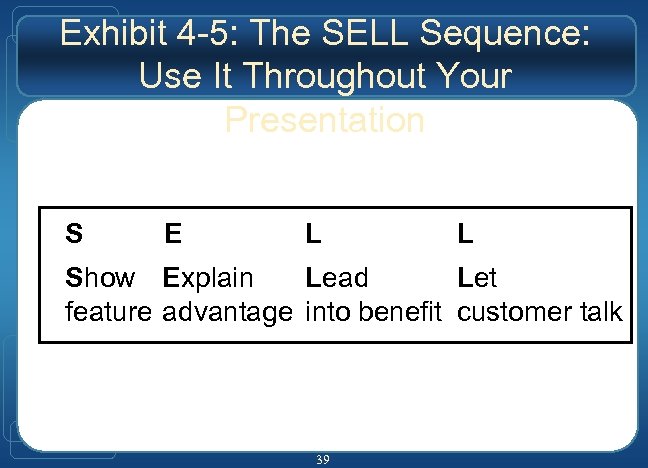 Exhibit 4 -5: The SELL Sequence: Use It Throughout Your Presentation S E L L Show Explain Lead Let feature advantage into benefit customer talk 39
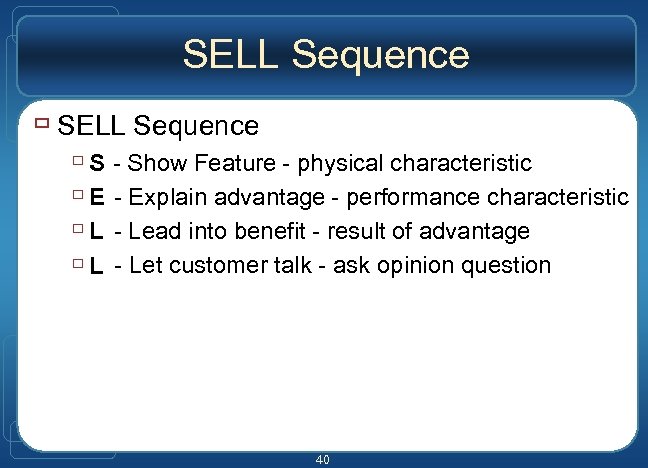 SELL Sequence ù S - Show Feature - physical characteristic ù E - Explain advantage - performance characteristic ù L - Lead into benefit - result of advantage ù L - Let customer talk - ask opinion question 40
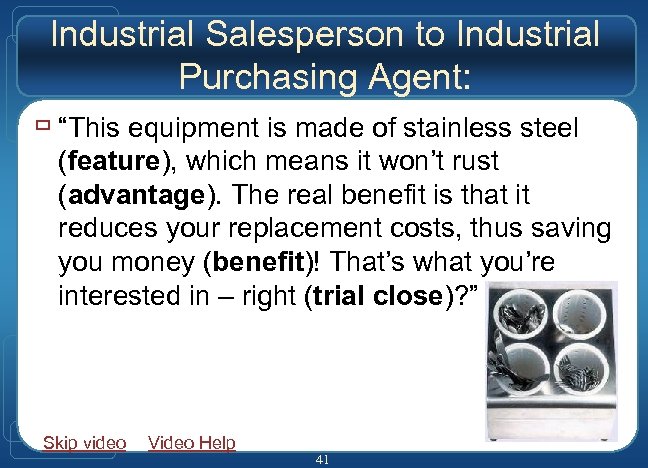 Industrial Salesperson to Industrial Purchasing Agent: ù “This equipment is made of stainless steel (feature), which means it won’t rust (advantage). The real benefit is that it reduces your replacement costs, thus saving you money (benefit)! That’s what you’re interested in – right (trial close)? ” Skip video Video Help 41
 42
42
 The Trial Close Is a Powerful Communication Technique To Produce* ù Two-way communication ù Participation from the other person 43
 A Challenge! Use the Trial Close in Your Normal Conversation To: * ù See if it helps your communication ù See if it gets the other person to participate in the conversation ù All you do is occasionally ask the person an opinion type question such as: ù “Is that a good place to eat? ” ù “What did you think about the movie? ” ù “How does that sound to you? ” 44
 Let’s Review! When Are the Times to Use a Trial Close? * 1. After making a strong selling point in the presentation (FABs) 2. After the presentation but before the close 3. After answering an objection 4. Immediately before you move to close the sale 45
 Let’s Review! What Does the Trial Close Allow You to Determine? 1. Whether the prospect likes your product’s FAB – the strong selling point 2. Whether you have successfully answered the objection 3. Whether any objections remain 4. Whether the prospect is ready for you to close the sale 46
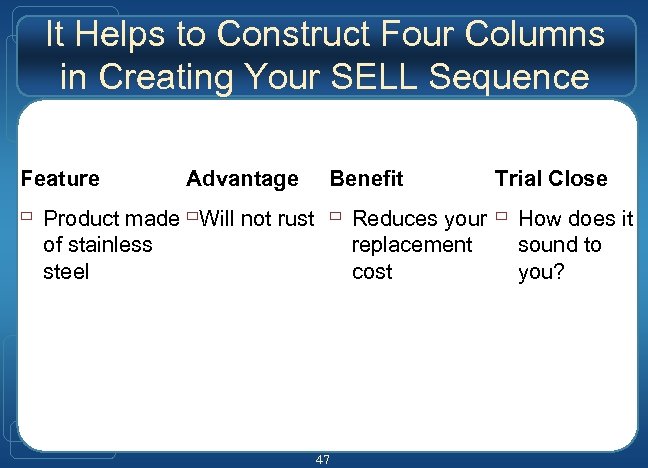 It Helps to Construct Four Columns in Creating Your SELL Sequence Feature Advantage Benefit Trial Close ù Product made ùWill not rust ù Reduces your ù How does it of stainless steel replacement cost 47 sound to you?
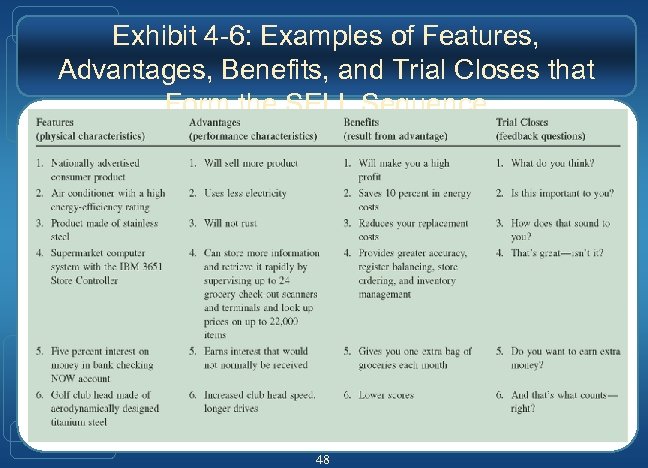 Exhibit 4 -6: Examples of Features, Advantages, Benefits, and Trial Closes that Form the SELL Sequence 48
 Your Buyer’s Perception ù Perception – how selects, organizes, interprets information ù Selective exposure – only portion of information used ù Selective distortion – perceptual process may alter information ù Selective retention – may remember only what supports their attitudes and beliefs 49
 Perceptions, Attitudes, and Beliefs ù Perceptions are learned ù Learning - knowledge based on past ù Attitude - learned predispositions ù Belief - trust or confidence placed in something/someone 50
 The Buyer’s Personality Should Be Considered ù Personality can be viewed as the individual’s distinguishing character traits, attitudes, or habits ù Self-concept ù Real self ù Self-image ù Ideal self ù Looking-glass self 51
 Adaptive Selling Based on Buyer’s Style ù Personality typing ù Adapt your presentation to the buyer’s style ù Thinker style ù Intuitor style ù Feeler style ù Sensor style 52
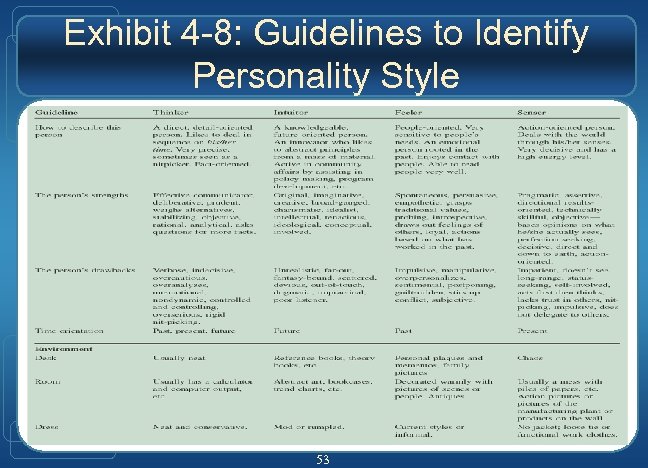 Exhibit 4 -8: Guidelines to Identify Personality Style 53
 Watch for Clues to Someone’s Personality Type ù How would you describe this person? ù What is their time orientation – past, present, future? ù What does their desk look like? ù What does their room look like? ù How do they dress? 54
 Determining Style Can Be Difficult ù What is the person’s primary style? ù What is the person’s secondary style? ù Does the person’s style comprise all four types? 55
 First Know Your Style ù This helps you to adapt to the other person’s style ù Which leads to better communication ù Knowing your style helps you identify a person’s style, especially if your styles are the same (It takes one to know one) 56
 You Can Classify Buying Situations ù Some decisions are routine ù Some decisions are limited ù Some decisions are extensive 57
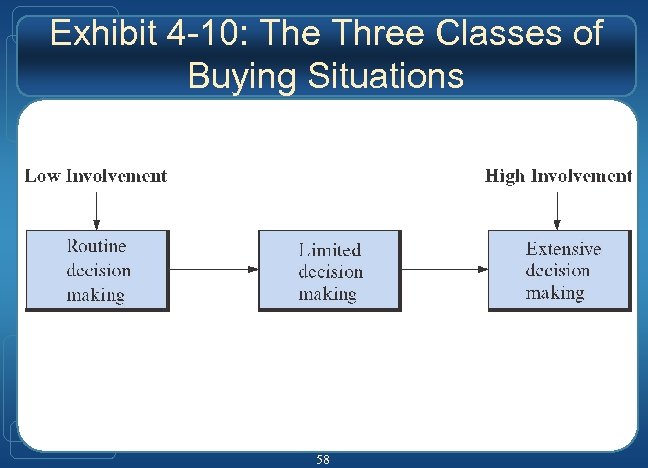 Exhibit 4 -10: The Three Classes of Buying Situations 58
 Technology Provides Information ù Technology provides information for customer decision making and service 59
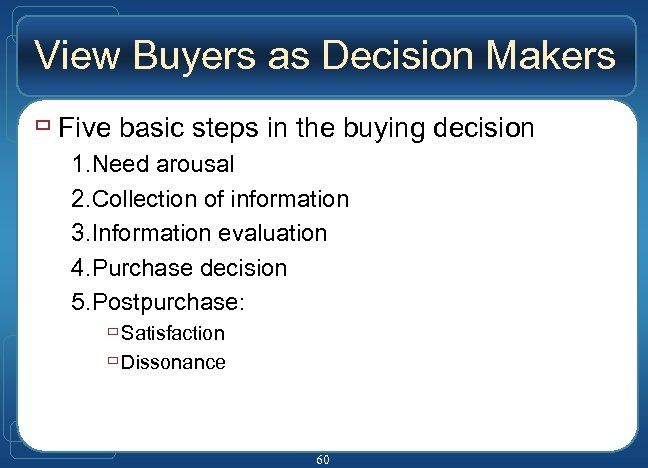 View Buyers as Decision Makers ù Five basic steps in the buying decision 1. Need arousal 2. Collection of information 3. Information evaluation 4. Purchase decision 5. Postpurchase: ù Satisfaction ù Dissonance 60
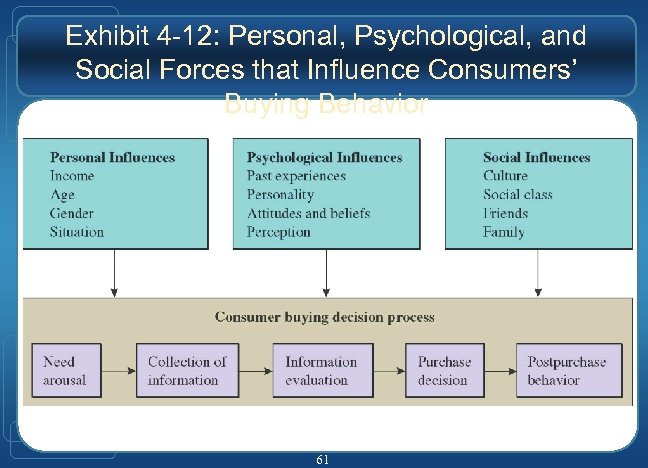 Exhibit 4 -12: Personal, Psychological, and Social Forces that Influence Consumers’ Buying Behavior 61
 Satisfied Customers Are Easier to Sell to ù It is easier to sell to a customer than to a stranger ù Building a relationship is important to a salesperson’s success 62
 To Buy or Not to Buy–a Choice Decision ù A salesperson needs to understand ù Factors that can influence the buying decision ù Buyers actually examine various factors that influence these decisions ù Buyers actually go through various steps in making decisions 63
 Summary of Major Selling Issues ù As a salesperson, be knowledgeable ù Understand the characteristics of the target market and how these characteristics relate to the buyer’s behavior ù The individual goes through various steps in the three buying situations of routine decision making, limited decision making, and extensive decision making ù Uncover who is involved in the buying decision and the main factors that influence the decision 64
 Summary of Major Selling Issues, cont… ù Psychological factors include the buyer’s motives, perceptions, learning, attitudes, beliefs, and personality ù Not all prospects will buy your products due to the many factors influencing their buying decision ù Need to uncover buyer’s needs, solve buyer’s problems, and provide the knowledge that allows them to develop personal attitudes toward the product 65
 Video Help: ù The video should start automatically. ù If it does not, you must move the mouse to the ù ù middle of the screen. When a hand icon appears the video is ready. Click once anywhere on the screen to start video. Click once during playback to pause/unpause video. Press the space bar twice to stop video and continue presentation. When video is over, click to continue presentation. Video One 66