



 1. The notion of Parts of Speech. Approaches to and criteria for singling out parts of speech. a) «Classical» (prescriptivist) approach. b) Functional (descriptivist) approach. c) Distributional (structuralist) approach. d) Complex three-criteria approach. 2. The system of Parts of Speech in Modern English. 3. The problem of notional and functional parts of speech.
 1(a) Prescriptive Approach Criterion: form Classes: declinables undeclinables
 1(b) Descriptive Approach H. Sweet Declinables: -noun-words (noun, noun pronoun, noun numeral, infinitive, gerund) -adjective-words (adjective, adjective pronoun, adjective numeral, participle) -verb (finite verb, verbals)
 Indeclinables (particles): -adverb -preposition -conjunction -interjection
 O. Jespersen Word Classes: -substantives -adjectives -pronouns -verbs (verbs and verbals) -particles (adverbs, prepositions, conjunctions, interjections).
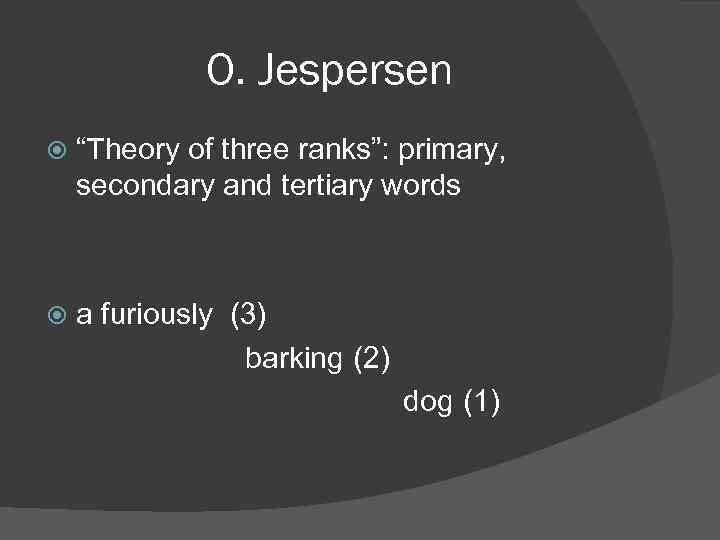 O. Jespersen “Theory of three ranks”: primary, secondary and tertiary words a furiously (3) barking (2) dog (1)
 1(c) Structural Approach Ch. Fries Substitution frames Frame A The concert was good. Frame B The clerk remembered the tax. Frame C The team went there.
 Ch. Fries 4 classes and 15 groups of words: Class 1 (concert); Class 2 (remembered); Class 3 (good); Class 4 (there).
 Groups: Group A (determiners) Group B (modal verbs) Group C (the negative particle “not”) Group D (adverbs of degree) Group E (coordinating conjunctions) Group F (prepositions) Group G (the auxiliary verb “to”) Group H (the introductory “there”) Group I (interrogative pronouns and adverbs) Group J (subordinating conjunctions) Group K (interjections) Group L (the words “yes” and “no”) Group M (the so called attention giving signals: look, say, listen) Group N (the word “please”) Group O (the forms “let us”, “lets” in request sentences).
 1(d) Complex Approach Meaning Form Function
 2. System of Parts of Speech Noun: 1) the categorial meaning of substance ("thingness"); 2) the changeable forms of number and case; the specific suffixal forms of derivation (prefixes in English do not discriminate parts of speech as such); 3) the substantive functions in the sentence (subject, object, substantival predicative); prepositional connections; modification by an adjective.
 Adjective: 1) the categorial meaning of prop erty (qualitative and relative); 2) the forms of the degrees of com parison (for qualitative adjectives); the specific suffixal forms of derivation; 3) adjectival functions in the sentence (attribute to a noun, adjectival predicative).
 Numeral: 1) the categorial meaning of num ber (cardinal and ordinal); 2) the narrow set of simple numerals; the specific forms of composition for compound numerals; the specific suffixal forms of derivation for ordinal numerals; 3) the functions of numerical attribute and numerical substantive.
 Pronoun: 1) the categorial meaning of indi cation (deixis); 2) the narrow sets of various status with the corre sponding formal properties of categorial changeability and word building; 3) the substantival and adjectival functions for different sets.
 Verb: 1) the categorial meaning of process (presented in the two upper series of forms, respectively, as finite process and non finite process); 2) the forms of the verbal categories of person, number, tense, aspect, voice, mood; the opposition of the finite and non finite forms; 3) the function of the finite predicate for the finite verb; the mixed verbal other than verbal functions for the non finite verb.
 Adverb: 1) the categorial meaning of the secondary property, i. e. the property of process or another property; 2) the forms of the degrees of comparison for qualitative adverbs; the specific suffixal forms of derivation; 3) the functions of various adverbial modifiers.
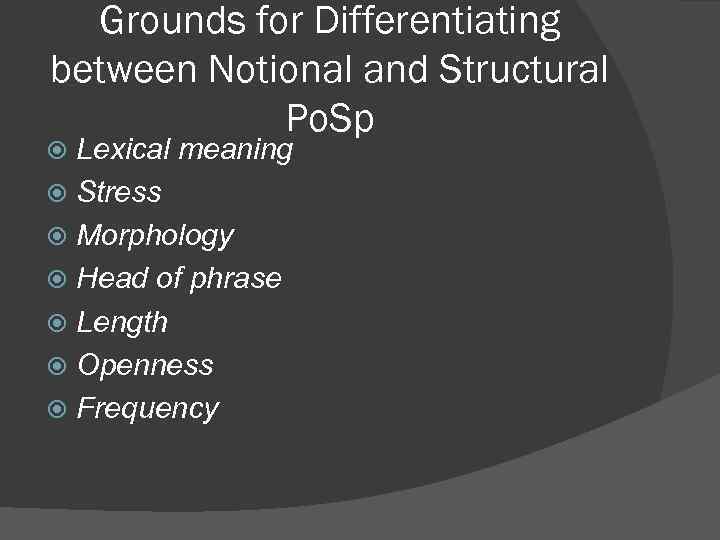 Grounds for Differentiating between Notional and Structural Po. Sp Lexical meaning Stress Morphology Head of phrase Length Openness Frequency
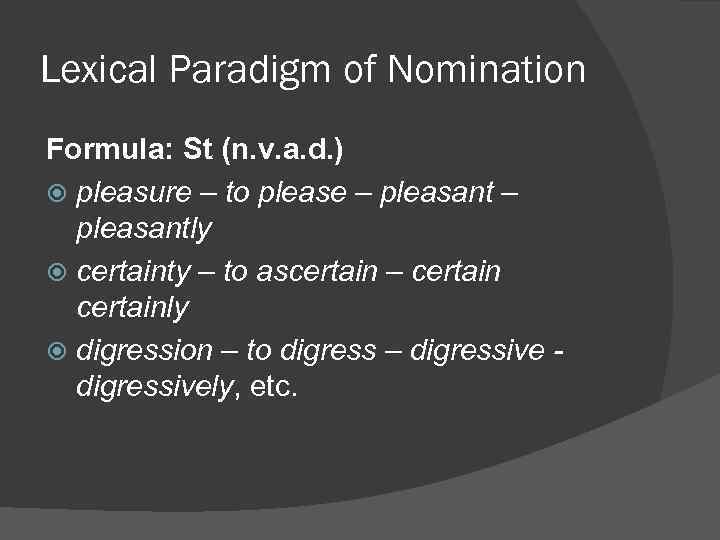 Lexical Paradigm of Nomination Formula: St (n. v. a. d. ) pleasure – to please – pleasantly certainty – to ascertain – certainly digression – to digress – digressively, etc.
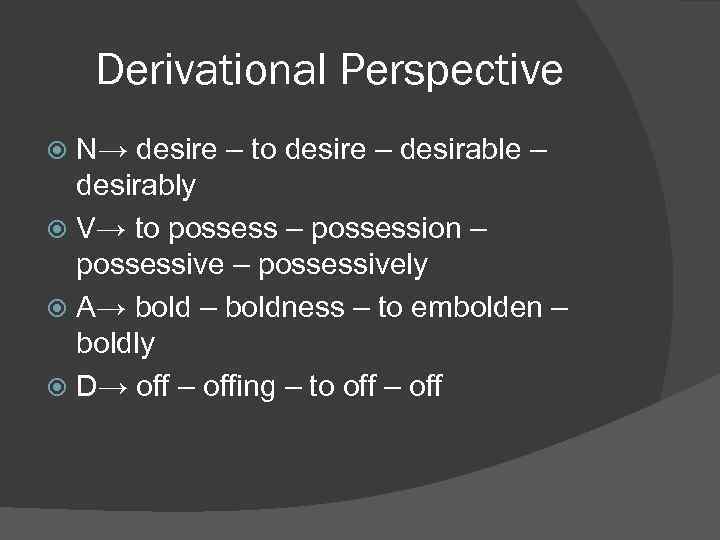 Derivational Perspective N→ desire – to desire – desirably V→ to possess – possession – possessively A→ bold – boldness – to embolden – boldly D→ off – offing – to off – off
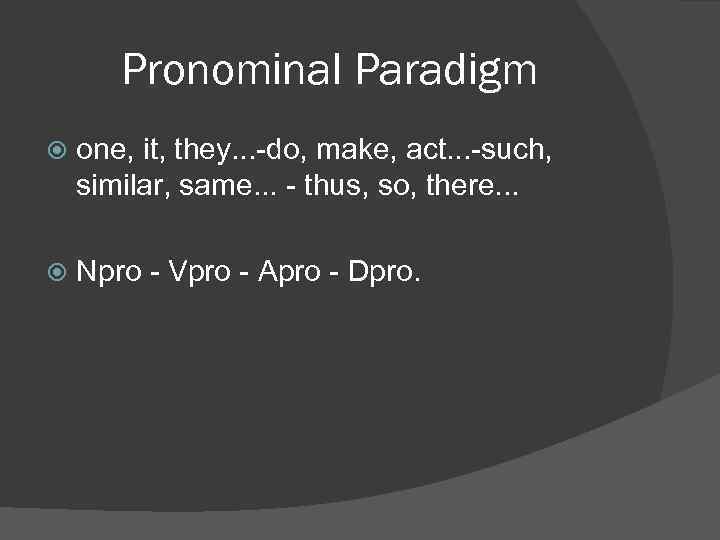 Pronominal Paradigm one, it, they. . . do, make, act. . . such, similar, same. . . thus, so, there. . . Npro Vpro Apro Dpro.