 Скачать презентацию 1 THE BUSINESS OF BANKING 1 1 1
41c1e13e978c18aba581770e9d130ce0.ppt
- Количество слайдов: 32



1 THE BUSINESS OF BANKING 1. 1 1. 2 1. 3 1. 4 Slide 1 Introduction to Banking Role of Banks in the Economy How the Banking System Works Other Financial Institutions © South-Western Publishing
Lesson 1. 1 INTRODUCTION TO BANKING GOALS Define the business of banking Identify trends in modern banking Slide 2 © South-Western Publishing
WHAT IS A BANK? l A bank is a business. l Banks sell their services to earn money. l Banks must earn a profit to survive. 3 © South-Western Publishing
A UNIQUE BUSINESS l The services banks offer to customers have to do almost entirely with handling money for other people. l Money is a medium of exchange—an agreed upon system for measuring values of goods and services. l Money shows how much something is worth. l A bank is a financial intermediary for the safeguarding, transferring, exchanging, or lending of money. l An intermediary is a facilitator acting between parties. l Banks facilitate the flow of money throughout our economy. 4 © South-Western Publishing
TYPES OF BANKS l Commercial banks l Retail banks l Central banks 5 © South-Western Publishing
BANKING TODAY l Traditionally, banking was viewed as a solid and slow-moving industry. l Banking today is an exciting, fast-moving, around -the-clock, around-the-world activity. 6 © South-Western Publishing
MERGERS l A merger occurs when one or more banks join or acquire another bank or banks. l Mergers increase the size of banks, giving them more resources. l Mergers decrease the number of banks. l Mergers have created an opening for a new wave of small local banks. 7 © South-Western Publishing
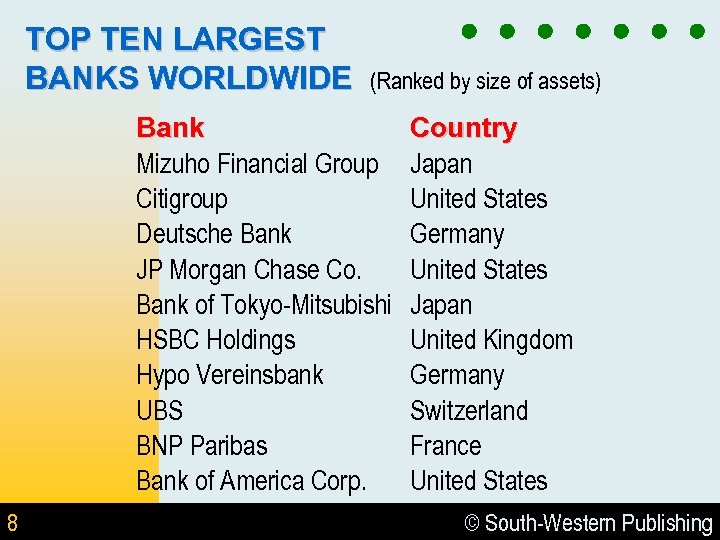
TOP TEN LARGEST BANKS WORLDWIDE (Ranked by size of assets) Bank Mizuho Financial Group Citigroup Deutsche Bank JP Morgan Chase Co. Bank of Tokyo-Mitsubishi HSBC Holdings Hypo Vereinsbank UBS BNP Paribas Bank of America Corp. 8 Country Japan United States Germany United States Japan United Kingdom Germany Switzerland France United States © South-Western Publishing
TECHNOLOGY l Impact on bankers l Accounting, auditing, and examining functions have been taken over by fast and efficient technology. l Funds transfer, record keeping, and financial analyses have become instantaneous. l Impact on consumers l Automated teller machines (ATMs) l “Smart” cards l Online banking 9 © South-Western Publishing
COMPETITION l As government regulations have changed, competition between banks has become fiercer. l Banks compete with each other and with other businesses that sell financial services. 10 © South-Western Publishing
Lesson 1. 2 ROLE OF BANKS IN THE ECONOMY GOALS List banking activities that contribute to economic stability Explain how banking expands the economy Slide 11 © South-Western Publishing
BANKS AND ECONOMICS l Money is a medium of exchange and the basis of the modern economy. l Banks and other institutions play a critical role in performing services that are essential to the functioning of an economy. 12 © South-Western Publishing
KEEPING YOUR MONEY SAFE l Record keeping l Identification l Enforcement l Transfer security l Sound business practices 13 © South-Western Publishing
SPREADING THE WEALTH l Banks play a key role in transferring money to provide growth and stabilizing the monetary supply. l Bank lending makes money available to consumers and businesses to make purchases they might not otherwise be able to make. 14 © South-Western Publishing
TRANSFERRING l Between banks and individual customers l Between banks and industry l Between banks and governments l Between governments 15 © South-Western Publishing
LENDING l Loans to businesses l Loans to governments l Loans to individuals l Credit cards l Home loans l Automobile loans 16 © South-Western Publishing
CREDITWORTHINESS l Evaluating the creditworthiness of customers is a banking function that affects the economy at large. l Banking policies and regulations regarding creditworthiness and the ratio of loans to deposits help guarantee a secure financial environment. 17 © South-Western Publishing
GUARANTEEING THE MONEY l In the United States, banks and the government work together to form the banking system and to make sure the money supply is adequate, appropriate, and trustworthy. l Much of this guarantee is backed through the central banking function of the Federal Reserve. l Individual banks work with the government to implement monetary policy, perform exchange functions, and defeat counterfeiters of currency. l Banks guarantee their own policies. 18 © South-Western Publishing
THE SUBSTANCE OF SOCIETY l A great part of the economic system is psychological. l Banks are at the heart of our financial system, and their effect on your life cannot be calculated. 19 © South-Western Publishing
Lesson 1. 3 HOW THE BANKING SYSTEM WORKS GOALS Explain how banks acquire money to do business Identify new services that banks offer to stay competitive Slide 20 © South-Western Publishing
MONEY AT WORK l Banks earn money in various ways. l Most of their incomes from the interest that people or businesses pay as they repay a loan. l When banks lend money, they put it to work. 21 © South-Western Publishing
THE SPREAD l The difference between what a bank pays in interest and what it receives in interest is called the spread, or net interest income. l The spread is not pure profit. The spread is income, or revenue. l Profit is what is left of revenue after costs are deducted. 22 © South-Western Publishing
OTHER FUNDS l In addition to interest income, banks have other sources of income. l They charge for various services such as rental of safe-deposit boxes, account maintenance fees for checking accounts, fees for online bill payments, and ATM transaction fees. l Banks make money on investments. l Banks may have funds at their disposal from stockholder investments. 23 © South-Western Publishing
ASSETS AND LIABILITIES l An asset is anything of value. In financial terms, that usually means money. l A liquid asset is anything that can readily be exchanged, like cash. l A liability, in financial terms, is a cash obligation. 24 © South-Western Publishing
TWO PRINCIPLES OF BANKING l A bank’s liabilities exceed its reserves. l A bank’s liabilities are more liquid than its assets. 25 © South-Western Publishing
BANKS WORKING FOR YOU l Banking has changed radically in the last 20 years. l Large regional banks have huge resources. l Smaller banks use the flexibility that sometimes comes with smaller size to their advantage. 26 © South-Western Publishing
CHANGES IN TRADITIONAL SERVICES l Branch locations l Extended hours l Drive-up windows l Variety of checking accounts l Savings options l Personal service 27 © South-Western Publishing
NEW SERVICES l Credit cards l Innovative lending l Automated teller machines (ATMs) l Smart cards l Online banking 28 © South-Western Publishing
Lesson 1. 4 OTHER FINANCIAL INSTITUTIONS GOALS Explain depository financial institutions Explain nondepository financial institutions Slide 29 © South-Western Publishing
TYPES OF FINANCIAL INSTITUTIONS l Depository intermediaries l Obtain funds from the public l Use the funds to finance their business l Nondepository intermediaries l Do not take or hold deposits l Earn their money by selling specific services or policies 30 © South-Western Publishing
DEPOSITORY INTERMEDIARIES l Commercial banks l Savings and loan associations l Mutual savings banks l Credit unions 31 © South-Western Publishing
NONDEPOSITORY INTERMEDIARIES l Insurance companies l Trusts companies/pension funds l Brokerage houses l Loan companies l Currency exchanges 32 © South-Western Publishing
Скачать презентацию 1 THE BUSINESS OF BANKING 1 1 1
41c1e13e978c18aba581770e9d130ce0.ppt