


 Скачать презентацию 1 TDT 4252 Modelling of Information Systems Advanced
897b9b93f8ff11bce50727d65ad1fdcd.ppt
- Количество слайдов: 59
 1 TDT 4252 Modelling of Information Systems Advanced Course Sobah Abbas Petersen Adjunct Associate Professor sap@idi. ntnu. no Lecture 15 – Enterprise Architecture: Gartner, FEA TDT 4252, Spring 2013
 2 This Lecture • Enterprise Architectures continued: Gartner, FEA – Based on lecture slides from Spring 2010, by Harald Rønneberg. • Requiered Reading: – A 16: Roger Sessions, A Comparison of the Top Four Enterprise-Architecture Methodologies, White Paper, Object. Watch Inc. May 2007. • Additional reading: – Federal Enterprise Architecture Framework, Version 1. 1, September 1999, (http: //www. cio. gov/documents/fedarch 1. pdf) – http: //en. wikipedia. org/wiki/Federal_Enterprise_Architecture – Cisco Systems, 2009. Federal Enterprise Architecture (FEA) and Network Services, White Paper, pages 1 -6. (http: //www. cisco. com/en/US/solutions/collateral/ns 340/ns 414/ns 859/C 11 -54235900_FEAnetsol. pdf) Lecture 15 – Enterprise Architecture: Gartner, FEA TDT 4252, Spring 2013
 3 What is Enterprise Architecture – recap Lecture 15 – Enterprise Architecture: Gartner, FEA TDT 4252, Spring 2013
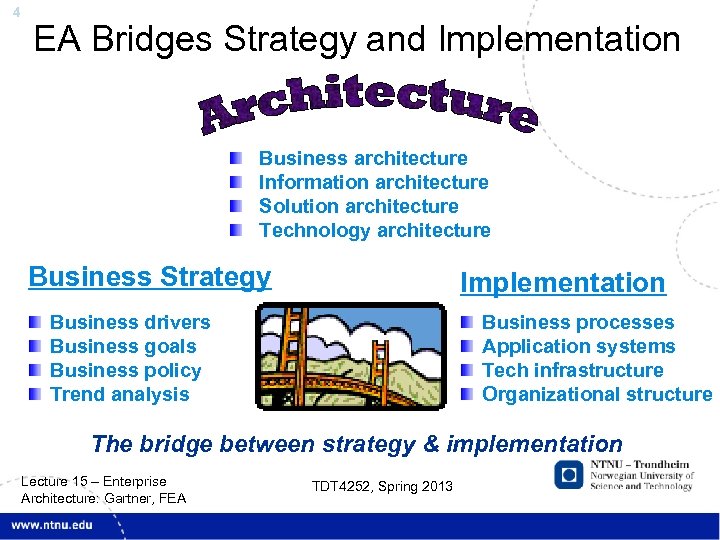 4 EA Bridges Strategy and Implementation Business architecture Information architecture Solution architecture Technology architecture Business Strategy Implementation Business drivers Business goals Business policy Trend analysis Business processes Application systems Tech infrastructure Organizational structure The bridge between strategy & implementation Lecture 15 – Enterprise Architecture: Gartner, FEA TDT 4252, Spring 2013
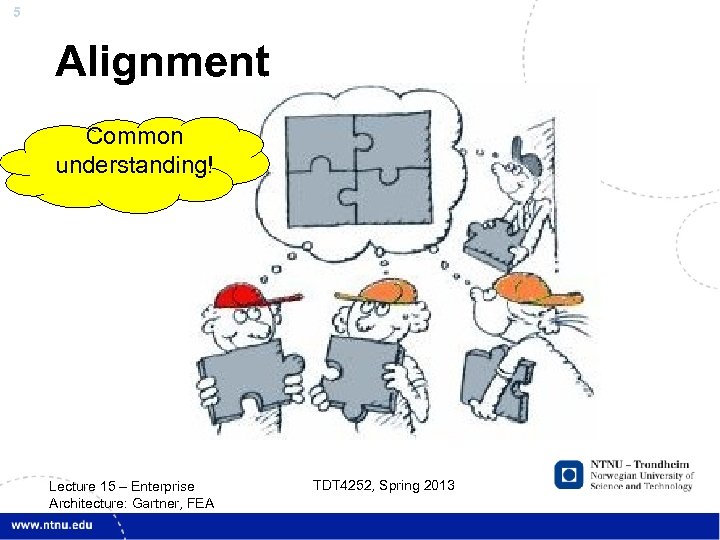 5 Alignment Common understanding! Lecture 15 – Enterprise Architecture: Gartner, FEA TDT 4252, Spring 2013
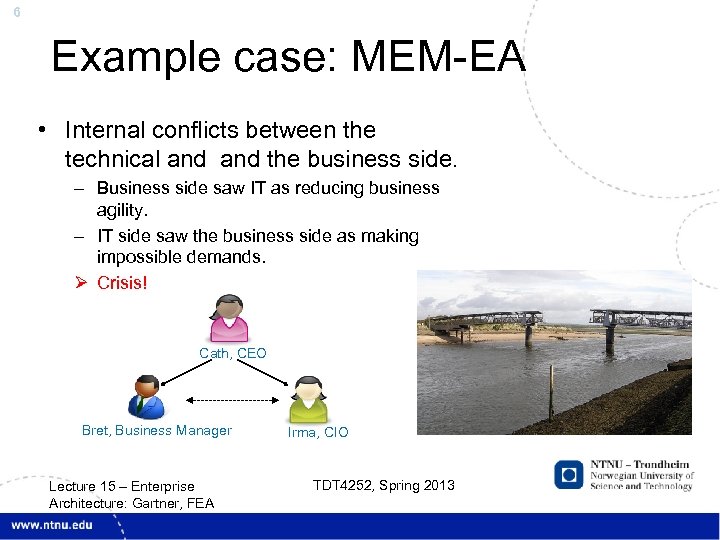 6 Example case: MEM-EA • Internal conflicts between the technical and the business side. – Business side saw IT as reducing business agility. – IT side saw the business side as making impossible demands. Ø Crisis! Cath, CEO Bret, Business Manager Lecture 15 – Enterprise Architecture: Gartner, FEA Irma, CIO TDT 4252, Spring 2013
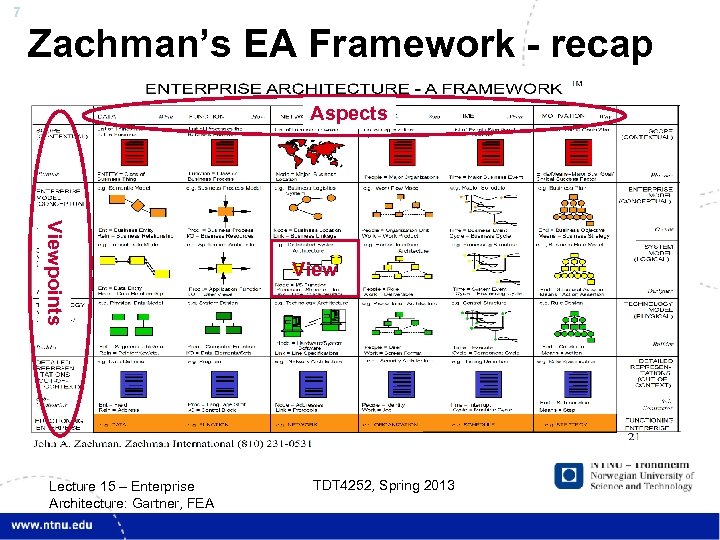 7 Zachman’s EA Framework - recap Aspects Viewpoints Lecture 15 – Enterprise Architecture: Gartner, FEA View TDT 4252, Spring 2013
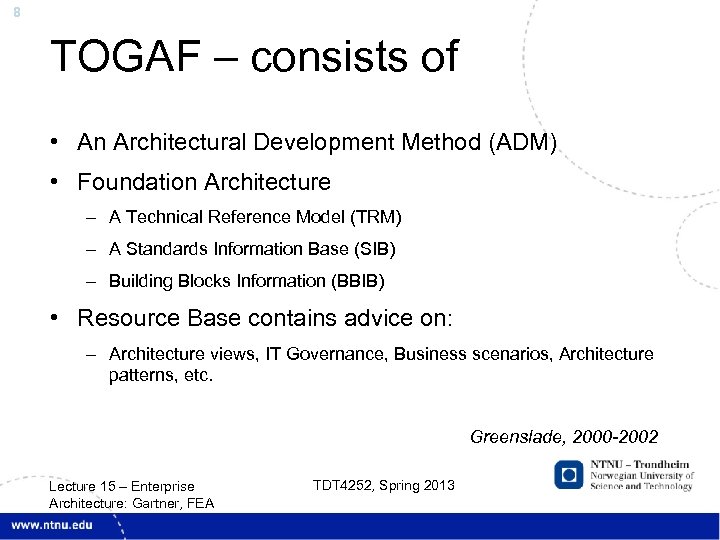 8 TOGAF – consists of • An Architectural Development Method (ADM) • Foundation Architecture – A Technical Reference Model (TRM) – A Standards Information Base (SIB) – Building Blocks Information (BBIB) • Resource Base contains advice on: – Architecture views, IT Governance, Business scenarios, Architecture patterns, etc. Greenslade, 2000 -2002 Lecture 15 – Enterprise Architecture: Gartner, FEA TDT 4252, Spring 2013
 9 TOGAF – Framework or Process? • TOGAF describes itself as a Framework. But the most important part of it is the Architectural Development Method (ADM): – ADM is a recipe for creating architecture. • TOGAF is an architectural process (Roger Sessions). • It complements Zachman’s Framework: – Zachman tell you how to categorise artifacts; TOGAF provides a process for creating them. Lecture 15 – Enterprise Architecture: Gartner, FEA TDT 4252, Spring 2013
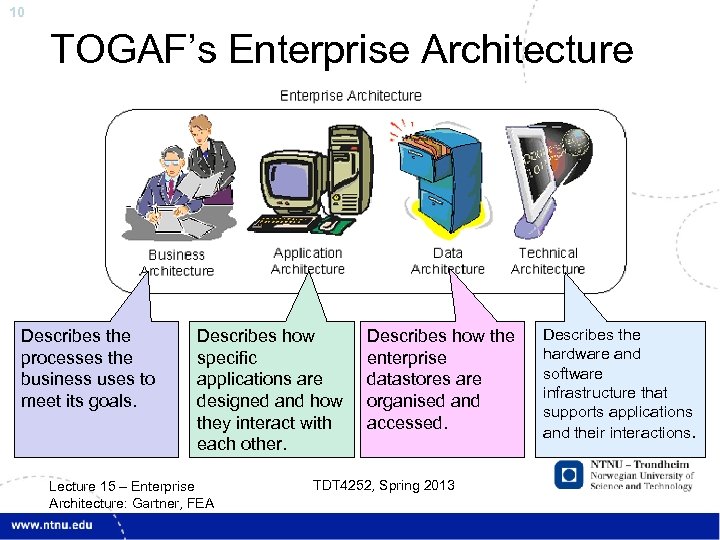 10 TOGAF’s Enterprise Architecture Describes the processes the business uses to meet its goals. Describes how specific applications are designed and how they interact with each other. Lecture 15 – Enterprise Architecture: Gartner, FEA Describes how the enterprise datastores are organised and accessed. TDT 4252, Spring 2013 Describes the hardware and software infrastructure that supports applications and their interactions.
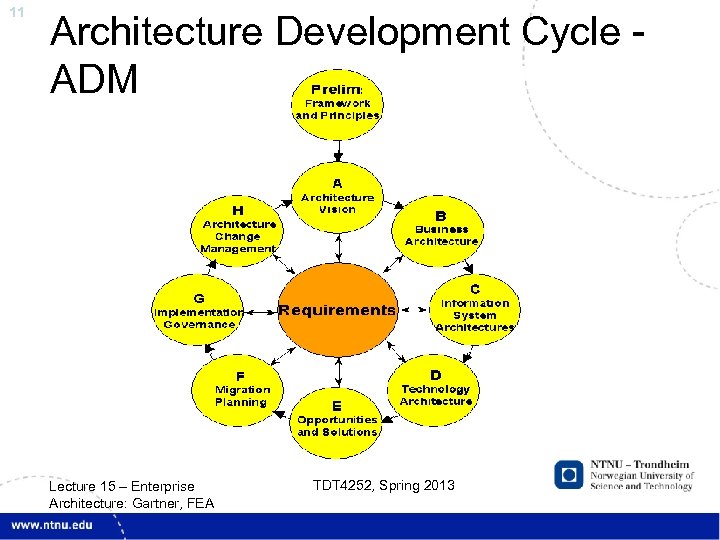 11 Architecture Development Cycle ADM Lecture 15 – Enterprise Architecture: Gartner, FEA TDT 4252, Spring 2013
 12 TOGAF - benefits + TOGAF is flexible about the architecture that is generated – ”architecture agnostic” or vendor neutral. + Comprehensive process, from business requirements to applications to infrastructure. • The final architecture may be good, bad or indifferent. ÷ TOGAF merely describes how to generate enterprise architecture, not necessarily how to generate a good one! Lecture 15 – Enterprise Architecture: Gartner, FEA TDT 4252, Spring 2013
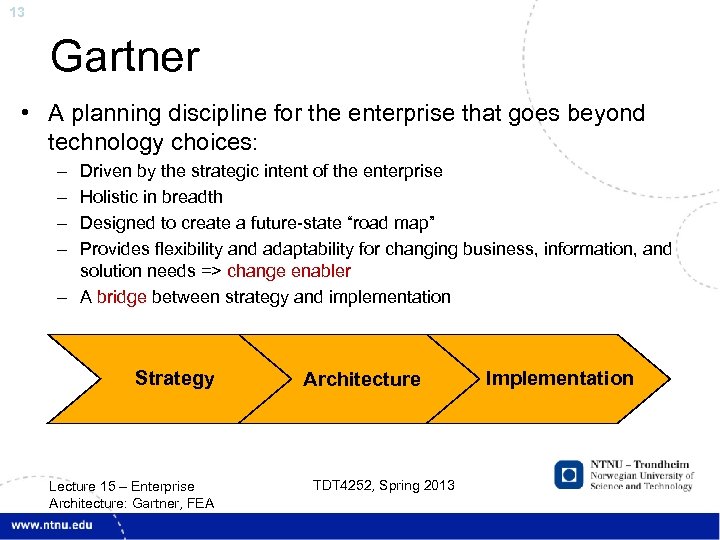 13 Gartner • A planning discipline for the enterprise that goes beyond technology choices: – – Driven by the strategic intent of the enterprise Holistic in breadth Designed to create a future-state “road map” Provides flexibility and adaptability for changing business, information, and solution needs => change enabler – A bridge between strategy and implementation Strategy Lecture 15 – Enterprise Architecture: Gartner, FEA Architecture TDT 4252, Spring 2013 Implementation
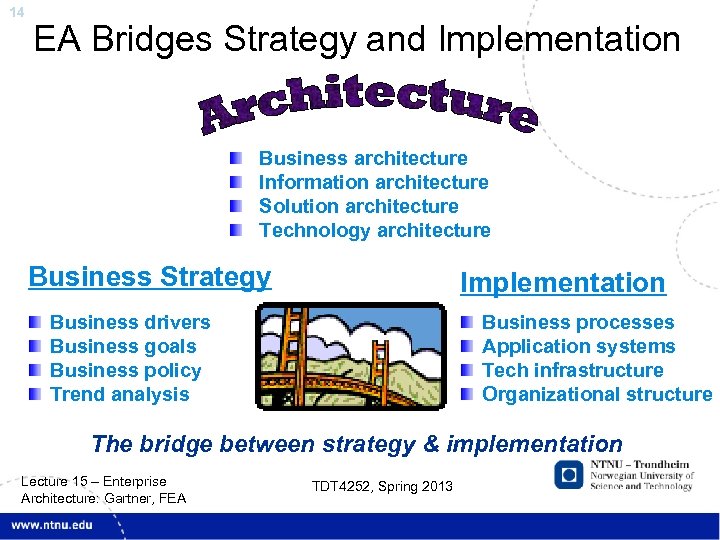 14 EA Bridges Strategy and Implementation Business architecture Information architecture Solution architecture Technology architecture Business Strategy Implementation Business drivers Business goals Business policy Trend analysis Business processes Application systems Tech infrastructure Organizational structure The bridge between strategy & implementation Lecture 15 – Enterprise Architecture: Gartner, FEA TDT 4252, Spring 2013
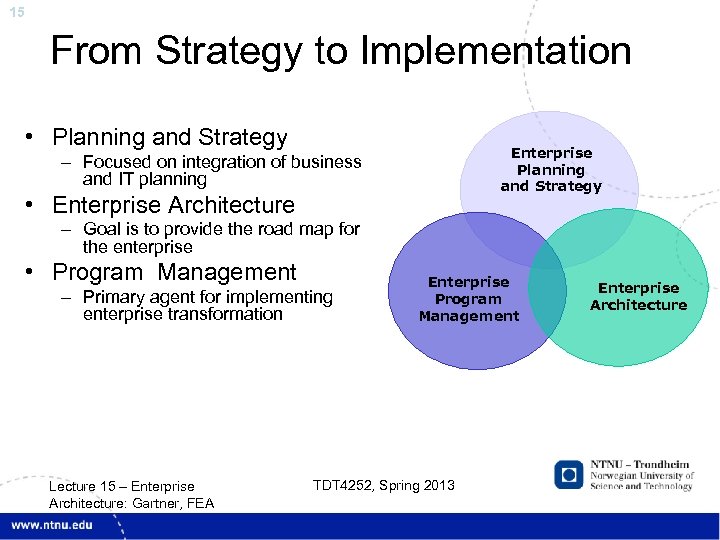 15 From Strategy to Implementation • Planning and Strategy Enterprise Planning and Strategy – Focused on integration of business and IT planning • Enterprise Architecture – Goal is to provide the road map for the enterprise • Program Management – Primary agent for implementing enterprise transformation Lecture 15 – Enterprise Architecture: Gartner, FEA Enterprise Program Management TDT 4252, Spring 2013 Enterprise Architecture
 16 Gartner • The Gartner EA methodology is a ”practice” – Sessions. • It is an ongoing process of creating, maintaining, and especially, leveraging an enterprise architecture that gives the enterprise its vitality. Lecture 15 – Enterprise Architecture: Gartner, FEA TDT 4252, Spring 2013
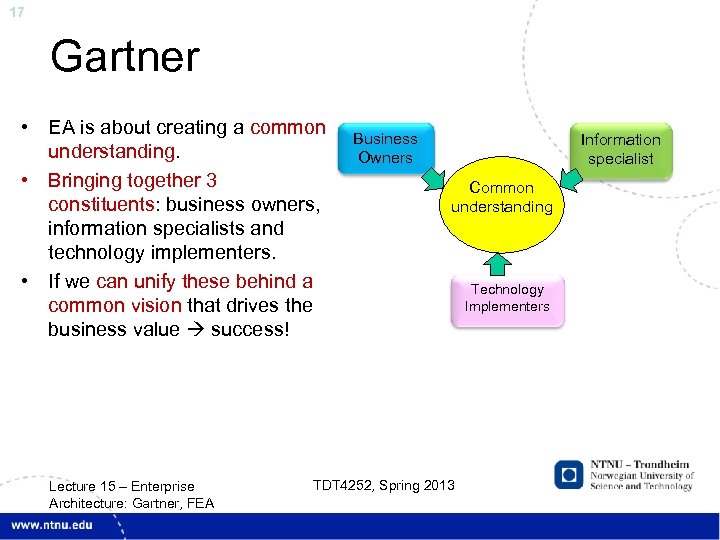 17 Gartner • EA is about creating a common understanding. • Bringing together 3 constituents: business owners, information specialists and technology implementers. • If we can unify these behind a common vision that drives the business value success! Lecture 15 – Enterprise Architecture: Gartner, FEA Business Owners Information specialist Common understanding TDT 4252, Spring 2013 Technology Implementers
 18 Gartner x • Enterprise Architecture must start where an organisation is going, not where it is x focussed on destination. • Recommends that an organisation begins by telling the story of where its strategic direction is heading and what the business drivers are to which it’s responding. Ø Goal: everybody understands and shares a single vision. • As soon as an organisation has a single vision, the implications on the business, technical, information and solution architectures can be considered. Lecture 15 – Enterprise Architecture: Gartner, FEA TDT 4252, Spring 2013
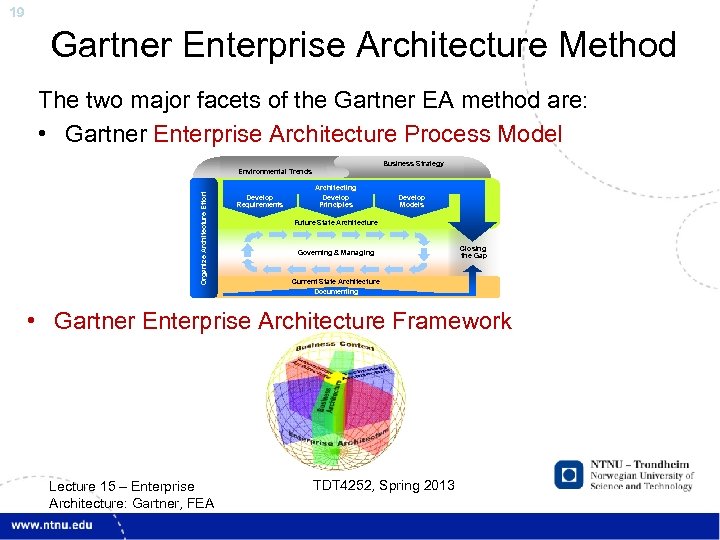 19 Gartner Enterprise Architecture Method The two major facets of the Gartner EA method are: • Gartner Enterprise Architecture Process Model Business Strategy Organize Architecture Effort Environmental Trends Develop Requirements Architecting Develop Principles Develop Models Future State Architecture Governing & Managing Closing the Gap Current State Architecture Documenting • Gartner Enterprise Architecture Framework Lecture 15 – Enterprise Architecture: Gartner, FEA TDT 4252, Spring 2013
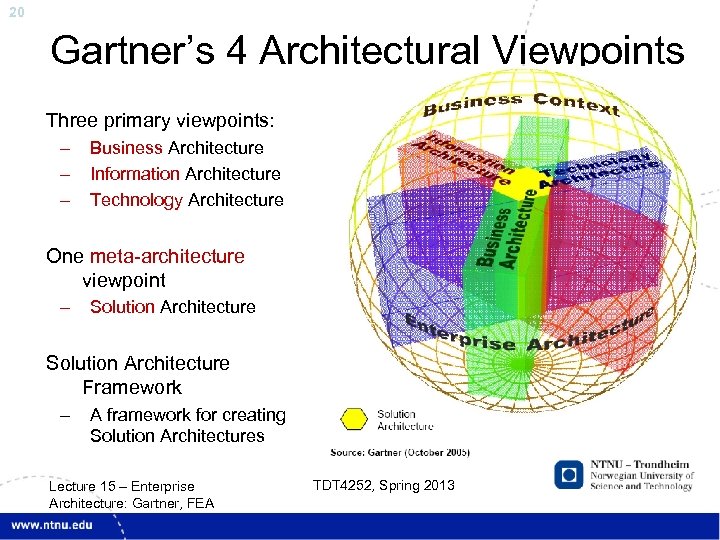 20 Gartner’s 4 Architectural Viewpoints Three primary viewpoints: – – – Business Architecture Information Architecture Technology Architecture One meta-architecture viewpoint – Solution Architecture Framework – A framework for creating Solution Architectures Lecture 15 – Enterprise Architecture: Gartner, FEA TDT 4252, Spring 2013
 21 Gartner’s 4 Architectural Viewpoints Business Architecture – Defines and describes the current- and future- state models of business activities (processes, assets and organization structure) Information Architecture – Defines and describes the current- and future- state models of the information value chain, key information artifacts (concepts), information flows Technology Architecture – Defines and describes the current- and future- state models of the infrastructure and technology platforms required for the solution architecture and which enables rapid engineering, solutions development and technical innovation Solution Architecture – – Combining and reconciling (integration) the loosely coupled and often conflicting viewpoints of the primary stakeholders into a unified architecture Having divided to conquer, we must reunite to rule SA is a consistent architectural description of a specific enterprise solution An intersection of viewpoints Lecture 15 – Enterprise Architecture: Gartner, FEA TDT 4252, Spring 2013
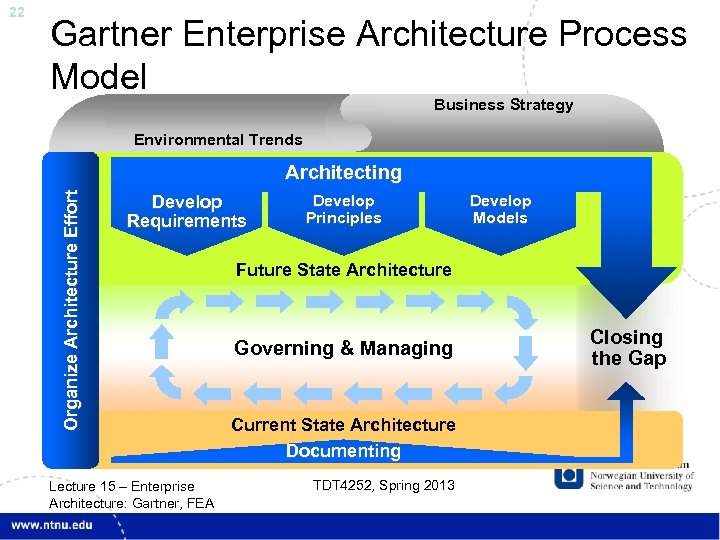 Gartner Enterprise Architecture Process Model Business Strategy Environmental Trends Architecting Organize Architecture Effort 22 Develop Requirements Lecture 15 – Enterprise Architecture: Gartner, FEA Develop Principles Develop Models Future State Architecture Governing & Managing Current State Architecture Documenting TDT 4252, Spring 2013 Closing the Gap
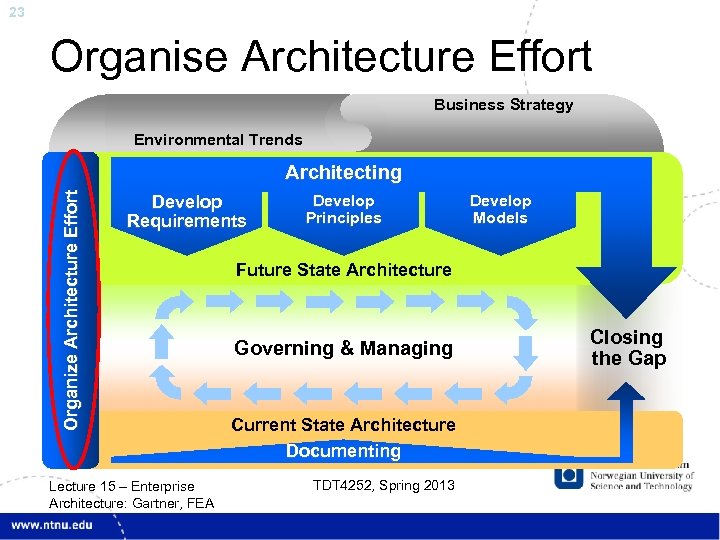 23 Organise Architecture Effort Business Strategy Environmental Trends Organize Architecture Effort Architecting Develop Requirements Lecture 15 – Enterprise Architecture: Gartner, FEA Develop Principles Develop Models Future State Architecture Governing & Managing Current State Architecture Documenting TDT 4252, Spring 2013 Closing the Gap
 24 Organise Architecture Effort - Activities • • • State the goals Scoping Buy-in and commitment Stakeholder analysis Set time box Establish EA team Lecture 15 – Enterprise Architecture: Gartner, FEA TDT 4252, Spring 2013
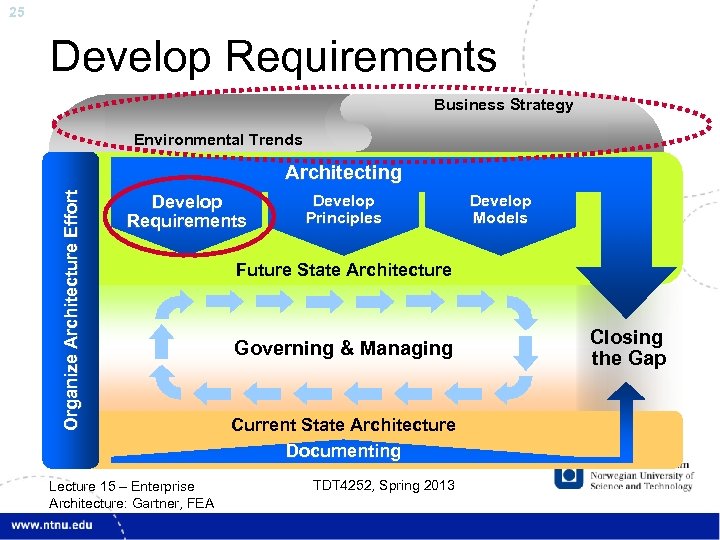 25 Develop Requirements Business Strategy Environmental Trends Organize Architecture Effort Architecting Develop Requirements Lecture 15 – Enterprise Architecture: Gartner, FEA Develop Principles Develop Models Future State Architecture Governing & Managing Current State Architecture Documenting TDT 4252, Spring 2013 Closing the Gap
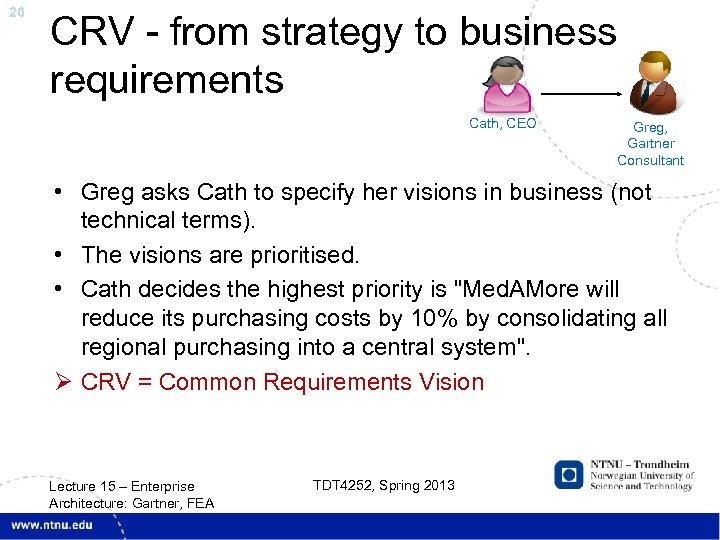 26 CRV - from strategy to business requirements Cath, CEO Greg, Gartner Consultant • Greg asks Cath to specify her visions in business (not technical terms). • The visions are prioritised. • Cath decides the highest priority is "Med. AMore will reduce its purchasing costs by 10% by consolidating all regional purchasing into a central system". Ø CRV = Common Requirements Vision Lecture 15 – Enterprise Architecture: Gartner, FEA TDT 4252, Spring 2013
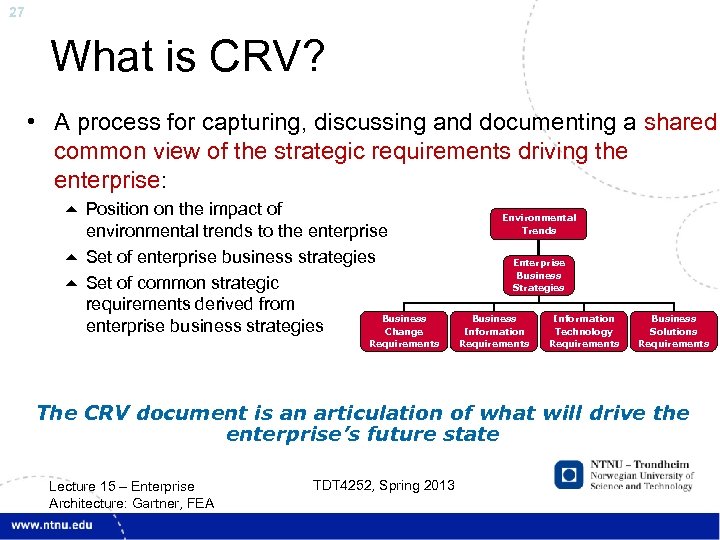 27 What is CRV? • A process for capturing, discussing and documenting a shared common view of the strategic requirements driving the enterprise: 5 Position on the impact of environmental trends to the enterprise 5 Set of enterprise business strategies 5 Set of common strategic requirements derived from Business enterprise business strategies Change Requirements Environmental Trends Enterprise Business Strategies Business Information Requirements Information Technology Requirements Business Solutions Requirements The CRV document is an articulation of what will drive the enterprise’s future state Lecture 15 – Enterprise Architecture: Gartner, FEA TDT 4252, Spring 2013
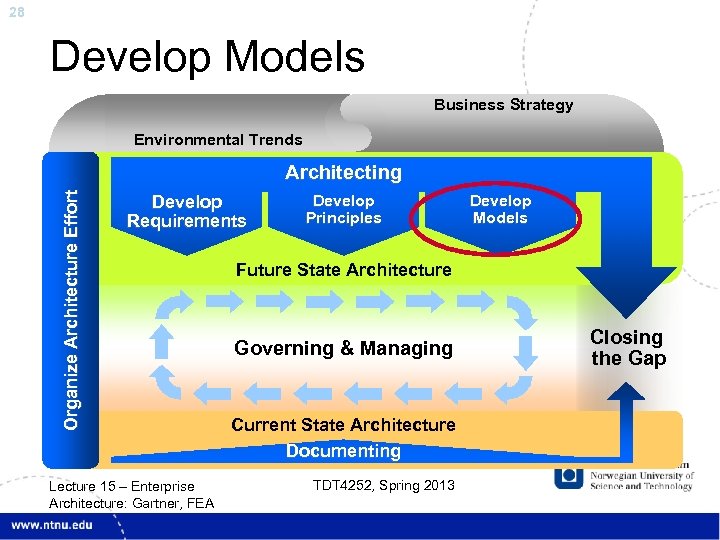 28 Develop Models Business Strategy Environmental Trends Organize Architecture Effort Architecting Develop Requirements Lecture 15 – Enterprise Architecture: Gartner, FEA Develop Principles Develop Models Future State Architecture Governing & Managing Current State Architecture Documenting TDT 4252, Spring 2013 Closing the Gap
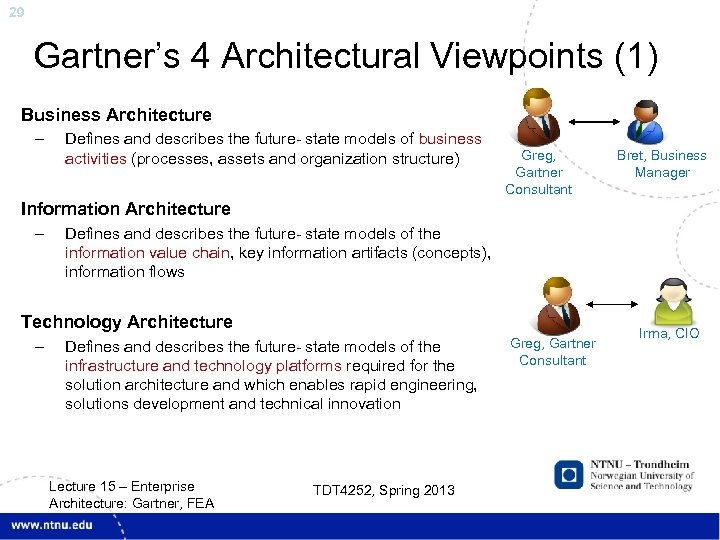 29 Gartner’s 4 Architectural Viewpoints (1) Business Architecture – Defines and describes the future- state models of business activities (processes, assets and organization structure) Greg, Gartner Consultant Bret, Business Manager Information Architecture – Defines and describes the future- state models of the information value chain, key information artifacts (concepts), information flows Technology Architecture – Defines and describes the future- state models of the infrastructure and technology platforms required for the solution architecture and which enables rapid engineering, solutions development and technical innovation Lecture 15 – Enterprise Architecture: Gartner, FEA TDT 4252, Spring 2013 Greg, Gartner Consultant Irma, CIO
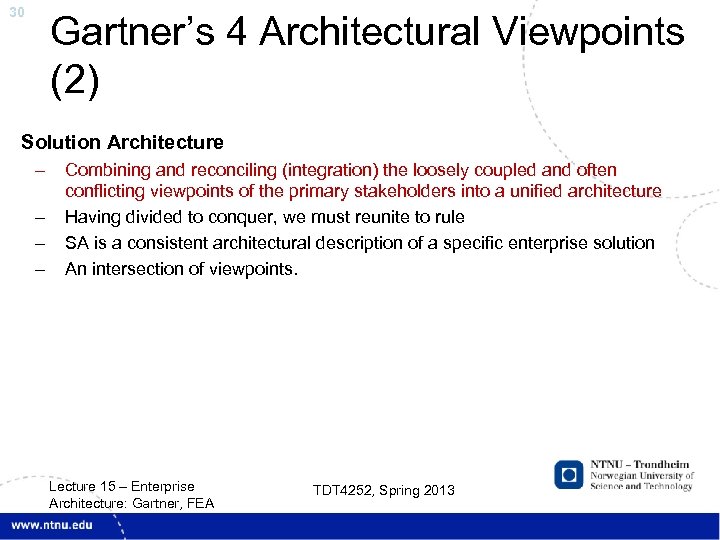 30 Gartner’s 4 Architectural Viewpoints (2) Solution Architecture – – Combining and reconciling (integration) the loosely coupled and often conflicting viewpoints of the primary stakeholders into a unified architecture Having divided to conquer, we must reunite to rule SA is a consistent architectural description of a specific enterprise solution An intersection of viewpoints. Lecture 15 – Enterprise Architecture: Gartner, FEA TDT 4252, Spring 2013
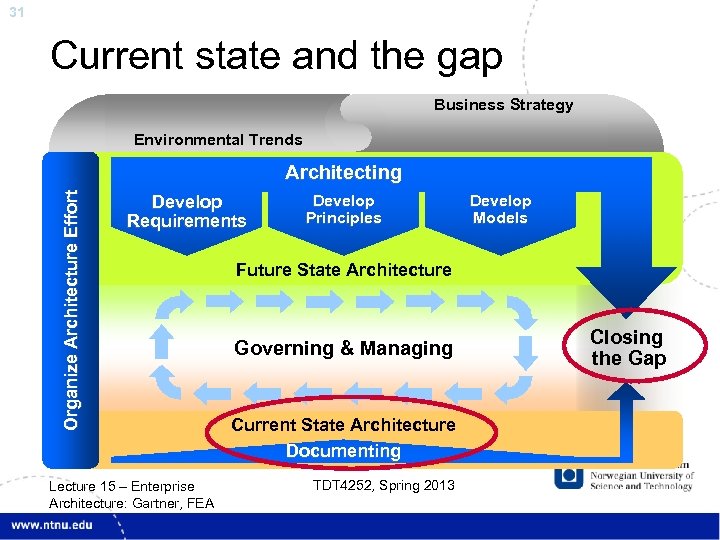 31 Current state and the gap Business Strategy Environmental Trends Organize Architecture Effort Architecting Develop Requirements Lecture 15 – Enterprise Architecture: Gartner, FEA Develop Principles Develop Models Future State Architecture Governing & Managing Current State Architecture Documenting TDT 4252, Spring 2013 Closing the Gap
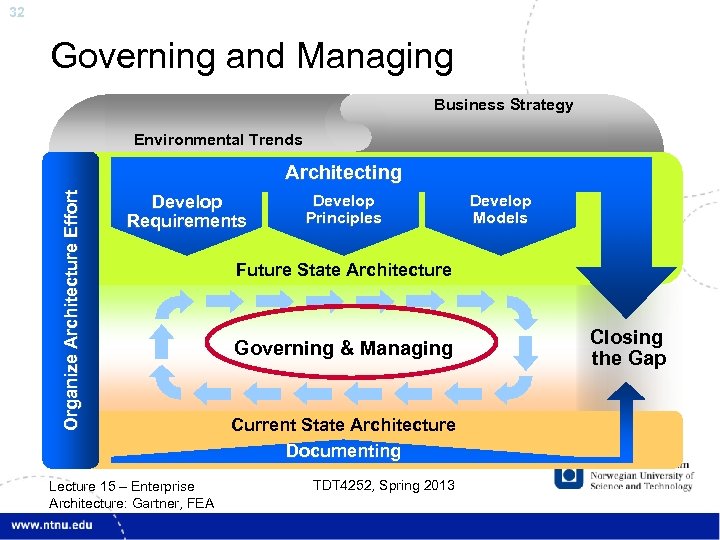 32 Governing and Managing Business Strategy Environmental Trends Organize Architecture Effort Architecting Develop Requirements Lecture 15 – Enterprise Architecture: Gartner, FEA Develop Principles Develop Models Future State Architecture Governing & Managing Current State Architecture Documenting TDT 4252, Spring 2013 Closing the Gap
 33 Gartner- benefits + Process completeness – the methodology fully guides you through a step-by-step process for creating EA. + Practical guidance. + Business focus. + Provides a methodology that can support governance. ÷ Does not provide a complete taxonomy. ÷ Not much information available about it. Lecture 15 – Enterprise Architecture: Gartner, FEA TDT 4252, Spring 2013
 34 What is FEAF? • FEAF (Federal Enterprise Architecture Framework) provides an organised structure and a collection of common terms by which Federal segments can integrate their respective architectures into the FEA (Federal Enterprise Architecture). • FEA is a strategic information asset base that defines the business, information necessary to operate the business, technology necessary to support the business operations and transitional processes for implementing new technologies in response to the changing needs of the business. Lecture 15 – Enterprise Architecture: Gartner, FEA TDT 4252, Spring 2013
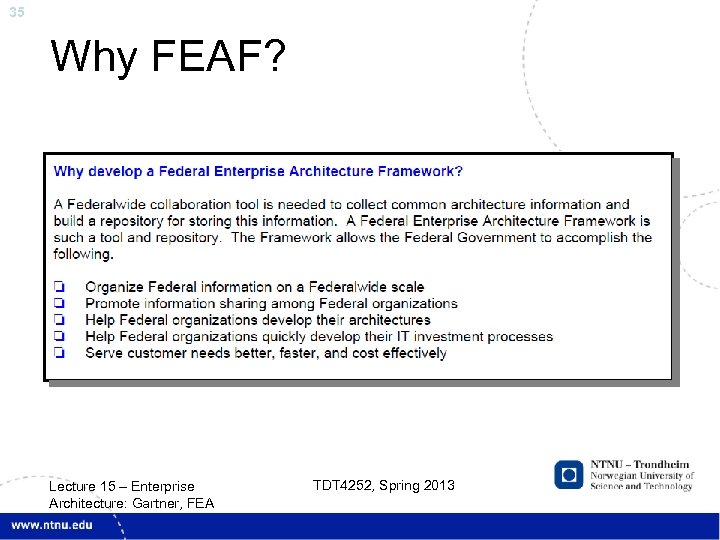 35 Why FEAF? Lecture 15 – Enterprise Architecture: Gartner, FEA TDT 4252, Spring 2013
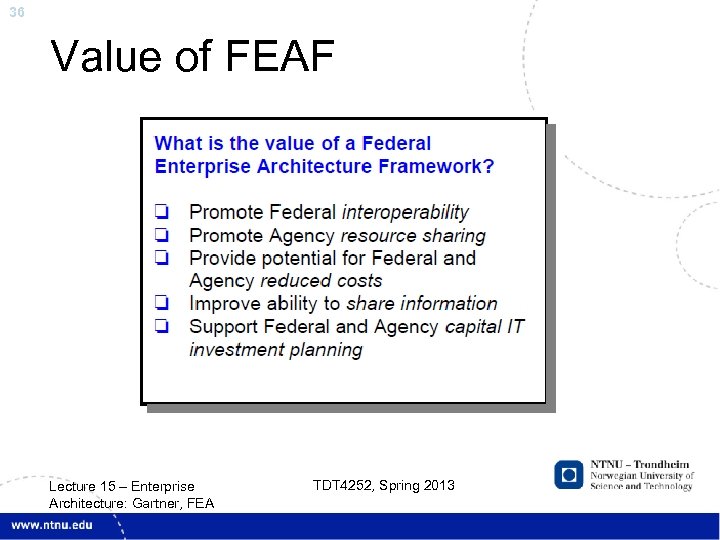 36 Value of FEAF Lecture 15 – Enterprise Architecture: Gartner, FEA TDT 4252, Spring 2013
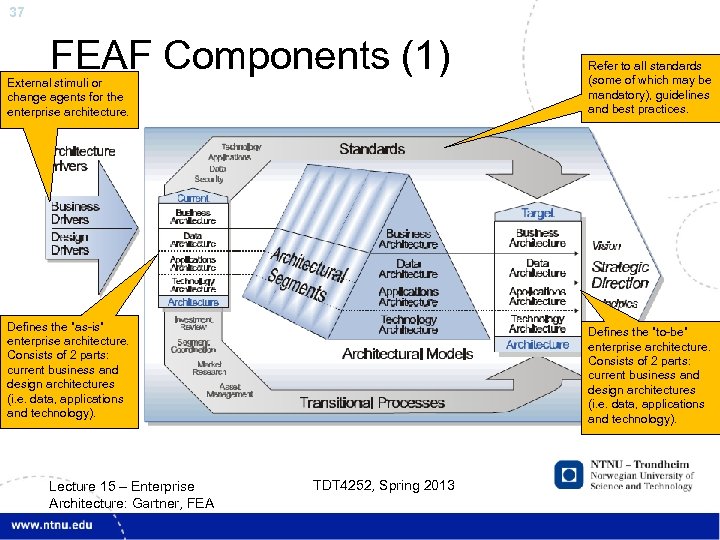 37 FEAF Components (1) External stimuli or change agents for the enterprise architecture. Refer to all standards (some of which may be mandatory), guidelines and best practices. Defines the ”as-is” enterprise architecture. Consists of 2 parts: current business and design architectures (i. e. data, applications and technology). Defines the ”to-be” enterprise architecture. Consists of 2 parts: current business and design architectures (i. e. data, applications and technology). Lecture 15 – Enterprise Architecture: Gartner, FEA TDT 4252, Spring 2013
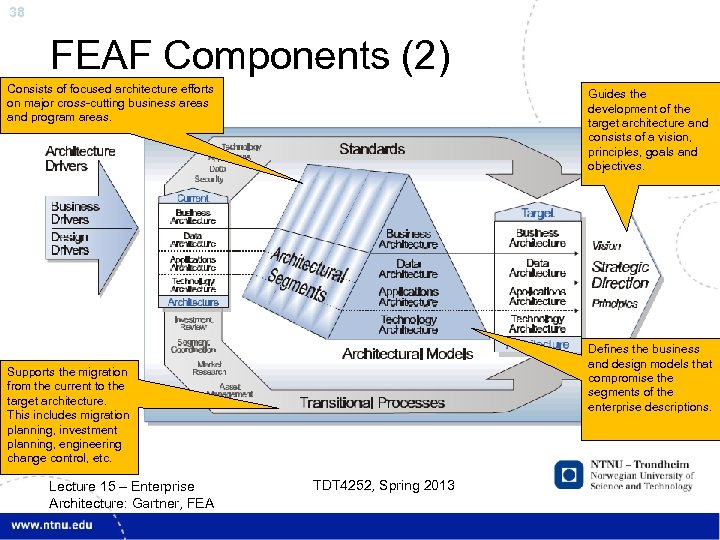 38 FEAF Components (2) Consists of focused architecture efforts on major cross-cutting business areas and program areas. Guides the development of the target architecture and consists of a vision, principles, goals and objectives. Defines the business and design models that compromise the segments of the enterprise descriptions. Supports the migration from the current to the target architecture. This includes migration planning, investment planning, engineering change control, etc. Lecture 15 – Enterprise Architecture: Gartner, FEA TDT 4252, Spring 2013
 39 FEAF - Segments • FEAF allows critical parts of the overall Federal Enterprise, called architectural segments, to be developed individually, while integrating these segments into the larger Enterprise Architecture. Lecture 15 – Enterprise Architecture: Gartner, FEA TDT 4252, Spring 2013
 40 FEA – Federal Enterprise Architecture • FEA is the latest attempt by the US federal government to unite its agencies and functions in a single common and ubiquitous enterprise architecture. • FEA is the most complete methodology. It has a: – A comprehensive taxonomy, like Zachman’s framework. – An architectural process, like TOGAF. • FEA can be viewed as either a methodology for creating an enterprise architecture or the result of applying that process to a particular enterprise. • FEA includes everything necessary for building an enterprise architecture. Lecture 15 – Enterprise Architecture: Gartner, FEA TDT 4252, Spring 2013
 41 FEA – Reference Models • The goal of the reference models is to provide standardised terms and definitions for the domain of enterprise architecture and thereby facilitate collaboration and sharing across the federal government. • It’s all about establishing a common language. • Collectively, the reference models comprise a framework for describing important elements of the FEA in a common and consistent way. Lecture 15 – Enterprise Architecture: Gartner, FEA TDT 4252, Spring 2013
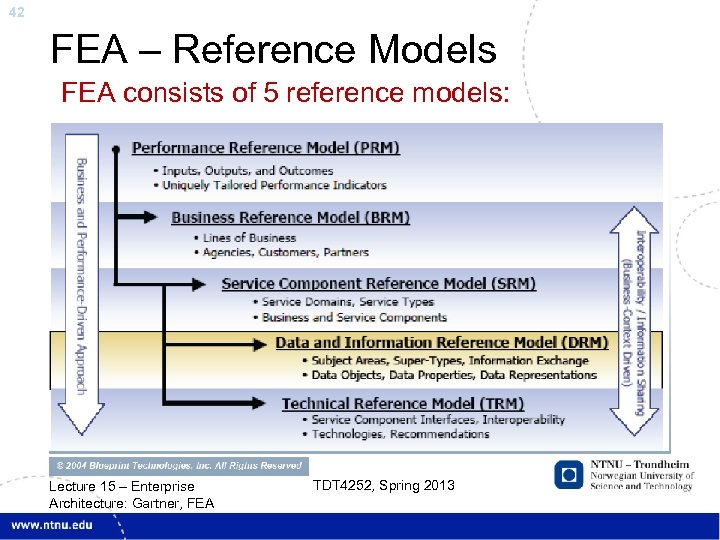 42 FEA – Reference Models FEA consists of 5 reference models: Lecture 15 – Enterprise Architecture: Gartner, FEA TDT 4252, Spring 2013
 43 FEA – Reference Models: descriptions • Business Reference Model (BRM): – Gives a business view of the various business functions. • Service Components Reference Model (CRM): – Gives a more IT view of systems that can support business functionality. • Technical Reference Model (TRM): – Defines the various technologies and standards that can be used in building ITsystems. • Data Reference Model (DRM): – Defines standard ways of describing data. • Performance Reference Model (PRM): – Defines standard ways of describing the value delivered by enterprise architecture. Lecture 15 – Enterprise Architecture: Gartner, FEA TDT 4252, Spring 2013
 44 FEA – Segment architecture approach • FEA perspective on EA: an enterprise is built of segments. • A segment is a major line-of-business functionality, such as human resources. • Although segments function at the political level (the agency), they are defined at the enterprise level (government). • Segments are defined globally to facilitate reuse across the different enterrpises. Lecture 15 – Enterprise Architecture: Gartner, FEA TDT 4252, Spring 2013
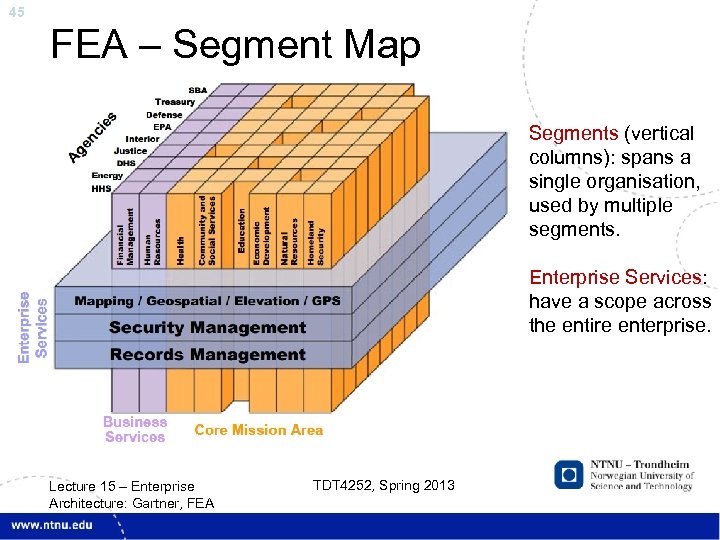 45 FEA – Segment Map Segments (vertical columns): spans a single organisation, used by multiple segments. Enterprise Services: have a scope across the entire enterprise. Lecture 15 – Enterprise Architecture: Gartner, FEA TDT 4252, Spring 2013
 46 FEA Process (1) • FEA Process is primarily focussed on creating a segment architecture for a subset of the overall enterprise. • Segment architecture development process: – – Step 1: Architectural analysis. Step 2: Architectural definition. Step 3: Investment and funding strategy. Step 4: Program management plan and execute projects. Lecture 15 – Enterprise Architecture: Gartner, FEA TDT 4252, Spring 2013
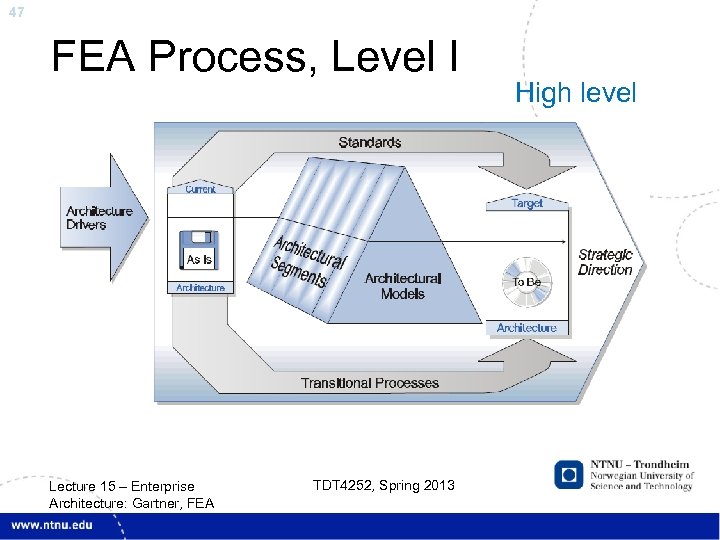 47 FEA Process, Level I Lecture 15 – Enterprise Architecture: Gartner, FEA TDT 4252, Spring 2013 High level
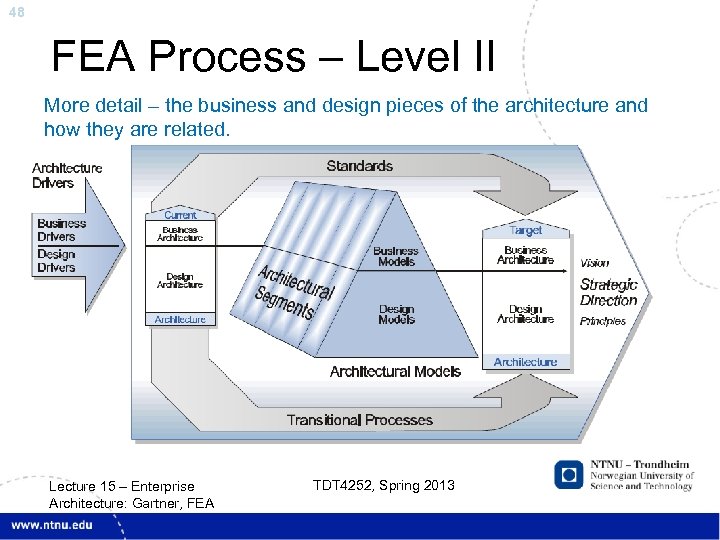 48 FEA Process – Level II More detail – the business and design pieces of the architecture and how they are related. Lecture 15 – Enterprise Architecture: Gartner, FEA TDT 4252, Spring 2013
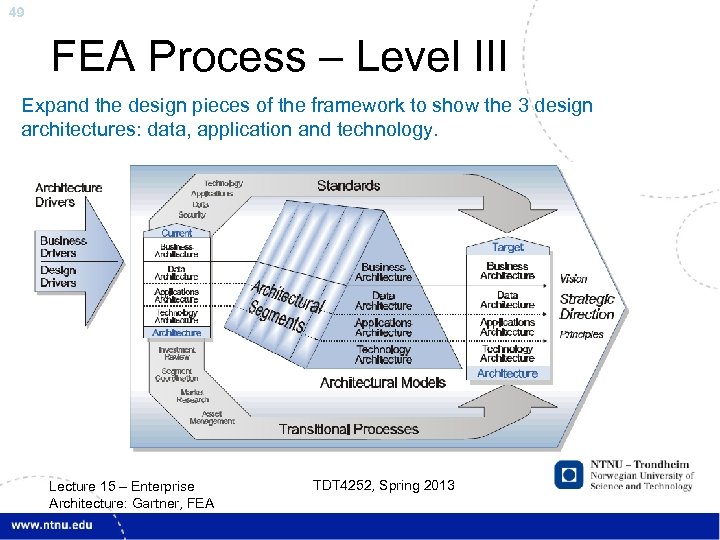 49 FEA Process – Level III Expand the design pieces of the framework to show the 3 design architectures: data, application and technology. Lecture 15 – Enterprise Architecture: Gartner, FEA TDT 4252, Spring 2013
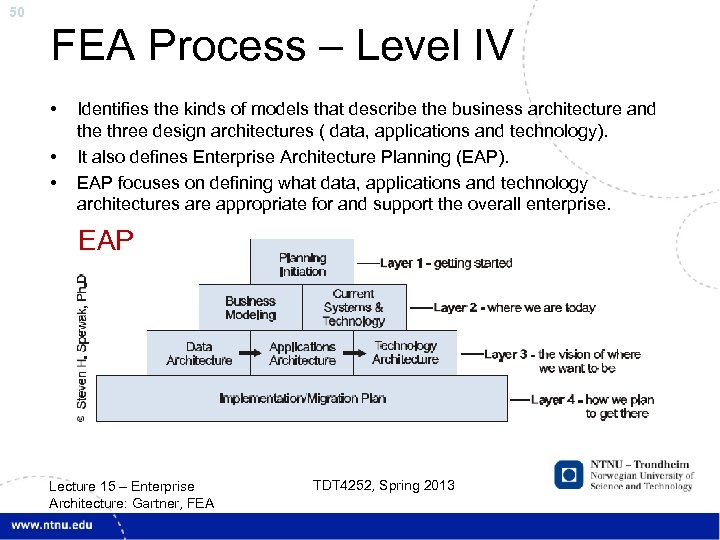 50 FEA Process – Level IV • • • Identifies the kinds of models that describe the business architecture and the three design architectures ( data, applications and technology). It also defines Enterprise Architecture Planning (EAP). EAP focuses on defining what data, applications and technology architectures are appropriate for and support the overall enterprise. EAP Lecture 15 – Enterprise Architecture: Gartner, FEA TDT 4252, Spring 2013
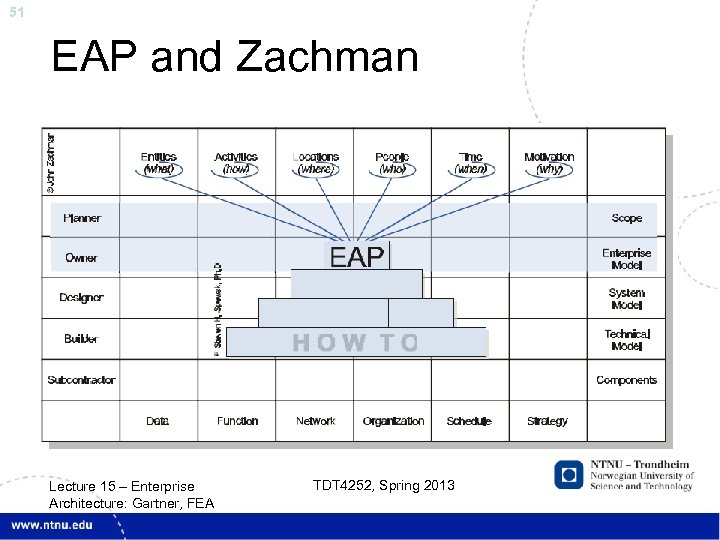 51 EAP and Zachman Lecture 15 – Enterprise Architecture: Gartner, FEA TDT 4252, Spring 2013
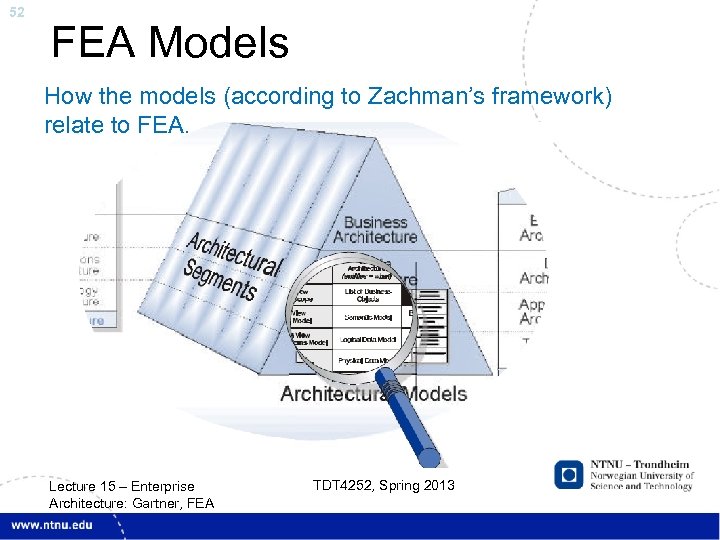 52 FEA Models How the models (according to Zachman’s framework) relate to FEA. Lecture 15 – Enterprise Architecture: Gartner, FEA TDT 4252, Spring 2013
 53 Discussion and example case • FEA and FEAF were originally designed for the federal US government. • Can FEA be applied to private enterprises? Cath, CEO Lecture 15 – Enterprise Architecture: Gartner, FEA Fred, FEA Consultant TDT 4252, Spring 2013
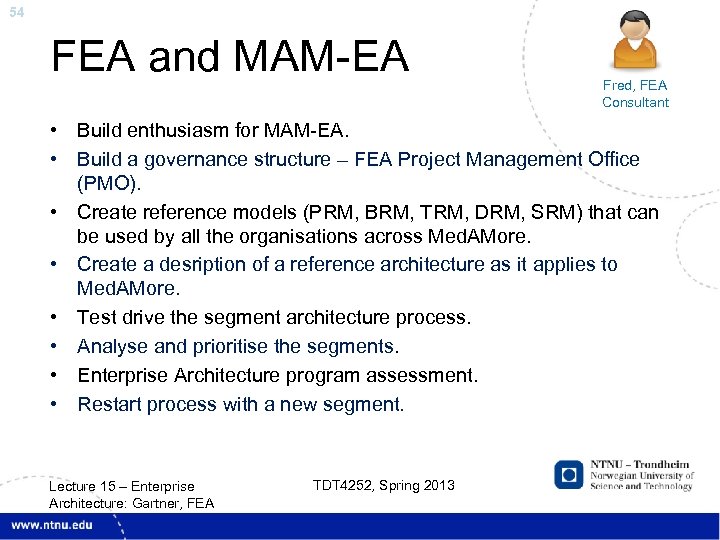 54 FEA and MAM-EA Fred, FEA Consultant • Build enthusiasm for MAM-EA. • Build a governance structure – FEA Project Management Office (PMO). • Create reference models (PRM, BRM, TRM, DRM, SRM) that can be used by all the organisations across Med. AMore. • Create a desription of a reference architecture as it applies to Med. AMore. • Test drive the segment architecture process. • Analyse and prioritise the segments. • Enterprise Architecture program assessment. • Restart process with a new segment. Lecture 15 – Enterprise Architecture: Gartner, FEA TDT 4252, Spring 2013
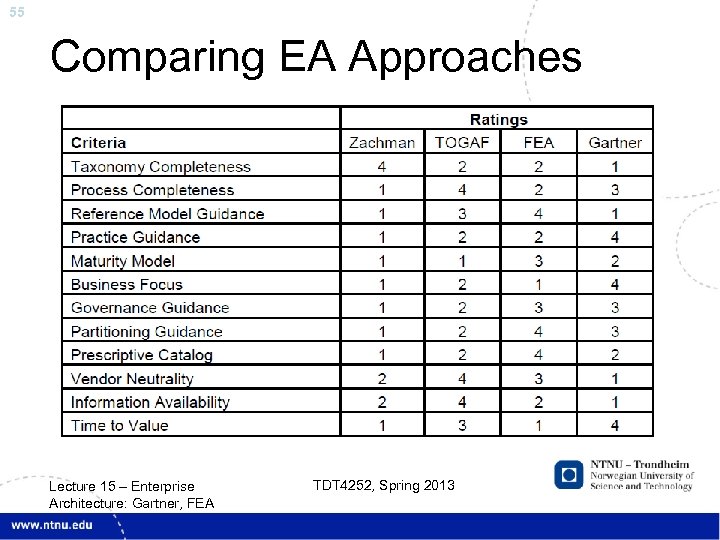 55 Comparing EA Approaches Lecture 15 – Enterprise Architecture: Gartner, FEA TDT 4252, Spring 2013
 56 How can we choose an EA methodology? • Go through the criteria for comparing and evaluating EA methodologies, that are important for your organisation. • Rate the methodologies. Ø What you may find out is that you need a blended approach, in which you create your own enterprise architecture, taking parts of different methodologies that provide the highest value for your specific needs. Lecture 15 – Enterprise Architecture: Gartner, FEA TDT 4252, Spring 2013
 57 x Discussions x • Several different EA Methodologies, quite different from one another. • Some of the methodologies complement one another, e. g. Zachman framework provides a taxonomy while TOGAF provides a process. • Enterprise architecture is a path, not a destination. • Main goal: to bring alignment to the business side and the technology side. Lecture 15 – Enterprise Architecture: Gartner, FEA TDT 4252, Spring 2013
 58 Summary • We have looked at several Enterprise Architecture methodologies: Zachman, TOGAF, Gartner and FEA. • We have compared them by using a case study. • Can we see similarities and differences between EA and Enterprise Modelling as we have discussed in this course? Lecture 15 – Enterprise Architecture: Gartner, FEA TDT 4252, Spring 2013
 59 What next? • Summary Lecture? Lecture 15 – Enterprise Architecture: Gartner, FEA TDT 4252, Spring 2013