 Скачать презентацию 1 Submerged Object Detection with Indirect Passive Sonar
56b08d4979b9b56fdf3e5e99cc870015.ppt
- Количество слайдов: 25



1 Submerged Object Detection with Indirect Passive Sonar Joseph R. Edwards†, Monica Montanari†, Don L. J. Chiat‡, I. N. Goh‡, Justin A. Nave† and Henrik Schmidt# †VASA Associates, Inc. , 8300 Greensboro Dr. , Suite 800, Mc. Lean, VA 22102 USA ‡Singapore Defence Science and Technology Agency #MIT Department of Mechanical Engineering, Cambridge, MA 02139 USA Dec. 13, 2005
2 Outline of Presentation I. Significance of Port Security in Singapore. II. The Threat Posed by Small Submersibles. III. Vulnerability to Undersea Intrusion. IV. Indirect Passive Sonar ( In. Pa. S) for Port Security. V. In. Pa. S Performance Analysis. VI. Role of acoustic propagation modeling. VII. Concluding remarks. Dec. 13, 2005
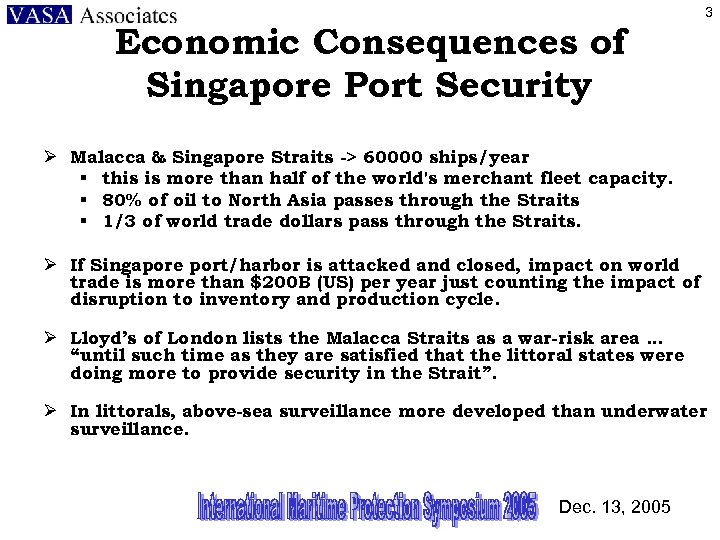
3 Economic Consequences of Singapore Port Security Ø Malacca & Singapore Straits -> 60000 ships/year § this is more than half of the world's merchant fleet capacity. § 80% of oil to North Asia passes through the Straits § 1/3 of world trade dollars pass through the Straits. Ø If Singapore port/harbor is attacked and closed, impact on world trade is more than $200 B (US) per year just counting the impact of disruption to inventory and production cycle. Ø Lloyd’s of London lists the Malacca Straits as a war-risk area … “until such time as they are satisfied that the littoral states were doing more to provide security in the Strait”. Ø In littorals, above-sea surveillance more developed than underwater surveillance. Dec. 13, 2005
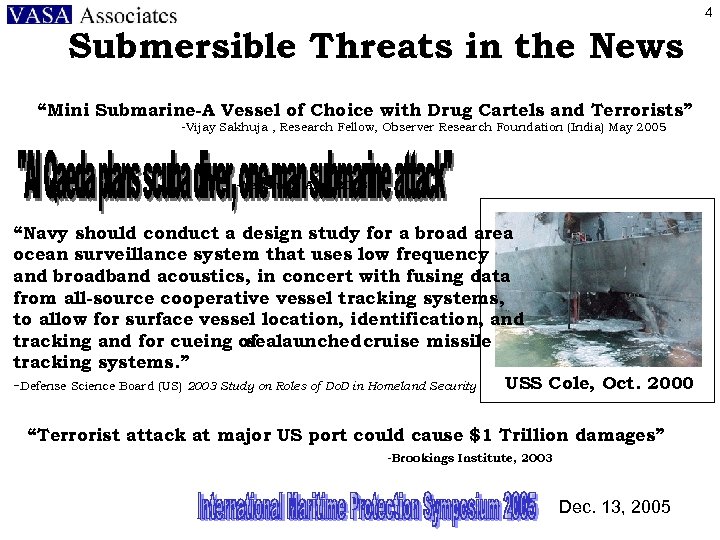
4 Submersible Threats in the News “Mini Submarine-A Vessel of Choice with Drug Cartels and Terrorists” -Vijay Sakhuja , Research Fellow, Observer Research Foundation (India) May 2005 -Newsmax, Aug. 2003 “Navy should conduct a design study for a broad area ocean surveillance system that uses low frequency and broadband acoustics, in concert with fusing data from all-source cooperative vessel tracking systems, to allow for surface vessel location, identification, and tracking and for cueing of sealaunched cruise missile tracking systems. ” USS Cole, Oct. 2000 -Defense Science Board (US) 2003 Study on Roles of Do. D in Homeland Security “Terrorist attack at major US port could cause $1 Trillion damages” -Brookings Institute, 2003 Dec. 13, 2005
5 U. S. National Strategy for Maritime Security Needs for Maximizing Domain Awareness: üSensor technology, human intelligence collection, and information processing tools to persistently monitor the maritime domain; üShared situational awareness to disseminate information to users at all levels; üAutomated tools to improve data fusion, analysis, and management in order to systematically track large quantities of data, and to detect, fuse, and analyze aberrant patterns of activity – consistent with the information privacy and other legal rights of Americans; and üIn order to advance to the next level of threat detection, transformational research and development programs in information fusion and analysis – these programs will develop the next qualitative level of capability for detection threats. Dec. 13, 2005
6 Undersea infiltration is a major maritime security challenge. . . Ferriere D. , Pysareva K. and Rucinski A. “Using Technology to Bridge Maritime Security Gaps”. , , , Sea Technology Magazine, August 2005 2. 5. Underwater Sabotage of a Port Facility - The challenge for the technologist is to protect the port infrastructure by identifying counter-technologies to combat possible attacks by underwater divers and remotely operated underwater vehicles without adversely impacting a port’s capability to openly and freely accommodate maritime commerce. …that is best addressed with networked multi-modal sensors. In San Diego, for example, the Navy’s radar network, the San Diego Port Authority’s video surveillance system, Customs and Border Protection’s border surveillance sensors, and the Coast Guard’s extensive radio network are all combined in one center…. Multi-agency centers such as the one in San Diego are prototypes for the kind of integration, coordination and cooperation between agencies and maritime authorities that we want to create to support all of our strategic ports. - Deputy Secretary of Homeland Security James Loy at the Maritime and Port Security Summit Washington, D. C. November 16, 2004 Dec. 13, 2005
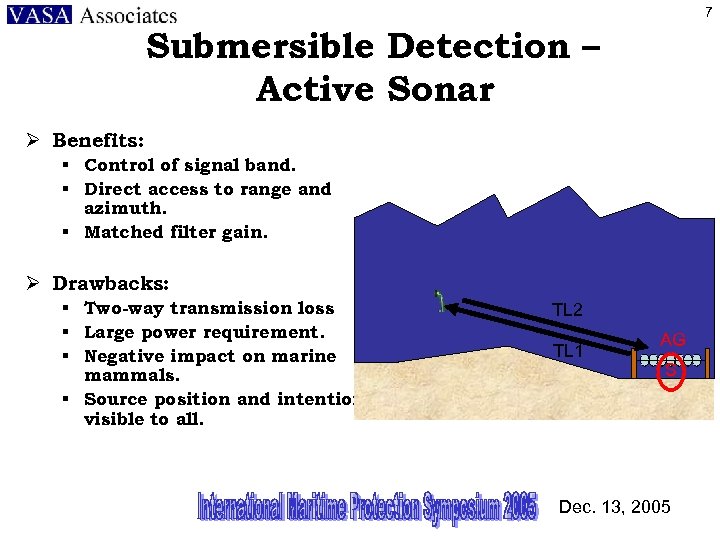
7 Submersible Detection – Active Sonar Ø Benefits: § Control of signal band. § Direct access to range and azimuth. § Matched filter gain. Ø Drawbacks: § Two-way transmission loss § Large power requirement. § Negative impact on marine mammals. § Source position and intention visible to all. TL TL 2 TL 1 S AG AG S Dec. 13, 2005
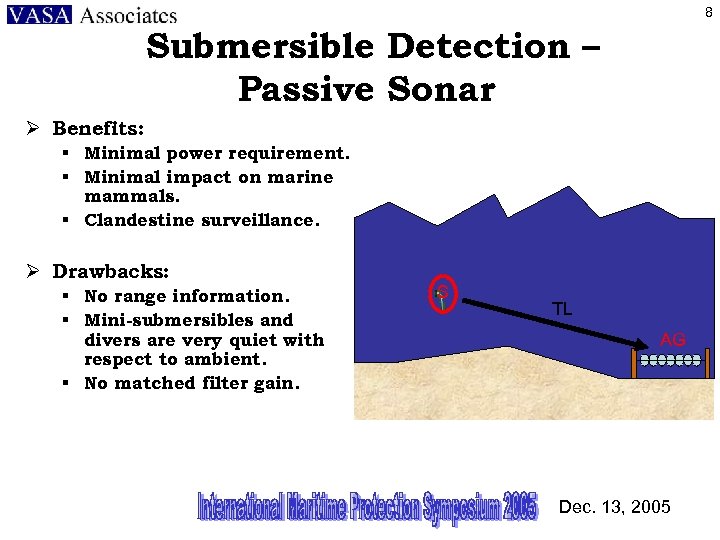
8 Submersible Detection – Passive Sonar Ø Benefits: § Minimal power requirement. § Minimal impact on marine mammals. § Clandestine surveillance. Ø Drawbacks: § No range information. § Mini-submersibles and divers are very quiet with respect to ambient. § No matched filter gain. S TL AG Dec. 13, 2005
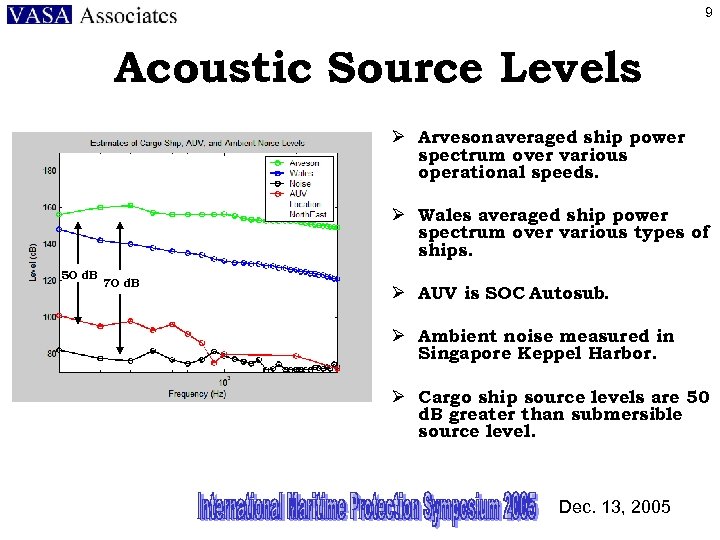
9 Acoustic Source Levels Ø Arveson averaged ship power spectrum over various operational speeds. Ø Wales averaged ship power spectrum over various types of ships. 50 d. B 70 d. B Ø AUV is SOC Autosub. Ø Ambient noise measured in Singapore Keppel Harbor. Ø Cargo ship source levels are 50 d. B greater than submersible source level. Dec. 13, 2005
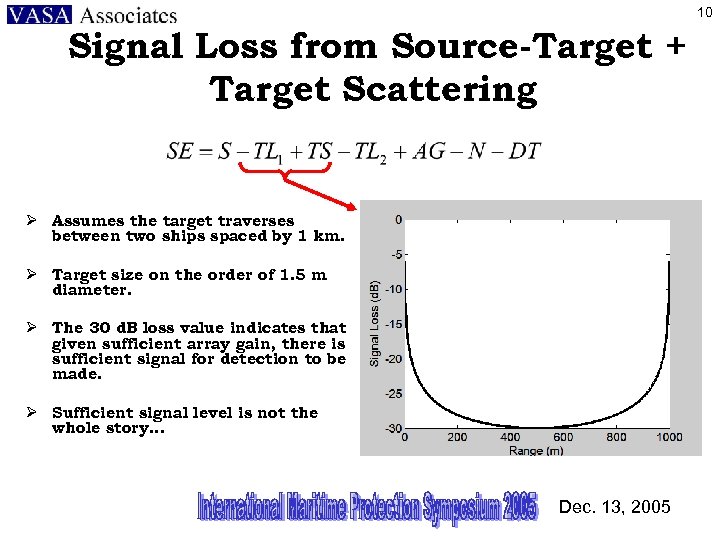
10 Signal Loss from Source-Target + Target Scattering Ø Assumes the target traverses between two ships spaced by 1 km. Ø Target size on the order of 1. 5 m diameter. Ø The 30 d. B loss value indicates that given sufficient array gain, there is sufficient signal for detection to be made. Ø Sufficient signal level is not the whole story… Dec. 13, 2005
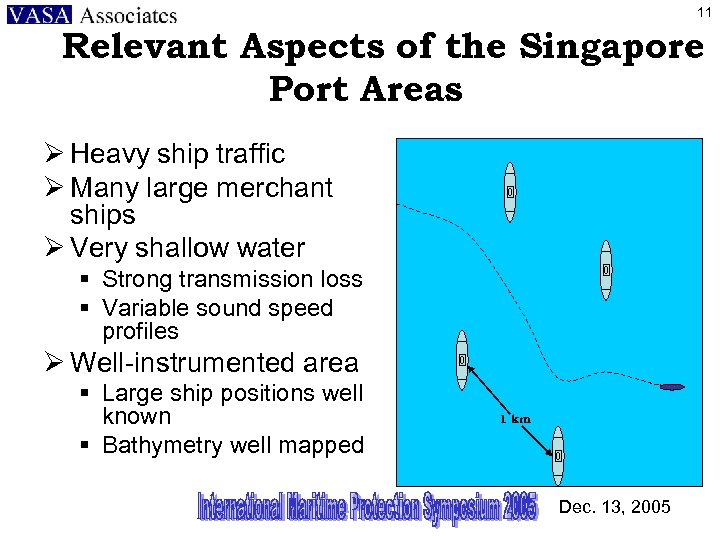
11 Relevant Aspects of the Singapore Port Areas Ø Heavy ship traffic Ø Many large merchant ships Ø Very shallow water § Strong transmission loss § Variable sound speed profiles Ø Well-instrumented area § Large ship positions well known § Bathymetry well mapped 1 km Dec. 13, 2005
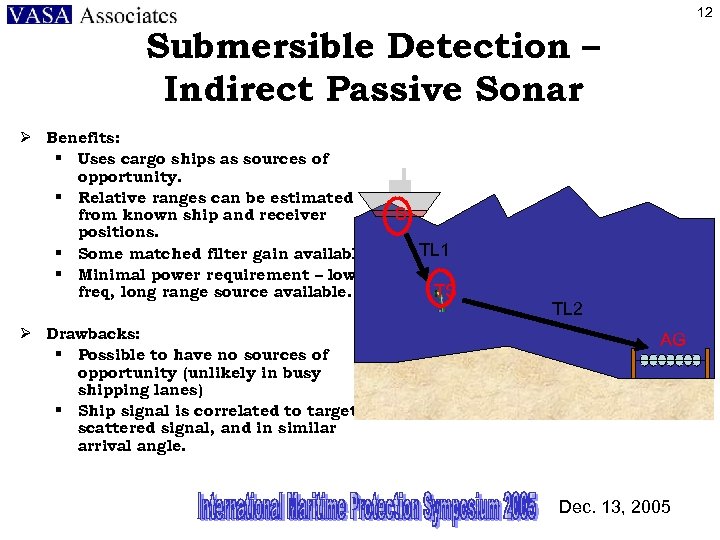
12 Submersible Detection – Indirect Passive Sonar Ø Benefits: § Uses cargo ships as sources of opportunity. § Relative ranges can be estimated from known ship and receiver positions. § Some matched filter gain available. § Minimal power requirement – low freq, long range source available. Ø Drawbacks: § Possible to have no sources of opportunity (unlikely in busy shipping lanes) § Ship signal is correlated to target scattered signal, and in similar arrival angle. S TL 1 TS TL 2 AG Dec. 13, 2005
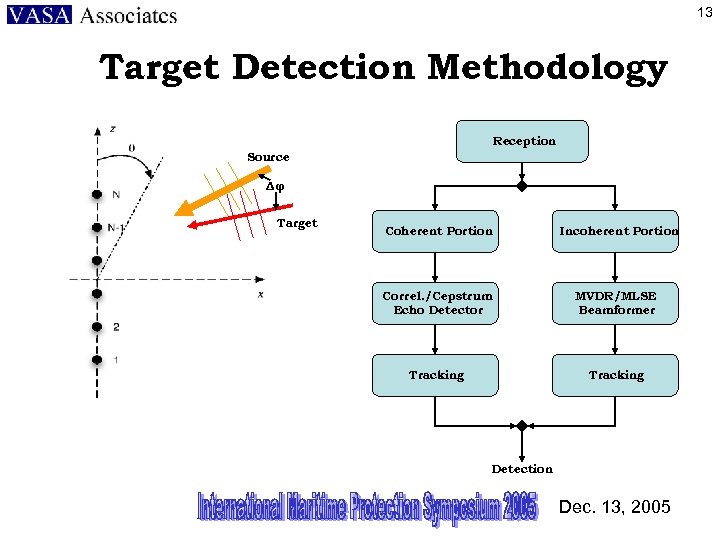
13 Target Detection Methodology Reception Source Δφ Target Coherent Portion Incoherent Portion Correl. /Cepstrum Echo Detector MVDR/MLSE Beamformer Tracking Detection Dec. 13, 2005
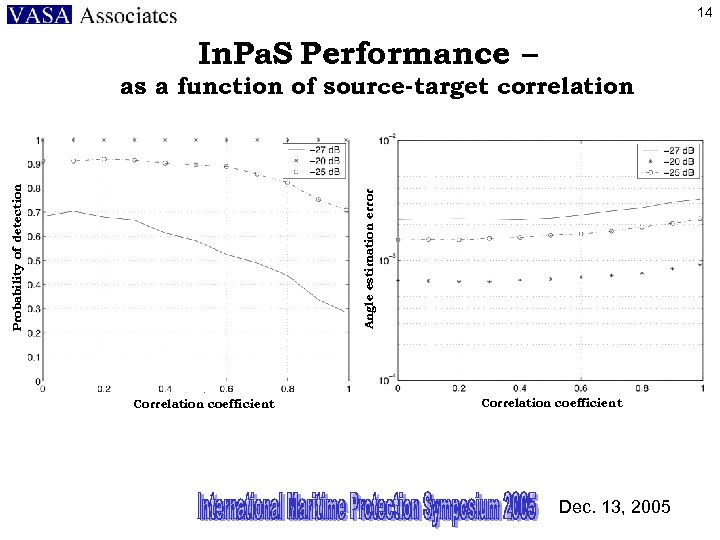
14 In. Pa. S Performance – Angle estimation error Probability of detection as a function of source-target correlation Correlation coefficient Dec. 13, 2005
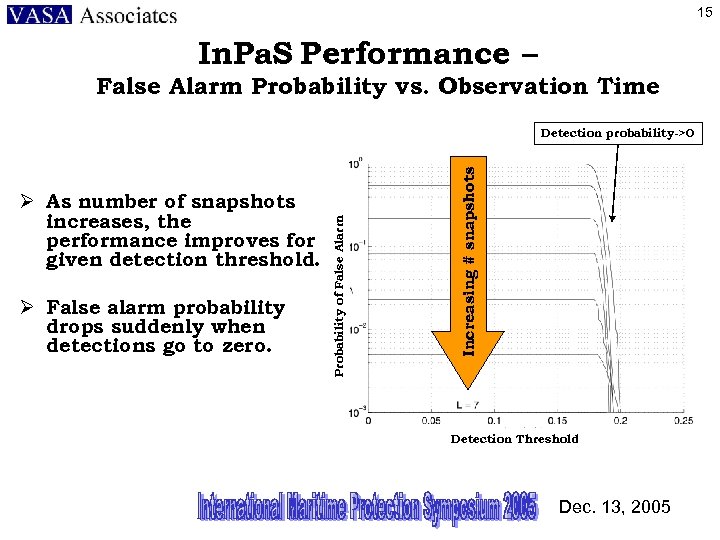
15 In. Pa. S Performance – False Alarm Probability vs. Observation Time Ø False alarm probability drops suddenly when detections go to zero. Increasing # snapshots Ø As number of snapshots increases, the performance improves for given detection threshold. Probability of False Alarm Detection probability->0 Detection Threshold Dec. 13, 2005
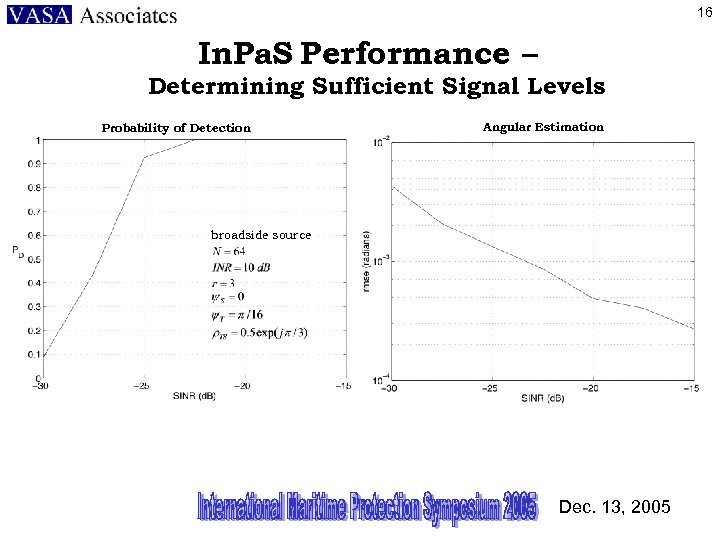
16 In. Pa. S Performance – Determining Sufficient Signal Levels Probability of Detection Angular Estimation broadside source Dec. 13, 2005
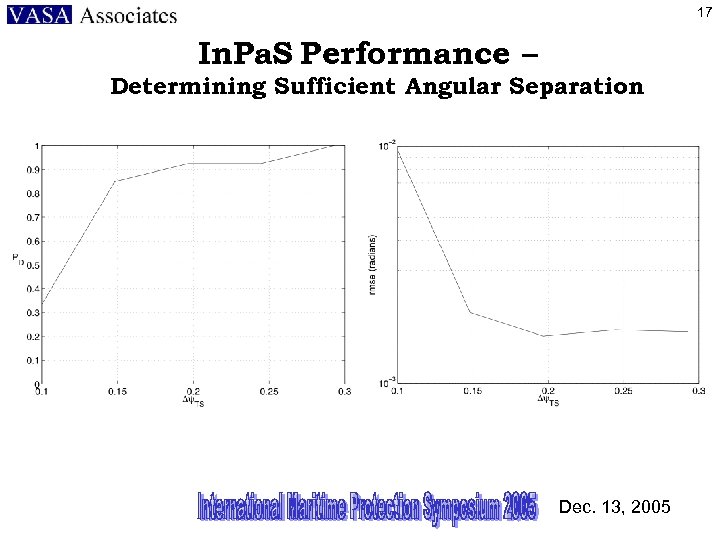
17 In. Pa. S Performance – Determining Sufficient Angular Separation Dec. 13, 2005
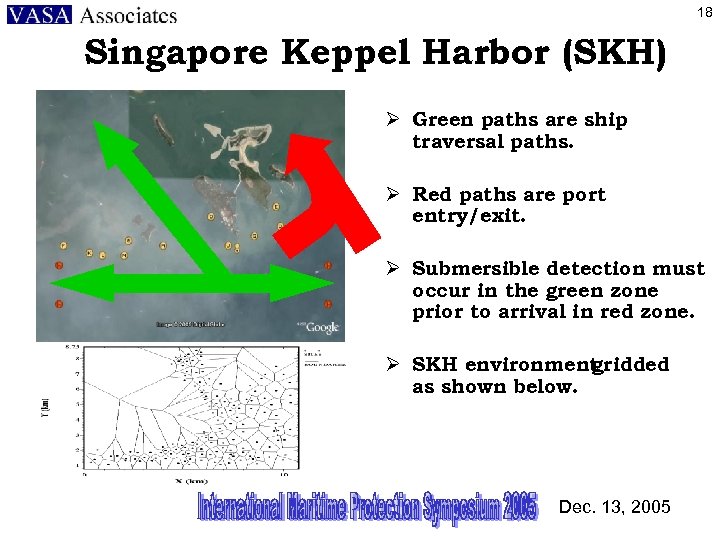
18 Singapore Keppel Harbor (SKH) Ø Green paths are ship traversal paths. Ø Red paths are port entry/exit. Ø Submersible detection must occur in the green zone prior to arrival in red zone. Ø SKH environment gridded as shown below. Dec. 13, 2005
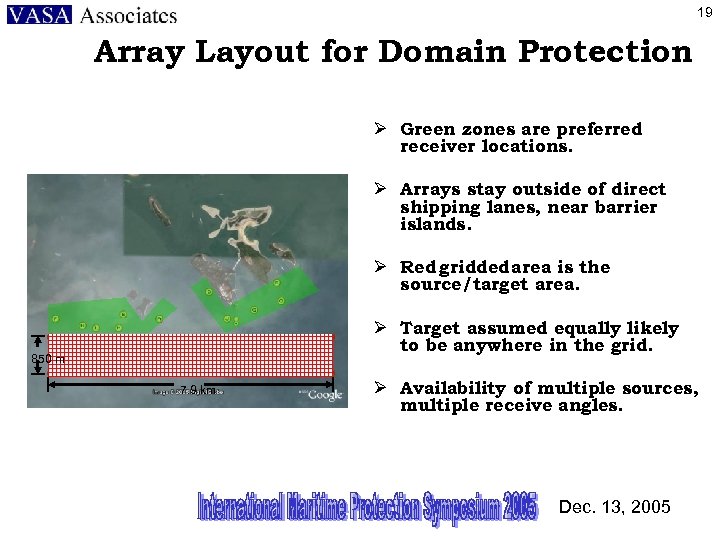
19 Array Layout for Domain Protection Ø Green zones are preferred receiver locations. Ø Arrays stay outside of direct shipping lanes, near barrier islands. Ø Red gridded area is the source/target area. Ø Target assumed equally likely to be anywhere in the grid. 850 m 7. 9 km Ø Availability of multiple sources, multiple receive angles. Dec. 13, 2005
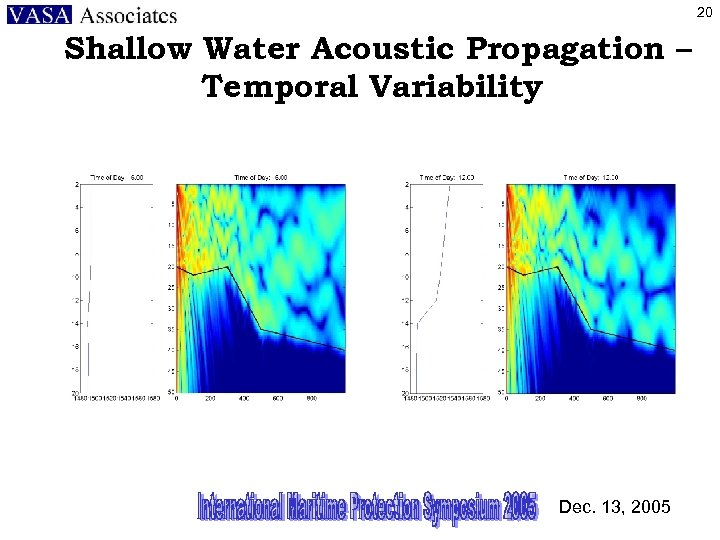
20 Shallow Water Acoustic Propagation – Temporal Variability Dec. 13, 2005
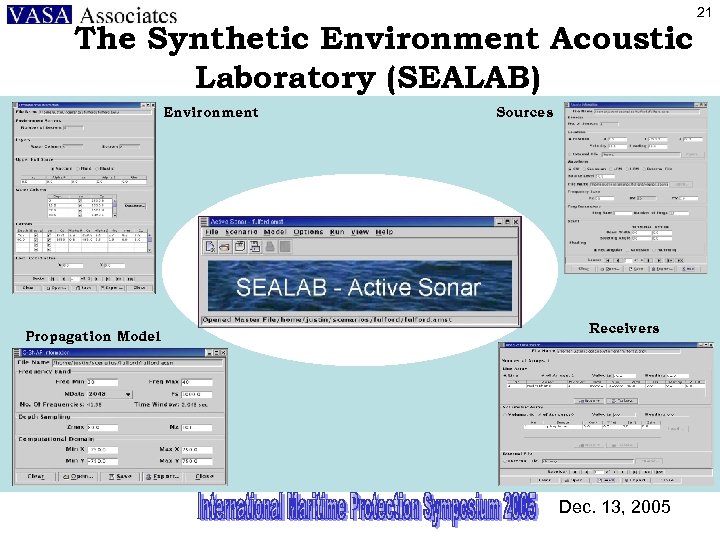
The Synthetic Environment Acoustic Laboratory (SEALAB) Environment Propagation Model Sources Receivers Dec. 13, 2005 21
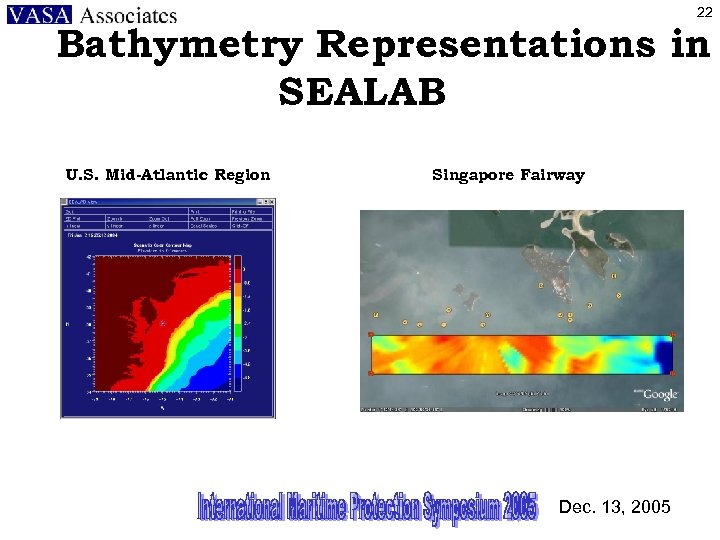
22 Bathymetry Representations in SEALAB U. S. Mid-Atlantic Region Singapore Fairway Dec. 13, 2005
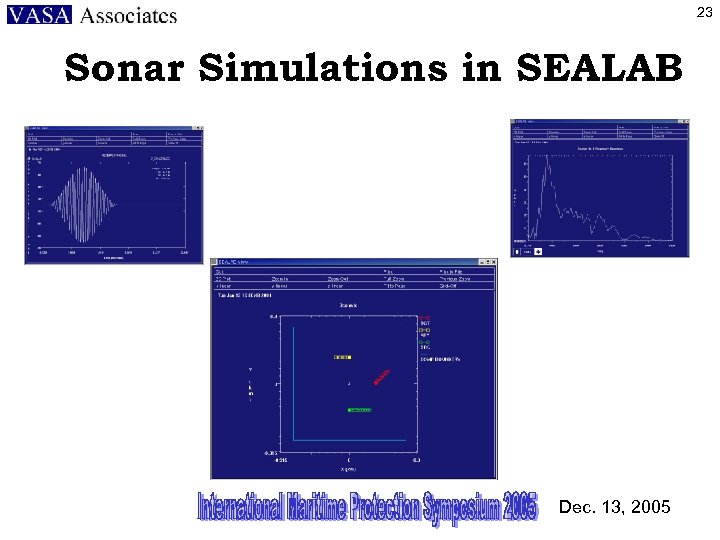
23 Sonar Simulations in SEALAB Dec. 13, 2005
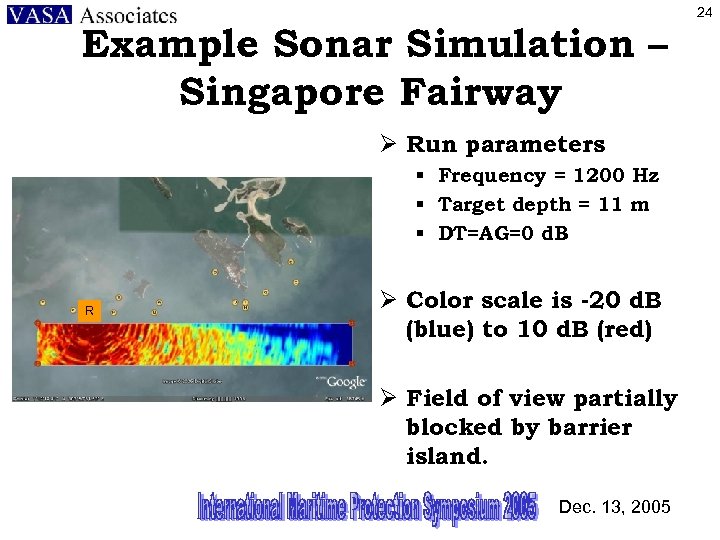
Example Sonar Simulation – Singapore Fairway Ø Run parameters § Frequency = 1200 Hz § Target depth = 11 m § DT=AG=0 d. B R Ø Color scale is -20 d. B (blue) to 10 d. B (red) Ø Field of view partially blocked by barrier island. Dec. 13, 2005 24
25 Conclusions Ø Undersea access methods to ports of call present a significant security challenge. Ø Unique situation of the Singapore waterways (dense ship traffic, shallow water, well-instrumented area with “Eye in the Sky”) enables cargo ships to be exploited as acoustic sources of opportunity. Ø In. Pa. S can be used in conjunction with additional sensor modalities to detect threats entering the harbor. Ø Pre-deployed fixed arrays can be placed for full area, full-time coverage of a desired waterway. Dec. 13, 2005
Скачать презентацию 1 Submerged Object Detection with Indirect Passive Sonar
56b08d4979b9b56fdf3e5e99cc870015.ppt