


 Скачать презентацию 1 Starting Soon Groundwater Statistics for Environmental Project
d2bad99764df1e064fb6e78df49e3a0f.ppt
- Количество слайдов: 92
 1 Starting Soon: Groundwater Statistics for Environmental Project Managers Technical and Regulatory Web-based Guidance on Groundwater Statistics and Monitoring Compliance (GSMC-1, 2013) at http: //www. itrcweb. org/gsmc-1/ Download Power. Point file • Clu-in training page at http: //www. clu-in. org/conf/itrc/gsmc/ • Under “Download Training Materials” Using Adobe Connect • Related Links (on right) § Select name of link § Click “Browse To” • Full Screen button near top of page Follow ITRC
 2 Welcome – Thanks for joining this ITRC Training Class Groundwater Statistics for Environmental Project Managers Groundwater Statistics and Monitoring Compliance (GSMC) Technical and Regulatory Guidance Web-Based Document (GSMC-1) Sponsored by: Interstate Technology and Regulatory Council (www. itrcweb. org) Hosted by: US EPA Clean Up Information Network (www. cluin. org)
 3 Housekeeping Course time is 2¼ hours This event is being recorded Trainers control slides • Want to control your own slides? You can download presentation file on Clu-in training page Questions and feedback • Throughout training: type in the “Q & A” box • At Q&A breaks: unmute your phone with #6 to ask out loud • At end of class: Feedback form available from last slide § Need confirmation of your participation today? Fill out the feedback form and check box for confirmation email and certificate Copyright 2017 Interstate Technology & Regulatory Council, 50 F Street, NW, Suite 350, Washington, DC 20001
 4 ITRC (www. itrcweb. org) – Shaping the Future of Regulatory Acceptance Host organization Network • State regulators Disclaimer • Full version in “Notes” section • Partially funded by the U. S. government § All 50 states, PR, DC § ITRC nor US government • Federal partners warranty material § ITRC nor US government DOE DOD • ITRC Industry Affiliates Program • Academia • Community stakeholders Follow ITRC endorse specific products EPA ITRC materials available for your use – see usage policy Available from www. itrcweb. org • Technical and regulatory guidance documents • Online and classroom training schedule • More…
 5 Meet the ITRC Trainers Harold Templin Lizanne Simmons Indiana Department of Environmental Management Indianapolis, IN 317 -232 -8711 htemplin@idem. IN. gov Kleinfelder, Inc. San Diego, CA 858 -320 -2267 Lsimmons @kleinfelder. com Chris Stubbs Ramboll Environ Emeryville, CA 510 -420 -2552 cstubbs @ramboll. com Randall Ryti Neptune and Company Los Alamos, NM 505 -662 -0500 rryti@neptuneinc. org
 6 Are You Drowning in Groundwater Data From Your Sites? What data should you use? Where do you start? What are the data telling you? How do you make the best use of your data?
 7 Can a Statistical Approach Help to Manage My Groundwater Data? If you are not a statistician • More informed consumer of statistics • Confidence to spot misapplications and mistakes • Review selection of tests • Understand language of statistics If you are a statistician • Help make your work and conclusions understandable to a general audience ITRC GSMC, Section 1
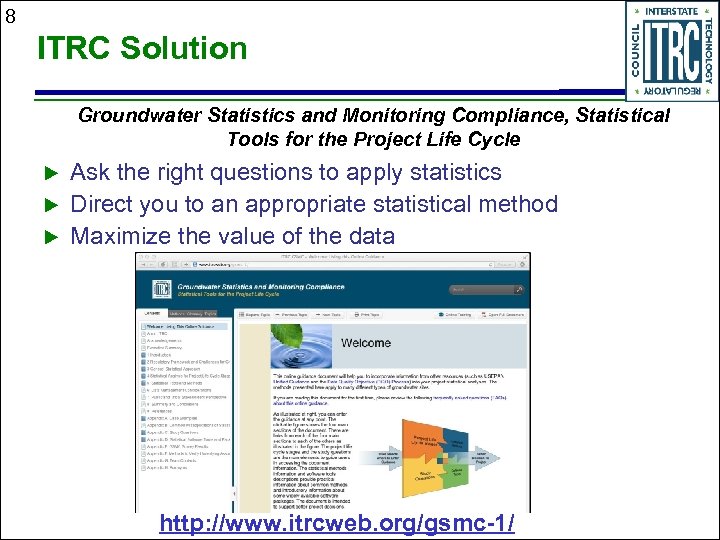 8 ITRC Solution Groundwater Statistics and Monitoring Compliance, Statistical Tools for the Project Life Cycle Ask the right questions to apply statistics Direct you to an appropriate statistical method Maximize the value of the data http: //www. itrcweb. org/gsmc-1/
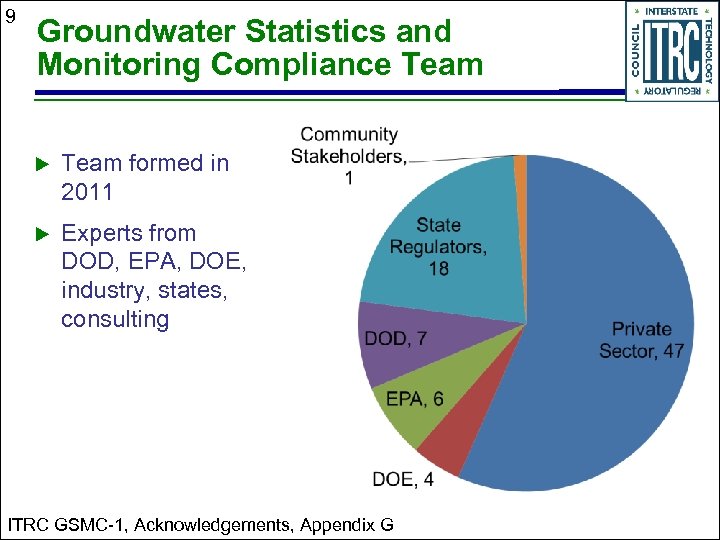 9 Groundwater Statistics and Monitoring Compliance Team formed in 2011 Experts from DOD, EPA, DOE, industry, states, consulting ITRC GSMC-1, Acknowledgements, Appendix G
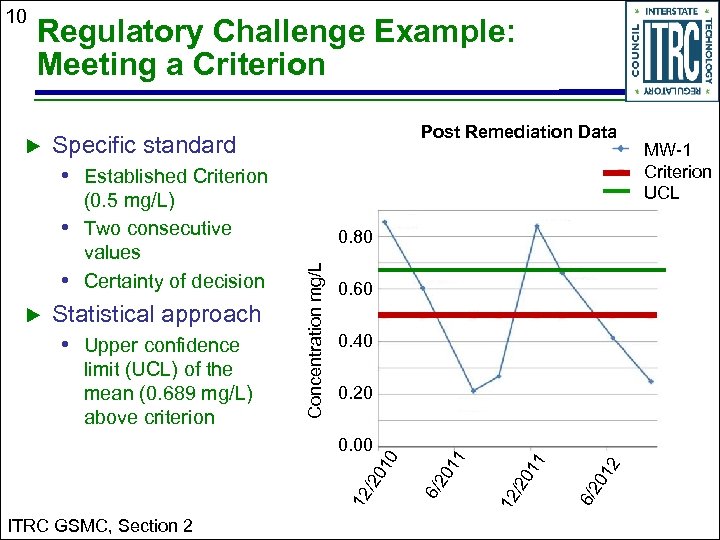 Regulatory Challenge Example: Meeting a Criterion Specific standard • Established Criterion (0. 5 mg/L) • Two consecutive values • Certainty of decision Post Remediation Data Statistical approach • Upper confidence limit (UCL) of the mean (0. 689 mg/L) above criterion 0. 80 Concentration mg/L 10 0. 60 0. 40 0. 20 ITRC GSMC, Section 2 01 2 6/2 12 /20 11 01 1 6/2 12 /20 10 0. 00 MW-1 Criterion UCL
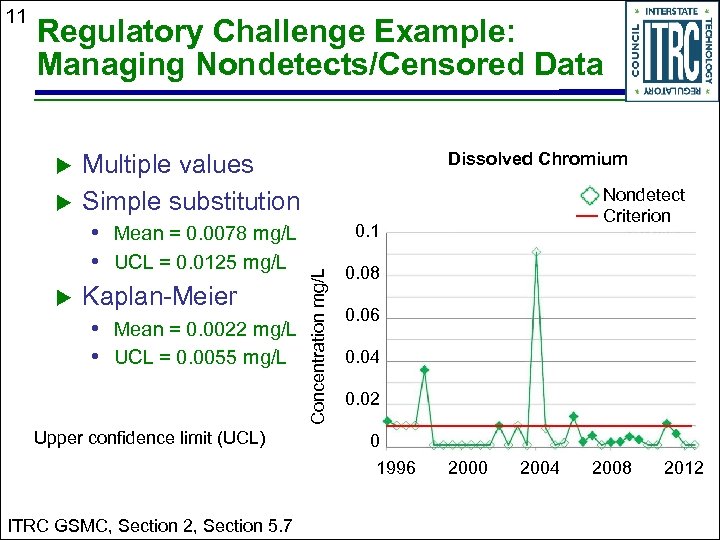 Regulatory Challenge Example: Managing Nondetects/Censored Data • Mean = 0. 0078 mg/L • UCL = 0. 0125 mg/L Dissolved Chromium Multiple values Simple substitution Kaplan-Meier • Mean = 0. 0022 mg/L • UCL = 0. 0055 mg/L Upper confidence limit (UCL) ITRC GSMC, Section 2, Section 5. 7 Nondetect Criterion 0. 1 Concentration mg/L 11 0. 08 0. 06 0. 04 0. 02 0 1996 2000 2004 2008 2012
 12 ITRC Document is for Environmental Project Managers You can use the document for a number of project management activities • Reviewing or using statistical calculations for reports • Making recommendations or decisions based on statistics • Demonstrating compliance for groundwater projects
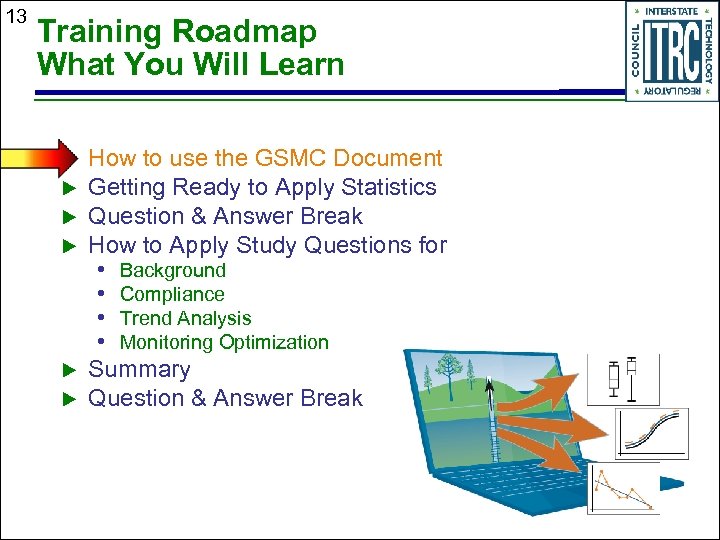 13 Training Roadmap What You Will Learn How to use the GSMC Document Getting Ready to Apply Statistics Question & Answer Break How to Apply Study Questions for • Background • Compliance • Trend Analysis • Monitoring Optimization Summary Question & Answer Break
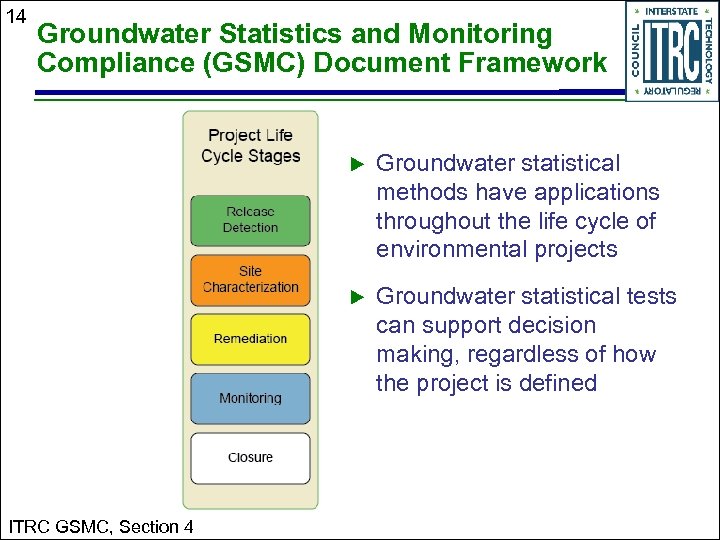 14 Groundwater Statistics and Monitoring Compliance (GSMC) Document Framework ITRC GSMC, Section 4 Groundwater statistical methods have applications throughout the life cycle of environmental projects Groundwater statistical tests can support decision making, regardless of how the project is defined
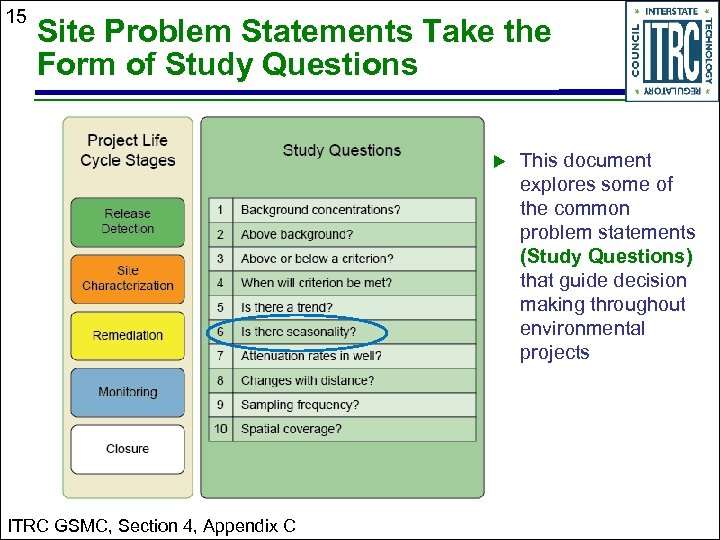 15 Site Problem Statements Take the Form of Study Questions ITRC GSMC, Section 4, Appendix C This document explores some of the common problem statements (Study Questions) that guide decision making throughout environmental projects
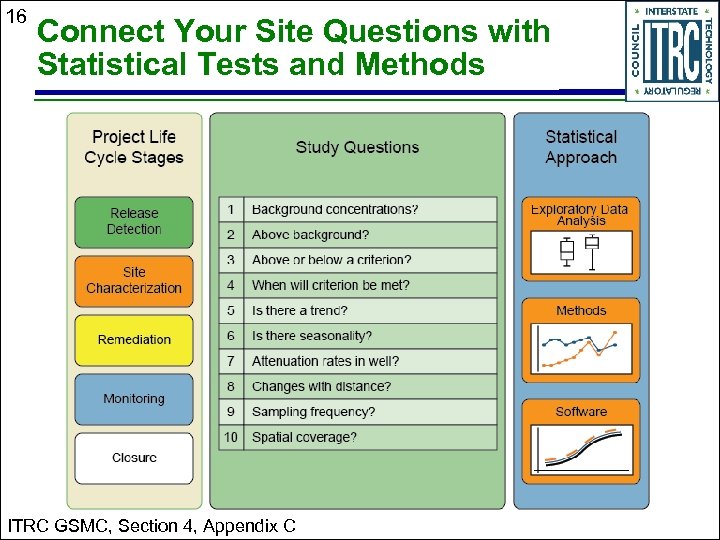 16 Connect Your Site Questions with Statistical Tests and Methods ITRC GSMC, Section 4, Appendix C
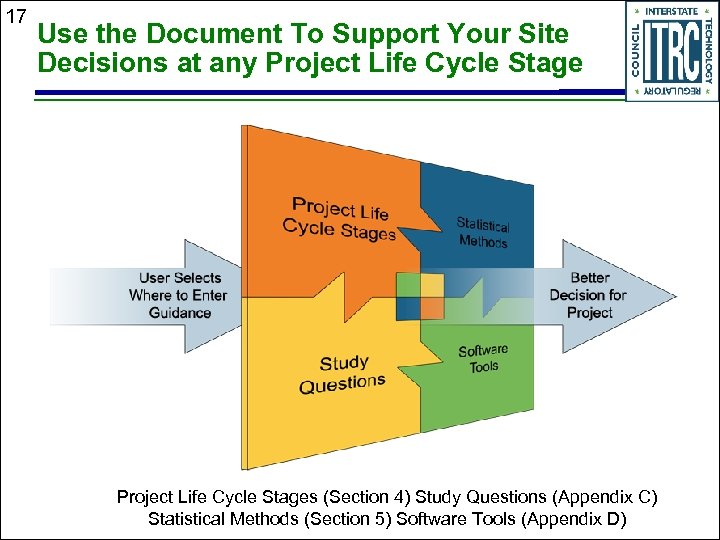 17 Use the Document To Support Your Site Decisions at any Project Life Cycle Stages (Section 4) Study Questions (Appendix C) Statistical Methods (Section 5) Software Tools (Appendix D)
 18 Connects to Other Statistical Resources For Groundwater Data Support use of EPA’s March 2009 Statistical Analysis of Groundwater Monitoring Data at RCRA Facilities (EPA’s Unified Guidance) Data Quality Objective (DQO) Process • Systematic planning tool based on the scientific method that identifies and defines the type, quality and quantity of data needed to satisfy a specified use Other statistics references ITRC GSMC, Section 9
 19 Training Roadmap How to use the GSMC Document Getting Ready to Apply Statistics Question & Answer Break How to Apply Study Questions for • Background • Compliance • Trend Analysis • Monitoring Optimization Summary Question & Answer Break
 20 What Use Is Statistics? Statistics is the science of drawing conclusions from data • • • Visualize and understand data Separate signal from noise Summarize large-scale behavior Quantify uncertainty Make better and more defensible decisions This section reviews the major elements of the statistical approach applied to groundwater data
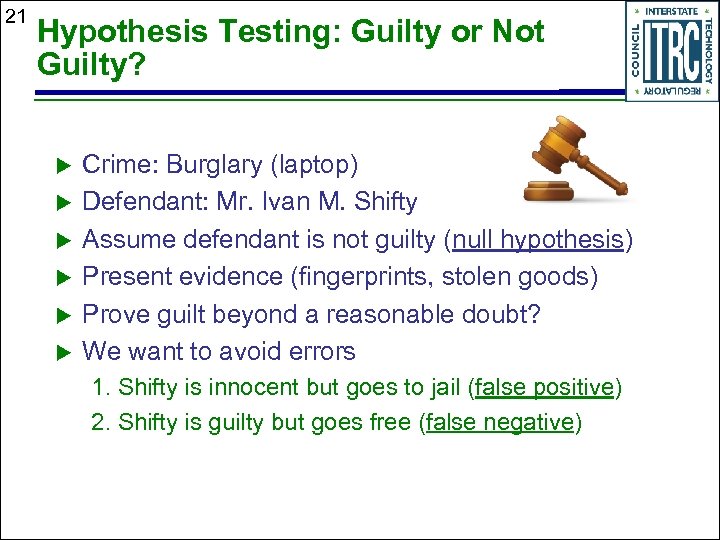 21 Hypothesis Testing: Guilty or Not Guilty? Crime: Burglary (laptop) Defendant: Mr. Ivan M. Shifty Assume defendant is not guilty (null hypothesis) Present evidence (fingerprints, stolen goods) Prove guilt beyond a reasonable doubt? We want to avoid errors 1. Shifty is innocent but goes to jail (false positive) 2. Shifty is guilty but goes free (false negative)
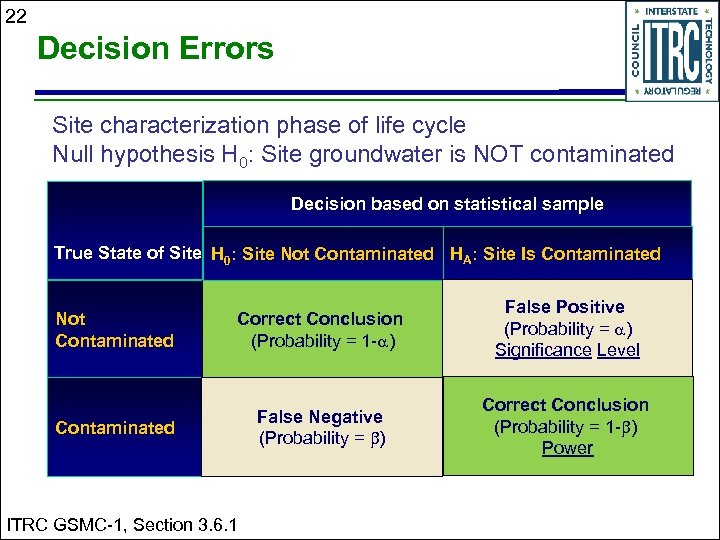 22 Decision Errors Site characterization phase of life cycle Null hypothesis H 0: Site groundwater is NOT contaminated Decision based on statistical sample True State of Site H 0: Site Not Contaminated HA: Site Is Contaminated Not Contaminated Correct Conclusion (Probability = 1 - ) False Positive (Probability = ) Significance Level Contaminated False Negative (Probability = ) Correct Conclusion (Probability = 1 - ) Power ITRC GSMC-1, Section 3. 6. 1
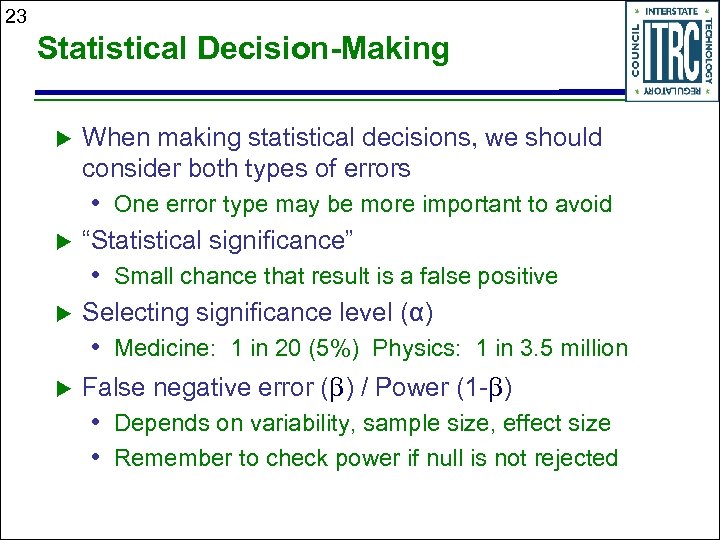 23 Statistical Decision-Making When making statistical decisions, we should consider both types of errors • One error type may be more important to avoid “Statistical significance” • Small chance that result is a false positive Selecting significance level (α) • Medicine: 1 in 20 (5%) Physics: 1 in 3. 5 million False negative error ( ) / Power (1 - ) • Depends on variability, sample size, effect size • Remember to check power if null is not rejected
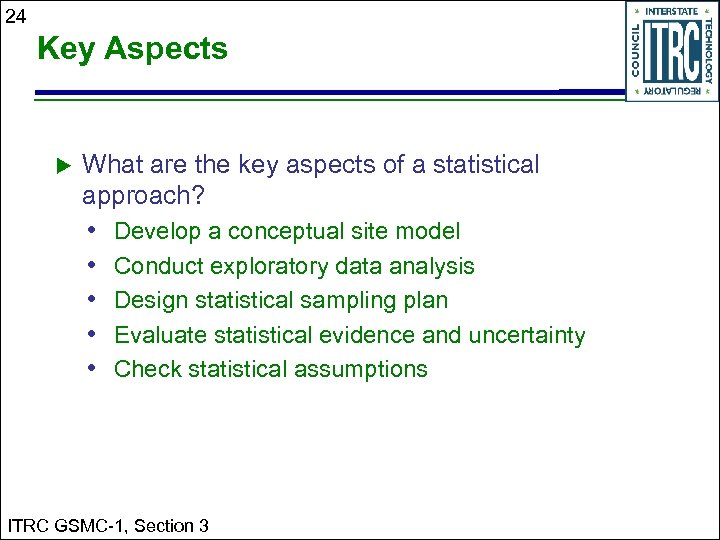 24 Key Aspects What are the key aspects of a statistical approach? • • • Develop a conceptual site model Conduct exploratory data analysis Design statistical sampling plan Evaluate statistical evidence and uncertainty Check statistical assumptions ITRC GSMC-1, Section 3
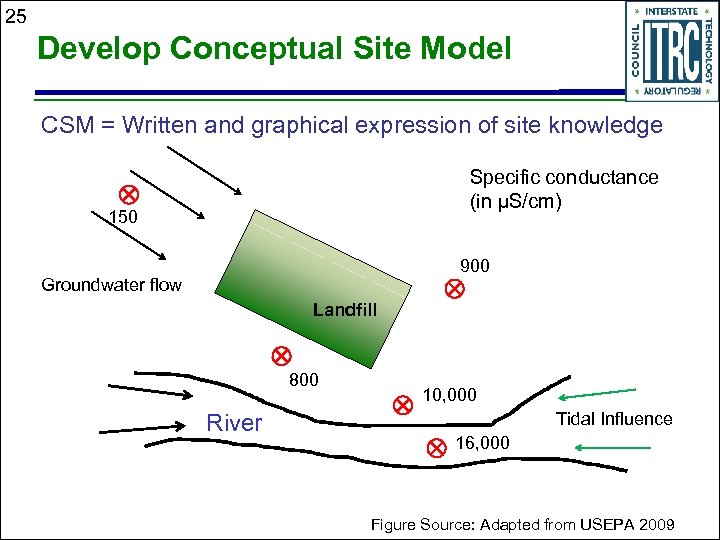 25 Develop Conceptual Site Model CSM = Written and graphical expression of site knowledge Specific conductance (in µS/cm) 150 900 Groundwater flow Landfill 800 River 10, 000 Tidal Influence 16, 000 Figure Source: Adapted from USEPA 2009
 26 CSM: Example Was there a release from the landfill? To answer, we statistically evaluate specific conductance (along with other parameters) Two possible approaches: • Interwell testing (compare multiple site wells, potentially affected vs. background wells) • Intrawell testing (compare results in one well over time) Based on CSM, one approach might be better ITRC GSMC-1, Section 3
 27 Conduct Exploratory Data Analysis All data should be plotted! The top 5 plots to use: • • • Time series plot – trends, inconsistencies Box plot – comparing groups, distributions, outliers Scatter plot – association between variables Histogram – distribution Probability plot –distribution, outliers ITRC GSMC-1, Section 5. 1
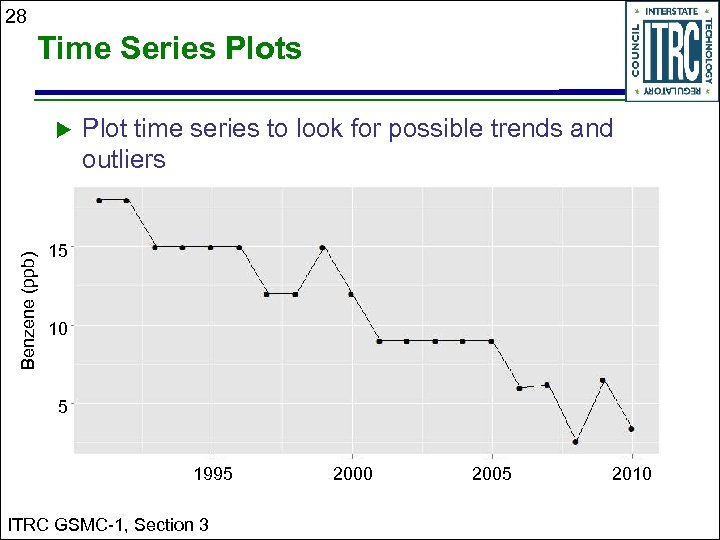 28 Time Series Plots Benzene (ppb) Plot time series to look for possible trends and outliers 15 10 5 1995 ITRC GSMC-1, Section 3 2000 2005 2010
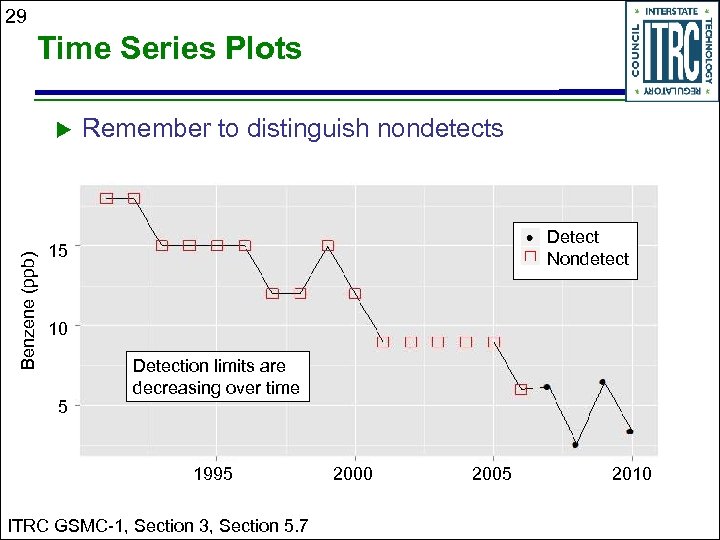 29 Time Series Plots Benzene (ppb) Remember to distinguish nondetects Detect Nondetect 15 10 5 Detection limits are decreasing over time 1995 ITRC GSMC-1, Section 3, Section 5. 7 2000 2005 2010
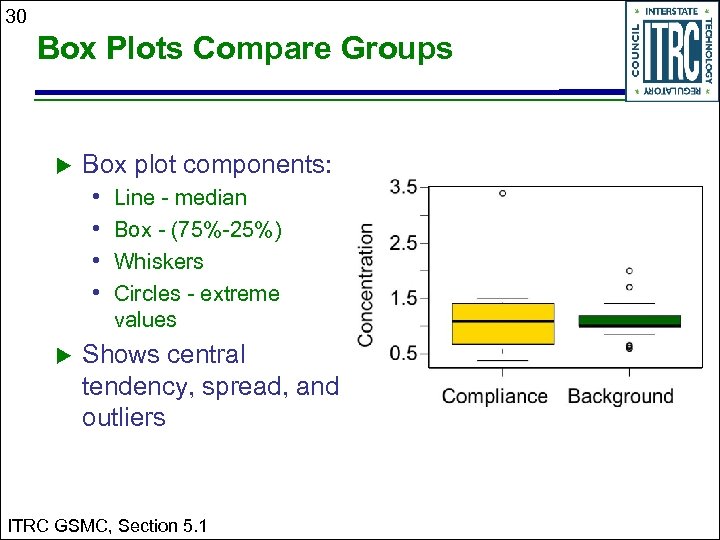 30 Box Plots Compare Groups Box plot components: • Line - median • Box - (75%-25%) • Whiskers • Circles - extreme values Shows central tendency, spread, and outliers ITRC GSMC, Section 5. 1
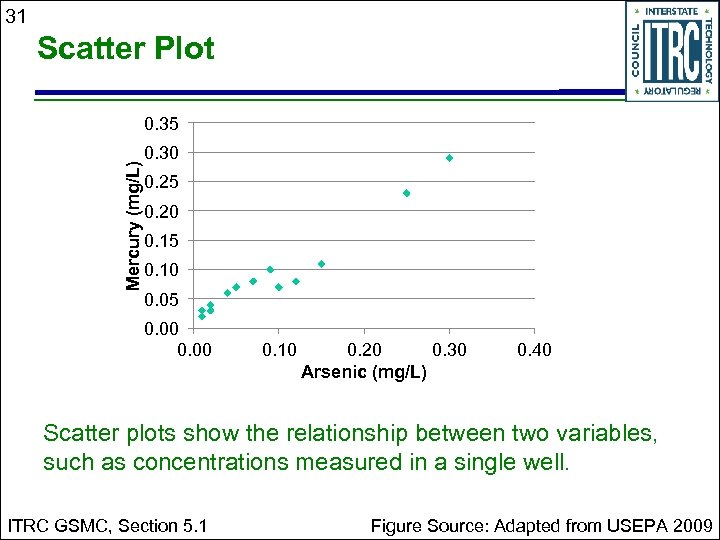 31 Scatter Plot Mercury (mg/L) 0. 35 0. 30 0. 25 0. 20 0. 15 0. 10 0. 05 0. 00 0. 10 0. 20 0. 30 Arsenic (mg/L) 0. 40 Scatter plots show the relationship between two variables, such as concentrations measured in a single well. ITRC GSMC, Section 5. 1 Figure Source: Adapted from USEPA 2009
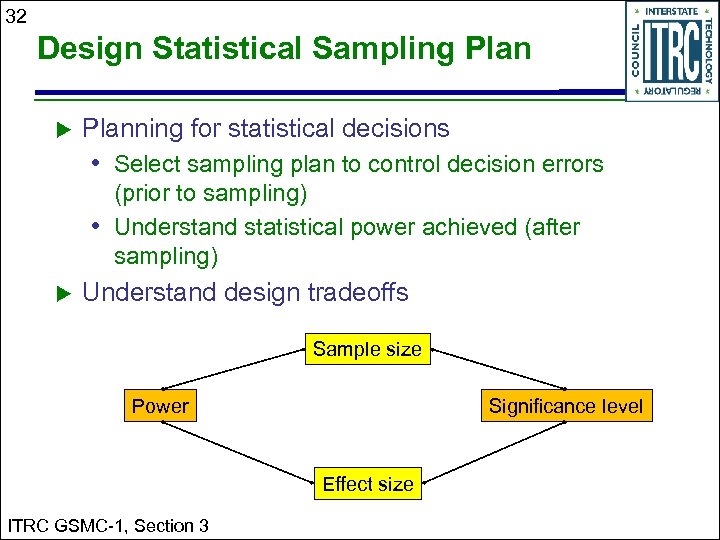 32 Design Statistical Sampling Planning for statistical decisions • Select sampling plan to control decision errors (prior to sampling) • Understand statistical power achieved (after sampling) Understand design tradeoffs Sample size Power Significance level Effect size ITRC GSMC-1, Section 3
 33 Evaluate Statistical Evidence Hypothesis testing • Null hypothesis (e. g. , not guilty) versus alternative hypothesis (e. g. , guilty) • Is there sufficient evidence to reject the null hypothesis (burden of proof)? Choice of null hypothesis depends on purpose • Do site concentrations exceed background? • Have cleanup goals been achieved? • Is there a trend in concentrations? ITRC GSMC-1, Section 3, 5
 34 Hypothesis Testing The Steps: 1. Define your hypotheses (null, alternative) 2. Compute the test statistic from the data under the assumption that the null is true 3. Calculate the probability (p-value) of what was observed if null were true 4. Make a decision • Reject null hypothesis if p-value is less than significance level of test (α) • Fail to reject the null and verify power of test
 35 Value of p-values All test statistics (and p-values) measure the discrepancy between what you actually observe and what you’d expect to see if the null is true Could these data have arisen solely due to natural variability? • P-value measures the strength of the evidence against the null hypothesis • Lower p-values represent stronger evidence (it’s less likely null is true) ITRC GSMC-1, Section 3
 36 Describing Uncertainty “The mean concentration is 5. 1 mg/L. ” How reliable is this estimate? Statistical Intervals • Use an interval (“error bars”) to show reliability • Types: confidence, prediction, tolerance Confidence level (1 -α) of the interval (e. g. , 95%) • Probability that interval will include the value of interest • Hypothesis tests can be formulated using intervals
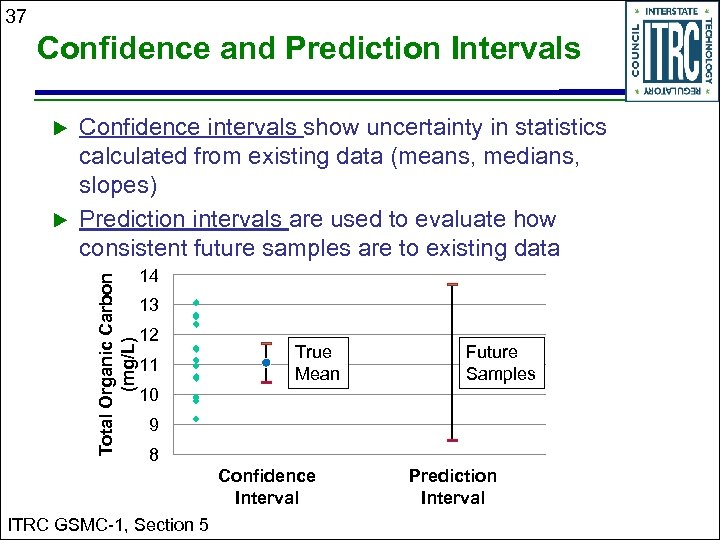 37 Confidence and Prediction Intervals Total Organic Carbon (mg/L) Confidence intervals show uncertainty in statistics calculated from existing data (means, medians, slopes) Prediction intervals are used to evaluate how consistent future samples are to existing data 14 13 12 11 True Mean Future Samples 10 9 8 Confidence Interval ITRC GSMC-1, Section 5 Prediction Interval
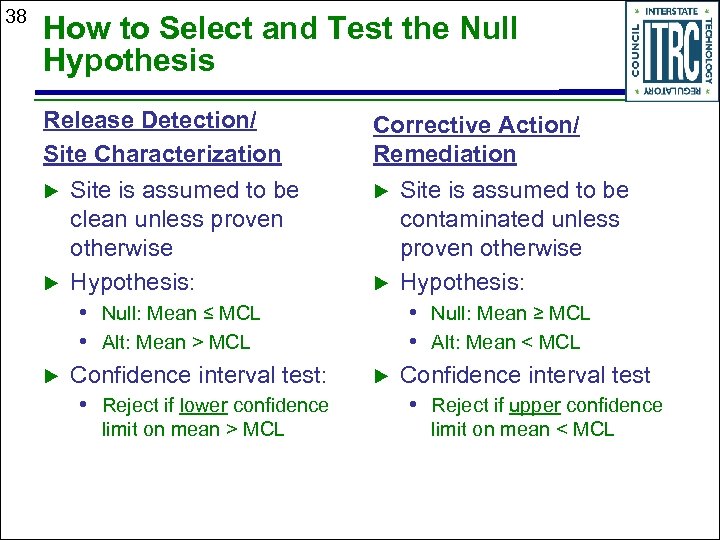 38 How to Select and Test the Null Hypothesis Release Detection/ Site Characterization Site is assumed to be clean unless proven otherwise Hypothesis: • Null: Mean ≤ MCL • Alt: Mean > MCL Confidence interval test: • Reject if lower confidence limit on mean > MCL Corrective Action/ Remediation Site is assumed to be contaminated unless proven otherwise Hypothesis: • Null: Mean ≥ MCL • Alt: Mean < MCL Confidence interval test • Reject if upper confidence limit on mean < MCL
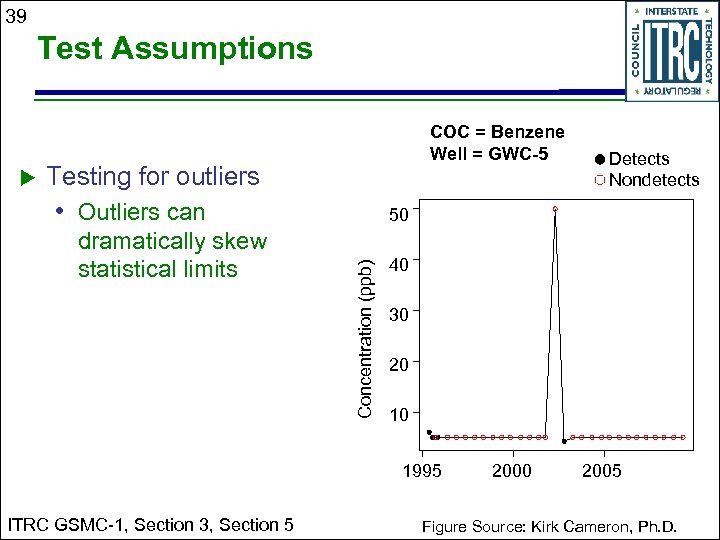 39 Test Assumptions COC = Benzene Well = GWC-5 Testing for outliers • Outliers can 50 Concentration (ppb) dramatically skew statistical limits 40 30 20 10 1995 ITRC GSMC-1, Section 3, Section 5 Detects Nondetects 2000 2005 Figure Source: Kirk Cameron, Ph. D.
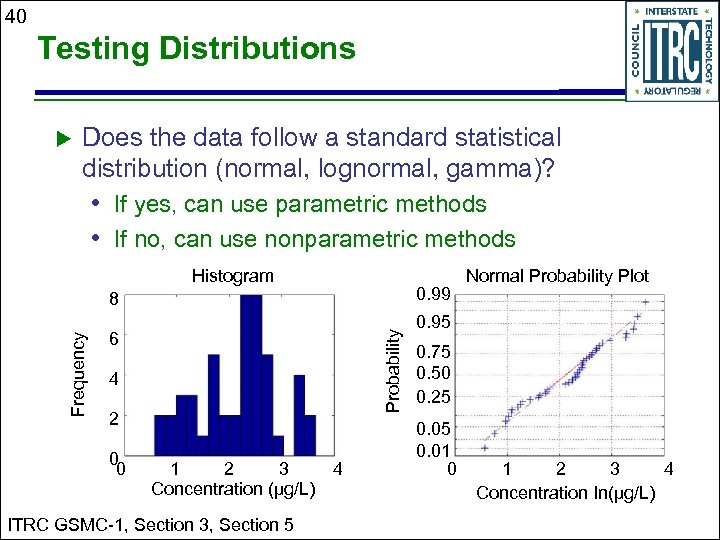 40 Testing Distributions Does the data follow a standard statistical distribution (normal, lognormal, gamma)? • If yes, can use parametric methods • If no, can use nonparametric methods Histogram 0. 99 Probability Frequency 8 6 4 2 0 0 1 2 3 4 Concentration (µg/L) ITRC GSMC-1, Section 3, Section 5 Normal Probability Plot 0. 95 0. 75 0. 50 0. 25 0. 01 0 1 2 3 4 Concentration In(µg/L)
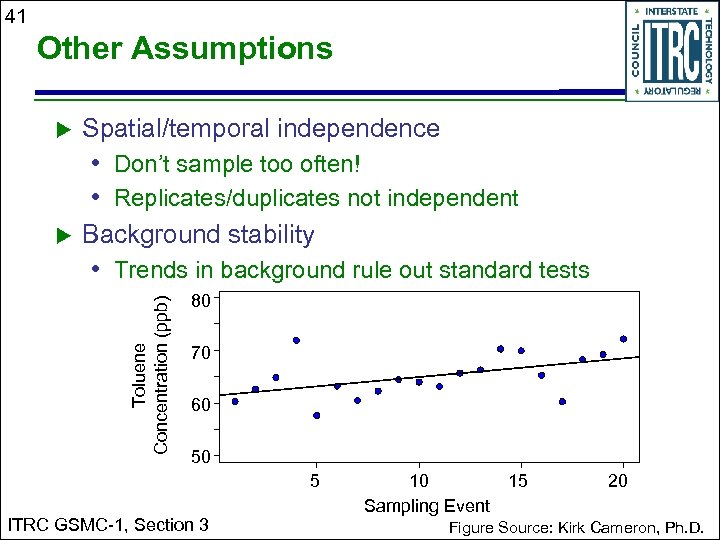 41 Other Assumptions Spatial/temporal independence • Don’t sample too often! • Replicates/duplicates not independent Background stability Toluene Concentration (ppb) • Trends in background rule out standard tests 80 70 60 50 5 ITRC GSMC-1, Section 3 10 Sampling Event 15 20 Figure Source: Kirk Cameron, Ph. D.
 42 Closing Thoughts on Getting Ready to Apply Statistics Plot the data Are there sufficient data to make a good decision with appropriate error rates? Confirm regulatory requirements Use results of statistical analyses with other lines of evidence “If you torture the data long enough, it will confess to anything. ”
 43 Question & Answer Break Follow ITRC
 44 Training Roadmap How to use the GSMC Document Getting Ready to Apply Statistics Question & Answer Break How to Apply Study Questions for • Background • Compliance • Trend Analysis • Monitoring Optimization Summary Question & Answer Break
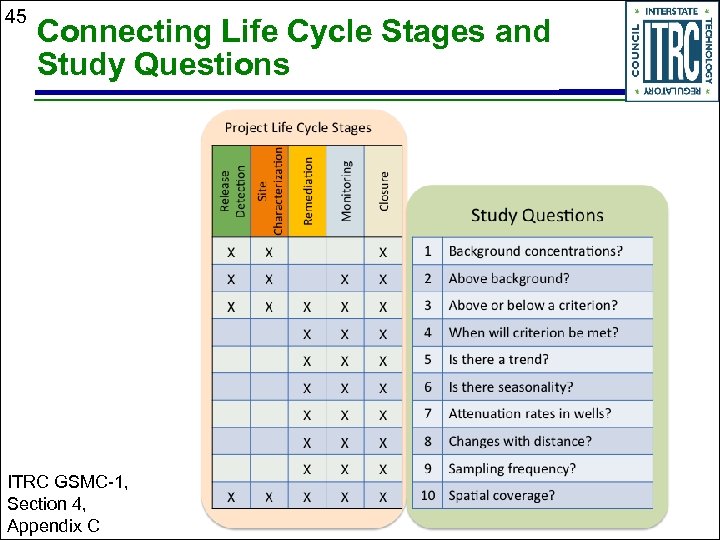 45 Connecting Life Cycle Stages and Study Questions ITRC GSMC-1, Section 4, Appendix C
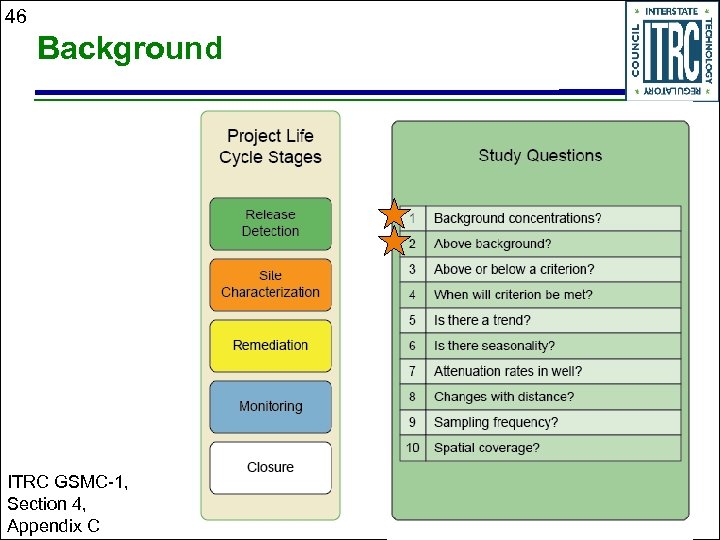 46 Background ITRC GSMC-1, Section 4, Appendix C
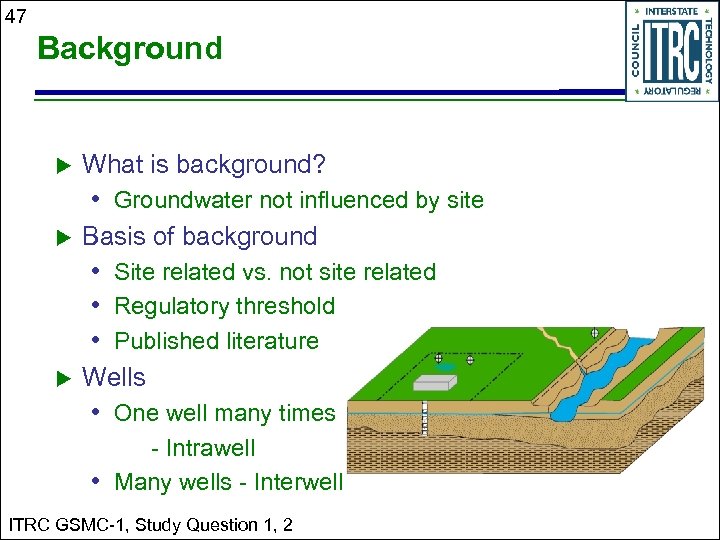 47 Background What is background? • Groundwater not influenced by site Basis of background • Site related vs. not site related • Regulatory threshold • Published literature Wells • One well many times - Intrawell • Many wells - Interwell ITRC GSMC-1, Study Question 1, 2
 48 Considerations for Statistical Analysis of Background Avoid known sources of site-related contamination Distance and direction of selected wells from source Review of geologic/hydrogeologic information Multiple aquifer characteristics Project data quality objectives (DQOs) • Sufficient number of samples • Quality of the dataset
 49 EDA for Background Use of EDA (Exploratory Data Analysis) in selection of background wells (section 3. 3. 3, section 3. 5) • Inspecting sample data – assess dataset quality § Multiple detection limits § Analytical methods (e. g. , EPA methods 8020, 8021, 8260) • Graphical plots of sample data – assess shape of the dataset (section 5. 1) • Determine the distribution of the sample data § Parametric or non-parametric (section 5. 6) § Outliers (section 5. 10) ITRC GSMC-1, Section 3, 5
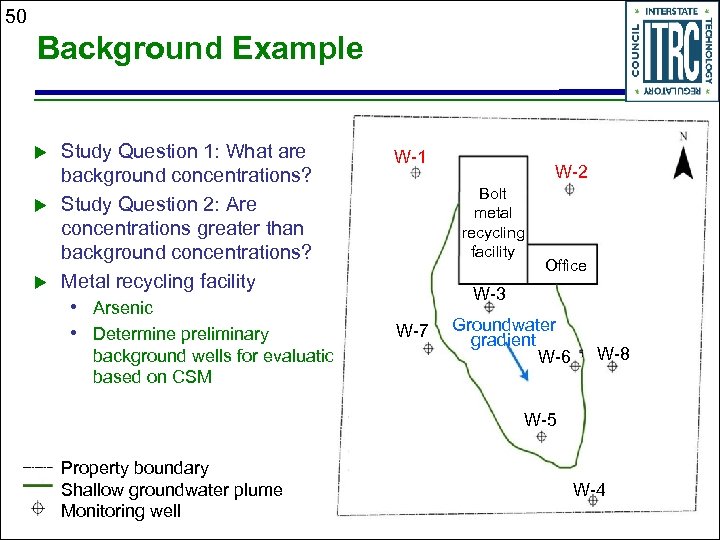 50 Background Example Study Question 1: What are background concentrations? Study Question 2: Are concentrations greater than background concentrations? Metal recycling facility • Arsenic • Determine preliminary background wells for evaluation based on CSM W-1 W-2 Bolt metal recycling facility Office W-3 W-7 Groundwater gradient W-6 W-8 W-5 Property boundary Shallow groundwater plume Monitoring well W-4
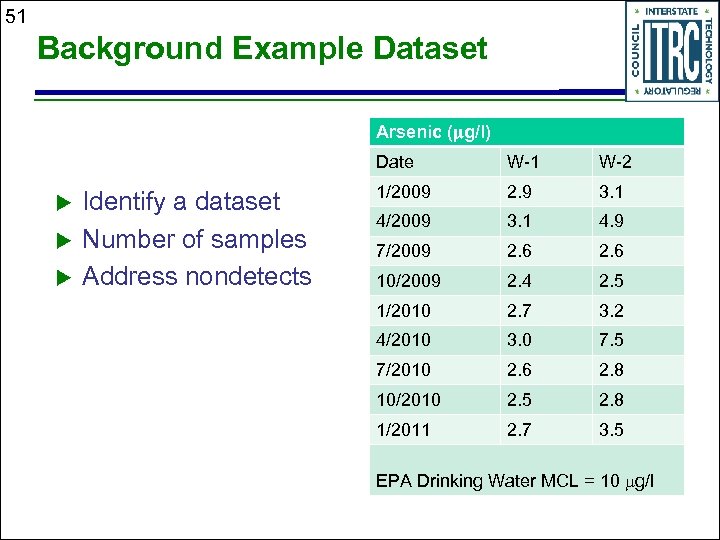 51 Background Example Dataset Arsenic (mg/l) Date Identify a dataset Number of samples Address nondetects W-1 W-2 1/2009 2. 9 3. 1 4/2009 3. 1 4. 9 7/2009 2. 6 10/2009 2. 4 2. 5 1/2010 2. 7 3. 2 4/2010 3. 0 7. 5 7/2010 2. 6 2. 8 10/2010 2. 5 2. 8 1/2011 2. 7 3. 5 EPA Drinking Water MCL = 10 mg/l
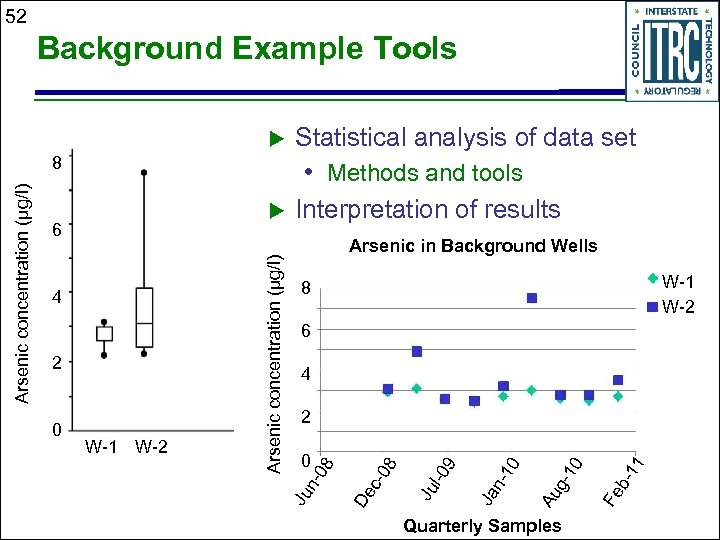 52 Background Example Tools • Methods and tools Quarterly Samples 11 b. Fe 10 g. Au Ja n- 0 10 2 Ju l-0 9 W-1 W-2 4 8 0 6 c-0 2 W-1 W-2 8 De 4 Arsenic in Background Wells 08 6 Interpretation of results Ju n- Arsenic concentration (µg/l) 8 Statistical analysis of data set
 53 Training Roadmap How to use the GSMC Document Getting Ready to Apply Statistics Question & Answer Break How to Apply Study Questions for • Background • Compliance • Trend Analysis • Monitoring Optimization Summary Question & Answer Break
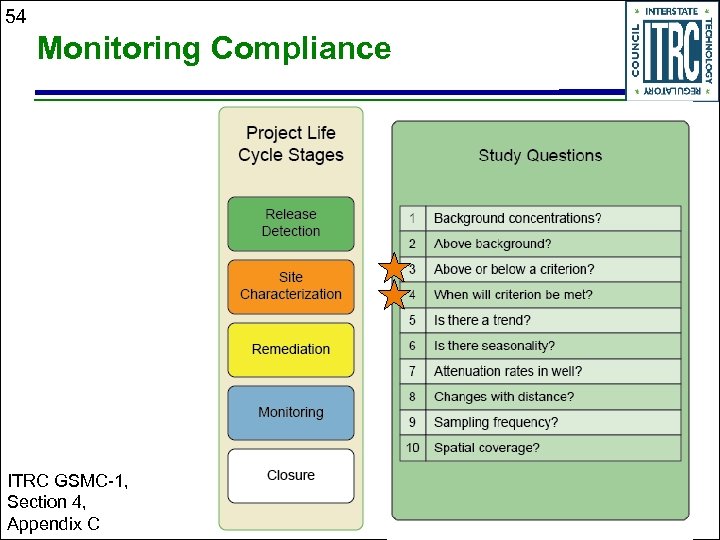 54 Monitoring Compliance ITRC GSMC-1, Section 4, Appendix C
 55 Why Monitoring Compliance? Why monitoring? • Evaluate site characteristics • Evaluate chemical concentrations for compliance with groundwater protection criteria Monitoring design • • Evaluate chemicals present over time Identifying a release Develop conceptual site model Compliance with regulatory requirements ITRC GSMC-1, Study Question 3
 56 Basis of Monitoring Compliance Groundwater criteria compliance • • MCL Background Risk-based value Ecological protection value Basis of compliance • • Number of samples Distribution Regulatory threshold What is the compliance point?
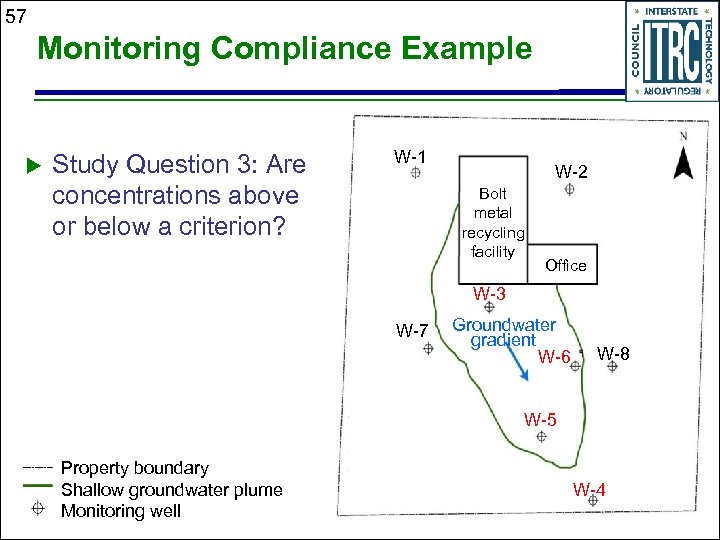 57 Monitoring Compliance Example Study Question 3: Are concentrations above or below a criterion? W-1 W-2 Bolt metal recycling facility Office W-3 W-7 Groundwater gradient W-6 W-8 W-5 Property boundary Shallow groundwater plume Monitoring well W-4
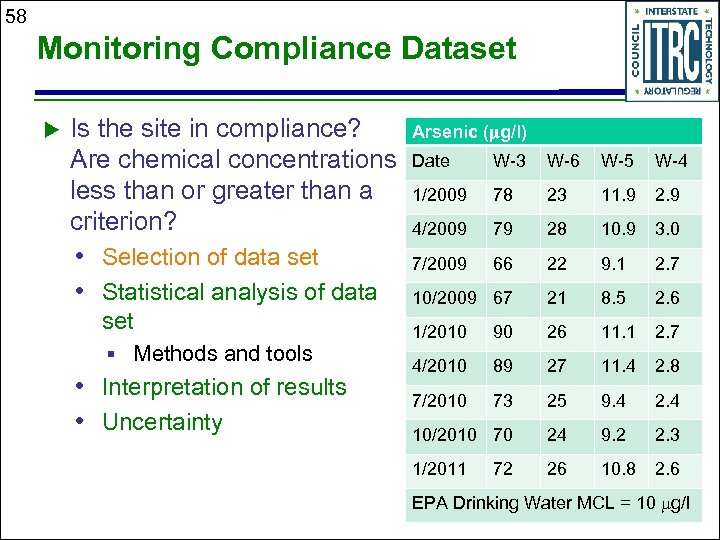 58 Monitoring Compliance Dataset Is the site in compliance? Are chemical concentrations less than or greater than a criterion? • Selection of data set • Statistical analysis of data set § Methods and tools • Interpretation of results • Uncertainty Arsenic (mg/l) Date W-3 W-6 W-5 W-4 1/2009 78 23 11. 9 2. 9 4/2009 79 28 10. 9 3. 0 7/2009 66 22 9. 1 2. 7 10/2009 67 21 8. 5 2. 6 1/2010 90 26 11. 1 2. 7 4/2010 89 27 11. 4 2. 8 7/2010 73 25 9. 4 2. 4 10/2010 70 24 9. 2 2. 3 1/2011 26 10. 8 2. 6 72 EPA Drinking Water MCL = 10 mg/l
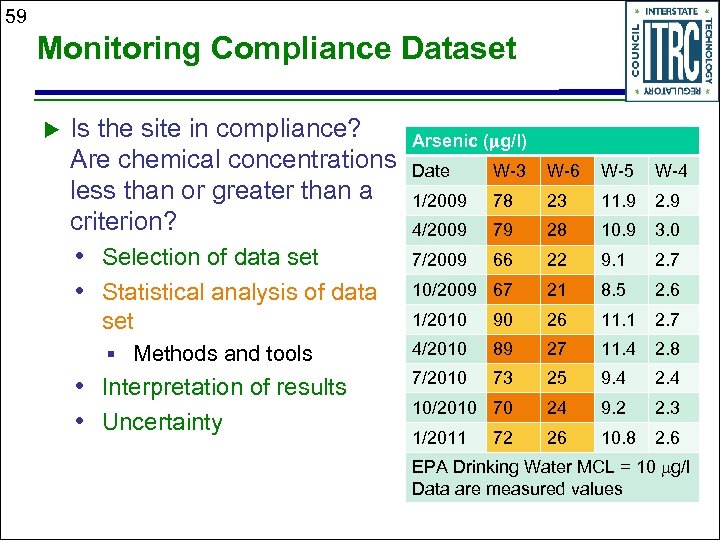 59 Monitoring Compliance Dataset Is the site in compliance? Are chemical concentrations less than or greater than a criterion? Arsenic (mg/l) Date W-3 W-6 W-5 W-4 1/2009 78 23 11. 9 2. 9 4/2009 79 28 10. 9 3. 0 7/2009 66 22 9. 1 2. 7 10/2009 67 21 8. 5 2. 6 set 1/2010 90 26 11. 1 2. 7 § Methods and tools 4/2010 89 27 11. 4 2. 8 • Interpretation of results • Uncertainty 7/2010 73 25 9. 4 2. 4 10/2010 70 24 9. 2 2. 3 1/2011 26 10. 8 2. 6 • Selection of data set • Statistical analysis of data 72 EPA Drinking Water MCL = 10 mg/l Data are measured values
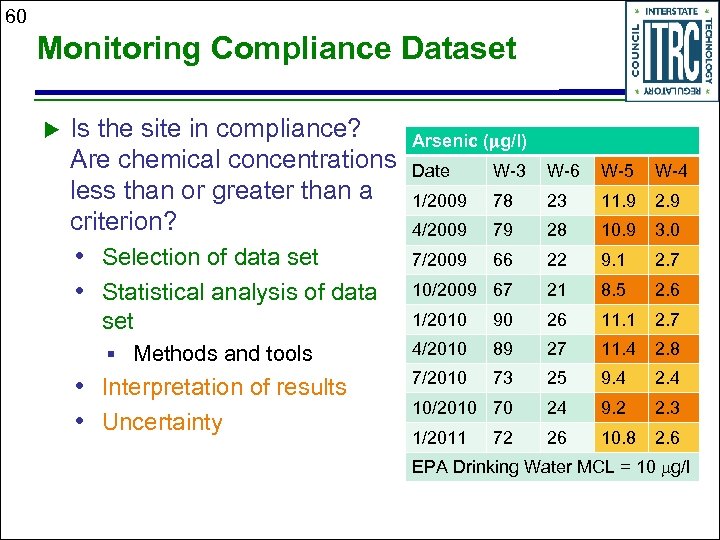 60 Monitoring Compliance Dataset Is the site in compliance? Are chemical concentrations less than or greater than a criterion? Arsenic (mg/l) Date W-3 W-6 W-5 W-4 1/2009 78 23 11. 9 2. 9 4/2009 79 28 10. 9 3. 0 7/2009 66 22 9. 1 2. 7 10/2009 67 21 8. 5 2. 6 set 1/2010 90 26 11. 1 2. 7 § Methods and tools 4/2010 89 27 11. 4 2. 8 • Interpretation of results • Uncertainty 7/2010 73 25 9. 4 2. 4 10/2010 70 24 9. 2 2. 3 1/2011 26 10. 8 2. 6 • Selection of data set • Statistical analysis of data 72 EPA Drinking Water MCL = 10 mg/l
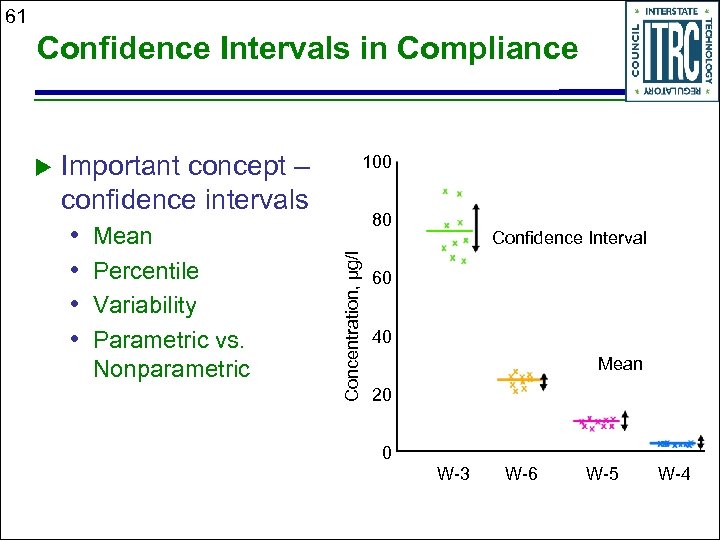 61 Confidence Intervals in Compliance Important concept – confidence intervals • Mean • Percentile • Variability • Parametric vs. Nonparametric 100 80 Concentration, µg/l Confidence Interval 60 40 Mean 20 0 W-3 W-6 W-5 W-4
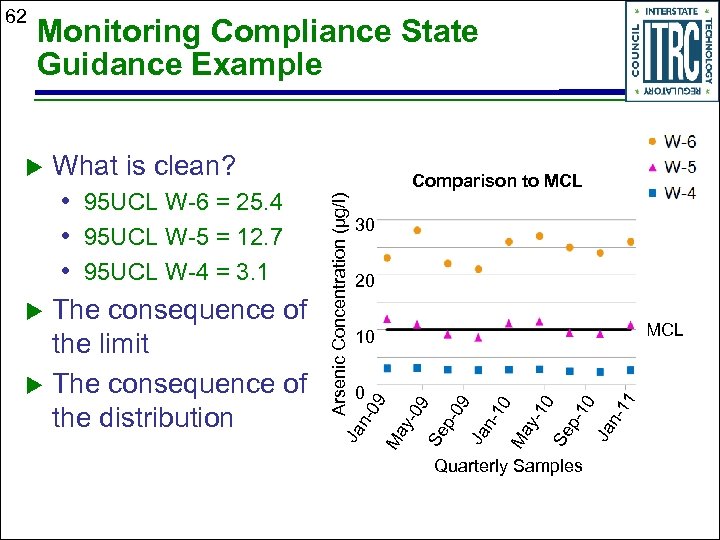 62 Monitoring Compliance State Guidance Example What is clean? • 95 UCL W-6 = 25. 4 • 95 UCL W-5 = 12. 7 • 95 UCL W-4 = 3. 1 The consequence of the limit The consequence of the distribution Arsenic Concentration (µg/l) Ja n 09 Ma y-0 9 Se p 09 Ja n 10 Ma y-1 0 Se p 10 Ja n 11 Comparison to MCL 30 20 10 0 Quarterly Samples MCL
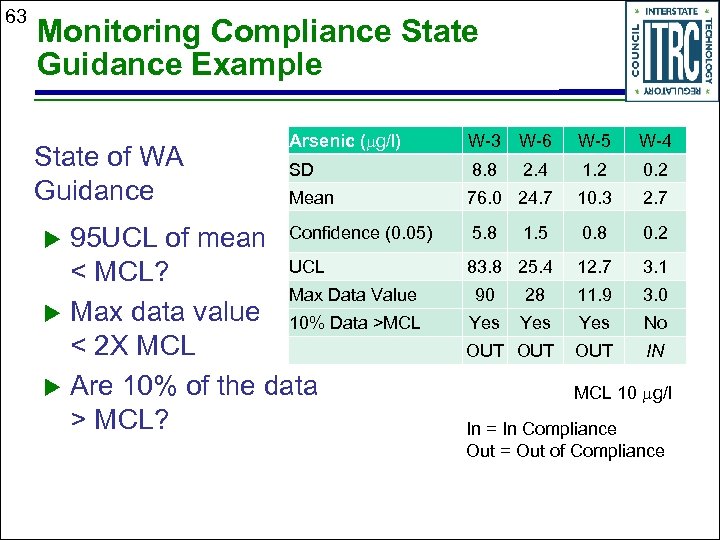 63 Monitoring Compliance State Guidance Example State of WA Guidance Arsenic (mg/l) W-3 W-6 W-5 W-4 SD 8. 8 2. 4 1. 2 0. 2 Mean 76. 0 24. 7 10. 3 2. 7 5. 8 1. 5 0. 8 0. 2 83. 8 25. 4 12. 7 3. 1 95 UCL of mean Confidence (0. 05) UCL < MCL? Max Data Value Max data value 10% Data >MCL < 2 X MCL Are 10% of the data > MCL? 90 28 11. 9 3. 0 Yes Yes No OUT OUT IN MCL 10 mg/l In = In Compliance Out = Out of Compliance
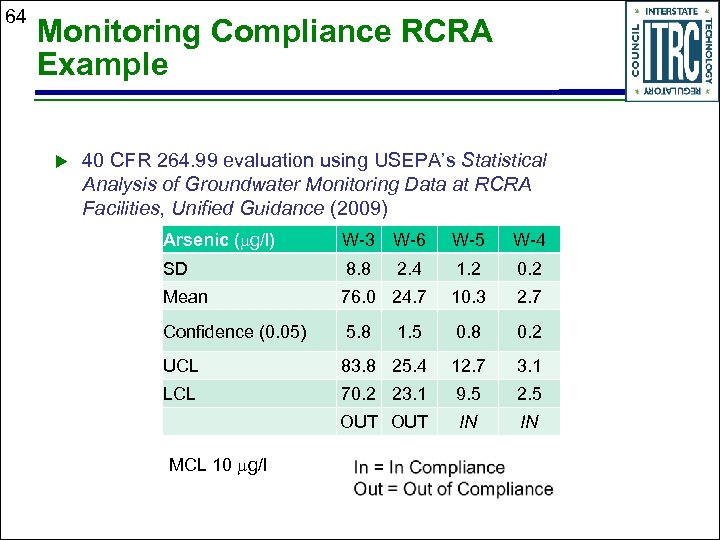 64 Monitoring Compliance RCRA Example 40 CFR 264. 99 evaluation using USEPA’s Statistical Analysis of Groundwater Monitoring Data at RCRA Facilities, Unified Guidance (2009) Arsenic (mg/l) W-3 W-6 W-5 W-4 SD 8. 8 2. 4 1. 2 0. 2 Mean 76. 0 24. 7 10. 3 2. 7 Confidence (0. 05) 5. 8 1. 5 0. 8 0. 2 UCL 83. 8 25. 4 12. 7 3. 1 LCL 70. 2 23. 1 9. 5 2. 5 OUT IN IN MCL 10 mg/l
 65 Training Roadmap How to use the GSMC Document Getting Ready to Apply Statistics Question & Answer Break How to Apply Study Questions for • Background • Compliance • Trend Analysis • Monitoring Optimization Summary Question & Answer Break
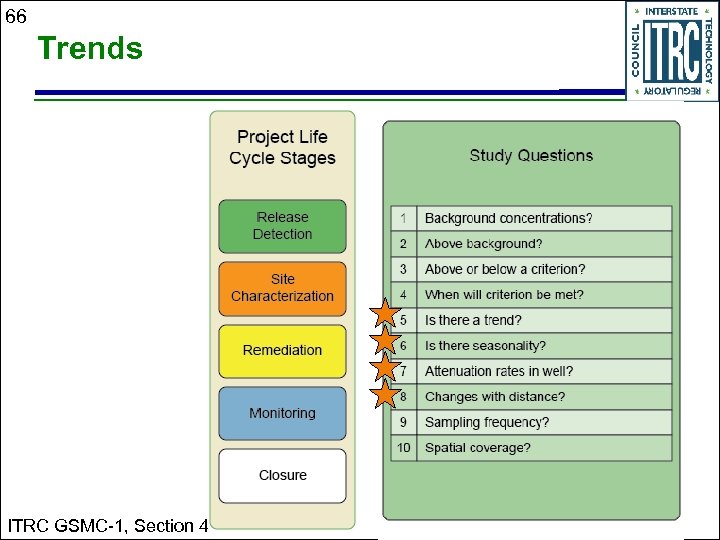 66 Trends ITRC GSMC-1, Section 4
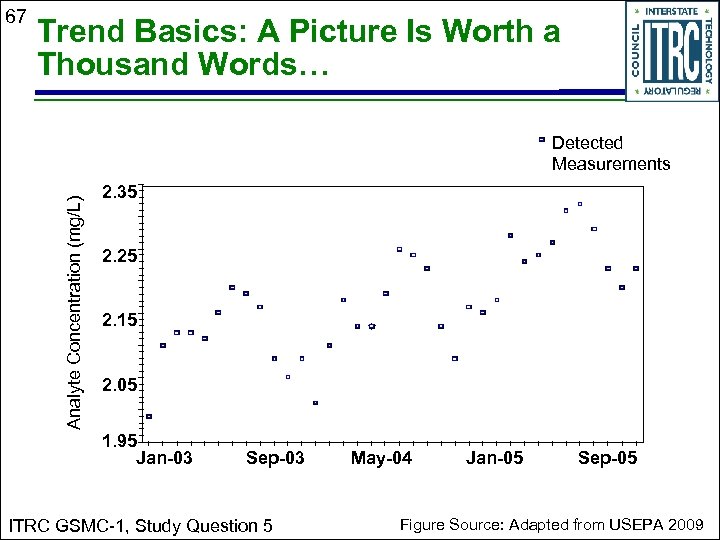 67 Trend Basics: A Picture Is Worth a Thousand Words… Analyte Concentration (mg/L) Detected Measurements 2. 35 2. 25 2. 15 2. 05 1. 95 Jan-03 Sep-03 ITRC GSMC-1, Study Question 5 May-04 Jan-05 Sep-05 Figure Source: Adapted from USEPA 2009
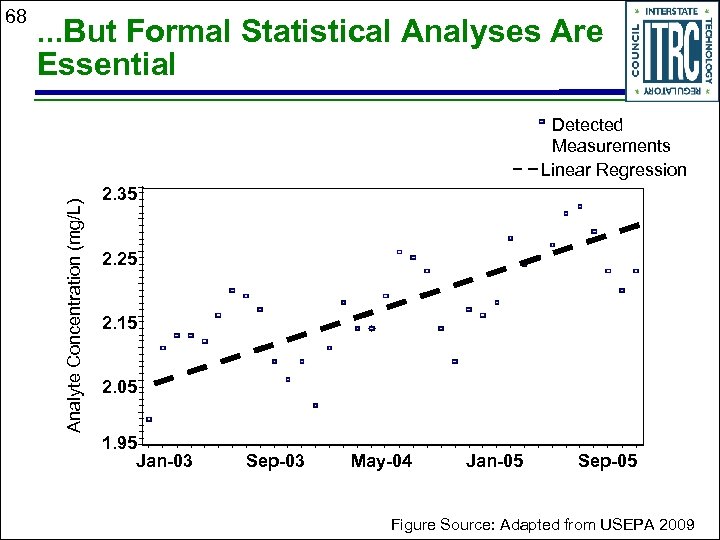 . . . But Formal Statistical Analyses Are Essential Detected Measurements Linear Regression Analyte Concentration (mg/L) 68 2. 35 2. 25 2. 15 2. 05 1. 95 Jan-03 Sep-03 May-04 Jan-05 Sep-05 Figure Source: Adapted from USEPA 2009
 69 Trend Applications All project life cycle phases • Exploratory Data Analysis (EDA Section 3. 3. 3) — are background levels stable? Specific project life cycle phases • Release detection (Section 4. 2) — are concentrations steadily increasing? • Assessing compliance (Section 4. 6) — is monitored natural attenuation feasible/realistic? • Optimization (Section 4. 5) — is the sampling effort appropriate?
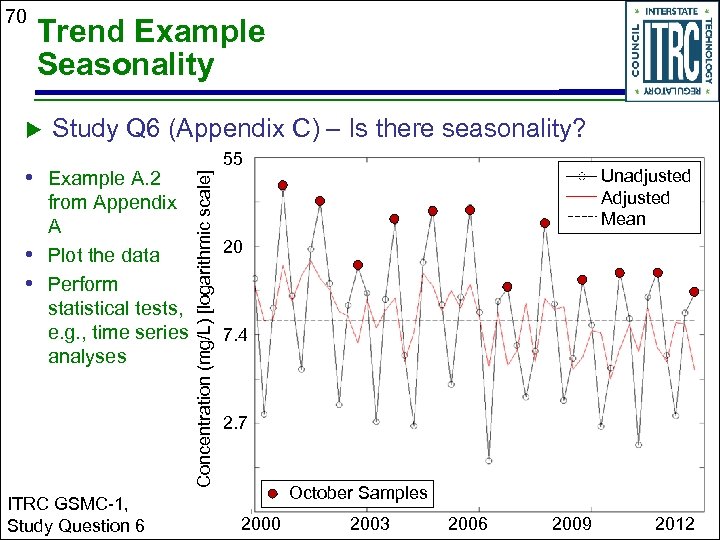 Trend Example Seasonality Study Q 6 (Appendix C) – Is there seasonality? • Example A. 2 55 Concentration (mg/L) [logarithmic scale] 70 from Appendix A • Plot the data • Perform statistical tests, e. g. , time series analyses ITRC GSMC-1, Study Question 6 Unadjusted Adjusted Mean 20 7. 4 2. 7 October Samples 2000 2003 2006 2009 2012
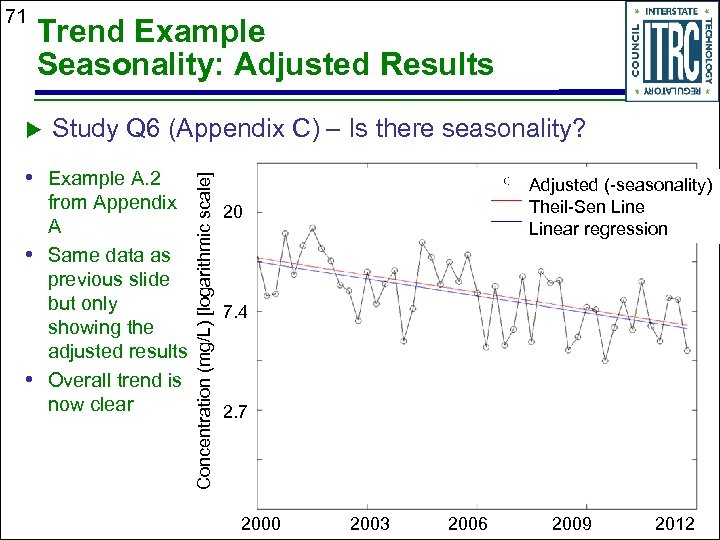 Trend Example Seasonality: Adjusted Results Study Q 6 (Appendix C) – Is there seasonality? • Example A. 2 from Appendix A • Same data as previous slide but only showing the adjusted results • Overall trend is now clear Concentration (mg/L) [logarithmic scale] 71 Adjusted (-seasonality) Theil-Sen Linear regression 20 7. 4 2. 7 2000 2003 2006 2009 2012
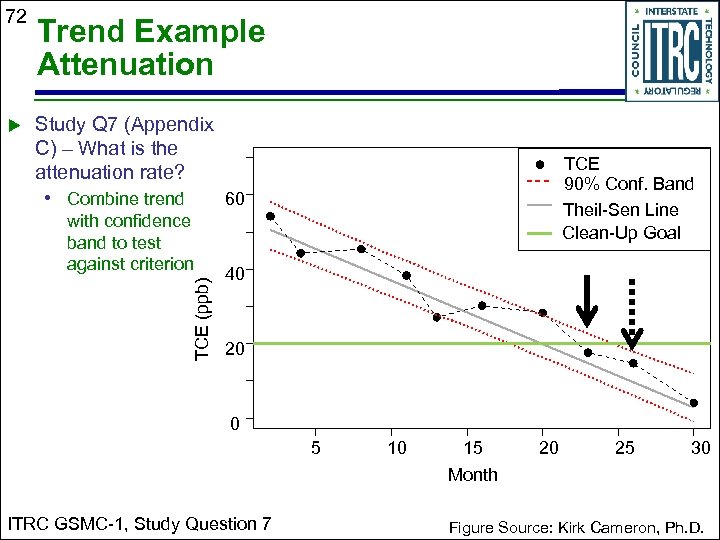 72 Trend Example Attenuation Study Q 7 (Appendix C) – What is the attenuation rate? • Combine trend TCE 90% Conf. Band Theil-Sen Line Clean-Up Goal 60 TCE (ppb) with confidence band to test against criterion 40 20 0 5 10 15 20 25 30 Month ITRC GSMC-1, Study Question 7 Figure Source: Kirk Cameron, Ph. D.
![73 Trend Example Projecting Concentrations 20 7. 4 Concentration (µg/L) [logarithmic scale] When will](https://present5.com/presentation/d2bad99764df1e064fb6e78df49e3a0f/image-73.jpg "73 Trend Example Projecting Concentrations 20 7. 4 Concentration (µg/L) [logarithmic scale] When will") 73 Trend Example Projecting Concentrations 20 7. 4 Concentration (µg/L) [logarithmic scale] When will the extrapolated mean concentration reach a criterion? • Example A. 2 from Appendix A • Project future concentrations using past trends ITRC GSMC-1, Study Question 4 Observations Estimated Mean Concentration Confidence Limits Criterion, 2 µg/l 2. 7 2000 2020 2040 2060
73 Trend Example Projecting Concentrations 20 7. 4 Concentration (µg/L) [logarithmic scale] When will the extrapolated mean concentration reach a criterion? • Example A. 2 from Appendix A • Project future concentrations using past trends ITRC GSMC-1, Study Question 4 Observations Estimated Mean Concentration Confidence Limits Criterion, 2 µg/l 2. 7 2000 2020 2040 2060
 74 Training Roadmap How to use the GSMC Document Getting Ready to Apply Statistics Question & Answer Break How to Apply Study Questions for • Background • Compliance • Trend Analysis • Monitoring Optimization Summary Question & Answer Break
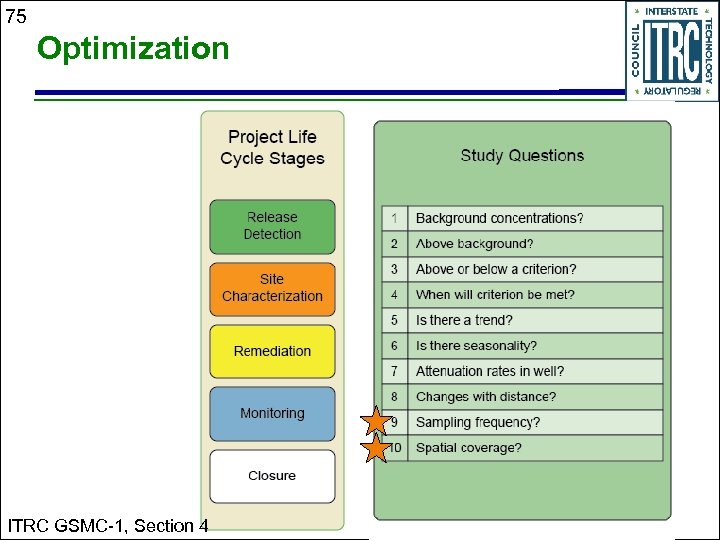 75 Optimization ITRC GSMC-1, Section 4
 76 Optimization entails efficient data collection – collecting the right amount of data for the decisions (Section 4. 5. 3) Sampling design optimized for any site when • Little statistical correlation or redundancy in sample results, AND • Adequate data collected for accurate decisions ITRC GSMC-1, Study Questions 9, 10
 77 Temporal Optimization Goal: optimize sampling frequencies • Are consecutive sampling events redundant? Or using statistical terminology - • Is autocorrelation present? Strategy: adjust frequency to minimize correlation while still capturing trends ITRC GSMC-1, Study Question 9
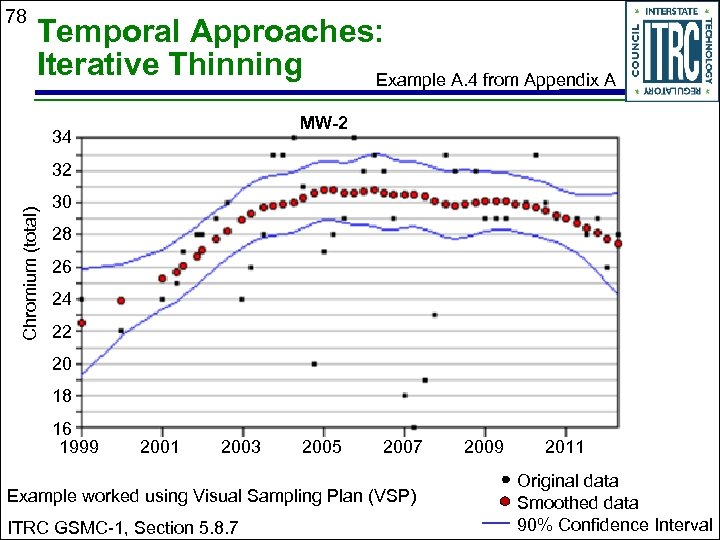 78 Temporal Approaches: Iterative Thinning Example A. 4 from Appendix A MW-2 34 Chromium (total) 32 30 28 26 24 22 20 18 16 1999 2001 2003 2005 2007 Example worked using Visual Sampling Plan (VSP) ITRC GSMC-1, Section 5. 8. 7 2009 2011 Original data Smoothed data 90% Confidence Interval
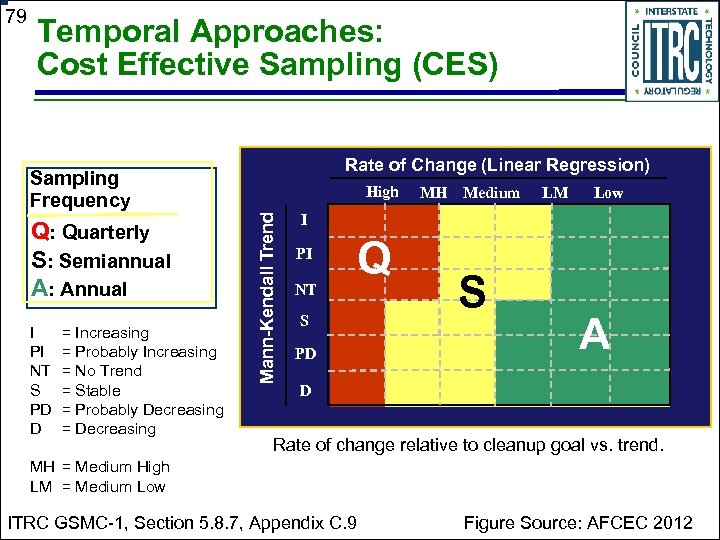 79 Temporal Approaches: Cost Effective Sampling (CES) Rate of Change (Linear Regression) Sampling Frequency I PI NT S PD D = Increasing = Probably Increasing = No Trend = Stable = Probably Decreasing = Decreasing Mann-Kendall Trend Q: Quarterly S: Semiannual A: Annual High MH Medium LM Low I PI NT S PD Q S A D Rate of change relative to cleanup goal vs. trend. MH = Medium High LM = Medium Low ITRC GSMC-1, Section 5. 8. 7, Appendix C. 9 Figure Source: AFCEC 2012
 80 Spatial Optimization Goal: optimize number and/or placement of well locations • Are any wells redundant? • Should new wells be added and where? Strategy: assess spatial uncertainty either by • Removing specific wells or groups of wells • Locating areas with highly uncertain concentrations and few or no wells ITRC GSMC-1, Study Question 10
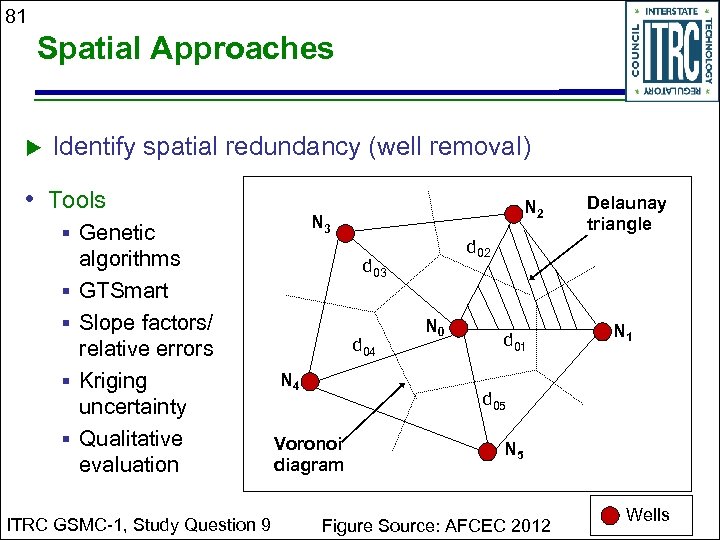 81 Spatial Approaches Identify spatial redundancy (well removal) • Tools N 3 § Genetic § § algorithms GTSmart Slope factors/ relative errors Kriging uncertainty Qualitative evaluation ITRC GSMC-1, Study Question 9 N 2 d 03 d 04 N 4 Delaunay triangle N 0 d 01 N 1 d 05 Voronoi diagram N 5 Figure Source: AFCEC 2012 Wells
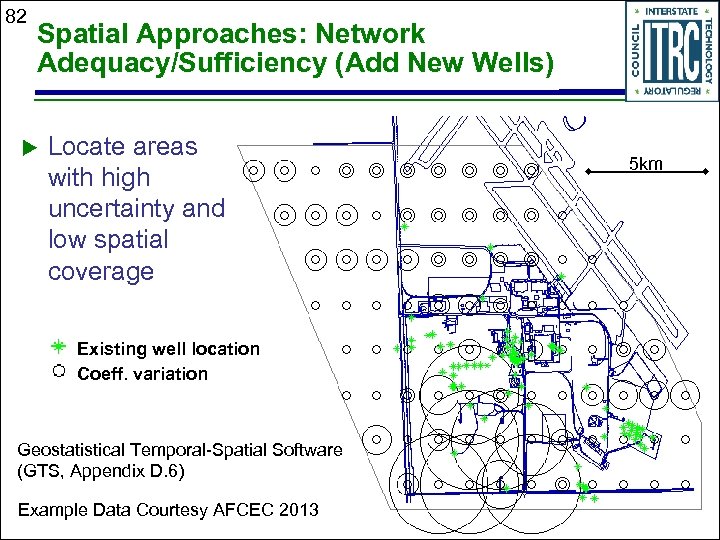 82 Spatial Approaches: Network Adequacy/Sufficiency (Add New Wells) Locate areas with high uncertainty and low spatial coverage Existing well location Coeff. variation Geostatistical Temporal-Spatial Software (GTS, Appendix D. 6) Example Data Courtesy AFCEC 2013 5 km
 83 Optimization Software Temporal and spatial optimization tools • 3 -Tiered Monitoring and Optimization Tool (3 TMO, • • Appendix D. 1) Monitoring and Remediation Optimization Software (MAROS, Appendix D. 11) Summit Tools (Appendix D. 21) Visual Sample Plan (VSP, Appendix D. 23) Geostatistical Temporal-Spatial Software (GTS, Appendix D. 6) ITRC GSMC-1, Appendix D
 84 Training Roadmap How to use the GSMC Document Getting Ready to Apply Statistics Question & Answer Break How to Apply Study Questions for • Background • Compliance • Trend Analysis • Monitoring Optimization Summary Question & Answer Break
 85 Statistical Methods/Tests 14 groups of methods • Grouped based type and application • Examples § 5. 1 Graphical methods § 5. 2 Confidence limits § 5. 5 Trends Details for each • Applications and relevant • • • § 5. 7 Nondetects References provided, including references to EPA’s Unified Guidance ITRC GSMC, Section 5 • • study questions are linked Assumptions Requirements and tips Strengths and weaknesses Further information Not intended as a “how to, ” but a resource
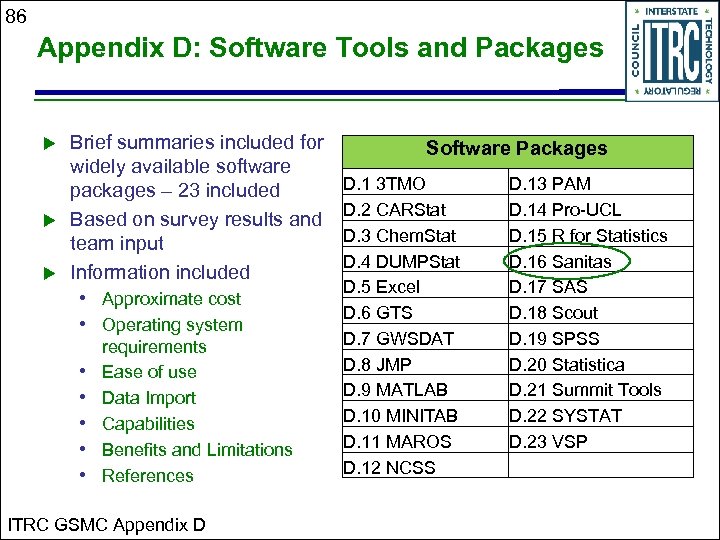 86 Appendix D: Software Tools and Packages Brief summaries included for widely available software packages – 23 included Based on survey results and team input Information included • Approximate cost • Operating system • • • requirements Ease of use Data Import Capabilities Benefits and Limitations References ITRC GSMC Appendix D Software Packages D. 1 3 TMO D. 2 CARStat D. 3 Chem. Stat D. 4 DUMPStat D. 5 Excel D. 6 GTS D. 7 GWSDAT D. 8 JMP D. 9 MATLAB D. 10 MINITAB D. 11 MAROS D. 12 NCSS D. 13 PAM D. 14 Pro-UCL D. 15 R for Statistics D. 16 Sanitas D. 17 SAS D. 18 Scout D. 19 SPSS D. 20 Statistica D. 21 Summit Tools D. 22 SYSTAT D. 23 VSP
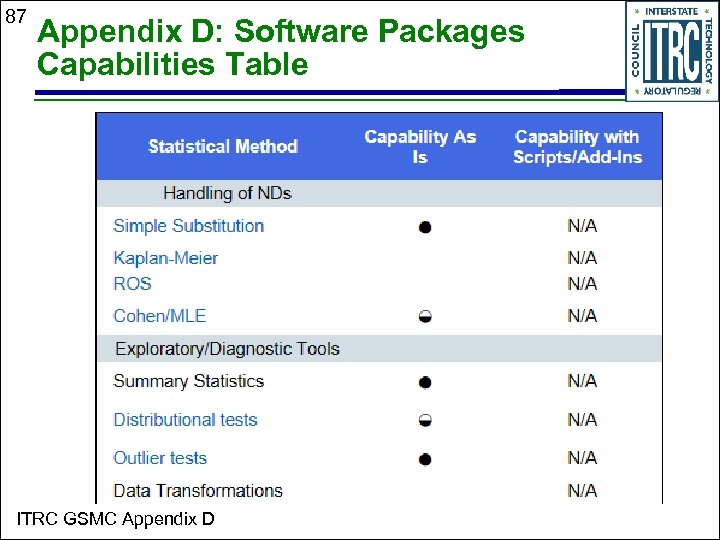 87 Appendix D: Software Packages Capabilities Table ITRC GSMC Appendix D
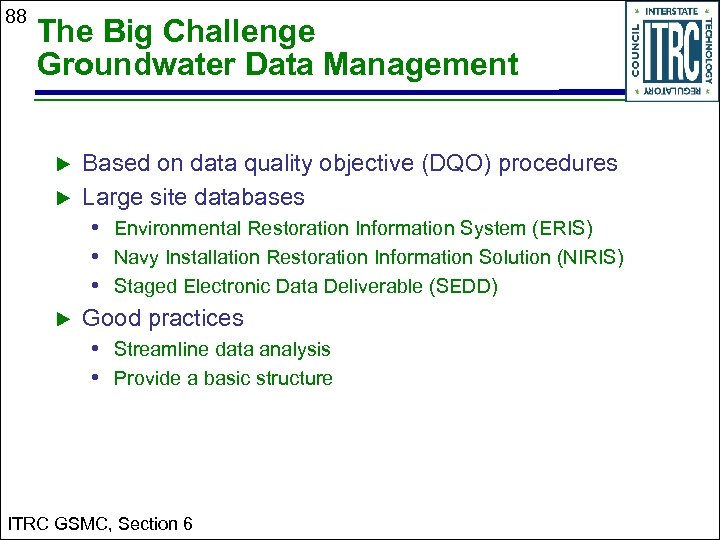 88 The Big Challenge Groundwater Data Management Based on data quality objective (DQO) procedures Large site databases • Environmental Restoration Information System (ERIS) • Navy Installation Restoration Information Solution (NIRIS) • Staged Electronic Data Deliverable (SEDD) Good practices • Streamline data analysis • Provide a basic structure ITRC GSMC, Section 6
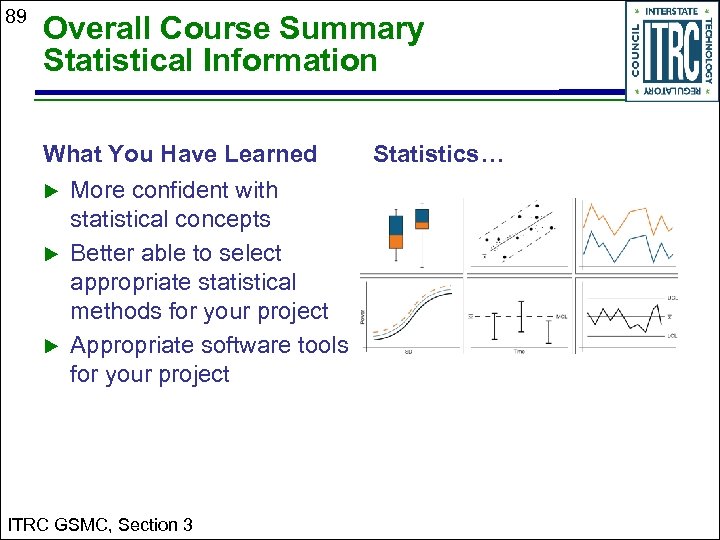 89 Overall Course Summary Statistical Information What You Have Learned Statistics… More confident with statistical concepts Better able to select appropriate statistical methods for your project Appropriate software tools for your project ITRC GSMC, Section 3
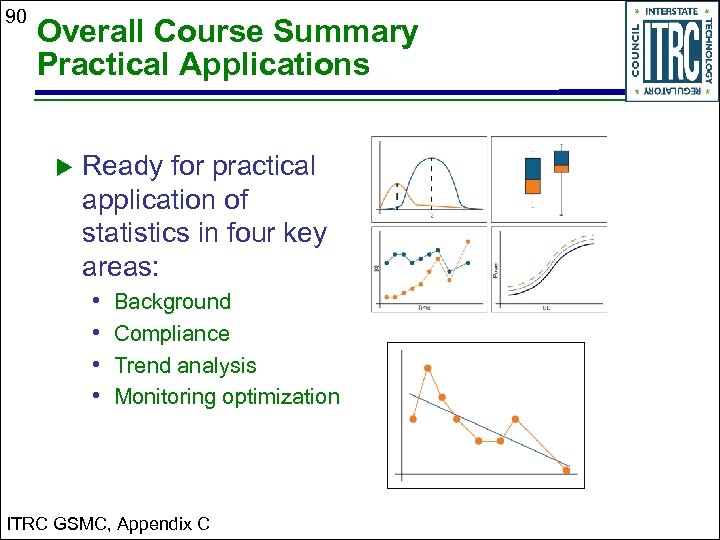 90 Overall Course Summary Practical Applications Ready for practical application of statistics in four key areas: • • Background Compliance Trend analysis Monitoring optimization ITRC GSMC, Appendix C
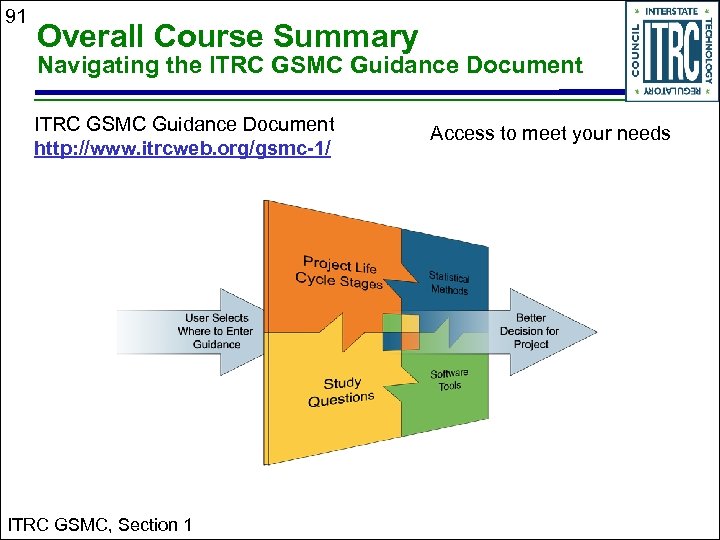 91 Overall Course Summary Navigating the ITRC GSMC Guidance Document http: //www. itrcweb. org/gsmc-1/ ITRC GSMC, Section 1 Access to meet your needs
 92 Follow ITRC Thank You 2 nd question and answer break Links to additional resources • http: //www. clu-in. org/conf/itrc/gsmc/resource. cfm Feedback form – please complete • http: //www. clu-in. org/conf/itrc/gsmc/feedback. cfm Need confirmation of your participation today? Fill out the feedback form and check box for confirmation email and certificate.