


 Скачать презентацию 1 st Q 2 Workshop Operational Issues from
bad03f744ad4a4a74fcd5c8b857cb5c7.ppt
- Количество слайдов: 17
 1 st Q 2 Workshop Operational Issues from NCDC Perspective • Archive, Access and Service • Assessment and Stewardship Steve Del Greco, Brian Nelson, Dongsoo Kim NOAA/NESDIS/NCDC Dongjun Seo – NOAA/NWS/OHD
 1 st Q 2 Workshop Incorporating Q 2 products into NOAA’s NCDC Archive, Operations and Customer Service Plan: § Archive Q 2 products on the NCDC robotic mass storage system § Provide dissemination/visualization capabilities for Q 2 products § Prepare for implementation of higher resolution data, new products, and new data streams (Dual Pol QPE, Phase Array) § Implement Q 2 products into spatial algorithms to be used to QC precipitation point data § Pilot Study on Regional Multisensor Precipitation Reanalysis
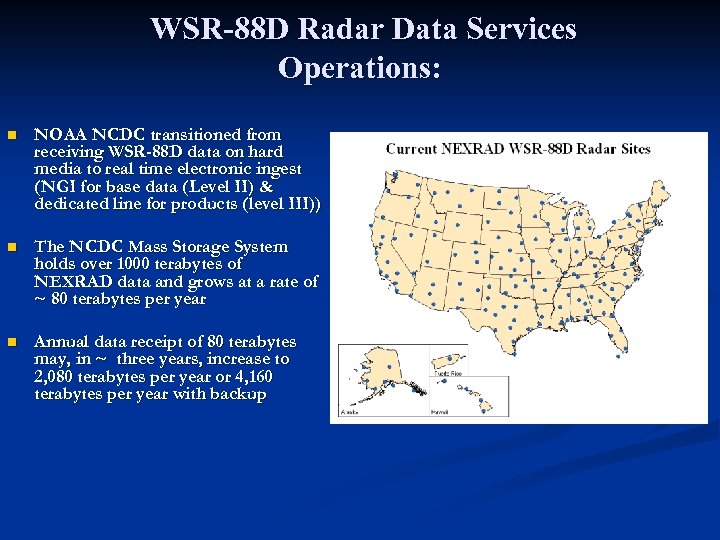 WSR-88 D Radar Data Services Operations: n NOAA NCDC transitioned from receiving WSR-88 D data on hard media to real time electronic ingest (NGI for base data (Level II) & dedicated line for products (level III)) n The NCDC Mass Storage System holds over 1000 terabytes of NEXRAD data and grows at a rate of ~ 80 terabytes per year n Annual data receipt of 80 terabytes may, in ~ three years, increase to 2, 080 terabytes per year or 4, 160 terabytes per year with backup
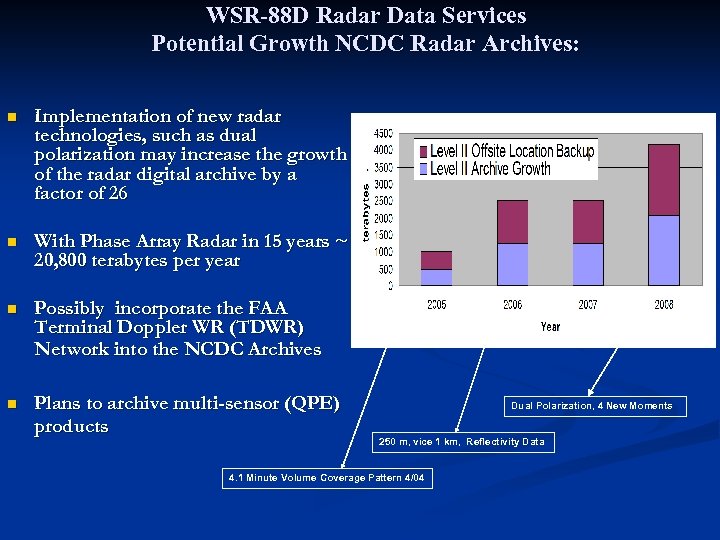 WSR-88 D Radar Data Services Potential Growth NCDC Radar Archives: n Implementation of new radar technologies, such as dual polarization may increase the growth of the radar digital archive by a factor of 26 n With Phase Array Radar in 15 years ~ 20, 800 terabytes per year n Possibly incorporate the FAA Terminal Doppler WR (TDWR) Network into the NCDC Archives n Plans to archive multi-sensor (QPE) products Dual Polarization, 4 New Moments 250 m, vice 1 km, Reflectivity Data 4. 1 Minute Volume Coverage Pattern 4/04
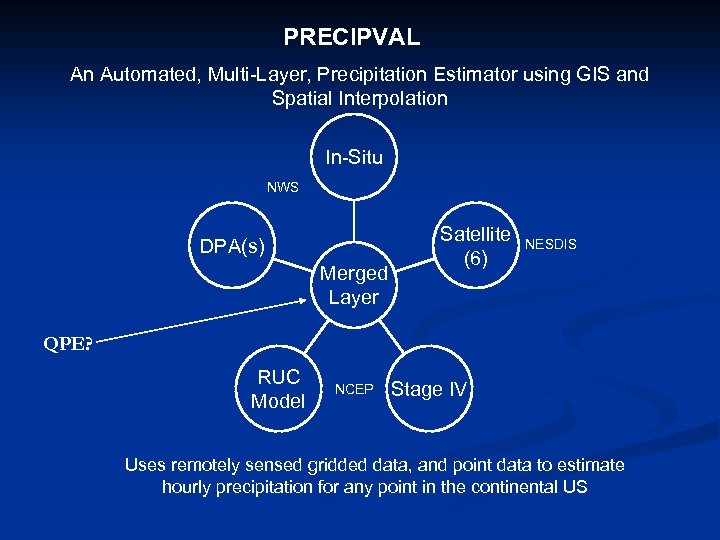 PRECIPVAL An Automated, Multi-Layer, Precipitation Estimator using GIS and Spatial Interpolation In-Situ NWS DPA(s) Merged Layer Satellite (6) NESDIS QPE? RUC Model NCEP Stage IV Uses remotely sensed gridded data, and point data to estimate hourly precipitation for any point in the continental US
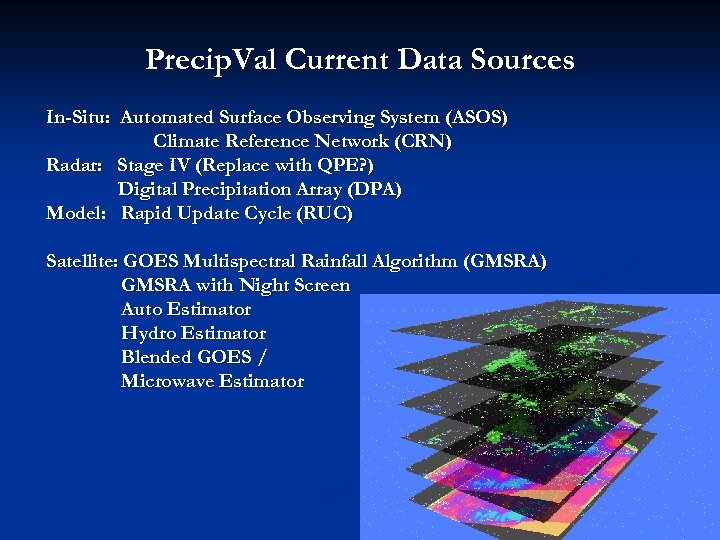 Precip. Val Current Data Sources In-Situ: Automated Surface Observing System (ASOS) Climate Reference Network (CRN) Radar: Stage IV (Replace with QPE? ) Digital Precipitation Array (DPA) Model: Rapid Update Cycle (RUC) Satellite: GOES Multispectral Rainfall Algorithm (GMSRA) GMSRA with Night Screen Auto Estimator Hydro Estimator Blended GOES / Microwave Estimator
 1 st Q 2 Workshop Assessment and Stewardship Pilot Study on Regional Multisensor Precipitation Reanalysis Objective: • Provision of high resolution (5 km), high frequency (1 hr) precipitation climate database • Input to Distributed Hydrologic Models • Input to Regional Climate Models
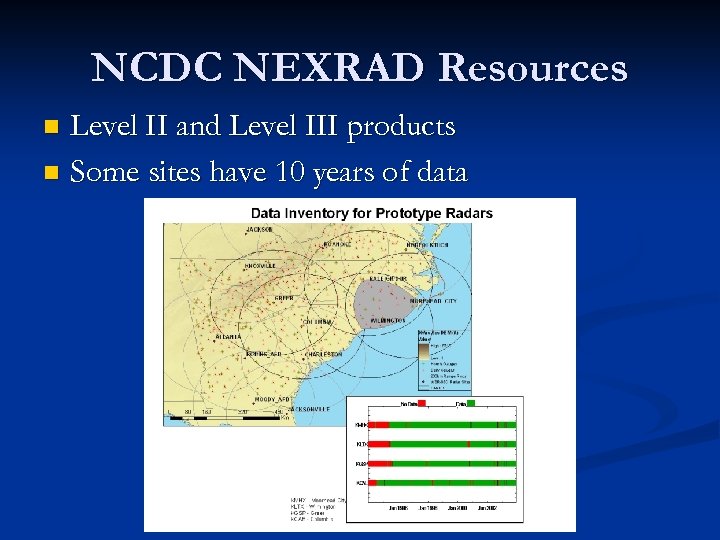 NCDC NEXRAD Resources Level II and Level III products n Some sites have 10 years of data n
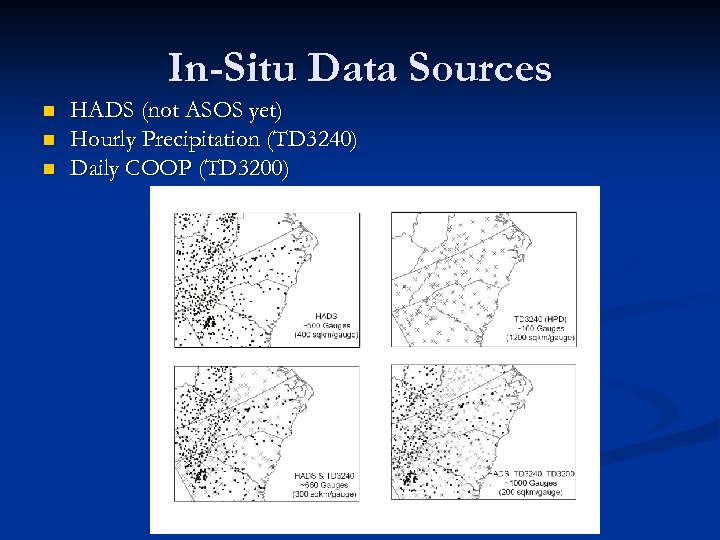 In-Situ Data Sources n n n HADS (not ASOS yet) Hourly Precipitation (TD 3240) Daily COOP (TD 3200)
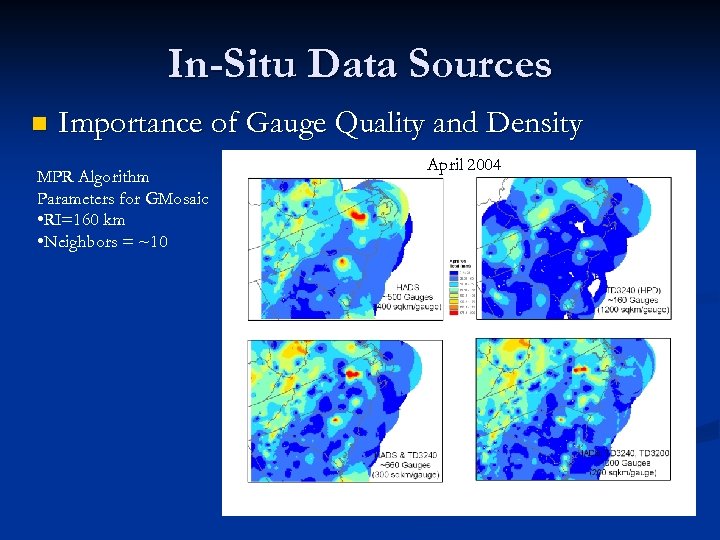 In-Situ Data Sources n Importance of Gauge Quality and Density MPR Algorithm Parameters for GMosaic • RI=160 km • Neighbors = ~10 April 2004
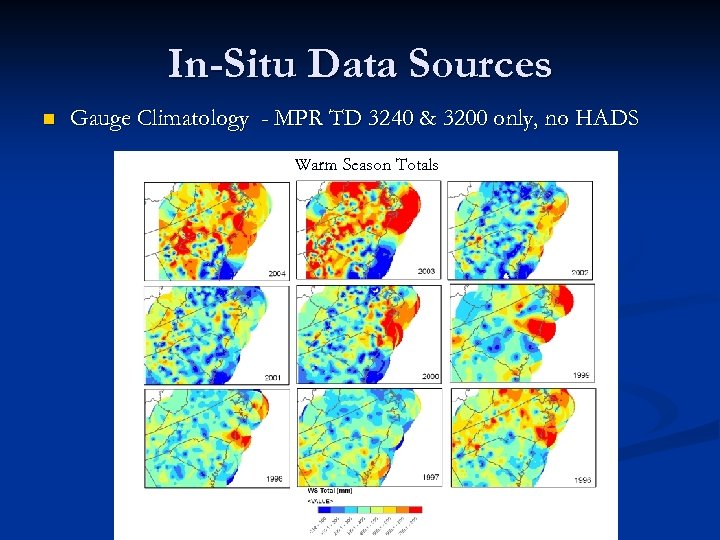 In-Situ Data Sources n Gauge Climatology - MPR TD 3240 & 3200 only, no HADS Warm Season Totals
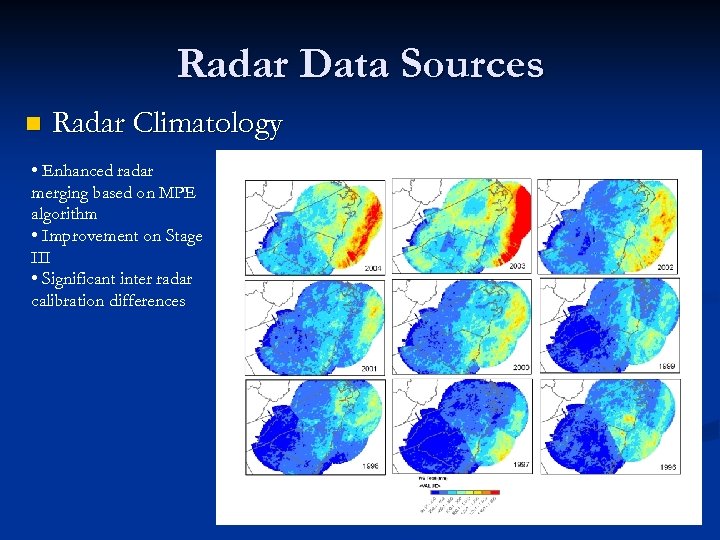 Radar Data Sources n Radar Climatology • Enhanced radar merging based on MPE algorithm • Improvement on Stage III • Significant inter radar calibration differences
 Reprocessing of HADS Precip Ongoing historic HADS (1996 -) archive will be completed by Aug 2006 n Sub-hourly PC will be converted to hourly PP n HADS precip will be included in Health of Network* for user feedback n Add QA/QC and data recovery under Scientific Data Stewardship discipline n * http: //www. ncdc. noaa. gov/oa/hofn
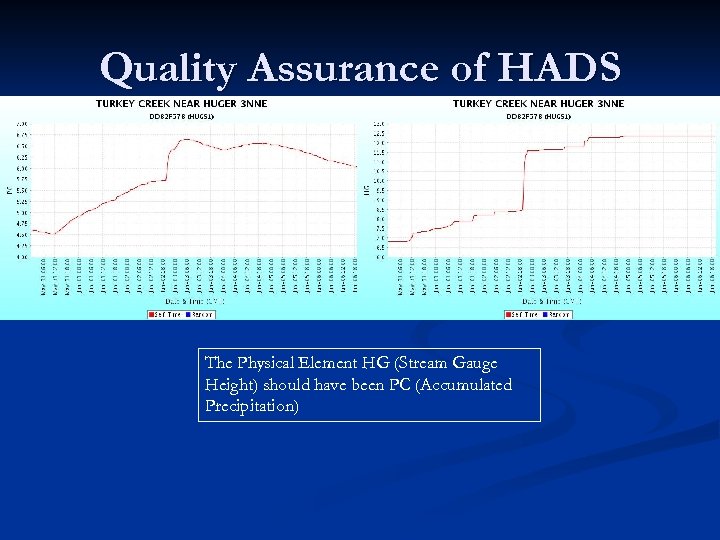 Quality Assurance of HADS The Physical Element HG (Stream Gauge Height) should have been PC (Accumulated Precipitation)
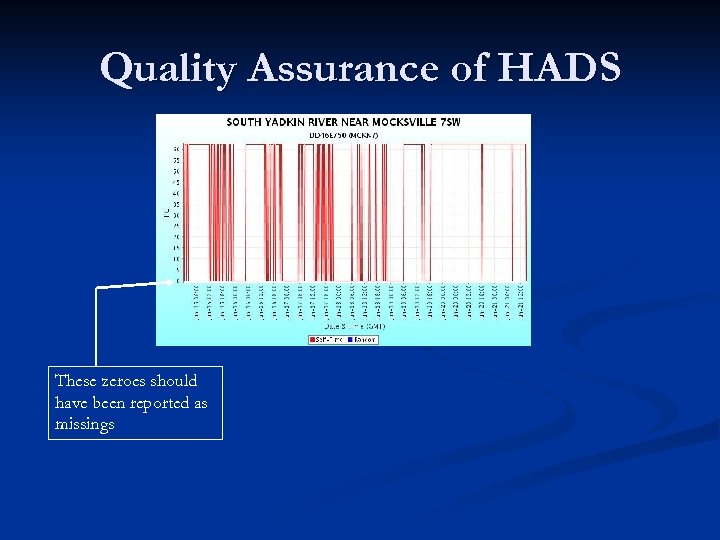 Quality Assurance of HADS These zeroes should have been reported as missings
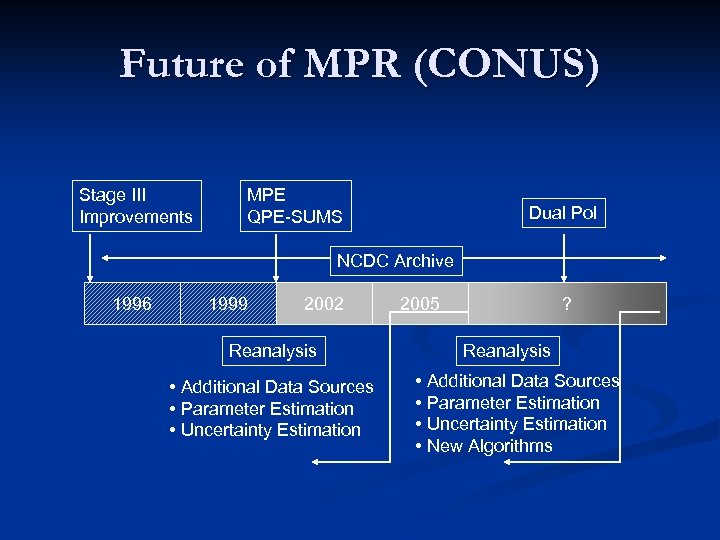 Future of MPR (CONUS) Stage III Improvements MPE QPE-SUMS Dual Pol NCDC Archive 1996 1999 2002 Reanalysis • Additional Data Sources • Parameter Estimation • Uncertainty Estimation 2005 ? Reanalysis • Additional Data Sources • Parameter Estimation • Uncertainty Estimation • New Algorithms
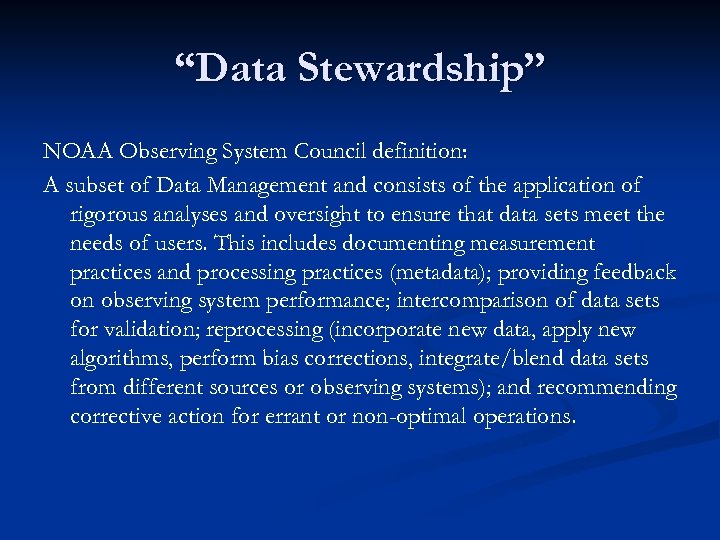 “Data Stewardship” NOAA Observing System Council definition: A subset of Data Management and consists of the application of rigorous analyses and oversight to ensure that data sets meet the needs of users. This includes documenting measurement practices and processing practices (metadata); providing feedback on observing system performance; intercomparison of data sets for validation; reprocessing (incorporate new data, apply new algorithms, perform bias corrections, integrate/blend data sets from different sources or observing systems); and recommending corrective action for errant or non-optimal operations.