 Скачать презентацию 1 Simple and Flexible Revocation Checking with Privacy
391fb5dab750fb47a09a5c25ed579887.ppt
- Количество слайдов: 24



1 Simple and Flexible Revocation Checking with Privacy John Solis and Gene Tsudik University of California, Irvine 6 th Workshop on Privacy Enhancing Technologies, June 28 -30, 2006
2 Digital Certificates ● PK Certificate – – Signed by issuer (CA) – ● Binds public key to identity-string (name) Valid from XXXX, Expires on YYYY Premature revocation: – Private key loss/compromise – Algorithm weakness – Subject becomes malicious – Change in security policy – Job change/Promotions 6 th Workshop on Privacy Enhancing Technologies, June 28 -30, 2006
3 Revocation Checking Issues ● Validate certificates prior to communication: – – Check revocation status (each time, even if cached) – ● Verify signature(s) Implies subsequent communication Privacy leak – third parties find out about: 1. 2. – Source of the revocation query Target of the query Goal: Construct a simple, efficient, and flexible privacy-preserving method for revocation checking 6 th Workshop on Privacy Enhancing Technologies, June 28 -30, 2006
4 Revocation Classes ● Implicit – ● Certificate owner supplies proof of non-revocation, e. g. , CRS Explicit – CA issues (signed) data structure containing revocation information, e. g. , CRL 6 th Workshop on Privacy Enhancing Technologies, June 28 -30, 2006
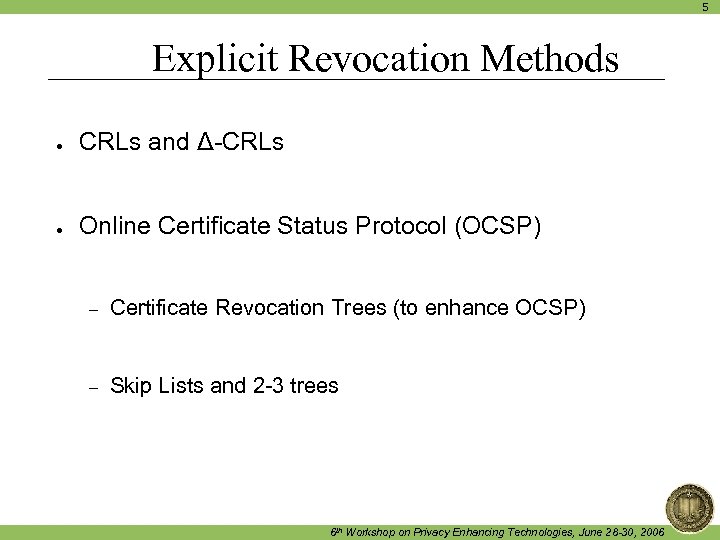
5 Explicit Revocation Methods ● CRLs and Δ-CRLs ● Online Certificate Status Protocol (OCSP) – Certificate Revocation Trees (to enhance OCSP) – Skip Lists and 2 -3 trees 6 th Workshop on Privacy Enhancing Technologies, June 28 -30, 2006
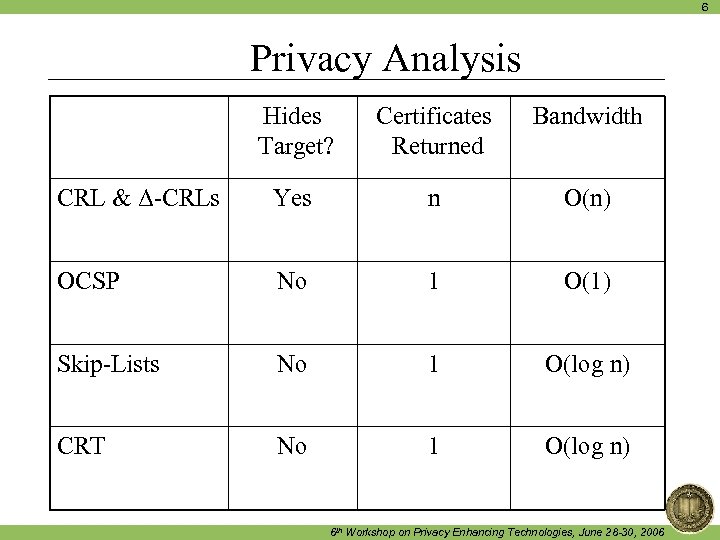
6 Privacy Analysis Hides Target? Certificates Returned Bandwidth CRL & Δ-CRLs Yes n O(n) OCSP No 1 O(1) Skip-Lists No 1 O(log n) CRT No 1 O(log n) 6 th Workshop on Privacy Enhancing Technologies, June 28 -30, 2006
7 Question: ● Is there a practical technique to provide privacy for current revocation methods? 6 th Workshop on Privacy Enhancing Technologies, June 28 -30, 2006
8 Related Work ● H. Kikuchi “Privacy-preserving revocation check in pki” – – ● Identifies problem Proposed heavy-weight (inefficient) cryptographic technique Private Information Retrieval (PIR) – Obscures targets of database queries – Multi-round protocols/Expensive crypto – Overkill 6 th Workshop on Privacy Enhancing Technologies, June 28 -30, 2006
9 Privacy Preserving Revocation Checking ● ● CRTs amenable to supporting privacy-preserving querying Modify CRT structure: 1. Range Queries 2. Permuted Ordering 6 th Workshop on Privacy Enhancing Technologies, June 28 -30, 2006
10 CRT Details : Notation ● n sequentially sorted revoked nodes – lo, hi - lowest and highest numbered nodes ● Ci - certificate with serial number i ● Li…Lm – Leaf nodes of CRT ● N(Li ) – Serial number of leaf node Li ● H() – cryptographic hash function ● ● co-path – sequence of nodes representing siblings of all direct ancestors LCA – Least common ancestor of two nodes 6 th Workshop on Privacy Enhancing Technologies, June 28 -30, 2006
11 CRT Construction ● Each leaf node Li contains: – Certificate hash ● ● ● Reason for revocation Each non leaf node computed as hash of child nodes – ● Date/time of revocation H(parent) = H(L||R) CA digital signs root node and distributes 6 th Workshop on Privacy Enhancing Technologies, June 28 -30, 2006
12 CRT Query ● Client queries certificate with serial number i ● If Ci is not revoked, compose response: 1. Two adjacent leaf nodes Lp, Lp+1 st N(Lp) < i < N(Lp+1) 2. Three partial co-paths: 1. 2. Lp+1 to LCA 3. Lp to LCA to Root Signed root node (maybe cached by client) 6 th Workshop on Privacy Enhancing Technologies, June 28 -30, 2006
13 CRT Query ● If Ci is revoked, then response: 1. 2. Co-path starting from sibling of parent node 3. ● Two adjacent sibling nodes Lp, Lp+1 st N(Lp) = i or N(Lp+1) = i Signed root node Clients verify response 1. 2. ● Re-compute root hash using returned leaf nodes and co-paths Verify signature on root node CRT inherently guarantees completeness 6 th Workshop on Privacy Enhancing Technologies, June 28 -30, 2006
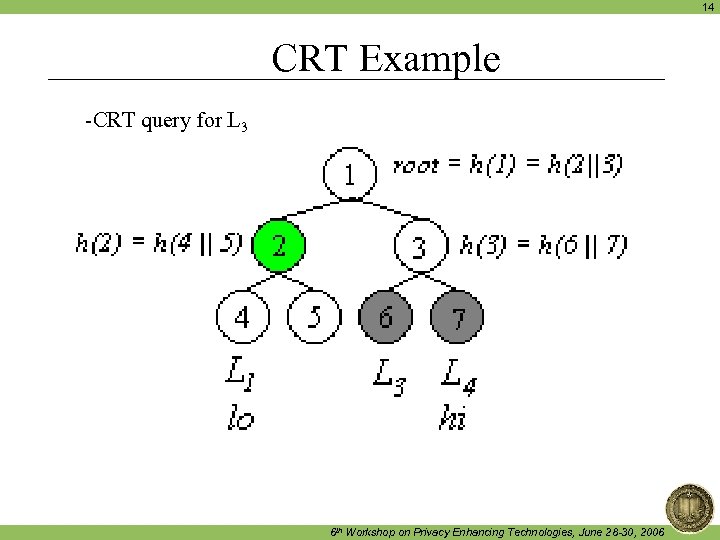
14 CRT Example -CRT query for L 3 6 th Workshop on Privacy Enhancing Technologies, June 28 -30, 2006
15 Privacy Preserving Revocation Checking ● CRTs amenable to include privacy ● Modify CRT structure: 1. Range Queries 2. Permuted Ordering 6 th Workshop on Privacy Enhancing Technologies, June 28 -30, 2006
16 Range Queries ● Observation: MOST Certificates ARE NOT revoked! ● Query for a range of certificates ● Range size determined by: 1. Desired degree of privacy 2. Density/number of revoked nodes 6 th Workshop on Privacy Enhancing Technologies, June 28 -30, 2006
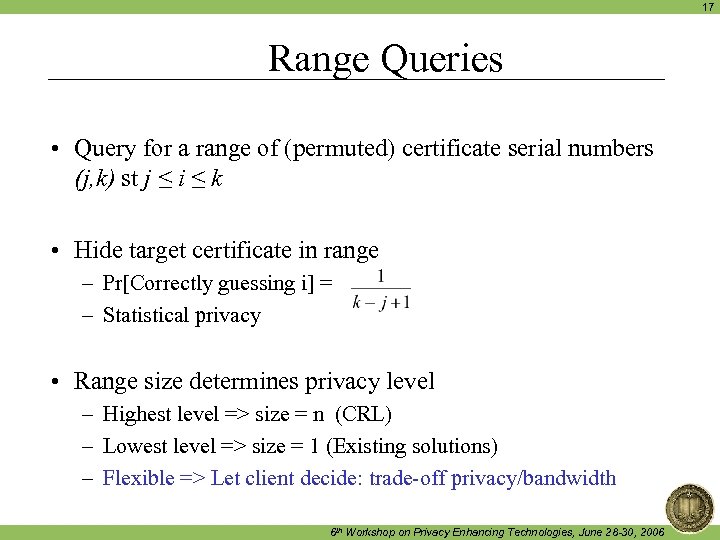
17 Range Queries • Query for a range of (permuted) certificate serial numbers (j, k) st j ≤ i ≤ k • Hide target certificate in range – Pr[Correctly guessing i] = – Statistical privacy • Range size determines privacy level – Highest level => size = n (CRL) – Lowest level => size = 1 (Existing solutions) – Flexible => Let client decide: trade-off privacy/bandwidth 6 th Workshop on Privacy Enhancing Technologies, June 28 -30, 2006
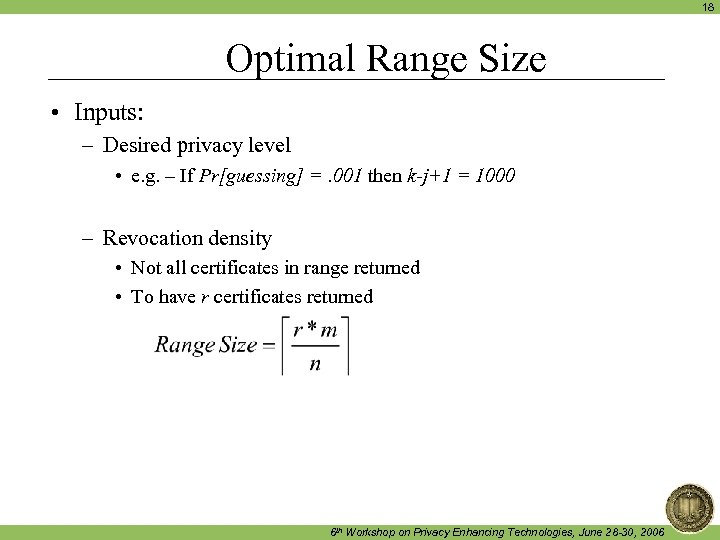
18 Optimal Range Size • Inputs: – Desired privacy level • e. g. – If Pr[guessing] =. 001 then k-j+1 = 1000 – Revocation density • Not all certificates in range returned • To have r certificates returned 6 th Workshop on Privacy Enhancing Technologies, June 28 -30, 2006
19 Privacy Preserving Revocation Checking ● Modify CRT structure: 1. Range Queries 2. Permuted Ordering 6 th Workshop on Privacy Enhancing Technologies, June 28 -30, 2006
20 Permuted Ordering ● CAs issue certificates sequentially – Pros: ● ● – Allows for defined subclasses Easier management Cons: ● Consecutive blocks possibly related (information leak) ● Solution: Permuted ordering 6 th Workshop on Privacy Enhancing Technologies, June 28 -30, 2006
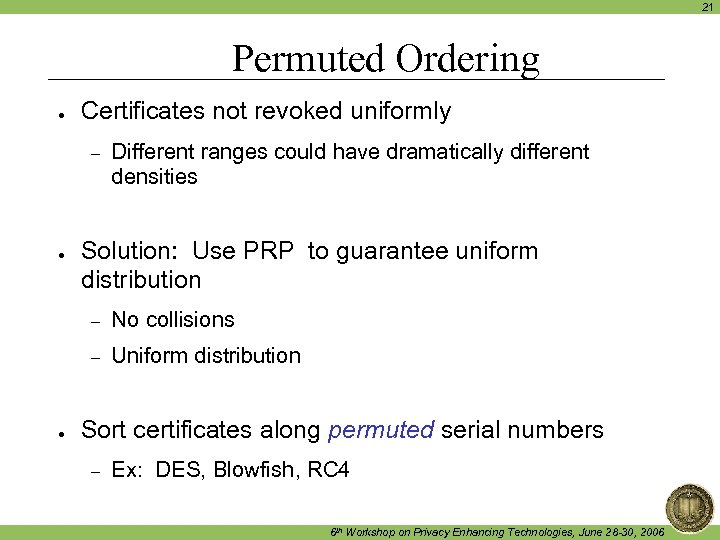
21 Permuted Ordering ● Certificates not revoked uniformly – ● Different ranges could have dramatically different densities Solution: Use PRP to guarantee uniform distribution – – ● No collisions Uniform distribution Sort certificates along permuted serial numbers – Ex: DES, Blowfish, RC 4 6 th Workshop on Privacy Enhancing Technologies, June 28 -30, 2006
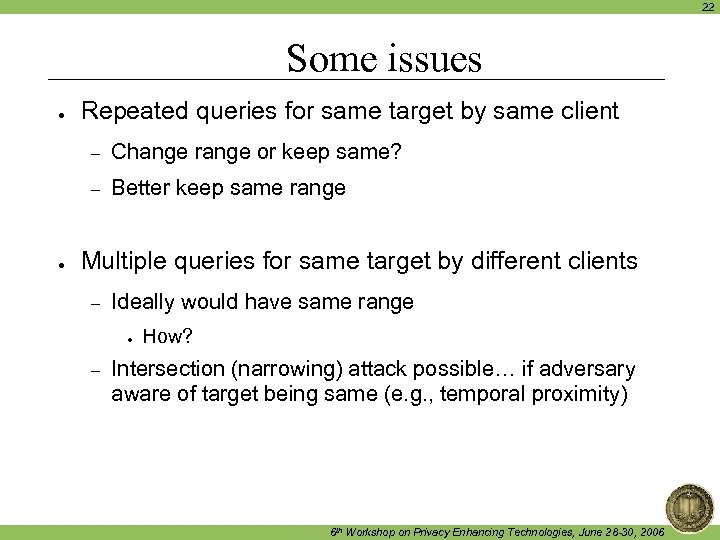
22 Some issues ● Repeated queries for same target by same client – – ● Change range or keep same? Better keep same range Multiple queries for same target by different clients – Ideally would have same range ● – How? Intersection (narrowing) attack possible… if adversary aware of target being same (e. g. , temporal proximity) 6 th Workshop on Privacy Enhancing Technologies, June 28 -30, 2006
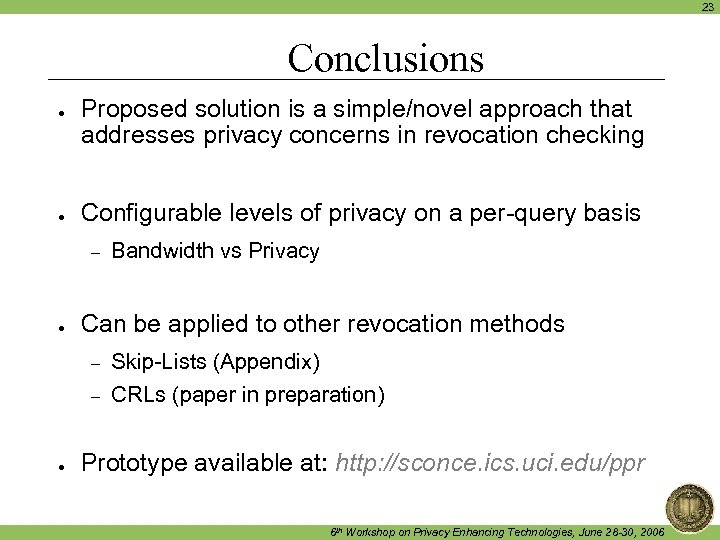
23 Conclusions ● ● Proposed solution is a simple/novel approach that addresses privacy concerns in revocation checking Configurable levels of privacy on a per-query basis – ● Bandwidth vs Privacy Can be applied to other revocation methods – – ● Skip-Lists (Appendix) CRLs (paper in preparation) Prototype available at: http: //sconce. ics. uci. edu/ppr 6 th Workshop on Privacy Enhancing Technologies, June 28 -30, 2006
24 Questions? 6 th Workshop on Privacy Enhancing Technologies, June 28 -30, 2006
Скачать презентацию 1 Simple and Flexible Revocation Checking with Privacy
391fb5dab750fb47a09a5c25ed579887.ppt