 Скачать презентацию 1 Short-Term Decisions and Accounting Information Prepared by
bf83134a7fc018a79f35ed34864016f7.ppt
- Количество слайдов: 39



1 Short-Term Decisions and Accounting Information Prepared by Douglas Cloud Pepperdine University 5
2 Objectives § Explain why decision making requires After reading this information not included in regular chapter, accounting reports. you should be able to: § Determine what costs and revenues are relevant to decisions. § Analyze the quantitative factors relevant to typical decisions. § Explain the importance of complementary effects to decisions of a segment of a larger entity. Continued
3 Objectives § Identify nonquantitative or long-term considerations that influence short-term decisions. § Describe some of the legal constraints on managers’ decisions.
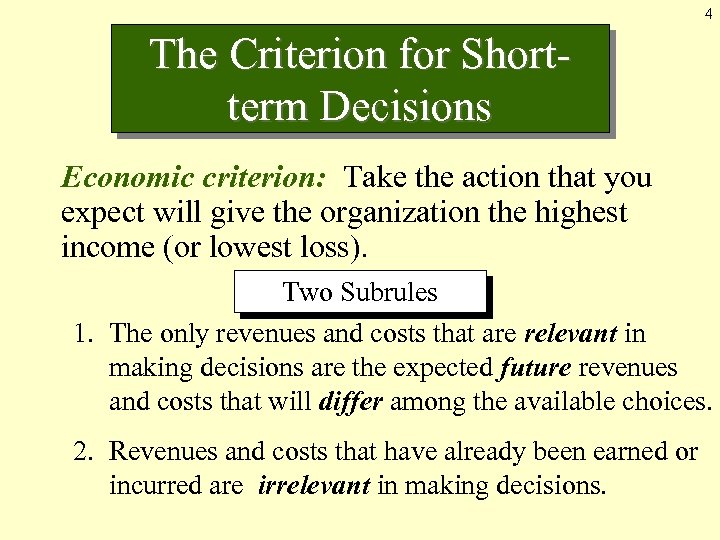
4 The Criterion for Shortterm Decisions Economic criterion: Take the action that you expect will give the organization the highest income (or lowest loss). Two Subrules 1. The only revenues and costs that are relevant in making decisions are the expected future revenues and costs that will differ among the available choices. 2. Revenues and costs that have already been earned or incurred are irrelevant in making decisions.
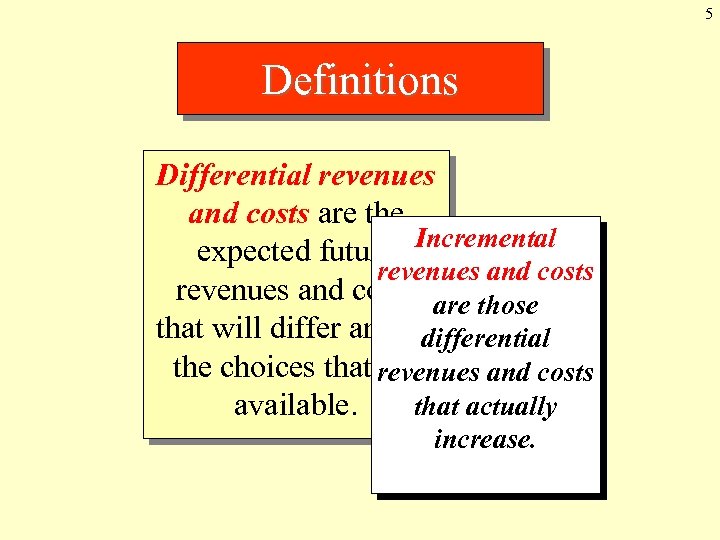
5 Definitions Differential revenues and costs are the Incremental expected future revenues and costs are those that will differ among differential the choices that revenues and costs are that actually available. increase.
6 Definitions Sunk costs are costs that have already been incurred and therefore will be the same no matter which alternative a manager selects. Examples: – Book value of equipment – Original purchase price of building
7 Definitions An opportunity cost is the benefit lost by taking one action as opposed to another. Example: Rental income lost if facility is used for production.
8 Typical Short-Term Decisions q Drop a Segment q Make-or-Buy q Joint Product q Special Order q Factors of Limited Supply Important: Short-term Perspective
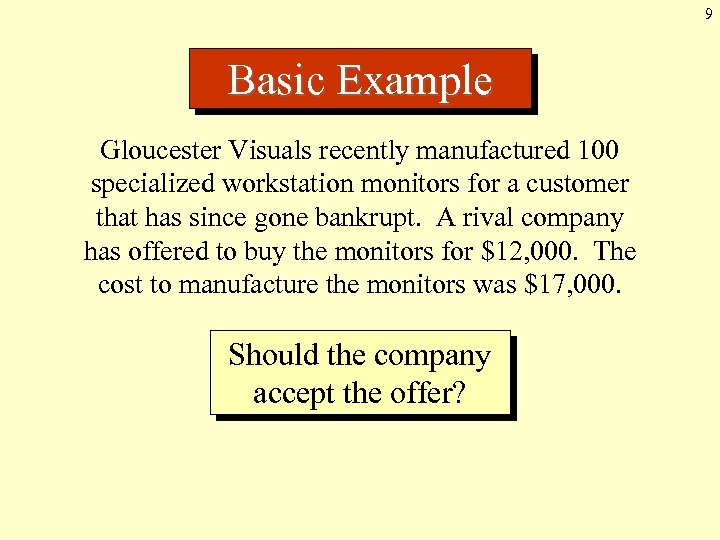
9 Basic Example Gloucester Visuals recently manufactured 100 specialized workstation monitors for a customer that has since gone bankrupt. A rival company has offered to buy the monitors for $12, 000. The cost to manufacture the monitors was $17, 000. Should the company accept the offer?
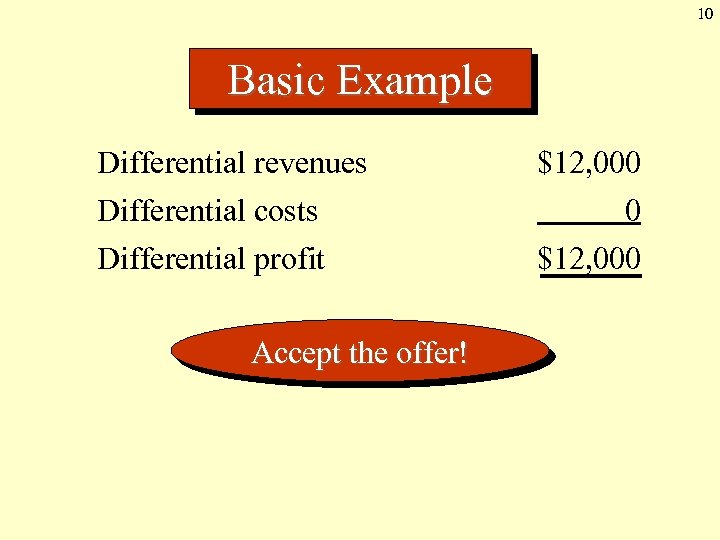
10 Basic Example Differential revenues Differential costs Differential profit Accept the offer! $12, 000 0 $12, 000
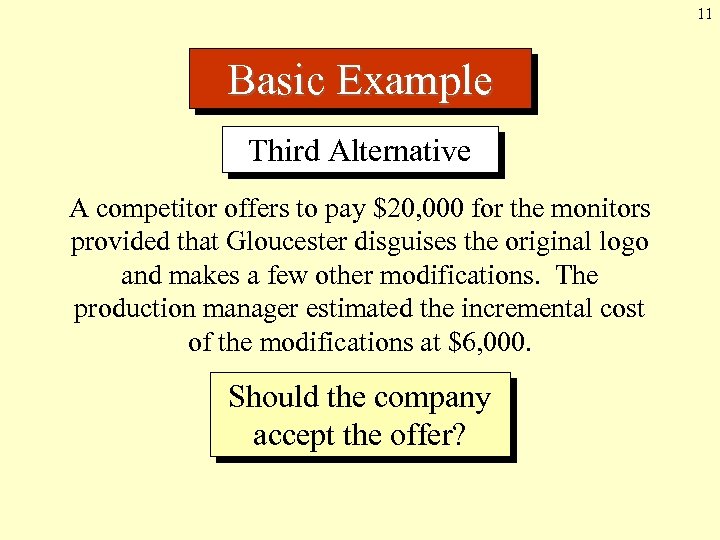
11 Basic Example Third Alternative A competitor offers to pay $20, 000 for the monitors provided that Gloucester disguises the original logo and makes a few other modifications. The production manager estimated the incremental cost of the modifications at $6, 000. Should the company accept the offer?
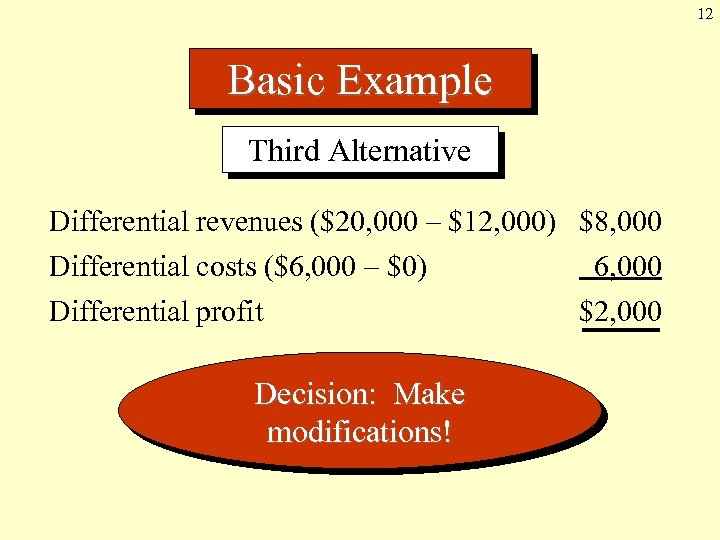
12 Basic Example Third Alternative Differential revenues ($20, 000 – $12, 000) $8, 000 Differential costs ($6, 000 – $0) Differential profit Decision: Make modifications! 6, 000 $2, 000
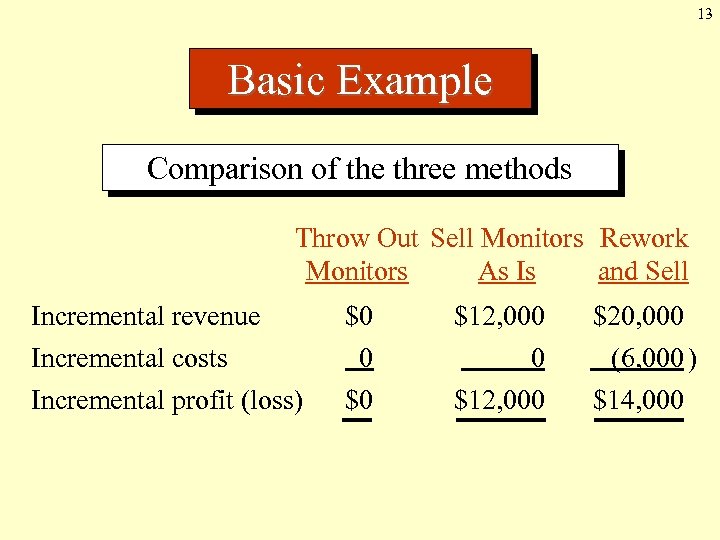
13 Basic Example Comparison of the three methods Throw Out Sell Monitors Rework Monitors As Is and Sell Incremental revenue Incremental costs Incremental profit (loss) $0 $12, 000 0 0 $0 $12, 000 $20, 000 (6, 000 ) $14, 000
14 Activity-Based Estimates Using ABC helps managers focus on what activities change as a result of a decision.
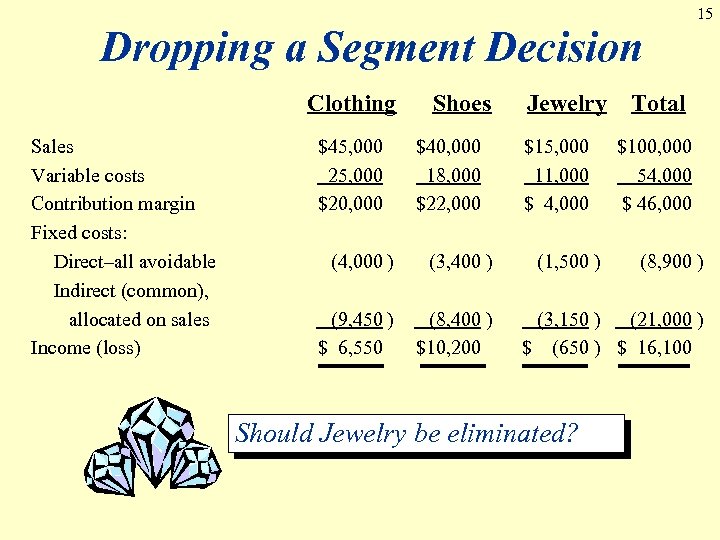
Dropping a Segment Decision Clothing Sales Variable costs Contribution margin Fixed costs: Direct–all avoidable Indirect (common), allocated on sales Income (loss) $45, 000 25, 000 $20, 000 Shoes $40, 000 18, 000 $22, 000 (4, 000 ) (3, 400 ) (9, 450 ) $ 6, 550 (8, 400 ) $10, 200 Jewelry $15, 000 11, 000 $ 4, 000 (1, 500 ) 15 Total $100, 000 54, 000 $ 46, 000 (8, 900 ) (3, 150 ) (21, 000 ) $ (650 ) $ 16, 100 Should Jewelry be eliminated?
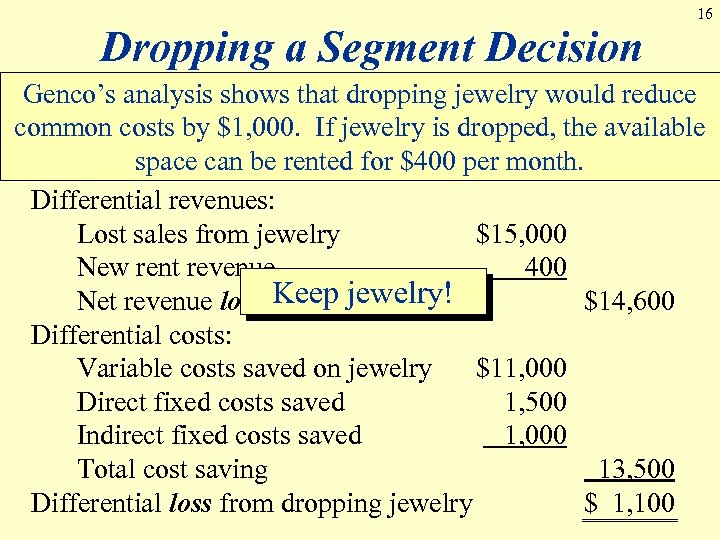
Dropping a Segment Decision 16 Genco’s analysis shows that dropping jewelry would reduce common costs by $1, 000. If jewelry is dropped, the available space can be rented for $400 per month. Differential revenues: Lost sales from jewelry $15, 000 New rent revenue 400 Net revenue lost Keep jewelry! $14, 600 Differential costs: Variable costs saved on jewelry $11, 000 Direct fixed costs saved 1, 500 Indirect fixed costs saved 1, 000 Total cost saving 13, 500 Differential loss from dropping jewelry $ 1, 100
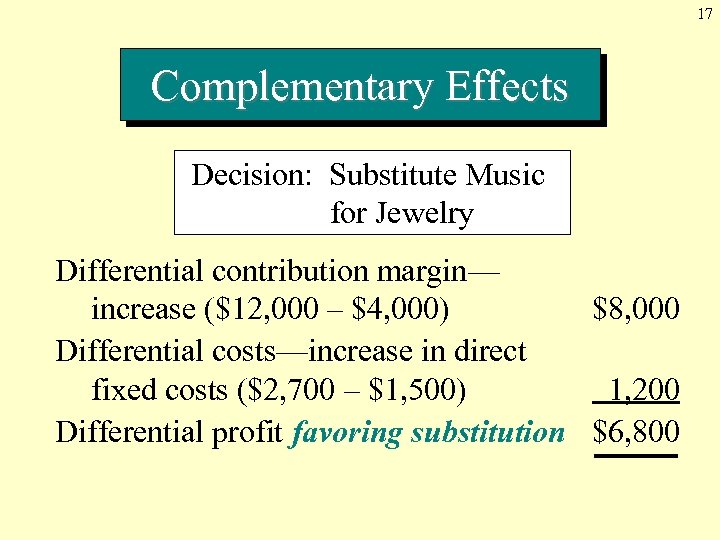
17 Complementary Effects Decision: Substitute Music for Jewelry Differential contribution margin— increase ($12, 000 – $4, 000) $8, 000 Differential costs—increase in direct fixed costs ($2, 700 – $1, 500) 1, 200 Differential profit favoring substitution $6, 800
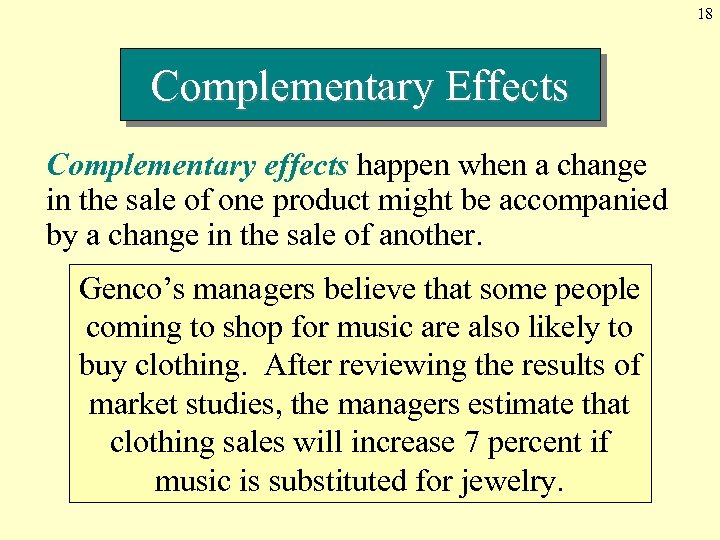
18 Complementary Effects Complementary effects happen when a change in the sale of one product might be accompanied by a change in the sale of another. Genco’s managers believe that some people coming to shop for music are also likely to buy clothing. After reviewing the results of market studies, the managers estimate that clothing sales will increase 7 percent if music is substituted for jewelry.
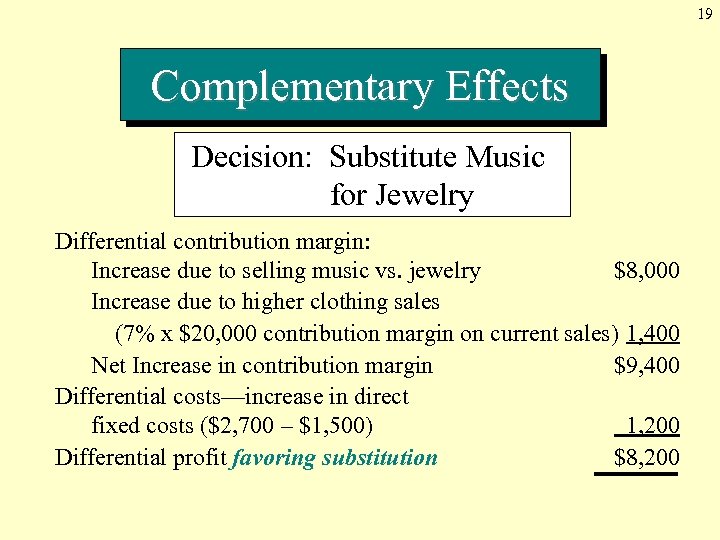
19 Complementary Effects Decision: Substitute Music for Jewelry Differential contribution margin: Increase due to selling music vs. jewelry $8, 000 Increase due to higher clothing sales (7% x $20, 000 contribution margin on current sales) 1, 400 Net Increase in contribution margin $9, 400 Differential costs—increase in direct fixed costs ($2, 700 – $1, 500) 1, 200 Differential profit favoring substitution $8, 200
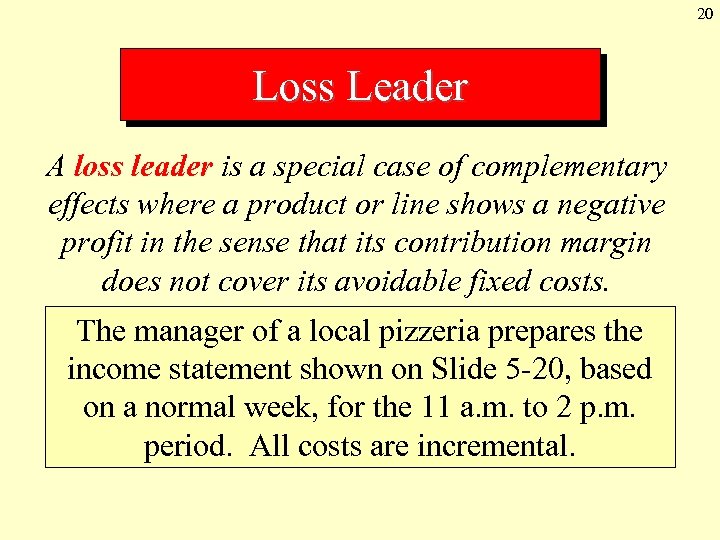
20 Loss Leader A loss leader is a special case of complementary effects where a product or line shows a negative profit in the sense that its contribution margin does not cover its avoidable fixed costs. The manager of a local pizzeria prepares the income statement shown on Slide 5 -20, based on a normal week, for the 11 a. m. to 2 p. m. period. All costs are incremental.
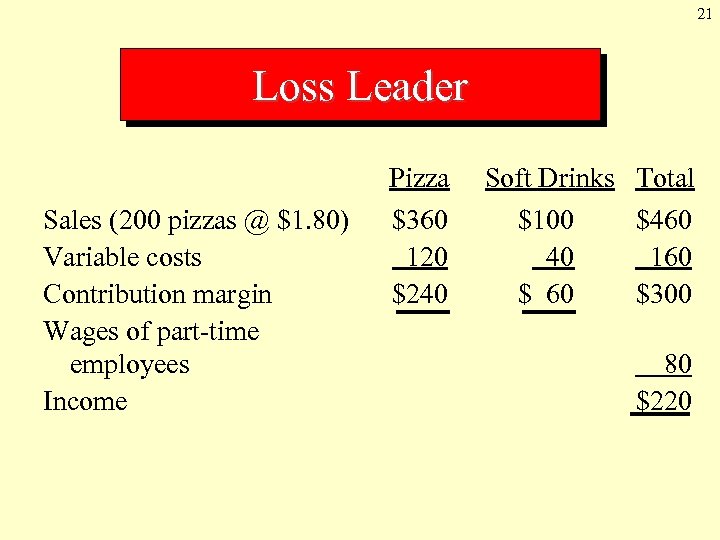
21 Loss Leader Sales (200 pizzas @ $1. 80) Variable costs Contribution margin Wages of part-time employees Income Pizza $360 120 $240 Soft Drinks Total $100 $460 40 160 $300 80 $220
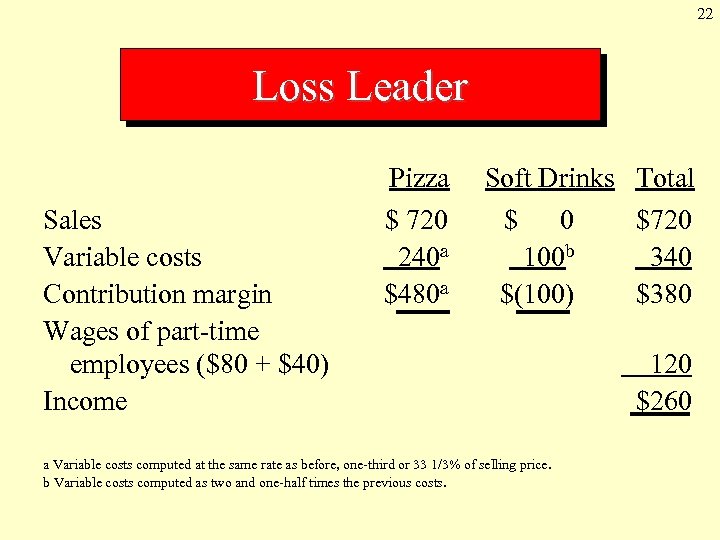
22 Loss Leader Sales Variable costs Contribution margin Wages of part-time employees ($80 + $40) Income Pizza $ 720 240 a $480 a Soft Drinks Total $ 0 $720 100 b 340 $(100) $380 a Variable costs computed at the same rate as before, one-third or 33 1/3% of selling price. b Variable costs computed as two and one-half times the previous costs. 120 $260
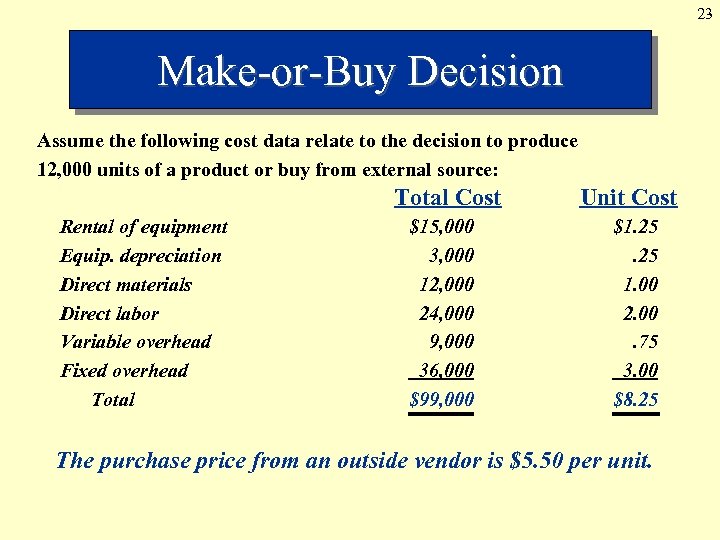
23 Make-or-Buy Decision Assume the following cost data relate to the decision to produce 12, 000 units of a product or buy from external source: Total Cost Rental of equipment Equip. depreciation Direct materials Direct labor Variable overhead Fixed overhead Total $15, 000 3, 000 12, 000 24, 000 9, 000 36, 000 $99, 000 Unit Cost $1. 25 1. 00 2. 00. 75 3. 00 $8. 25 The purchase price from an outside vendor is $5. 50 per unit.
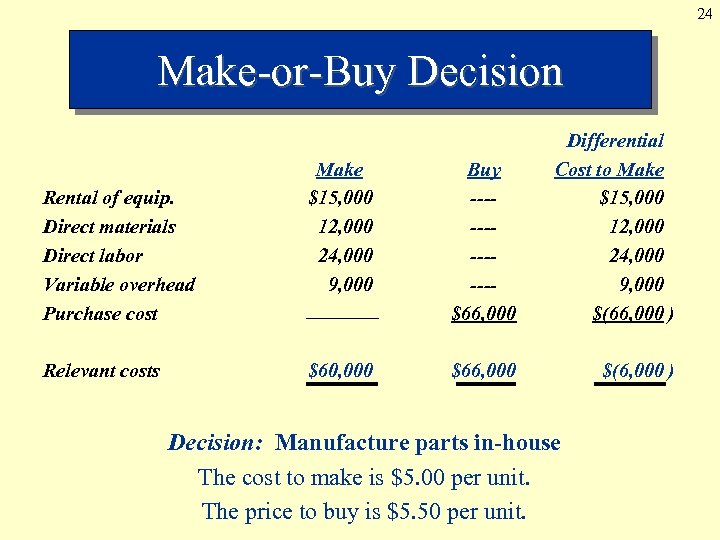
24 Make-or-Buy Decision Relevant costs Buy ------$66, 000 $60, 000 Rental of equip. Direct materials Direct labor Variable overhead Purchase cost Make $15, 000 12, 000 24, 000 9, 000 Differential Cost to Make $15, 000 12, 000 24, 000 9, 000 $(66, 000 ) $66, 000 $(6, 000 ) Decision: Manufacture parts in-house The cost to make is $5. 00 per unit. The price to buy is $5. 50 per unit.
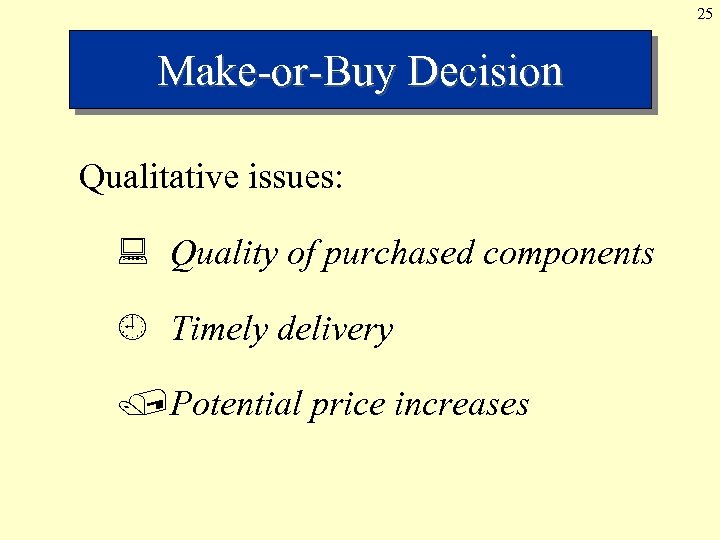
25 Make-or-Buy Decision Qualitative issues: : Quality of purchased components ¿ Timely delivery / Potential price increases
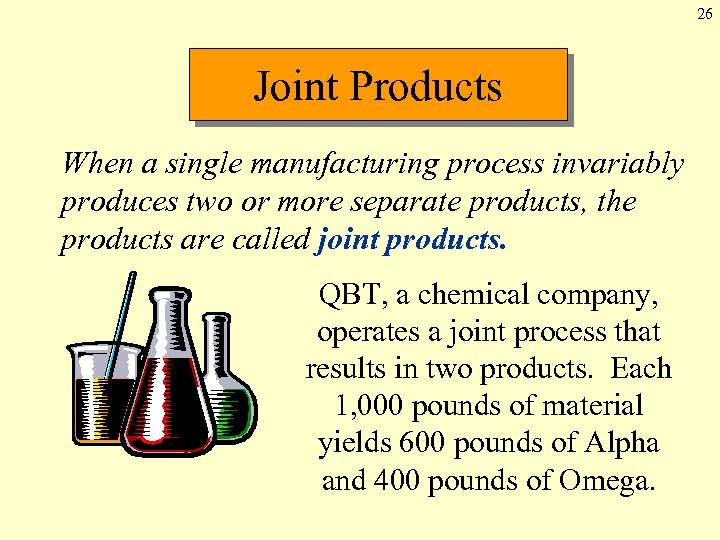
26 Joint Products When a single manufacturing process invariably produces two or more separate products, the products are called joint products. QBT, a chemical company, operates a joint process that results in two products. Each 1, 000 pounds of material yields 600 pounds of Alpha and 400 pounds of Omega.
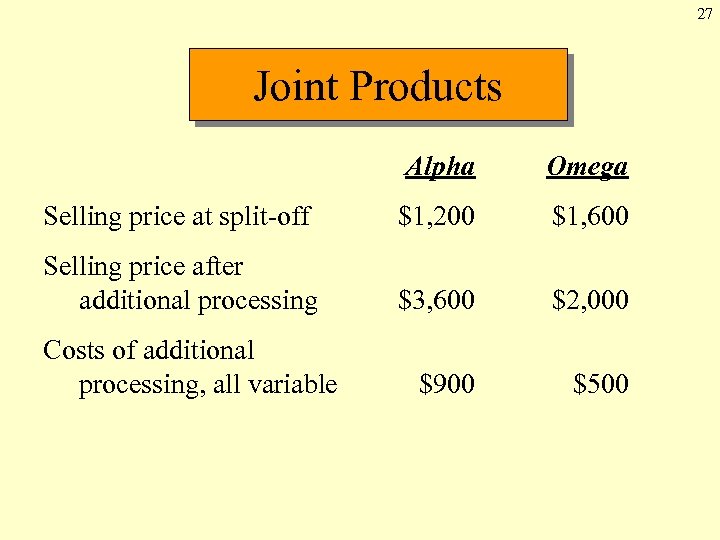
27 Joint Products Alpha Omega Selling price at split-off $1, 200 $1, 600 Selling price after additional processing $3, 600 $2, 000 $900 $500 Costs of additional processing, all variable
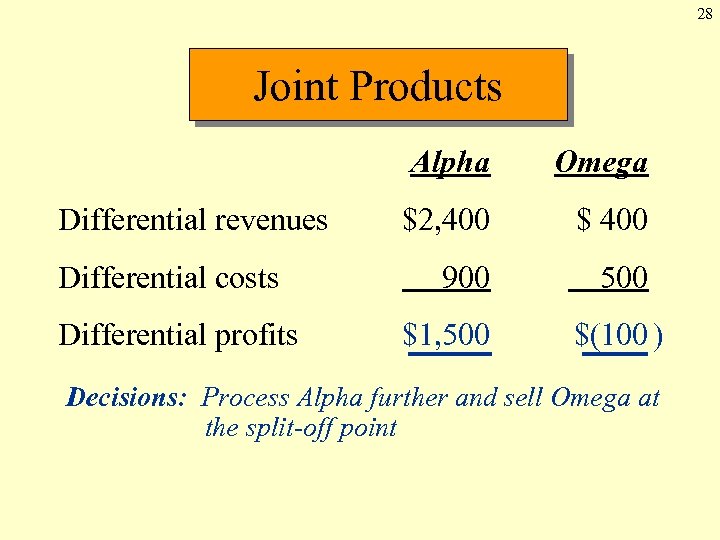
28 Joint Products Alpha Differential revenues Differential costs Differential profits Omega $2, 400 $ 400 900 500 $1, 500 $(100 ) Decisions: Process Alpha further and sell Omega at the split-off point
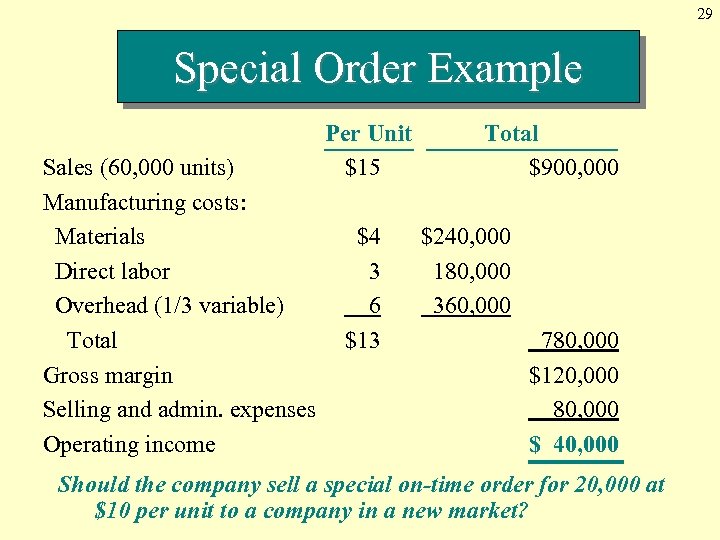
29 Special Order Example Sales (60, 000 units) Manufacturing costs: Materials Direct labor Overhead (1/3 variable) Total Gross margin Selling and admin. expenses Operating income Per Unit $15 $4 3 6 $13 Total $900, 000 $240, 000 180, 000 360, 000 780, 000 $120, 000 80, 000 $ 40, 000 Should the company sell a special on-time order for 20, 000 at $10 per unit to a company in a new market?
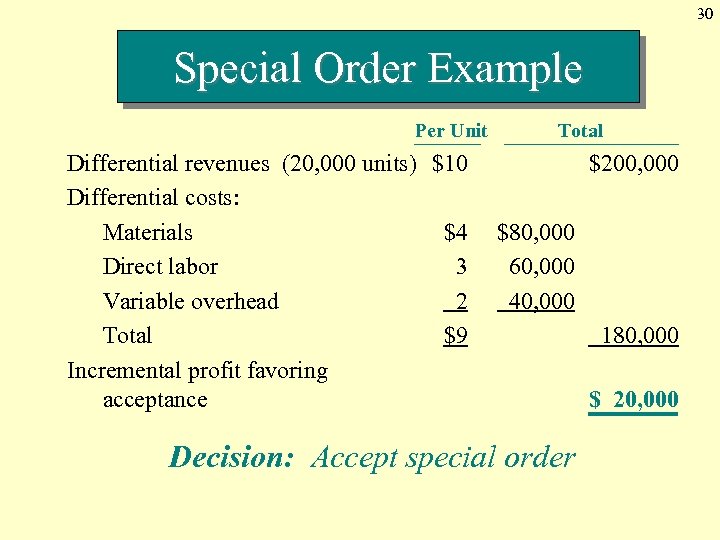
30 Special Order Example Per Unit Differential revenues (20, 000 units) $10 Differential costs: Materials $4 Direct labor 3 Variable overhead 2 Total $9 Incremental profit favoring acceptance Total $200, 000 $80, 000 60, 000 40, 000 Decision: Accept special order 180, 000 $ 20, 000
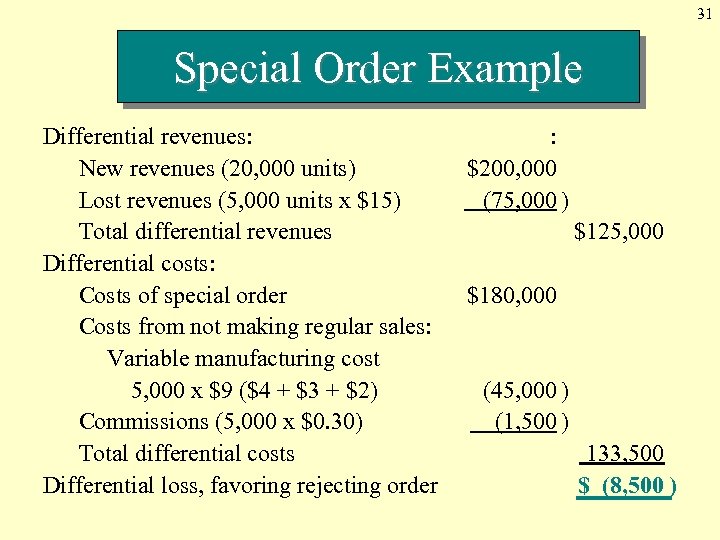
31 Special Order Example Differential revenues: New revenues (20, 000 units) Lost revenues (5, 000 units x $15) Total differential revenues Differential costs: Costs of special order Costs from not making regular sales: Variable manufacturing cost 5, 000 x $9 ($4 + $3 + $2) Commissions (5, 000 x $0. 30) Total differential costs Differential loss, favoring rejecting order : $200, 000 (75, 000 ) $125, 000 $180, 000 (45, 000 ) (1, 500 ) 133, 500 $ (8, 500 )
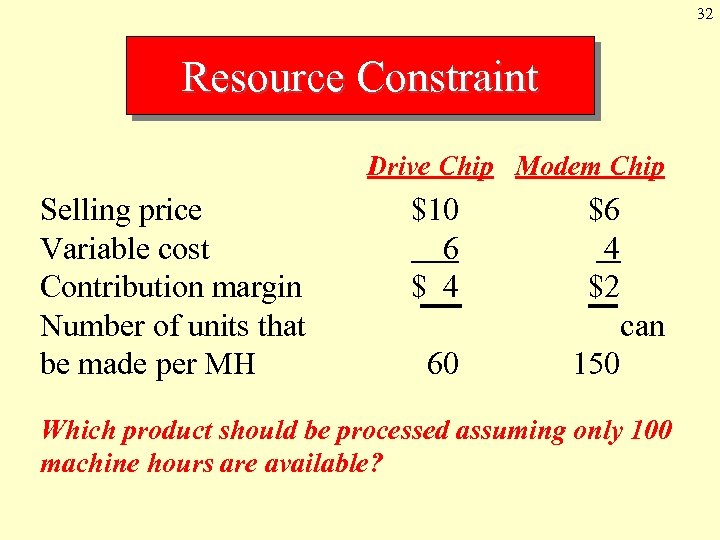
32 Resource Constraint Drive Chip Modem Chip Selling price Variable cost Contribution margin Number of units that be made per MH $10 6 $ 4 $6 4 $2 can 60 150 Which product should be processed assuming only 100 machine hours are available?
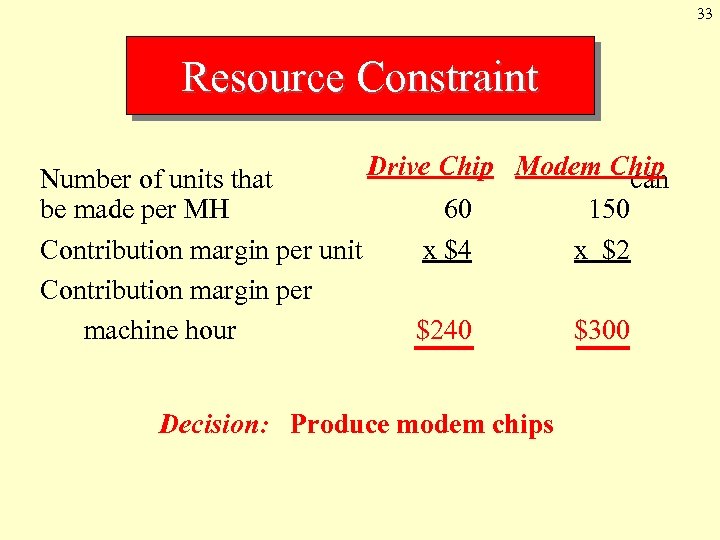
33 Resource Constraint Number of units that be made per MH Contribution margin per unit Contribution margin per machine hour Drive Chip Modem Chip can 60 x $4 150 x $2 $240 $300 Decision: Produce modem chips
34 Decision Making Under Environmental Constraints Antitrust laws forbid actions that might substantially reduce competition. Anti-dumping laws address aspects of unfair competition in international trade.
35 Decision Making Under Environmental Constraints The Sherman Act, Clayton Act, Robinson-Patman Act, and the statutes of many states prohibit predatory pricing. Predatory pricing is pricing below cost in the short term to drive competitors out of business and eventually to raise prices.
36 Decision Making Under Environmental Constraints The Robinson-Patman Act forbids charging different prices to different customers unless there are intrinsic cost differences in serving the different customers; in other words, this act forbids discriminatory pricing. The Federal Trade Commission (FTC) is the regulatory agency responsible for enforcing the act.
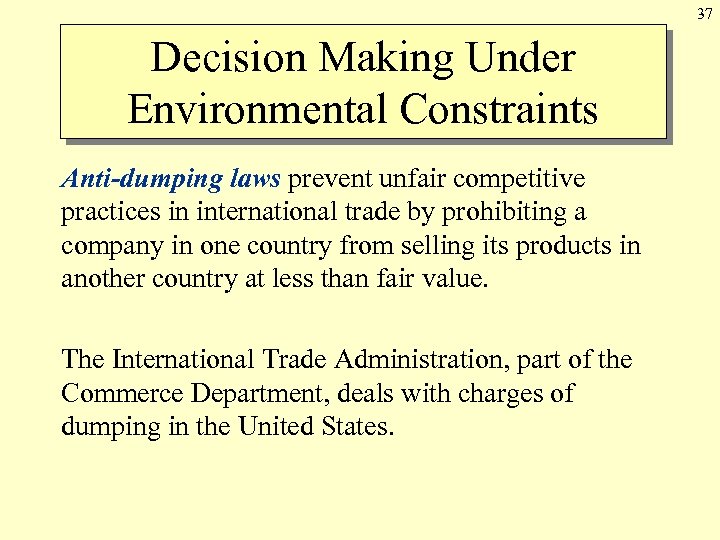
37 Decision Making Under Environmental Constraints Anti-dumping laws prevent unfair competitive practices in international trade by prohibiting a company in one country from selling its products in another country at less than fair value. The International Trade Administration, part of the Commerce Department, deals with charges of dumping in the United States.
38 Chapter 5 The End

39
Скачать презентацию 1 Short-Term Decisions and Accounting Information Prepared by
bf83134a7fc018a79f35ed34864016f7.ppt