


1 Shaping
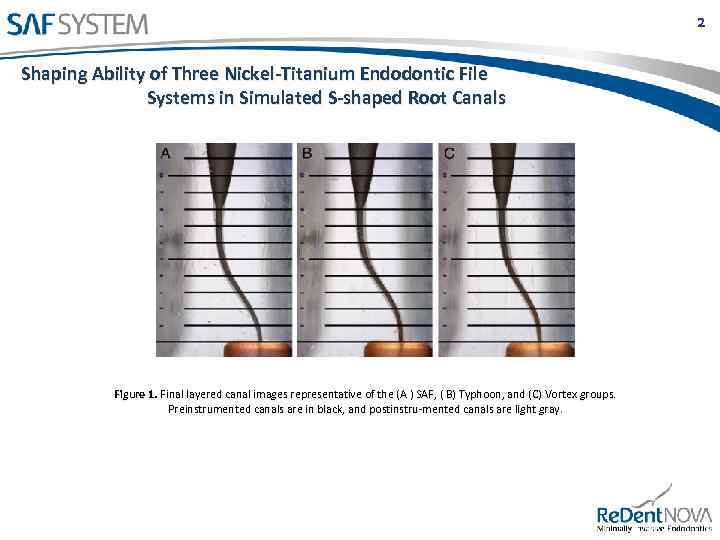
2 Shaping Ability of Three Nickel-Titanium Endodontic File Systems in Simulated S-shaped Root Canals Figure 1. Final layered canal images representative of the (A ) SAF, ( B) Typhoon, and (C) Vortex groups. Preinstrumented canals are in black, and postinstru-mented canals are light gray.
3 Shaping Ability of Three Nickel-Titanium Endodontic File Systems in Simulated S-shaped Root Canals
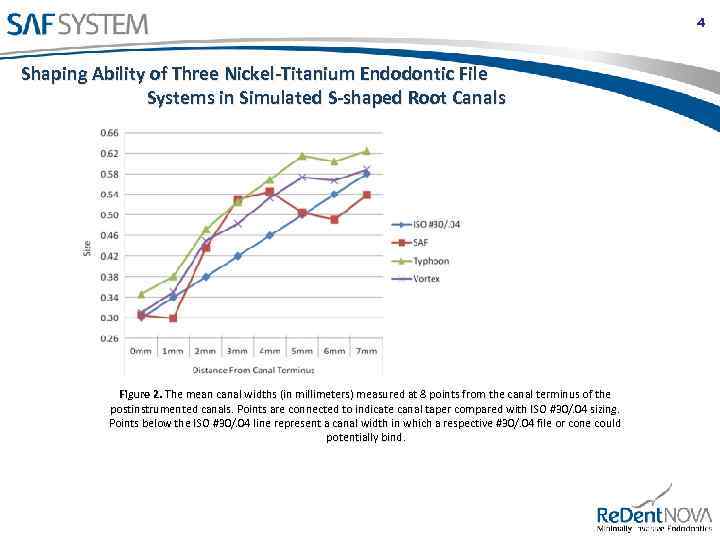
4 Shaping Ability of Three Nickel-Titanium Endodontic File Systems in Simulated S-shaped Root Canals Figure 2. The mean canal widths (in millimeters) measured at 8 points from the canal terminus of the postinstrumented canals. Points are connected to indicate canal taper compared with ISO #30/. 04 sizing. Points below the ISO #30/. 04 line represent a canal width in which a respective #30/. 04 file or cone could potentially bind.
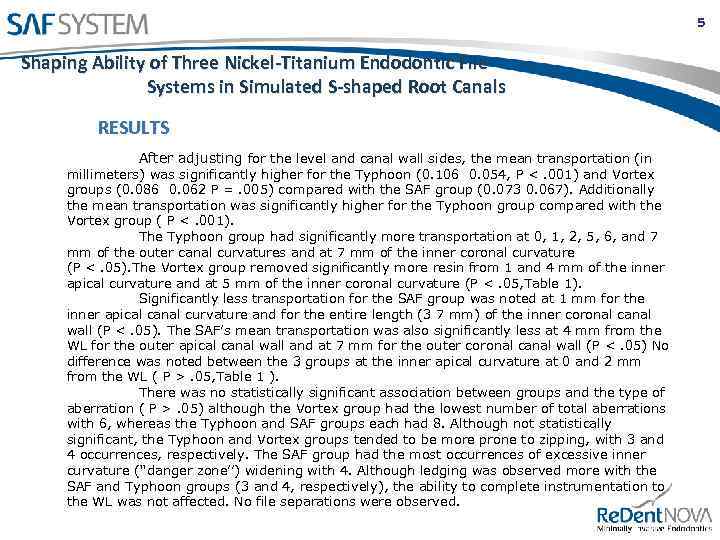
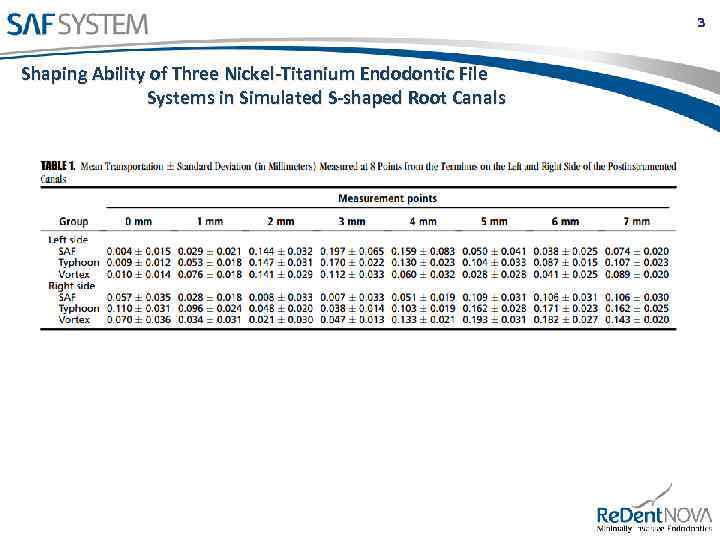
5 Shaping Ability of Three Nickel-Titanium Endodontic File Systems in Simulated S-shaped Root Canals RESULTS After adjusting for the level and canal wall sides, the mean transportation (in millimeters) was significantly higher for the Typhoon (0. 106 0. 054, P <. 001) and Vortex groups (0. 086 0. 062 P =. 005) compared with the SAF group (0. 073 0. 067). Additionally the mean transportation was significantly higher for the Typhoon group compared with the Vortex group ( P <. 001). The Typhoon group had significantly more transportation at 0, 1, 2, 5, 6, and 7 mm of the outer canal curvatures and at 7 mm of the inner coronal curvature (P <. 05). The Vortex group removed significantly more resin from 1 and 4 mm of the inner apical curvature and at 5 mm of the inner coronal curvature (P <. 05, Table 1). Significantly less transportation for the SAF group was noted at 1 mm for the inner apical canal curvature and for the entire length (3 7 mm) of the inner coronal canal wall (P <. 05). The SAF’s mean transportation was also significantly less at 4 mm from the WL for the outer apical canal wall and at 7 mm for the outer coronal canal wall (P <. 05) No difference was noted between the 3 groups at the inner apical curvature at 0 and 2 mm from the WL ( P >. 05, Table 1 ). There was no statistically significant association between groups and the type of aberration ( P >. 05) although the Vortex group had the lowest number of total aberrations with 6, whereas the Typhoon and SAF groups each had 8. Although not statistically significant, the Typhoon and Vortex groups tended to be more prone to zipping, with 3 and 4 occurrences, respectively. The SAF group had the most occurrences of excessive inner curvature (‘‘danger zone’’) widening with 4. Although ledging was observed more with the SAF and Typhoon groups (3 and 4, respectively), the ability to complete instrumentation to the WL was not affected. No file separations were observed.
6 микро. КЛКТ анализ – трансплантация корневого канала Красный - более 40% поверхности была затронута файлом Зеленый – зона контакта ; Прозрачный - конечное препарирование Peters & Paqué Int Endod J, 36: 86 -92, 2003
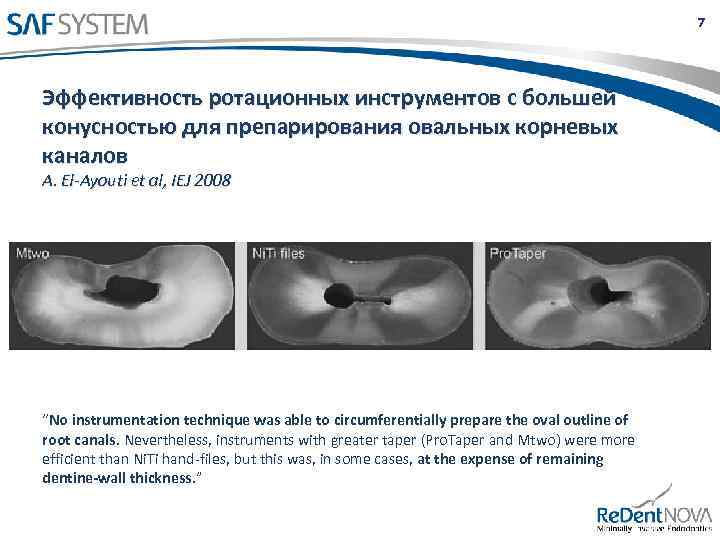
7 Эффективность ротационных инструментов с большей конусностью для препарирования овальных корневых каналов A. El-Ayouti et al, IEJ 2008 “No instrumentation technique was able to circumferentially prepare the oval outline of root canals. Nevertheless, instruments with greater taper (Pro. Taper and Mtwo) were more efficient than Ni. Ti hand-files, but this was, in some cases, at the expense of remaining dentine-wall thickness. ”
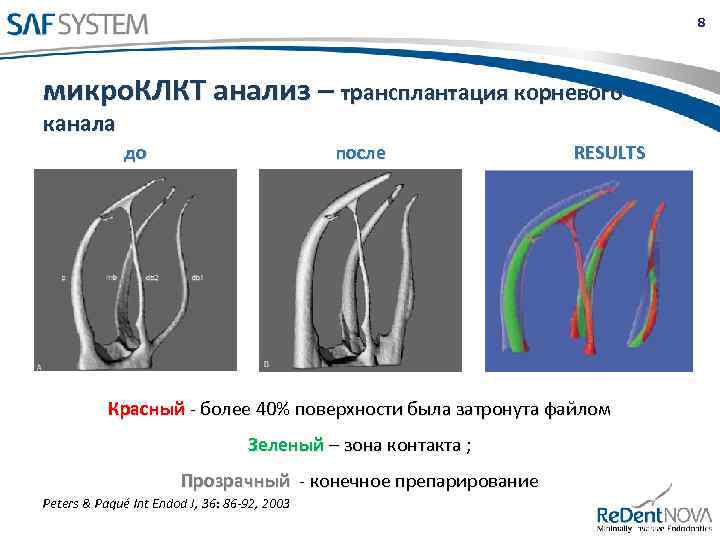
8 микро. КЛКТ анализ – трансплантация корневого канала до после RESULTS Красный - более 40% поверхности была затронута файлом Зеленый – зона контакта ; Прозрачный - конечное препарирование Peters & Paqué Int Endod J, 36: 86 -92, 2003
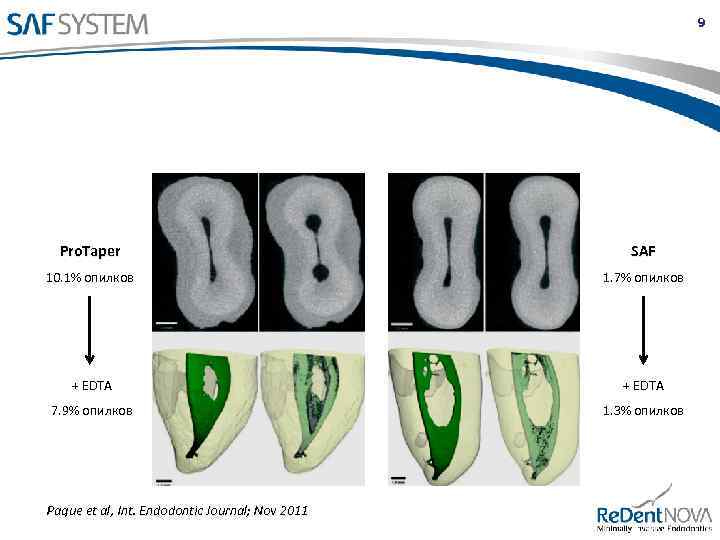
9 Pro. Taper SAF 10. 1% опилков 1. 7% опилков + EDTA 7. 9% опилков 1. 3% опилков Paque et al, Int. Endodontic Journal; Nov 2011
