


 Скачать презентацию 1 Security in Computer Networks Multilateral Security in
a4ac90b86f917672414c3fa7c9316d1c.ppt
- Количество слайдов: 123
 1 Security in Computer Networks Multilateral Security in Distributed and by Distributed Systems Transparencies for the Last Part of the Lecture: Security and Cryptography II Andreas Pfitzmann Technische Universität Dresden, Faculty of Computer Science, D-01062 Dresden Nöthnitzer Str. 46, Room 3071 Phone: +49 351 463 -38277, e-mail: pfitza@inf. tu-dresden. de, http: //dud. inf. tu-dresden. de/
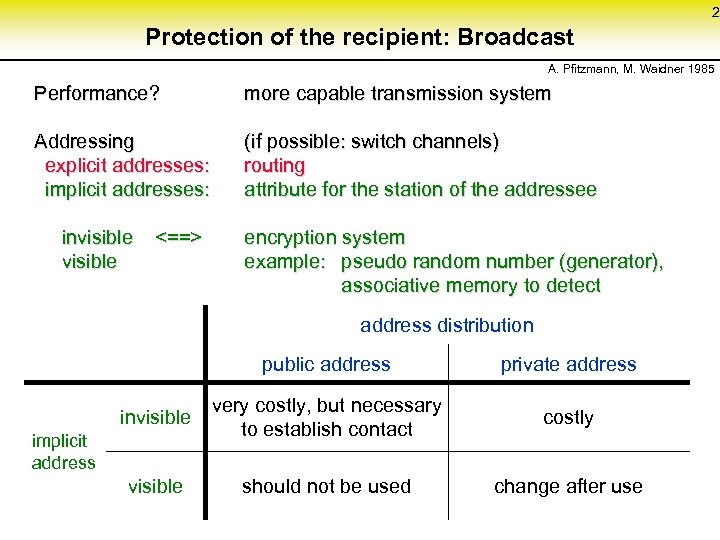 2 Protection of the recipient: Broadcast A. Pfitzmann, M. Waidner 1985 Performance? more capable transmission system Addressing (if possible: switch channels) explicit addresses: routing implicit addresses: attribute for the station of the addressee invisible <==> visible encryption system example: pseudo random number (generator), associative memory to detect address distribution public address private address invisible very costly, but necessary to establish contact costly visible should not be used change after use implicit address
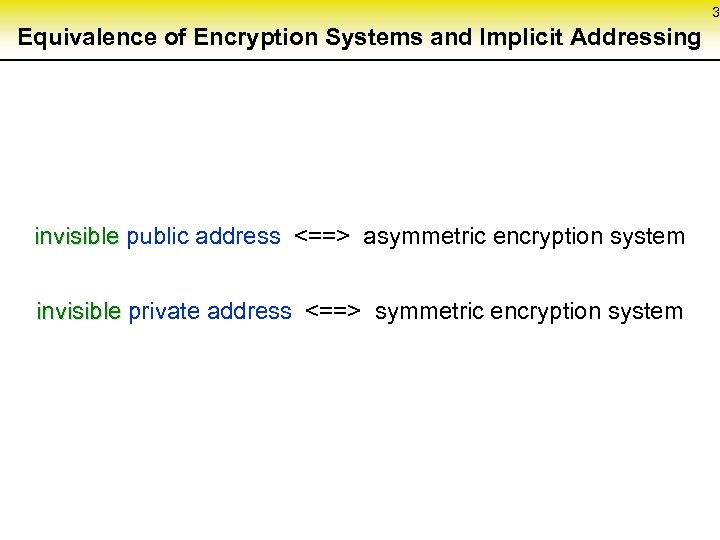 3 Equivalence of Encryption Systems and Implicit Addressing invisible public address <==> asymmetric encryption system invisible private address <==> symmetric encryption system invisible
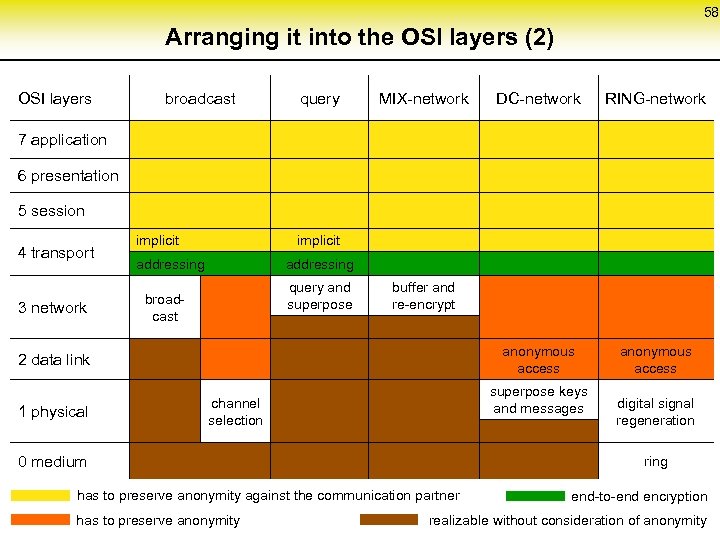
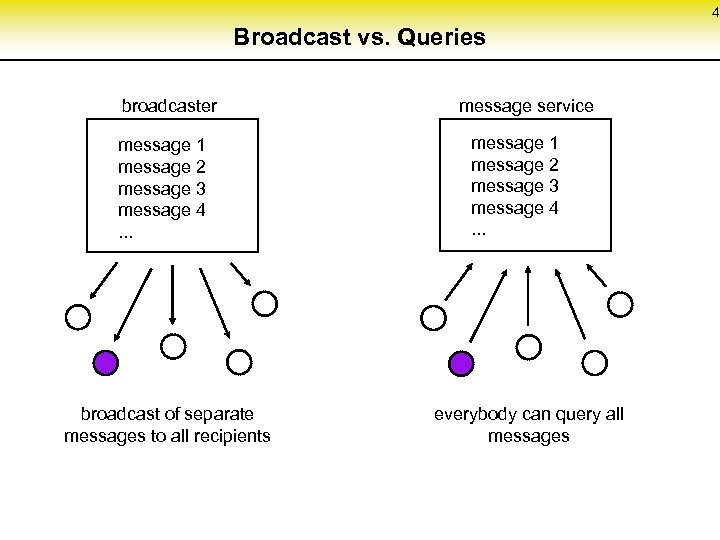 4 Broadcast vs. Queries broadcaster message 1 message 2 message 3 message 4. . . broadcast of separate messages to all recipients message service message 1 message 2 message 3 message 4. . . everybody can query all messages
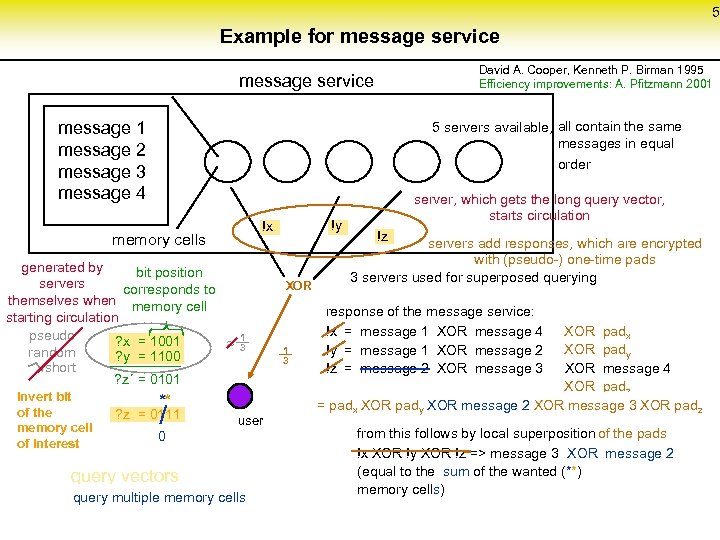 5 Example for message service David A. Cooper, Kenneth P. Birman 1995 Efficiency improvements: A. Pfitzmann 2001 message service message 1 message 2 message 3 message 4 5 servers available, all contain the same messages in equal order memory cells generated by bit position servers corresponds to themselves when memory cell starting circulation pseudo ? x = 1001 1 3 random ? y = 1100 short ? z´ = 0101 invert bit of the memory cell of interest ** ? z = 0111 !y ? y !x ? x user 0 query vectors query multiple memory cells XOR 1 3 server, which gets the long query vector, starts circulation ? z !z servers add responses, which are encrypted with (pseudo-) one-time pads 3 servers used for superposed querying response of the message service: XOR padx !x = message 1 XOR message 4 XOR pady !y = message 1 XOR message 2 !z = message 2 XOR message 3 XOR message 4 XOR padz = padxx XOR padyy XOR message 3 XOR padz = pad XOR message 2 XOR message 3 XOR padz from this follows by local superposition of the pads !x XOR !y XOR !z => message 3 XOR message 2 (equal to the sum of the wanted (**) (equal to the content of the wanted (*) memory cells) memory cell)
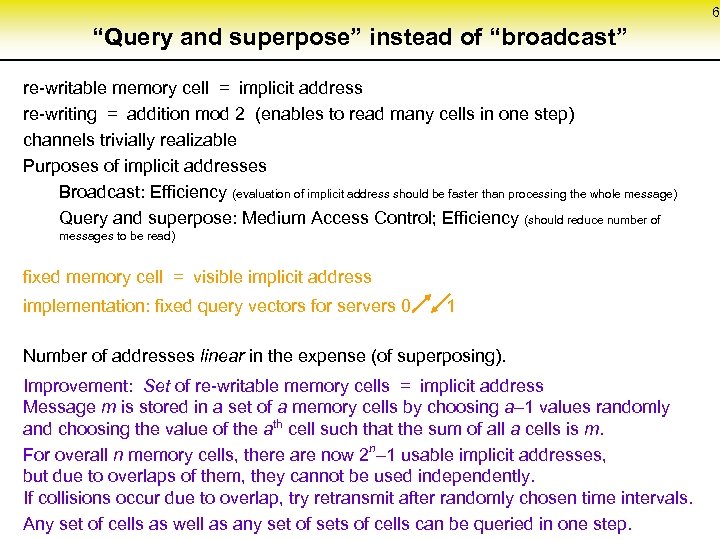 6 “Query and superpose” instead of “broadcast” re-writable memory cell = implicit address re-writing = addition mod 2 (enables to read many cells in one step) channels trivially realizable Purposes of implicit addresses Broadcast: Efficiency (evaluation of implicit address should be faster than processing the whole message) Query and superpose: Medium Access Control; Efficiency (should reduce number of messages to be read) fixed memory cell = visible implicit address implementation: fixed query vectors for servers 0 1 Number of addresses linear in the expense (of superposing). Improvement: Set of re-writable memory cells = implicit address Message m is stored in a set of a memory cells by choosing a– 1 values randomly and choosing the value of the ath cell such that the sum of all a cells is m. For overall n memory cells, there are now 2 n– 1 usable implicit addresses, but due to overlaps of them, they cannot be used independently. If collisions occur due to overlap, try retransmit after randomly chosen time intervals. Any set of cells as well as any set of sets of cells can be queried in one step.
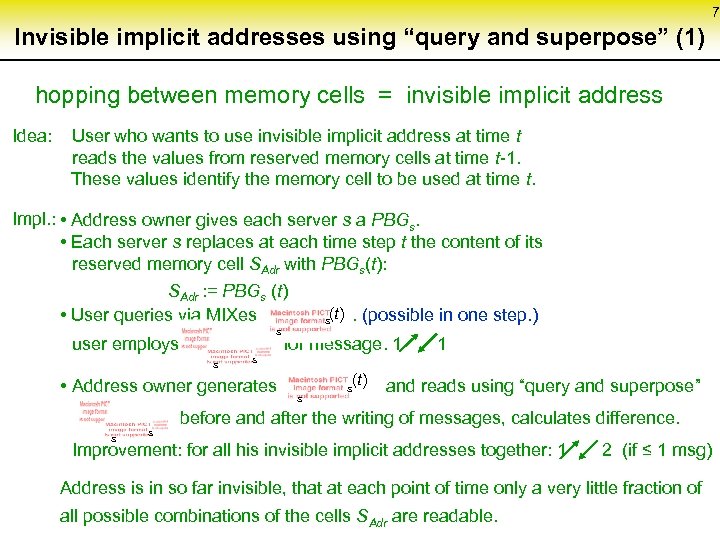 7 Invisible implicit addresses using “query and superpose” (1) hopping between memory cells = invisible implicit address Idea: User who wants to use invisible implicit address at time t reads the values from reserved memory cells at time t-1. These values identify the memory cell to be used at time t. • Address owner gives each server s a PBG. Impl. : s • Each server s replaces at each time step t the content of its reserved memory cell SAdr with PBGs(t): SAdr : = PBGs (t) • User queries via MIXes . (possible in one step. ) s(t) s user employs for message. 1 1 s s (t) • Address owner generates and reads using “query and superpose” s s before and after the writing of messages, calculates difference. s s Improvement: for all his invisible implicit addresses together: 1 2 (if ≤ 1 msg) Address is in so far invisible, that at each point of time only a very little fraction of all possible combinations of the cells SAdr are readable.
 8 Invisible implicit addresses using “query and superpose” (2) hopping between memory cells = invisible implicit address can be extended to hopping between sets of memory cells = invisible implicit address
 9 Fault tolerance (and countering modifying attacks) What if server (intentionally) does 1. not respond or 2. delivers wrong response? 1. Submit the same query vector to another server. 2. Messages should be authenticated so the user can check their integrity and thereby detect whether at least one server did deliver a wrong response. If so, use a disjoint set of servers or lay traps by sending the same query vector to many servers and checking their responses by comparison.
 10 Protection of the sender Dummy messages • don’t protect against addressee of meaningful messages • make the protection of the recipient more inefficient Unobservability of neighboring lines and stations as well as digital signal regeneration example: RING-network
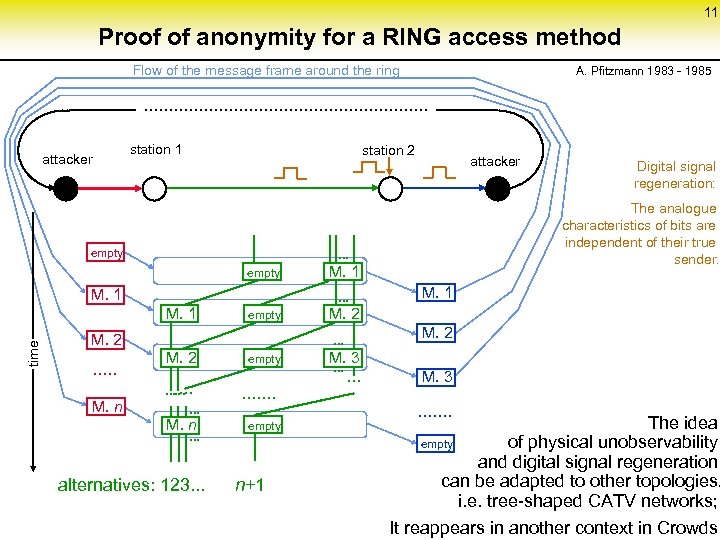 11 Proof of anonymity for a RING access method Flow of the message frame around the ring A. Pfitzmann 1983 - 1985 . . . attacker station 1 station 2 empty M. 1 time M. 1 empty M. 2 M. n M. 1. . . . M. n . . . empty . . . . empty alternatives: 123. . . n+1 M. 2 . . . M. 2 Digital signal regeneration: The analogue characteristics of bits are independent of their true sender. . empty . . . attacker M. 3. . . M. 3 . . . . The idea empty of physical unobservability and digital signal regeneration can be adapted to other topologies, i. e. tree-shaped CATV networks; It reappears in another context in Crowds
 12 Fault tolerance of the RING-network Requirement For each possible error, anonymity has to be guaranteed. Problem Anonymity: little global information Fault tolerance: much global information Principles Fault tolerance through weaker anonymity in a single operational mode (anonymity-mode) Fault tolerance through a special operational mode (fault tolerancemode)
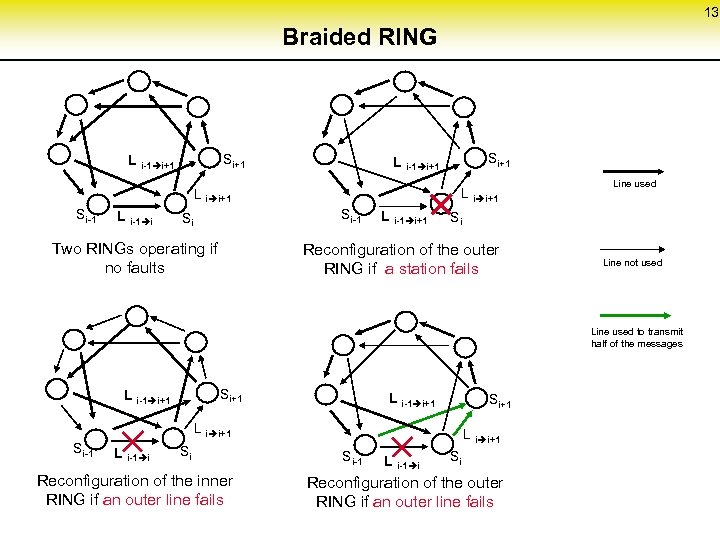 13 Braided RING Si+1 L i-1 i+1 L i i+1 Si-1 L i-1 i Si-1 Si Two RINGs operating if no faults Si+1 L i-1 i+1 Line used Si Reconfiguration of the outer RING if a station fails Line not used Line used to transmit half of the messages Si+1 L i-1 i+1 Si+1 L i i+1 Si-1 L i-1 i Si Reconfiguration of the inner RING if an outer line fails L i i+1 Si-1 L i-1 i Si Reconfiguration of the outer RING if an outer line fails
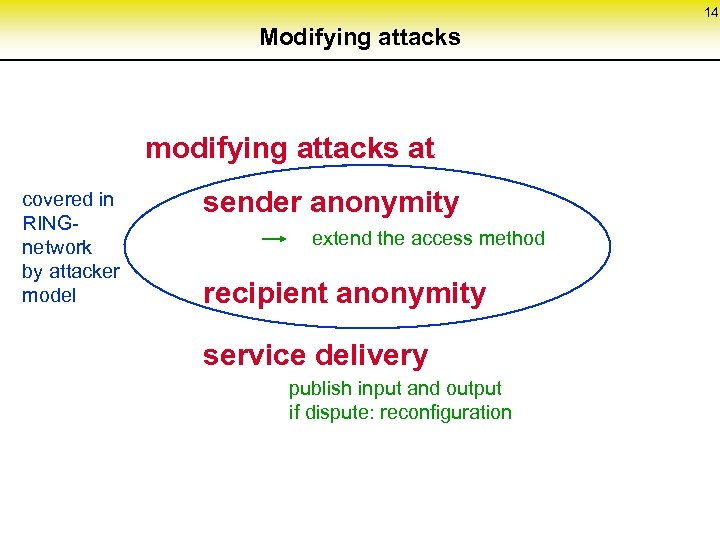 14 Modifying attacks modifying attacks at covered in RINGnetwork by attacker model sender anonymity extend the access method recipient anonymity service delivery publish input and output if dispute: reconfiguration
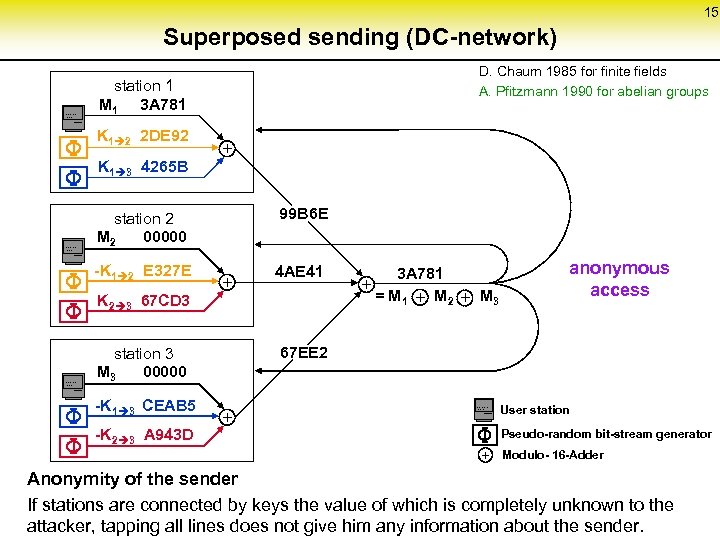 15 Superposed sending (DC-network). . . . D. Chaum 1985 for finite fields A. Pfitzmann 1990 for abelian groups station 1 M 1 3 A 781 K 1 2 2 DE 92 K 1 3 4265 B + 99 B 6 E -K 1 2 E 327 E . . . . station 2 M 2 00000 4 AE 41 K 2 3 67 CD 3 . . . . + -K 2 3 A 943 D anonymous access 67 EE 2 station 3 M 3 00000 -K 1 3 CEAB 5 3 A 781 + = M 1 + M 2 + M 3 + + . . . . User station Pseudo-random bit-stream generator + Modulo- 16 -Adder Anonymity of the sender If stations are connected by keys the value of which is completely unknown to the attacker, tapping all lines does not give him any information about the sender.
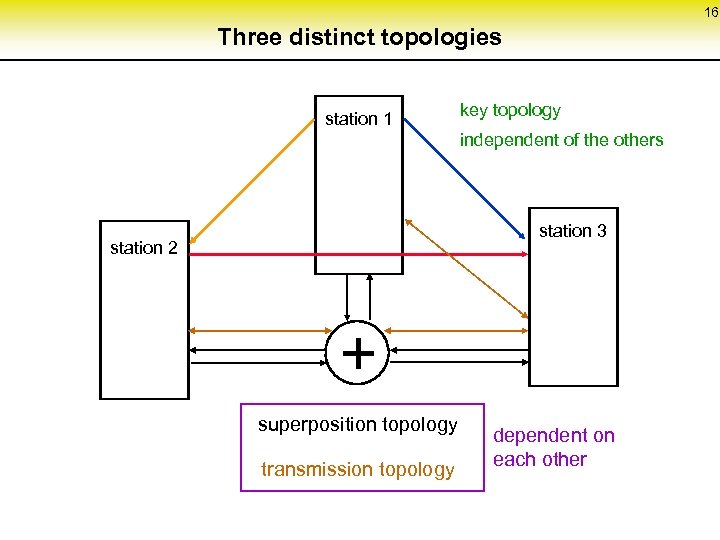 16 Three distinct topologies station 1 key topology independent of the others station 3 station 2 + superposition topology transmission topology dependent on each other
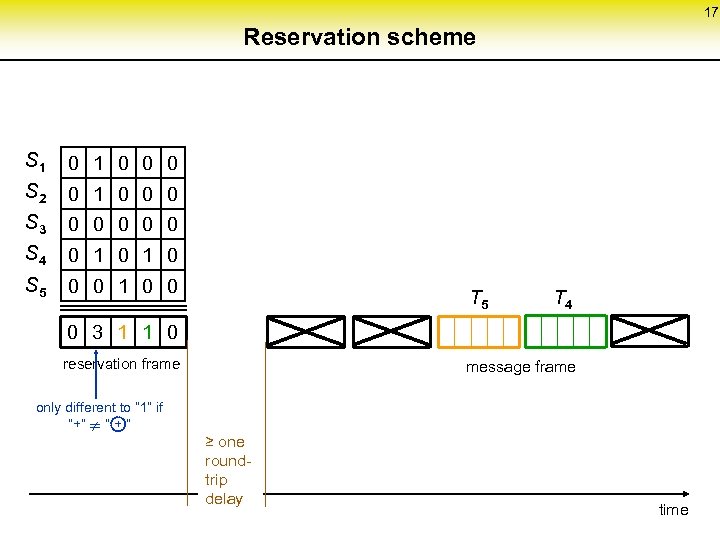 17 Reservation scheme S 1 0 0 0 S 2 0 1 0 0 0 S 3 0 0 0 S 4 0 1 0 S 5 0 0 1 0 0 T 5 T 4 0 3 1 1 0 reservation frame only different to “ 1” if “+” “ + ” ¹ message frame ≥ one round- trip delay time
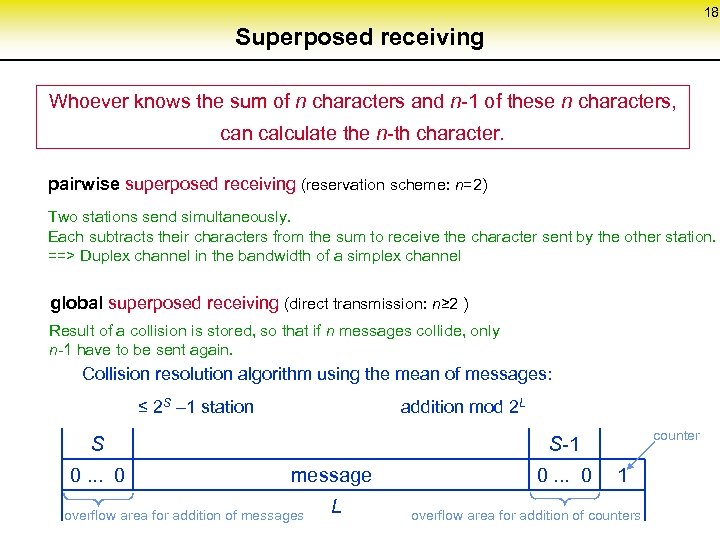 18 Superposed receiving Whoever knows the sum of n characters and n-1 of these n characters, can calculate the n-th character. pairwise superposed receiving (reservation scheme: n=2) Two stations send simultaneously. Each subtracts their characters from the sum to receive the character sent by the other station. ==> Duplex channel in the bandwidth of a simplex channel global superposed receiving (direct transmission: n≥ 2 ) Result of a collision is stored, so that if n messages collide, only n-1 have to be sent again. Collision resolution algorithm using the mean of messages: ≤ 2 S – 1 station addition mod 2 L S 0. . . 0 counter S-1 message L overflow area for addition of messages 0. . . 0 1 overflow area for addition of counters
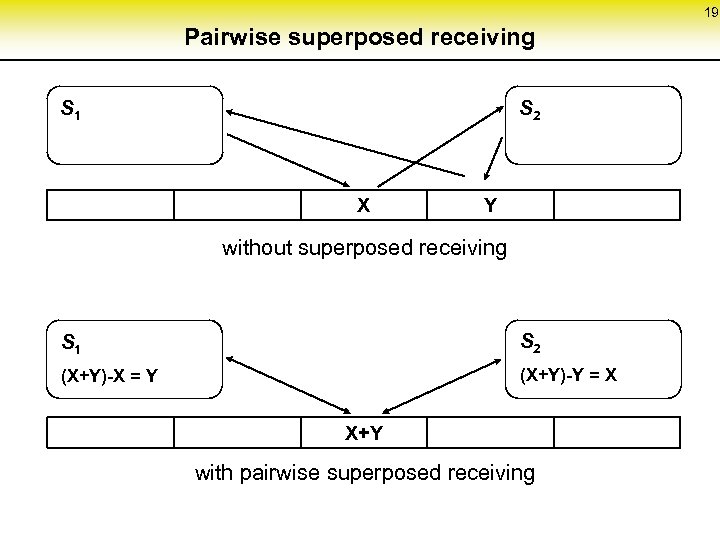 19 Pairwise superposed receiving S 2 S 1 X Y without superposed receiving S 1 S 2 (X+Y)-X = Y (X+Y)-Y = X X+Y with pairwise superposed receiving
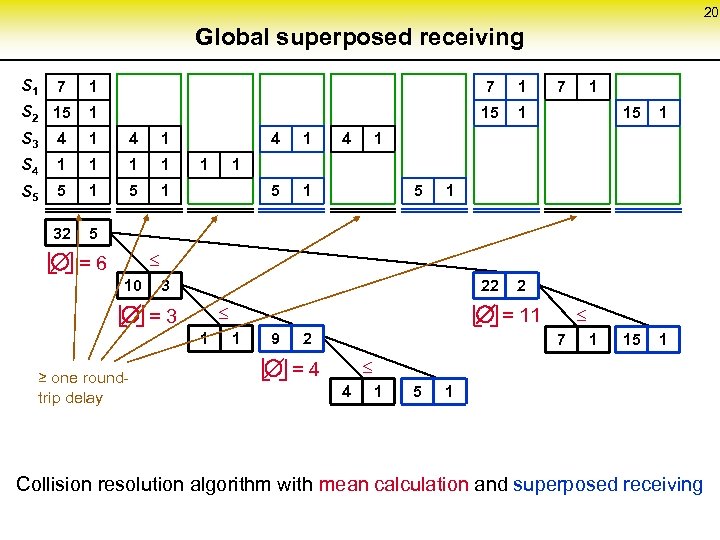 20 Global superposed receiving S 1 7 1 S 2 15 S 3 4 1 15 1 1 4 1 S 4 1 1 S 5 5 1 32 5 22 2 4 5 1 1 4 1 7 1 15 1 1 1 5 1 £ = 6 10 3 £ = 3 1 ≥ one round- trip delay 1 £ = 11 9 2 7 1 £ = 4 4 1 5 1 Collision resolution algorithm with mean calculation and superposed receiving
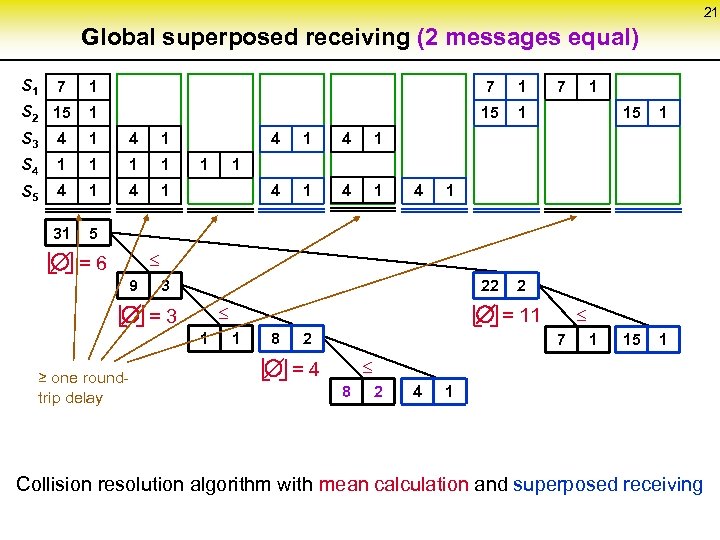 21 Global superposed receiving (2 messages equal) S 1 7 1 S 2 15 S 3 4 1 15 1 1 4 1 S 4 1 1 S 5 4 1 31 5 22 2 4 4 1 1 15 1 1 4 1 1 7 1 4 1 £ = 6 9 3 £ = 3 1 ≥ one round- trip delay 1 £ = 11 8 2 7 1 £ = 4 8 2 4 1 Collision resolution algorithm with mean calculation and superposed receiving
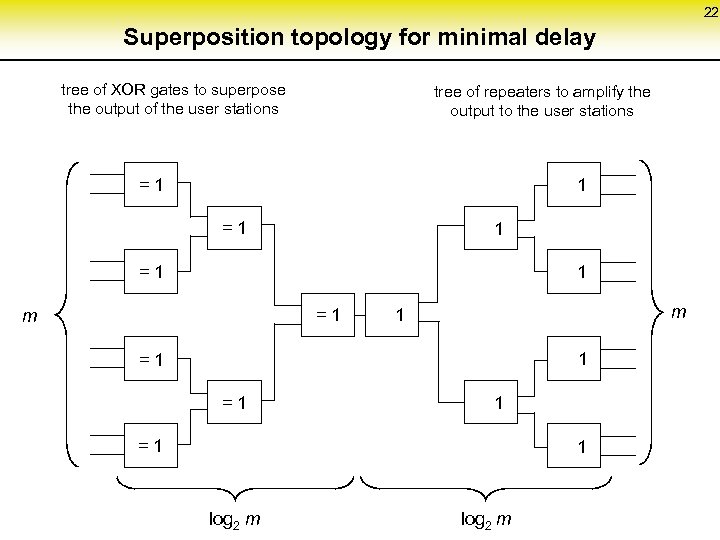 22 Superposition topology for minimal delay tree of XOR gates to superpose the output of the user stations tree of repeaters to amplify the output to the user stations 1 = 1 1 1 = 1 m m 1 1 = 1 1 log 2 m
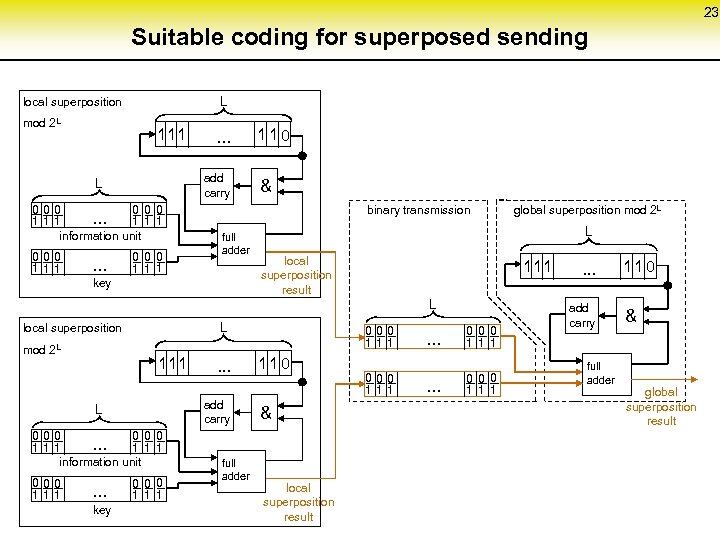 23 Suitable coding for superposed sending L local superposition mod 2 L 111 add carry L 000 0 0 0. . . 1 111 information unit 000 111 . . . 0 0 0 1 11 0 & binary transmission full adder key L local superposition result 111 L L local superposition mod 2 L 111 add carry L 000 0 0 0. . . 1 111 information unit 000 111 . . . key . . . 0 0 0 1 1 1 full adder global superposition mod 2 L 000 111 110 & local superposition result 000 111 . . . 0 0 0 1 1 1 . . . add carry full adder 110 & global superposition result
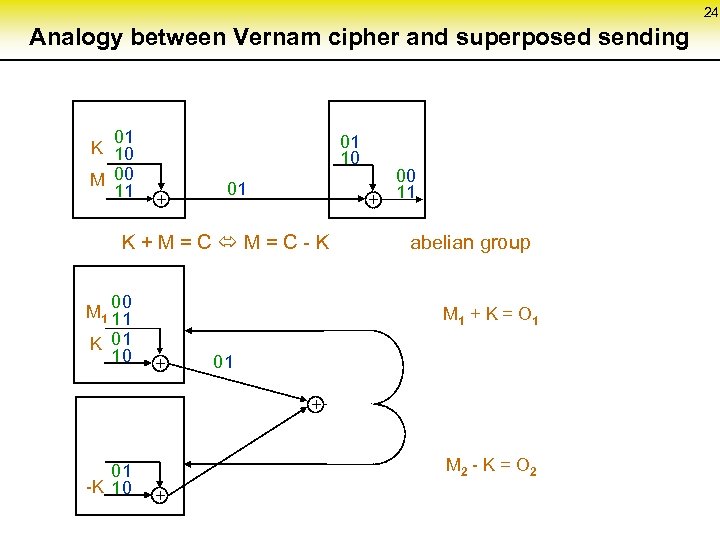 24 Analogy between Vernam cipher and superposed sending 01 K 10 M 00 11 01 10 + 01 K + M = C - K 00 M 1 11 K 01 10 00 + 11 abelian group M 1 + K = O 1 + 01 -K 10 M 2 - K = O 2 +
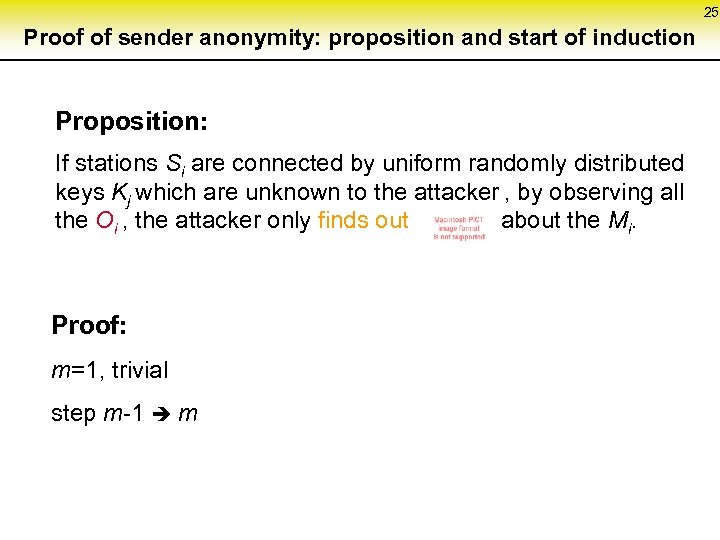 25 Proof of sender anonymity: proposition and start of induction Proposition: If stations Si are connected by uniform randomly distributed keys Kj which are unknown to the attacker , by observing all the Oi , the attacker only finds out about the Mi. Proof: m=1, trivial step m-1 m
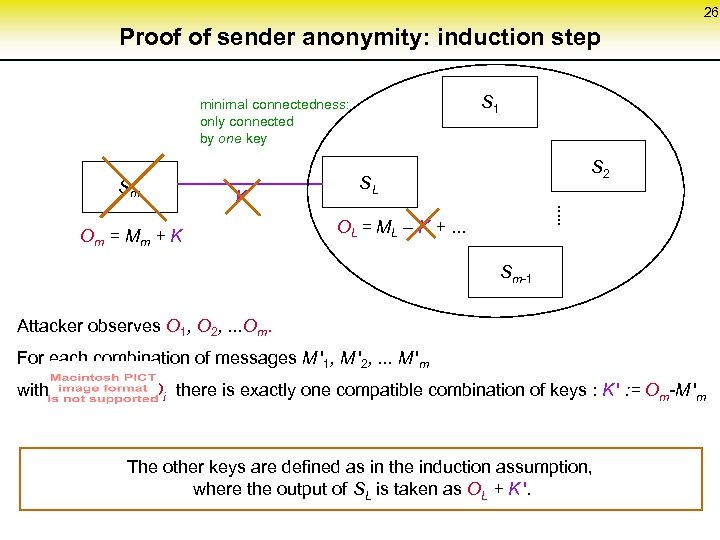 26 Proof of sender anonymity: induction step S 1 minimal connectedness: only connected by one key Sm K Om = M m + K S 2 SL . . . OL = ML – K +. . . Sm-1 Attacker observes O 1, O 2, . . . Om. For each combination of messages M '1, M '2, . . . M 'm with Oi there is exactly one compatible combination of keys : K ' : = Om-M 'm The other keys are defined as in the induction assumption, where the output of SL is taken as OL + K '.
 27 Information-theoretic anonymity in spite of modifying attacks Problems: 1) The attacker sends messages only to some users. If he gets an answer, the addressee was among these users. 2) To be able to punish a modifying attack at service delivery, corrupted messages have to be investigated. But this may not apply to meaningful messages of users truthful to the protocol.
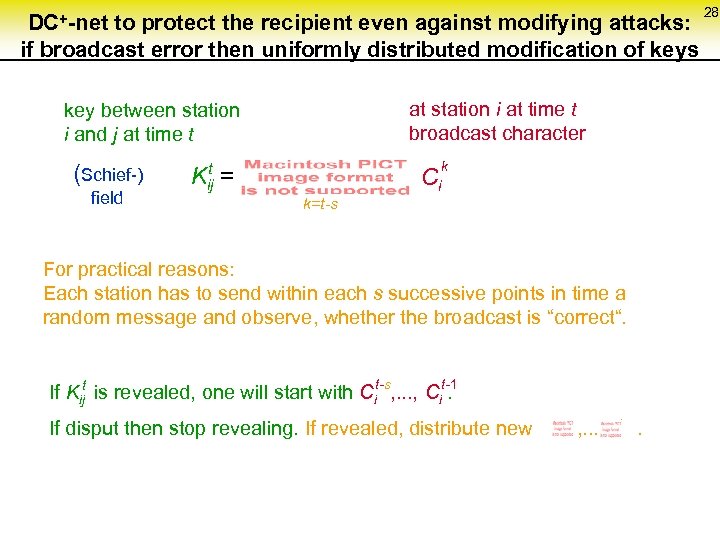 DC+-net to protect the recipient even against modifying attacks: if broadcast error then uniformly distributed modification of keys at station i at time t broadcast character key between station i and j at time t (Schief-) field k t Kij = Ci k=1 k=t-s For practical reasons: Each station has to send within each s successive points in time a random message and observe, whether the broadcast is “correct“. t-s t If Kij is revealed, one will start with Ci , . . . , Cit-1 . s If disput then stop revealing. If revealed, distribute new , . . . , . 28
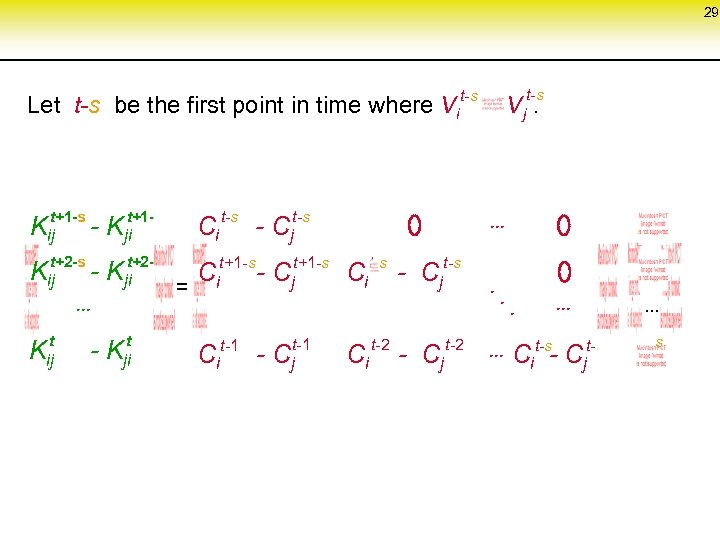 29 Let t-s be the first point in time where Vi t-s t+1 -s - Kjit+1 -s Ci t+2 -s - Kjit+2 -s C = i Kij . . . t Kij t - Kji Ci t-1 t-s - Cj t+1 -s - Cj t-1 - Cj t-s Vj. t-s . . . Ci t-s Ci t-2 - Cj t-s - Cj . t-2 . . . . t-s Ci - C j s
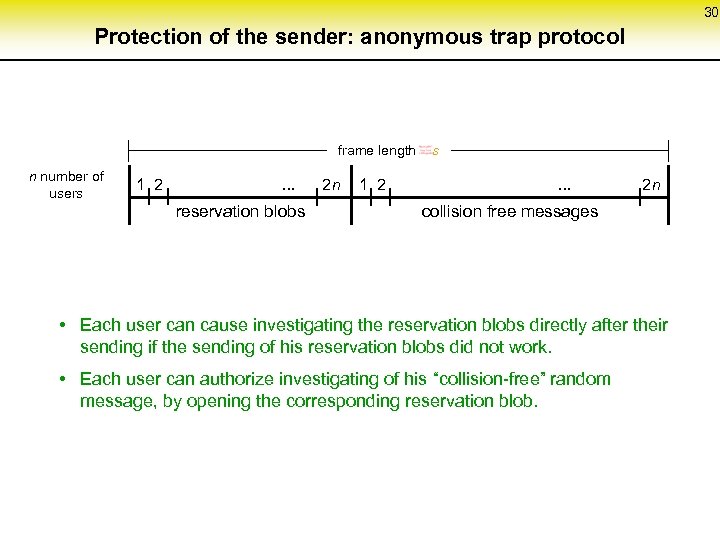 30 Protection of the sender: anonymous trap protocol frame length s n number of users 1 2 . . . 2 n 1 2 . . . 2 n reservation blobs collision free messages • Each user can cause investigating the reservation blobs directly after their sending if the sending of his reservation blobs did not work. • Each user can authorize investigating of his “collision-free” random message, by opening the corresponding reservation blob.
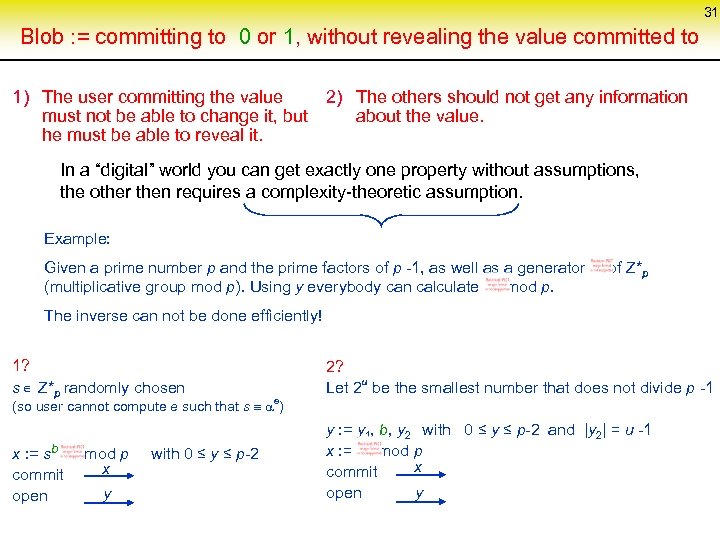 31 Blob : = committing to 0 or 1, without revealing the value committed to 1) The user committing the value 2) The others should not get any information must not be able to change it, but about the value. he must be able to reveal it. In a “digital” world you can get exactly one property without assumptions, the other then requires a complexity-theoretic assumption. Example: Given a prime number p and the prime factors of p -1, as well as a generator of Z*p (multiplicative group mod p). Using y everybody can calculate mod p. The inverse can not be done efficiently! 1? Î s Z*p randomly chosen 2? Let 2 u be the smallest number that does not divide p -1 x : = sb mod p x commit y open y : = y 1, b, y 2 with 0 ≤ y ≤ p-2 and |y 2| = u -1 x : = mod p x commit y open (so user cannot compute e such that s e) with 0 ≤ y ≤ p-2
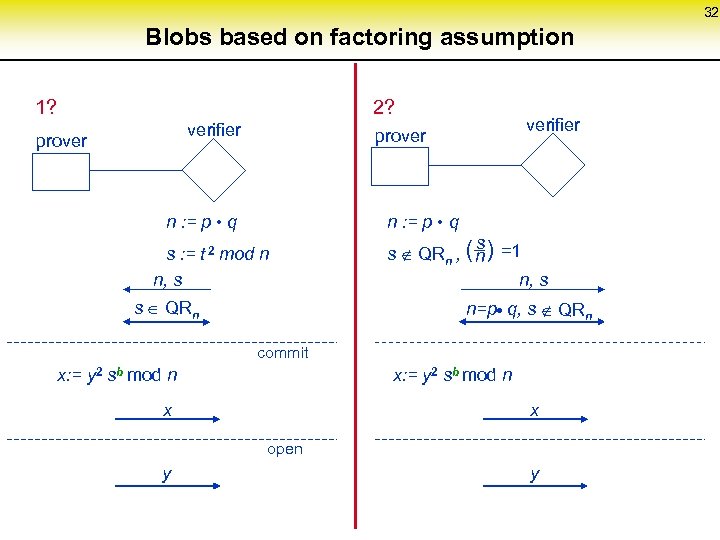 32 Blobs based on factoring assumption 1? 2? verifier prover n : = p • q s : = t 2 mod n n, s s Î QRn s s Ï QRn , ( ) =1 n n, s n=p • q, s Ï QRn commit x: = y 2 sb mod n x x open y y
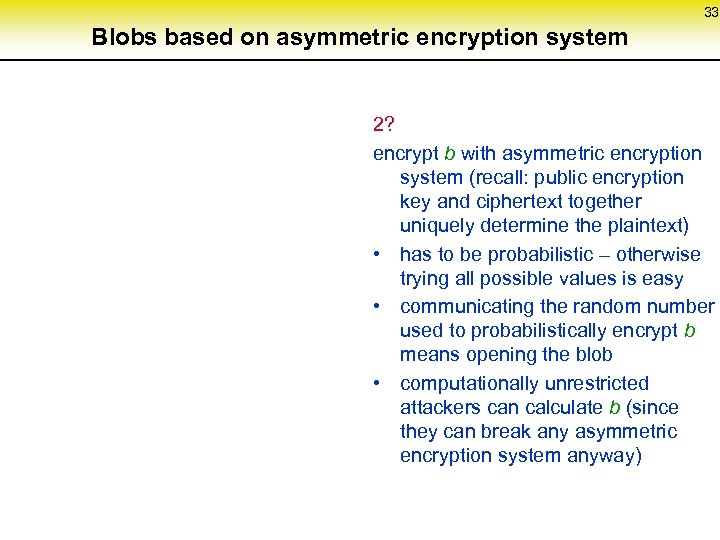 33 Blobs based on asymmetric encryption system 2? encrypt b with asymmetric encryption system (recall: public encryption key and ciphertext together uniquely determine the plaintext) • has to be probabilistic – otherwise trying all possible values is easy • communicating the random number used to probabilistically encrypt b means opening the blob • computationally unrestricted attackers can calculate b (since they can break any asymmetric encryption system anyway)
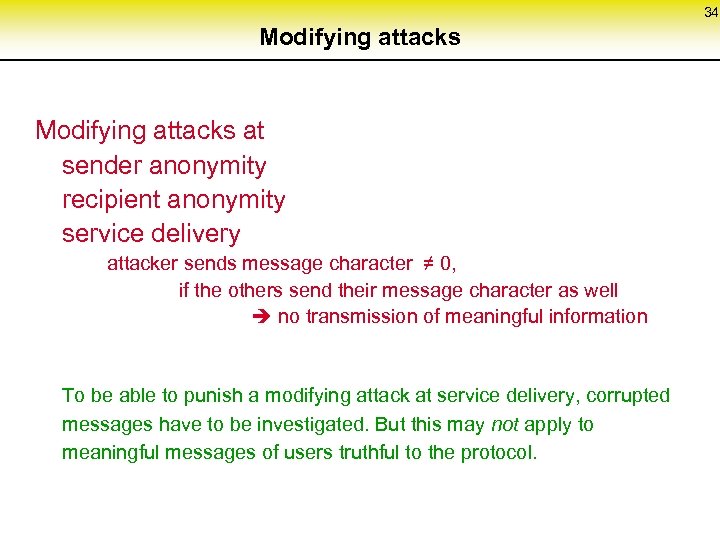 34 Modifying attacks at sender anonymity recipient anonymity service delivery attacker sends message character ≠ 0, if the others send their message character as well no transmission of meaningful information To be able to punish a modifying attack at service delivery, corrupted messages have to be investigated. But this may not apply to meaningful messages of users truthful to the protocol.
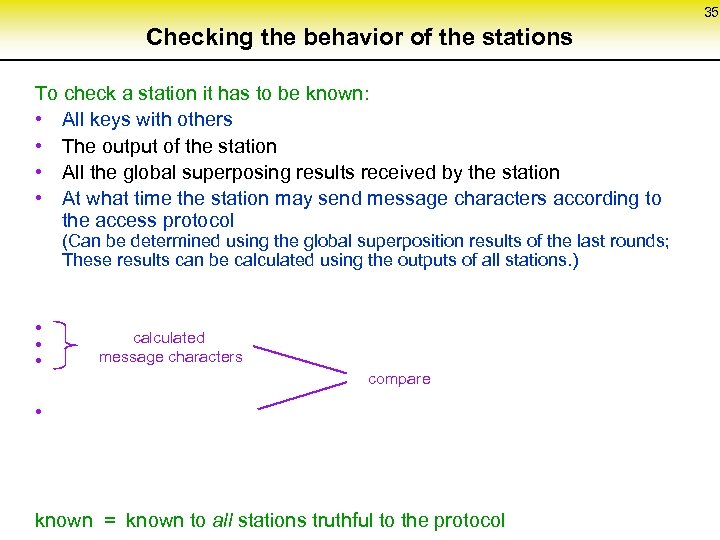 35 Checking the behavior of the stations To check a station it has to be known: • All keys with others • The output of the station • All the global superposing results received by the station • At what time the station may send message characters according to the access protocol (Can be determined using the global superposition results of the last rounds; These results can be calculated using the outputs of all stations. ) • • • • calculated message characters compare known = known to all stations truthful to the protocol
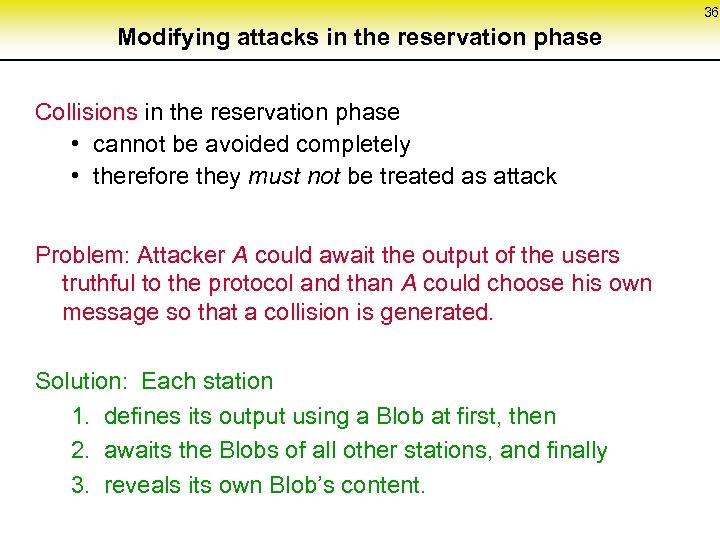 36 Modifying attacks in the reservation phase Collisions in the reservation phase • cannot be avoided completely • therefore they must not be treated as attack Problem: Attacker A could await the output of the users truthful to the protocol and than A could choose his own message so that a collision is generated. Solution: Each station 1. defines its output using a Blob at first, then 2. awaits the Blobs of all other stations, and finally 3. reveals its own Blob’s content.
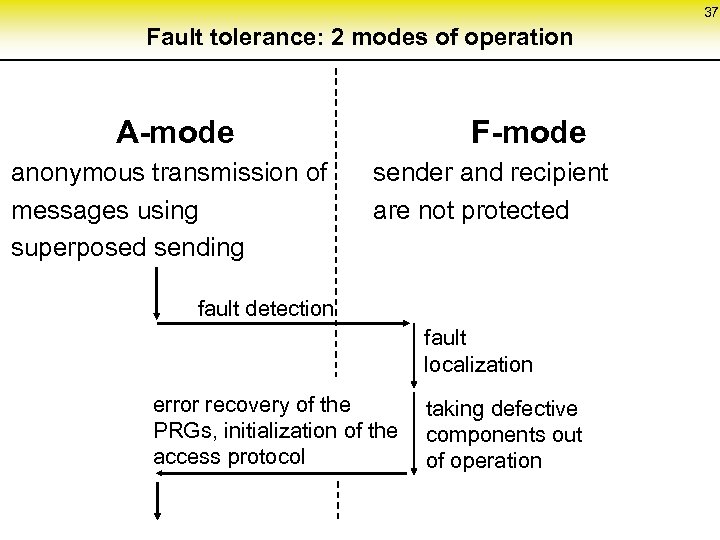 37 Fault tolerance: 2 modes of operation A-mode anonymous transmission of messages using superposed sending F-mode sender and recipient are not protected fault detection fault localization error recovery of the taking defective PRGs, initialization of the components out access protocol of operation
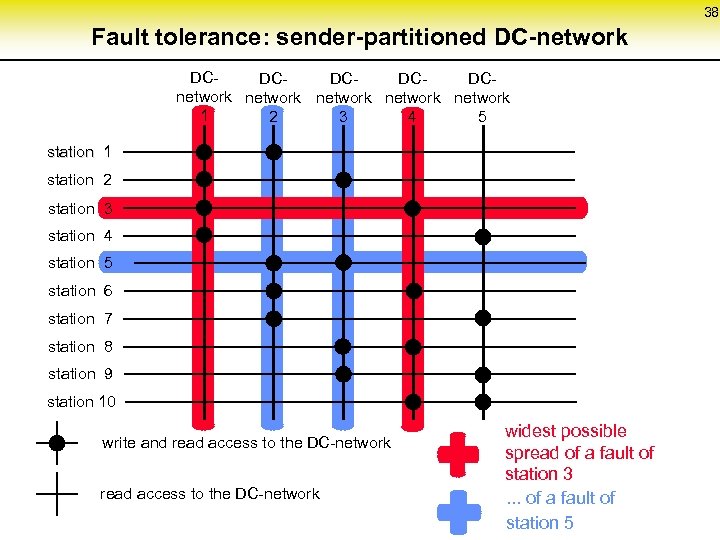 38 Fault tolerance: sender-partitioned DC-network DCDCDCnetwork network 1 2 3 4 5 station 1 station 2 station 3 station 4 station 5 station 6 station 7 station 8 station 9 station 10 write and read access to the DC-network widest possible spread of a fault of station 3. . . of a fault of station 5
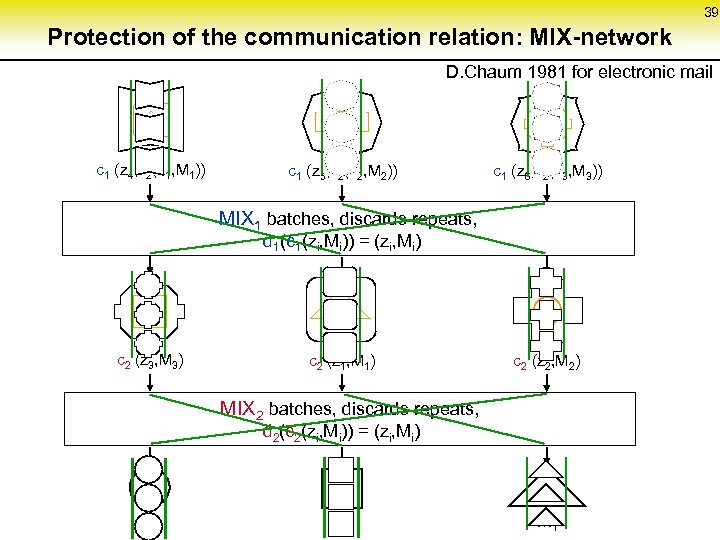 39 Protection of the communication relation: MIX-network D. Chaum 1981 for electronic mail c 1 (z 4, c 2(z 1, M 1)) c 1 (z 5, c 2(z 2, M 2)) c 1 (z 6, c 2(z 3, M 3)) MIX 1 batches, discards repeats, d 1(c 1(zi, Mi)) = (zi, Mi) c 2 (z 3, M 3) c 2 (z 1, M 1) c 2 (z 2, M 2) MIX 2 batches, discards repeats, d 2(c 2(zi, Mi)) = (zi, Mi) M 2 M 3 M 1
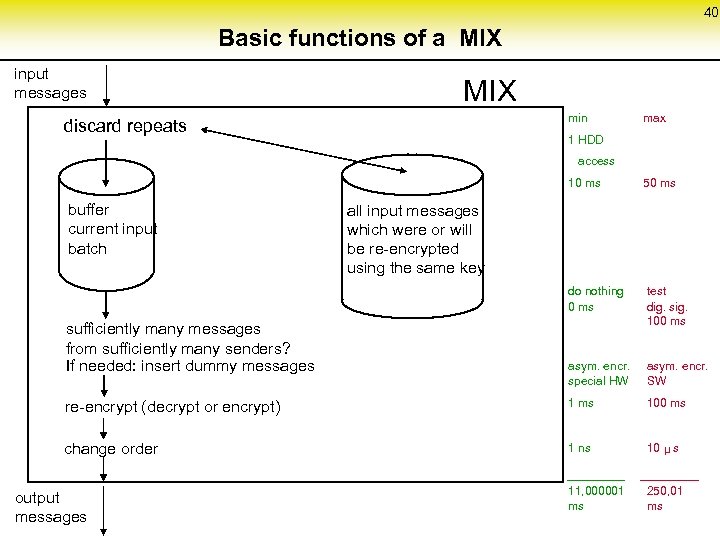 40 Basic functions of a MIX input messages MIX min discard repeats max 1 HDD access 10 ms do nothing 0 ms buffer current input batch sufficiently many messages from sufficiently many senders? If needed: insert dummy messages 50 ms test dig. sig. 100 ms all input messages which were or will be re-encrypted using the same key asym. encr. special HW SW re-encrypt (decrypt or encrypt) 1 ms 100 ms change order 1 ns 10 s µ 11, 000001 ms 250, 01 ms output messages
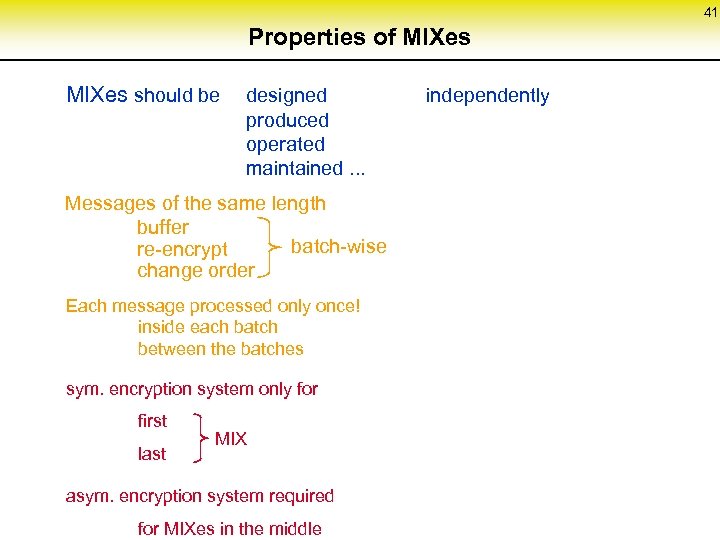 41 Properties of MIXes should be designed produced operated maintained. . . Messages of the same length buffer batch-wise re-encrypt change order Each message processed only once! inside each batch between the batches sym. encryption system only for first last MIX asym. encryption system required for MIXes in the middle independently
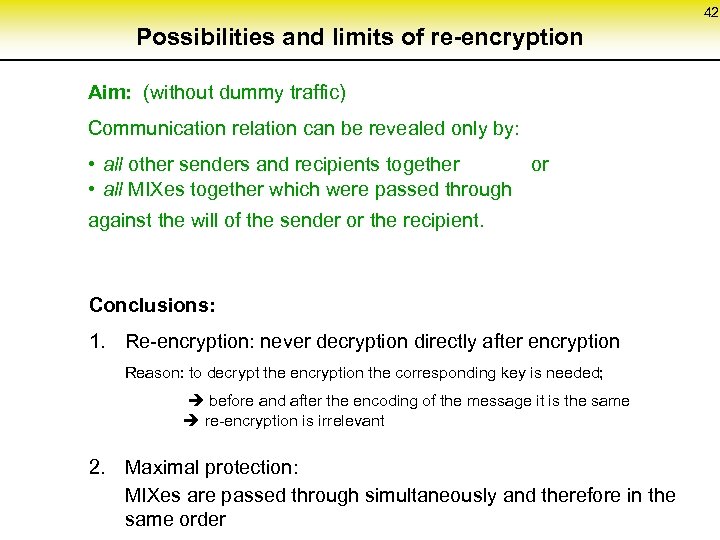 42 Possibilities and limits of re-encryption Aim: (without dummy traffic) Communication relation can be revealed only by: • all other senders and recipients together or • all MIXes together which were passed through against the will of the sender or the recipient. Conclusions: 1. Re-encryption: never decryption directly after encryption Reason: to decrypt the encryption the corresponding key is needed; before and after the encoding of the message it is the same re-encryption is irrelevant 2. Maximal protection: MIXes are passed through simultaneously and therefore in the same order
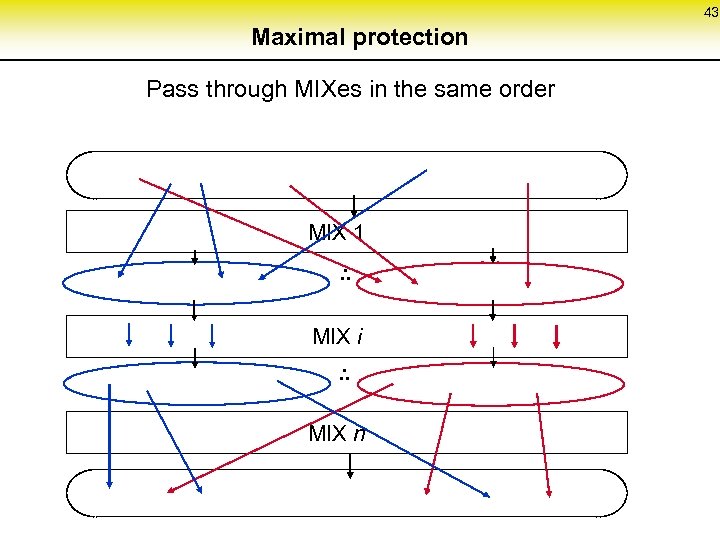 43 Maximal protection Pass through MIXes in the same order MIX 1. . . MIX i. . . MIX n
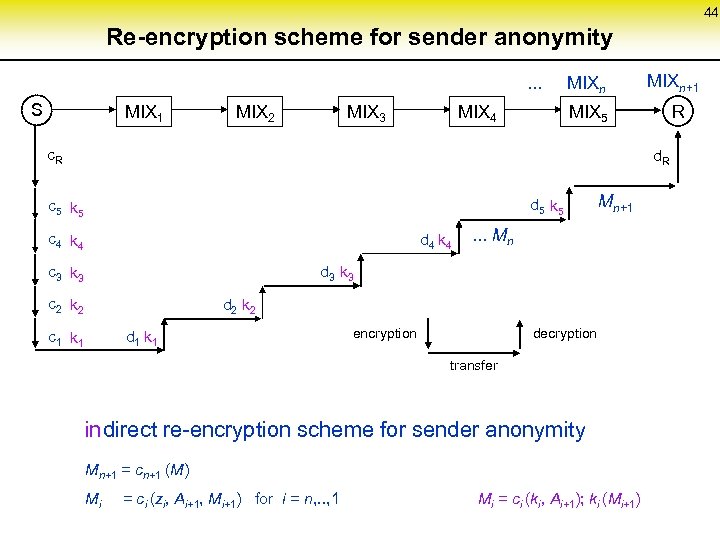 44 Re-encryption scheme for sender anonymity. . . MIXn S MIX 1 MIX 2 MIX 3 MIX 4 MIXn+1 MIX 5 c. R R d 5 k 5 c 4 k 4 d 4 k 4 c 3 k 3 Mn+1 . . . Mn d 3 k 3 c 2 k 2 d 1 k 1 c 1 k 1 encryption decryption transfer in direct re-encryption scheme for sender anonymity Mn+1 = cn+1 (M) Mi = ci (zi, Ai+1, Mi+1) for i = n, . . , 1 Mi = ci (ki, Ai+1); ki (Mi+1)
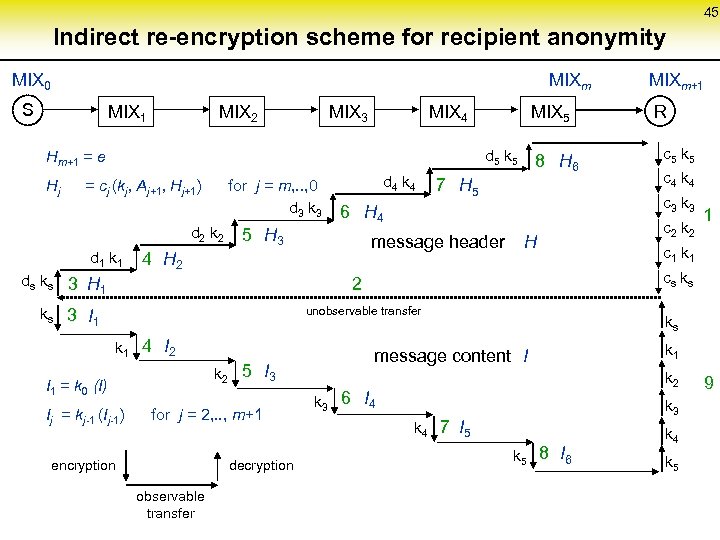 45 Indirect re-encryption scheme for recipient anonymity MIX 0 MIXm S MIX 1 MIX 2 MIX 3 MIX 4 d 5 k 5 Hm+1 = e Hj MIX 5 = cj (kj, Aj+1, Hj+1) for j = m, . . , 0 d 3 k 3 d 2 k 2 d 1 k 1 5 H 3 d 4 k 4 7 H 5 4 H 2 H unobservable transfer k 1 4 I 2 Ij = kj-1 (Ij-1) for j = 2, . . , m+1 encryption decryption observable transfer k 3 c 4 k 4 c 2 k 2 1 c 1 ks message content I k 2 5 I 3 I 1 = k 0 (I) c 5 k 5 cs ks 2 ks 3 I 1 R c 3 k 3 6 H 4 message header ds ks 3 H 1 8 H 6 MIXm+1 k 2 6 I 4 k 3 k 4 7 I 5 k 5 8 I 6 k 4 k 5 9
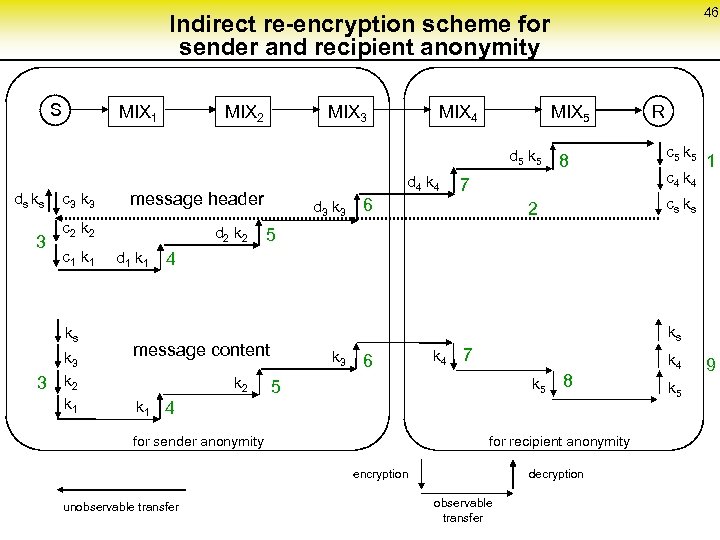 46 Indirect re-encryption scheme for sender and recipient anonymity S MIX 1 MIX 2 MIX 3 MIX 4 MIX 5 d 5 k 5 ds ks 3 c 3 ks 3 message header c 2 k 2 c 1 k 3 k 2 k 1 d 4 k 4 d 2 k 2 d 1 k 1 d 3 k 3 6 8 7 R c 5 k 5 c 4 k 4 1 cs ks 2 5 4 ks message content k 2 k 3 6 k 4 7 k 5 5 8 k 1 4 for sender anonymity for recipient anonymity encryption unobservable transfer decryption observable transfer k 4 k 5 9
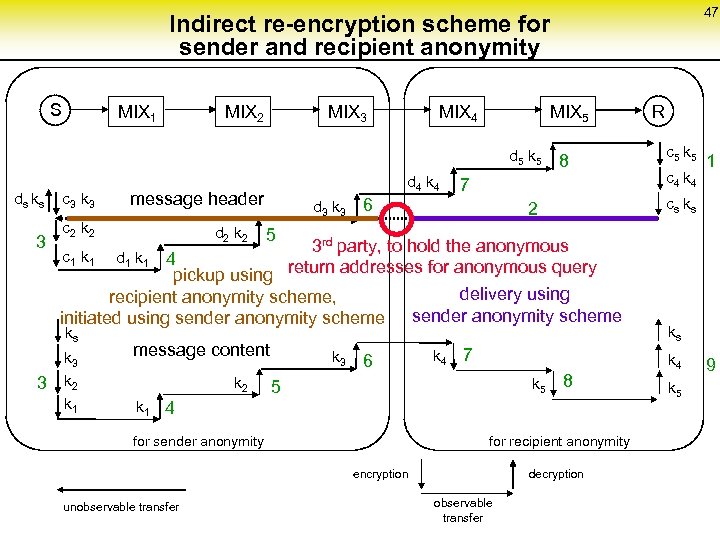 47 Indirect re-encryption scheme for sender and recipient anonymity S MIX 1 MIX 2 MIX 3 MIX 4 MIX 5 d 5 k 5 ds ks 3 c 3 k 3 message header c 2 k 2 d 3 k 3 6 7 k 3 k 2 k 1 k 3 6 k 4 7 k 5 5 8 k 1 4 for sender anonymity for recipient anonymity encryption unobservable transfer c 4 k 4 1 5 message content k 2 c 5 k 5 cs ks 2 3 rd party, to hold the anonymous c 1 k 1 d 1 k 1 4 pickup using return addresses for anonymous query delivery using recipient anonymity scheme, initiated using sender anonymity scheme ks 3 d 4 k 4 8 R decryption observable transfer ks k 4 k 5 9
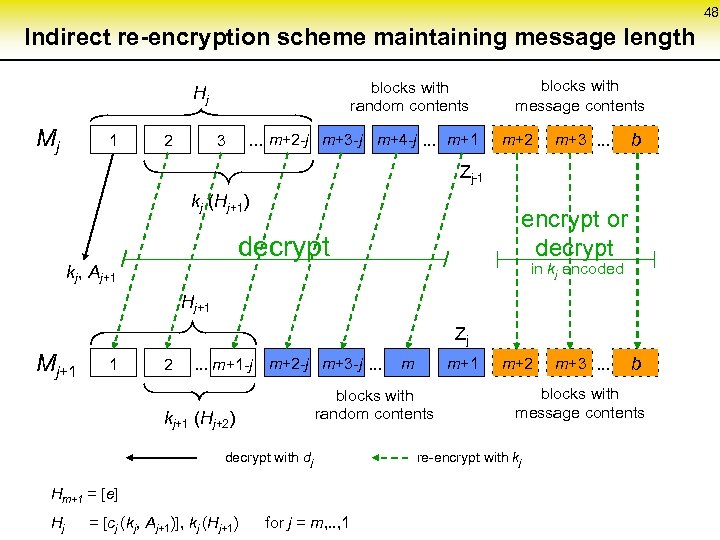 48 Indirect re-encryption scheme maintaining message length blocks with random contents Hj Mj 1 2 . . . m+2 -j m+3 -j m+4 -j. . . m+1 3 blocks with message contents m+2 m+3. . . b Zj-1 kj (Hj+1) encrypt or decrypt kj, Aj+1 in kj encoded Hj+1 Zj Mj+1 1 2 . . . m+1 -j m+2 -j m+3 -j. . . decrypt with dj Hm+1 = [e] = [cj (kj, Aj+1)], kj (Hj+1) m+1 blocks with random contents kj+1 (Hj+2) Hj m for j = m, . . , 1 m+2 m+3. . . b blocks with message contents re-encrypt with kj
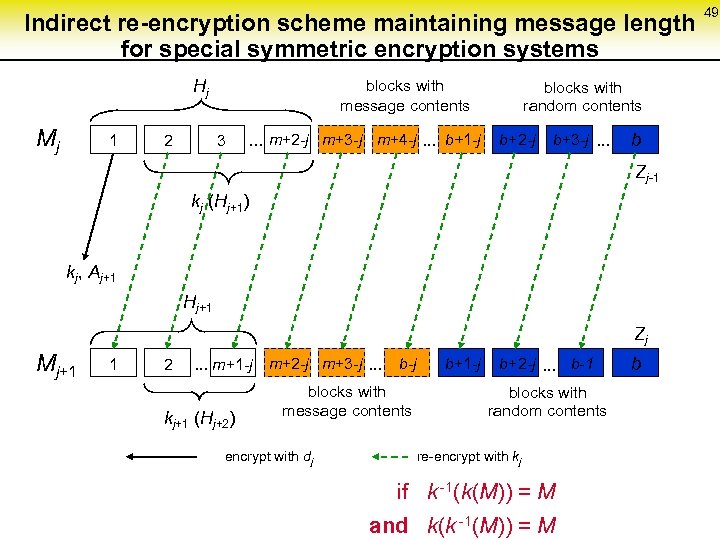 Indirect re-encryption scheme maintaining message length for special symmetric encryption systems Hj Mj 1 2 blocks with message contents 3 . . . m+2 -j m+3 -j m+4 -j. . . b+1 -j blocks with random contents b+2 -j b+3 -j. . . b Zj-1 kj (Hj+1) kj, Aj+1 Hj+1 Zj Mj+1 1 2 . . . m+1 -j m+2 -j m+3 -j. . . b-j kj+1 (Hj+2) blocks with message contents encrypt with dj b+1 -j b+2 -j. . . b-1 blocks with random contents re-encrypt with kj if k -1(k(M)) = M and k(k -1(M)) = M b 49
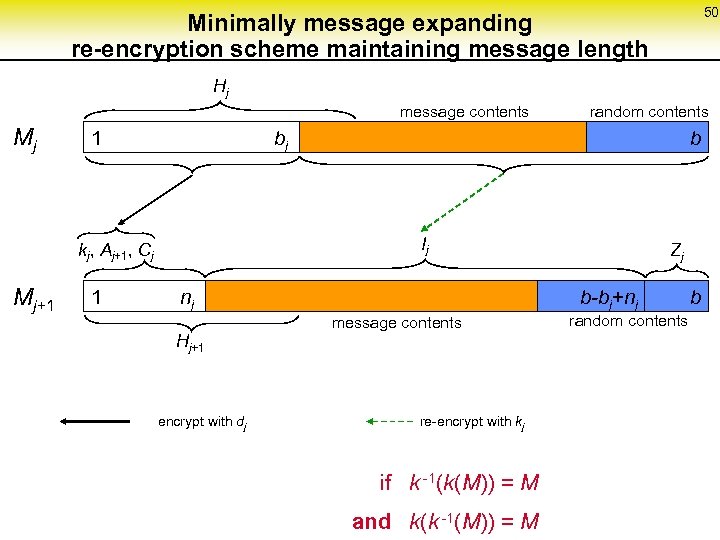 50 Minimally message expanding re-encryption scheme maintaining message length Hj message contents Mj 1 bj b Ij kj, Aj+1, Cj Mj+1 random contents 1 nj Hj+1 encrypt with dj Zj b-bj+nj message contents re-encrypt with kj if k -1(k(M)) = M and k(k -1(M)) = M random contents b
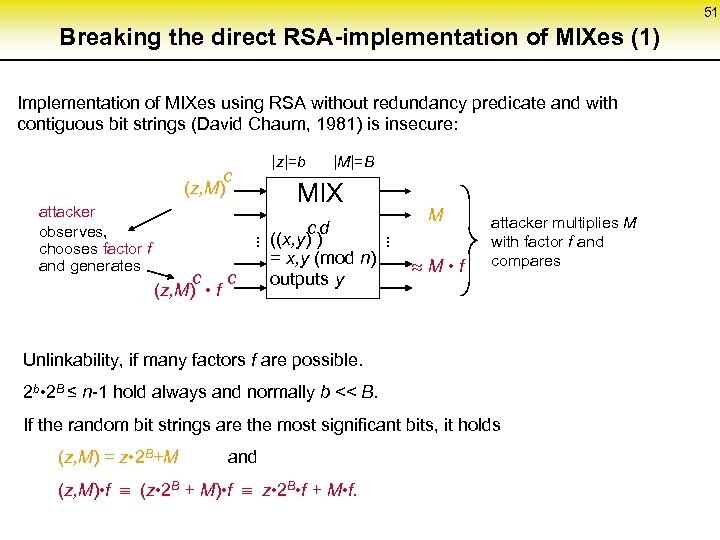 51 Breaking the direct RSA-implementation of MIXes (1) Implementation of MIXes using RSA without redundancy predicate and with contiguous bit strings (David Chaum, 1981) is insecure: |z|=b |M|=B c (z, M) attacker observes, chooses factor f and generates c c (z, M) • f MIX c. ((x, y) )d. . . = x, y (mod n) outputs y M M • f attacker multiplies M with factor f and compares Unlinkability, if many factors f are possible. 2 b • 2 B ≤ n-1 hold always and normally b << B. If the random bit strings are the most significant bits, it holds (z, M) = z • 2 B+M and (z, M) • f (z • 2 B + M) • f z • 2 B • f + M • f.
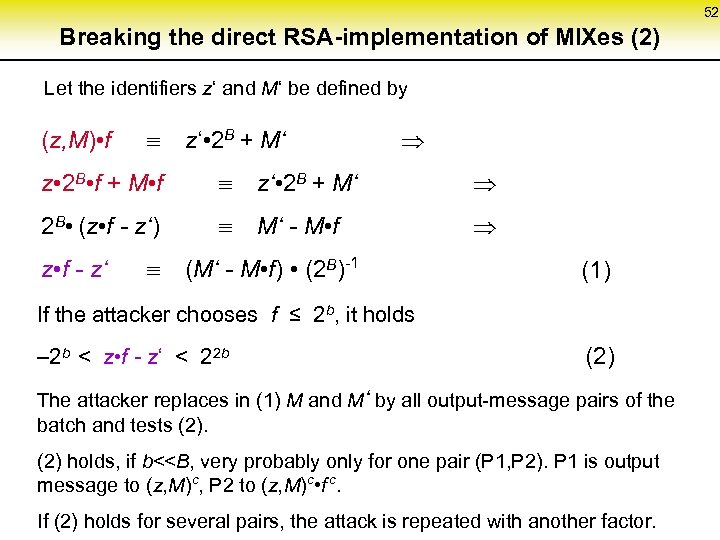 52 Breaking the direct RSA-implementation of MIXes (2) Let the identifiers z‘ and M‘ be defined by (z, M) • f z • 2 B • f + M • f z‘ • 2 B + M‘ 2 B • (z • f - z‘) M‘ - M • f z • f - z‘ (M‘ - M • f) • (2 B)-1 (1) If the attacker chooses f ≤ 2 b, it holds – 2 b < z • f - z‘ < 22 b (2) The attacker replaces in (1) M and M‘ by all output-message pairs of the batch and tests (2) holds, if b<
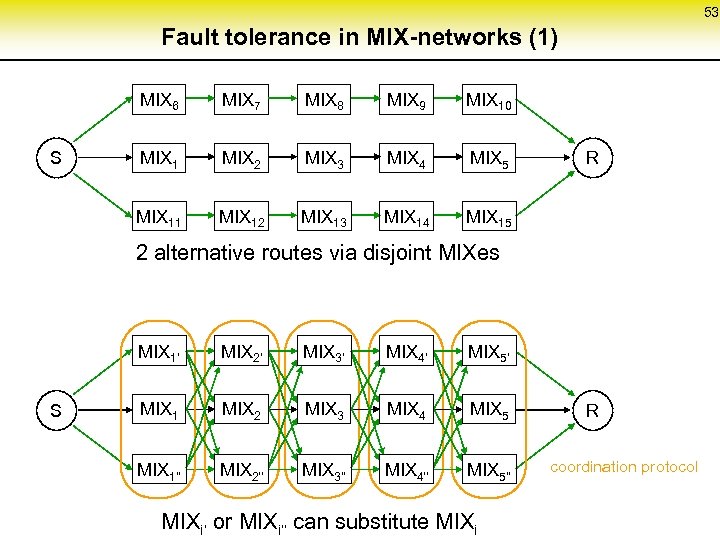 53 Fault tolerance in MIX-networks (1) MIX 6 MIX 8 MIX 9 MIX 10 MIX 1 MIX 2 MIX 3 MIX 4 MIX 5 MIX 11 S MIX 7 MIX 12 MIX 13 MIX 14 MIX 15 R 2 alternative routes via disjoint MIXes MIX 1‘ S MIX 2‘ MIX 3‘ MIX 4‘ MIX 5‘ MIX 1 MIX 2 MIX 3 MIX 4 MIX 5 MIX 1‘‘ MIX 2‘‘ MIX 3‘‘ MIX 4‘‘ MIX 5‘‘ MIXi‘ or MIXi‘‘ can substitute MIXi R coordination protocol
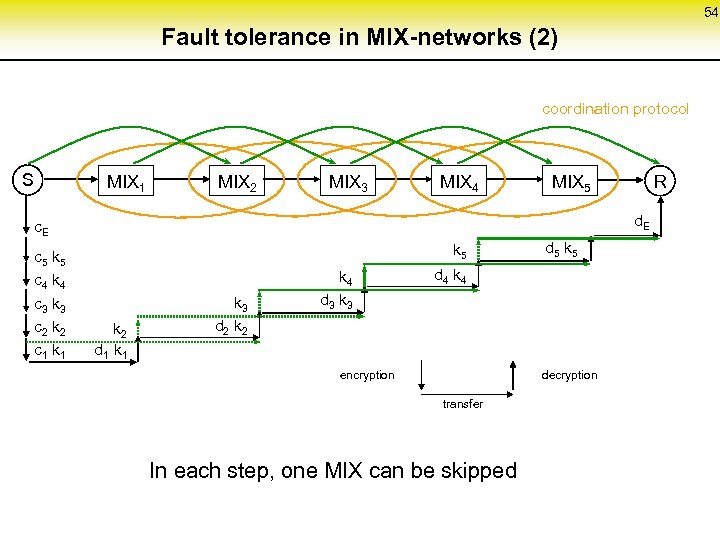 54 Fault tolerance in MIX-networks (2) coordination protocol S MIX 1 MIX 2 MIX 3 MIX 4 MIX 5 d. E c 5 k 5 c 4 k 4 c 3 k 3 c 2 k 2 c 1 k 1 R k 5 k 2 d 1 k 3 d 2 k 4 d 3 k 3 d 5 k 5 d 4 k 4 encryption decryption transfer In each step, one MIX can be skipped
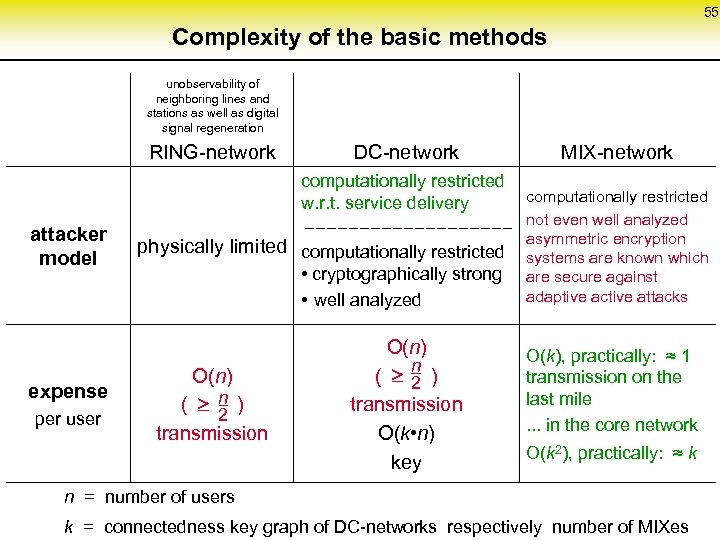 55 Complexity of the basic methods unobservability of neighboring lines and stations as well as digital signal regeneration RING-network DC-network MIX-network computationally restricted w. r. t. service delivery attacker model physically limited computationally restricted • cryptographically strong • well analyzed expense per user O(n) n ( ) 2 transmission O(k • n) key not even well analyzed asymmetric encryption systems are known which are secure against adaptive active attacks O(k), practically: ≈ 1 transmission on the last mile. . . in the core network O(k 2), practically: ≈ k n = number of users k = connectedness key graph of DC-networks respectively number of MIXes
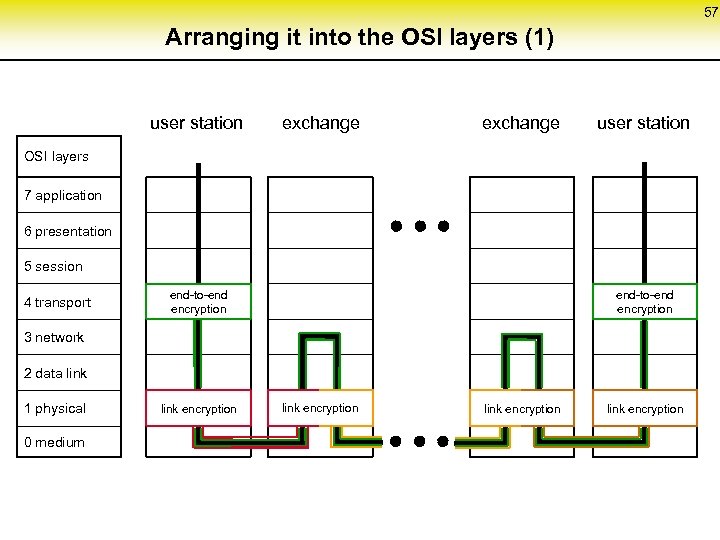
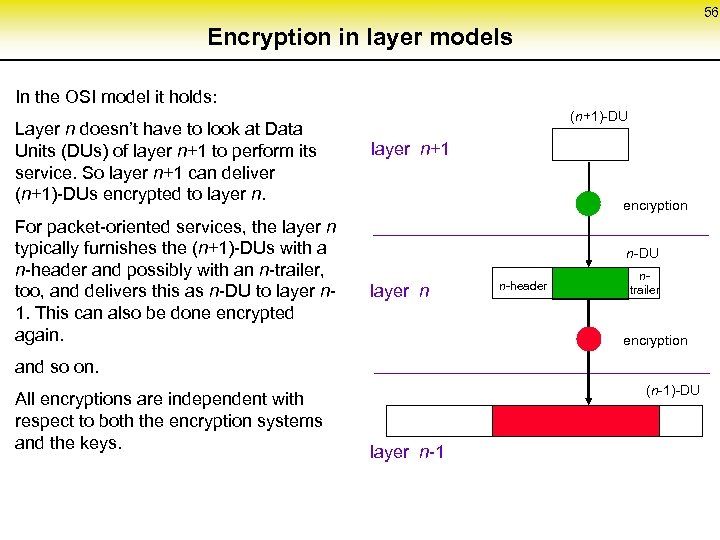 56 Encryption in layer models In the OSI model it holds: Layer n doesn’t have to look at Data Units (DUs) of layer n+1 to perform its service. So layer n+1 can deliver (n+1)-DUs encrypted to layer n. For packet-oriented services, the layer n typically furnishes the (n+1)-DUs with a n-header and possibly with an n-trailer, too, and delivers this as n-DU to layer n 1. This can also be done encrypted again. (n+1)-DU layer n+1 encryption n-DU layer n n-header ntrailer encryption and so on. All encryptions are independent with respect to both the encryption systems and the keys. (n-1)-DU layer n-1
 57 Arranging it into the OSI layers (1) user station exchange user station OSI layers 7 application 6 presentation 5 session 4 transport end-to-end encryption 3 network 2 data link 1 physical 0 medium link encryption
 58 Arranging it into the OSI layers (2) OSI layers broadcast query MIX-network DC-network RING-network anonymous access 7 application 6 presentation 5 session 4 transport 3 network implicit addressing query and superpose broadcast buffer and re-encrypt 2 data link 1 physical superpose keys and messages channel selection 0 medium ring has to preserve anonymity against the communication partner has to preserve anonymity digital signal regeneration end-to-end encryption realizable without consideration of anonymity
 59 Tolerating errors and active attacks Problems: series systems w. r. t. availability maintain the anonymity of „honest“ users There adequate extensions.
 60 Network extension by stages. . . efficiency hierarchical communication networks user station broadband cable network local exchange (LE) long distance network with MIXes for some services + . . MIX cascade
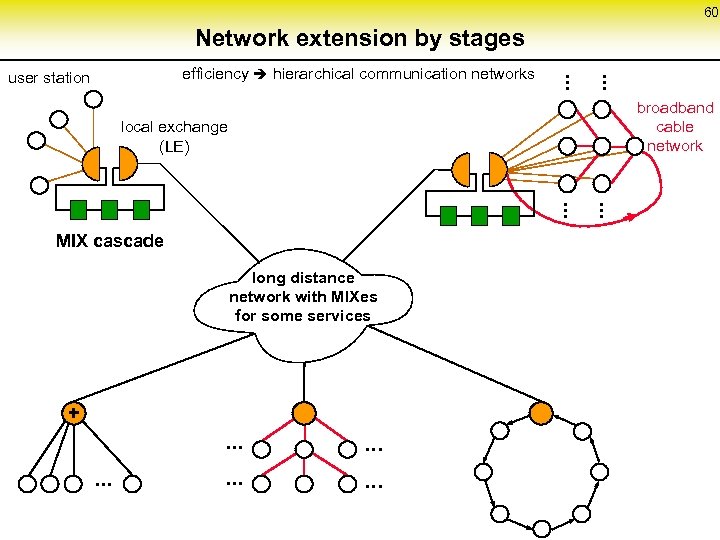
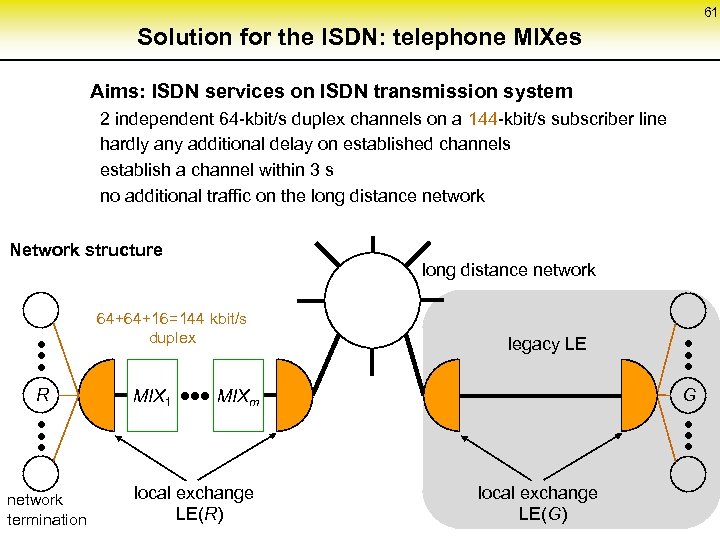 61 Solution for the ISDN: telephone MIXes Aims: ISDN services on ISDN transmission system 2 independent 64 -kbit/s duplex channels on a 144 -kbit/s subscriber line hardly any additional delay on established channels establish a channel within 3 s no additional traffic on the long distance network Network structure long distance network • • • R • • • network termination 64+64+16=144 kbit/s duplex MIX 1 • • • MIX legacy LE G m local exchange LE(R) • • • local exchange LE(G)
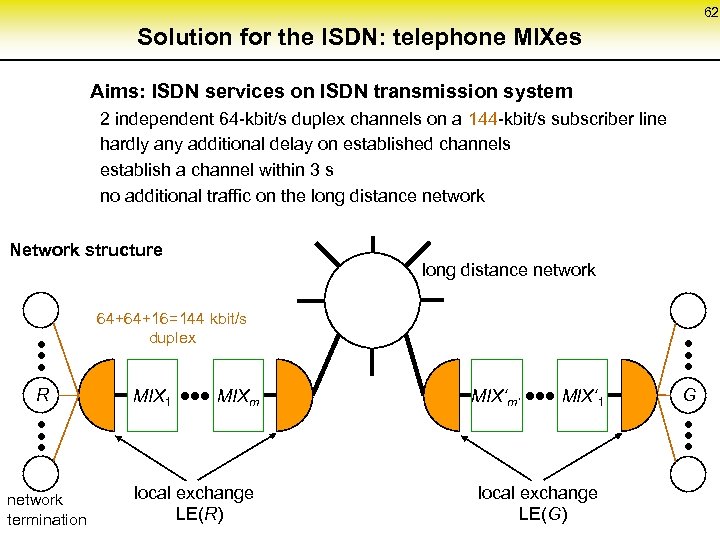 62 Solution for the ISDN: telephone MIXes Aims: ISDN services on ISDN transmission system 2 independent 64 -kbit/s duplex channels on a 144 -kbit/s subscriber line hardly any additional delay on established channels establish a channel within 3 s no additional traffic on the long distance network Network structure long distance network • • • R • • • network termination 64+64+16=144 kbit/s duplex MIX 1 • • • MIX m local exchange LE(R) MIX‘m’ • • • MIX‘ • • • 1 local exchange LE(G) G • • •
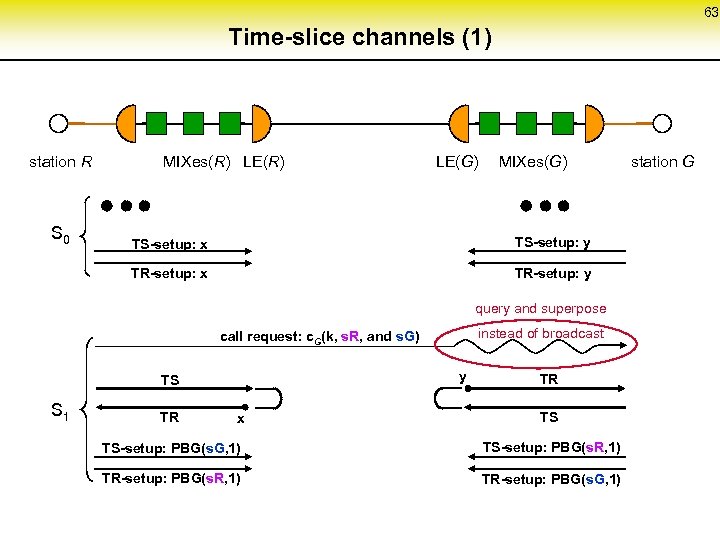 63 Time-slice channels (1) station R S 0 MIXes(R) LE(G) MIXes(G) TS-setup: x TS-setup: y TR-setup: x TR-setup: y query and superpose instead of broadcast call request: c. G(k, s. R, and s. G) y TS S 1 TR x TR TS TS-setup: PBG(s. G, 1) TS-setup: PBG(s. R, 1) TR-setup: PBG(s. G, 1) station G
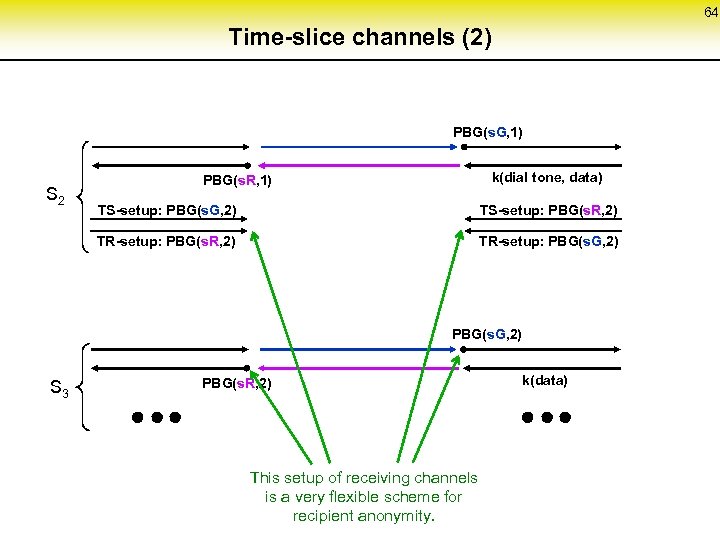 64 Time-slice channels (2) PBG(s. G, 1) S 2 k(dial tone, data) PBG(s. R, 1) TS-setup: PBG(s. G, 2) TS-setup: PBG(s. R, 2) TR-setup: PBG(s. G, 2) S 3 PBG(s. R, 2) This setup of receiving channels is a very flexible scheme for recipient anonymity. k(data)
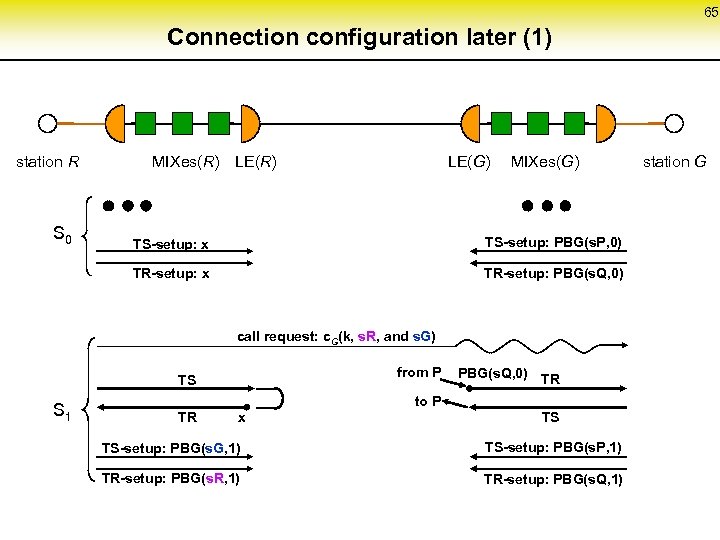 65 Connection configuration later (1) station R S 0 MIXes(R) LE(G) MIXes(G) TS-setup: x TS-setup: PBG(s. P, 0) TR-setup: x TR-setup: PBG(s. Q, 0) call request: c. G(k, s. R, and s. G) from P TS S 1 PBG(s. Q, 0) TR to P TR x TS TS-setup: PBG(s. G, 1) TS-setup: PBG(s. P, 1) TR-setup: PBG(s. R, 1) TR-setup: PBG(s. Q, 1) station G
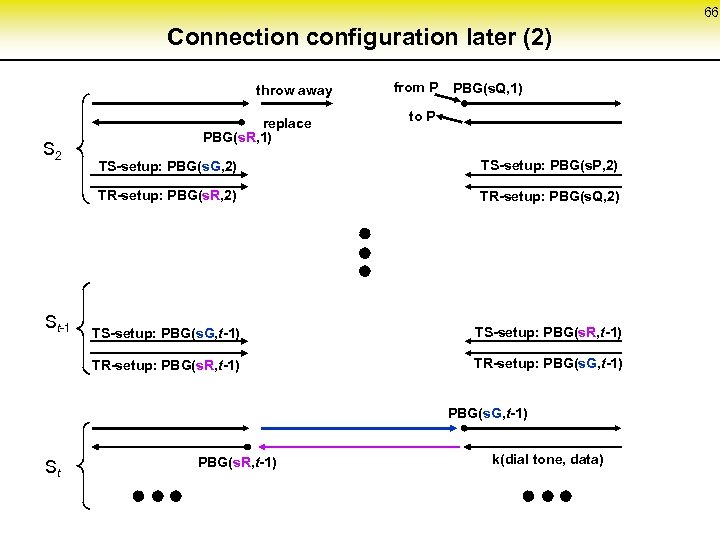 66 Connection configuration later (2) throw away S 2 replace PBG(s. R, 1) from P PBG(s. Q, 1) to P TS-setup: PBG(s. P, 2) TR-setup: PBG(s. R, 2) TR-setup: PBG(s. Q, 2) TS-setup: PBG(s. G, t-1) TS-setup: PBG(s. R, t-1) TR-setup: PBG(s. R, t-1) St-1 TS-setup: PBG(s. G, 2) TR-setup: PBG(s. G, t-1) St PBG(s. R, t-1) k(dial tone, data)
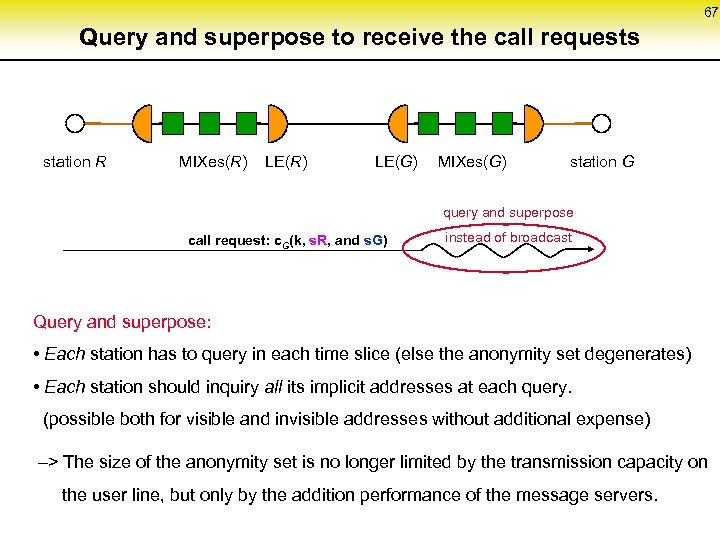 67 Query and superpose to receive the call requests station R MIXes(R) LE(G) MIXes(G) station G query and superpose call request: c. G(k, s. R, and s. G) instead of broadcast Query and superpose: • Each station has to query in each time slice (else the anonymity set degenerates) • Each station should inquiry all its implicit addresses at each query. (possible both for visible and invisible addresses without additional expense) –> The size of the anonymity set is no longer limited by the transmission capacity on the user line, but only by the addition performance of the message servers.
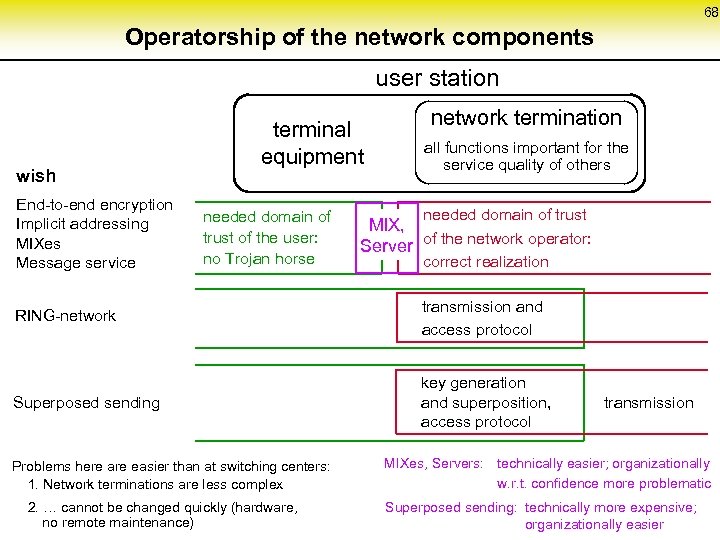 68 Operatorship of the network components user station wish End-to-end encryption Implicit addressing MIXes Message service terminal equipment needed domain of trust of the user: no Trojan horse network termination all functions important for the service quality of others needed domain of trust MIX, of the network operator: Server correct realization RING-network transmission and access protocol Superposed sending key generation and superposition, access protocol transmission Problems here are easier than at switching centers: 1. Network terminations are less complex MIXes, Servers: technically easier; organizationally w. r. t. confidence more problematic 2. … cannot be changed quickly (hardware, no remote maintenance) Superposed sending: technically more expensive; organizationally easier
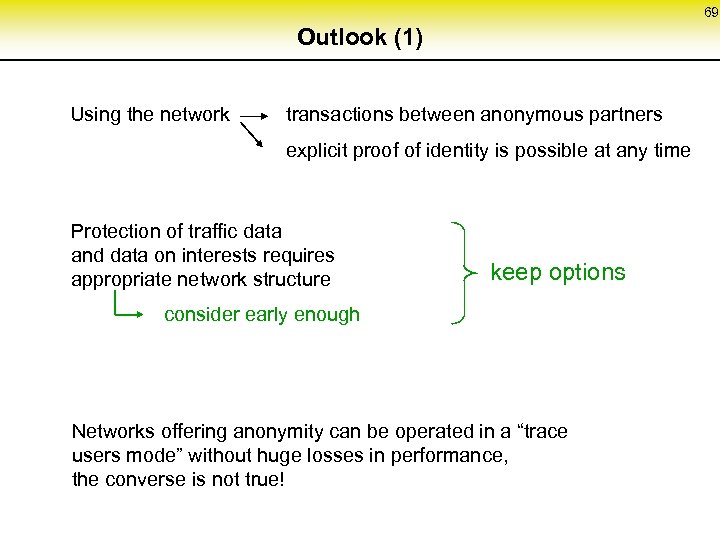 69 Outlook (1) Using the network transactions between anonymous partners explicit proof of identity is possible at any time Protection of traffic data and data on interests requires appropriate network structure keep options consider early enough Networks offering anonymity can be operated in a “trace users mode” without huge losses in performance, the converse is not true!
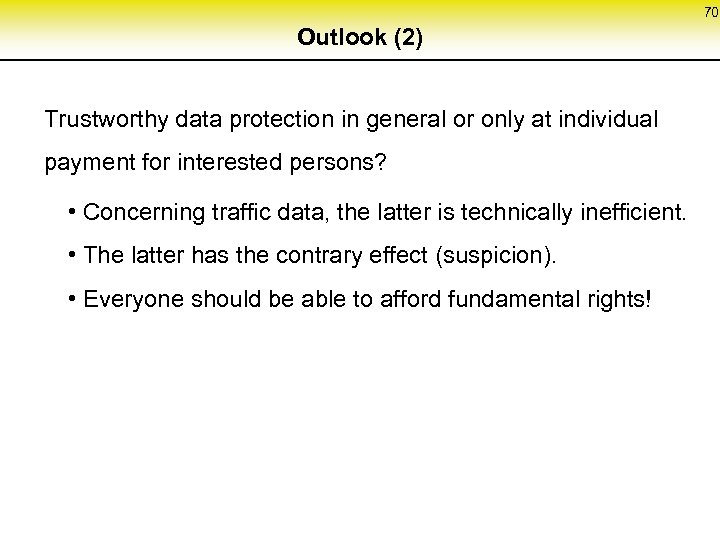 70 Outlook (2) Trustworthy data protection in general or only at individual payment for interested persons? • Concerning traffic data, the latter is technically inefficient. • The latter has the contrary effect (suspicion). • Everyone should be able to afford fundamental rights!
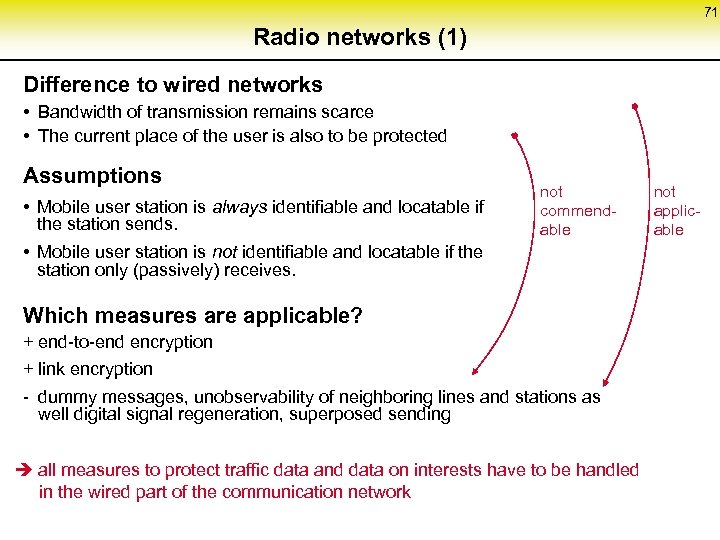 71 Radio networks (1) Difference to wired networks • Bandwidth of transmission remains scarce • The current place of the user is also to be protected Assumptions • Mobile user station is always identifiable and locatable if the station sends. not commendable • Mobile user station is not identifiable and locatable if the station only (passively) receives. Which measures are applicable? + end-to-end encryption + link encryption - dummy messages, unobservability of neighboring lines and stations as well digital signal regeneration, superposed sending all measures to protect traffic data and data on interests have to be handled in the wired part of the communication network not applicable
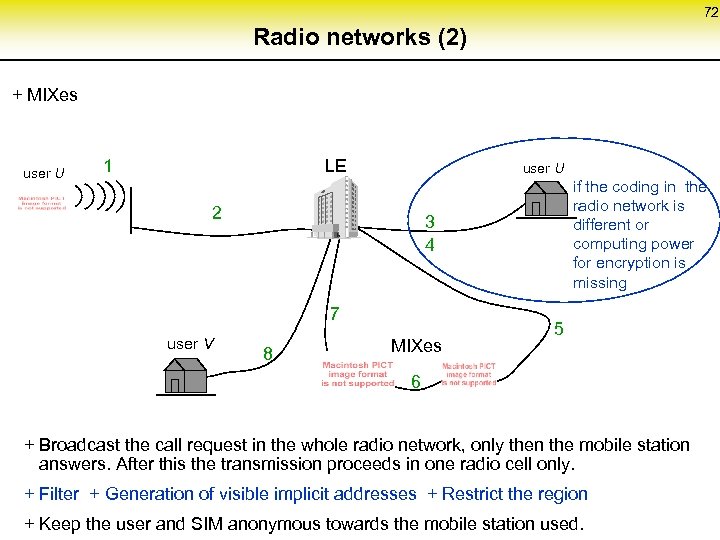 72 Radio networks (2) + MIXes user U 1 LE user U 2 3 4 7 user V if the coding in the radio network is different or computing power for encryption is missing 8 MIXes 5 6 + Broadcast the call request in the whole radio network, only then the mobile station answers. After this the transmission proceeds in one radio cell only. + Filter + Generation of visible implicit addresses + Restrict the region + Keep the user and SIM anonymous towards the mobile station used.
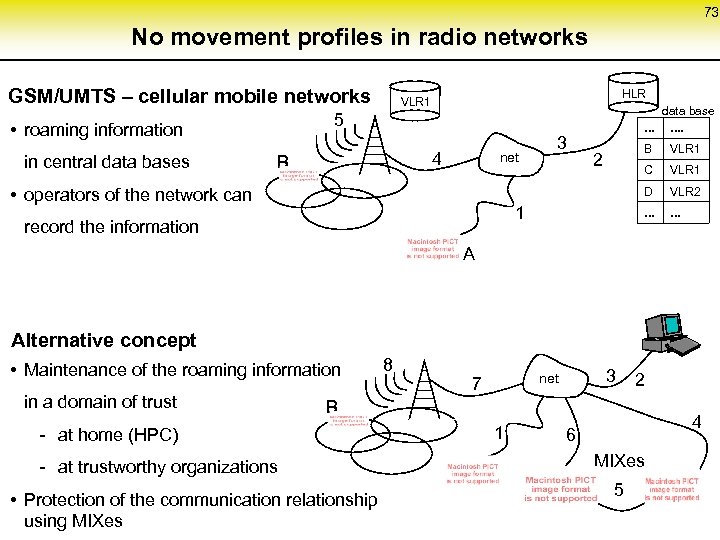 73 No movement profiles in radio networks GSM/UMTS – cellular mobile networks data base. . . . 5 • roaming information in central data bases HLR VLR 1 3 B • operators of the network can B C 1 record the information VLR 1 VLR 2 . . . 2 VLR 1 D 4 net . . . A Alternative concept • Maintenance of the roaming information in a domain of trust 8 3 net 7 2 B - at home (HPC) - at trustworthy organizations • Protection of the communication relationship using MIXes 1 4 6 MIXes 5
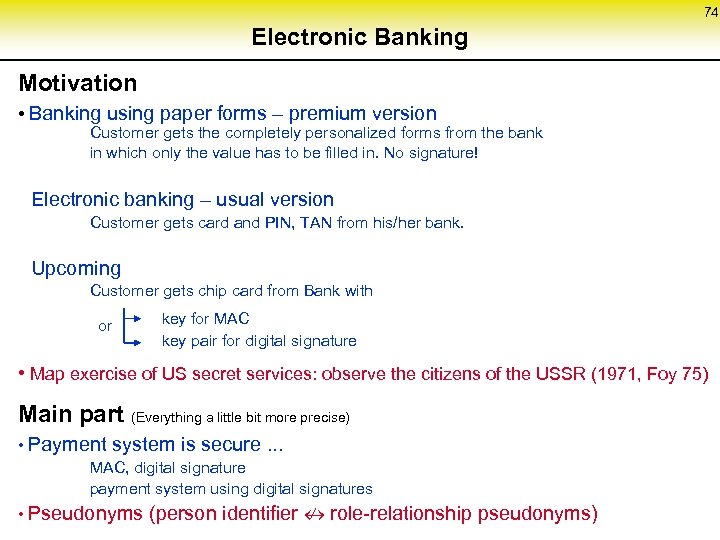 74 Electronic Banking Motivation • Banking using paper forms – premium version Customer gets the completely personalized forms from the bank in which only the value has to be filled in. No signature! Electronic banking – usual version Customer gets card and PIN, TAN from his/her bank. Upcoming Customer gets chip card from Bank with or key for MAC key pair for digital signature • Map exercise of US secret services: observe the citizens of the USSR (1971, Foy 75) Main part (Everything a little bit more precise) • Payment system is secure. . . MAC, digital signature payment system using digital signatures • Pseudonyms (person identifier role-relationship pseudonyms)
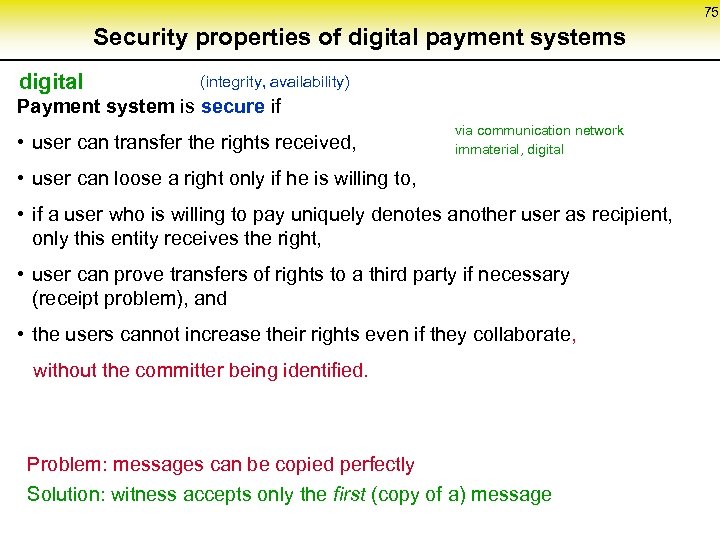 75 Security properties of digital payment systems digital (integrity, availability) Payment system is secure if • user can transfer the rights received, via communication network immaterial, digital • user can loose a right only if he is willing to, • if a user who is willing to pay uniquely denotes another user as recipient, only this entity receives the right, • user can prove transfers of rights to a third party if necessary (receipt problem), and , • the users cannot increase their rights even if they collaborate. without the committer being identified. Problem: messages can be copied perfectly Solution: witness accepts only the first (copy of a) message
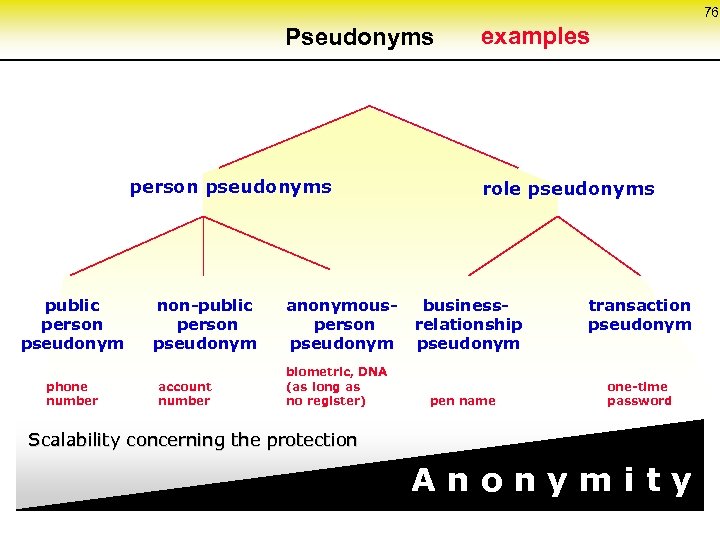 76 Pseudonyms person pseudonyms public person pseudonym phone number non-public person pseudonym account number anonymous person pseudonym biometric, DNA (as long as no register) examples role pseudonyms business- relationship pseudonym pen name transaction pseudonym one-time password Scalability concerning the protection A n o n y m i t y
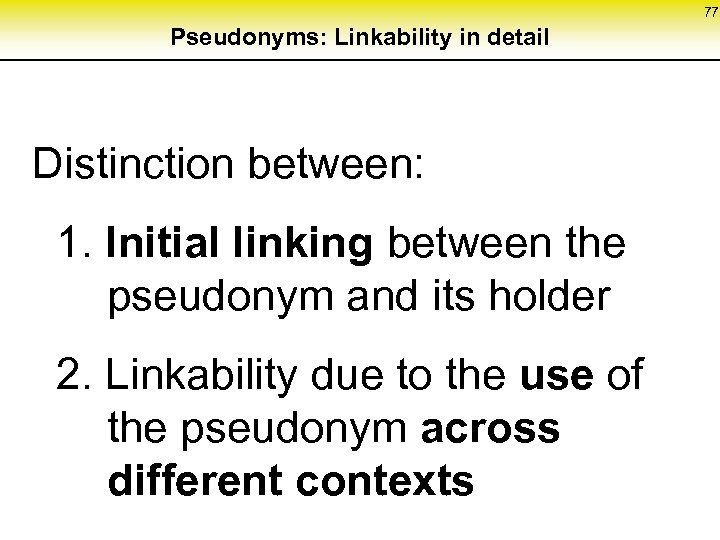 77 Pseudonyms: Linkability in detail Distinction between: 1. Initial linking between the pseudonym and its holder 2. Linkability due to the use of the pseudonym across different contexts
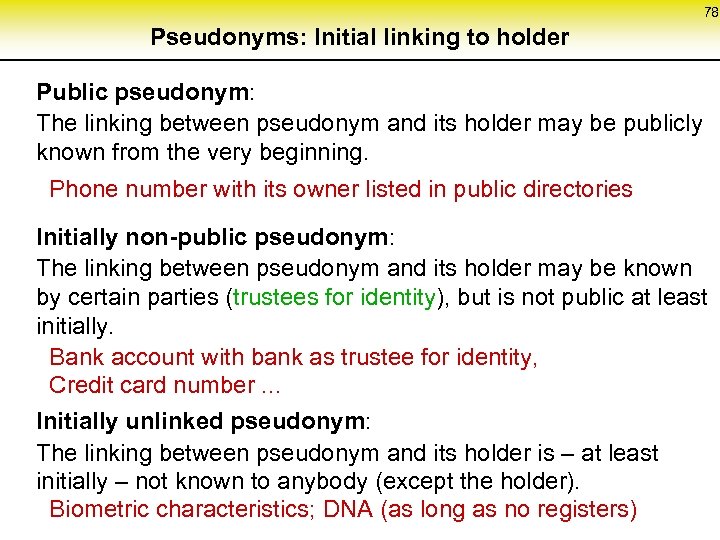 78 Pseudonyms: Initial linking to holder Public pseudonym: The linking between pseudonym and its holder may be publicly known from the very beginning. Phone number with its owner listed in public directories Initially non-public pseudonym: The linking between pseudonym and its holder may be known by certain parties (trustees for identity), but is not public at least initially. Bank account with bank as trustee for identity, Credit card number. . . Initially unlinked pseudonym: The linking between pseudonym and its holder is – at least initially – not known to anybody (except the holder). Biometric characteristics; DNA (as long as no registers)
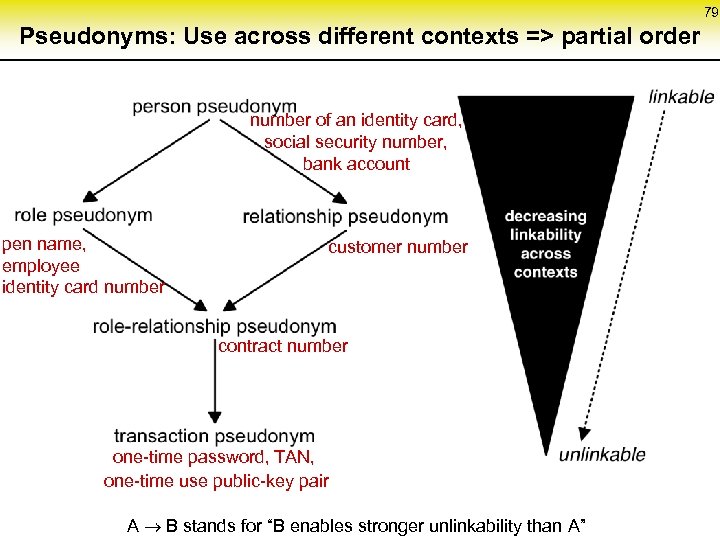 79 Pseudonyms: Use across different contexts => partial order number of an identity card, social security number, bank account pen name, employee identity card number customer number contract number one-time password, TAN, one-time use public-key pair A B stands for “B enables stronger unlinkability than A”
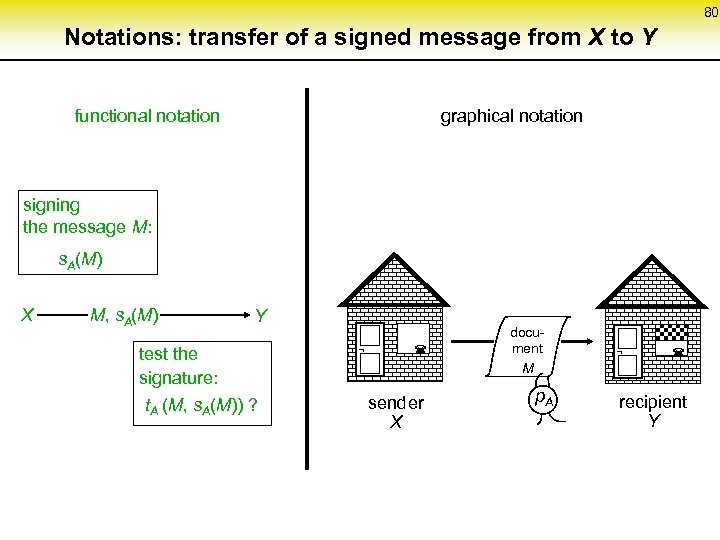 80 Notations: transfer of a signed message from X to Y functional notation graphical notation signing the message M: s. A(M) X M, s. A(M) Y test the signature: t. A (M, s. A(M)) ? ¬ sender X document M p. A ¬ recipient Y
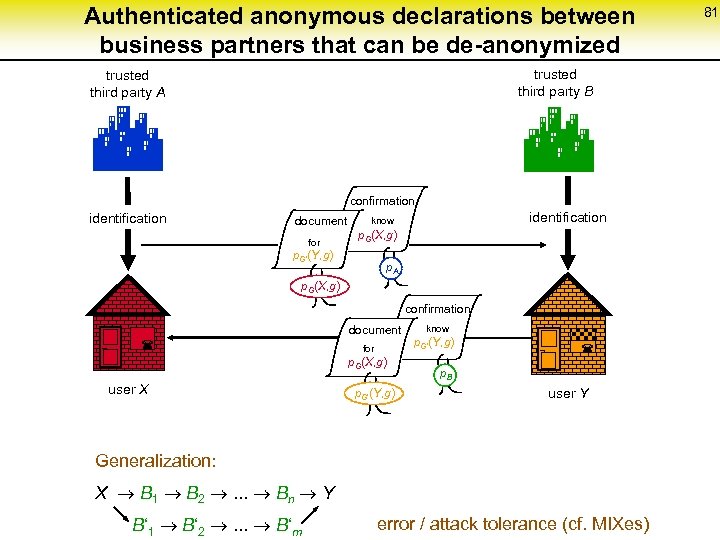 Authenticated anonymous declarations between business partners that can be de-anonymized trusted third party A trusted third party B confirmation identification document for identification know p. G(X, g) p. G‘(Y, g) p. A p. G(X, g) confirmation document ¬ for p. G(X, g) user X p. G‘(Y, g) know p. G‘(Y, g) ¬ p. B user Y Generalization: X B 1 B 2 . . . Bn Y B‘ 1 B‘ 2 . . . B‘m error / attack tolerance (cf. MIXes) 81
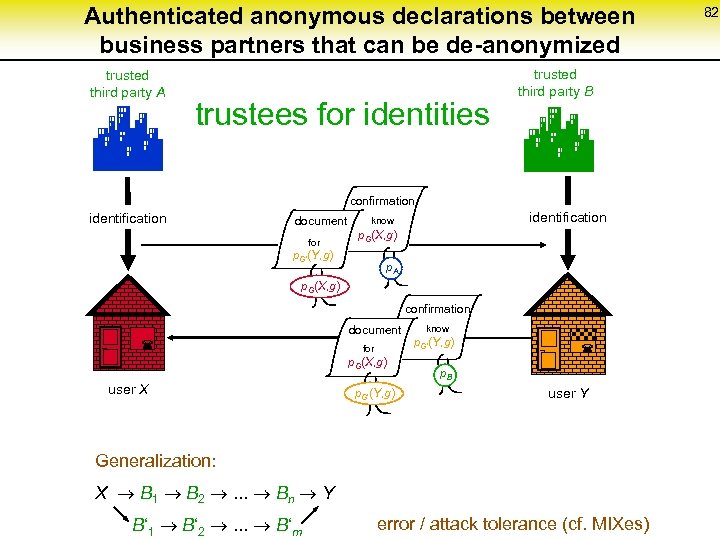 Authenticated anonymous declarations between business partners that can be de-anonymized trusted third party A trustees for identities trusted third party B confirmation identification document for identification know p. G(X, g) p. G‘(Y, g) p. A p. G(X, g) confirmation document ¬ for p. G(X, g) user X p. G‘(Y, g) know p. G‘(Y, g) ¬ p. B user Y Generalization: X B 1 B 2 . . . Bn Y B‘ 1 B‘ 2 . . . B‘m error / attack tolerance (cf. MIXes) 82
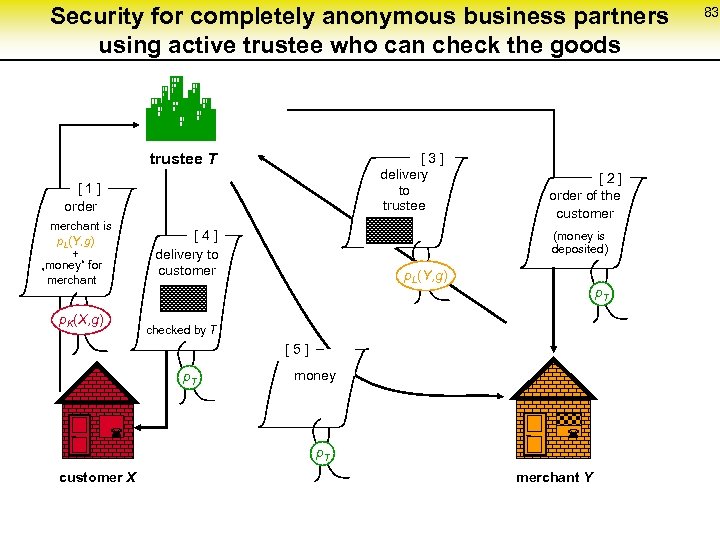 Security for completely anonymous business partners using active trustee who can check the goods trustee T [ 3 ] delivery to trustee [ 1 ] order merchant is p. L(Y, g) + „money“ for merchant p. K(X, g) [ 4 ] delivery to customer [ 2 ] order of the customer (money is deposited) p. L(Y, g) p. T checked by T [ 5 ] p. T ¬ money ¬ p. T customer X merchant Y 83
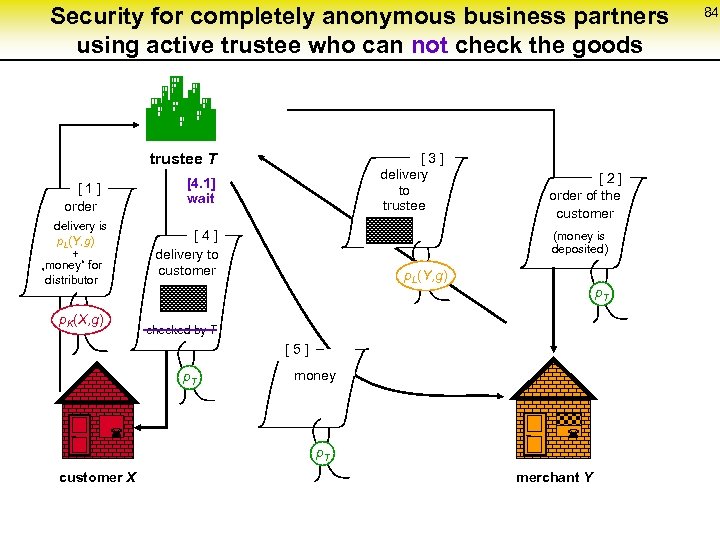 Security for completely anonymous business partners using active trustee who can not check the goods trustee T [ 3 ] delivery to trustee [4. 1] wait [ 1 ] order delivery is p. L(Y, g) + „money“ for distributor [ 4 ] delivery to customer p. K(X, g) [ 2 ] order of the customer (money is deposited) p. L(Y, g) p. T checked by T [ 5 ] p. T ¬ money ¬ p. T customer X merchant Y 84
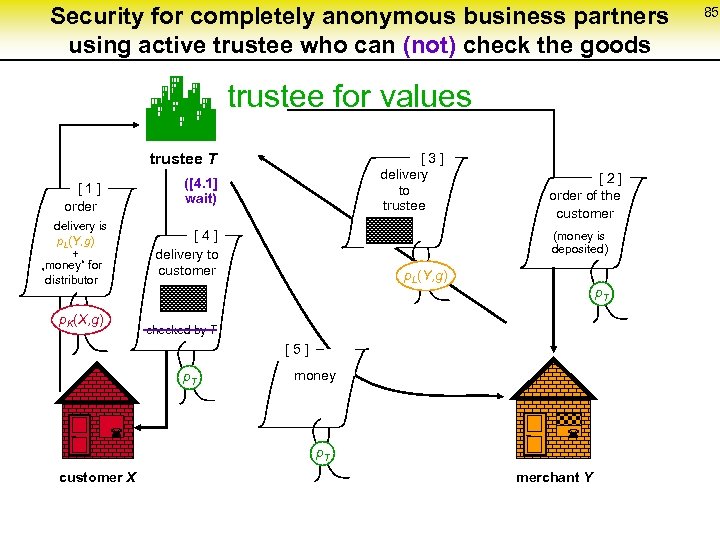 Security for completely anonymous business partners using active trustee who can (not) check the goods trustee for values trustee T [ 3 ] delivery to trustee ([4. 1] wait) [ 1 ] order delivery is p. L(Y, g) + „money“ for distributor [ 4 ] delivery to customer p. K(X, g) [ 2 ] order of the customer (money is deposited) p. L(Y, g) p. T checked by T [ 5 ] p. T ¬ money ¬ p. T customer X merchant Y 85
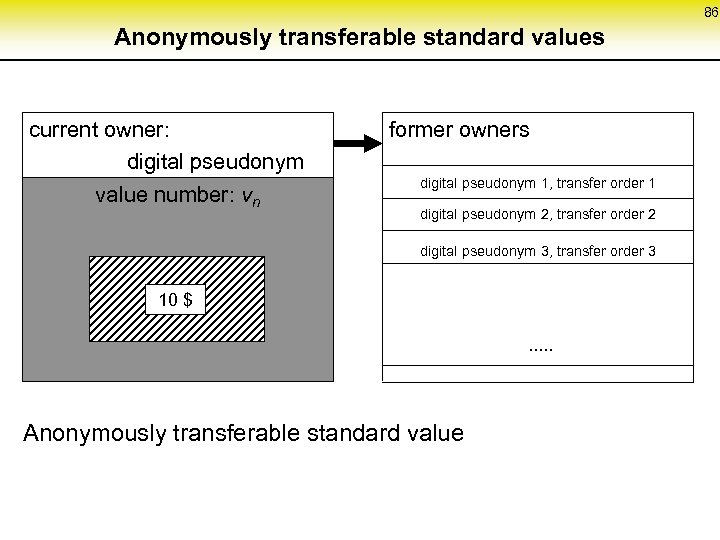 86 Anonymously transferable standard values current owner: digital pseudonym value number: vn former owners digital pseudonym 1, transfer order 1 digital pseudonym 2, transfer order 2 digital pseudonym 3, transfer order 3 10 $ . . . Anonymously transferable standard value
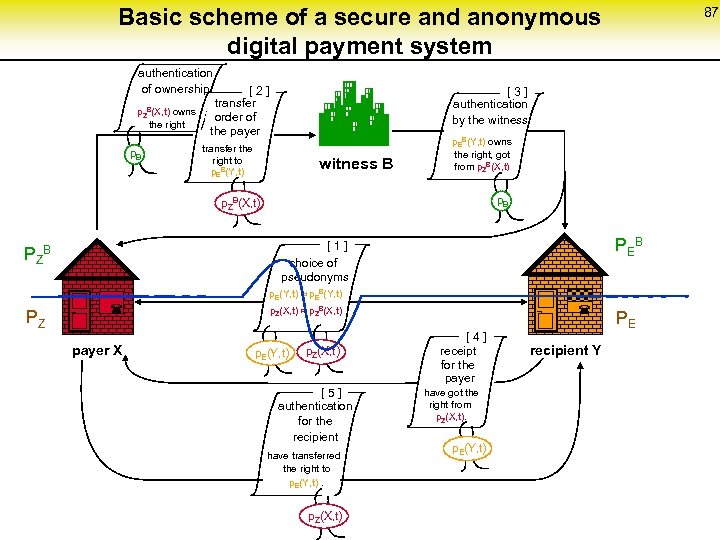 Basic scheme of a secure and anonymous digital payment system authentication of ownership p. ZB(X, t) owns the right p. B [ 2 ] transfer order of the payer transfer the right to p. EB(Y, t) witness B [ 3 ] authentication by the witness p. EB(Y, t) owns the right, got from p. ZB(X, t) p. B p. ZB(X, t) PEB [ 1 ] choice of pseudonyms P ZB 87 p. E(Y, t) p. EB(Y, t) PZ p. Z(X, t) p. ZB(X, t) payer X p. Z(X, t) ¬ p. E(Y, t) [ 5 ] authentication for the recipient have transferred the right to p. E(Y, t). p. Z(X, t) ¬ [ 4 ] receipt for the payer have got the right from p. Z(X, t). p. E(Y, t) recipient Y PE
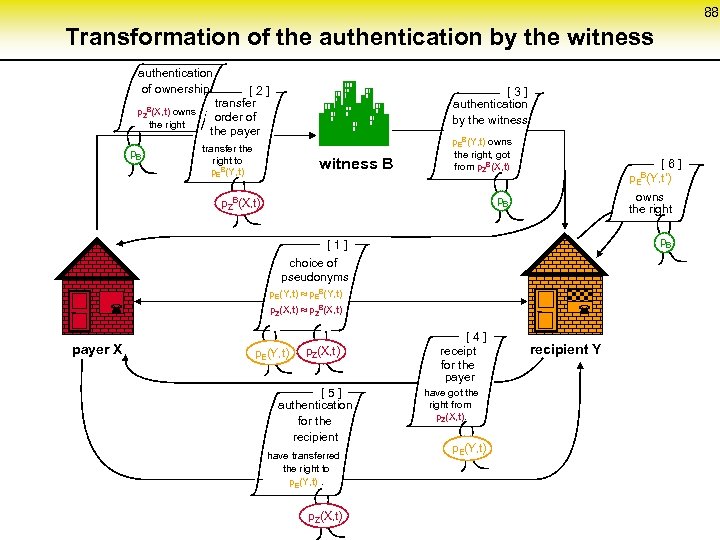 88 Transformation of the authentication by the witness authentication of ownership p. ZB(X, t) owns the right p. B [ 2 ] transfer order of the payer transfer the right to p. EB(Y, t) witness B [ 3 ] authentication by the witness p. EB(Y, t) owns the right, got from p. ZB(X, t) [ 6 ] p. EB(Y, t‘) owns the right p. B p. ZB(X, t) p. B [ 1 ] choice of pseudonyms p. E(Y, t) p. EB(Y, t) p. Z(X, t) p. ZB(X, t) payer X p. Z(X, t) ¬ p. E(Y, t) [ 5 ] authentication for the recipient have transferred the right to p. E(Y, t). p. Z(X, t) ¬ [ 4 ] receipt for the payer have got the right from p. Z(X, t). p. E(Y, t) recipient Y
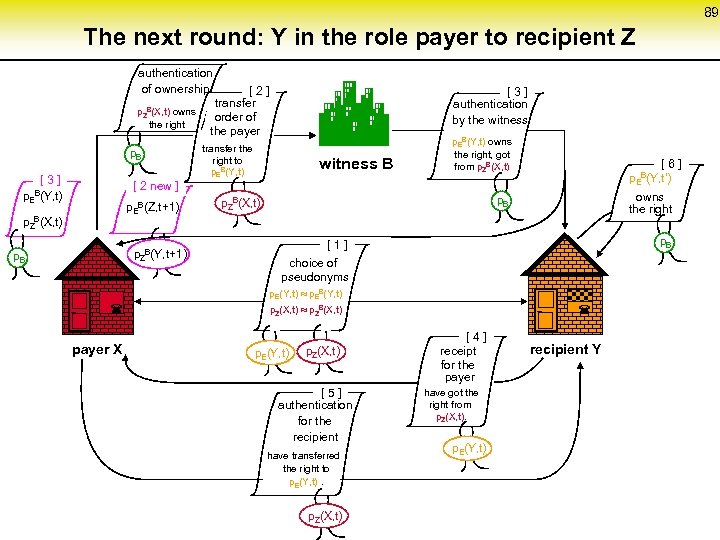 89 The next round: Y in the role payer to recipient Z authentication of ownership p. ZB(X, t) owns the right p. B [ 3 ] p. EB(Y, t) [ 2 ] transfer order of the payer transfer the right to p. EB(Y, t) witness B [ 3 ] authentication by the witness p. EB(Y, t) owns the right, got from p. ZB(X, t) [ 6 ] p. EB(Y, t‘) [ 2 new ] p. EB(Z, t+1) p. ZB(X, t) p. ZB(Y, t+1) p. B owns the right p. B p. ZB(X, t) p. B [ 1 ] choice of pseudonyms p. E(Y, t) p. EB(Y, t) p. Z(X, t) p. ZB(X, t) payer X p. Z(X, t) ¬ p. E(Y, t) [ 5 ] authentication for the recipient have transferred the right to p. E(Y, t). p. Z(X, t) ¬ [ 4 ] receipt for the payer have got the right from p. Z(X, t). p. E(Y, t) recipient Y
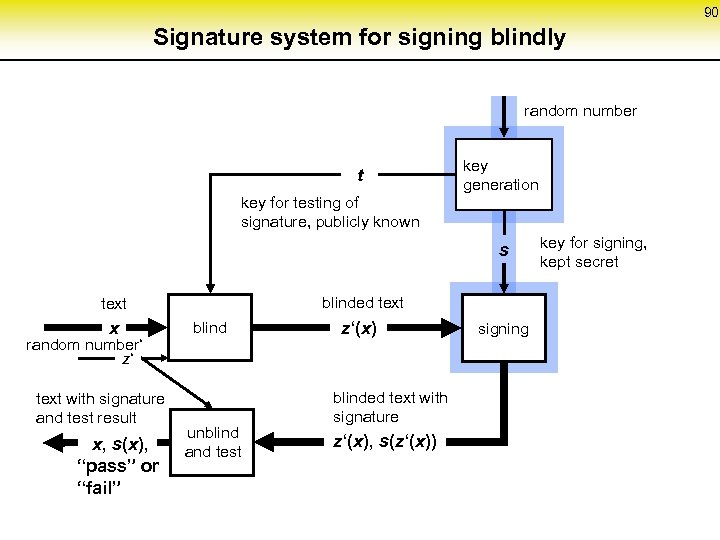 90 Signature system for signing blindly random number t key for testing of signature, publicly known key generation s blinded text x random number‘ z‘ text with signature and test result x, s(x), “pass” or “fail” blind unblind and test z‘(x) blinded text with signature z‘(x), s(z‘(x)) signing key for signing, kept secret
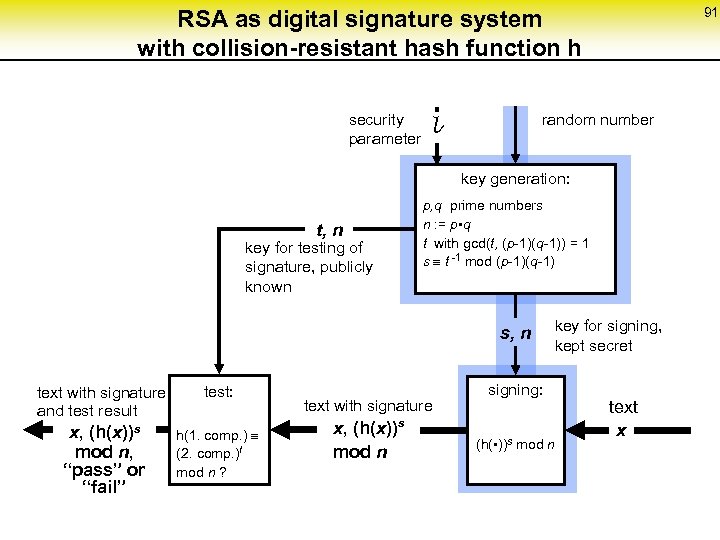 91 RSA as digital signature system with collision-resistant hash function h security parameter random number l key generation: p, q prime numbers n : = p • q t with gcd(t, (p-1)(q-1)) = 1 s t -1 mod (p-1)(q-1) t, n key for testing of signature, publicly known s, n text with signature and test result test: x, (h(x))s mod n, “pass” or “fail” h(1. comp. ) (2. comp. )t mod n ? text with signature x, (h(x)) mod n key for signing, kept secret signing: s (h( • ))s mod n text x
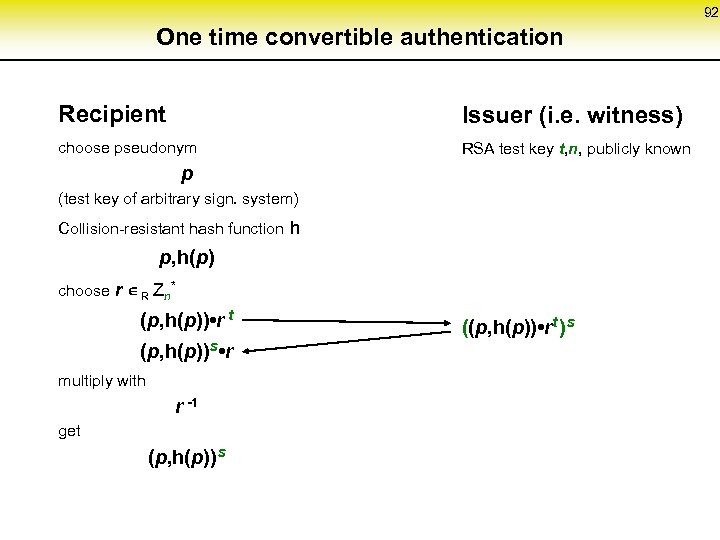 92 One time convertible authentication Recipient Issuer (i. e. witness) choose pseudonym RSA test key t, n, publicly known p (test key of arbitrary sign. system) Collision-resistant hash function h p, h(p) choose r R Zn* (p, h(p)) • r t (p, h(p))s • r multiply with r -1 get (p, h(p))s ((p, h(p)) • rt )s
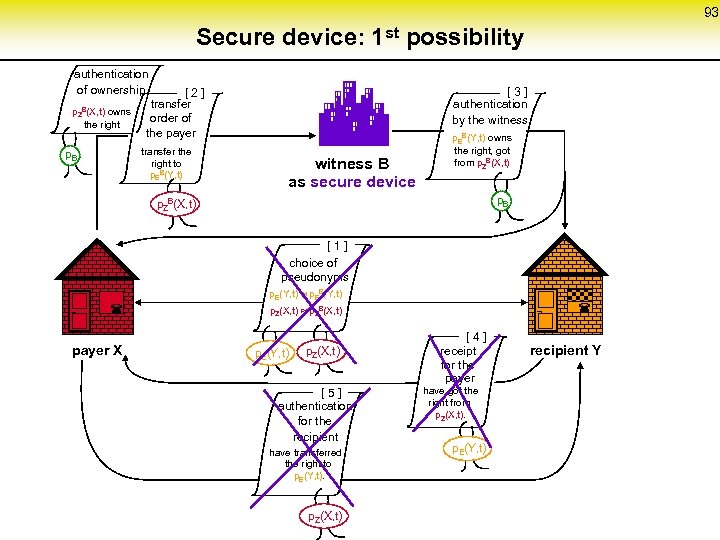 93 Secure device: 1 st possibility authentication of ownership p. ZB(X, t) owns the right transfer the right to p. EB(Y, t) p. B [ 2 ] transfer order of the payer witness B as secure device [ 3 ] authentication by the witness p. EB(Y, t) owns the right, got from p. ZB(X, t) p. B p. ZB(X, t) [ 1 ] choice of pseudonyms p. E(Y, t) p. EB(Y, t) p. Z(X, t) p. ZB(X, t) payer X p. Z(X, t) ¬ p. E(Y, t) [ 5 ] authentication for the recipient have transferred the right to p. E(Y, t). p. Z(X, t) ¬ [ 4 ] receipt for the payer have got the right from p. Z(X, t). p. E(Y, t) recipient Y
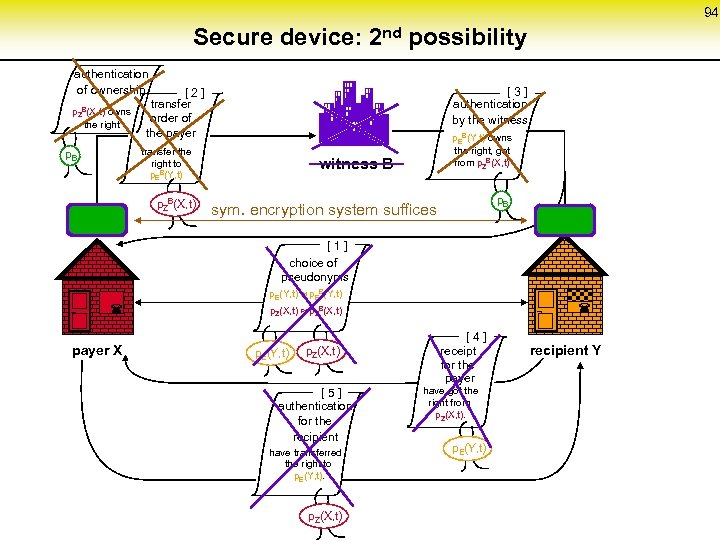 94 Secure device: 2 nd possibility authentication of ownership p. ZB(X, t) owns the right [ 2 ] transfer order of the payer transfer the right to p. EB(Y, t) p. B p. ZB(X, t) [ 3 ] authentication by the witness p. EB(Y, t) owns the right, got from p. ZB(X, t) witness B p. B sym. encryption system suffices [ 1 ] choice of pseudonyms p. E(Y, t) p. EB(Y, t) p. Z(X, t) p. ZB(X, t) payer X p. Z(X, t) ¬ p. E(Y, t) [ 5 ] authentication for the recipient have transferred the right to p. E(Y, t). p. Z(X, t) ¬ [ 4 ] receipt for the payer have got the right from p. Z(X, t). p. E(Y, t) recipient Y
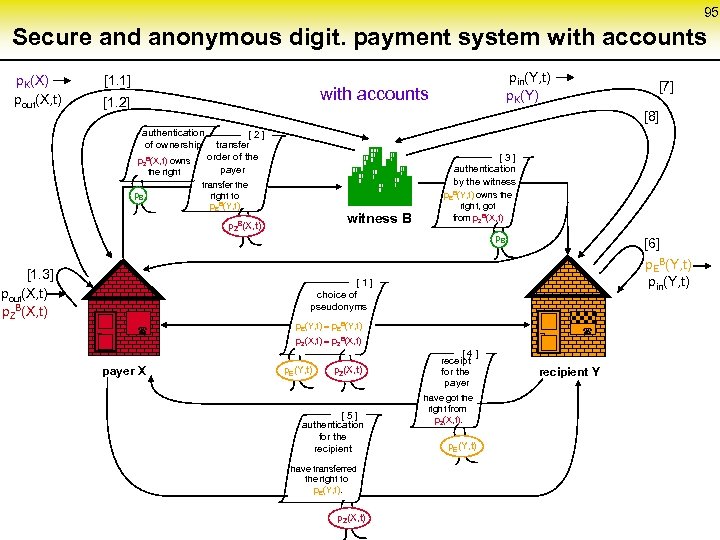 95 Secure and anonymous digit. payment system with accounts p. K(X) pout(X, t) [1. 1] pin(Y, t) p. K(Y) with accounts [1. 2] [7] [8] authentication of ownership p. ZB(X, t) owns the right p. B [ 2 ] transfer order of the payer transfer the right to p. EB(Y, t) witness B p. ZB(X, t) [1. 3] pout(X, t) p. ZB(X, t) [ 3 ] authentication by the witness p. EB(Y, t) owns the right, got from p. ZB(X, t) p. B [6] p. EB(Y, t) pin(Y, t) [ 1 ] choice of pseudonyms ¬ payer X p. E(Y, t) p. EB(Y, t) ¬ p. Z(X, t) p. ZB(X, t) p. E(Y, t) p. Z(X, t) [ 5 ] authentication for the recipient have transferred the right to p. E(Y, t). p. Z(X, t) [ 4 ] receipt for the payer have got the right from p. Z(X, t). p. E(Y, t) recipient Y
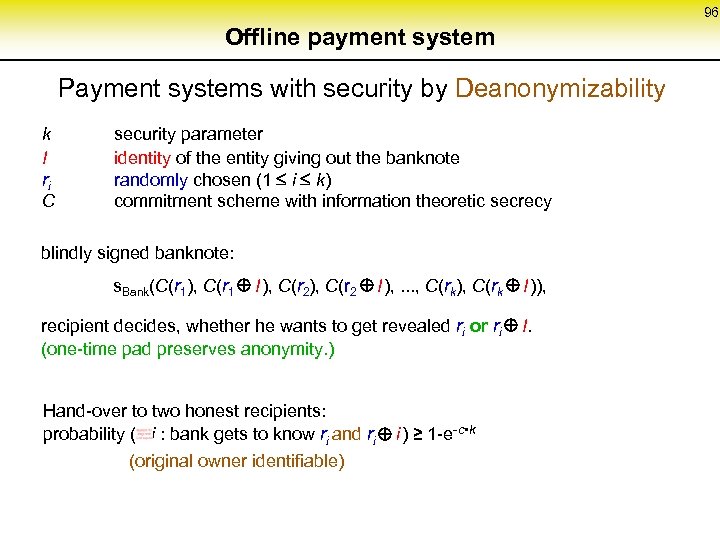 96 Offline payment system Payment systems with security by Deanonymizability k I ri C security parameter identity of the entity giving out the banknote randomly chosen (1 i k) commitment scheme with information theoretic secrecy blindly signed banknote: s. Bank(C(r 1), C(r 1 I ), C(r 2 I ), . . . , C(rk), C(rk I )), recipient decides, whether he wants to get revealed ri or ri I. (one-time pad preserves anonymity. ) Hand-over to two honest recipients: probability ( i : bank gets to know ri and ri i ) ≥ 1 -e-c • k (original owner identifiable)
 97 Outlook legal certainty vs. liability online / offline debit = pre-paid / pay-now / credit only special software or hardware, too ? universal means of payment or multifaceted bonus systems ? one or multiple currencies ? one or multiple systems ?
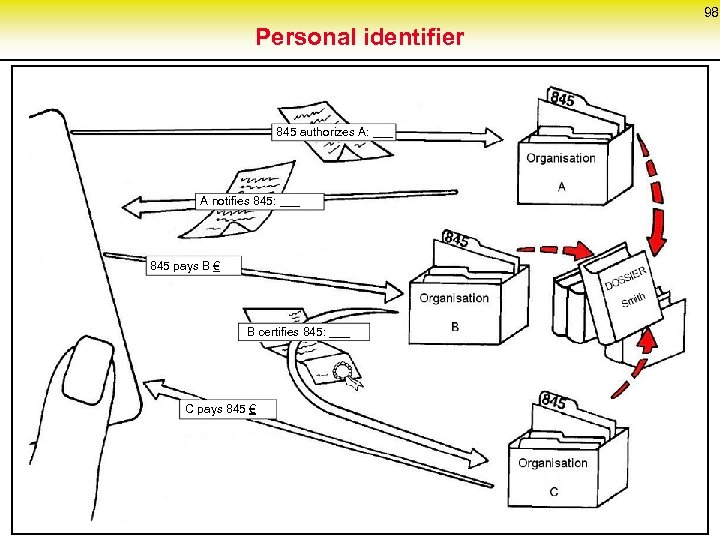 98 Personal identifier 845 authorizes A: ___ A notifies 845: ___ 845 pays B € B certifies 845: ___ C pays 845 €
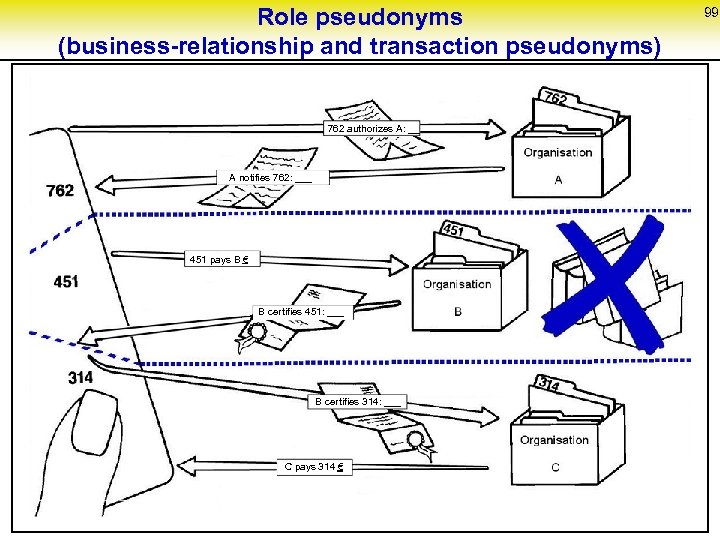 Role pseudonyms (business-relationship and transaction pseudonyms) 762 authorizes A: __ A notifies 762: ___ 451 pays B € B certifies 451: ___ B certifies 314: ___ C pays 314 € 99
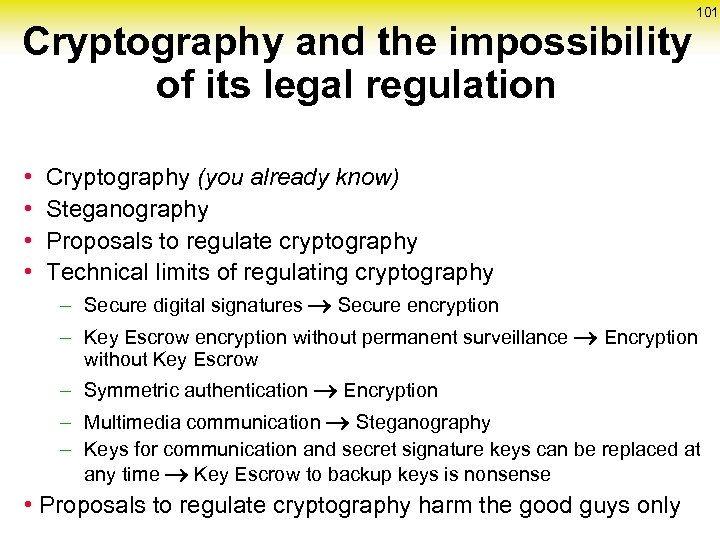 Cryptography and the impossibility of its legal regulation 101 • Cryptography (you already know) • Steganography • Proposals to regulate cryptography • Technical limits of regulating cryptography – Secure digital signatures Secure encryption – Key Escrow encryption without permanent surveillance Encryption without Key Escrow – Symmetric authentication Encryption – Multimedia communication Steganography – Keys for communication and secret signature keys can be replaced at any time Key Escrow to backup keys is nonsense • Proposals to regulate cryptography harm the good guys only
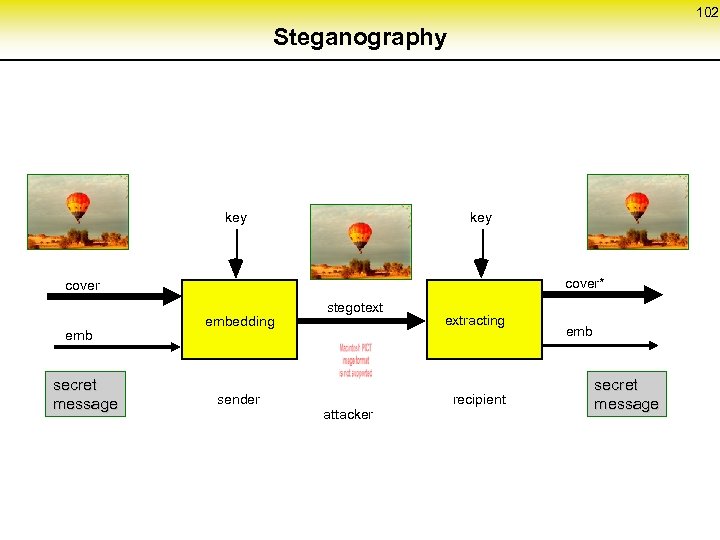 102 Steganography key cover* cover emb secret message embedding stegotext sender extracting recipient attacker emb secret message
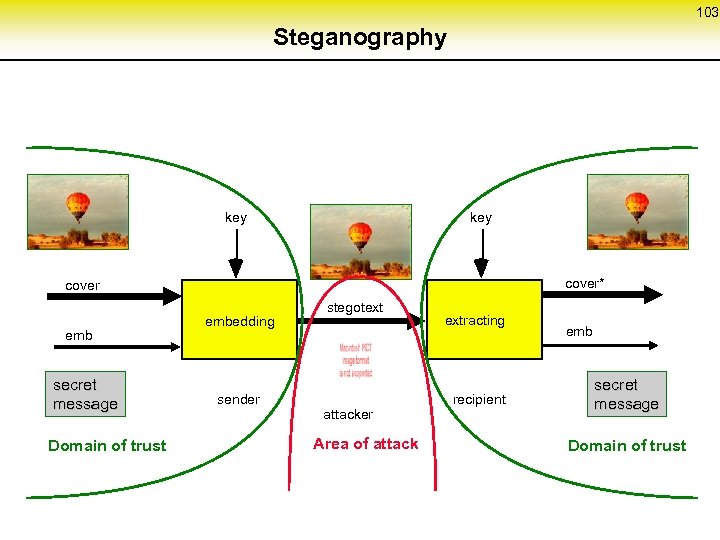 103 Steganography key cover* cover emb secret message Domain of trust embedding stegotext sender extracting recipient attacker Area of attack emb secret message Domain of trust
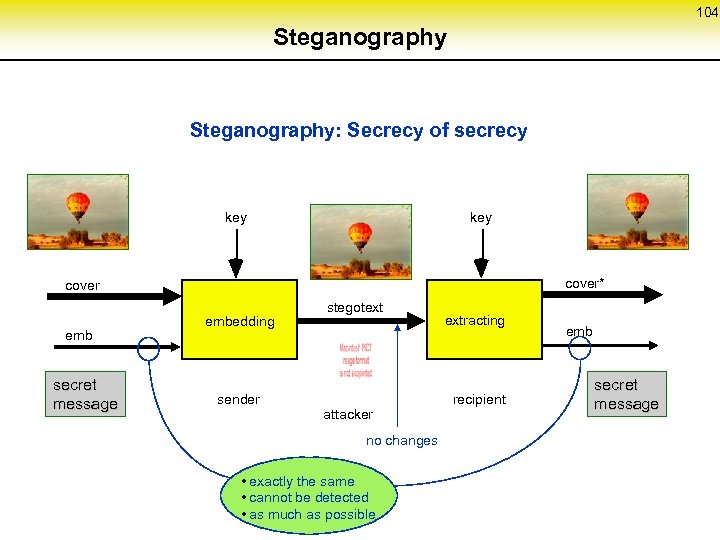 104 Steganography: Secrecy of secrecy key cover* cover emb secret message embedding stegotext sender extracting recipient attacker no changes • exactly the same • cannot be detected • as much as possible emb secret message
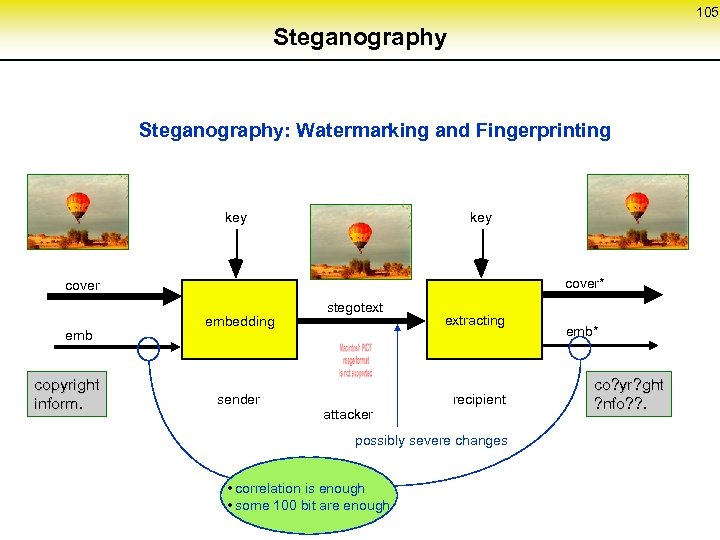 105 Steganography: Watermarking and Fingerprinting key cover* cover emb copyright inform. embedding stegotext sender extracting recipient attacker possibly severe changes • correlation is enough • some 100 bit are enough emb* co? yr? ght ? nfo? ? .
 106 Proposals to regulate cryptography ? ? • Would you regulate cryptography to help fight crime ? • If so: How ?
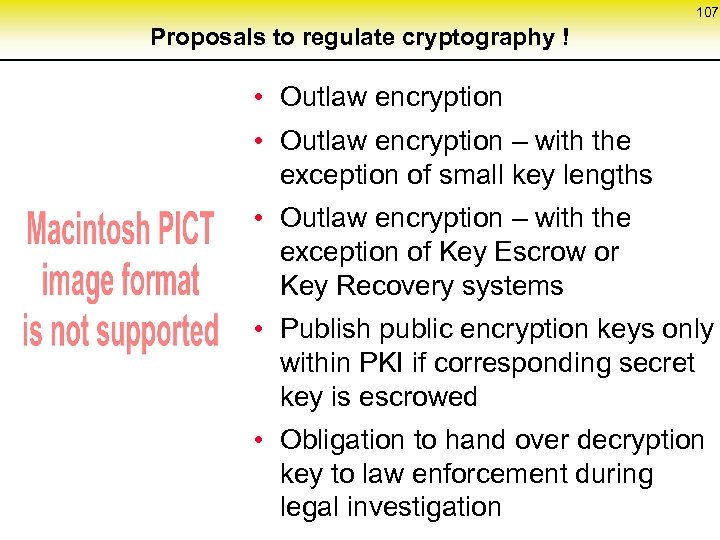 107 Proposals to regulate cryptography ! • Outlaw encryption – with the exception of small key lengths • Outlaw encryption – with the exception of Key Escrow or Key Recovery systems • Publish public encryption keys only within PKI if corresponding secret key is escrowed • Obligation to hand over decryption key to law enforcement during legal investigation
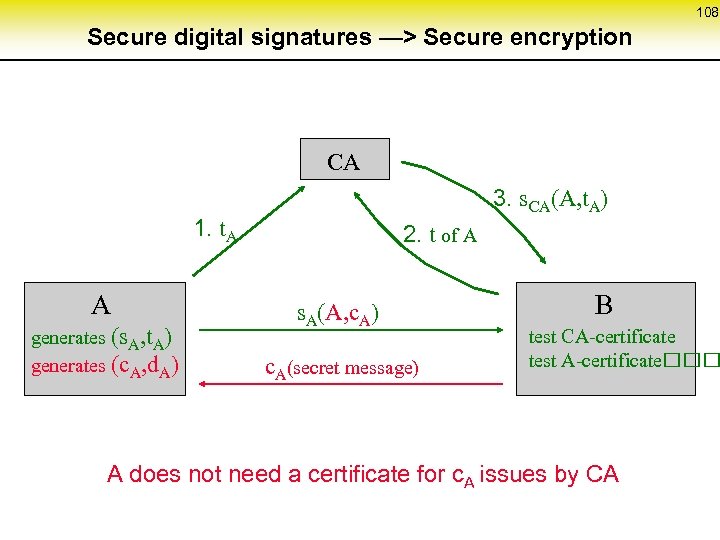 108 Secure digital signatures —> Secure encryption CA 3. s. CA(A, t. A) 1. t. A A generates (s. A, t. A) generates (c. A, d. A) 2. t of A s. A(A, c. A) c. A(secret message) B test CA-certificate test A-certificate A does not need a certificate for c. A issues by CA
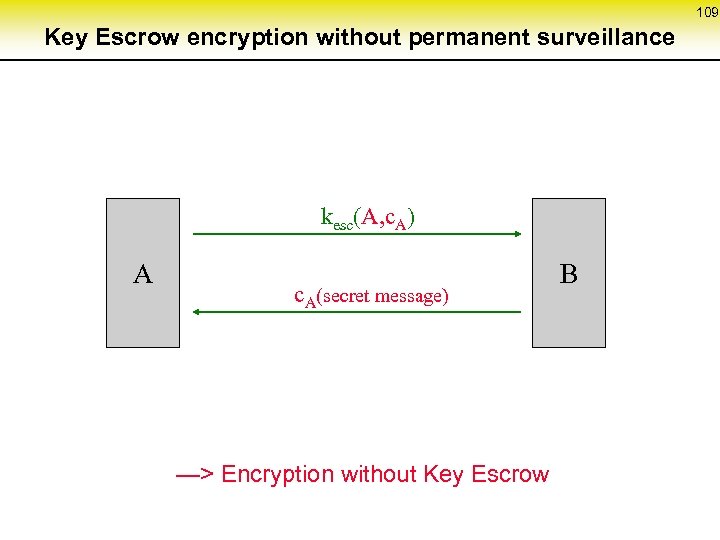 109 Key Escrow encryption without permanent surveillance kesc(A, c. A) A c. A(secret message) —> Encryption without Key Escrow B
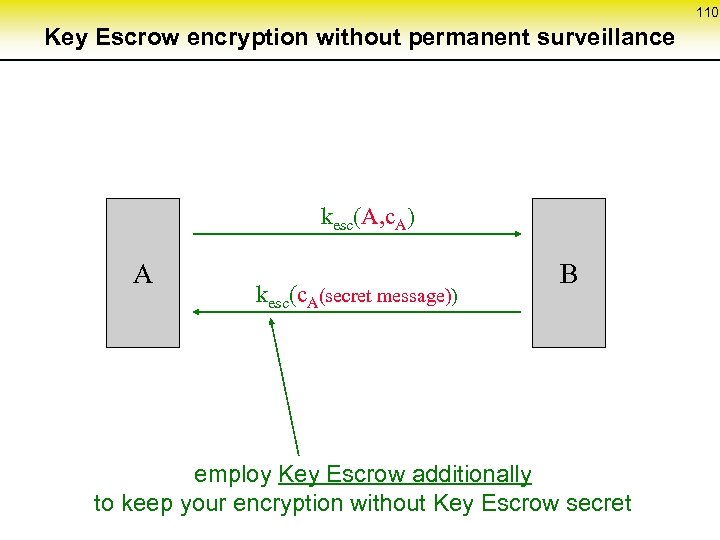 110 Key Escrow encryption without permanent surveillance kesc(A, c. A) A kesc(c. A(secret message)) B employ Key Escrow additionally to keep your encryption without Key Escrow secret
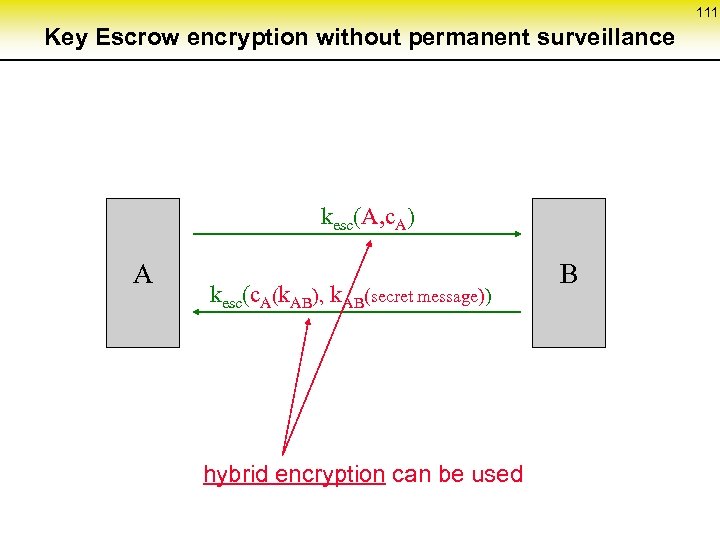 111 Key Escrow encryption without permanent surveillance kesc(A, c. A) A kesc(c. A(k. AB), k. AB(secret message)) hybrid encryption can be used B
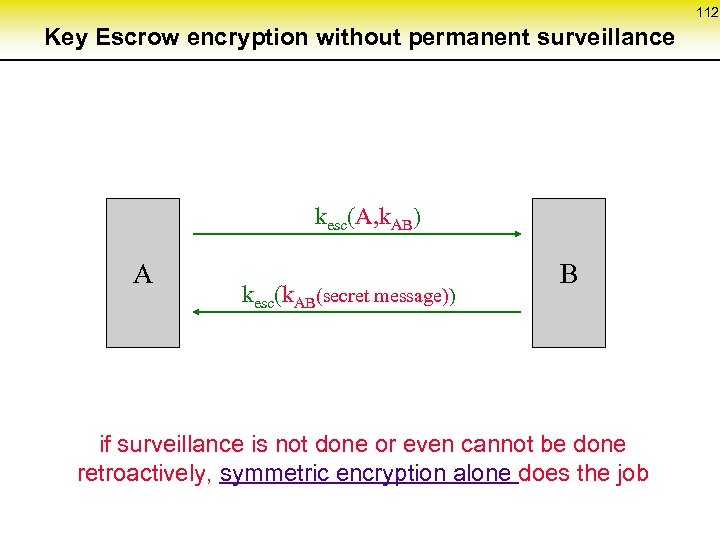 112 Key Escrow encryption without permanent surveillance kesc(A, k. AB) A kesc(k. AB(secret message)) B if surveillance is not done or even cannot be done retroactively, symmetric encryption alone does the job
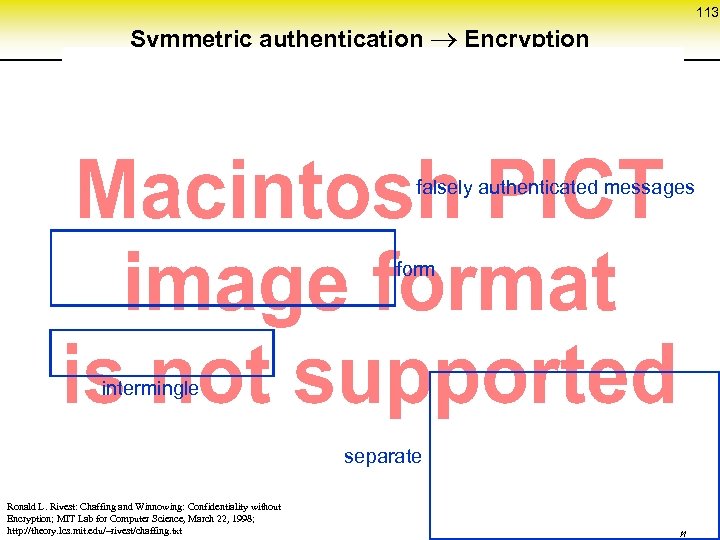 113 Symmetric authentication Encryption falsely authenticated messages form intermingle separate Ronald L. Rivest: Chaffing and Winnowing: Confidentiality without Encryption; MIT Lab for Computer Science, March 22, 1998; http: //theory. lcs. mit. edu/~rivest/chaffing. txt n
 Symmetric authentication Encryption falsely authenticated messages form and intermingle without knowing the key separate 114
 115 Key exchange for steganography ? Exchanging keys outside the communication network is easy for small closed groups, in particular it is easy for criminals and terrorists. Large open groups need a method of key exchange which works without transmitting suspicious messages within the communication network – asymmetric encryption cannot be used directly for key exchange. Solution: Diffie-Hellman Public-Key Agreement Uses public keys of a commonly used digital signature systems (DSS, developed and standardized by NSA and NIST, USA)
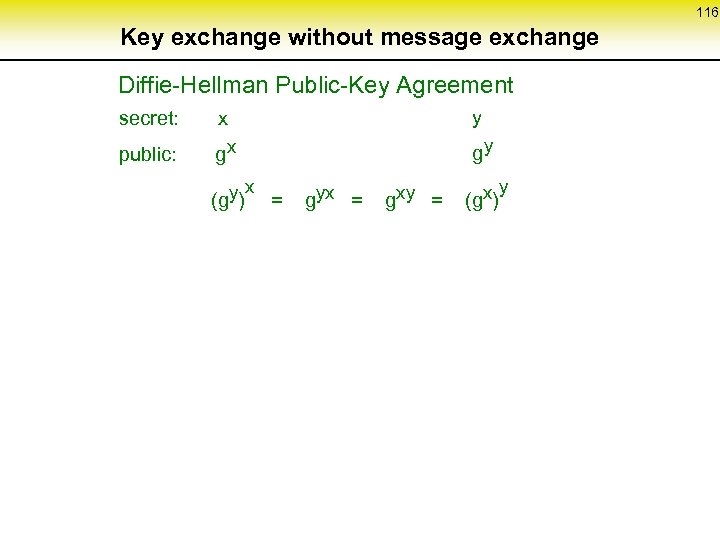 116 Key exchange without message exchange Diffie-Hellman Public-Key Agreement secret: x y public: gx gy x y (gy) = gyx = gxy = (gx)
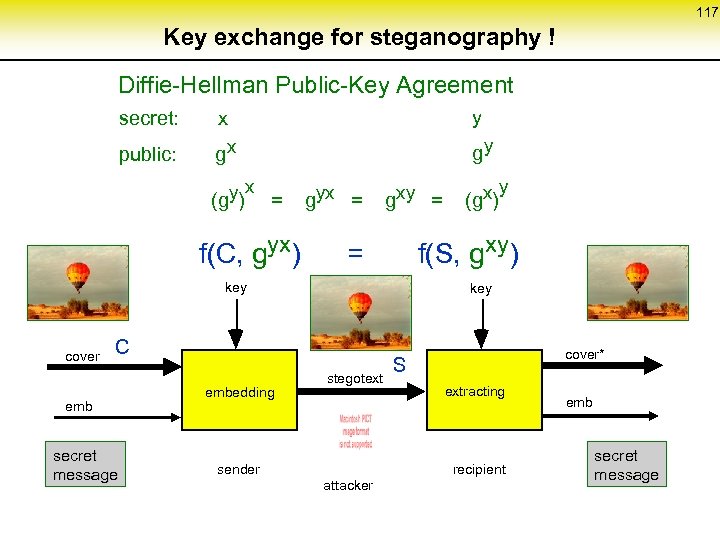 117 Key exchange for steganography ! Diffie-Hellman Public-Key Agreement secret: x y public: gx gy x y (gy) = gyx = gxy = (gx) f(C, gyx) = f(S, gxy) key cover key C emb secret message embedding stegotext sender cover* S extracting recipient attacker emb secret message
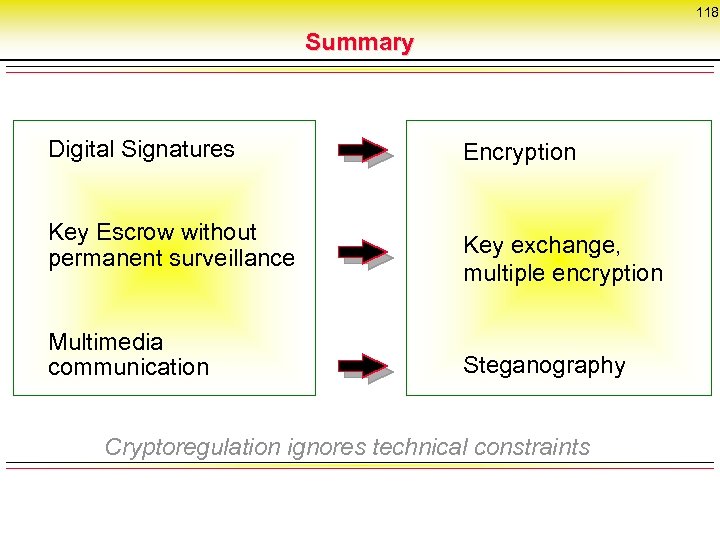 118 Summary Digital Signatures Key Escrow without permanent surveillance Multimedia communication Encryption Key exchange, multiple encryption Steganography Cryptoregulation ignores technical constraints
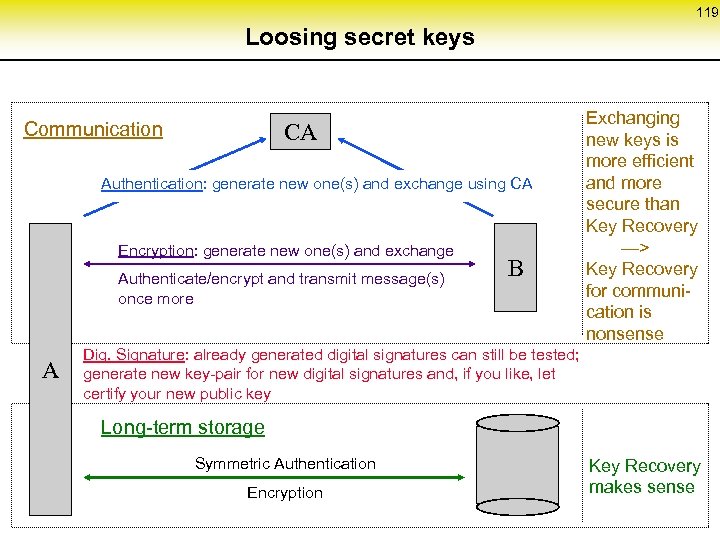 119 Loosing secret keys Communication CA Authentication: generate new one(s) and exchange using CA Encryption: generate new one(s) and exchange Authenticate/encrypt and transmit message(s) once more A B Exchanging new keys is more efficient and more secure than Key Recovery —> Key Recovery for communication is nonsense Dig. Signature: already generated digital signatures can still be tested; generate new key-pair for new digital signatures and, if you like, let certify your new public key Long-term storage Symmetric Authentication Encryption Key Recovery makes sense
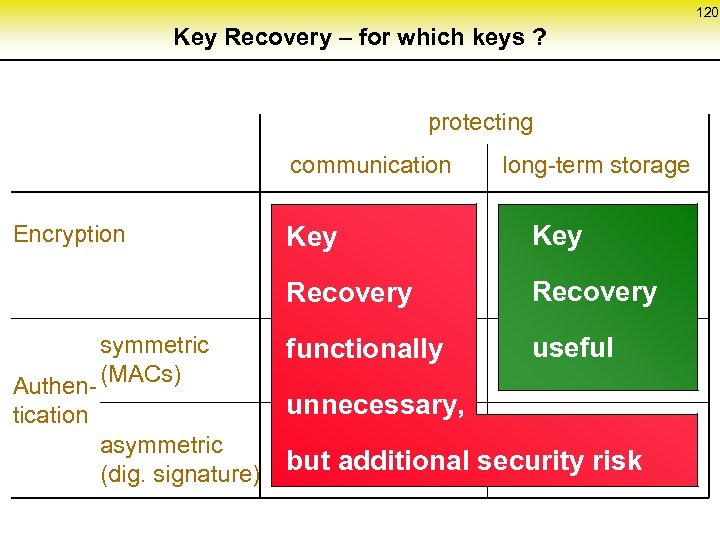 120 Key Recovery – for which keys ? protecting communication long-term storage symmetric Authen- (MACs) tication asymmetric (dig. signature) Key Recovery Encryption Recovery functionally useful unnecessary, but additional security risk
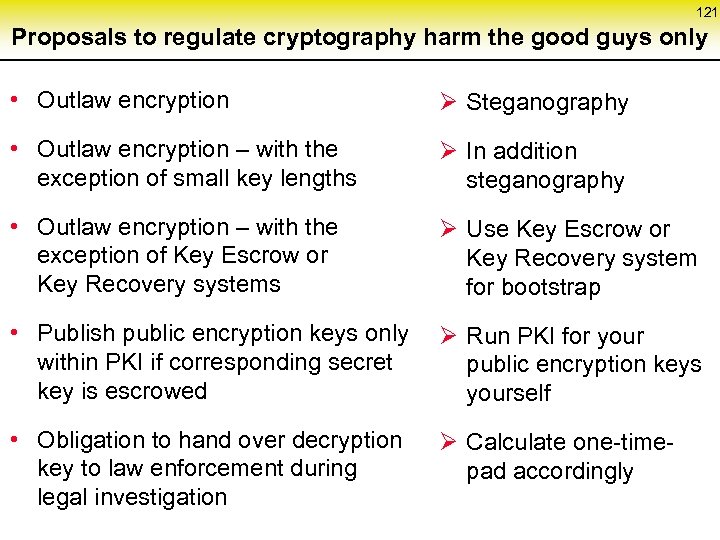 121 Proposals to regulate cryptography harm the good guys only • Outlaw encryption Ø Steganography • Outlaw encryption – with the exception of small key lengths Ø In addition steganography • Outlaw encryption – with the exception of Key Escrow or Key Recovery systems Ø Use Key Escrow or Key Recovery system for bootstrap • Publish public encryption keys only Ø Run PKI for your within PKI if corresponding secret public encryption keys key is escrowed yourself • Obligation to hand over decryption key to law enforcement during legal investigation Ø Calculate one-timepad accordingly
 122 (Im-)Possibility to regulate anonymous/pseudonymous communication • Explicit techniques (you already know theory) • Workarounds
 (Im-)Possibility to regulate anonymous/pseudonymous communication Anon-Proxies MIXes Cascade: AN. ON P 2 P: TOR All this exists abroad without regulation – as long as we do not have a global home policy 123
 (Im-)Possibility to regulate anonymous/pseudonymous communication But even domestic: Public phones, Prepaid phones, open unprotected WLANs, insecure Bluetooth mobile phones, . . . Data retention is nearly nonsense, since „criminals“ will use workarounds, cf. above 124