


 Скачать презентацию 1 Science Plan Restructuring of ICES Science and
6628db516cacb124fc4e2482a8195ce3.ppt
- Количество слайдов: 17
 1 Science Plan, Restructuring of ICES Science and offers for joint activities Presentation to SCOR Project Summit, March 30 – April 1, 2009
 2 2007 ICES Strategic Plan Why an update was needed: • • 2002 plan is now 6 years old • for the science aspects of 2002 plan, feeling that the goals were not prescriptive enough • need to re-consider the priorities of the member countries for marine research • integrated management and EAM have evolved in member countries with associated policy , requiring changes • Need for balance between bottom-up activities from scientists within ICES, and top-down perspective from delegates, clients and member countries
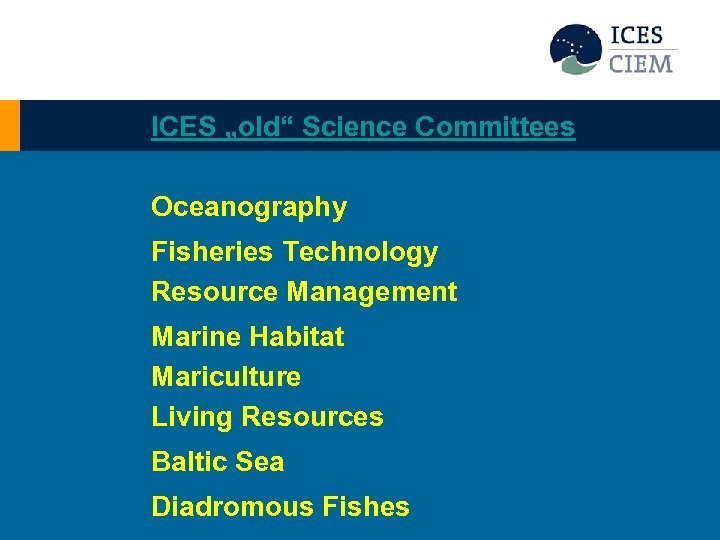 ICES „old“ Science Committees Oceanography Fisheries Technology Resource Management Marine Habitat Mariculture Living Resources Baltic Sea Diadromous Fishes
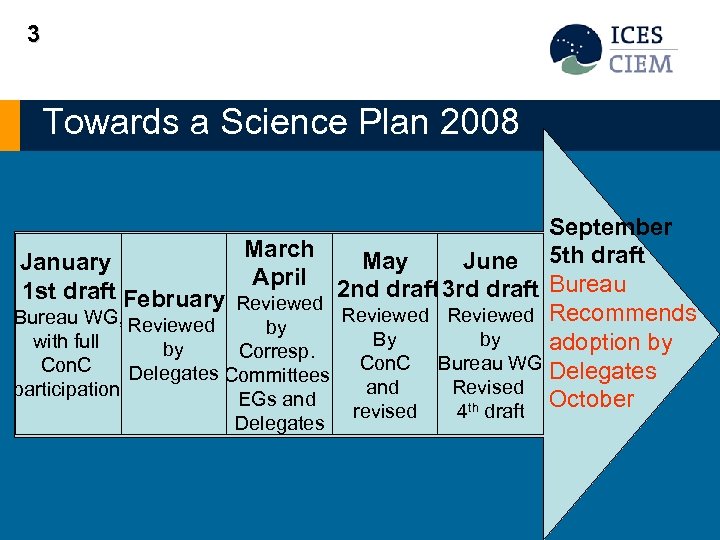 3 Towards a Science Plan 2008 September March May June 5 th draft January April 1 st draft February Reviewed 2 nd draft 3 rd draft Bureau Reviewed Recommends Bureau WG, Reviewed by By by with full adoption by by Corresp. Con. C Delegates Committees Con. C Bureau WG Delegates and Revised participation EGs and October revised 4 th draft Delegates
 4 ICES Science Plan (2009 -2013) Focus of Plan – medium term strategic issues considered to be critical to the demands for scientific advice in a five to ten year time period Results – 16 research topics within 3 thematic areas, some general points on implementation
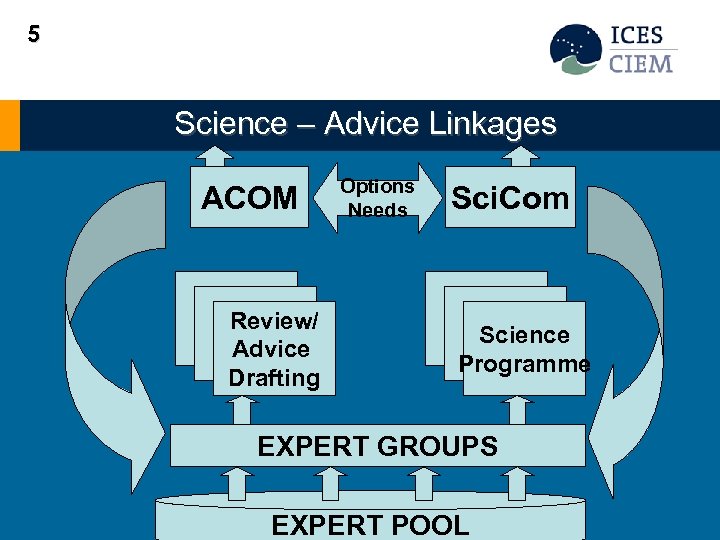 5 Science – Advice Linkages ACOM Review/ Advice Drafting Options Needs Sci. Com Science Programme EXPERT GROUPS EXPERT POOL
 6 Thematic Area 1: Understanding Ecosystem Functioning • Climate change processes, and predictions of impacts • Fish life history information in support of EAM • Biodiversity and the health of marine ecosystems • The role of coastal zone habitat in population dynamics of commercially exploited species • Top predators (marine mammals, seabirds, and large pelagics) in marine ecosystems • Sensitive ecosystems (deep sea corals, seamounts, Arctic areas), as well as rare and datapoor species • Integration of surveys in support of EAM
 7 Thematic Area 2: Understanding Interactions of Human Activities with Ecosystems • Impacts of fishing with marine ecosystems • Carrying capacity and ecosystem interactions associated with mariculture • Influence of development of renewable energy resources (e. g. wind, hydropower, tidal and waves) on marine habitat and biota • Population and community level impacts of contaminants, eutrophication, and habitat changes in the coastal zone • Introduced and invasive species, their impacts on ecosystems and interactions with climate change processes
 8 Thematic Area 3: Development of Options for Sustainable Use of Ecosystems • Marine living resource management tools • Operational modelling combining oceanographic, ecosystem and population processes • Marine spatial planning, including the effectiveness of management practices [e. g. Marine Protected Areas (MPAs)], and its role in the conservation of biodiversity • Contributions to socio-economic understanding of ecosystem goods and services, and forecasting of the impact of human activities
 9 Some observations on the priorities identified • 16 topics reflect the changing societal concerns on oceans by member countries • Perhaps surprising focus on coastal zone issues • Ambitious agenda, thus need to prioritize, and define the ICES niche within topic • Flexible, multi-disciplinary and horizontal, approach needed for delivery • Need for issue based strategic partnering, and enhanced capacity in specific disciplines • Strong links with advisory needs for Integrated Management under the Ecosystem Approach
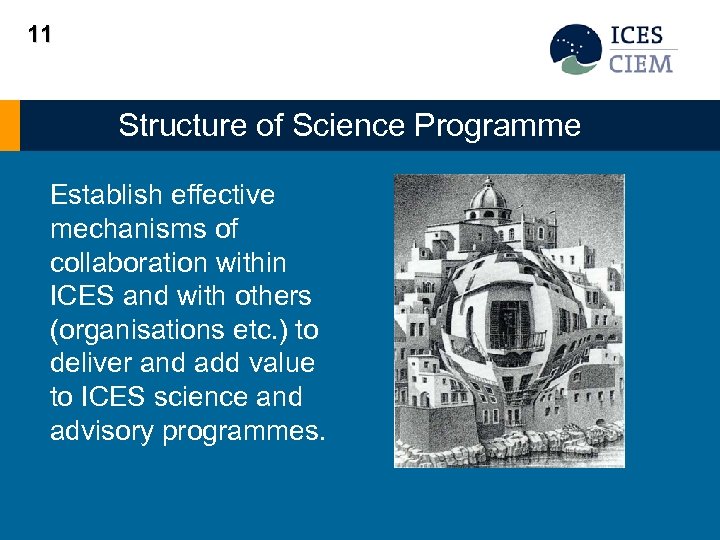 11 Structure of Science Programme Establish effective mechanisms of collaboration within ICES and with others (organisations etc. ) to deliver and add value to ICES science and advisory programmes.
 12 Evolution of Science Structure • The new Consultative Committee is called “the ICES Science Committee (Sci. Com) • Has national representation (20 delegates), plus present committee Chairs are invited, plus up to five members to fill disciplinary expertise lacking • Is fully empowered to establish the intermediate layer as needed to deliver the science plan: disciplinary, geographical, dissemination • Work plan in 2009 for Expert Groups based on resolutions approved by Council 2008
 17 Recommendations Functions of Sci. Com -Interfacing with the advisory services to identify science priorities -Strategic planning -Management of science activities to achieve the goals of the science plan (including making progress on 16 topics within the 3 thematic areas) -Implementation of cross-cutting activities/programmes through partnerships -Nurturing scientific disciplines and methodologies -Quality assurance of products (e. g. publications, state of knowledge syntheses, advice on research priorities and strategies) -Overseeing the ASC and symposia
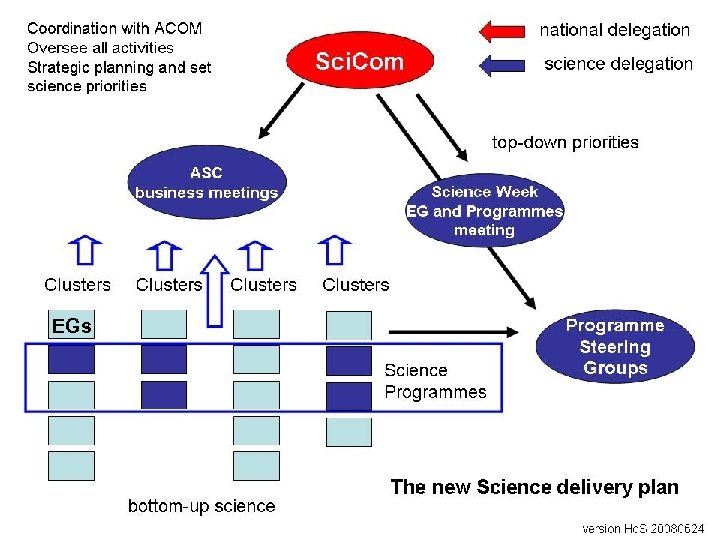 17 Perspective: a model EGs
 ICES co-sponsored symposia 2009/10 • 2008/3/MHC 04 The Sixth International Conference on Marine Bioinvasions will be held from 24– 27 August 2009, in Portland, Oregon, USA, with Judith Pederson (US), Gil Rilov (US), and Mark Sytsma, (US) as conveners. • 2008/3/LRC 05 A Cephalopod International Advisory Council, CIAC ’ 09 symposium on “The effects of environmental variability on cephalopod populations” will be held from 3 -11 September 2009, in Vigo, Spain, with Ángel Guerra et al. as conveners. • 2008/3/OCC 06 A Symposium on “Carrying Capacity what does it mean in a Changing Ocean? ” will be held during [xx-xx/xx/ 2010], at Lisbon, Portugal, with Maria Fatima Borges (Portugal), Jake Rice (Canada), and NN (PICES) as Conveners.
 ICES co-sponsored symposia 2011 • 2008/3/OCC 07 A Symposium on “Hydrobiological and ecosystem variability in the ICES area during the first decade of the XXI century” will be held during [spring/summer 2011], in Santander, Spain with Alicia Lavín (IEO) as local organizer and conveners to be named (tentatively Ken Drinkwater IMR Bergen, possibly someone from NAFO) • 2008/3/OCC 08 The 5 th International Zooplankton Production Symposium will be held during March or April 2011, at Pucon, Chile with Ruben Escribano as local organizer and Steve Hay (UK) as ICES convener, together with conveners appointed by PICES and IMBER (contacts with both institutions are initiated).
 29 October 2008