


 Скачать презентацию 1 SAFE OPERATION OF MACHINES A TRAINING FOR
e2976a36cb3a860aa15871794003919a.ppt
- Количество слайдов: 69
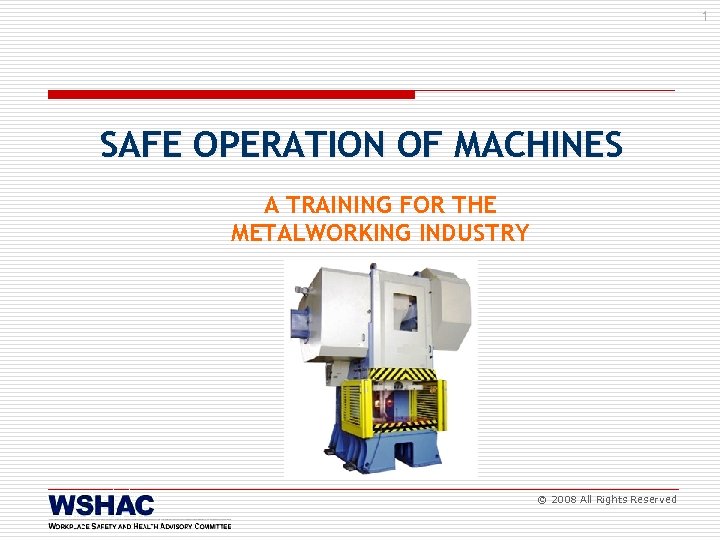 1 SAFE OPERATION OF MACHINES A TRAINING FOR THE METALWORKING INDUSTRY © 2008 All Rights Reserved
 2 Table of Contents The following topics will be covered: 1. Introduction 2. Incidents related with machine operation 3. Machine Hazards 4. Machine Safety • Risk Management • Control Measures • Safe Practices © 2008 All Rights Reserved
 3 1. Introduction This slide is prepared for the workers in the metalworking industry for a better understanding of the hazards associated with the machines used in the industry. Hence, control measures and risk levels can be assessed for effective control of the hazards. The hazards identified in the presentation may be applicable to other industries. © 2008 All Rights Reserved
 4 2. Incident History Incidents occurred due to: • Lack of protection (e. g. equipment safeguards); • Not following procedures; • Lack of training; • Lack of maintenance; • Horseplay; and • Others © 2008 All Rights Reserved
 5 2. Incident History These incidents can cause: • Damage to the body, e. g. cuts, crushing of limb, etc • Injuries by energies released from the machine, e. g. electrical shock, burn, etc • Fatalities © 2008 All Rights Reserved
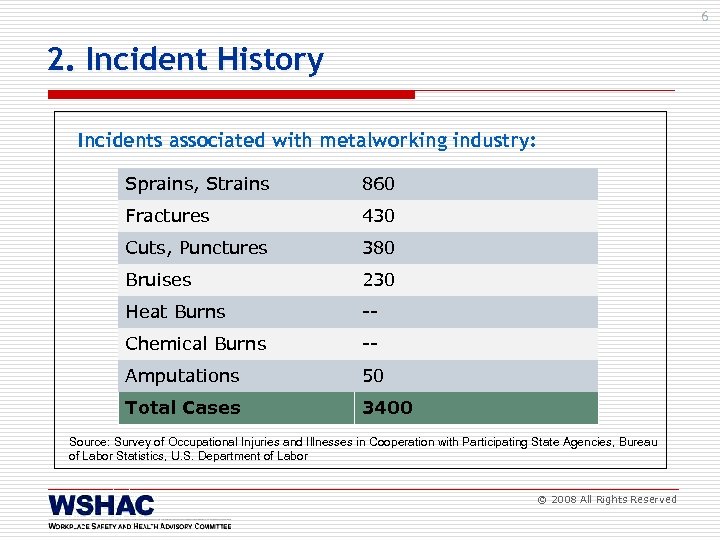 6 2. Incident History Incidents associated with metalworking industry: Sprains, Strains 860 Fractures 430 Cuts, Punctures 380 Bruises 230 Heat Burns -- Chemical Burns -- Amputations 50 Total Cases 3400 Source: Survey of Occupational Injuries and Illnesses in Cooperation with Participating State Agencies, Bureau of Labor Statistics, U. S. Department of Labor © 2008 All Rights Reserved
 7 3. Machine Hazards When identifying the hazards related with machines, we shall consider: • type of machines • layout of machines • driven method, e. g. electricity, air, etc • operating parameters, e. g. speed, pressure, temperature, size of cut, mobility, etc. • materials to be processed or handled and method of feed © 2008 All Rights Reserved
 8 3. Machine Hazards • operator position and controls • access for setting adjustments and maintenance • environmental factors, e. g. dust, fumes, noise, temperature, humidity etc • operating requirements including what the operator needs to do © 2008 All Rights Reserved
 9 3. Machine Hazards Typical hazards related with operation of machines include: v mechanical: e. g. crushing, shearing, cutting or severing, stabbing or puncture v high pressure fluid ejection v electrical shock v noise and vibration v contact with extremes of temperature v ergonomics v others © 2008 All Rights Reserved
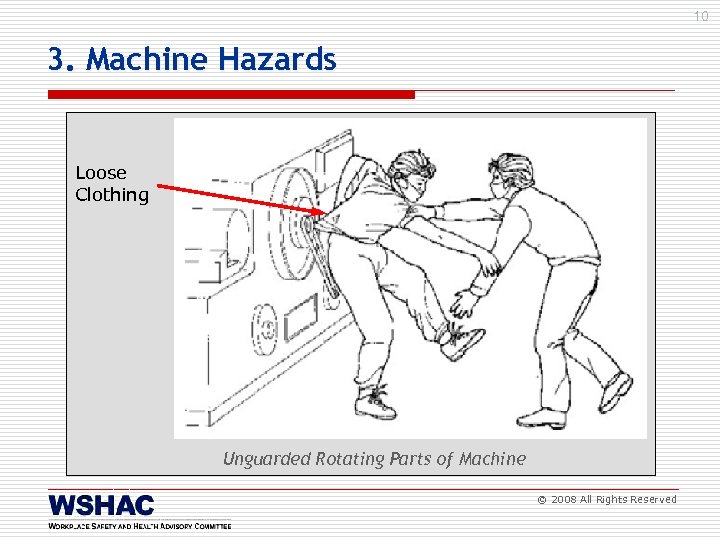 10 3. Machine Hazards Loose Clothing Pictures or Graphs Within This Area Unguarded Rotating Parts of Machine © 2008 All Rights Reserved
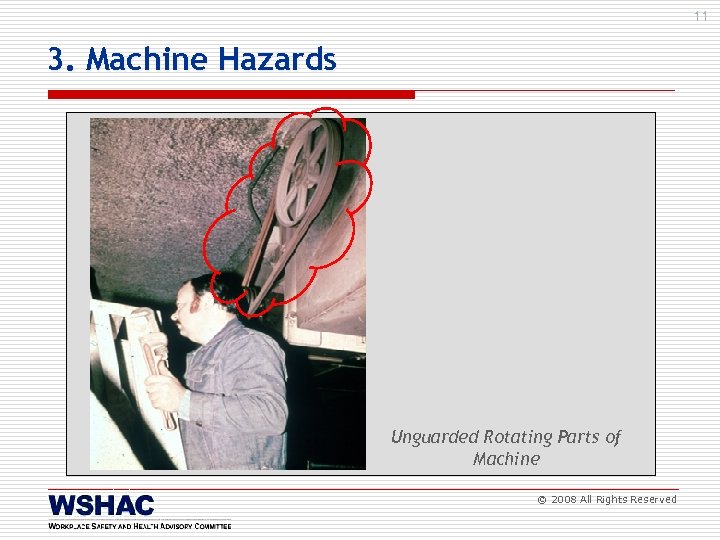 11 3. Machine Hazards Unguarded Rotating Parts of Machine © 2008 All Rights Reserved
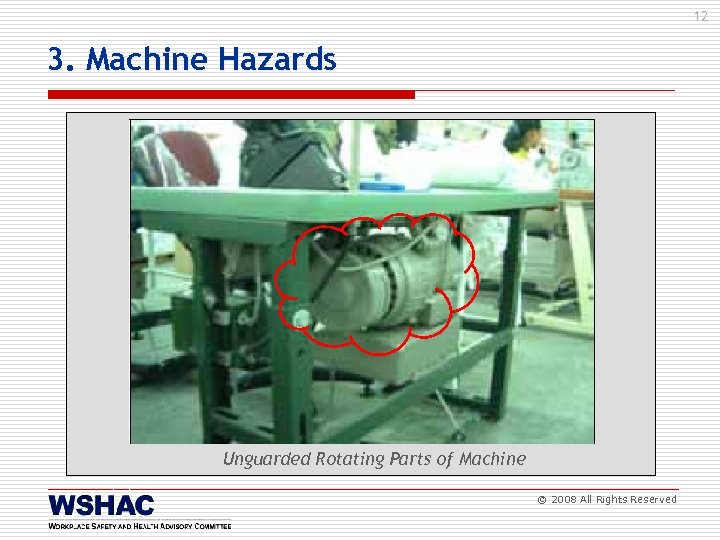 12 3. Machine Hazards Pictures or Graphs Within This Area Unguarded Rotating Parts of Machine © 2008 All Rights Reserved
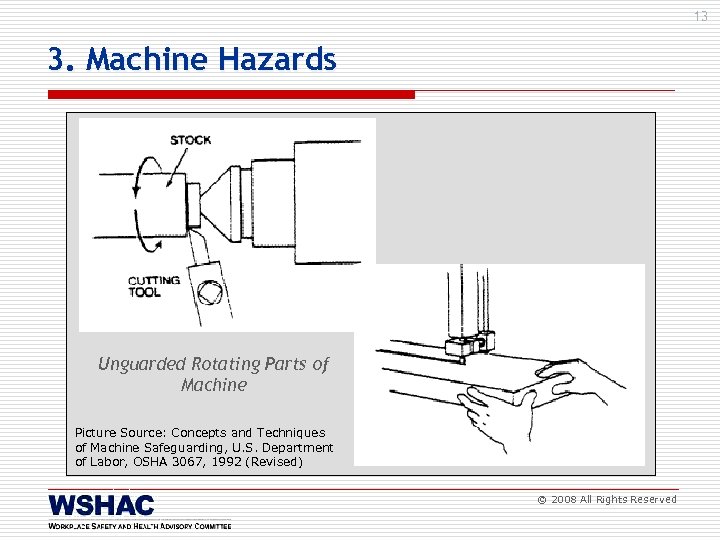 13 3. Machine Hazards Unguarded Rotating Parts of Machine Picture Source: Concepts and Techniques of Machine Safeguarding, U. S. Department of Labor, OSHA 3067, 1992 (Revised) © 2008 All Rights Reserved
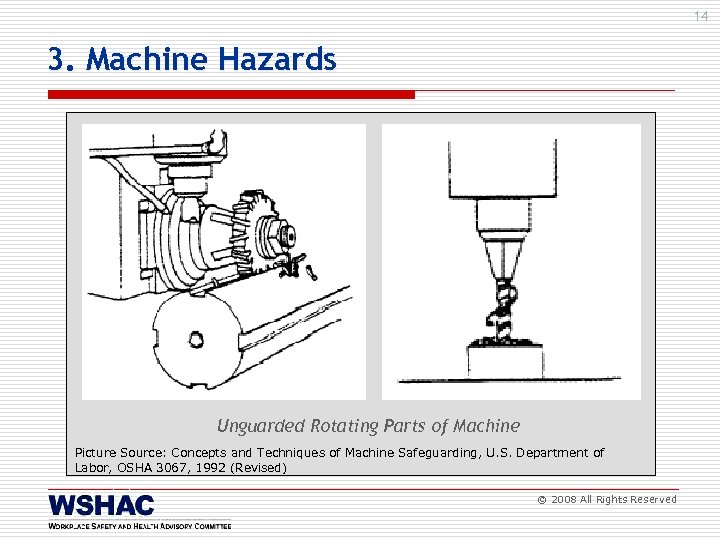 14 3. Machine Hazards Unguarded Rotating Parts of Machine Picture Source: Concepts and Techniques of Machine Safeguarding, U. S. Department of Labor, OSHA 3067, 1992 (Revised) © 2008 All Rights Reserved
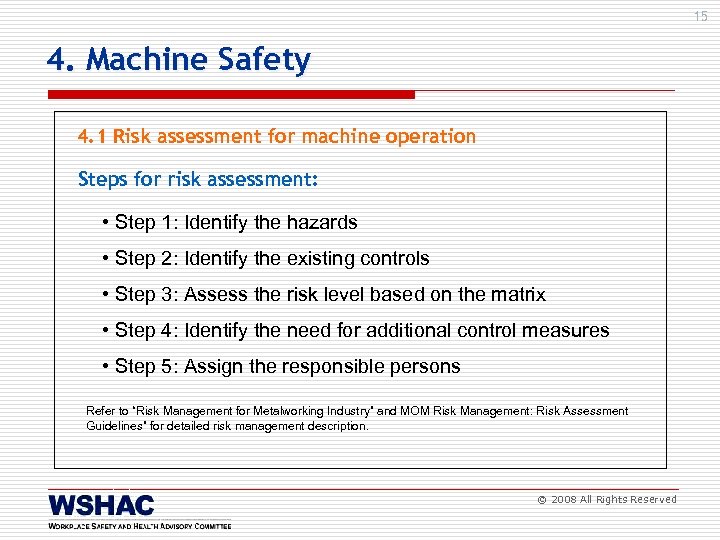 15 4. Machine Safety 4. 1 Risk assessment for machine operation Steps for risk assessment: • Step 1: Identify the hazards • Step 2: Identify the existing controls • Step 3: Assess the risk level based on the matrix • Step 4: Identify the need for additional control measures • Step 5: Assign the responsible persons Refer to “Risk Management for Metalworking Industry” and MOM Risk Management: Risk Assessment Guidelines” for detailed risk management description. © 2008 All Rights Reserved
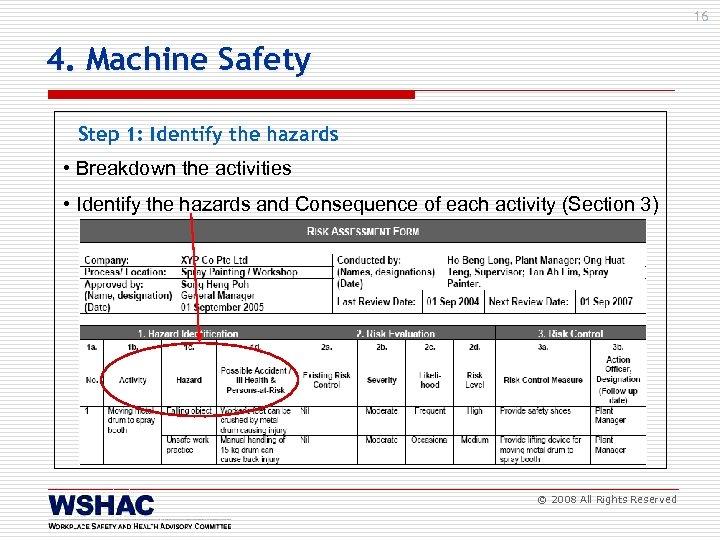 16 4. Machine Safety Step 1: Identify the hazards • Breakdown the activities • Identify the hazards and Consequence of each activity (Section 3) © 2008 All Rights Reserved
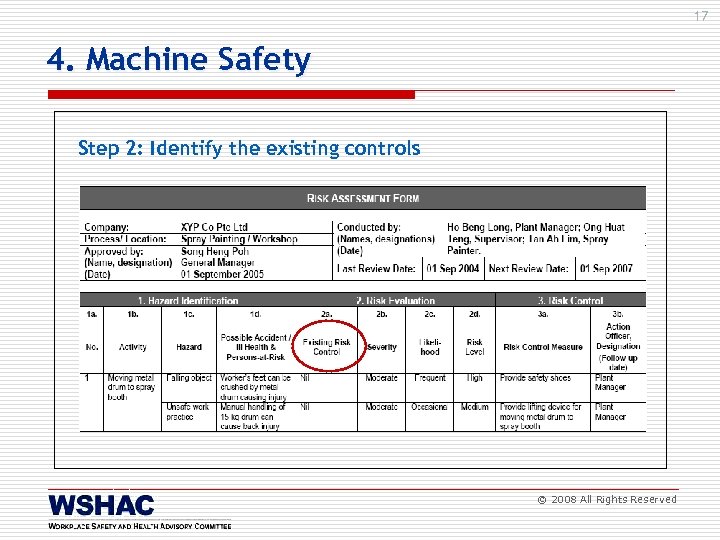 17 4. Machine Safety Step 2: Identify the existing controls © 2008 All Rights Reserved
 18 4. Machine Safety Step 2: Identify the existing controls • any safeguards in place? • any written procedures to control or mitigate the risk? • what are the PPE used? © 2008 All Rights Reserved
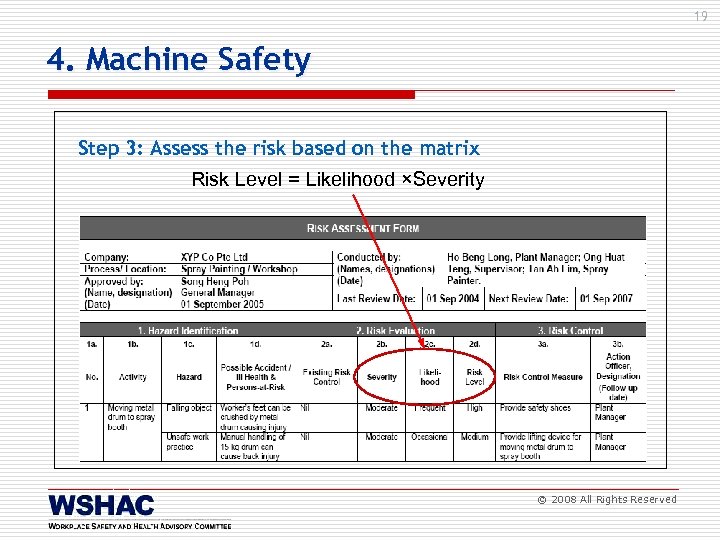 19 4. Machine Safety Step 3: Assess the risk based on the matrix Risk Level = Likelihood ×Severity © 2008 All Rights Reserved
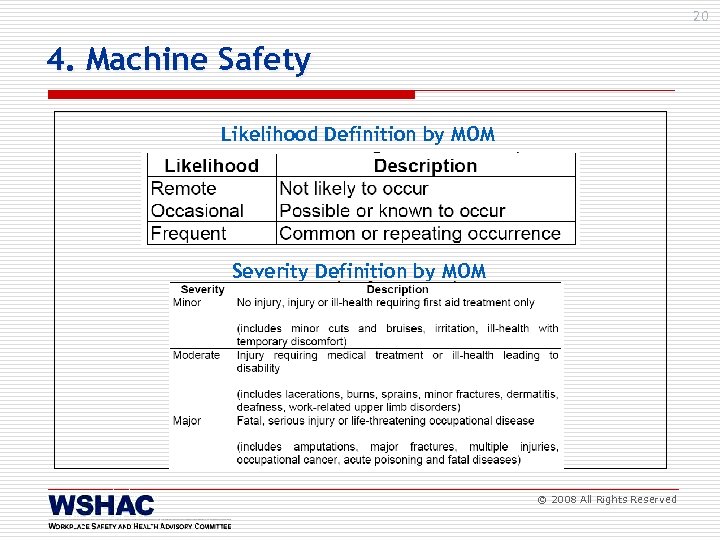 20 4. Machine Safety Likelihood Definition by MOM Severity Definition by MOM © 2008 All Rights Reserved
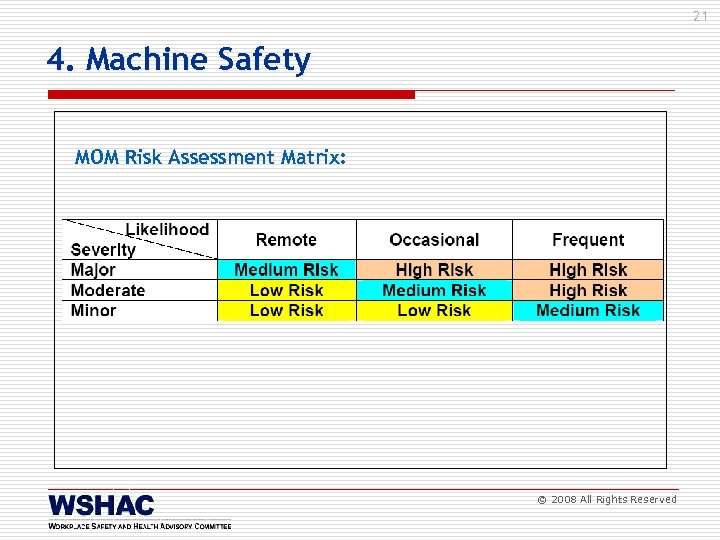 21 4. Machine Safety MOM Risk Assessment Matrix: © 2008 All Rights Reserved
 22 4. Machine Safety Step 4: Identify the need for additional control v What is the risk level with the consideration of existing controls? • High risk must be reduced to at least medium risk before startup of work v Whether the risk level can be further reduced to As Low As Reasonably Practical (ALARP)? © 2008 All Rights Reserved
 23 4. Machine Safety Step 5: Assign the responsible person v Responsible person shall be assigned for each identified activity v Time frame for the activity can also be decided v Responsible person shall ensure the effective closure of the activity © 2008 All Rights Reserved
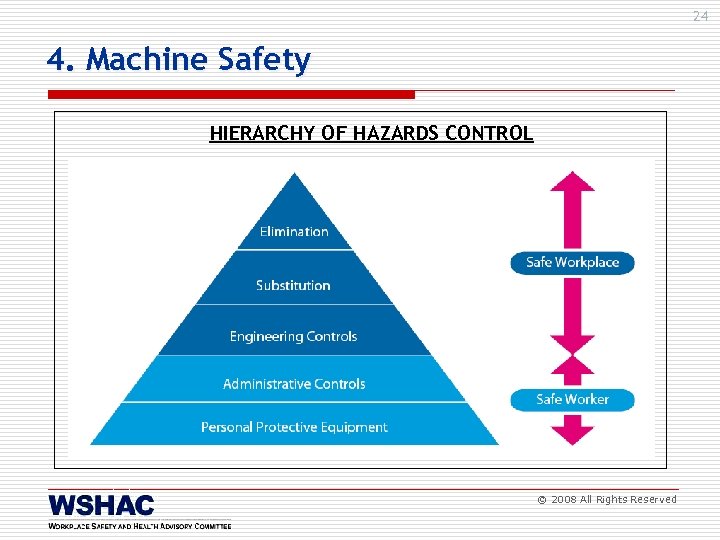 24 4. Machine Safety HIERARCHY OF HAZARDS CONTROL © 2008 All Rights Reserved
 25 4. Machine Safety 4. 2 Control Measures Types of hazards control measures • Machine guarding • Using devices, e. g. sensor, gates, etc • Distance • Use of automatic or semi-automatic fed and ejection/robots • Use of feeding tools • Training, Procedures (LOTO), etc • PPE © 2008 All Rights Reserved
 26 4. Machine Safety Types of machine guarding • Fixed guard • Interlocked guard • Adjustable guard • Self-adjusting guard © 2008 All Rights Reserved
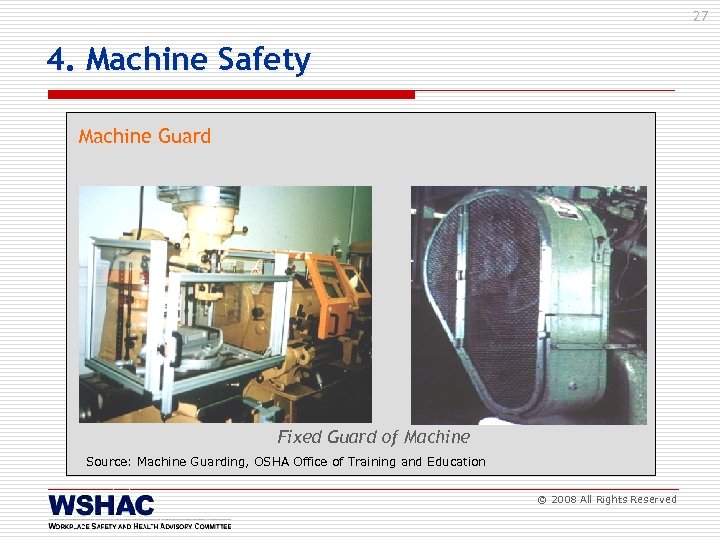 27 4. Machine Safety Machine Guard Fixed Guard of Machine Source: Machine Guarding, OSHA Office of Training and Education © 2008 All Rights Reserved
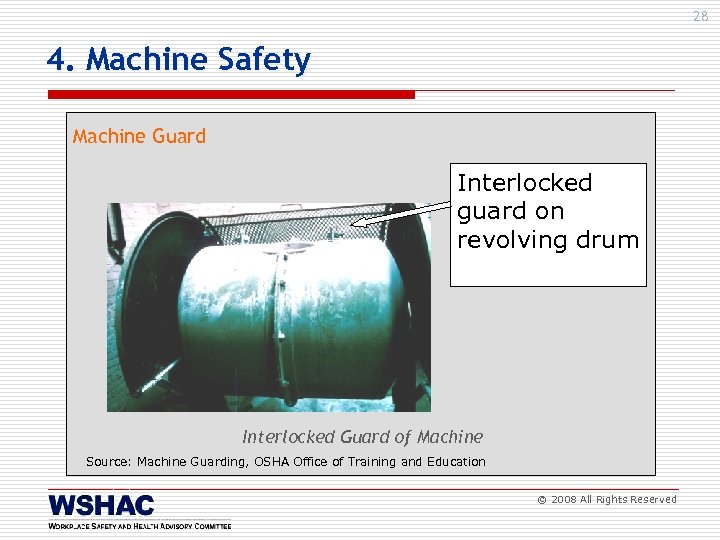 28 4. Machine Safety Machine Guard Interlocked guard on revolving drum Interlocked Guard of Machine Source: Machine Guarding, OSHA Office of Training and Education © 2008 All Rights Reserved
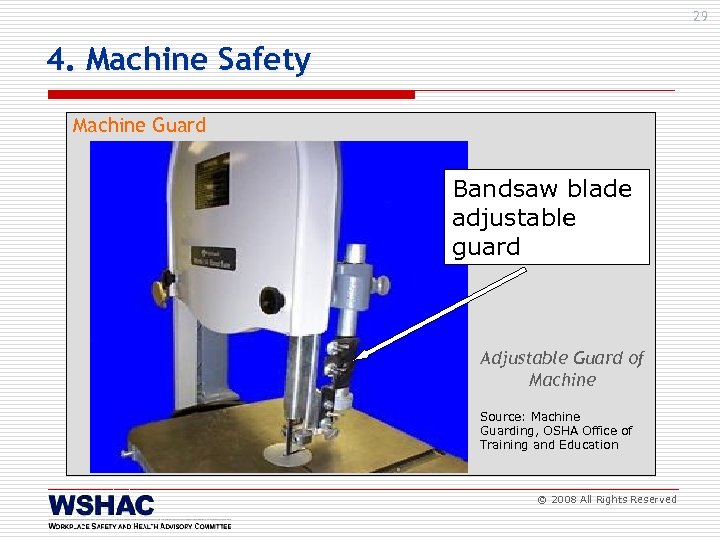 29 4. Machine Safety Machine Guard Bandsaw blade adjustable guard Adjustable Guard of Machine Source: Machine Guarding, OSHA Office of Training and Education © 2008 All Rights Reserved
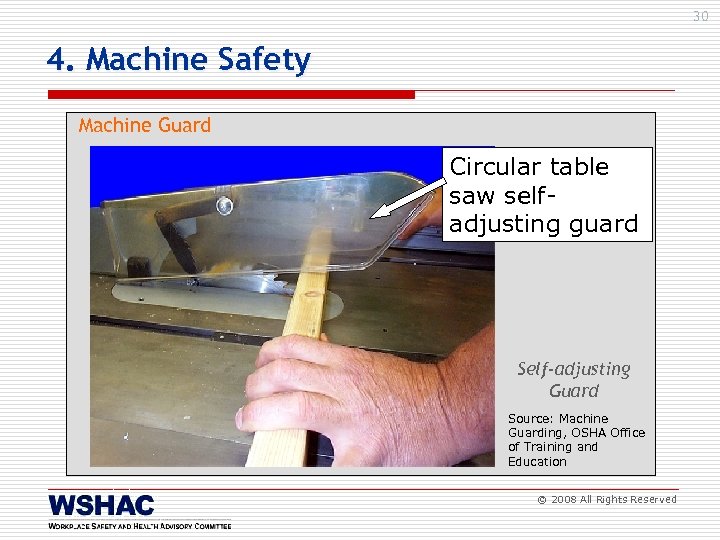 30 4. Machine Safety Machine Guard Circular table saw selfadjusting guard Self-adjusting Guard Source: Machine Guarding, OSHA Office of Training and Education © 2008 All Rights Reserved
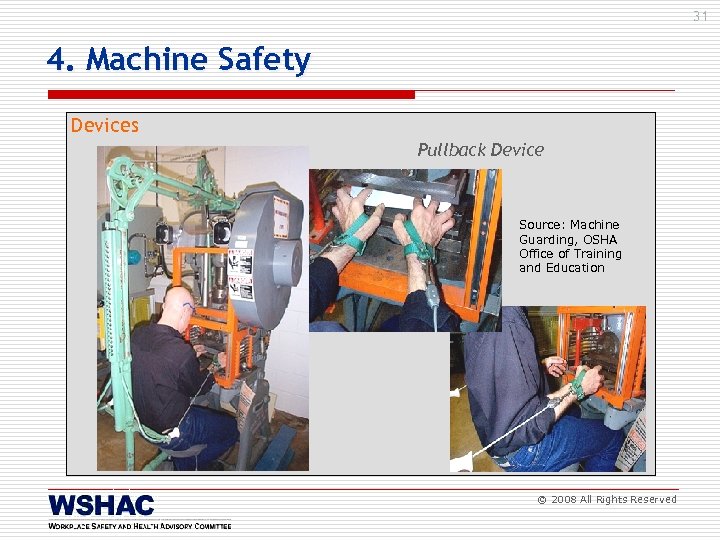 31 4. Machine Safety Devices Pullback Device Source: Machine Guarding, OSHA Office of Training and Education © 2008 All Rights Reserved
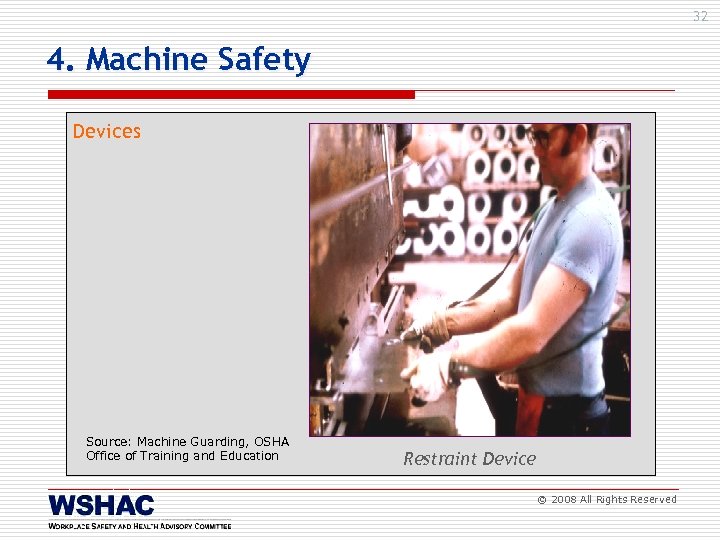 32 4. Machine Safety Devices Source: Machine Guarding, OSHA Office of Training and Education Restraint Device © 2008 All Rights Reserved
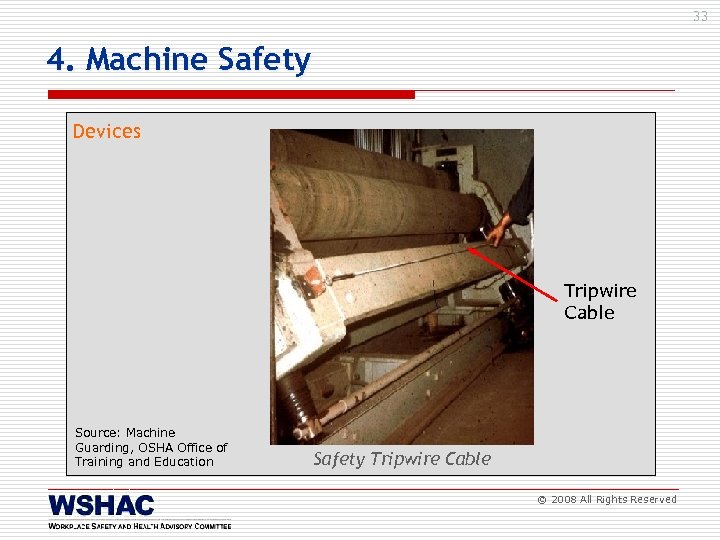 33 4. Machine Safety Devices Tripwire Cable Source: Machine Guarding, OSHA Office of Training and Education Safety Tripwire Cable © 2008 All Rights Reserved
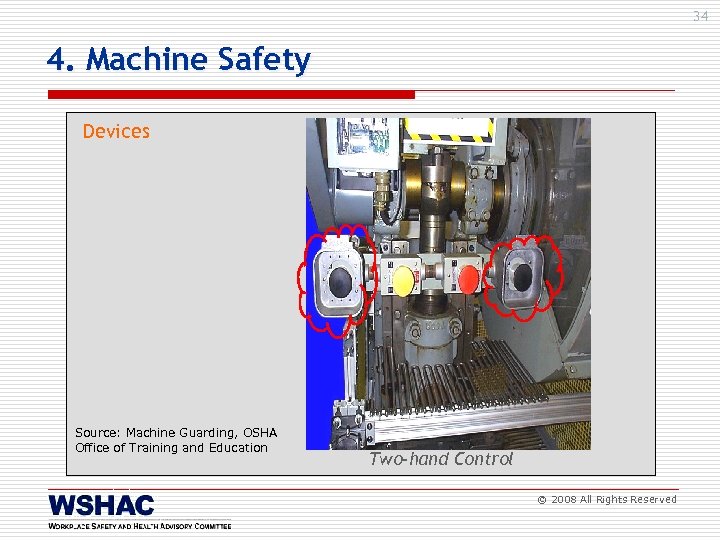 34 4. Machine Safety Devices Source: Machine Guarding, OSHA Office of Training and Education Two-hand Control © 2008 All Rights Reserved
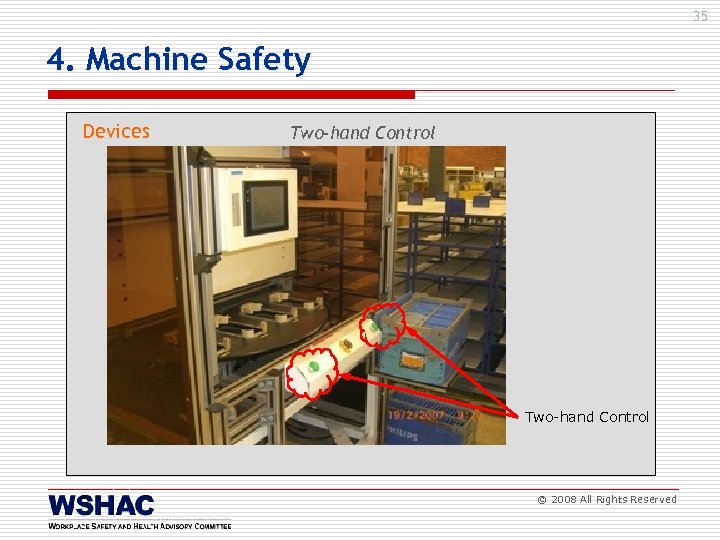 35 4. Machine Safety Devices Two-hand Control © 2008 All Rights Reserved
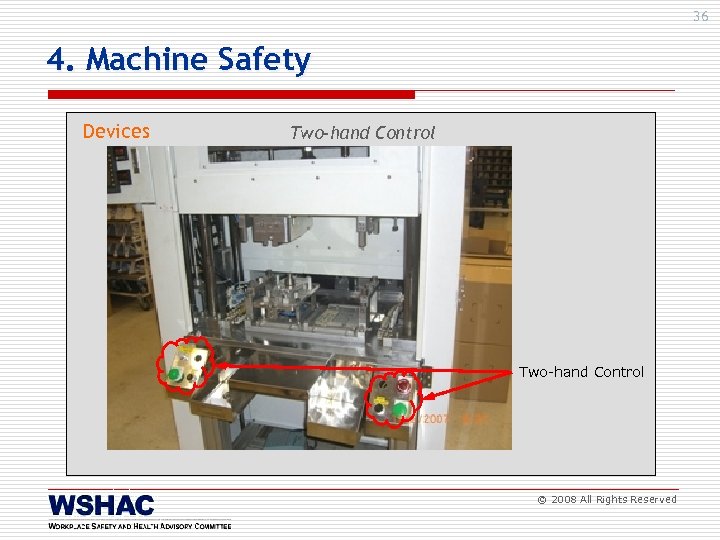 36 4. Machine Safety Devices Two-hand Control © 2008 All Rights Reserved
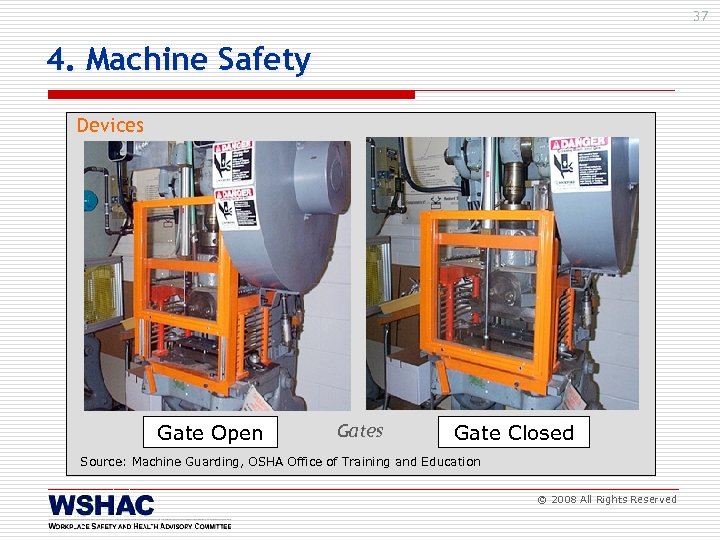 37 4. Machine Safety Devices Gate Open Gates Gate Closed Source: Machine Guarding, OSHA Office of Training and Education © 2008 All Rights Reserved
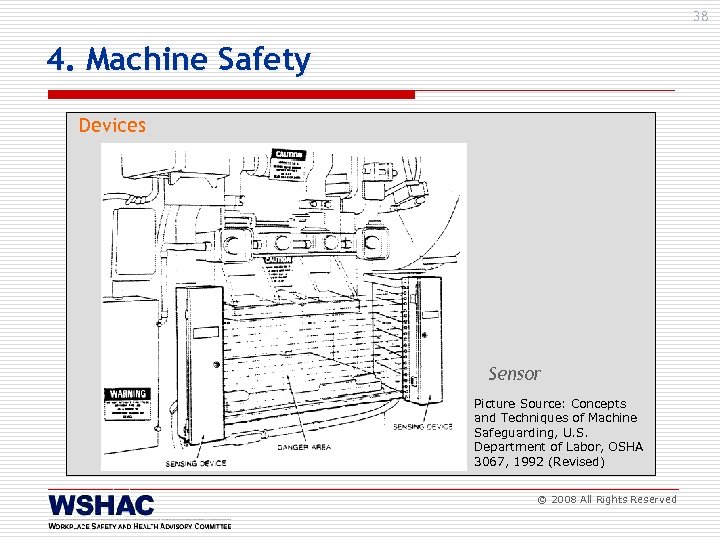 38 4. Machine Safety Devices Sensor Picture Source: Concepts and Techniques of Machine Safeguarding, U. S. Department of Labor, OSHA 3067, 1992 (Revised) © 2008 All Rights Reserved
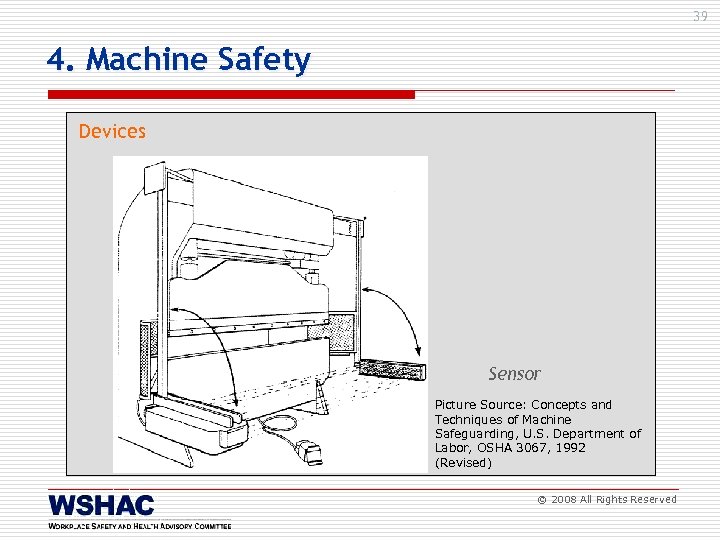 39 4. Machine Safety Devices Sensor Picture Source: Concepts and Techniques of Machine Safeguarding, U. S. Department of Labor, OSHA 3067, 1992 (Revised) © 2008 All Rights Reserved
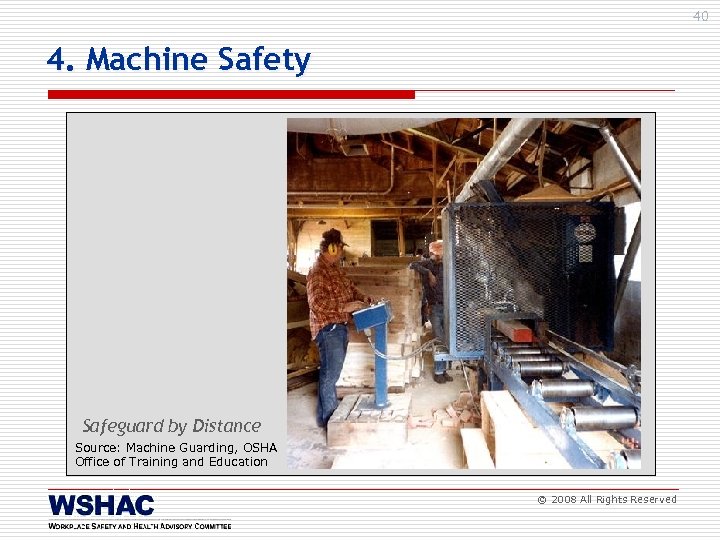 40 4. Machine Safety Safeguard by Distance Source: Machine Guarding, OSHA Office of Training and Education © 2008 All Rights Reserved
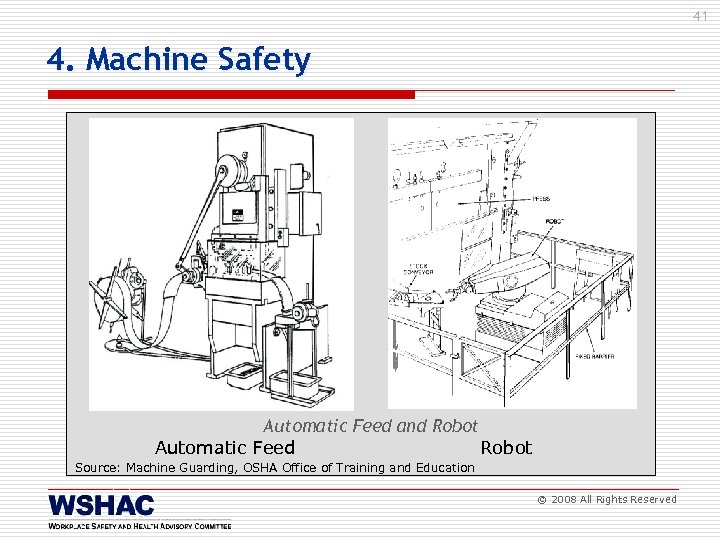 41 4. Machine Safety Automatic Feed and Robot Automatic Feed Robot Source: Machine Guarding, OSHA Office of Training and Education © 2008 All Rights Reserved
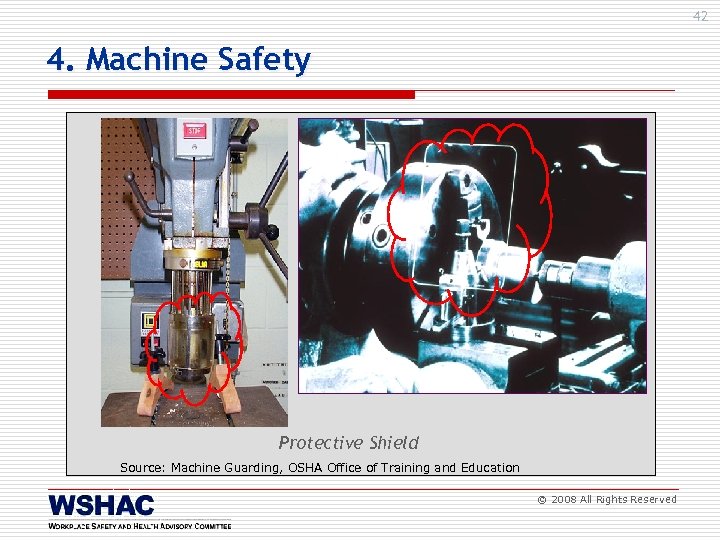 42 4. Machine Safety Protective Shield Source: Machine Guarding, OSHA Office of Training and Education © 2008 All Rights Reserved
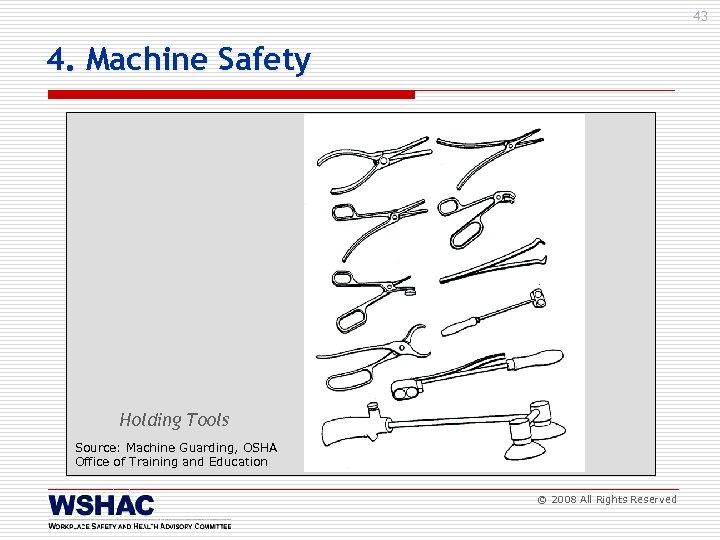 43 4. Machine Safety Holding Tools Source: Machine Guarding, OSHA Office of Training and Education © 2008 All Rights Reserved
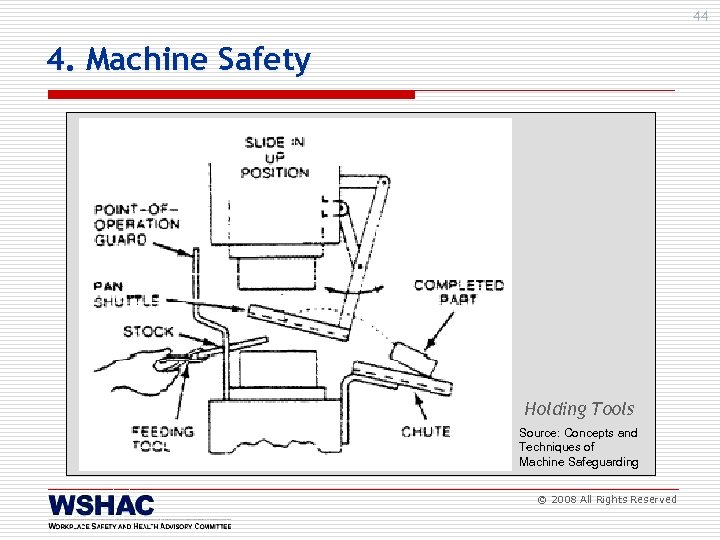 44 4. Machine Safety Holding Tools Source: Concepts and Techniques of Machine Safeguarding © 2008 All Rights Reserved
 45 4. Machine Safety Emergency Switch Emergency switch is provided when emergency stopping of machine is necessary, and hence, the switch shall: v Be easily accessible to the operator; and v Be designed for unexpected activation When necessary, buddy system shall be considered. © 2008 All Rights Reserved
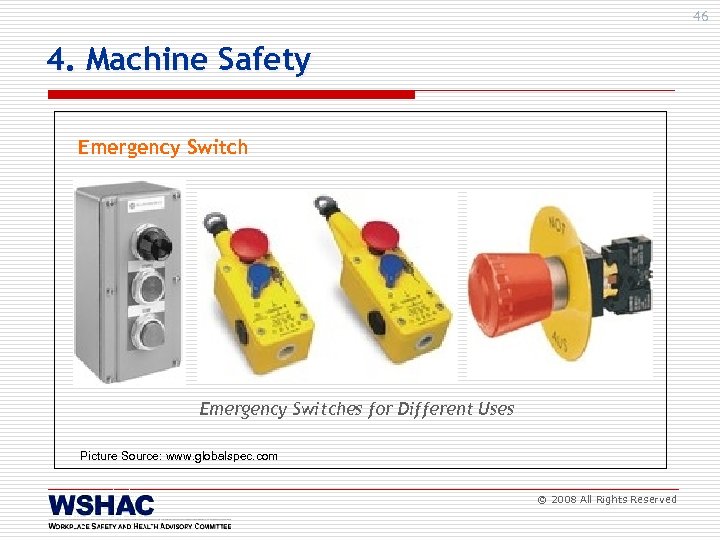 46 4. Machine Safety Emergency Switches for Different Uses Picture Source: www. globalspec. com © 2008 All Rights Reserved
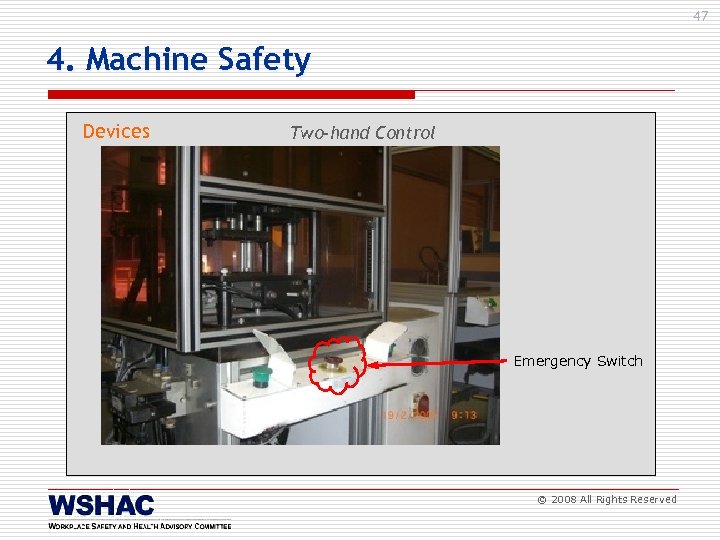 47 4. Machine Safety Devices Two-hand Control Emergency Switch © 2008 All Rights Reserved
 48 4. Machine Safety Power Trucks While using power trucks for material transportation, the following could be applied: • Do not block the vision • No passengers allowed • Wrap the load from falling • Limit the speed • Consider door access control to minimize the impact to pedestrians Refer to “Safe Operation of Forklift” for details. © 2008 All Rights Reserved
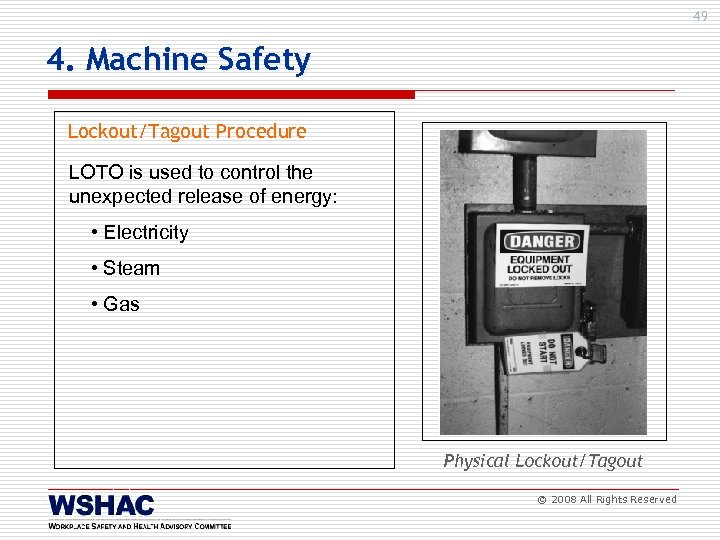 49 4. Machine Safety Lockout/Tagout Procedure LOTO is used to control the unexpected release of energy: • Electricity • Steam • Gas Single Photo at this/within Size/Area Physical Lockout/Tagout © 2008 All Rights Reserved
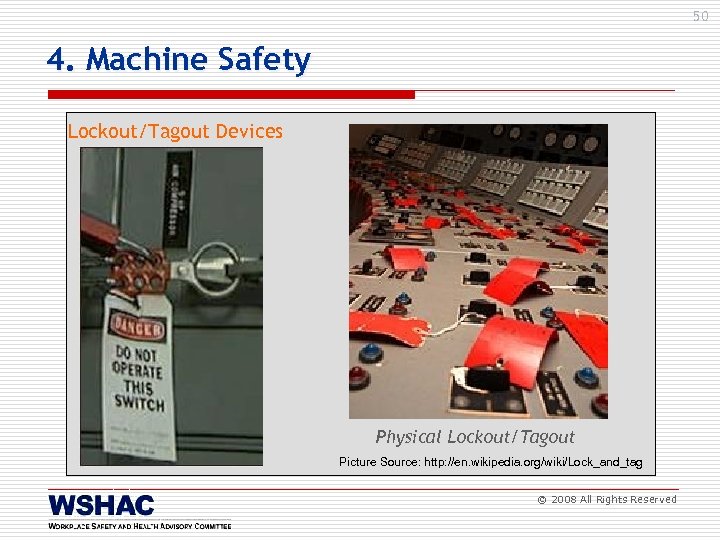 50 4. Machine Safety Lockout/Tagout Devices Physical Lockout/Tagout Picture Source: http: //en. wikipedia. org/wiki/Lock_and_tag © 2008 All Rights Reserved
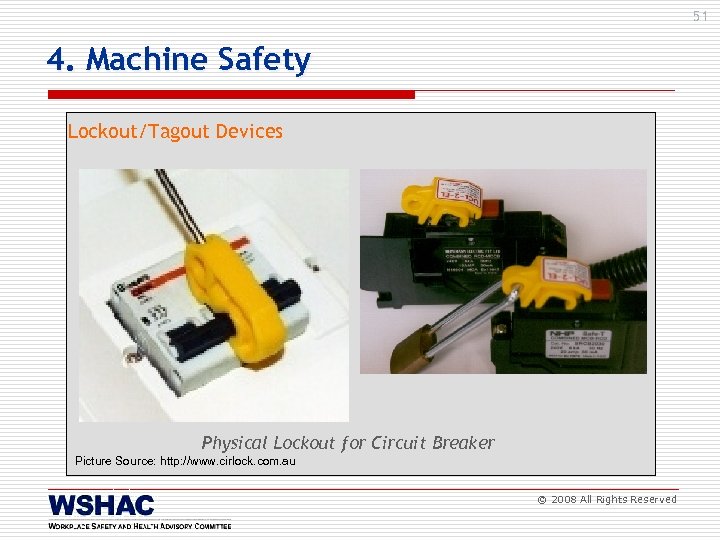 51 4. Machine Safety Lockout/Tagout Devices Physical Lockout for Circuit Breaker Picture Source: http: //www. cirlock. com. au © 2008 All Rights Reserved
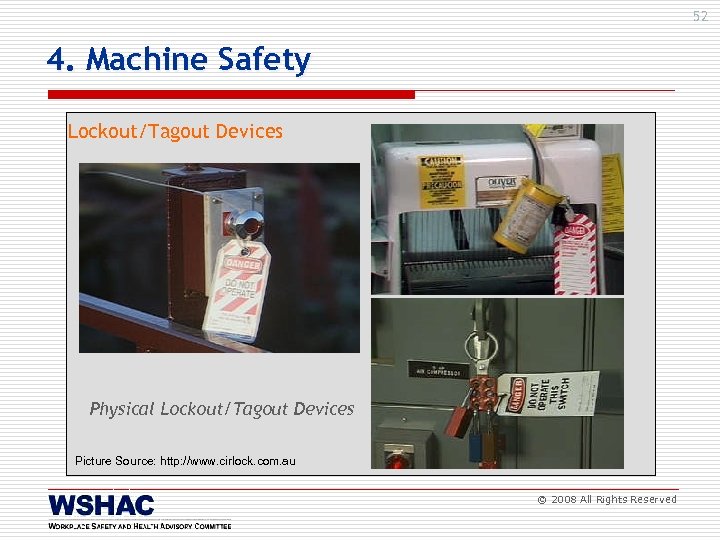 52 4. Machine Safety Lockout/Tagout Devices Physical Lockout/Tagout Devices Picture Source: http: //www. cirlock. com. au © 2008 All Rights Reserved
 53 4. Machine Safety Lockout/Tagout (LOTO) Procedure What must be included in the LOTO Procedure? v A statement on how to use the procedures; v Steps to shut down, isolate, block, and secure machines; v Steps designating the safe placement, removal, and transfer of LOTO devices and identifying who has responsibility for the LOTO devices; and v Requirements to determine and verify the effectiveness of lockout devices, tagout devices, and other energy-control measures. © 2008 All Rights Reserved
 54 4. Machine Safety Lockout/Tagout (LOTO) Procedure What must workers do before maintenance activities? 1. Prepare for shutdown; 2. Shut down the machine; 3. Disconnect or isolate the machine from the energy source(s); 4. Apply the lockout or tagout device(s) to the energyisolating device(s); 5. Release, restrain, or render safe all potential hazardous stored or residual energy. Regularly inspect to avoid reaccumulation of energy if necessary. 6. Verify the isolation and de-energization of the machine. © 2008 All Rights Reserved
 55 4. Machine Safety Lockout/Tagout (LOTO) Procedure What must workers do before removing LOTO device and reenergize the machine? Step 1: Inspect machines or their components to assure that they are operationally intact and that nonessential items are removed from the area; and Step 2: Check to assure that everyone is positioned safely and away from machines. © 2008 All Rights Reserved
 56 4. Machine Safety Lockout/Tagout (LOTO) Procedure What are the limitations for tagout devices? v A tagout device is a prominent warning of the hazards; v Tags do not provide the physical restraint of a lock; v Tags may evoke a false sense of security; v Therefore, lockout devices is considered more secure and more effective than tagout devices in protecting employees from hazardous energy. © 2008 All Rights Reserved
 57 4. Machine Safety Training Before using any machine, you should: v Be trained by qualified person/agent v Clarify any doubt on machine usage v Have the correct certificate, if required by law v Inspect the machine for good condition (or inspected by qualified persons) v Do not operate machine unless authorized © 2008 All Rights Reserved
 58 4. Machine Safety PPE Before using any machine, you should ensure that: v Proper PPE is used to conduct the work v The PPE is in good condition v Proper training has been given on how to use PPE © 2008 All Rights Reserved
 59 4. Machine Safety Ergonomics Some basic tips to improve ergonomics: v Use equipment to aid material handling v Use correct material handling position v Maintain comfortable position when working v Do the work with proper tools Refer to Material Handling for Metalworking Industry for more details about ergonomic hazard control. © 2008 All Rights Reserved
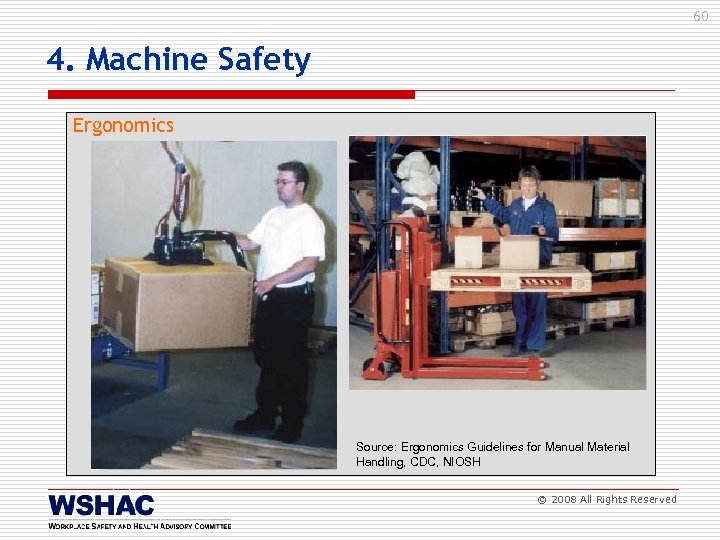 60 4. Machine Safety Ergonomics Source: Ergonomics Guidelines for Manual Material Handling, CDC, NIOSH © 2008 All Rights Reserved
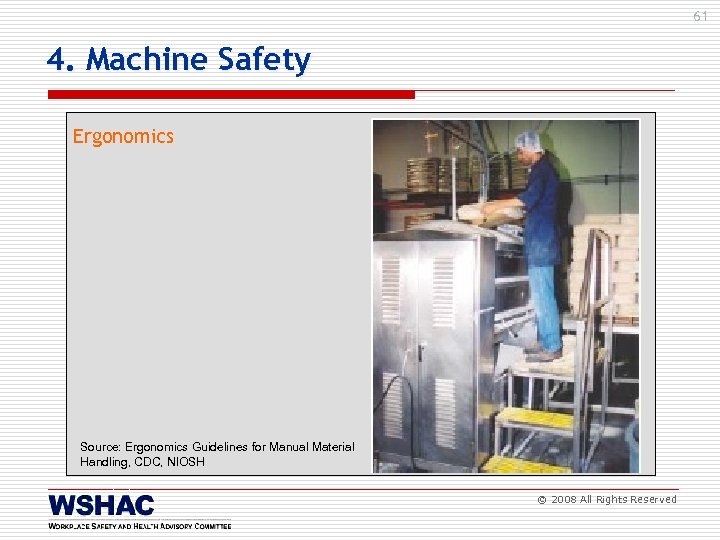 61 4. Machine Safety Ergonomics Source: Ergonomics Guidelines for Manual Material Handling, CDC, NIOSH © 2008 All Rights Reserved
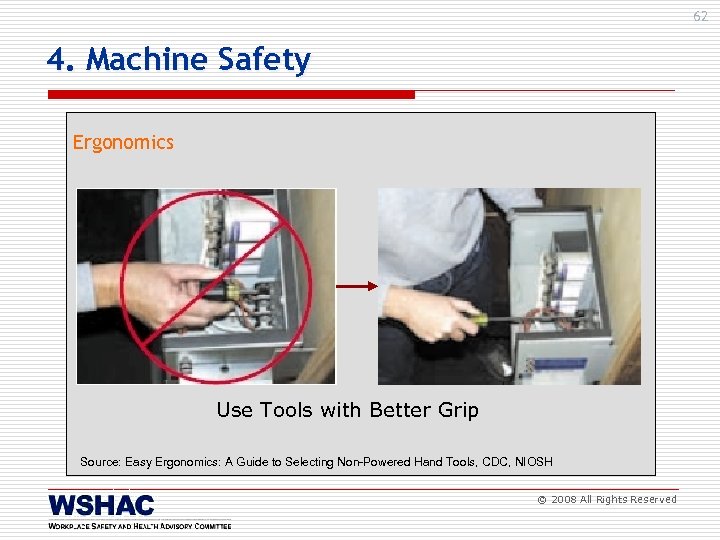 62 4. Machine Safety Ergonomics Use Tools with Better Grip Source: Easy Ergonomics: A Guide to Selecting Non-Powered Hand Tools, CDC, NIOSH © 2008 All Rights Reserved
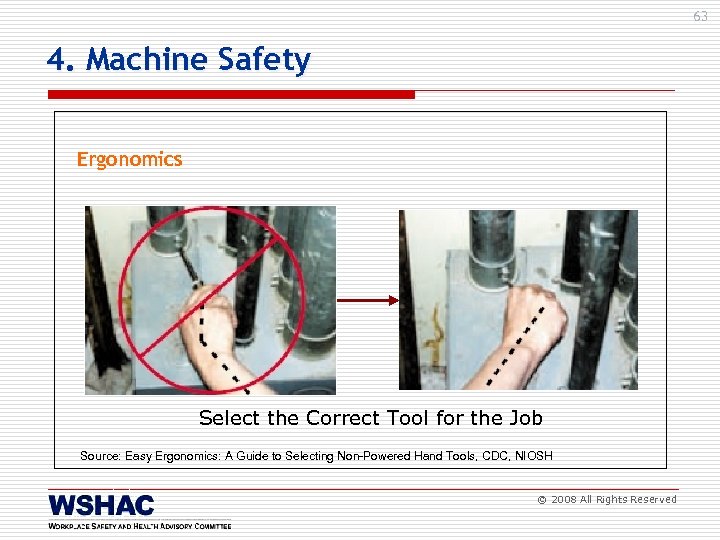 63 4. Machine Safety Ergonomics Select the Correct Tool for the Job Source: Easy Ergonomics: A Guide to Selecting Non-Powered Hand Tools, CDC, NIOSH © 2008 All Rights Reserved
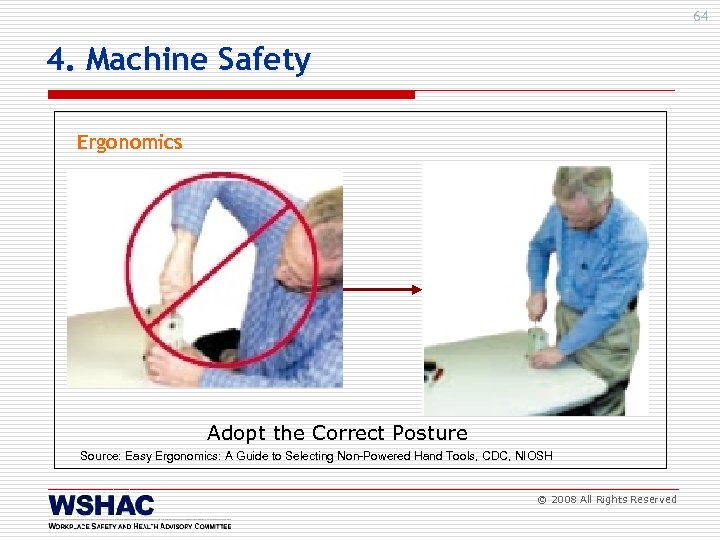 64 4. Machine Safety Ergonomics Adopt the Correct Posture Source: Easy Ergonomics: A Guide to Selecting Non-Powered Hand Tools, CDC, NIOSH © 2008 All Rights Reserved
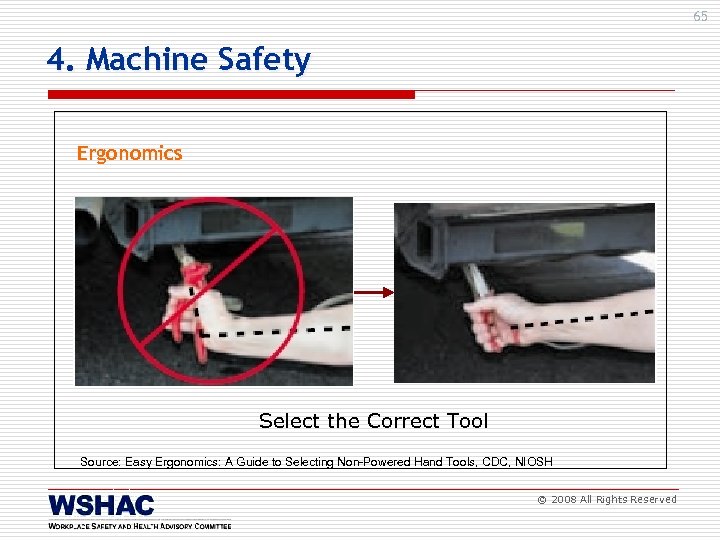 65 4. Machine Safety Ergonomics Select the Correct Tool Source: Easy Ergonomics: A Guide to Selecting Non-Powered Hand Tools, CDC, NIOSH © 2008 All Rights Reserved
 66 4. Machine Safety Safe Practices The following practices shall be observed at all times: v Always use the safety devices correctively; v Do not wear loose clothing/ties when operating machines with rotating parts; v Tie up or cover up long hair; v Use devices to remove trapped materials from machine; v Switch off the machine before retrieving dropped material(s) from inside the machine. © 2008 All Rights Reserved
 67 Exercise Identify the hazards associated with the machines used by you, considering: • What control measures are in place to reduce the hazard? • Whether the control measures are adequate, e. g. any incident occurred? • What improvements can be made to reduce the risk? © 2008 All Rights Reserved
 68 Reference 1. Workplace Safety, Volume 4 of Safety at Work Series, John Ridley and John Channing, Butterworth Heinemann, 1999 2. Risk Management: Risk Assessment Guidelines, MOM 3. Machine Guarding, OSHA Office of Training and Education 4. Risk Management: Risk Assessment Guidelines, MOM 5. National OSH Programme-Based Engagement (Pro. BE), Technical Advisory For Metalworking Industry – Understanding the Hazards of Metalworking Industry. 6. Handbook of OSHA Construction Safety and Health, 2 nd Ed, Charles D. Reese, James Vernon Eidson, CRC, 2006 7. Concepts and Techniques of Machine Safeguarding, U. S. Department of Labor, OSHA 3067, 1992 (Revised) 8. Control of Hazardous Energy (Lockout/Tagout), U. S. Department of Labor, OSHA 3120, 2002 (Revised) 9. Easy Ergonomics: A Guide to Selecting Non-Powered Hand Tools, CDC, NIOSH, 2004 10. Survey of Occupational Injuries and Illnesses in Cooperation with Participating State Agencies, Bureau of Labor Statistics, U. S. Department of Labor 11. CP 91: 2001 – Lockout Procedure © 2008 All Rights Reserved
 69 Thank You © 2008 All Rights Reserved