 Скачать презентацию 1 Processes of Reform Capacity Building Module
4dcbae39907c529487685abccec4959d.ppt
- Количество слайдов: 31



1 Processes of Reform Capacity Building Module
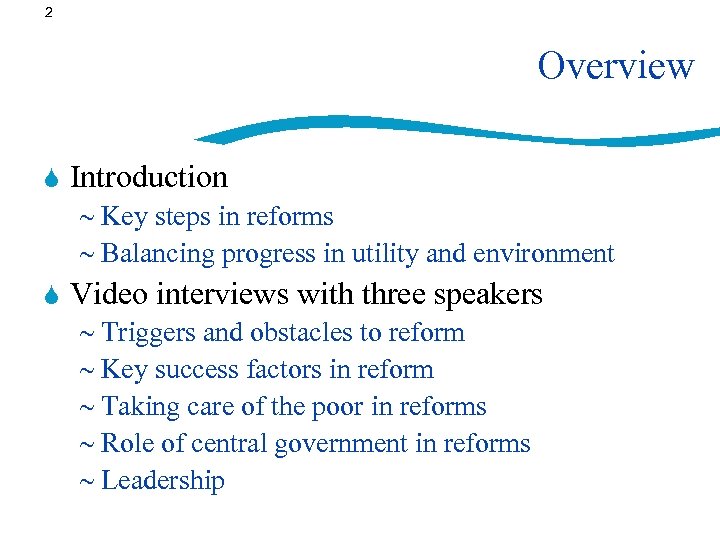
2 Overview S Introduction ~ Key steps in reforms ~ Balancing progress in utility and environment S Video interviews with three speakers ~ Triggers and obstacles to reform ~ Key success factors in reform ~ Taking care of the poor in reforms ~ Role of central government in reforms ~ Leadership
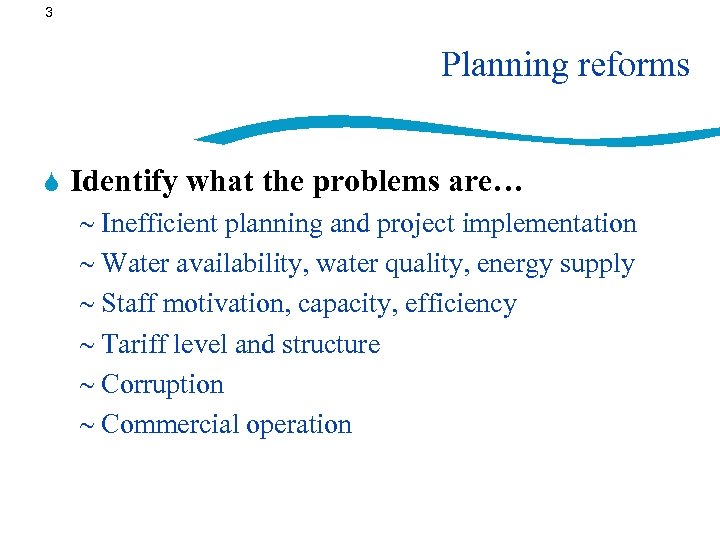
3 Planning reforms S Identify what the problems are… ~ Inefficient planning and project implementation ~ Water availability, water quality, energy supply ~ Staff motivation, capacity, efficiency ~ Tariff level and structure ~ Corruption ~ Commercial operation
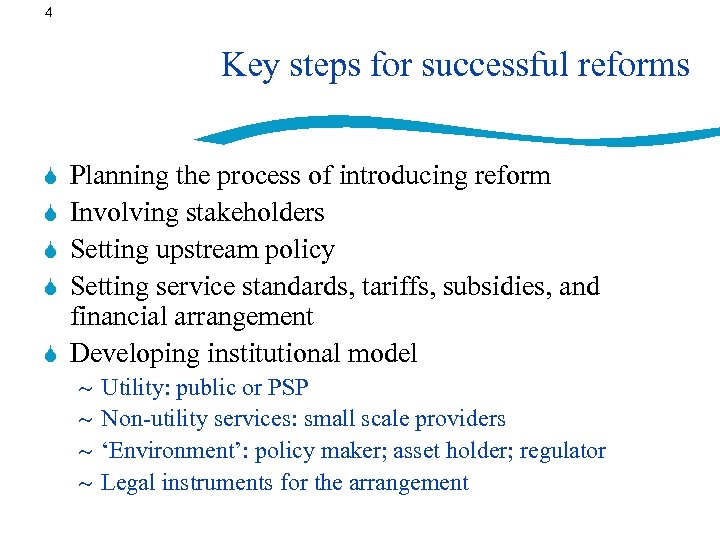
4 Key steps for successful reforms S S S Planning the process of introducing reform Involving stakeholders Setting upstream policy Setting service standards, tariffs, subsidies, and financial arrangement Developing institutional model ~ ~ Utility: public or PSP Non-utility services: small scale providers ‘Environment’: policy maker; asset holder; regulator Legal instruments for the arrangement
5 Involving stakeholders S S S S Politicians: local and national levels Management and staff of public utility Consumer associations NGO: national and int’l (service to the poor, environment, governance…) Financiers: multi and bi-lateral Alternative suppliers (tankers, drilling companies…) Media: national and int’l Private sector: local and int’l
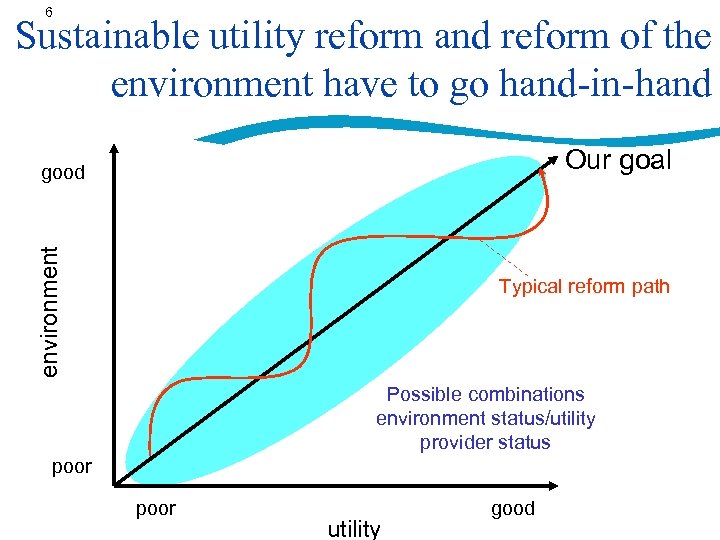
6 Sustainable utility reform and reform of the environment have to go hand-in-hand Our goal environment good Typical reform path Possible combinations environment status/utility provider status poor utility good
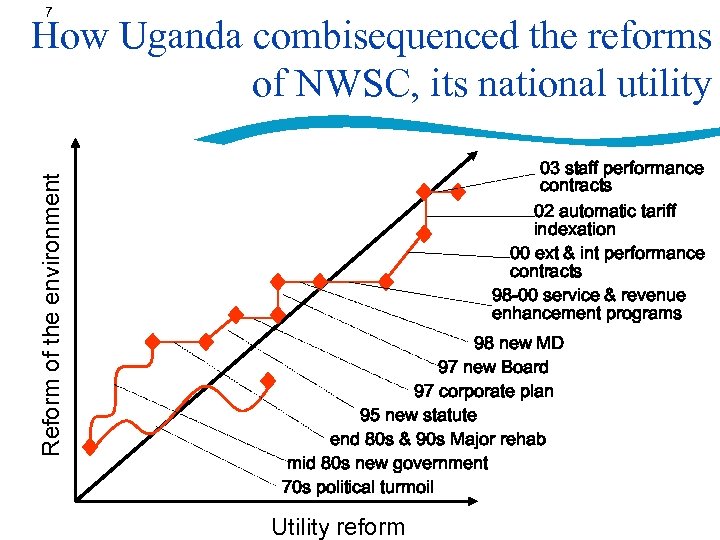
7 Reform of the environment How Uganda combisequenced the reforms of NWSC, its national utility 03 staff performance contracts 02 automatic tariff indexation 00 ext & int performance contracts 98 -00 service & revenue enhancement programs 98 new MD 97 new Board 97 corporate plan 95 new statute end 80 s & 90 s Major rehab mid 80 s new government 70 s political turmoil Utility reform
8 Overview S Introduction ~ Key steps in reforms ~ Balancing progress in utility and environment S Video interviews with three speakers ~ Triggers and obstacles to reform ~ Key success factors in reform ~ Taking care of the poor in reforms ~ Role of central government in reforms ~ Leadership
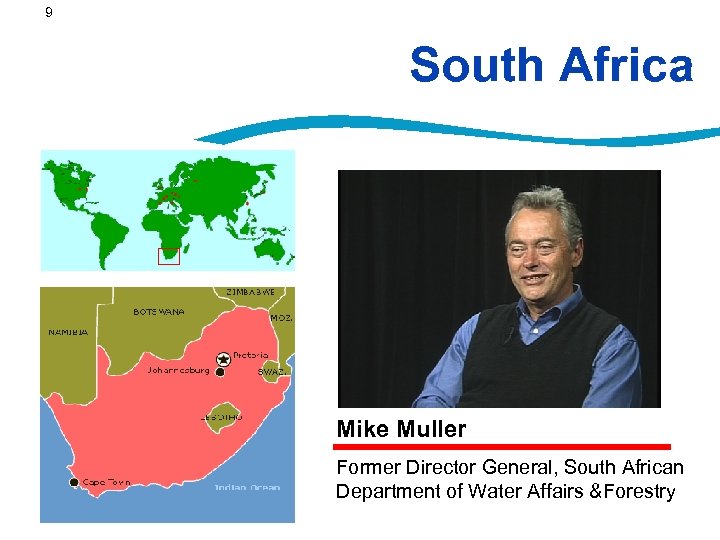
9 South Africa Mike Muller Former Director General, South African Department of Water Affairs &Forestry
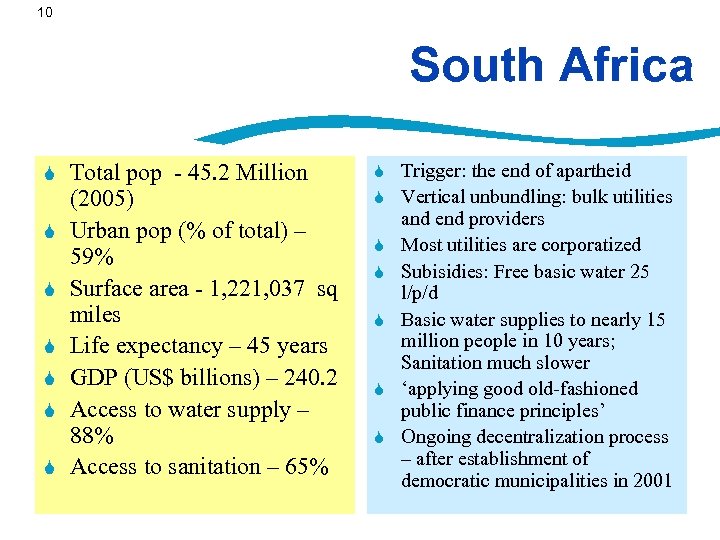
10 South Africa S S S S Total pop - 45. 2 Million (2005) Urban pop (% of total) – 59% Surface area - 1, 221, 037 sq miles Life expectancy – 45 years GDP (US$ billions) – 240. 2 Access to water supply – 88% Access to sanitation – 65% S S S S Trigger: the end of apartheid Vertical unbundling: bulk utilities and end providers Most utilities are corporatized Subisidies: Free basic water 25 l/p/d Basic water supplies to nearly 15 million people in 10 years; Sanitation much slower ‘applying good old-fashioned public finance principles’ Ongoing decentralization process – after establishment of democratic municipalities in 2001
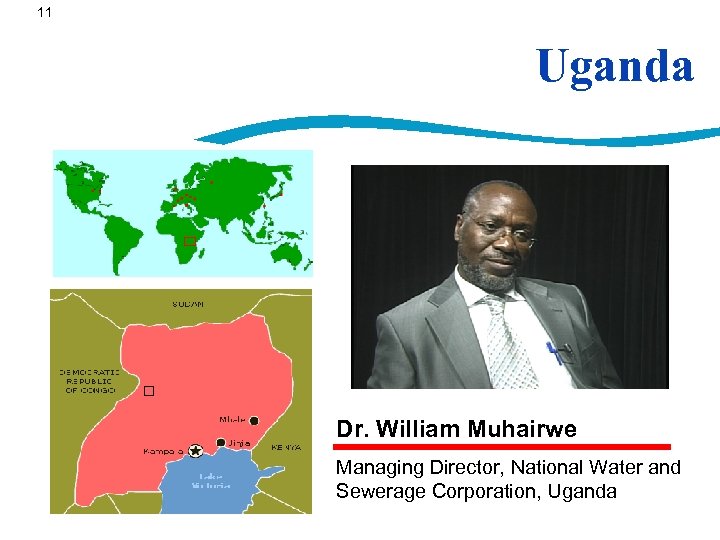
11 Uganda Dr. William Muhairwe Managing Director, National Water and Sewerage Corporation, Uganda
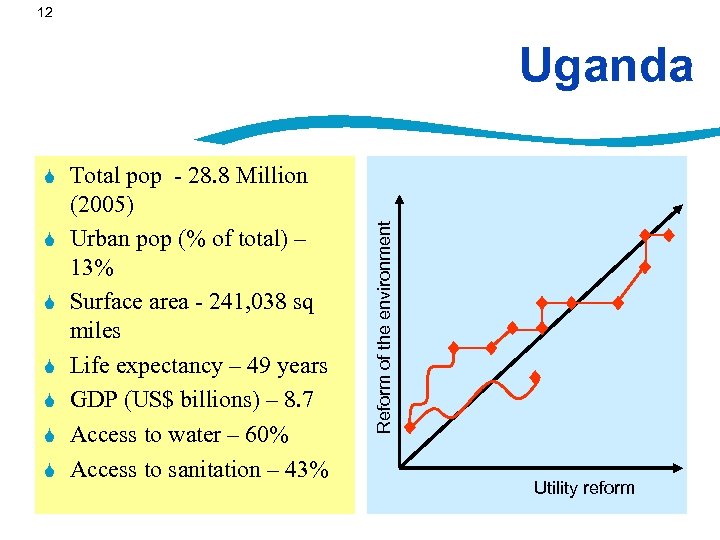
12 S S S S Total pop - 28. 8 Million (2005) Urban pop (% of total) – 13% Surface area - 241, 038 sq miles Life expectancy – 49 years GDP (US$ billions) – 8. 7 Access to water – 60% Access to sanitation – 43% Reform of the environment Uganda Utility reform
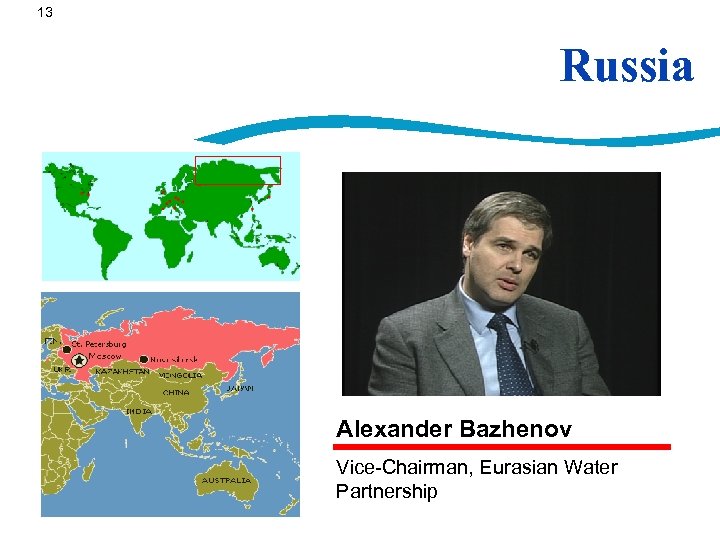
13 Russia Alexander Bazhenov Vice-Chairman, Eurasian Water Partnership
14 Russia S S S S Total pop - 143. 2 Million (2005) Urban pop (% of total) – 73% Surface area - 17, 075, 200 sq miles Life expectancy – 65 years GDP (US$ billions) – 763. 7 Access to water – 97% Access to sanitation – 87% S S S S Trigger: the end of communism Subsidies: l’goti and maximum % expenditure WSS part of broader Housing and Communal Services sector – centralized billing and collection Mostly municipal departments with little autonomy History of focus on infra: low efficiency Regulation is regional ‘oblast’ responsibility Boom & bust of PSP in 03/04; now 2 nd generation PSP
15 Overview S Introduction ~ Key steps in reforms ~ Balancing progress in utility and environment S Video interviews with three speakers ~ Triggers and obstacles to reform ~ Key success factors in reform ~ Taking care of the poor in reforms ~ Role of central government in reforms ~ Leadership
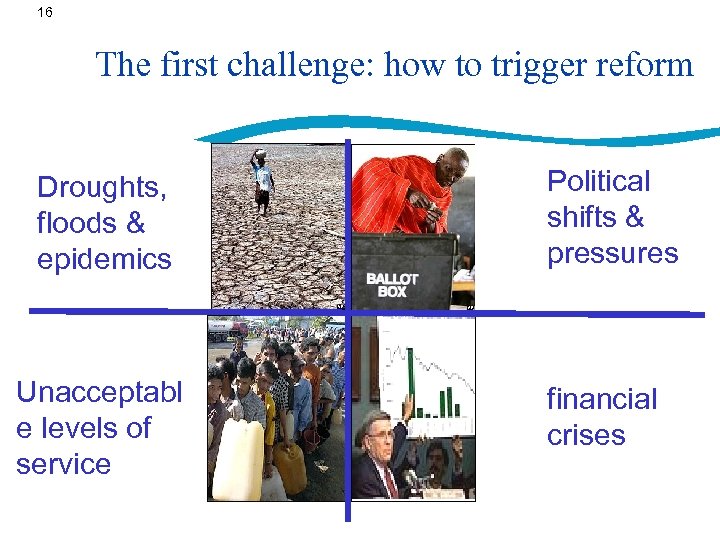
16 The first challenge: how to trigger reform Droughts, floods & epidemics Unacceptabl e levels of service Political shifts & pressures financial crises
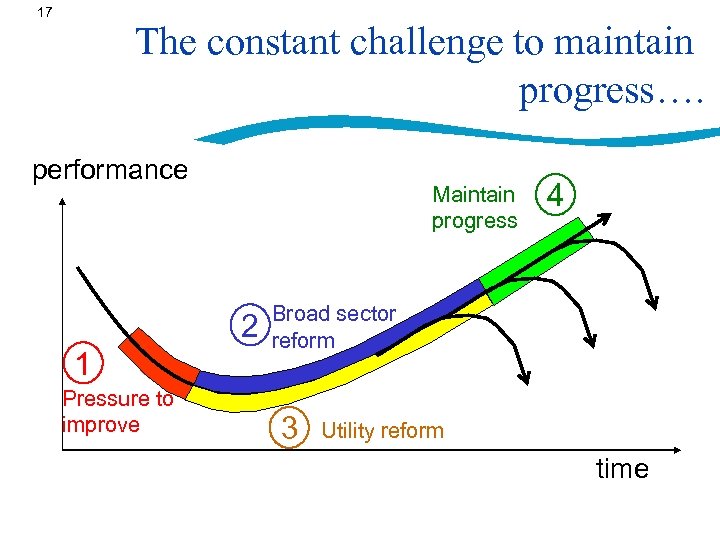
17 The constant challenge to maintain progress…. performance Maintain progress 2 1 Pressure to improve 4 Broad sector reform 3 Utility reform time

18 Triggers and Obstacles to Reform Click the button to play a 5 minute video clip. (Windows Media; 9, 421 k)
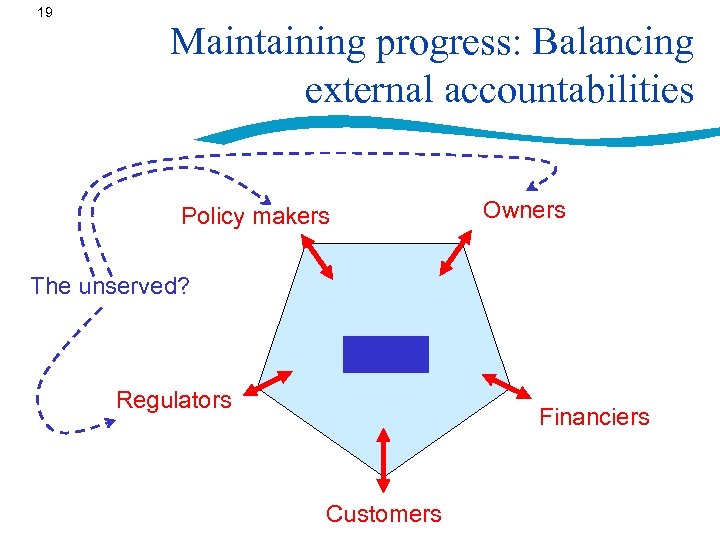
19 Maintaining progress: Balancing external accountabilities Policy makers Owners The unserved? Regulators Financiers Customers
20 Overview S Introduction ~ Key steps in reforms ~ Balancing progress in utility and environment S Video interviews with three speakers ~ Triggers and obstacles to reform ~ Key success factors in reform ~ Taking care of the poor in reforms ~ Role of central government in reforms ~ Leadership

21 Key Success Factors in Reform Click the button to play a 5 minute video clip. (Windows Media; 9, 208 k)
22 Overview S Introduction ~ Key steps in reforms ~ Balancing progress in utility and environment S Video interviews with three speakers ~ Triggers and obstacles to reform ~ Key success factors in reform ~ Taking care of the poor in reforms ~ Role of central government in reforms ~ Leadership
23 Taking Care of the Poor in Reforms Click the button to play a 10 minute video clip. (Windows Media; 15, 619 k)
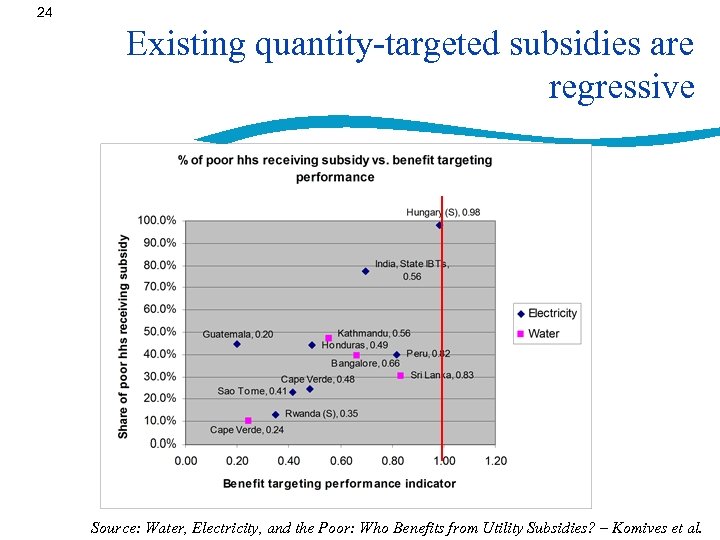
24 Existing quantity-targeted subsidies are regressive Source: Water, Electricity, and the Poor: Who Benefits from Utility Subsidies? – Komives et al.
25 Who are the urban poor? Typically use multiple sources and differentiate drinking from other uses - purchase small quantities if a free source is available: S May share a house or yard tap with multiple families – design standards underestimate number of users S May purchase from a neighbor – poor households are often heterogeneous; differentiate demand as slums may have mixed densities, income levels S May use a public standpipe/standpost/kiosk – the level of consumption is constrained by distance traveled, time spent collecting water S May rely on small-scale private sector when services do not meet their needs – choose to have water delivered to house rather than walking to and queuing at the standpipe BUT: poor households do pay for water often at higher rate (per cubic meter) than wealthy households
26 How to improve services for the poor? S The long term utility solution: a private house/yard -connection for all S Standpipes – from free to paid service S Augmenting small-scale service providers S How to deal with self provisioning?
27 Overview S Introduction ~ Key steps in reforms ~ Balancing progress in utility and environment S Video interviews with three speakers ~ Triggers and obstacles to reform ~ Key success factors in reform ~ Taking care of the poor in reforms ~ Role of central government in reforms ~ Leadership
28 The Role of the Central Government Click the button to play a 4 minute video clip. (Windows Media; 7, 526 k)
29 Overview S Introduction ~ Key steps in reforms ~ Balancing progress in utility and environment S Video interviews with three speakers ~ Triggers and obstacles to reform ~ Key success factors in reform ~ Taking care of the poor in reforms ~ Role of central government in reforms ~ Leadership
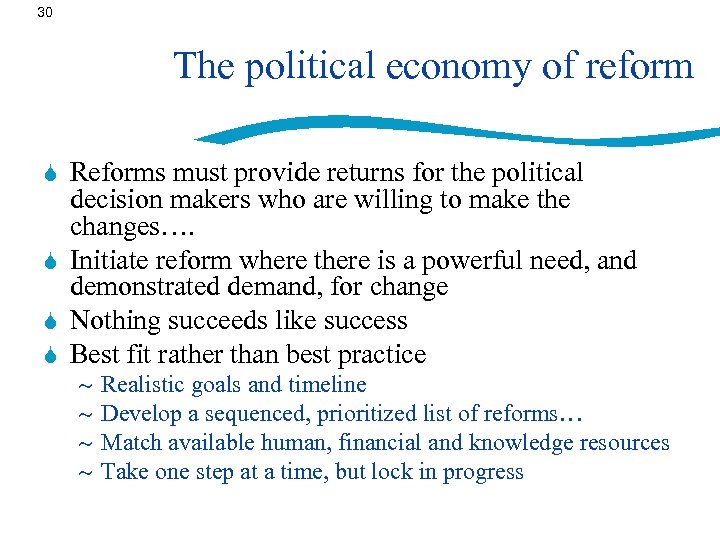
30 The political economy of reform Reforms must provide returns for the political decision makers who are willing to make the changes…. S Initiate reform where there is a powerful need, and demonstrated demand, for change S Nothing succeeds like success S Best fit rather than best practice S ~ ~ Realistic goals and timeline Develop a sequenced, prioritized list of reforms… Match available human, financial and knowledge resources Take one step at a time, but lock in progress
31 The Importance of Leadership Click the button to play a 3 minute video clip. (Windows Media; 3, 477 k)
Скачать презентацию 1 Processes of Reform Capacity Building Module
4dcbae39907c529487685abccec4959d.ppt