



 1
1
 Part 1 THE MEAN VALUES 2
 СHAPTER QUESTIONS 1. Measures of location 2. Types of means 3. Measures of location for ungrouped data - Arithmetic mean - Harmonic mean - Geometric mean - Median and Mode 4. Measures of location for grouped data - Arithmetic mean - Harmonic mean - Geometric mean - Median and Mode 3
 • Properties to describe numerical data: – Central tendency – Dispersion – Shape • Measures calculated for: – Sample data • Statistics – Entire population • Parameters 4
 Measures of location include: • Arithmetic mean • Harmonic mean • Geometric mean • Median • Mode 5
 UNGROUPED or raw data refers to data as they were collected, that is, before they are summarised or organised in any way or form GROUPED data refers to data summarised in a frequency table 6
 What is the mean? • The mean - is a general indicator characterizing the typical level of varying trait per unit of qualitatively homogeneous population. 7
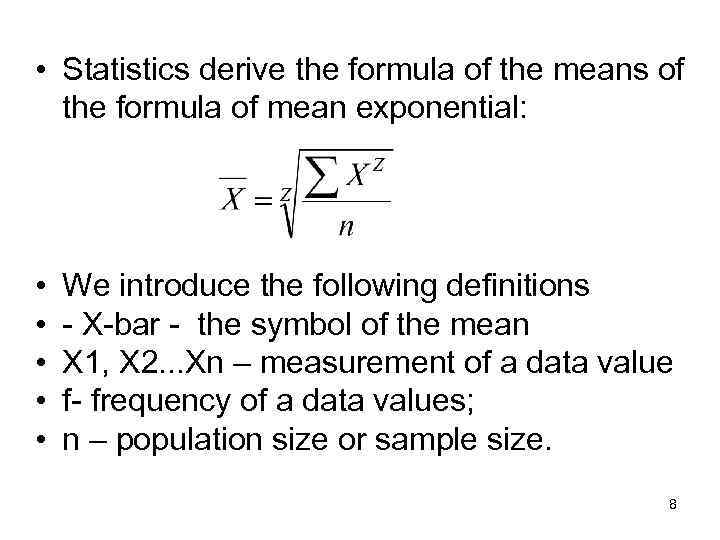 • Statistics derive the formula of the means of the formula of mean exponential: • • • We introduce the following definitions - X-bar - the symbol of the mean Х 1, Х 2. . . Хn – measurement of a data value f- frequency of a data values; n – population size or sample size. 8
 • There are the following types of mean: • If z = -1 - the harmonic mean, • z = 0 - the geometric mean, • z = +1 - arithmetic mean, • z = +2 - mean square, • z = +3 - mean cubic, etc. 9
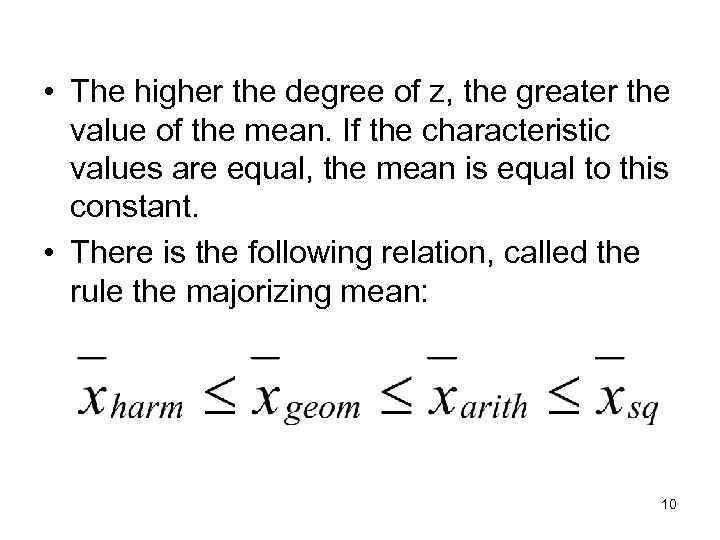 • The higher the degree of z, the greater the value of the mean. If the characteristic values are equal, the mean is equal to this constant. • There is the following relation, called the rule the majorizing mean: 10
 There are two ways of calculating mean: • for ungrouped data is calculated as a simple mean • for grouped data is calculated weighted mean 11
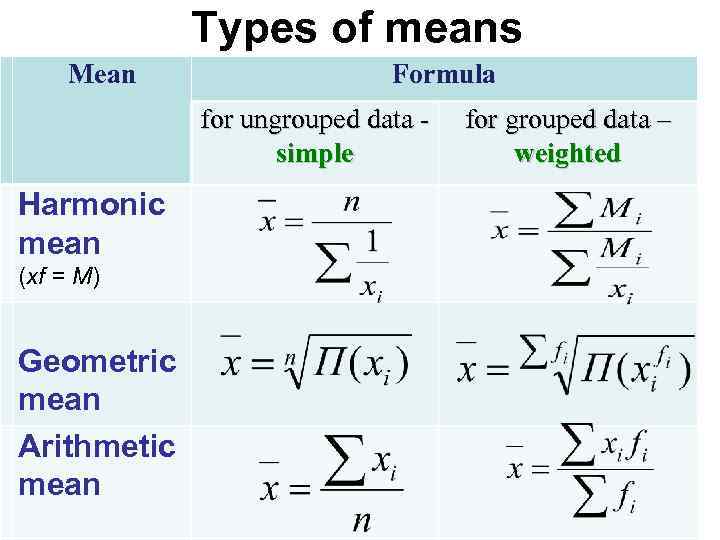 Types of means Mean Formula for ungrouped data - for grouped data – simple weighted Harmonic mean (xf = M) Geometric mean Arithmetic mean
 Arithmetic mean value is called the mean value of the sign, in the calculation of the total volume of which feature in the aggregate remains unchanged 13
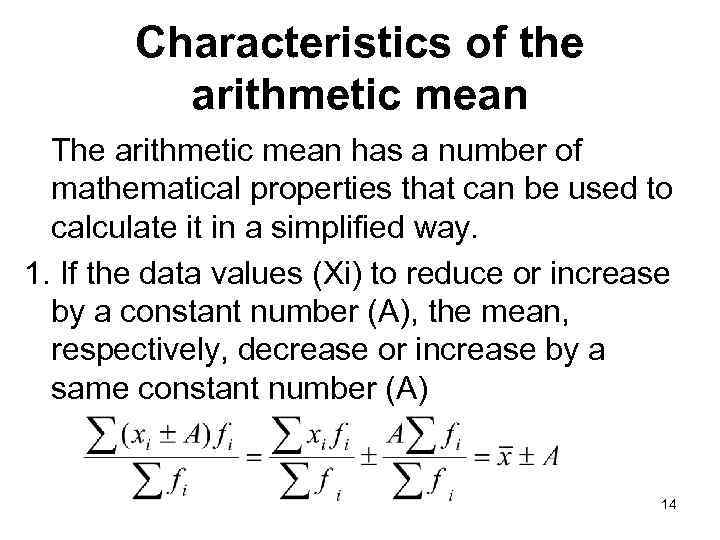 Characteristics of the arithmetic mean The arithmetic mean has a number of mathematical properties that can be used to calculate it in a simplified way. 1. If the data values (Xi) to reduce or increase by a constant number (A), the mean, respectively, decrease or increase by a same constant number (A) 14
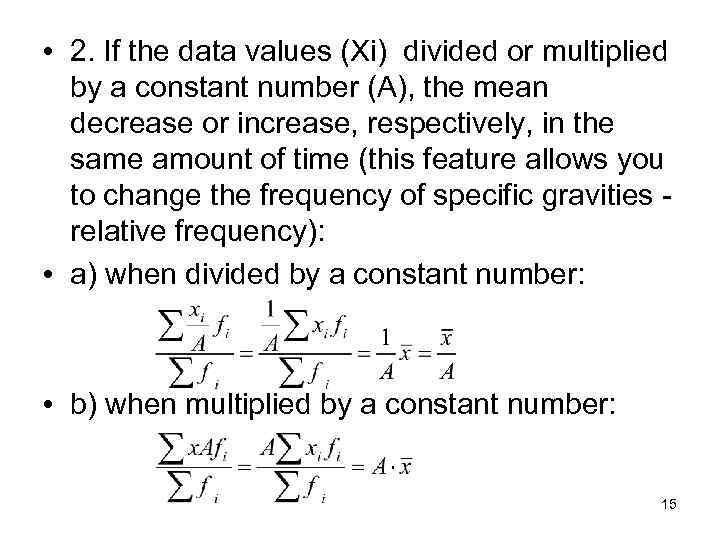 • 2. If the data values (Xi) divided or multiplied by a constant number (A), the mean decrease or increase, respectively, in the same amount of time (this feature allows you to change the frequency of specific gravities relative frequency): • a) when divided by a constant number: • b) when multiplied by a constant number: 15
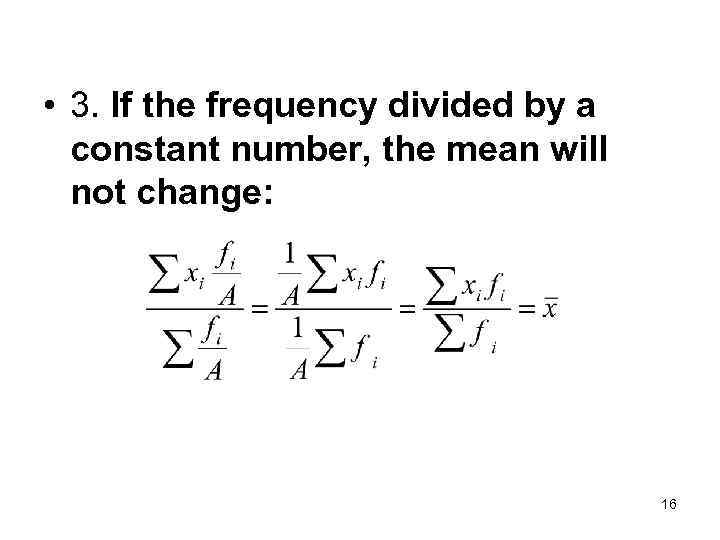 • 3. If the frequency divided by a constant number, the mean will not change: 16
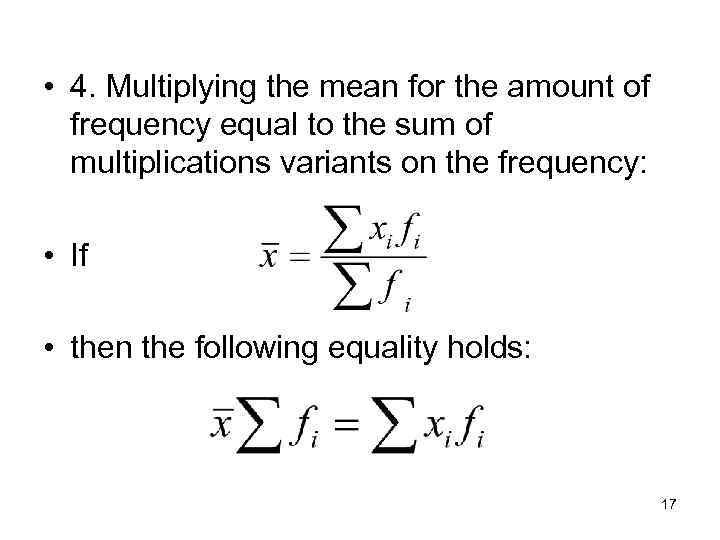 • 4. Multiplying the mean for the amount of frequency equal to the sum of multiplications variants on the frequency: • If • then the following equality holds: 17
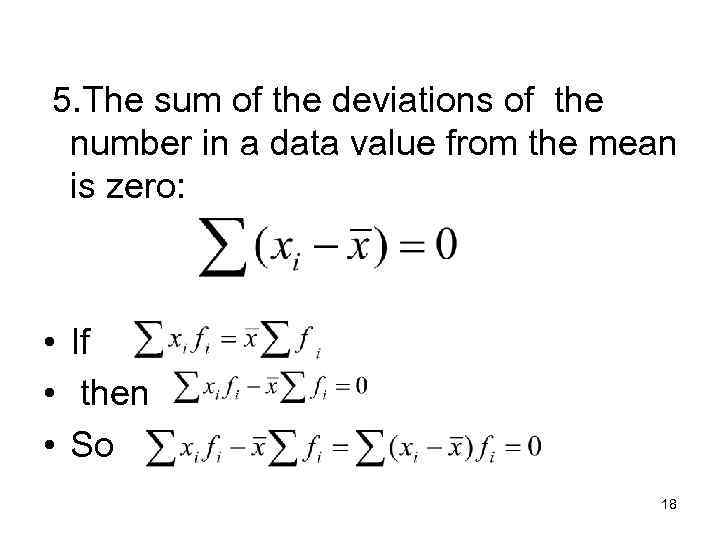 5. The sum of the deviations of the number in a data value from the mean is zero: • If • then • So 18
 Measures of location for ungrouped data • In calculating summary values for a data collection, the best is to find a central, or typical, value for the data. • More important measures of central tendency are presented in this section: • Mean (simple or weighter) • Median and Mode 19
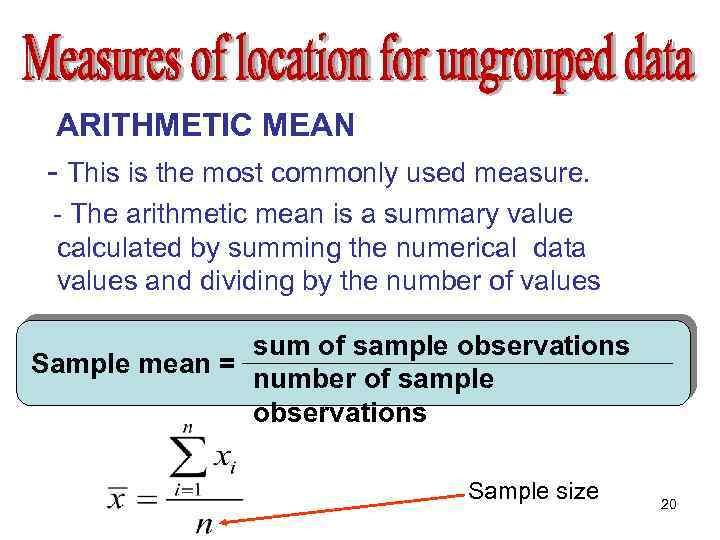 ARITHMETIC MEAN - This is the most commonly used measure. - The arithmetic mean is a summary value calculated by summing the numerical data values and dividing by the number of values sum of sample observations Sample mean = number of sample observations Sample size 20
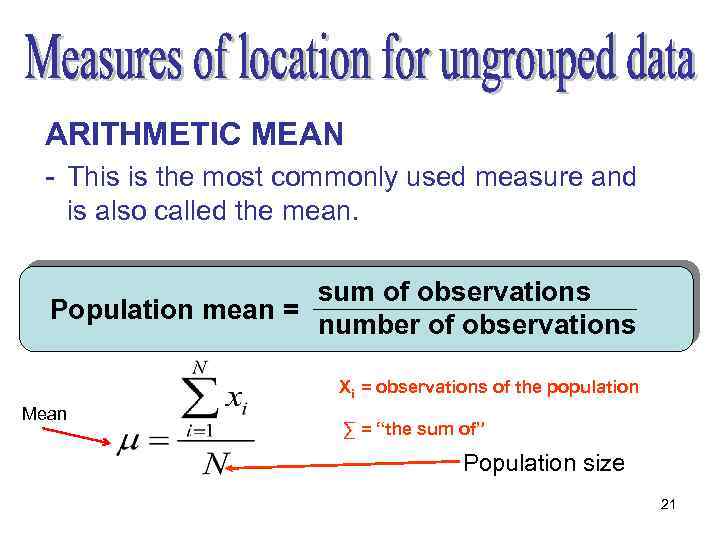 ARITHMETIC MEAN - This is the most commonly used measure and is also called the mean. sum of observations Population mean = number of observations Xi = observations of the population Mean ∑ = “the sum of” Population size 21
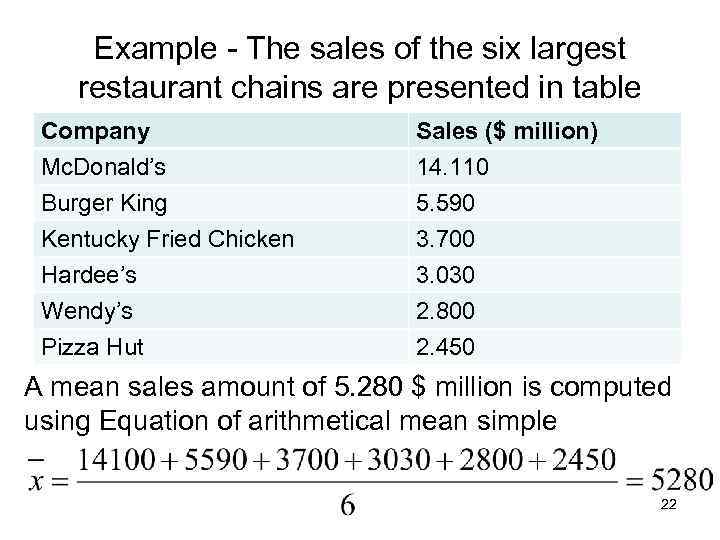 Example - The sales of the six largest restaurant chains are presented in table Company Mc. Donald’s Burger King Kentucky Fried Chicken Sales ($ million) 14. 110 5. 590 3. 700 Hardee’s Wendy’s Pizza Hut 3. 030 2. 800 2. 450 A mean sales amount of 5. 280 $ million is computed using Equation of arithmetical mean simple 22
 MEDIAN for ungrouped data • The median of a data is the middle item in a set of observation that are arranged in order of magnitude. • The median is the measure of location most often reported for annual income and property value data. • A few extremely large incomes or property values can inflate the mean. 23
 Characteristics of the median • MEDIAN – Every ordinal-level, interval-level and ratio-level data set has a median – The median is not sensitive to extreme values – The median does not have valuable mathematical properties for use in further computations – Half the values in data set is smaller than median. – Half the values in data set is larger than median. – Order the data from small to large. 24
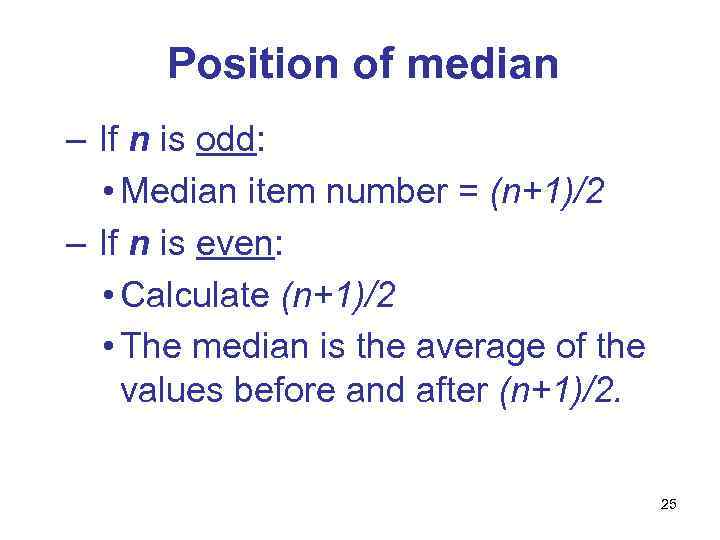 Position of median – If n is odd: • Median item number = (n+1)/2 – If n is even: • Calculate (n+1)/2 • The median is the average of the values before and after (n+1)/2. 25
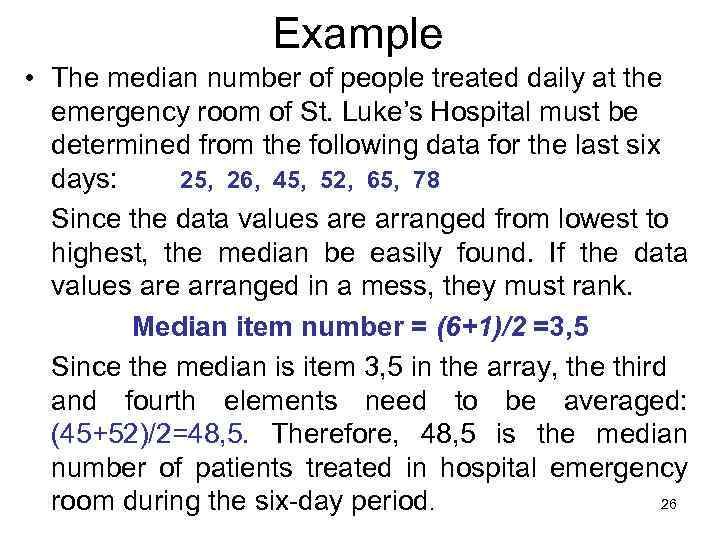 Example • The median number of people treated daily at the emergency room of St. Luke’s Hospital must be determined from the following data for the last six days: 25, 26, 45, 52, 65, 78 Since the data values are arranged from lowest to highest, the median be easily found. If the data values are arranged in a mess, they must rank. Median item number = (6+1)/2 =3, 5 Since the median is item 3, 5 in the array, the third and fourth elements need to be averaged: (45+52)/2=48, 5. Therefore, 48, 5 is the median number of patients treated in hospital emergency 26 room during the six-day period.
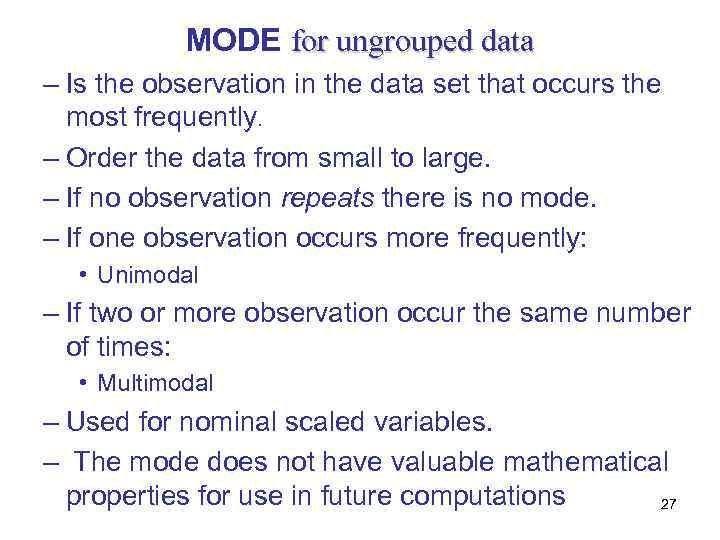 MODE for ungrouped data – Is the observation in the data set that occurs the most frequently. – Order the data from small to large. – If no observation repeats there is no mode. – If one observation occurs more frequently: • Unimodal – If two or more observation occur the same number of times: • Multimodal – Used for nominal scaled variables. – The mode does not have valuable mathematical properties for use in future computations 27
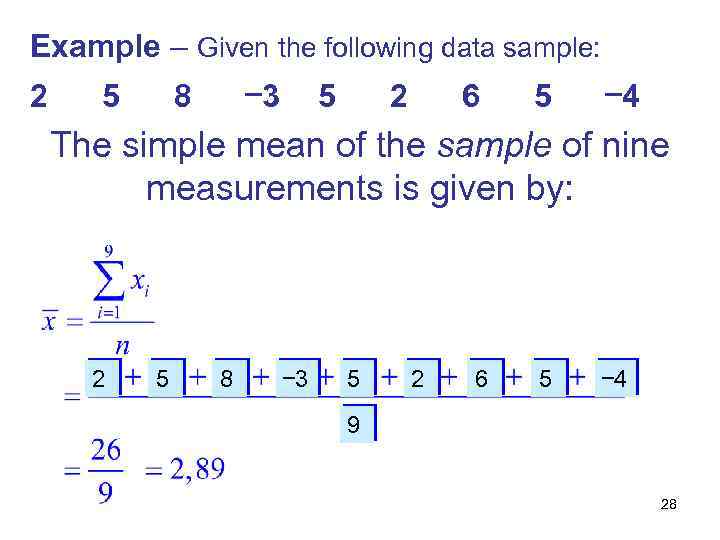 Example – Given the following data sample: 2 5 8 5 − 3 2 6 5 − 4 The simple mean of the sample of nine measurements is given by: 2 5 8 − 3 5 2 6 5 − 4 9 28
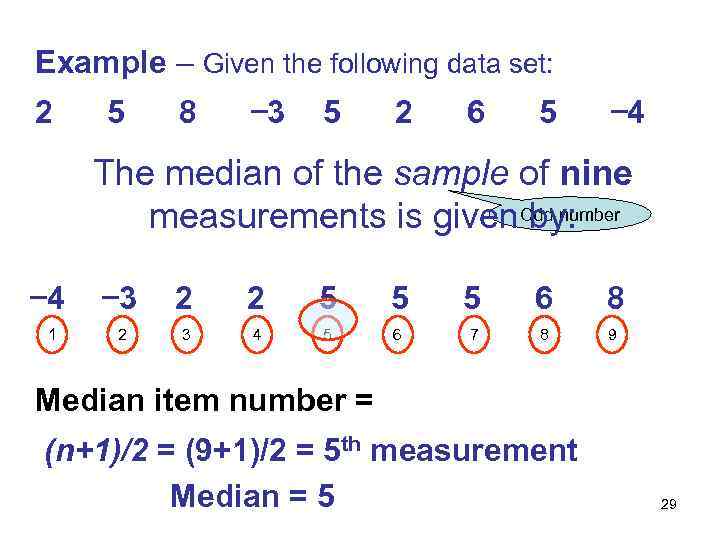 Example – Given the following data set: 2 5 8 − 3 5 2 6 5 − 4 The median of the sample of nine measurements is given Odd number by: − 4 − 3 2 2 5 5 5 6 8 1 2 3 4 5 6 7 8 9 Median item number = (n+1)/2 = (9+1)/2 = 5 th measurement Median = 5 29
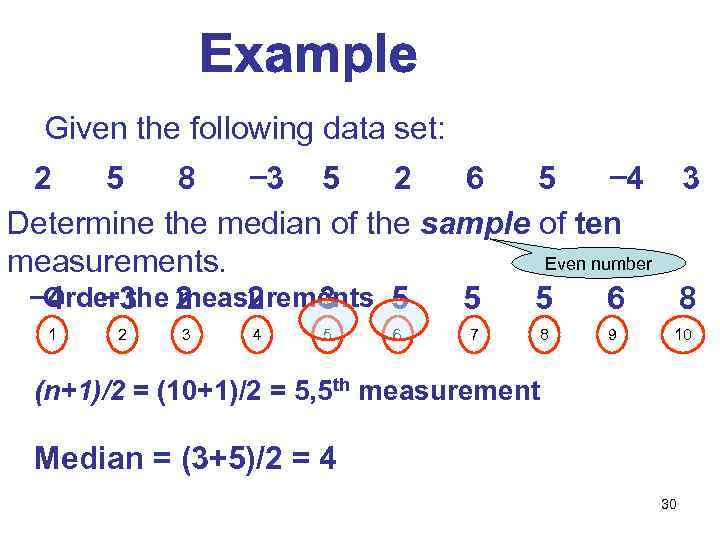 Given the following data set: 2 5 8 − 3 5 2 6 5 − 4 3 Determine the median of the sample of ten Even number measurements. Order the measurements 5 − 4 − 3 2 2 3 5 5 6 8 1 2 3 4 5 6 7 8 9 10 (n+1)/2 = (10+1)/2 = 5, 5 th measurement Median = (3+5)/2 = 4 30
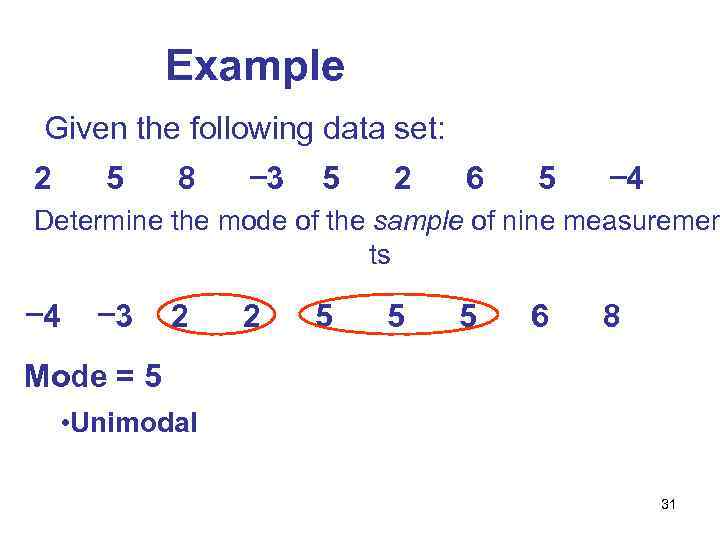 Example Given the following data set: 2 5 8 − 3 5 2 6 5 − 4 Determine the mode of the sample of nine measuremen • Order the measurements − 4 − 3 2 2 5 5 5 6 8 Mode = 5 • Unimodal 31
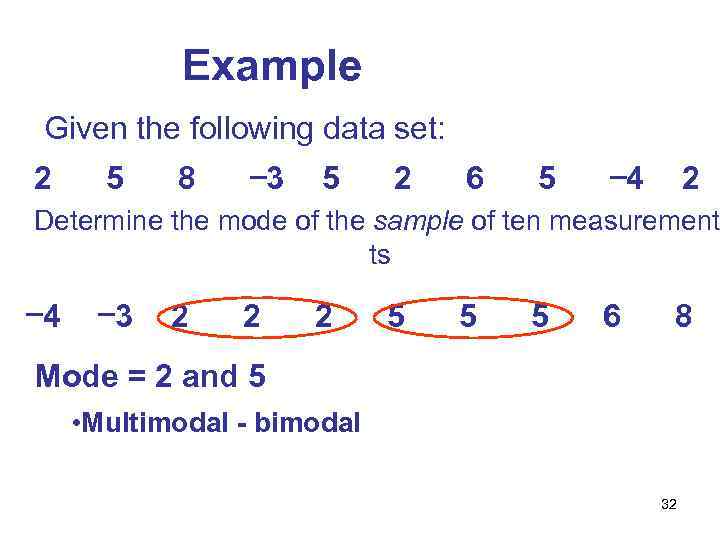 Example Given the following data set: 2 5 8 − 3 5 2 6 5 2 − 4 Determine the mode of the sample of ten measurement • Order the measurements − 4 − 3 2 2 2 5 5 5 6 8 Mode = 2 and 5 • Multimodal - bimodal 32
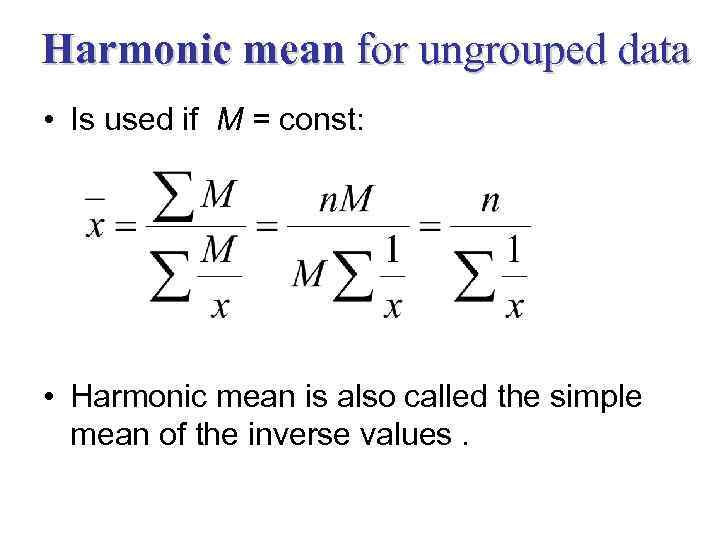 Harmonic mean for ungrouped data • Is used if М = const: • Harmonic mean is also called the simple mean of the inverse values.
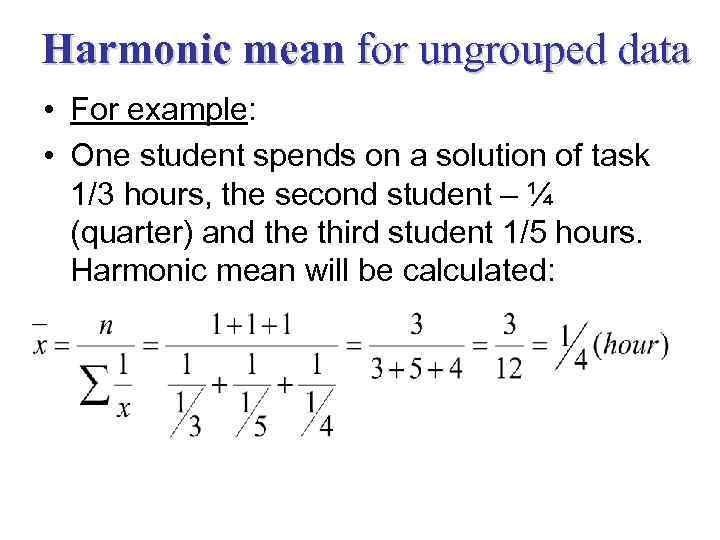 Harmonic mean for ungrouped data • For example: • One student spends on a solution of task 1/3 hours, the second student – ¼ (quarter) and the third student 1/5 hours. Harmonic mean will be calculated:
 Geometric mean for ungrouped data • This value is used as the average of the relations between the two values, or in the ranks of the distributions presented in the form of a geometric progression. 35
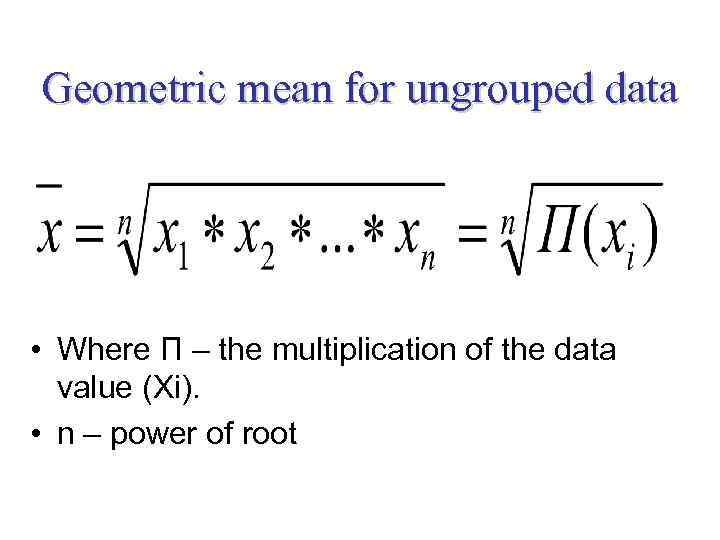 Geometric mean for ungrouped data • Where П – the multiplication of the data value (Xi). • n – power of root
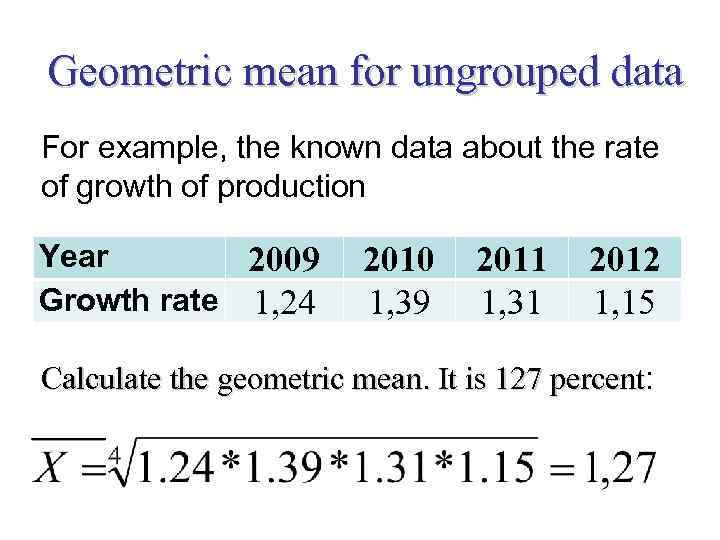 Geometric mean for ungrouped data For example, the known data about the rate of growth of production Year 2009 Growth rate 1, 24 2010 1, 39 2011 1, 31 2012 1, 15 Calculate the geometric mean. It is 127 percent: Calculate the geometric mean. It is 127 percent
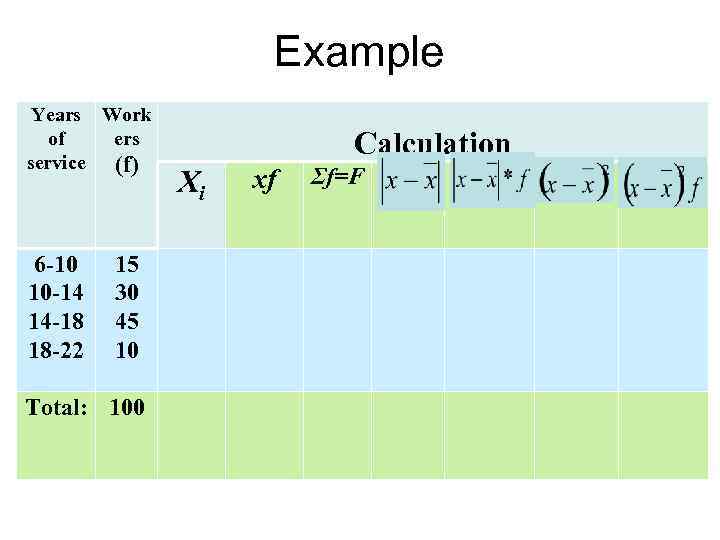
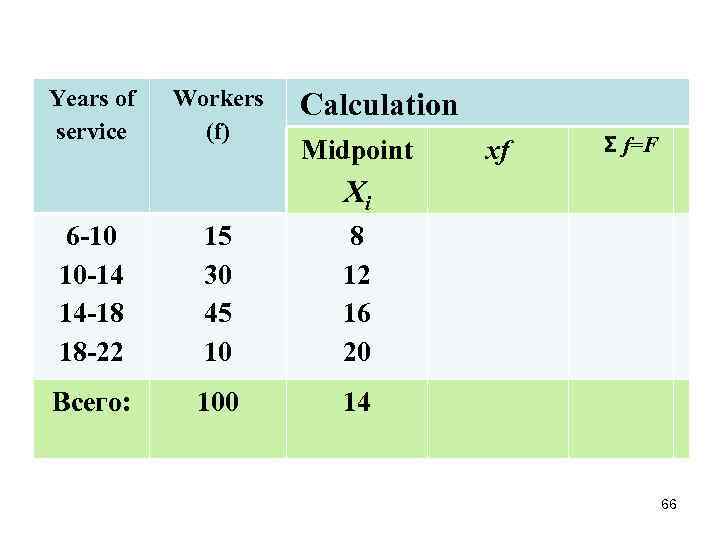
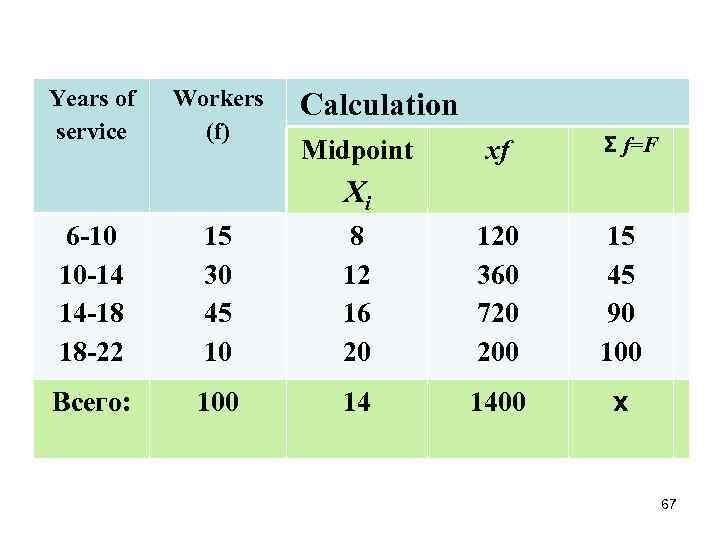
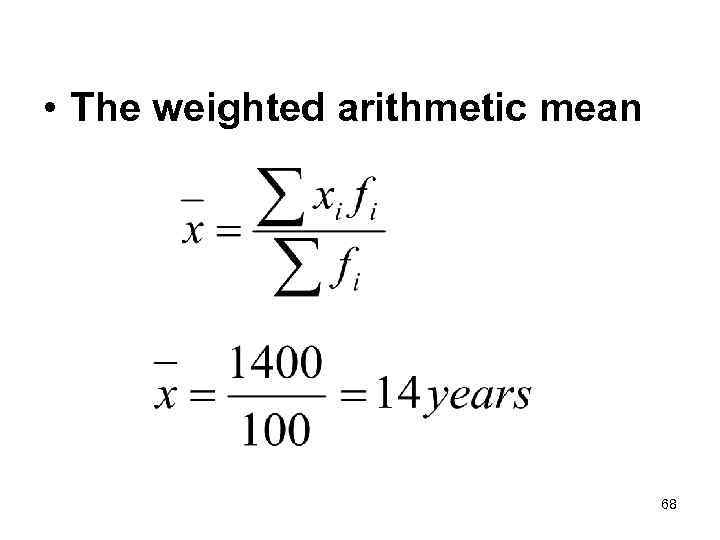
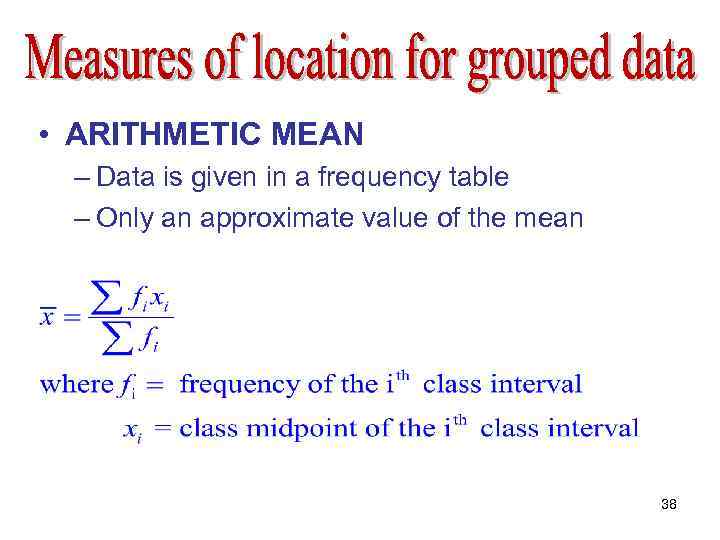 • ARITHMETIC MEAN – Data is given in a frequency table – Only an approximate value of the mean 38
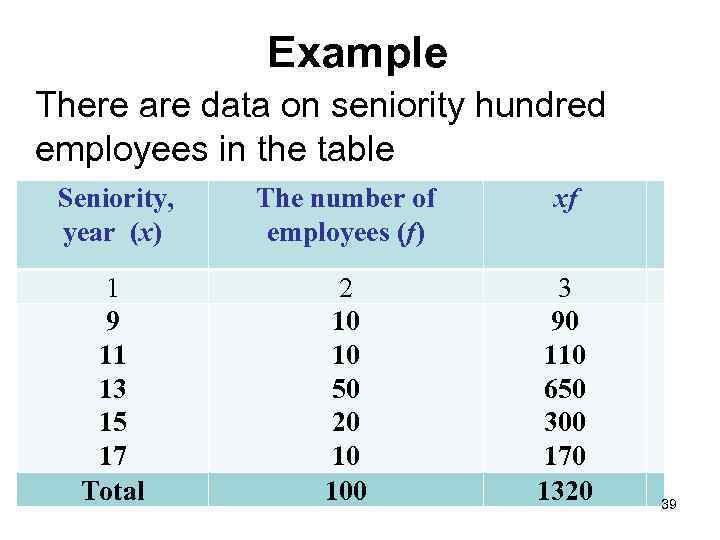 Example There are data on seniority hundred employees in the table Seniority, year (х) The number of employees (f) xf 1 9 11 13 15 17 Total 2 10 10 50 20 10 100 3 90 110 650 300 170 1320 39
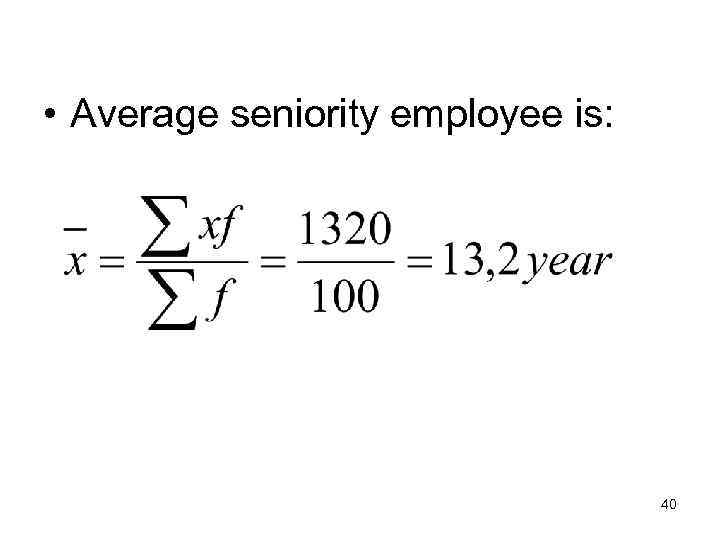 • Average seniority employee is: 40
 Harmonic mean for grouped data • Harmonic mean - is the reciprocal of the arithmetic mean. Harmonic mean is used when statistical information does not contain frequencies, and presented as xf = M. 41
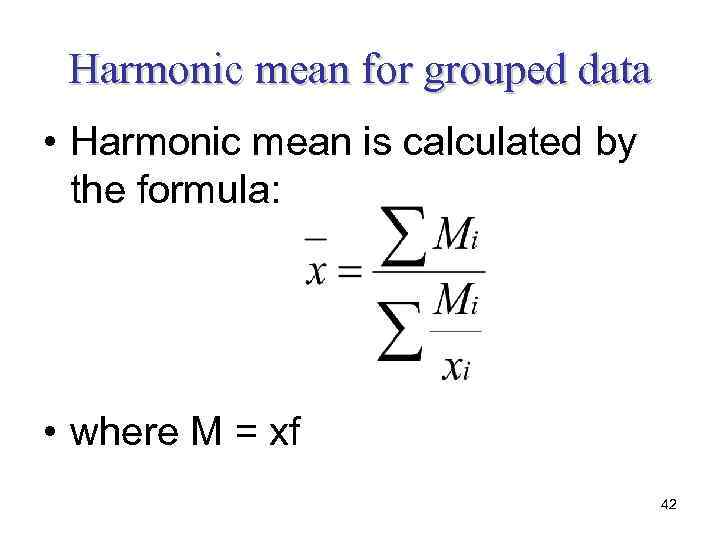 Harmonic mean for grouped data • Harmonic mean is calculated by the formula: • where M = xf 42
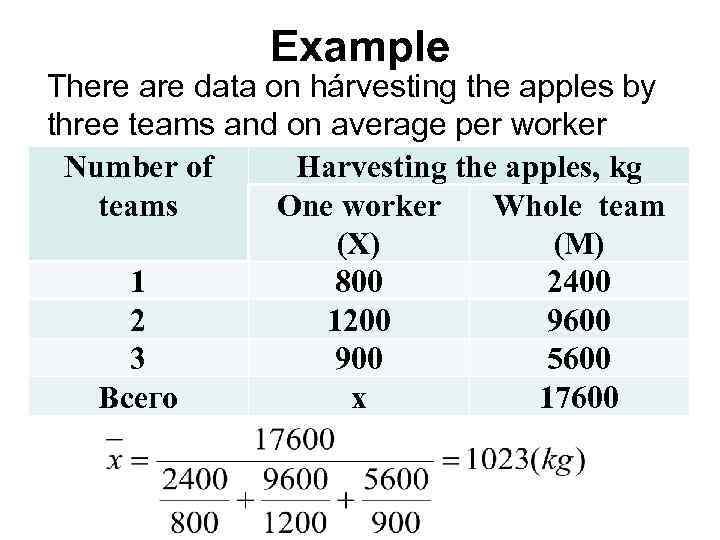 Example There are data on hárvesting the apples by three teams and on average per worker Number of Harvesting the apples, kg One worker Whole teams (X) (M) 1 800 2400 2 1200 9600 3 900 5600 Всего х 17600
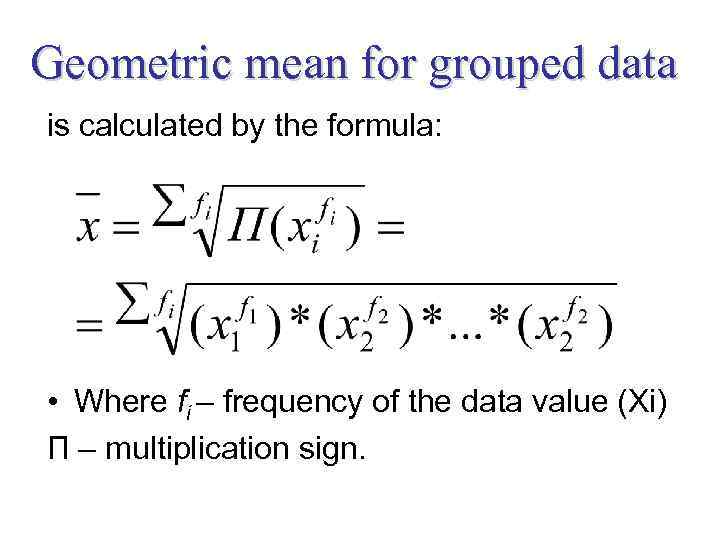 Geometric mean for grouped data is calculated by the formula: • Where fi – frequency of the data value (Xi) П – multiplication sign.
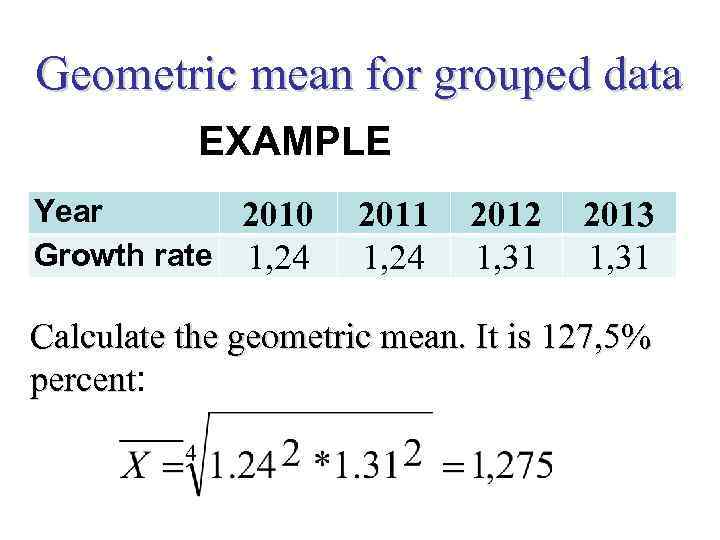 Geometric mean for grouped data EXAMPLE Year 2010 Growth rate 1, 24 2011 1, 24 2012 1, 31 2013 1, 31 Calculate the geometric mean. It is 127, 5% percent: percent
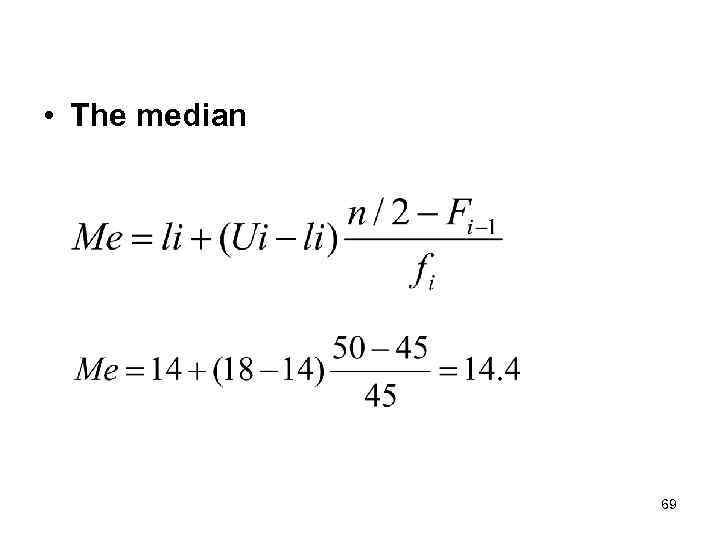
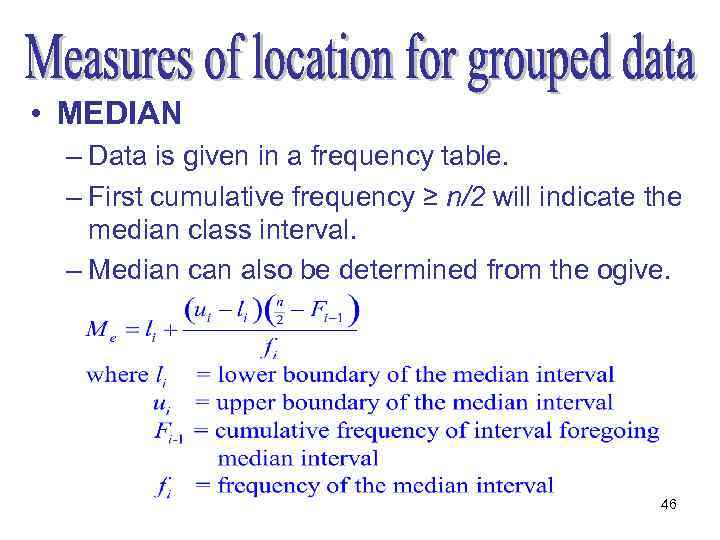 • MEDIAN – Data is given in a frequency table. – First cumulative frequency ≥ n/2 will indicate the median class interval. – Median can also be determined from the ogive. 46
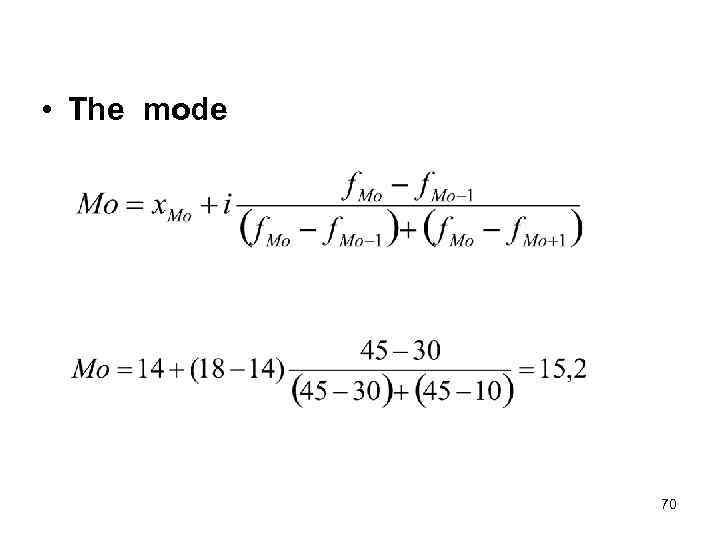
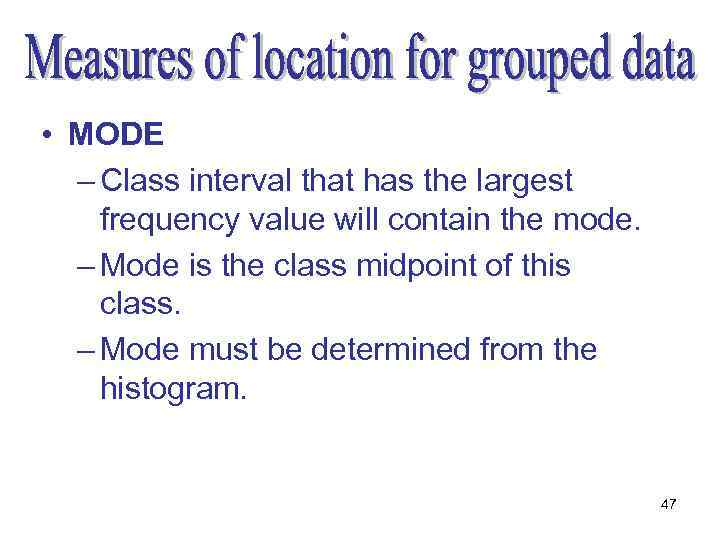 • MODE – Class interval that has the largest frequency value will contain the mode. – Mode is the class midpoint of this class. – Mode must be determined from the histogram. 47
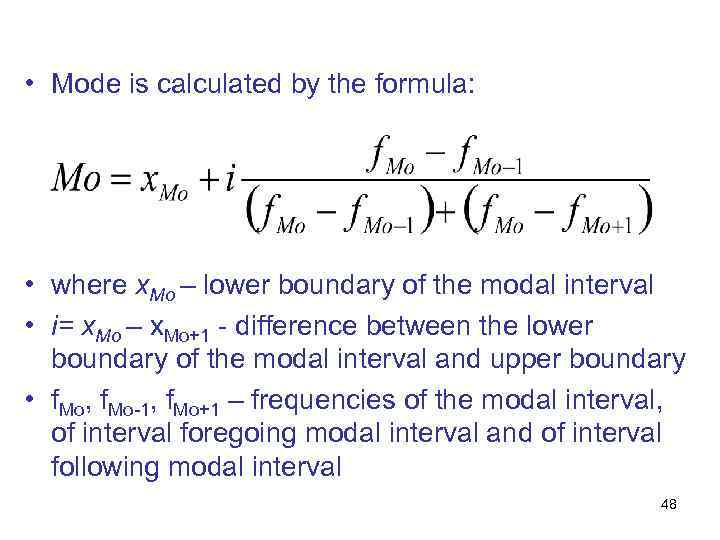 • Mode is calculated by the formula: • where х. Мо – lower boundary of the modal interval • i= х. Мо – x. Mo+1 - difference between the lower boundary of the modal interval and upper boundary • f. Mo, f. Mo-1, f. Mo+1 – frequencies of the modal interval, of interval foregoing modal interval and of interval following modal interval 48
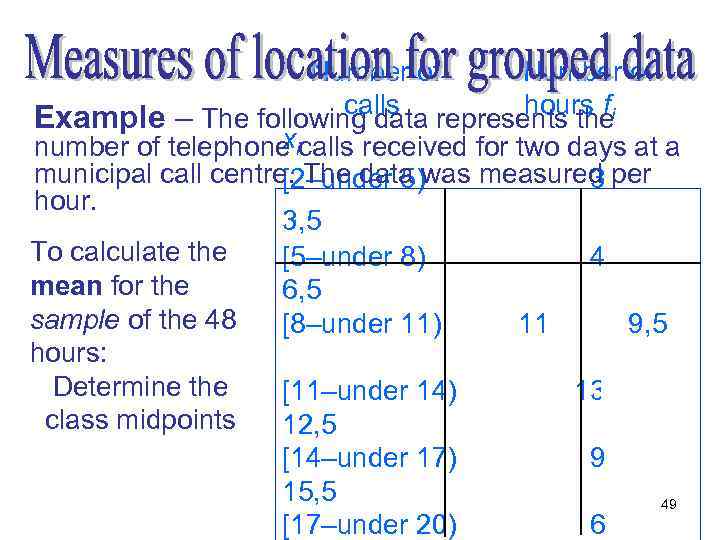 Number of calls hours fi Example – The following data represents the x number of telephone icalls received for two days at a municipal call centre. The data was measured per [2–under 5) 3 hour. 3, 5 To calculate the [5–under 8) 4 mean for the 6, 5 sample of the 48 [8–under 11) 11 9, 5 hours: Determine the [11–under 14) 13 class midpoints 12, 5 [14–under 17) 9 15, 5 49 [17–under 20) 6
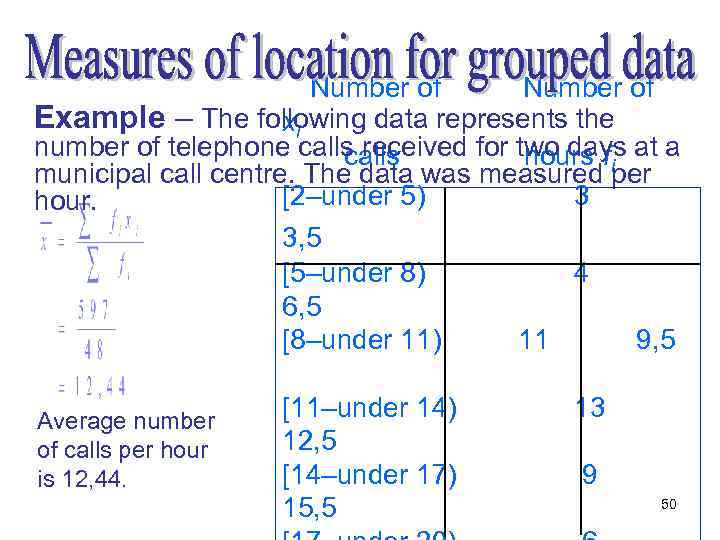 Number of Example – The following data represents the xi number of telephone calls received for two days at a calls hours fi municipal call centre. The data was measured per [2–under 5) 3 hour. 3, 5 [5–under 8) 4 6, 5 [8–under 11) 11 9, 5 Average number of calls per hour is 12, 44. [11–under 14) 12, 5 [14–under 17) 15, 5 13 9 50
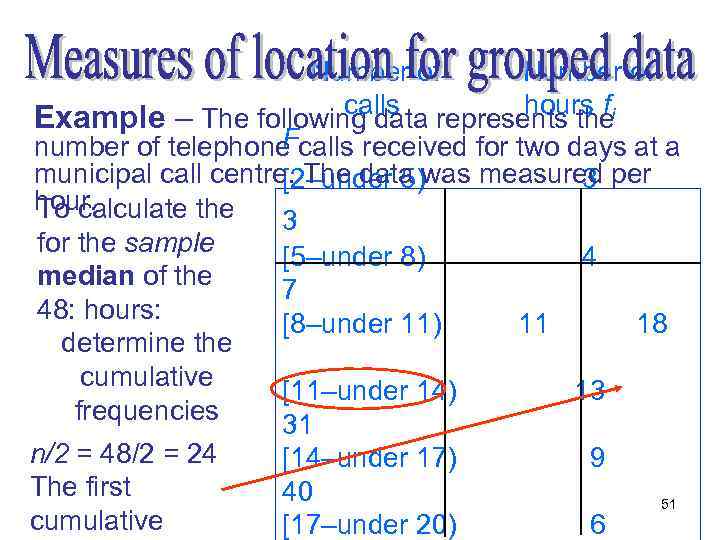 Number of calls hours fi Example – The following data represents the F number of telephone calls received for two days at a municipal call centre. The data was measured per [2–under 5) 3 hour. To calculate the 3 for the sample [5–under 8) 4 median of the 7 48: hours: [8–under 11) 11 18 determine the cumulative [11–under 14) 13 frequencies 31 n/2 = 48/2 = 24 The first cumulative [14–under 17) 40 [17–under 20) 9 6 51
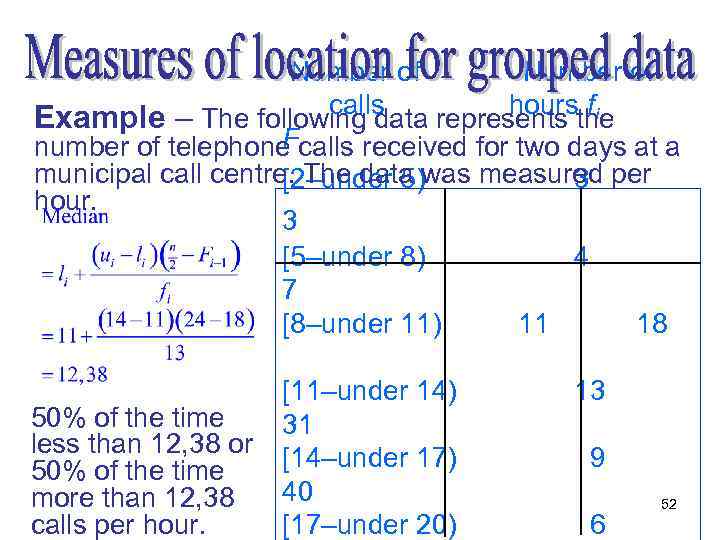 Number of calls hours fi Example – The following data represents the F number of telephone calls received for two days at a municipal call centre. The data was measured per [2–under 5) 3 hour. 3 [5–under 8) 4 7 [8–under 11) 11 18 50% of the time less than 12, 38 or 50% of the time more than 12, 38 calls per hour. [11–under 14) 31 [14–under 17) 40 [17–under 20) 13 9 6 52
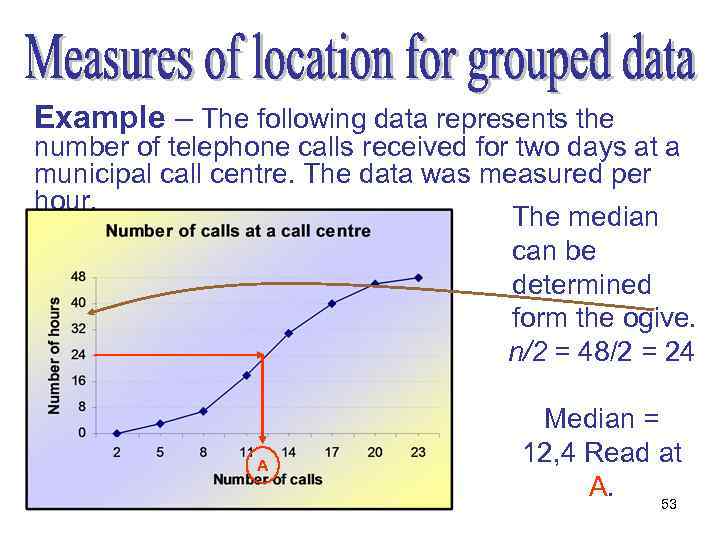 Example – The following data represents the number of telephone calls received for two days at a municipal call centre. The data was measured per hour. The median can be determined form the ogive. n/2 = 48/2 = 24 A Median = 12, 4 Read at A. 53
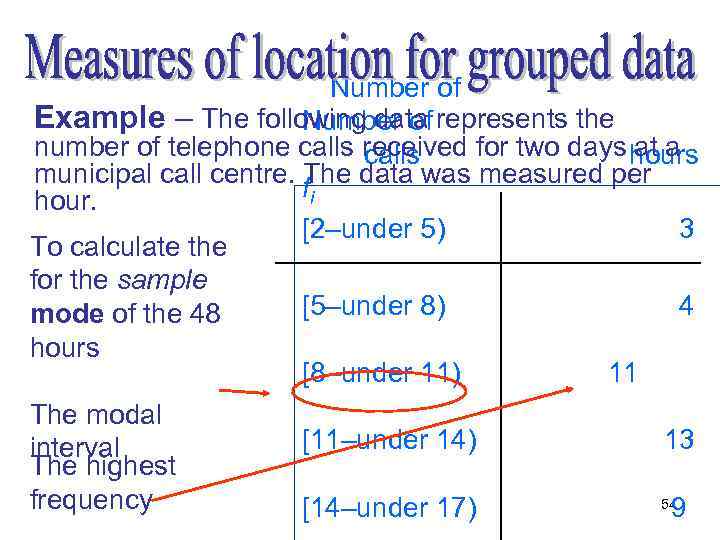 Number of Example – The following data represents the Number of number of telephone calls received for two days hours at a calls municipal call centre. The data was measured per fi hour. [2–under 5) 3 To calculate the for the sample [5–under 8) 4 mode of the 48 hours [8–under 11) 11 The modal [11–under 14) 13 interval The highest frequency 54 [14–under 17) 9
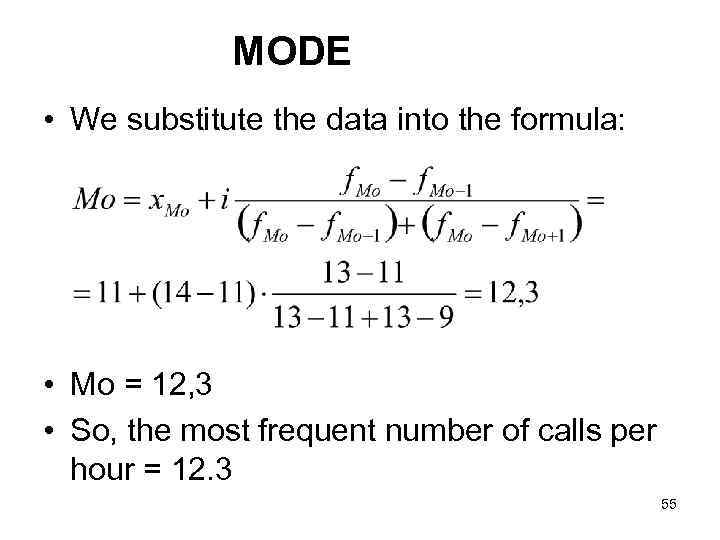 MODE • We substitute the data into the formula: • Mo = 12, 3 • So, the most frequent number of calls per hour = 12. 3 55
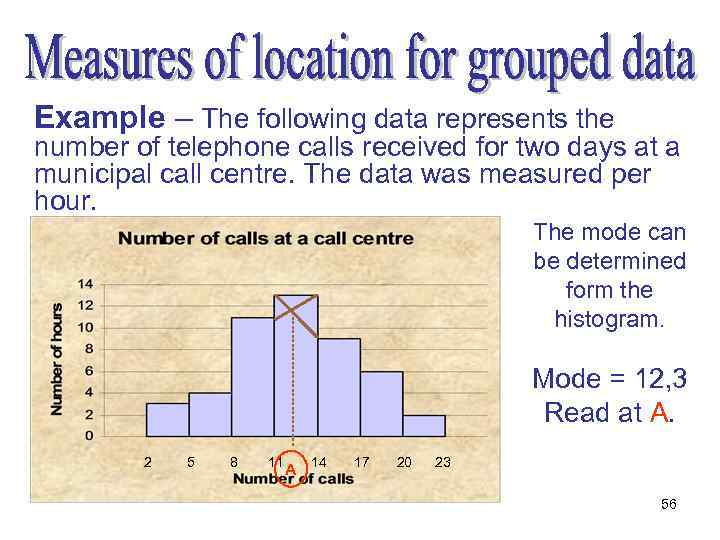 Example – The following data represents the number of telephone calls received for two days at a municipal call centre. The data was measured per hour. The mode can be determined form the histogram. Mode = 12, 3 Read at A. 2 5 8 11 A 14 17 20 23 56
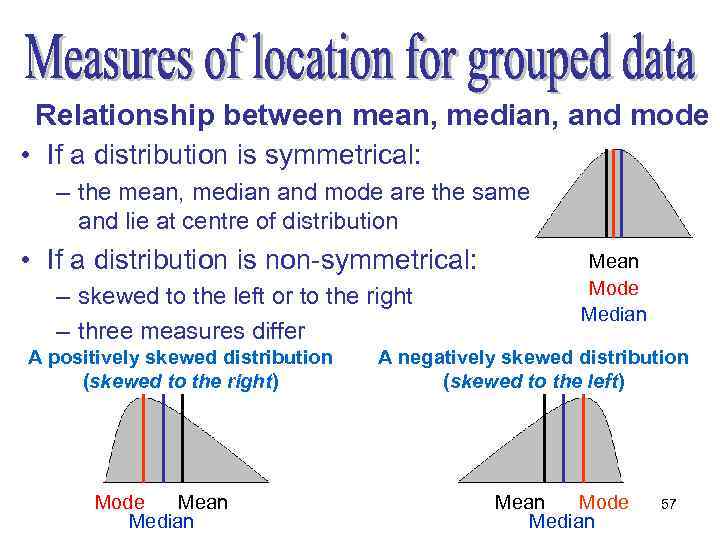 Relationship between mean, median, and mode • If a distribution is symmetrical: – the mean, median and mode are the same and lie at centre of distribution • If a distribution is non-symmetrical: – skewed to the left or to the right – three measures differ A positively skewed distribution (skewed to the right) Mode Mean Median Mean Mode Median A negatively skewed distribution (skewed to the left) Mean Mode Median 57
 58
58
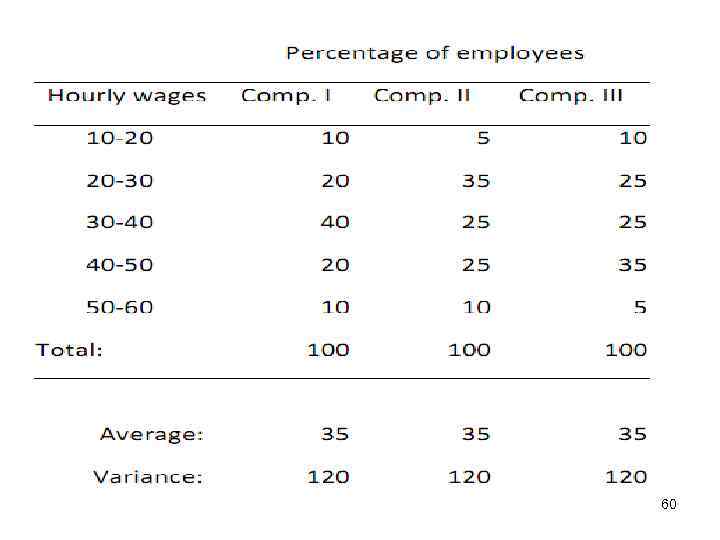
 EXAMPLE • Consider a study of the hourly wage rates in three different companies, For simplicity, assume that they employ the same number of employees: 100 people. 59
 60
60
 • So we have three 100 -element samples, which have the same average value (35) and the same variability (120). But these are different samples. The diversity of these samples can be seen even better when we draw their histograms. 61
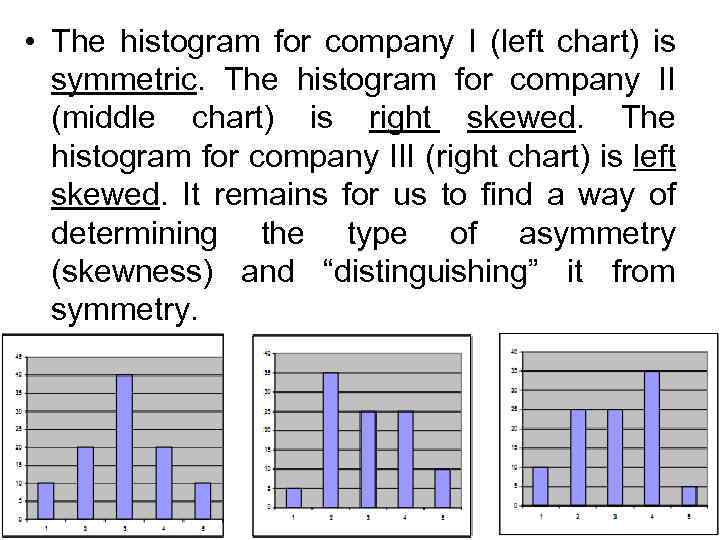 • The histogram for company I (left chart) is symmetric. The histogram for company II (middle chart) is right skewed. The histogram for company III (right chart) is left skewed. It remains for us to find a way of determining the type of asymmetry (skewness) and “distinguishing” it from symmetry. 62
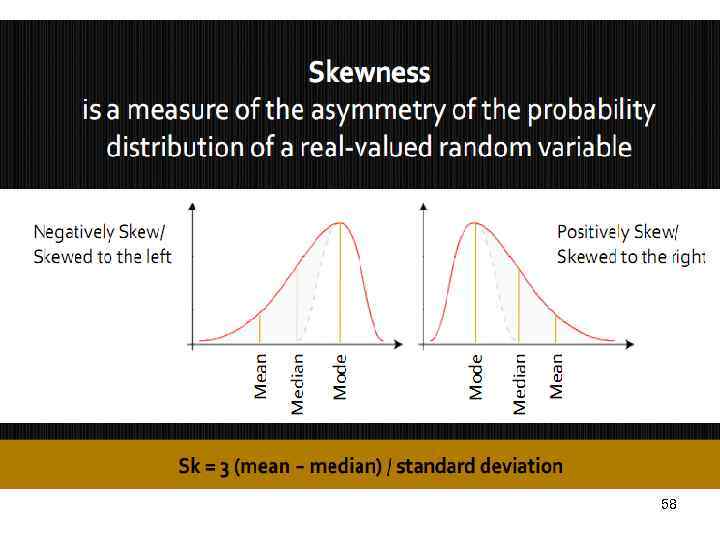
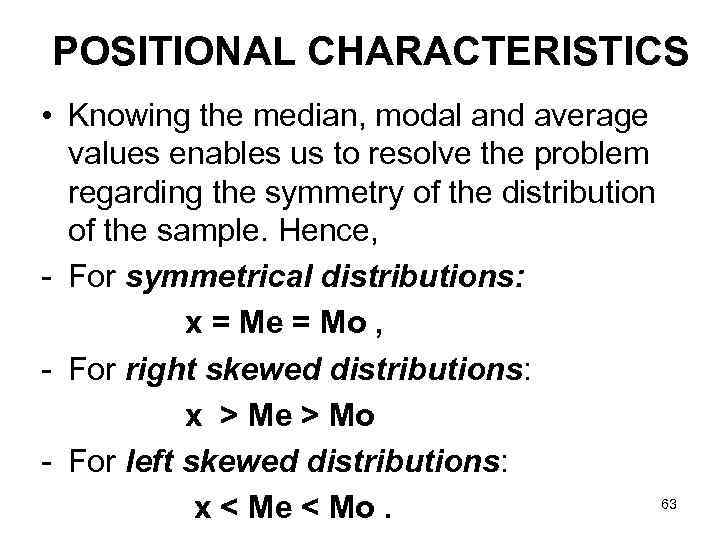 POSITIONAL CHARACTERISTICS • Knowing the median, modal and average values enables us to resolve the problem regarding the symmetry of the distribution of the sample. Hence, - For symmetrical distributions: x = Me = Mo , - For right skewed distributions: x > Me > Mo - For left skewed distributions: 63 x < Me < Mo.
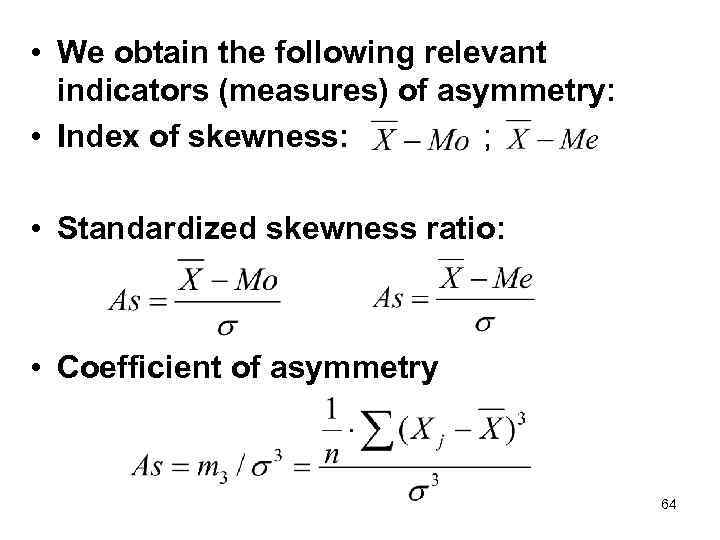 • We obtain the following relevant indicators (measures) of asymmetry: • Index of skewness: ; • Standardized skewness ratio: • Coefficient of asymmetry 64
 Example Years Work of ers service (f) 6 -10 10 -14 14 -18 18 -22 15 30 45 10 Calculation Хi xf Σf=F Total: 100
 Years of service Workers (f) Calculation Midpoint xf Σ f=F Хi 6 -10 10 -14 14 -18 18 -22 15 30 45 10 8 12 16 20 Всего: 100 14 66
 Years of service Workers (f) Calculation Midpoint xf Σ f=F Хi 6 -10 10 -14 14 -18 18 -22 15 30 45 10 8 12 16 20 120 360 720 200 15 45 90 100 Всего: 100 14 1400 x 67
 • The weighted arithmetic mean 68
 • The median 69
 • The mode 70
 71
71