


 Скачать презентацию 1 Option Pricing Elements of Financial Risk Management
efb308da5cab415c04913c2cf25c03dc.ppt
- Количество слайдов: 86
 1 Option Pricing Elements of Financial Risk Management Chapter 10 Peter Christoffersen Elements of Financial Risk Management Second Edition © 2012 by Peter Christoffersen
 Overview 2 • In this chapter we derive a no-arbitrage relationship between put and call prices on same underlying asset • Summarize binomial tree approach to option pricing • Establish an option pricing formula under simplistic assumption that daily returns on the underlying asset follow a normal distribution with constant variance • Extend the normal distribution model by allowing for skewness and kurtosis in returns • Extend the model by allowing for time-varying variance relying on the GARCH models • Introduce the ad hoc implied volatility function (IVF) approach to option pricing. Elements of Financial Risk Management Second Edition © 2012 by Peter Christoffersen
 Basic Definitions • An European call option gives the owner the right but not the obligation to buy a unit of the underlying asset days from now at the price X • is the number of days to maturity • X is the strike price of the option • c is the price of the European option today • St is the price of the underlying asset today • is the price of the underlying at maturity Elements of Financial Risk Management Second Edition © 2012 by Peter Christoffersen 3
 Basic Definitions 4 • A European put option gives the owner the option the right to sell a unit of the underlying asset days from now at the price X • p denotes the price of the European put option today • The European options restricts the owner from exercising the option before the maturity date • American options can be exercised any time before the maturity date • Note that the number of days to maturity is counted is calendar days and not in trading days. • A standard year has 365 calendar days but only around 252 trading days. Elements of Financial Risk Management Second Edition © 2012 by Peter Christoffersen
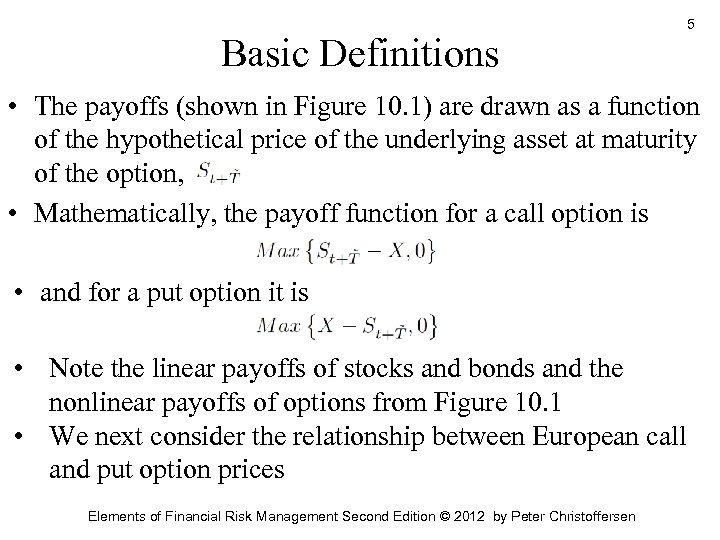 Basic Definitions 5 • The payoffs (shown in Figure 10. 1) are drawn as a function of the hypothetical price of the underlying asset at maturity of the option, • Mathematically, the payoff function for a call option is • and for a put option it is • Note the linear payoffs of stocks and bonds and the nonlinear payoffs of options from Figure 10. 1 • We next consider the relationship between European call and put option prices Elements of Financial Risk Management Second Edition © 2012 by Peter Christoffersen
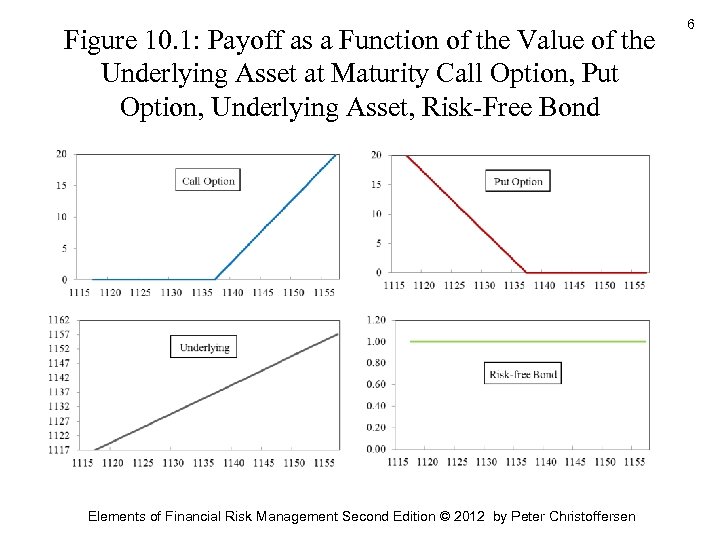 Figure 10. 1: Payoff as a Function of the Value of the Underlying Asset at Maturity Call Option, Put Option, Underlying Asset, Risk-Free Bond Elements of Financial Risk Management Second Edition © 2012 by Peter Christoffersen 6
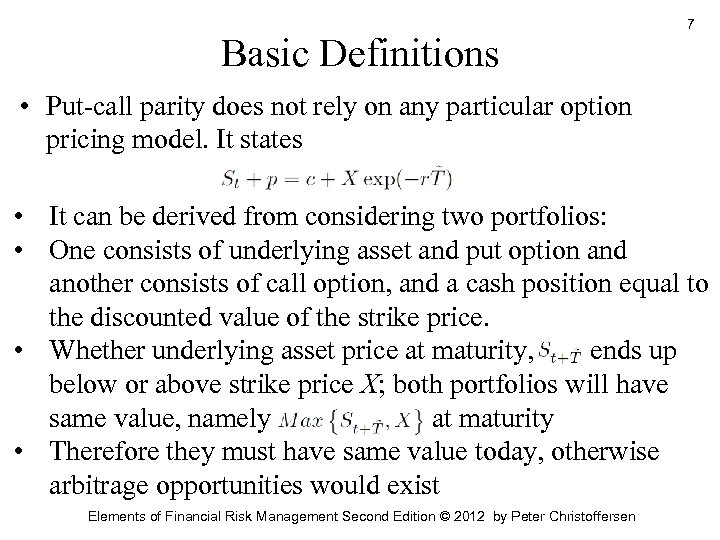 Basic Definitions 7 • Put-call parity does not rely on any particular option pricing model. It states • It can be derived from considering two portfolios: • One consists of underlying asset and put option and another consists of call option, and a cash position equal to the discounted value of the strike price. • Whether underlying asset price at maturity, ends up below or above strike price X; both portfolios will have same value, namely , at maturity • Therefore they must have same value today, otherwise arbitrage opportunities would exist Elements of Financial Risk Management Second Edition © 2012 by Peter Christoffersen
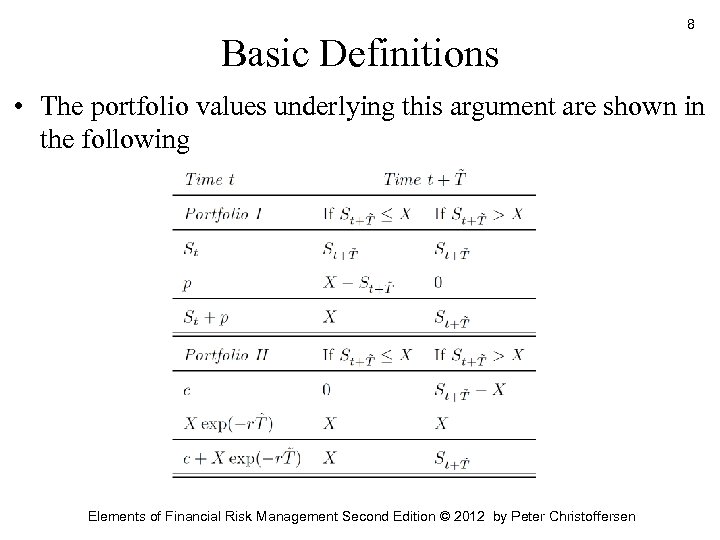 Basic Definitions 8 • The portfolio values underlying this argument are shown in the following Elements of Financial Risk Management Second Edition © 2012 by Peter Christoffersen
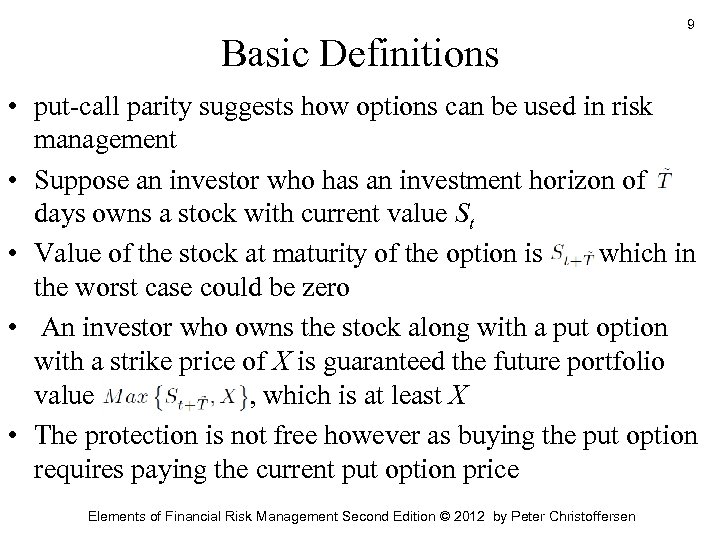 Basic Definitions 9 • put-call parity suggests how options can be used in risk management • Suppose an investor who has an investment horizon of days owns a stock with current value St • Value of the stock at maturity of the option is which in the worst case could be zero • An investor who owns the stock along with a put option with a strike price of X is guaranteed the future portfolio value , which is at least X • The protection is not free however as buying the put option requires paying the current put option price Elements of Financial Risk Management Second Edition © 2012 by Peter Christoffersen
 Option Pricing Using Binomial Trees 10 • We begin by assuming that the distribution of the future price of the underlying risky asset is binomial • This means that in a short interval of time, the stock price can only take on one of two values, up and down • Binomial tree approach is able to compute the fair market value of American options, which are complicated because early exercise is possible Elements of Financial Risk Management Second Edition © 2012 by Peter Christoffersen
 Option Pricing Using Binomial Trees 11 • The binomial tree option pricing method will be illustrated using the following example: • We want to find the fair value of a call and a put option with three months to maturity • Strike price of $900. • The current price of the underlying stock is $1, 000 • The volatility of the log return on the stock is 0. 60 or 60% per year corresponding to per calendar day Elements of Financial Risk Management Second Edition © 2012 by Peter Christoffersen
 12 Step 1: Build the Tree for the Stock Price • In our example we will assume that the tree has two steps during the three-month maturity of the option • In practice, a hundred or so steps will be used • The more steps we use, the more accurate the model price will be • If the option has three months to maturity and we are building a tree with two steps then each step in the tree corresponds to 1. 5 months • The magnitude of up and down move in each step reflect a volatility of • dt denotes the length (in years) of a step in the tree Elements of Financial Risk Management Second Edition © 2012 by Peter Christoffersen
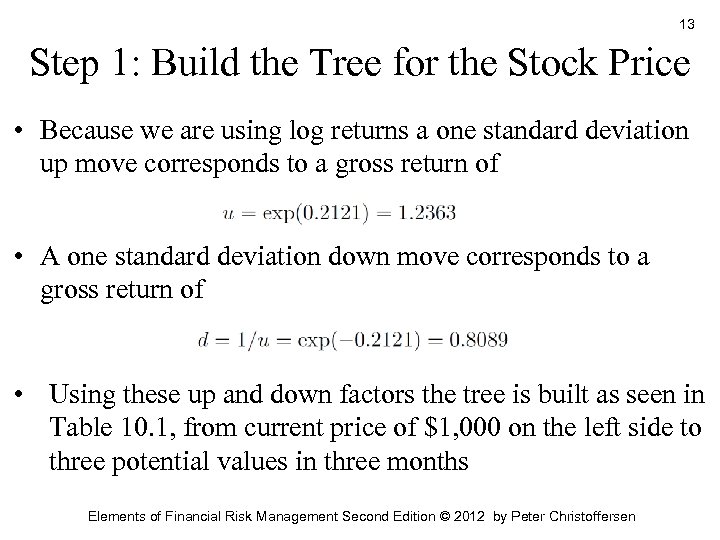 13 Step 1: Build the Tree for the Stock Price • Because we are using log returns a one standard deviation up move corresponds to a gross return of • A one standard deviation down move corresponds to a gross return of • Using these up and down factors the tree is built as seen in Table 10. 1, from current price of $1, 000 on the left side to three potential values in three months Elements of Financial Risk Management Second Edition © 2012 by Peter Christoffersen
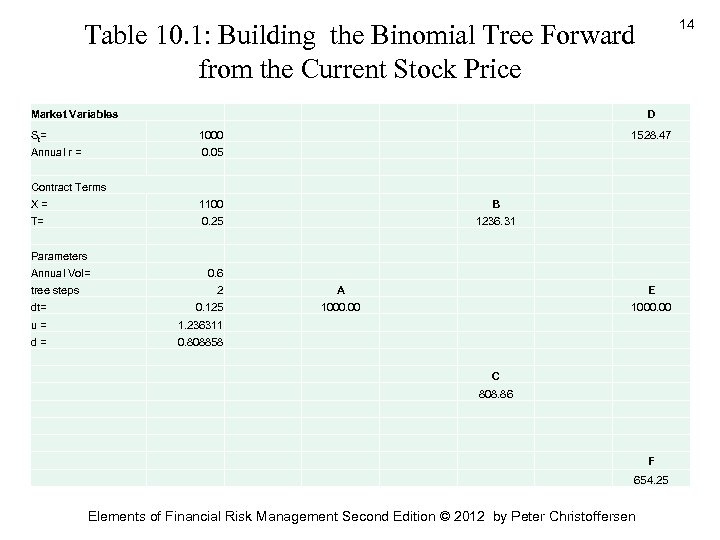 14 Table 10. 1: Building the Binomial Tree Forward from the Current Stock Price Market Variables D St= 1000 Annual r = 1528. 47 0. 05 Contract Terms X = 1100 B T= 0. 25 1236. 31 Parameters Annual Vol= tree steps 0. 6 2 dt= 0. 125 u = E 1000. 00 1. 236311 d = A 0. 808858 C 808. 86 F 654. 25 Elements of Financial Risk Management Second Edition © 2012 by Peter Christoffersen
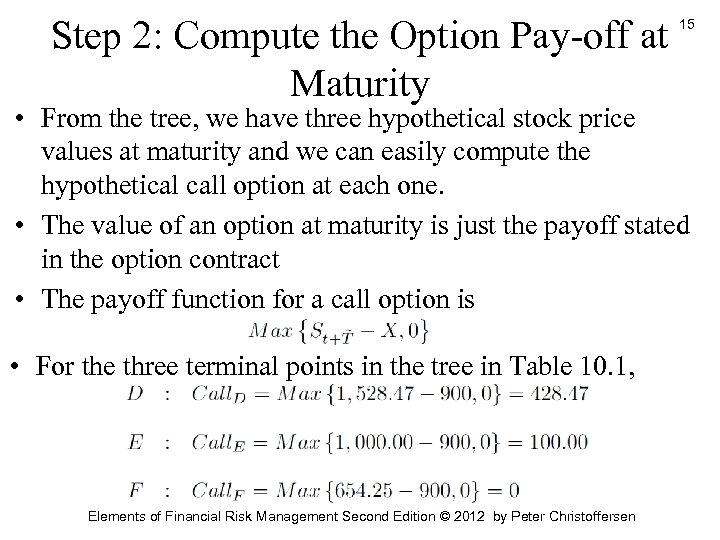 Step 2: Compute the Option Pay-off at Maturity 15 • From the tree, we have three hypothetical stock price values at maturity and we can easily compute the hypothetical call option at each one. • The value of an option at maturity is just the payoff stated in the option contract • The payoff function for a call option is • For the three terminal points in the tree in Table 10. 1, Elements of Financial Risk Management Second Edition © 2012 by Peter Christoffersen
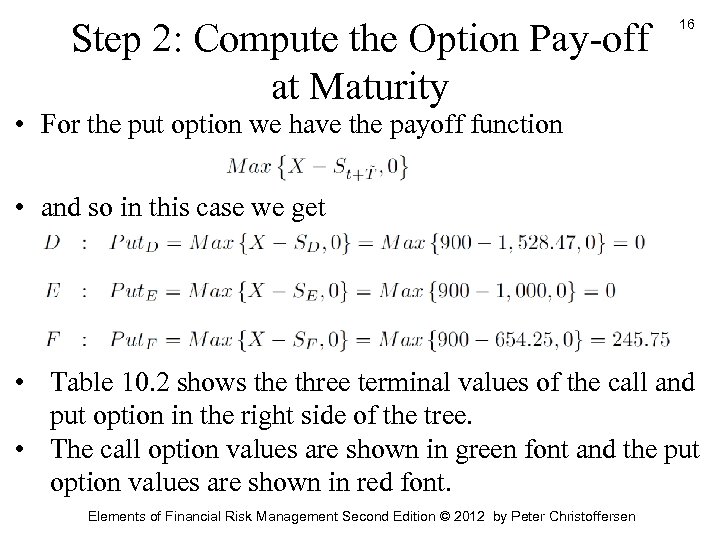 Step 2: Compute the Option Pay-off at Maturity 16 • For the put option we have the payoff function • and so in this case we get • Table 10. 2 shows the three terminal values of the call and put option in the right side of the tree. • The call option values are shown in green font and the put option values are shown in red font. Elements of Financial Risk Management Second Edition © 2012 by Peter Christoffersen
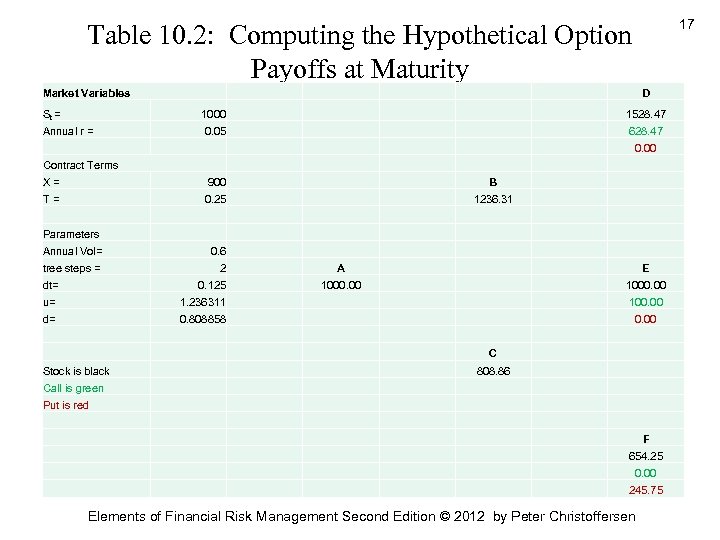 17 Table 10. 2: Computing the Hypothetical Option Payoffs at Maturity Market Variables D St = 1000 1528. 47 Annual r = 0. 05 628. 47 0. 00 Contract Terms X = 900 B T = 0. 25 1236. 31 Parameters Annual Vol= 0. 6 tree steps = 2 A E 1000. 00 dt= 0. 125 u= 1. 236311 100. 00 d= 0. 808858 0. 00 C Stock is black 808. 86 Call is green Put is red F 654. 25 0. 00 245. 75 Elements of Financial Risk Management Second Edition © 2012 by Peter Christoffersen
 Step 3: Work Backwards in the Tree to Get the Current Option Value 18 • Stock price at B = $1, 236. 31 and at C = $808. 86 • We need to compute a option value at B and C • Going forward from B the stock can only move to either D or E • We know the stock price and option price at D and E • We also need the return on a risk-free bond with 1. 5 months to maturity • The term structure of government debt can be used to obtain this information • Let us assume that the term structure of interest rates is flat at 5% per year Elements of Financial Risk Management Second Edition © 2012 by Peter Christoffersen
 Step 3: Work Backwards in the Tree to Get the Current Option Value 19 • Key insight is that in a binomial tree we are able to construct a risk-free portfolio using stock and option • Our portfolio is risk-free and it must earn exactly the riskfree rate, which is 5% per year in our example • Consider a portfolio of 1 call option and B shares of the stock • We need to find a B such that the portfolio of the option and the stock is risk-free Elements of Financial Risk Management Second Edition © 2012 by Peter Christoffersen
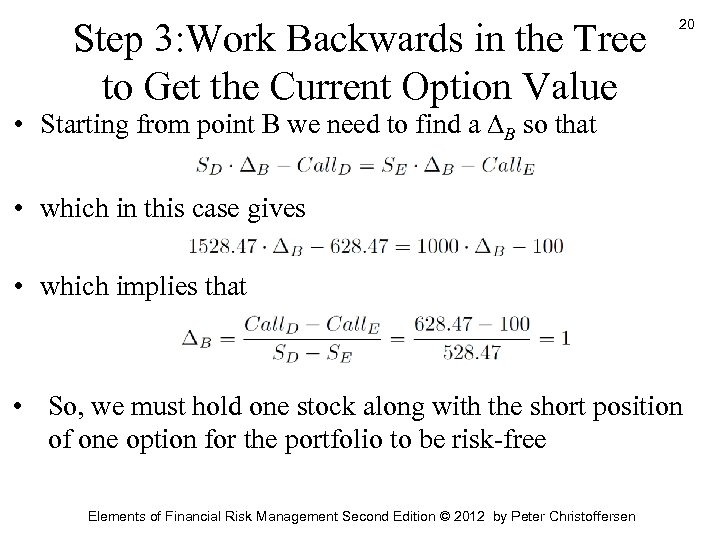 Step 3: Work Backwards in the Tree to Get the Current Option Value 20 • Starting from point B we need to find a B so that • which in this case gives • which implies that • So, we must hold one stock along with the short position of one option for the portfolio to be risk-free Elements of Financial Risk Management Second Edition © 2012 by Peter Christoffersen
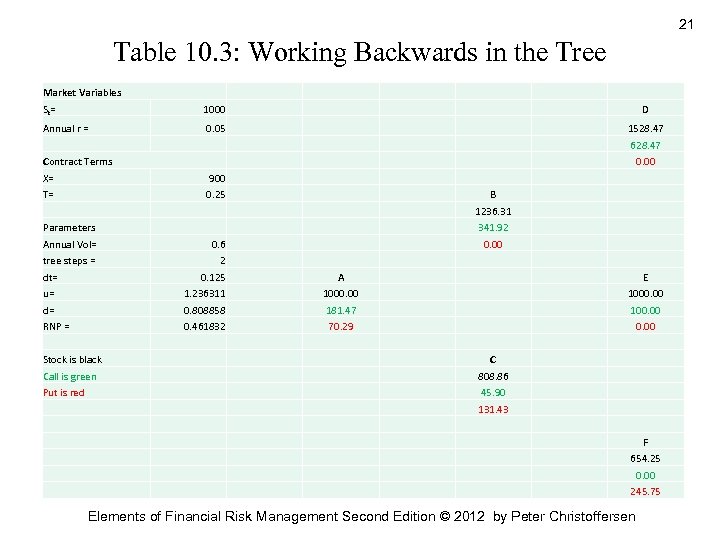 21 Table 10. 3: Working Backwards in the Tree Market Variables St= 1000 D Annual r = 0. 05 Contract Terms X= T= 1528. 47 628. 47 0. 00 900 0. 25 Parameters Annual Vol= tree steps = dt= u= d= RNP = Stock is black Call is green Put is red 0. 6 2 0. 125 1. 236311 0. 808858 0. 461832 B 1236. 31 341. 92 0. 00 A 1000. 00 181. 47 70. 29 E 1000. 00 100. 00 C 808. 86 45. 90 131. 43 F 654. 25 0. 00 245. 75 Elements of Financial Risk Management Second Edition © 2012 by Peter Christoffersen
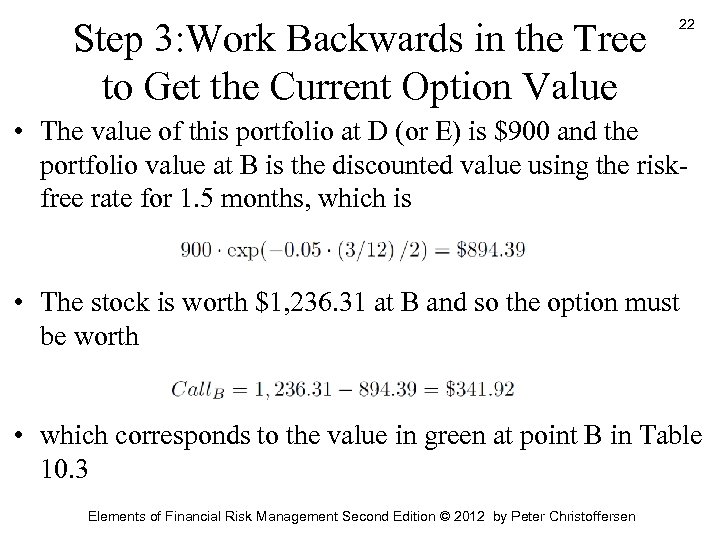 Step 3: Work Backwards in the Tree to Get the Current Option Value 22 • The value of this portfolio at D (or E) is $900 and the portfolio value at B is the discounted value using the riskfree rate for 1. 5 months, which is • The stock is worth $1, 236. 31 at B and so the option must be worth • which corresponds to the value in green at point B in Table 10. 3 Elements of Financial Risk Management Second Edition © 2012 by Peter Christoffersen
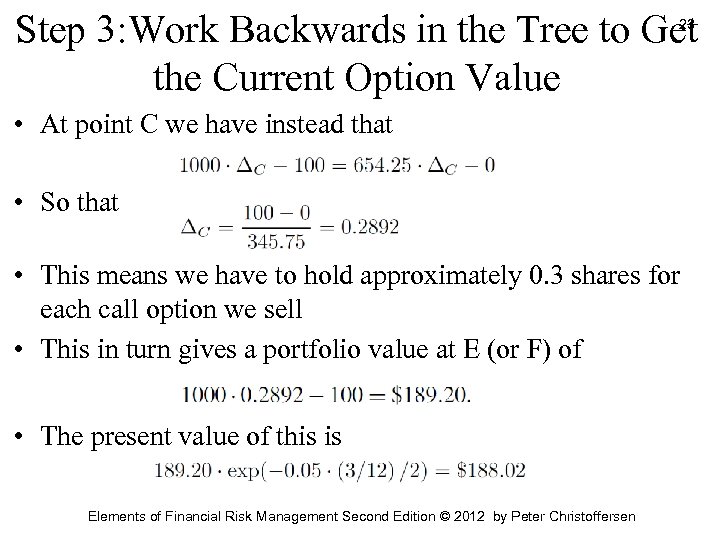 Step 3: Work Backwards in the Tree to Get the Current Option Value 23 • At point C we have instead that • So that • This means we have to hold approximately 0. 3 shares for each call option we sell • This in turn gives a portfolio value at E (or F) of • The present value of this is Elements of Financial Risk Management Second Edition © 2012 by Peter Christoffersen
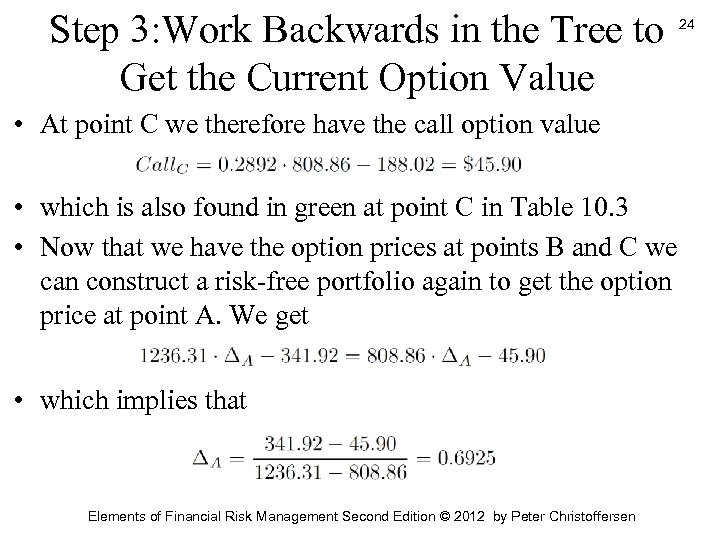 Step 3: Work Backwards in the Tree to Get the Current Option Value • At point C we therefore have the call option value • which is also found in green at point C in Table 10. 3 • Now that we have the option prices at points B and C we can construct a risk-free portfolio again to get the option price at point A. We get • which implies that Elements of Financial Risk Management Second Edition © 2012 by Peter Christoffersen 24
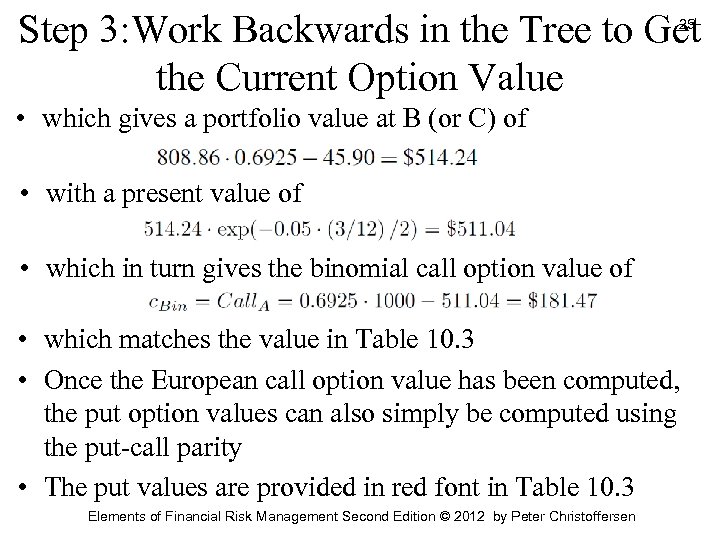 Step 3: Work Backwards in the Tree to Get the Current Option Value 25 • which gives a portfolio value at B (or C) of • with a present value of • which in turn gives the binomial call option value of • which matches the value in Table 10. 3 • Once the European call option value has been computed, the put option values can also simply be computed using the put-call parity • The put values are provided in red font in Table 10. 3 Elements of Financial Risk Management Second Edition © 2012 by Peter Christoffersen
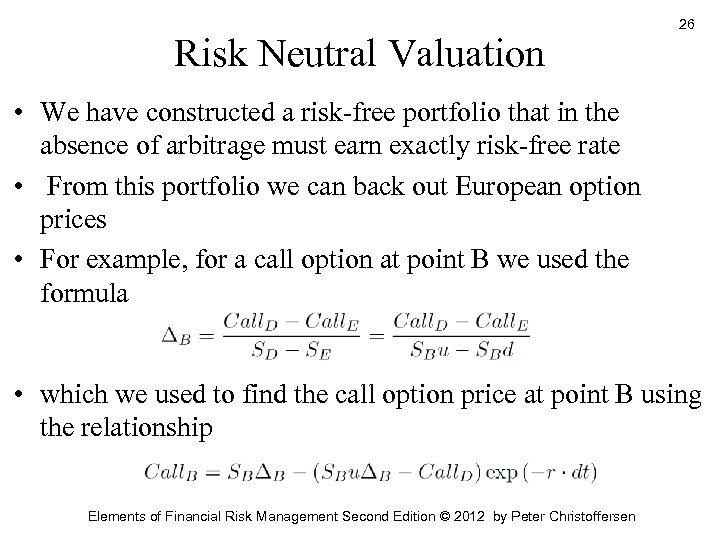 Risk Neutral Valuation 26 • We have constructed a risk-free portfolio that in the absence of arbitrage must earn exactly risk-free rate • From this portfolio we can back out European option prices • For example, for a call option at point B we used the formula • which we used to find the call option price at point B using the relationship Elements of Financial Risk Management Second Edition © 2012 by Peter Christoffersen
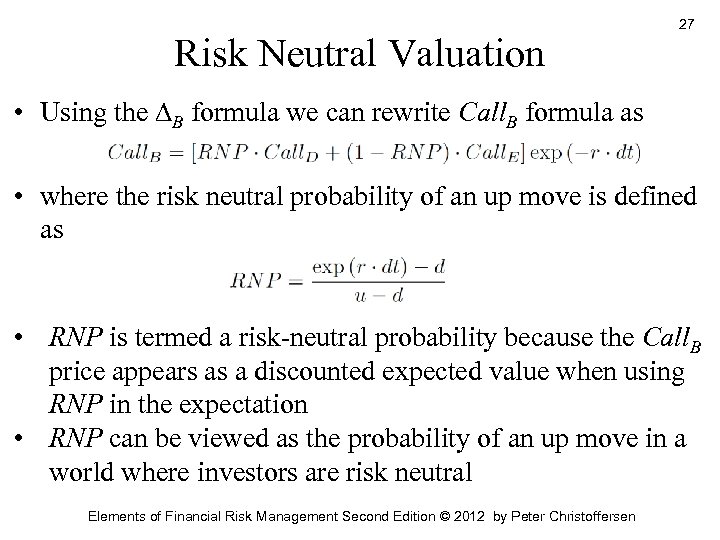 Risk Neutral Valuation 27 • Using the B formula we can rewrite Call. B formula as • where the risk neutral probability of an up move is defined as • RNP is termed a risk-neutral probability because the Call. B price appears as a discounted expected value when using RNP in the expectation • RNP can be viewed as the probability of an up move in a world where investors are risk neutral Elements of Financial Risk Management Second Edition © 2012 by Peter Christoffersen
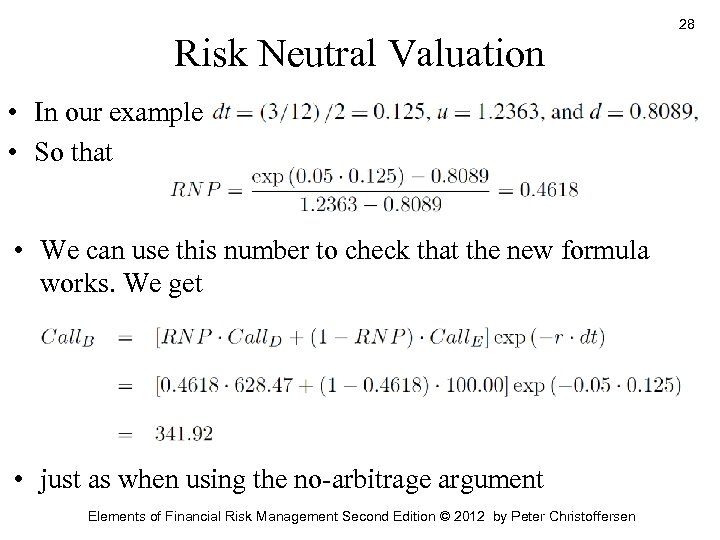 Risk Neutral Valuation • In our example • So that • We can use this number to check that the new formula works. We get • just as when using the no-arbitrage argument Elements of Financial Risk Management Second Edition © 2012 by Peter Christoffersen 28
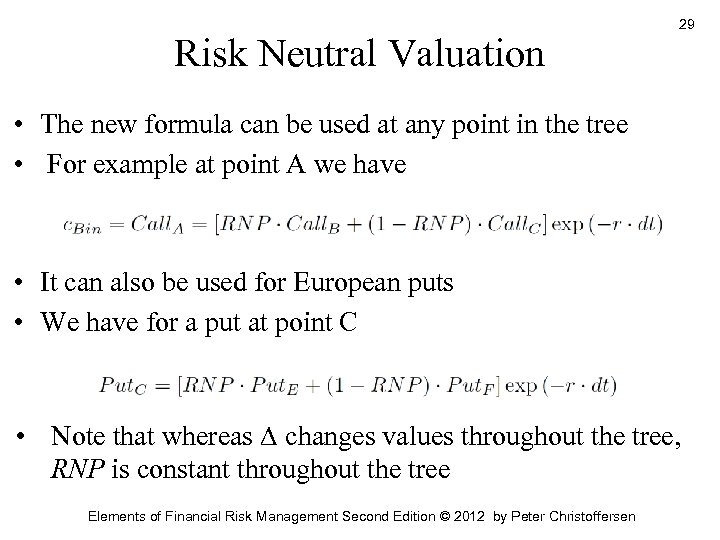 Risk Neutral Valuation 29 • The new formula can be used at any point in the tree • For example at point A we have • It can also be used for European puts • We have for a put at point C • Note that whereas changes values throughout the tree, RNP is constant throughout the tree Elements of Financial Risk Management Second Edition © 2012 by Peter Christoffersen
 Pricing an American Option using the Binomial Tree 30 • American options can be exercised prior to maturity • This added flexibility gives them potentially higher fair market values than European-style options • Binomial trees can be used to price American options • At the maturity of the option American- and Europeanstyle options are equivalent • But at each intermediate point in the tree we must compare European option value with early exercise value and put the largest of two into tree at that point Elements of Financial Risk Management Second Edition © 2012 by Peter Christoffersen
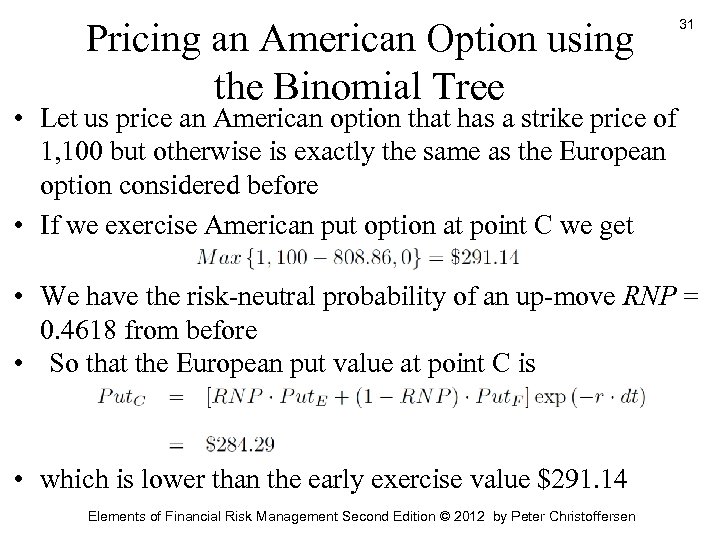 Pricing an American Option using the Binomial Tree 31 • Let us price an American option that has a strike price of 1, 100 but otherwise is exactly the same as the European option considered before • If we exercise American put option at point C we get • We have the risk-neutral probability of an up-move RNP = 0. 4618 from before • So that the European put value at point C is • which is lower than the early exercise value $291. 14 Elements of Financial Risk Management Second Edition © 2012 by Peter Christoffersen
 Pricing an American Option using the Binomial Tree 32 • Early exercise of the put is optimal at point C as fair market value of the American option is $291. 14 at C • This value will now influence the American put option value at point A, which will also be larger than its corresponding European put option value. • Table 10. 4 shows that the American put is worth $180. 25 at point A • The American call option price is $90. 25, which turns out to be the European call option price as well • American call stock options should only be exercised early if a large cash dividend is imminent Elements of Financial Risk Management Second Edition © 2012 by Peter Christoffersen
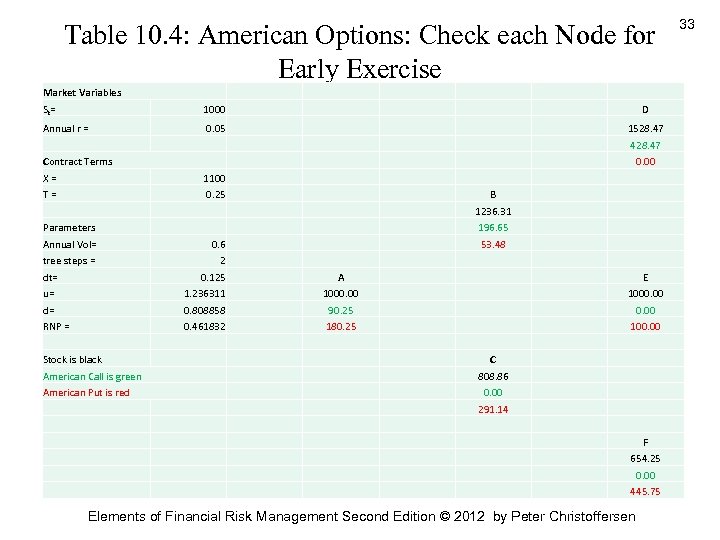 Table 10. 4: American Options: Check each Node for Early Exercise Market Variables St= 1000 D Annual r = 0. 05 Contract Terms X= T= 1528. 47 428. 47 0. 00 1100 0. 25 Parameters Annual Vol= tree steps = dt= u= d= RNP = Stock is black American Call is green American Put is red 0. 6 2 0. 125 1. 236311 0. 808858 0. 461832 B 1236. 31 196. 65 53. 48 A 1000. 00 90. 25 180. 25 E 1000. 00 100. 00 C 808. 86 0. 00 291. 14 F 654. 25 0. 00 445. 75 Elements of Financial Risk Management Second Edition © 2012 by Peter Christoffersen 33
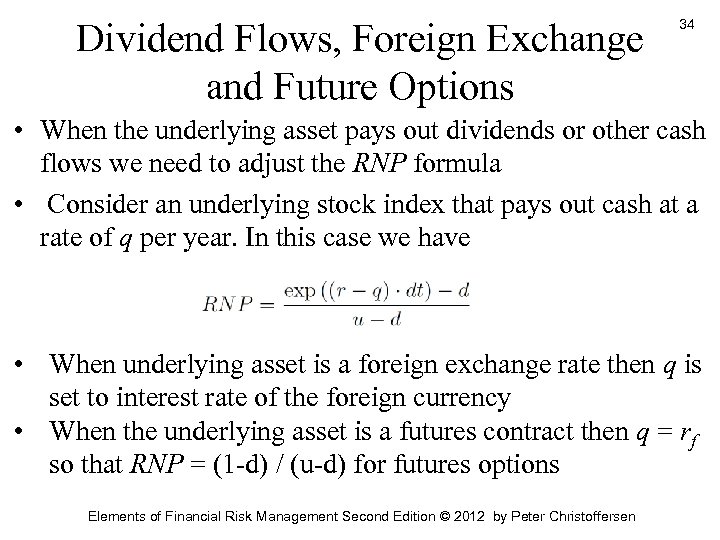 Dividend Flows, Foreign Exchange and Future Options 34 • When the underlying asset pays out dividends or other cash flows we need to adjust the RNP formula • Consider an underlying stock index that pays out cash at a rate of q per year. In this case we have • When underlying asset is a foreign exchange rate then q is set to interest rate of the foreign currency • When the underlying asset is a futures contract then q = rf so that RNP = (1 -d) / (u-d) for futures options Elements of Financial Risk Management Second Edition © 2012 by Peter Christoffersen
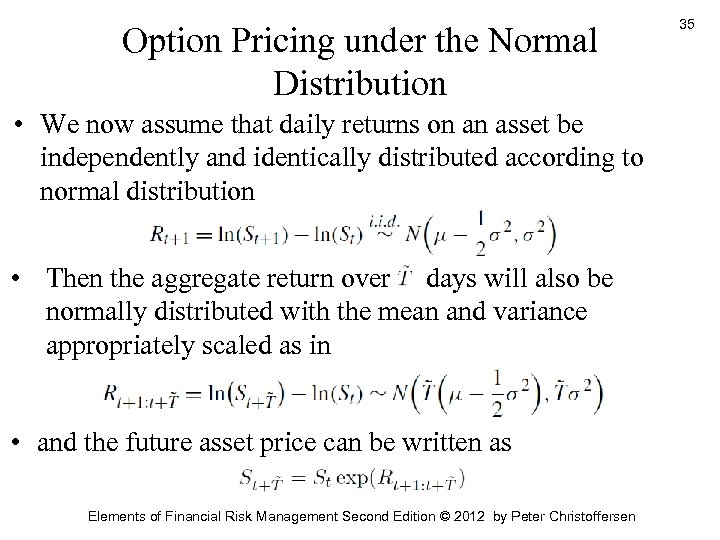 Option Pricing under the Normal Distribution • We now assume that daily returns on an asset be independently and identically distributed according to normal distribution • Then the aggregate return over days will also be normally distributed with the mean and variance appropriately scaled as in • and the future asset price can be written as Elements of Financial Risk Management Second Edition © 2012 by Peter Christoffersen 35
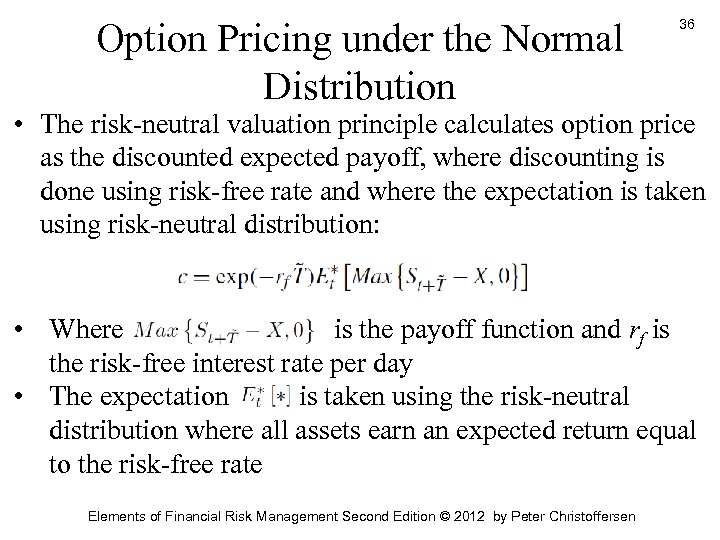 Option Pricing under the Normal Distribution 36 • The risk-neutral valuation principle calculates option price as the discounted expected payoff, where discounting is done using risk-free rate and where the expectation is taken using risk-neutral distribution: • Where is the payoff function and rf is the risk-free interest rate per day • The expectation is taken using the risk-neutral distribution where all assets earn an expected return equal to the risk-free rate Elements of Financial Risk Management Second Edition © 2012 by Peter Christoffersen
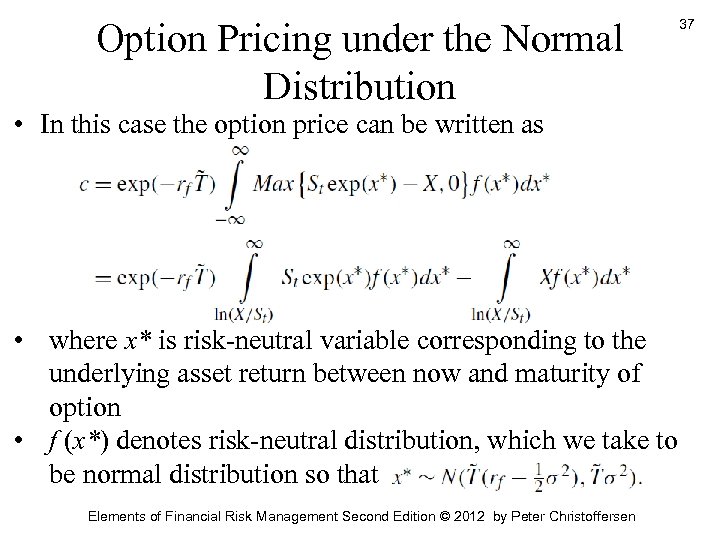 Option Pricing under the Normal Distribution • In this case the option price can be written as • where x* is risk-neutral variable corresponding to the underlying asset return between now and maturity of option • f (x*) denotes risk-neutral distribution, which we take to be normal distribution so that Elements of Financial Risk Management Second Edition © 2012 by Peter Christoffersen 37
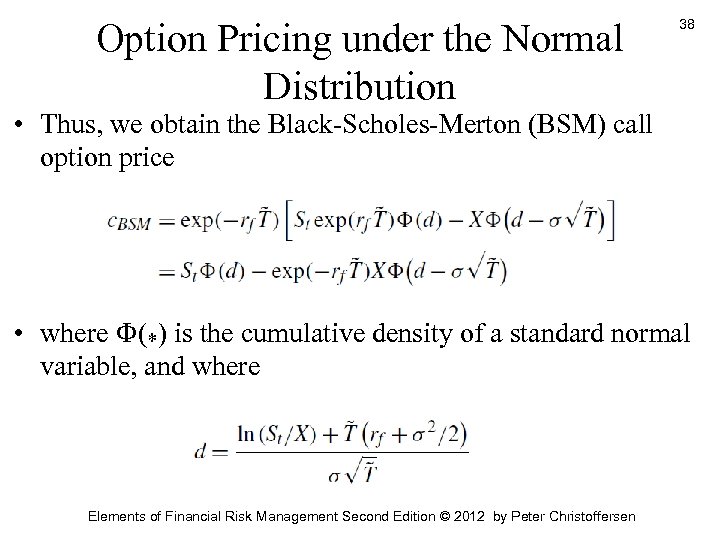 Option Pricing under the Normal Distribution 38 • Thus, we obtain the Black-Scholes-Merton (BSM) call option price • where (*) is the cumulative density of a standard normal variable, and where Elements of Financial Risk Management Second Edition © 2012 by Peter Christoffersen
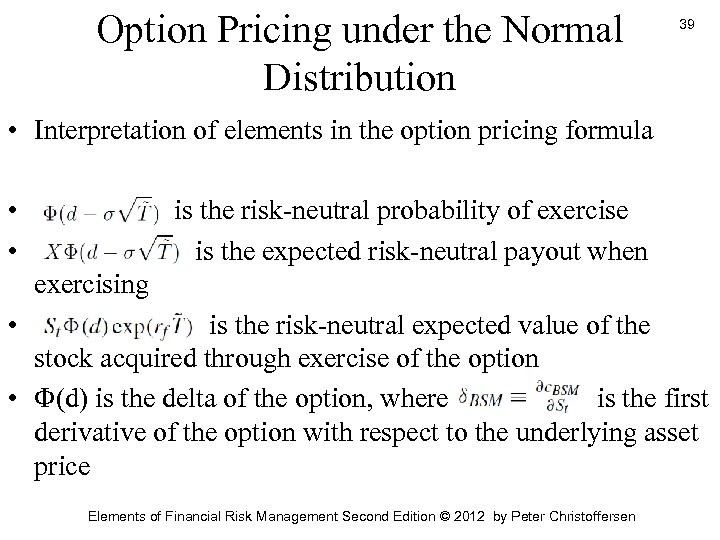 Option Pricing under the Normal Distribution 39 • Interpretation of elements in the option pricing formula • is the risk-neutral probability of exercise • is the expected risk-neutral payout when exercising • is the risk-neutral expected value of the stock acquired through exercise of the option • (d) is the delta of the option, where is the first derivative of the option with respect to the underlying asset price Elements of Financial Risk Management Second Edition © 2012 by Peter Christoffersen
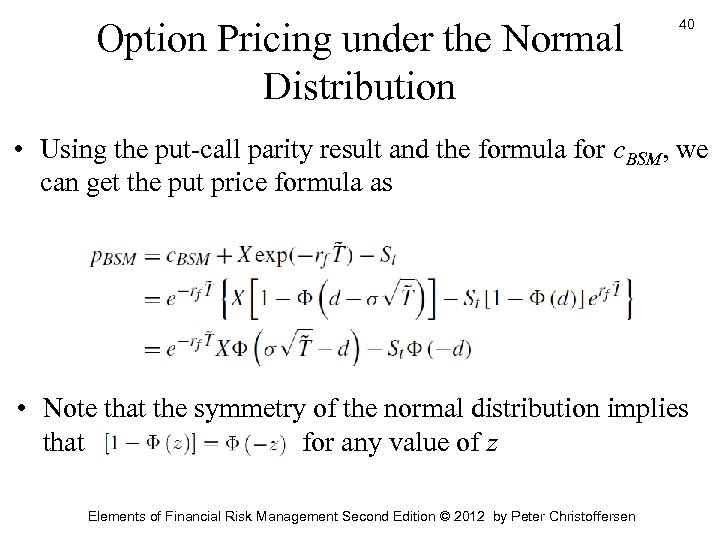 Option Pricing under the Normal Distribution 40 • Using the put-call parity result and the formula for c. BSM, we can get the put price formula as • Note that the symmetry of the normal distribution implies that for any value of z Elements of Financial Risk Management Second Edition © 2012 by Peter Christoffersen
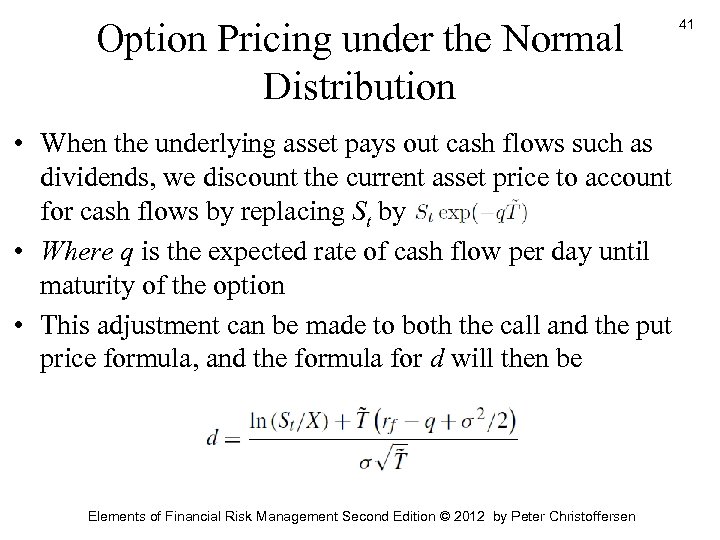 Option Pricing under the Normal Distribution • When the underlying asset pays out cash flows such as dividends, we discount the current asset price to account for cash flows by replacing St by • Where q is the expected rate of cash flow per day until maturity of the option • This adjustment can be made to both the call and the put price formula, and the formula for d will then be Elements of Financial Risk Management Second Edition © 2012 by Peter Christoffersen 41
 Option Pricing under the Normal Distribution 42 • The adjustment is made because the option holder at maturity receives only the underlying asset on that date and not the cash flow that has accrued to the asset during the life of the option. • This cash flow is retained by the owner of the underlying asset Elements of Financial Risk Management Second Edition © 2012 by Peter Christoffersen
 Option Pricing under the Normal Distribution 43 • We now use the Black-Scholes pricing model to price a European call option written on the S&P 500 index • On January 6, 2010, the value of index was 1137. 14 • The European call option has a strike price of 1110 and 43 days to maturity • The risk-free interest rate for a 43 -day holding period is found from the T-bill rates to be 0. 0006824% per day (that is, 0. 000006824) • The dividend accruing to the index over the next 43 days is expected to be 0. 0056967% per day • Assume volatility of the index is 0. 979940% per day Elements of Financial Risk Management Second Edition © 2012 by Peter Christoffersen
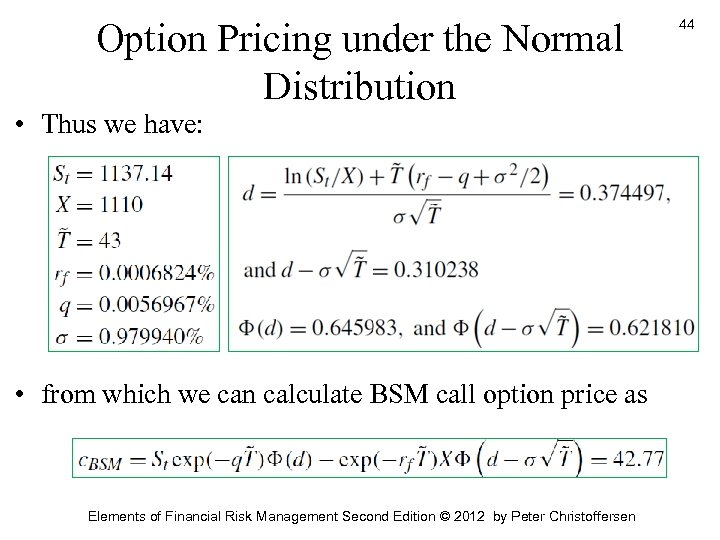 Option Pricing under the Normal Distribution • Thus we have: • from which we can calculate BSM call option price as Elements of Financial Risk Management Second Edition © 2012 by Peter Christoffersen 44
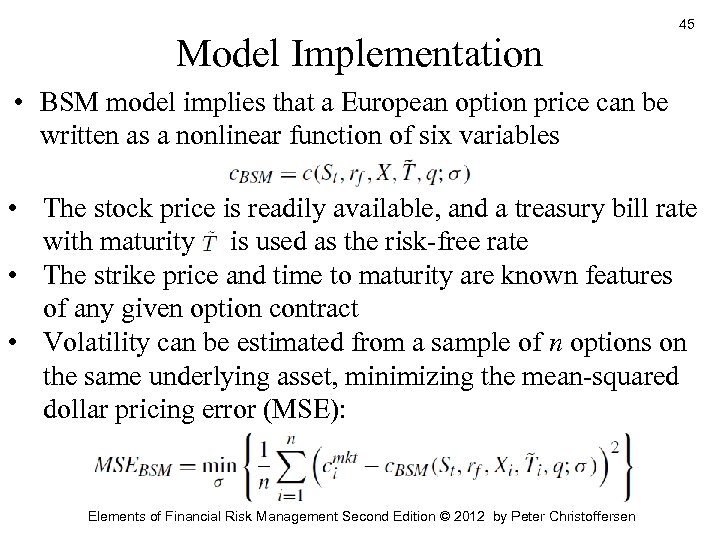 Model Implementation 45 • BSM model implies that a European option price can be written as a nonlinear function of six variables • The stock price is readily available, and a treasury bill rate with maturity is used as the risk-free rate • The strike price and time to maturity are known features of any given option contract • Volatility can be estimated from a sample of n options on the same underlying asset, minimizing the mean-squared dollar pricing error (MSE): Elements of Financial Risk Management Second Edition © 2012 by Peter Christoffersen
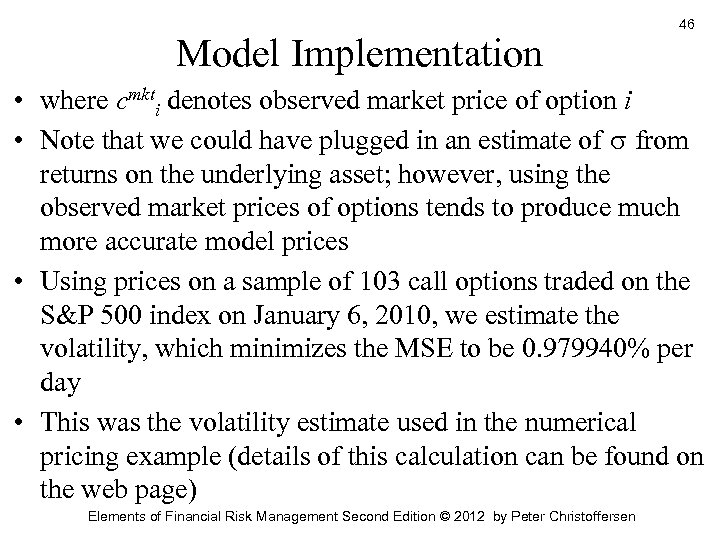 Model Implementation 46 • where cmkti denotes observed market price of option i • Note that we could have plugged in an estimate of s from returns on the underlying asset; however, using the observed market prices of options tends to produce much more accurate model prices • Using prices on a sample of 103 call options traded on the S&P 500 index on January 6, 2010, we estimate the volatility, which minimizes the MSE to be 0. 979940% per day • This was the volatility estimate used in the numerical pricing example (details of this calculation can be found on the web page) Elements of Financial Risk Management Second Edition © 2012 by Peter Christoffersen
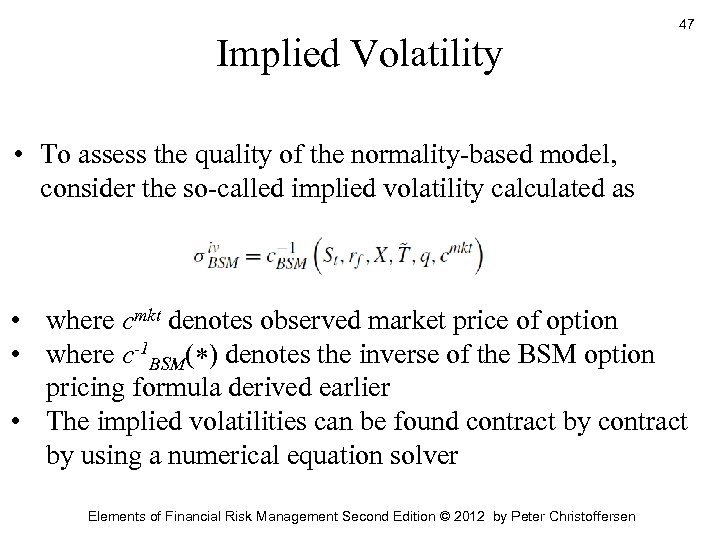 Implied Volatility 47 • To assess the quality of the normality-based model, consider the so-called implied volatility calculated as • where cmkt denotes observed market price of option • where c-1 BSM( ) denotes the inverse of the BSM option pricing formula derived earlier • The implied volatilities can be found contract by using a numerical equation solver Elements of Financial Risk Management Second Edition © 2012 by Peter Christoffersen
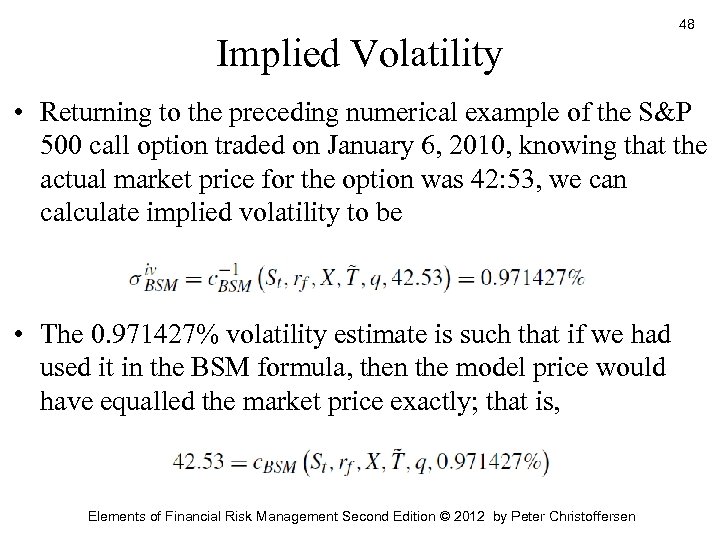 Implied Volatility 48 • Returning to the preceding numerical example of the S&P 500 call option traded on January 6, 2010, knowing that the actual market price for the option was 42: 53, we can calculate implied volatility to be • The 0. 971427% volatility estimate is such that if we had used it in the BSM formula, then the model price would have equalled the market price exactly; that is, Elements of Financial Risk Management Second Edition © 2012 by Peter Christoffersen
 Implied Volatility 49 • If the normality assumption imposed on the model were true, then the implied volatility should be roughly constant across strike prices and maturities • However, actual option data displays systematic patterns in implied volatility, thus violating the normality-based option pricing theory • Smirk and smile patterns in implied volatility constitute evidence of misspecification in BSM model • Consider for example pricing options with the BSM formula using a daily volatility of approximately 1% for all options Elements of Financial Risk Management Second Edition © 2012 by Peter Christoffersen
 Implied Volatility • For options that are in-the-money—that is, S/X > 1—the BSM implied volatility is higher than 1% • It means that the BSM model needs a higher than 1% volatility to fit the market data • This is because option prices are increasing in the underlying volatility. • Using the BSM formula with a volatility of 1% would result in a BSM price that is too low. • Thus BSM underprice in-the-money call options • From the put-call parity formula, we see that the BSM model also underprices out-of-the-money put options Elements of Financial Risk Management Second Edition © 2012 by Peter Christoffersen 50
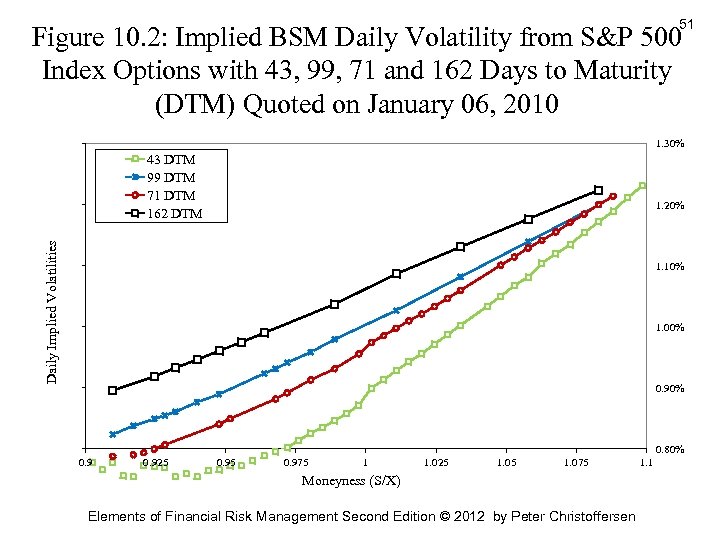 51 Figure 10. 2: Implied BSM Daily Volatility from S&P 500 Index Options with 43, 99, 71 and 162 Days to Maturity (DTM) Quoted on January 06, 2010 1. 30% 43 DTM 99 DTM 71 DTM 162 DTM Daily Implied Volatilities 1. 20% 1. 10% 1. 00% 0. 90% 0. 80% 0. 925 0. 975 1 1. 025 1. 075 Moneyness (S/X) Elements of Financial Risk Management Second Edition © 2012 by Peter Christoffersen 1. 1
 Allowing for Skewness and Kurtosis 52 • We now try to make up for mispricing in BSM model • We again have one day returns defined as • and -period returns as • We now define skewness of the one-day return as • Skewness is informative about the degree of asymmetry of the distribution • A negative skewness arises from large negative returns being observed more frequently than large positive returns Elements of Financial Risk Management Second Edition © 2012 by Peter Christoffersen
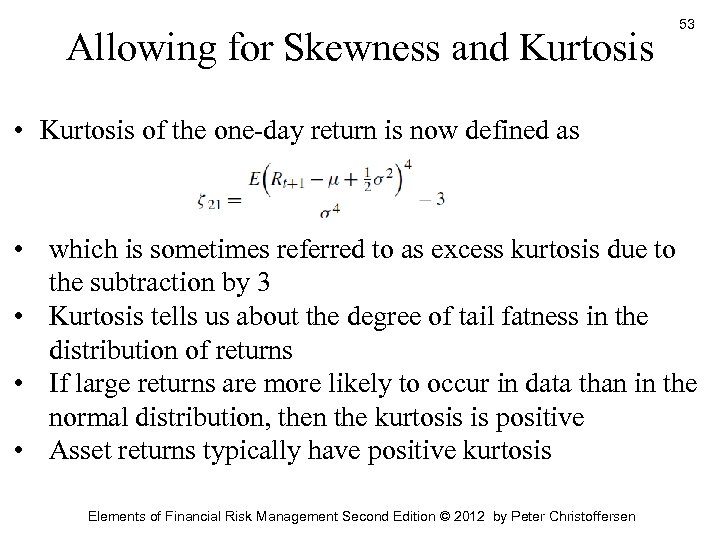 Allowing for Skewness and Kurtosis 53 • Kurtosis of the one-day return is now defined as • which is sometimes referred to as excess kurtosis due to the subtraction by 3 • Kurtosis tells us about the degree of tail fatness in the distribution of returns • If large returns are more likely to occur in data than in the normal distribution, then the kurtosis is positive • Asset returns typically have positive kurtosis Elements of Financial Risk Management Second Edition © 2012 by Peter Christoffersen
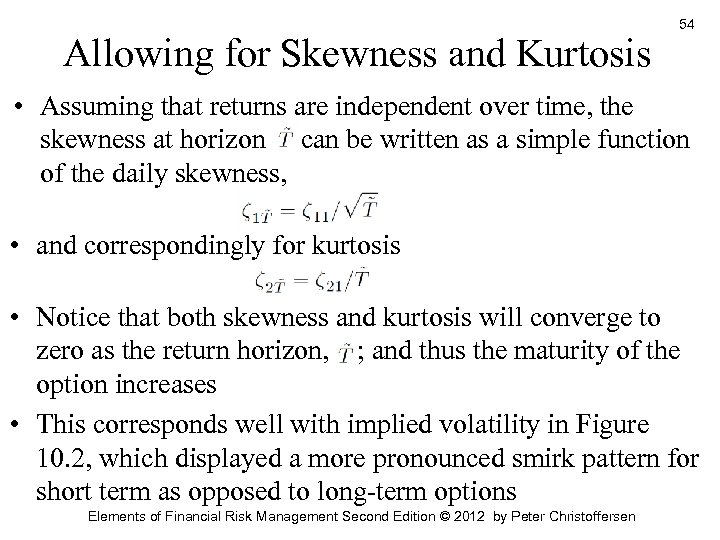 Allowing for Skewness and Kurtosis 54 • Assuming that returns are independent over time, the skewness at horizon can be written as a simple function of the daily skewness, • and correspondingly for kurtosis • Notice that both skewness and kurtosis will converge to zero as the return horizon, ; and thus the maturity of the option increases • This corresponds well with implied volatility in Figure 10. 2, which displayed a more pronounced smirk pattern for short term as opposed to long-term options Elements of Financial Risk Management Second Edition © 2012 by Peter Christoffersen
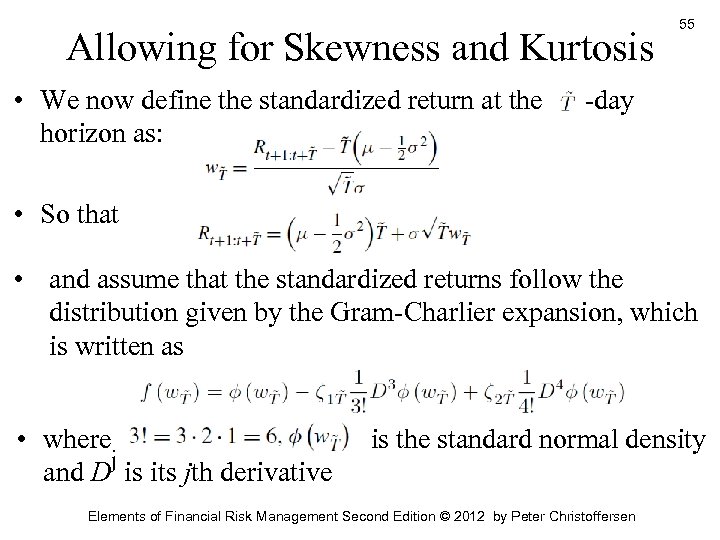 Allowing for Skewness and Kurtosis • We now define the standardized return at the horizon as: 55 -day • So that • and assume that the standardized returns follow the distribution given by the Gram-Charlier expansion, which is written as • where j and D is its jth derivative is the standard normal density Elements of Financial Risk Management Second Edition © 2012 by Peter Christoffersen
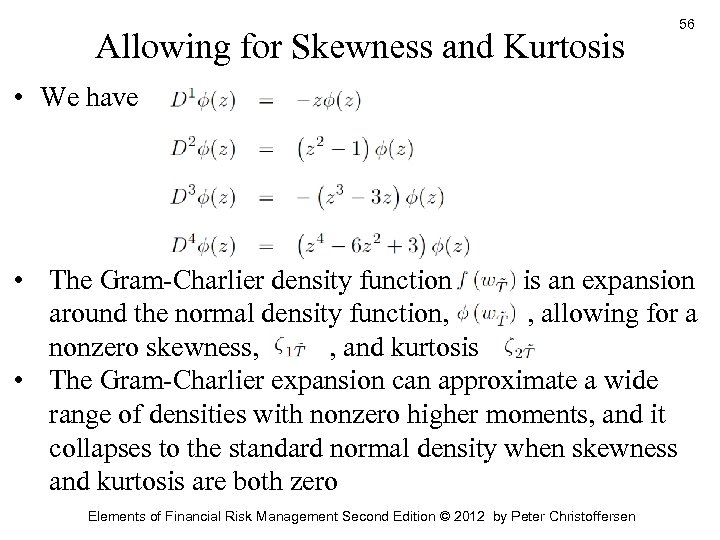 Allowing for Skewness and Kurtosis 56 • We have • The Gram-Charlier density function is an expansion around the normal density function, , allowing for a nonzero skewness, , and kurtosis • The Gram-Charlier expansion can approximate a wide range of densities with nonzero higher moments, and it collapses to the standard normal density when skewness and kurtosis are both zero Elements of Financial Risk Management Second Edition © 2012 by Peter Christoffersen
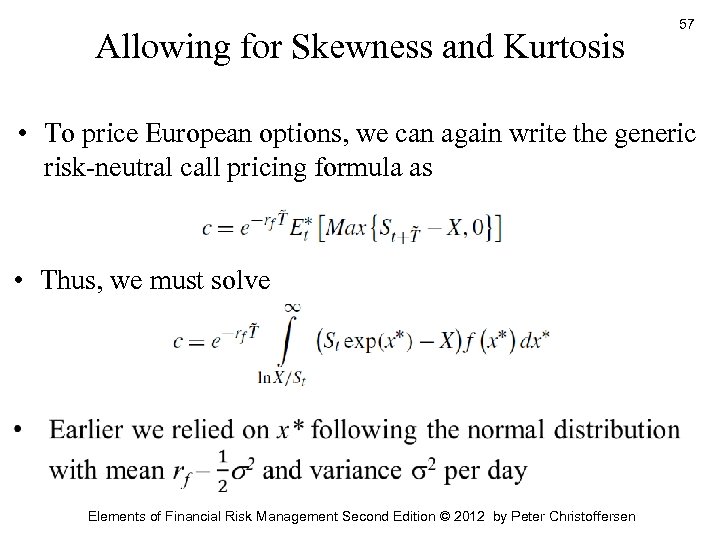 Allowing for Skewness and Kurtosis 57 • To price European options, we can again write the generic risk-neutral call pricing formula as • Thus, we must solve Elements of Financial Risk Management Second Edition © 2012 by Peter Christoffersen
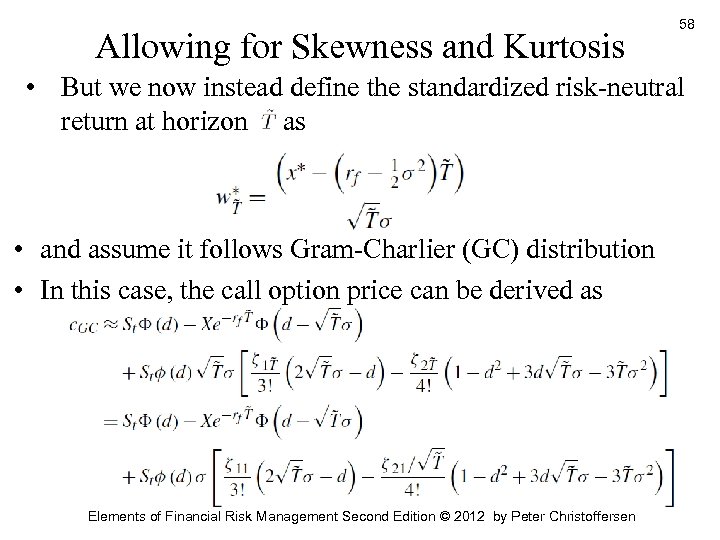 Allowing for Skewness and Kurtosis 58 • But we now instead define the standardized risk-neutral return at horizon as • and assume it follows Gram-Charlier (GC) distribution • In this case, the call option price can be derived as Elements of Financial Risk Management Second Edition © 2012 by Peter Christoffersen
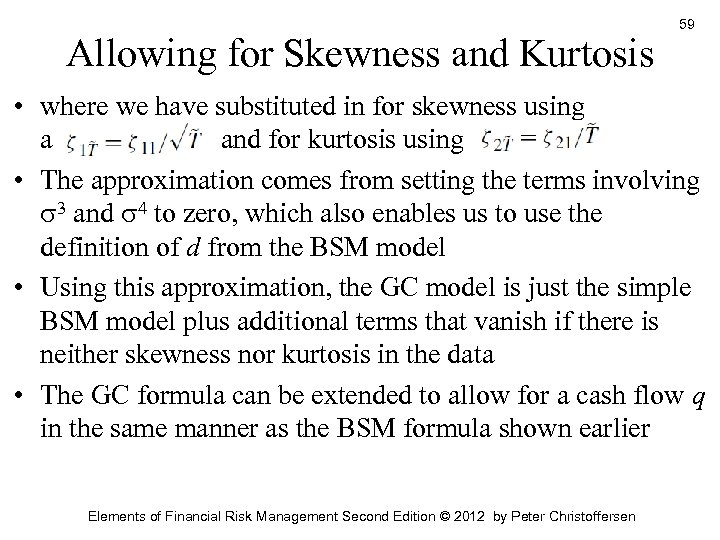 Allowing for Skewness and Kurtosis 59 • where we have substituted in for skewness using a and for kurtosis using • The approximation comes from setting the terms involving s 3 and s 4 to zero, which also enables us to use the definition of d from the BSM model • Using this approximation, the GC model is just the simple BSM model plus additional terms that vanish if there is neither skewness nor kurtosis in the data • The GC formula can be extended to allow for a cash flow q in the same manner as the BSM formula shown earlier Elements of Financial Risk Management Second Edition © 2012 by Peter Christoffersen
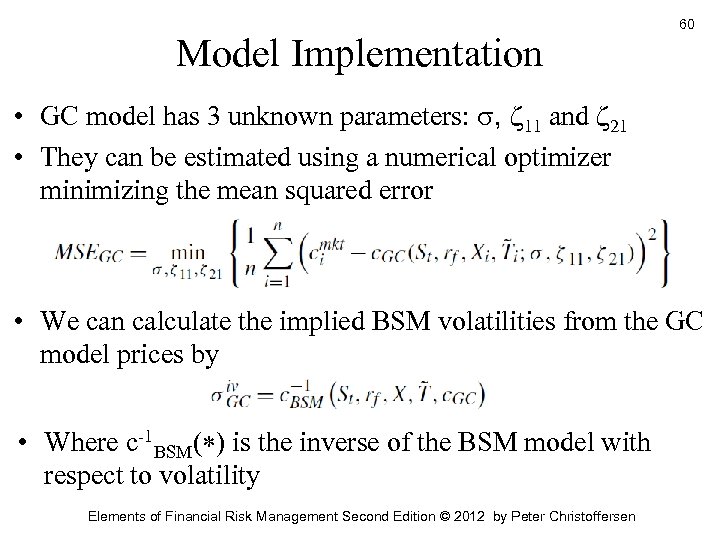 Model Implementation 60 • GC model has 3 unknown parameters: s, 11 and 21 • They can be estimated using a numerical optimizer minimizing the mean squared error • We can calculate the implied BSM volatilities from the GC model prices by • Where c-1 BSM( ) is the inverse of the BSM model with respect to volatility Elements of Financial Risk Management Second Edition © 2012 by Peter Christoffersen
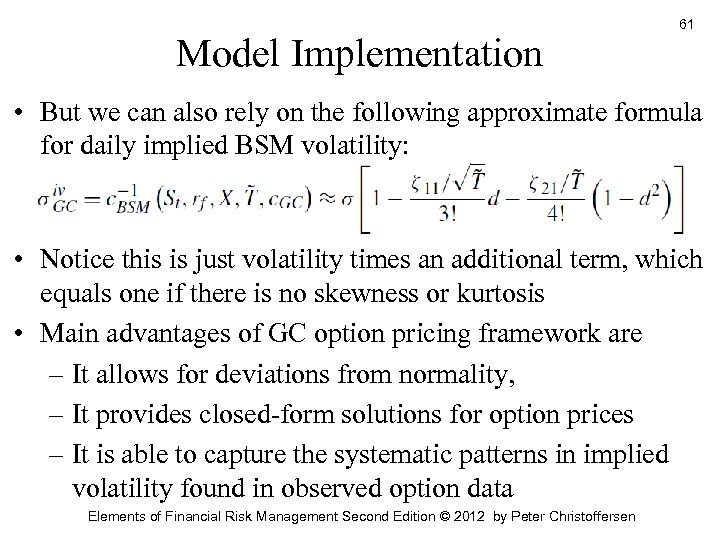 Model Implementation 61 • But we can also rely on the following approximate formula for daily implied BSM volatility: • Notice this is just volatility times an additional term, which equals one if there is no skewness or kurtosis • Main advantages of GC option pricing framework are – It allows for deviations from normality, – It provides closed-form solutions for option prices – It is able to capture the systematic patterns in implied volatility found in observed option data Elements of Financial Risk Management Second Edition © 2012 by Peter Christoffersen
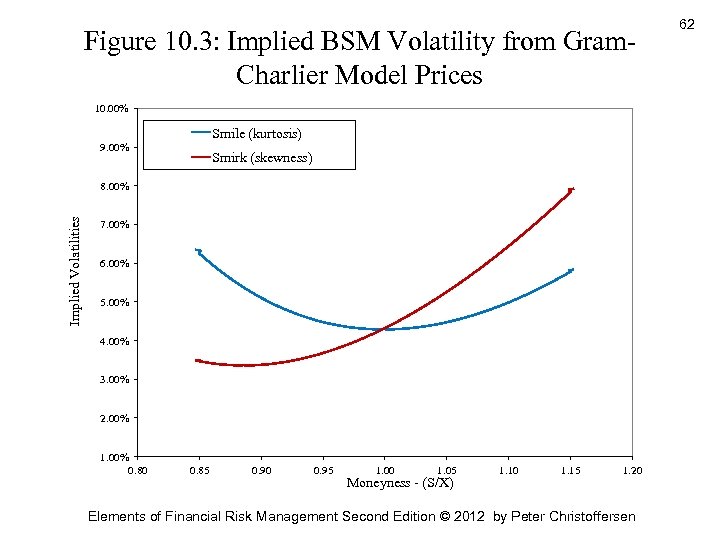 Figure 10. 3: Implied BSM Volatility from Gram. Charlier Model Prices 10. 00% Smile (kurtosis) 9. 00% Smirk (skewness) Implied Volatilities 8. 00% 7. 00% 6. 00% 5. 00% 4. 00% 3. 00% 2. 00% 1. 00% 0. 80 0. 85 0. 90 0. 95 1. 00 1. 05 Moneyness - (S/X) 1. 10 1. 15 1. 20 Elements of Financial Risk Management Second Edition © 2012 by Peter Christoffersen 62
 Allowing for Dynamic Volatility 63 • The GC model is able to capture the strike price structure but not the maturity structure in observed options prices • We now consider option pricing allowing for the underlying asset returns to follow a GARCH process • The GARCH option pricing model assumes that the expected return on the underlying asset is equal to the riskfree rate, rf , plus a premium for volatility risk, l, as well as a normalization term • The observed daily return is then equal to the expected return plus a noise term Elements of Financial Risk Management Second Edition © 2012 by Peter Christoffersen
 Allowing for Dynamic Volatility 64 • The noise term is conditionally normally distributed with mean zero and variance following a GARCH(1, 1) process with leverage • By letting past return feed into variance in a magnitude depending on the sign of the return, the leverage effect creates an asymmetry in distribution of returns • This asymmetry is important for capturing the skewness implied in observed option prices Elements of Financial Risk Management Second Edition © 2012 by Peter Christoffersen
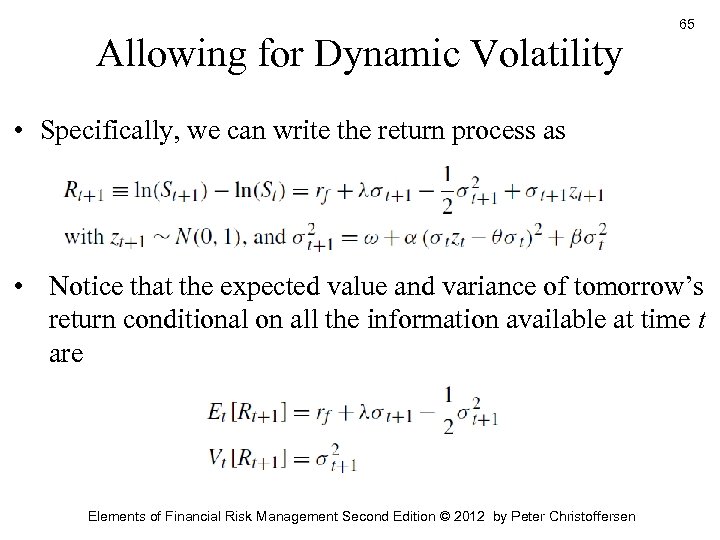 Allowing for Dynamic Volatility 65 • Specifically, we can write the return process as • Notice that the expected value and variance of tomorrow’s return conditional on all the information available at time t are Elements of Financial Risk Management Second Edition © 2012 by Peter Christoffersen
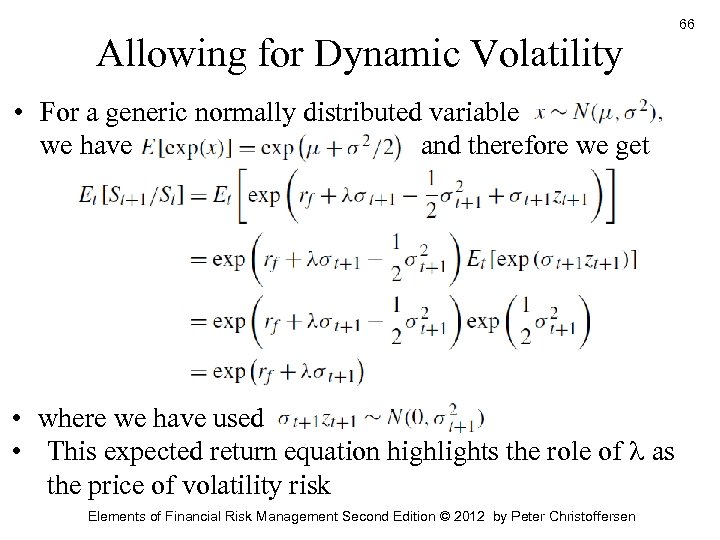 Allowing for Dynamic Volatility 66 • For a generic normally distributed variable we have and therefore we get • where we have used • This expected return equation highlights the role of l as the price of volatility risk Elements of Financial Risk Management Second Edition © 2012 by Peter Christoffersen
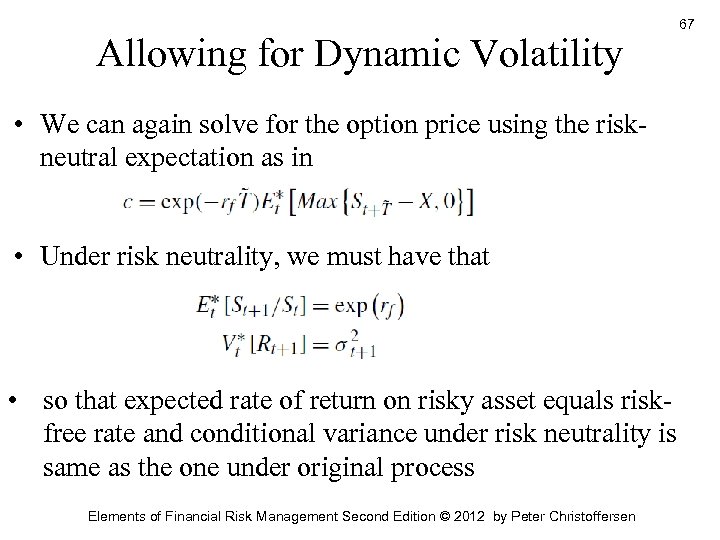 Allowing for Dynamic Volatility • We can again solve for the option price using the riskneutral expectation as in • Under risk neutrality, we must have that • so that expected rate of return on risky asset equals riskfree rate and conditional variance under risk neutrality is same as the one under original process Elements of Financial Risk Management Second Edition © 2012 by Peter Christoffersen 67
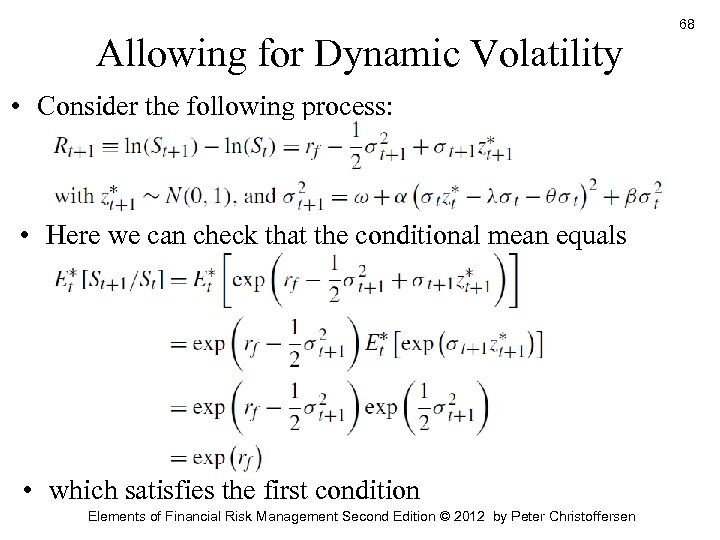 Allowing for Dynamic Volatility • Consider the following process: • Here we can check that the conditional mean equals • which satisfies the first condition Elements of Financial Risk Management Second Edition © 2012 by Peter Christoffersen 68
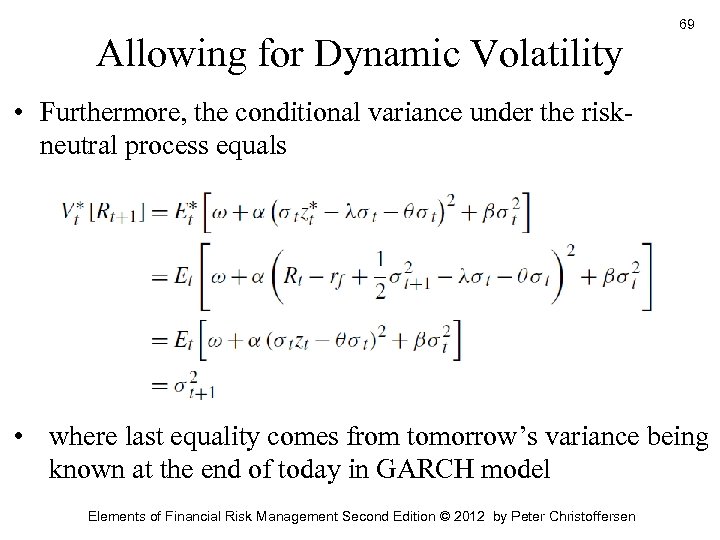 Allowing for Dynamic Volatility 69 • Furthermore, the conditional variance under the riskneutral process equals • where last equality comes from tomorrow’s variance being known at the end of today in GARCH model Elements of Financial Risk Management Second Edition © 2012 by Peter Christoffersen
 Allowing for Dynamic Volatility • The conclusion is that the conditions for a risk-neutral process are met • An advantage of the GARCH option pricing approach introduced here is its flexibility • The previous analysis could easily be redone for any of GARCH variance models introduced in Chapter 4 • More important, it is able to fit observed option prices quite well Elements of Financial Risk Management Second Edition © 2012 by Peter Christoffersen 70
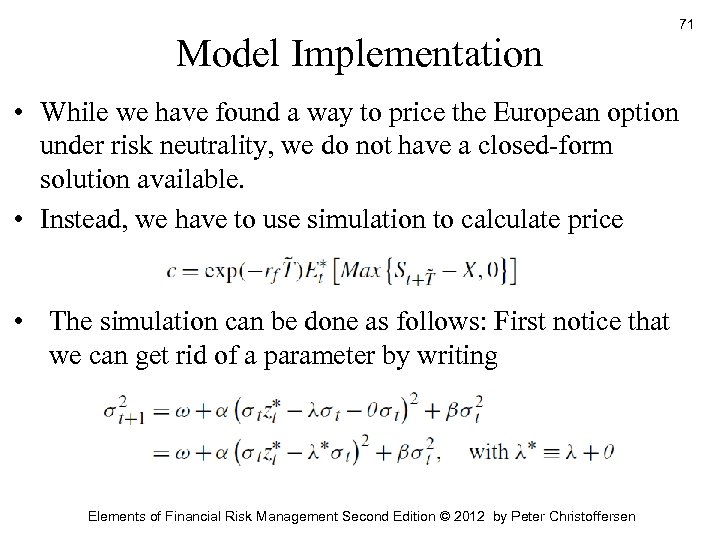 Model Implementation • While we have found a way to price the European option under risk neutrality, we do not have a closed-form solution available. • Instead, we have to use simulation to calculate price • The simulation can be done as follows: First notice that we can get rid of a parameter by writing Elements of Financial Risk Management Second Edition © 2012 by Peter Christoffersen 71
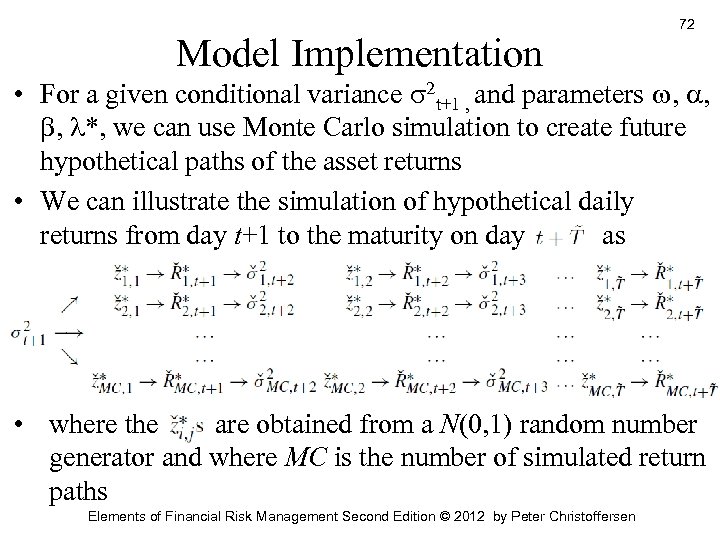 Model Implementation 72 • For a given conditional variance s 2 t+1 , and parameters w, a, b, l*, we can use Monte Carlo simulation to create future hypothetical paths of the asset returns • We can illustrate the simulation of hypothetical daily returns from day t+1 to the maturity on day as • where the are obtained from a N(0, 1) random number generator and where MC is the number of simulated return paths Elements of Financial Risk Management Second Edition © 2012 by Peter Christoffersen
![Model Implementation 73 • We need to calculate the expectation term E*t[*] in the](https://present5.com/presentation/efb308da5cab415c04913c2cf25c03dc/image-73.jpg "Model Implementation 73 • We need to calculate the expectation term E*t[*] in the") Model Implementation 73 • We need to calculate the expectation term E*t[*] in the option pricing formula using the risk-neutral process, thus, we calculate the simulated risk-neutral return in period t+j for simulation path i as • and the variance is updated by • the simulation paths in the first period all start out from the same s 2 t+1; therefore, for all i, we have Elements of Financial Risk Management Second Edition © 2012 by Peter Christoffersen
Model Implementation 73 • We need to calculate the expectation term E*t[*] in the option pricing formula using the risk-neutral process, thus, we calculate the simulated risk-neutral return in period t+j for simulation path i as • and the variance is updated by • the simulation paths in the first period all start out from the same s 2 t+1; therefore, for all i, we have Elements of Financial Risk Management Second Edition © 2012 by Peter Christoffersen
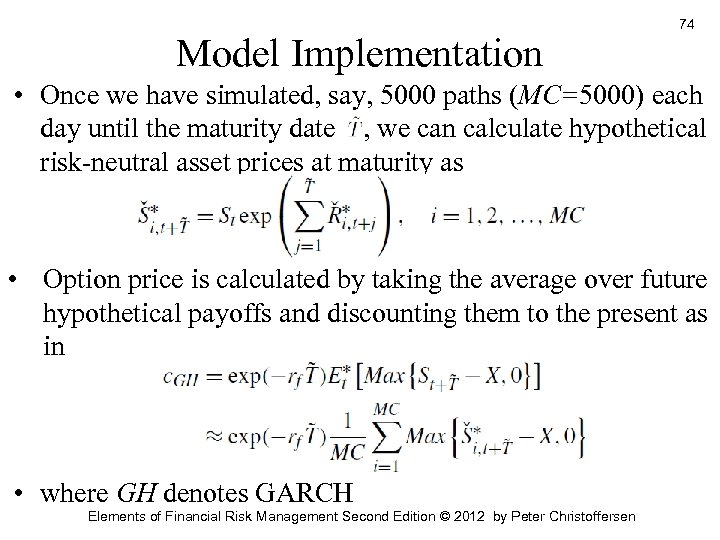 Model Implementation 74 • Once we have simulated, say, 5000 paths (MC=5000) each day until the maturity date , we can calculate hypothetical risk-neutral asset prices at maturity as • Option price is calculated by taking the average over future hypothetical payoffs and discounting them to the present as in • where GH denotes GARCH Elements of Financial Risk Management Second Edition © 2012 by Peter Christoffersen
 Model Implementation 75 • Thus, we use simulation to calculate the average future payoff, which is then used as an estimate of the expected value, E*t[*] • As number of Monte Carlo replications gets infinitely large, the average will converge to the expectation. • Around 5000 replications provide a precise estimate • In theory, we can estimate all the parameters in the GARCH model using the maximum likelihood method on the underlying asset returns • But to obtain a better fit of the option prices, we can instead minimize the option pricing errors directly Elements of Financial Risk Management Second Edition © 2012 by Peter Christoffersen
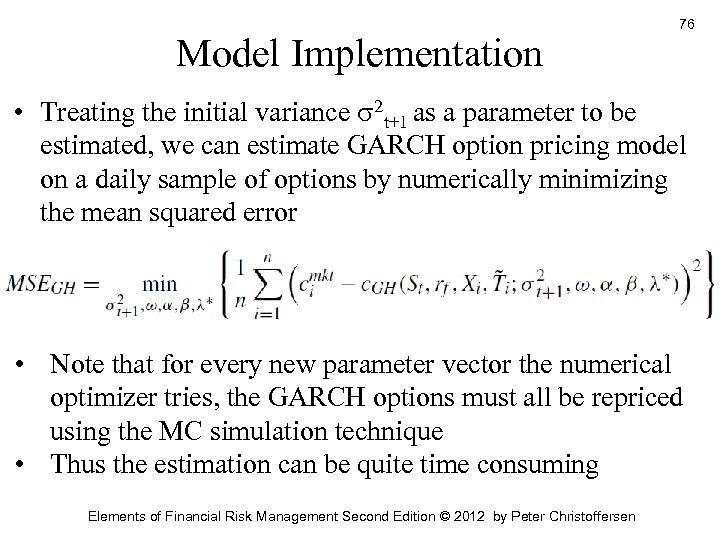 Model Implementation 76 • Treating the initial variance s 2 t+1 as a parameter to be estimated, we can estimate GARCH option pricing model on a daily sample of options by numerically minimizing the mean squared error • Note that for every new parameter vector the numerical optimizer tries, the GARCH options must all be repriced using the MC simulation technique • Thus the estimation can be quite time consuming Elements of Financial Risk Management Second Edition © 2012 by Peter Christoffersen
 Closed Form GARCH Option Pricing Model 77 • A drawback of the GARCH option pricing framework is that it does not provide us with a closed-form solution for the option price, which must instead be calculated through simulation • Although the simulation technique is straightforward, it does take computing time and introduces an additional source of error arising from approximation of the simulated average to the expected value • To overcome these issues, we introduce the closed-form GARCH or CFG model Elements of Financial Risk Management Second Edition © 2012 by Peter Christoffersen
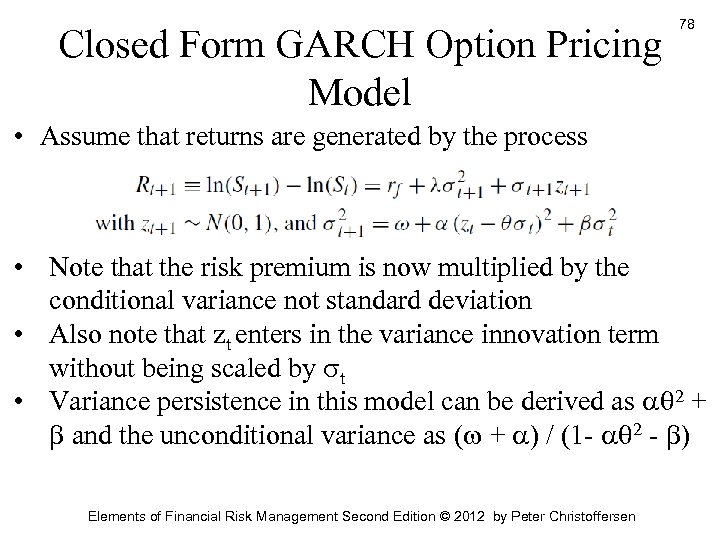 Closed Form GARCH Option Pricing Model 78 • Assume that returns are generated by the process • Note that the risk premium is now multiplied by the conditional variance not standard deviation • Also note that zt enters in the variance innovation term without being scaled by st • Variance persistence in this model can be derived as aq 2 + b and the unconditional variance as (w + a) / (1 - aq 2 - b) Elements of Financial Risk Management Second Edition © 2012 by Peter Christoffersen
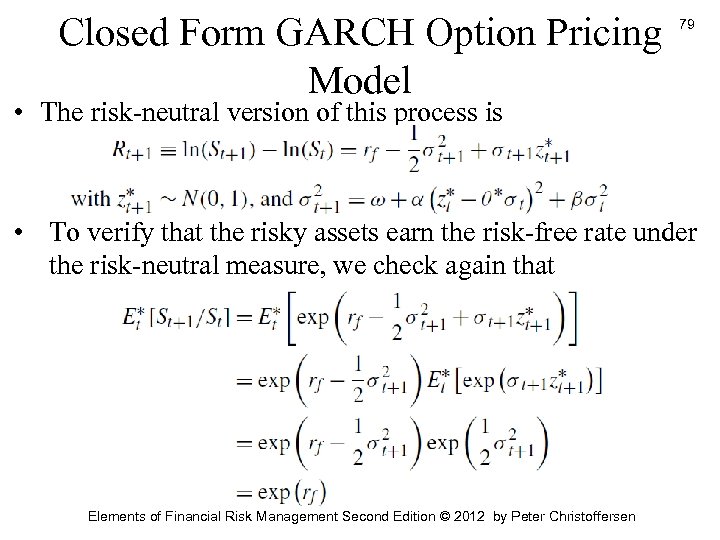 Closed Form GARCH Option Pricing Model 79 • The risk-neutral version of this process is • To verify that the risky assets earn the risk-free rate under the risk-neutral measure, we check again that Elements of Financial Risk Management Second Edition © 2012 by Peter Christoffersen
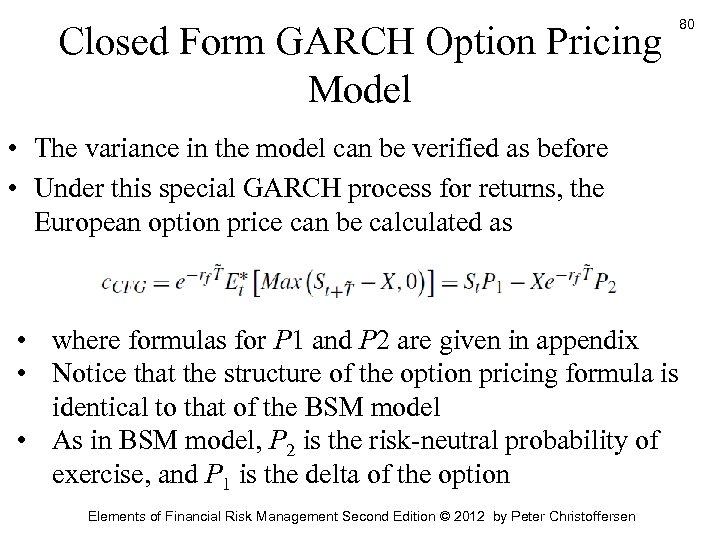 Closed Form GARCH Option Pricing Model • The variance in the model can be verified as before • Under this special GARCH process for returns, the European option price can be calculated as • where formulas for P 1 and P 2 are given in appendix • Notice that the structure of the option pricing formula is identical to that of the BSM model • As in BSM model, P 2 is the risk-neutral probability of exercise, and P 1 is the delta of the option Elements of Financial Risk Management Second Edition © 2012 by Peter Christoffersen 80
 81 Implied Volatility Function (IVF) Models • This approach to European option pricing is completely static and ad hoc but it turns out to offer reasonably good fit to observed option prices • The idea behind the approach is that the implied volatility smile changes only slowly over time • If we can estimate a functional form on the smile today, then that functional form may work reasonably in pricing options in the near future as well • The implied volatility smiles and smirks mentioned earlier suggest that option prices may be well captured by the following four-step approach: Elements of Financial Risk Management Second Edition © 2012 by Peter Christoffersen
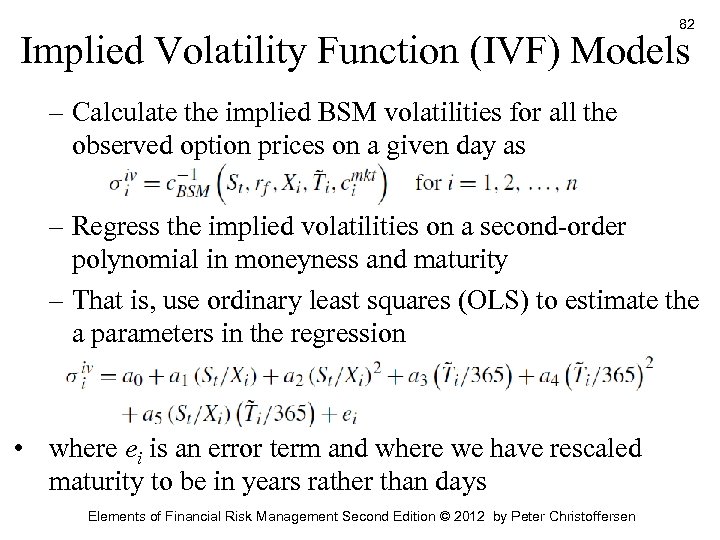 82 Implied Volatility Function (IVF) Models – Calculate the implied BSM volatilities for all the observed option prices on a given day as – Regress the implied volatilities on a second-order polynomial in moneyness and maturity – That is, use ordinary least squares (OLS) to estimate the a parameters in the regression • where ei is an error term and where we have rescaled maturity to be in years rather than days Elements of Financial Risk Management Second Edition © 2012 by Peter Christoffersen
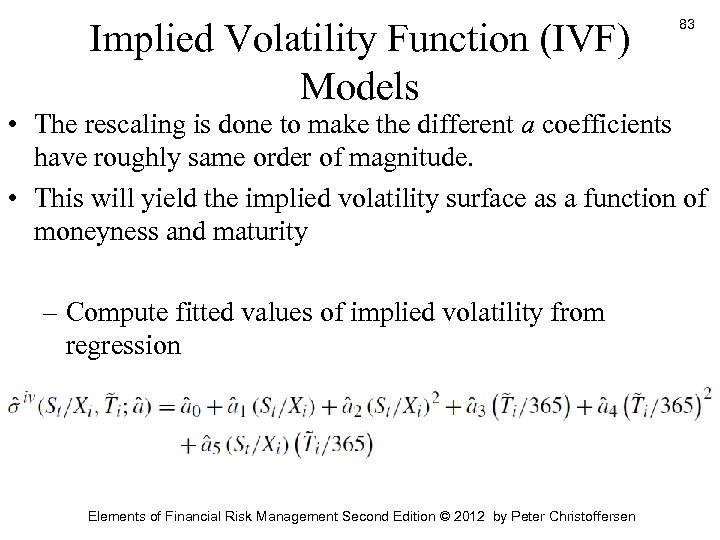 Implied Volatility Function (IVF) Models 83 • The rescaling is done to make the different a coefficients have roughly same order of magnitude. • This will yield the implied volatility surface as a function of moneyness and maturity – Compute fitted values of implied volatility from regression Elements of Financial Risk Management Second Edition © 2012 by Peter Christoffersen
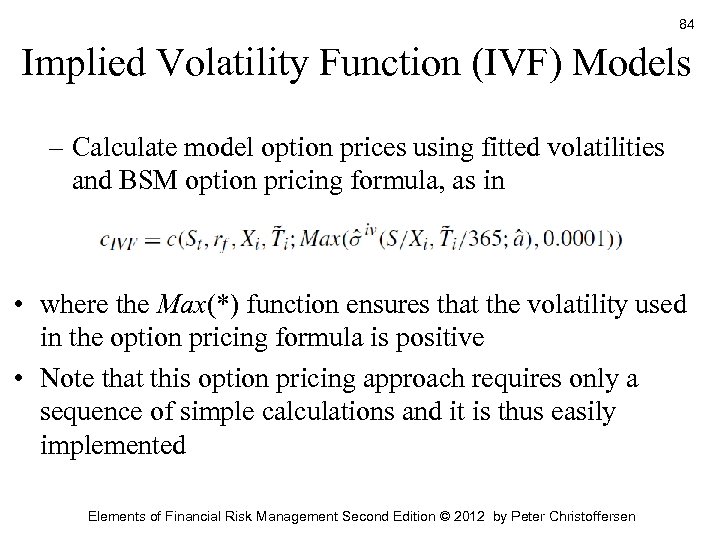 84 Implied Volatility Function (IVF) Models – Calculate model option prices using fitted volatilities and BSM option pricing formula, as in • where the Max(*) function ensures that the volatility used in the option pricing formula is positive • Note that this option pricing approach requires only a sequence of simple calculations and it is thus easily implemented Elements of Financial Risk Management Second Edition © 2012 by Peter Christoffersen
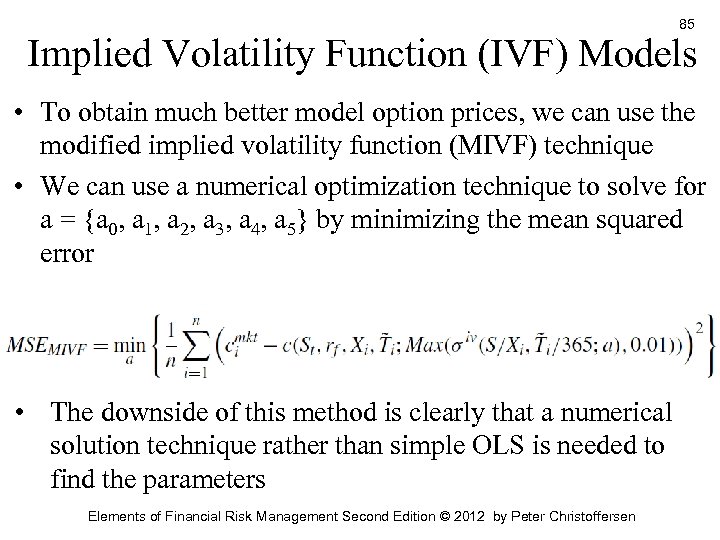 85 Implied Volatility Function (IVF) Models • To obtain much better model option prices, we can use the modified implied volatility function (MIVF) technique • We can use a numerical optimization technique to solve for a = {a 0, a 1, a 2, a 3, a 4, a 5} by minimizing the mean squared error • The downside of this method is clearly that a numerical solution technique rather than simple OLS is needed to find the parameters Elements of Financial Risk Management Second Edition © 2012 by Peter Christoffersen
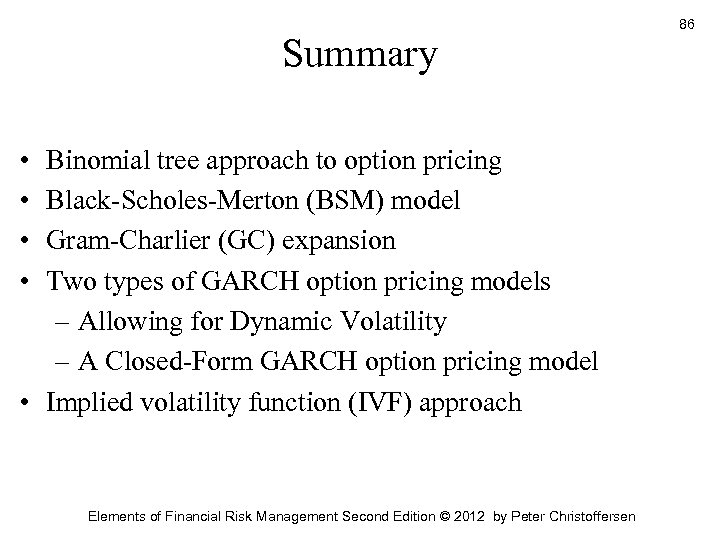 Summary • • Binomial tree approach to option pricing Black-Scholes-Merton (BSM) model Gram-Charlier (GC) expansion Two types of GARCH option pricing models – Allowing for Dynamic Volatility – A Closed-Form GARCH option pricing model • Implied volatility function (IVF) approach Elements of Financial Risk Management Second Edition © 2012 by Peter Christoffersen 86