


1 of 29 © Boardworks Ltd 2009
2 of 29 © Boardworks Ltd 2009
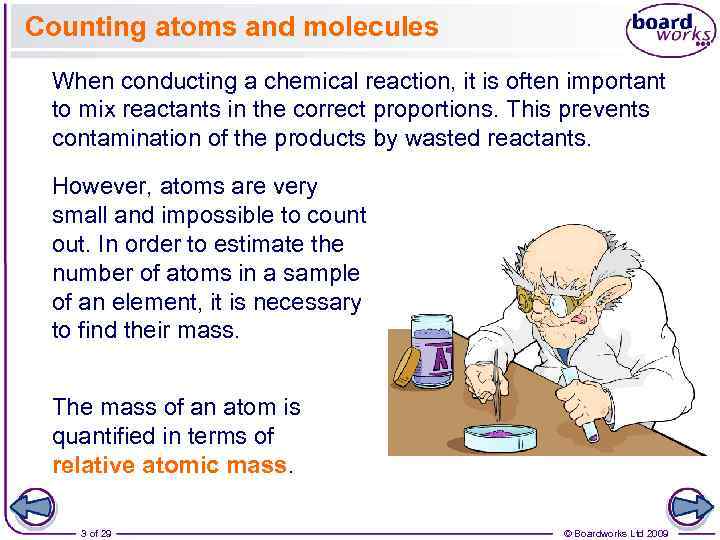
Counting atoms and molecules When conducting a chemical reaction, it is often important to mix reactants in the correct proportions. This prevents contamination of the products by wasted reactants. However, atoms are very small and impossible to count out. In order to estimate the number of atoms in a sample of an element, it is necessary to find their mass. The mass of an atom is quantified in terms of relative atomic mass. 3 of 29 © Boardworks Ltd 2009
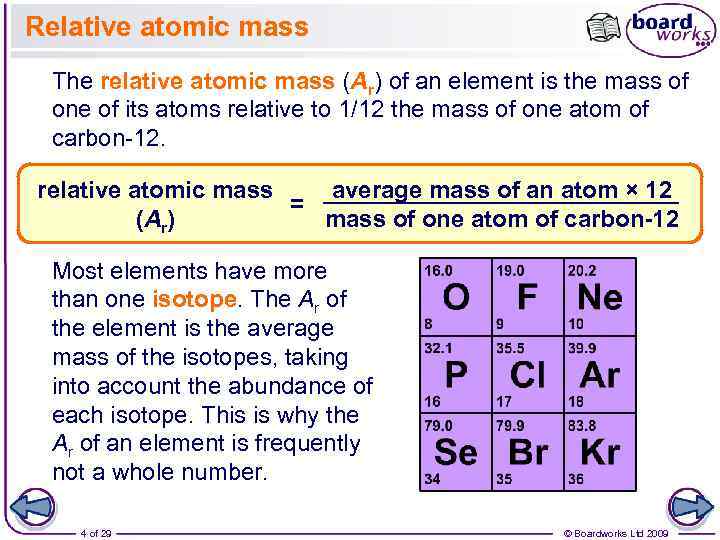
Relative atomic mass The relative atomic mass (Ar) of an element is the mass of one of its atoms relative to 1/12 the mass of one atom of carbon-12. relative atomic mass average mass of an atom × 12 = (Ar) mass of one atom of carbon-12 Most elements have more than one isotope. The Ar of the element is the average mass of the isotopes, taking into account the abundance of each isotope. This is why the Ar of an element is frequently not a whole number. 4 of 29 © Boardworks Ltd 2009
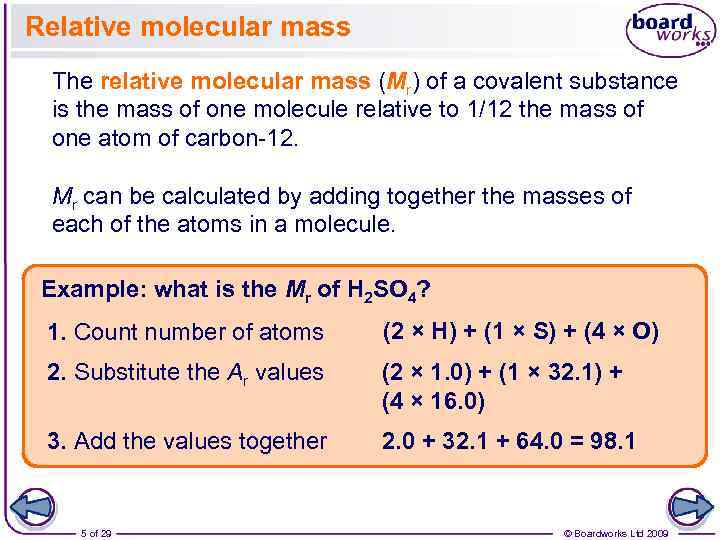
Relative molecular mass The relative molecular mass (Mr) of a covalent substance is the mass of one molecule relative to 1/12 the mass of one atom of carbon-12. Mr can be calculated by adding together the masses of each of the atoms in a molecule. Example: what is the Mr of H 2 SO 4? 1. Count number of atoms (2 × H) + (1 × S) + (4 × O) 2. Substitute the Ar values (2 × 1. 0) + (1 × 32. 1) + (4 × 16. 0) 3. Add the values together 2. 0 + 32. 1 + 64. 0 = 98. 1 5 of 29 © Boardworks Ltd 2009
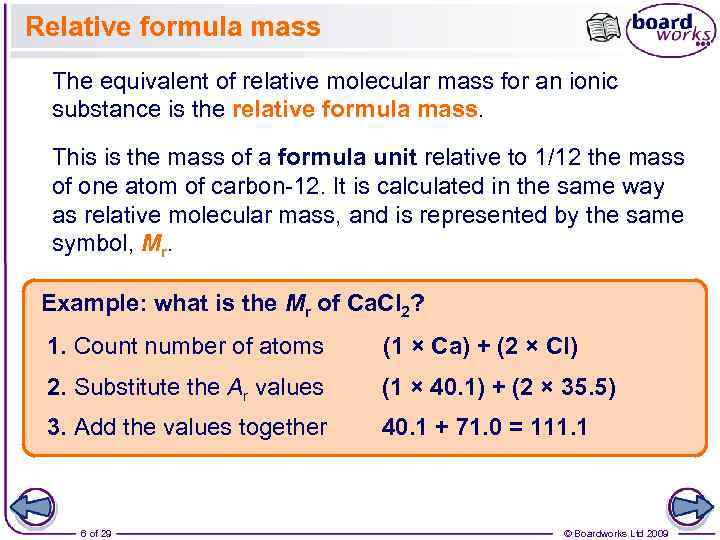
Relative formula mass The equivalent of relative molecular mass for an ionic substance is the relative formula mass. This is the mass of a formula unit relative to 1/12 the mass of one atom of carbon-12. It is calculated in the same way as relative molecular mass, and is represented by the same symbol, Mr. Example: what is the Mr of Ca. Cl 2? 1. Count number of atoms (1 × Ca) + (2 × Cl) 2. Substitute the Ar values (1 × 40. 1) + (2 × 35. 5) 3. Add the values together 40. 1 + 71. 0 = 111. 1 6 of 29 © Boardworks Ltd 2009
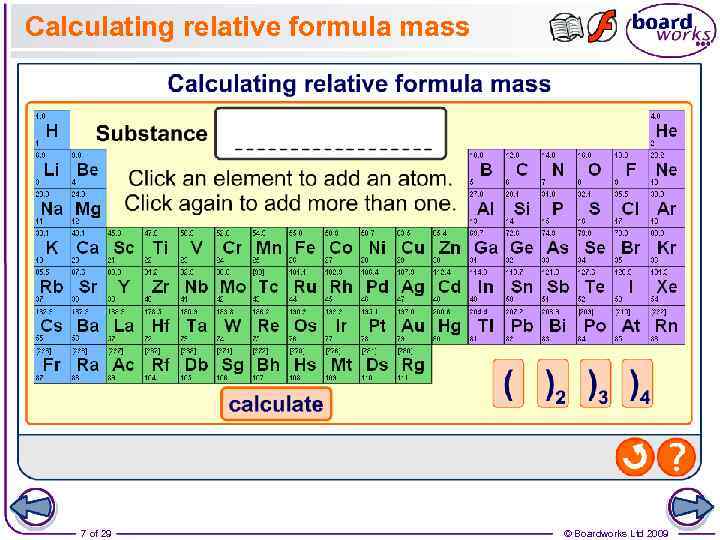
Calculating relative formula mass 7 of 29 © Boardworks Ltd 2009
8 of 29 © Boardworks Ltd 2009
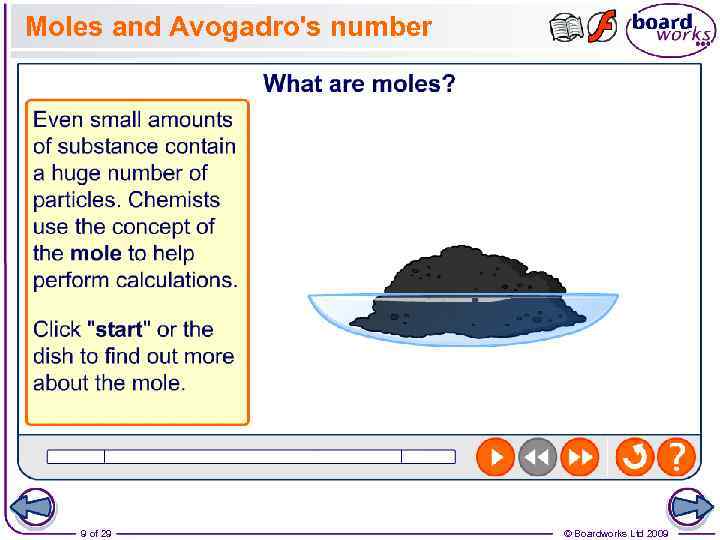
Moles and Avogadro's number 9 of 29 © Boardworks Ltd 2009
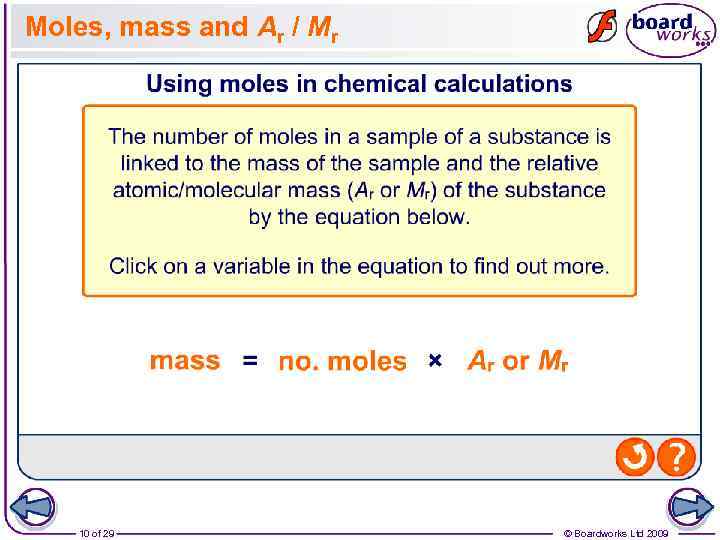
Moles, mass and Ar / Mr 10 of 29 © Boardworks Ltd 2009
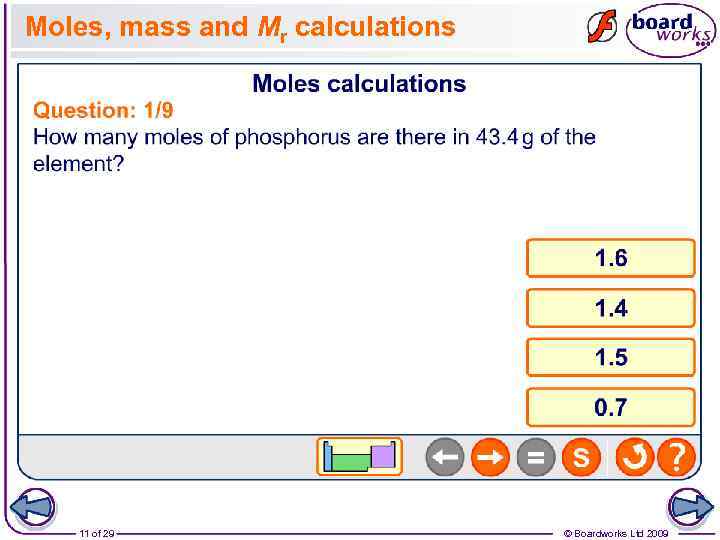
Moles, mass and Mr calculations 11 of 29 © Boardworks Ltd 2009
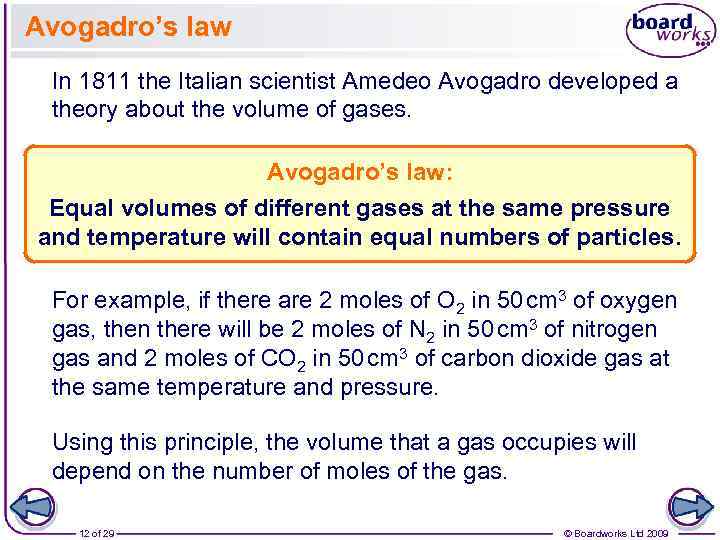
Avogadro’s law In 1811 the Italian scientist Amedeo Avogadro developed a theory about the volume of gases. Avogadro’s law: Equal volumes of different gases at the same pressure and temperature will contain equal numbers of particles. For example, if there are 2 moles of O 2 in 50 cm 3 of oxygen gas, then there will be 2 moles of N 2 in 50 cm 3 of nitrogen gas and 2 moles of CO 2 in 50 cm 3 of carbon dioxide gas at the same temperature and pressure. Using this principle, the volume that a gas occupies will depend on the number of moles of the gas. 12 of 29 © Boardworks Ltd 2009
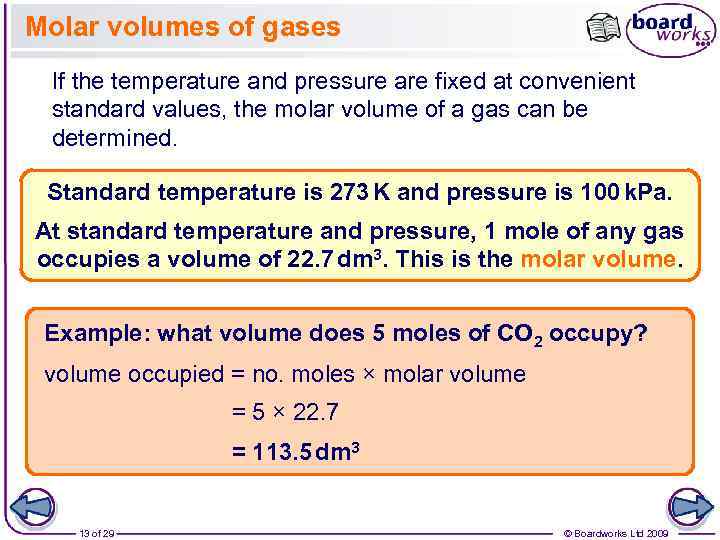
Molar volumes of gases If the temperature and pressure are fixed at convenient standard values, the molar volume of a gas can be determined. Standard temperature is 273 K and pressure is 100 k. Pa. At standard temperature and pressure, 1 mole of any gas occupies a volume of 22. 7 dm 3. This is the molar volume. Example: what volume does 5 moles of CO 2 occupy? volume occupied = no. moles × molar volume = 5 × 22. 7 = 113. 5 dm 3 13 of 29 © Boardworks Ltd 2009
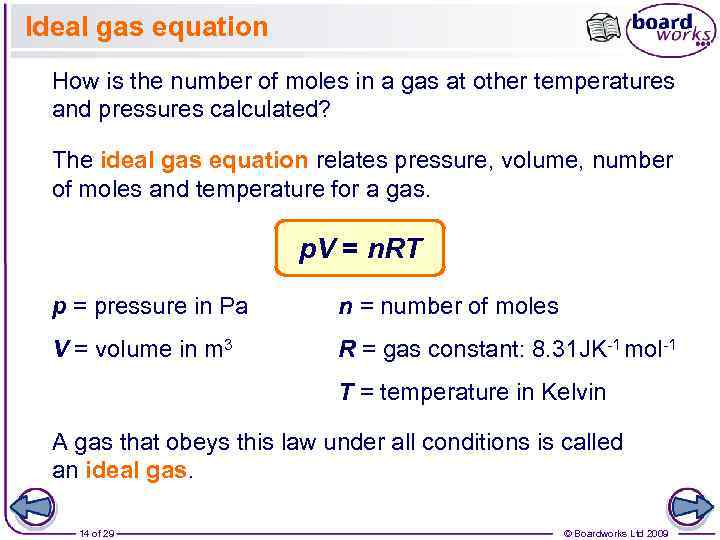
Ideal gas equation How is the number of moles in a gas at other temperatures and pressures calculated? The ideal gas equation relates pressure, volume, number of moles and temperature for a gas. p. V = n. RT p = pressure in Pa n = number of moles V = volume in m 3 R = gas constant: 8. 31 JK-1 mol-1 T = temperature in Kelvin A gas that obeys this law under all conditions is called an ideal gas. 14 of 29 © Boardworks Ltd 2009
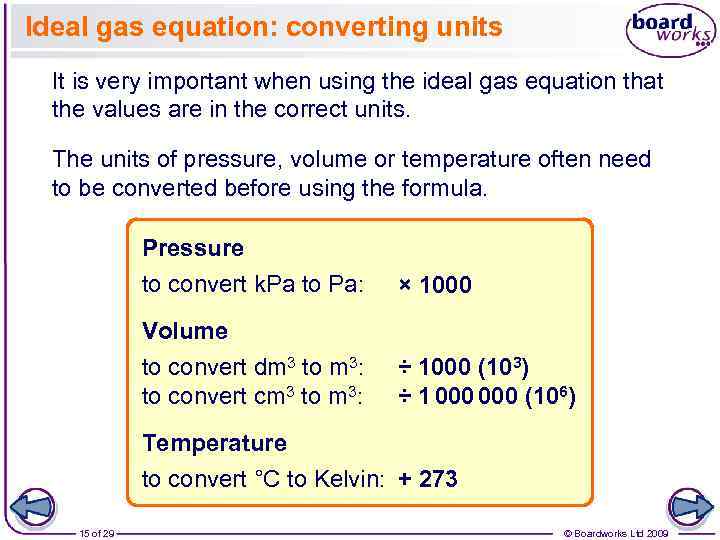
Ideal gas equation: converting units It is very important when using the ideal gas equation that the values are in the correct units. The units of pressure, volume or temperature often need to be converted before using the formula. Pressure to convert k. Pa to Pa: × 1000 Volume to convert dm 3 to m 3: to convert cm 3 to m 3: ÷ 1000 (103) ÷ 1 000 (106) Temperature to convert °C to Kelvin: + 273 15 of 29 © Boardworks Ltd 2009
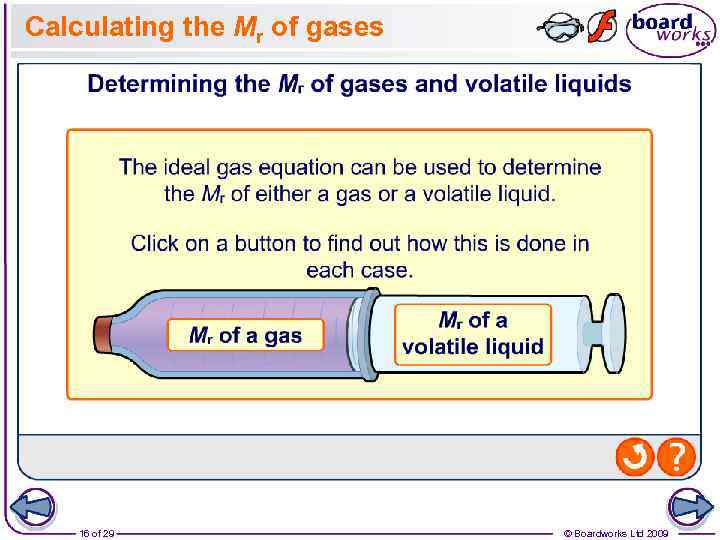
Calculating the Mr of gases 16 of 29 © Boardworks Ltd 2009
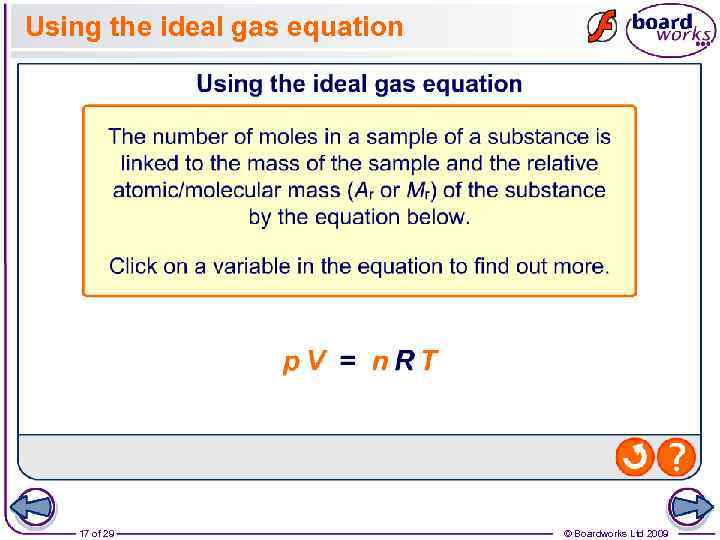
Using the ideal gas equation 17 of 29 © Boardworks Ltd 2009
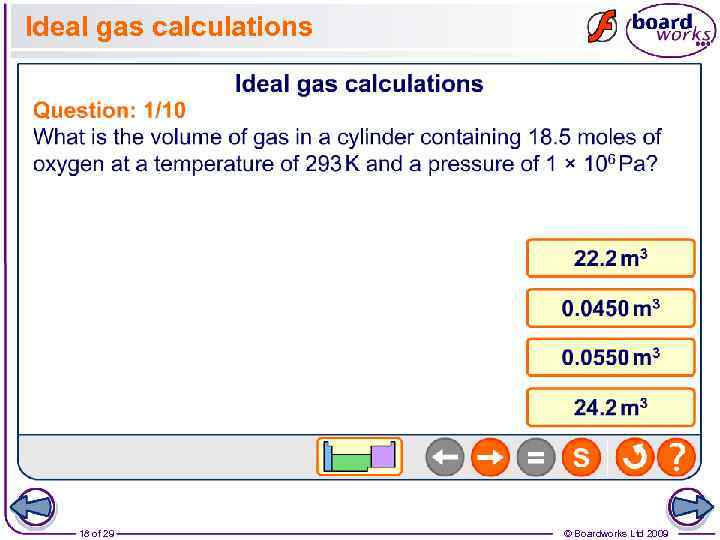
Ideal gas calculations 18 of 29 © Boardworks Ltd 2009
19 of 29 © Boardworks Ltd 2009
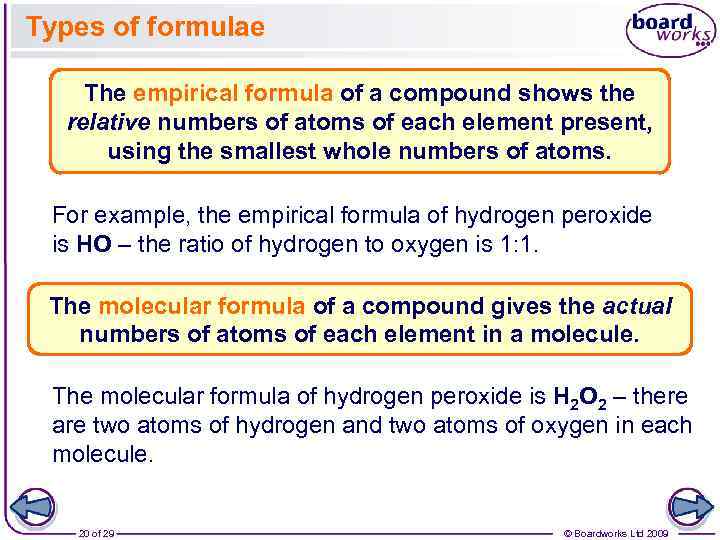
Types of formulae The empirical formula of a compound shows the relative numbers of atoms of each element present, using the smallest whole numbers of atoms. For example, the empirical formula of hydrogen peroxide is HO – the ratio of hydrogen to oxygen is 1: 1. The molecular formula of a compound gives the actual numbers of atoms of each element in a molecule. The molecular formula of hydrogen peroxide is H 2 O 2 – there are two atoms of hydrogen and two atoms of oxygen in each molecule. 20 of 29 © Boardworks Ltd 2009
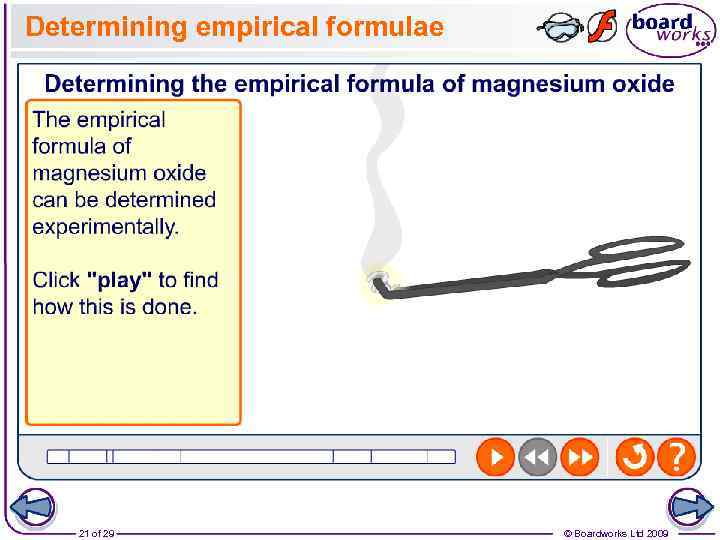
Determining empirical formulae 21 of 29 © Boardworks Ltd 2009
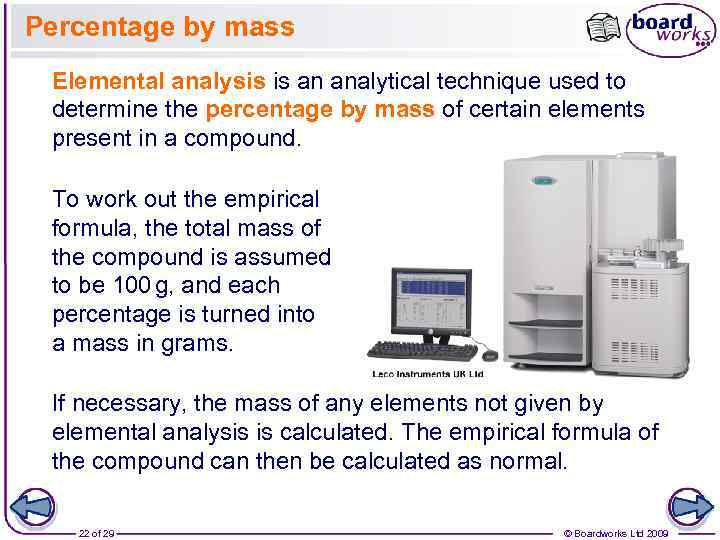
Percentage by mass Elemental analysis is an analytical technique used to determine the percentage by mass of certain elements present in a compound. To work out the empirical formula, the total mass of the compound is assumed to be 100 g, and each percentage is turned into a mass in grams. If necessary, the mass of any elements not given by elemental analysis is calculated. The empirical formula of the compound can then be calculated as normal. 22 of 29 © Boardworks Ltd 2009
Calculating empirical formulae 23 of 29 © Boardworks Ltd 2009
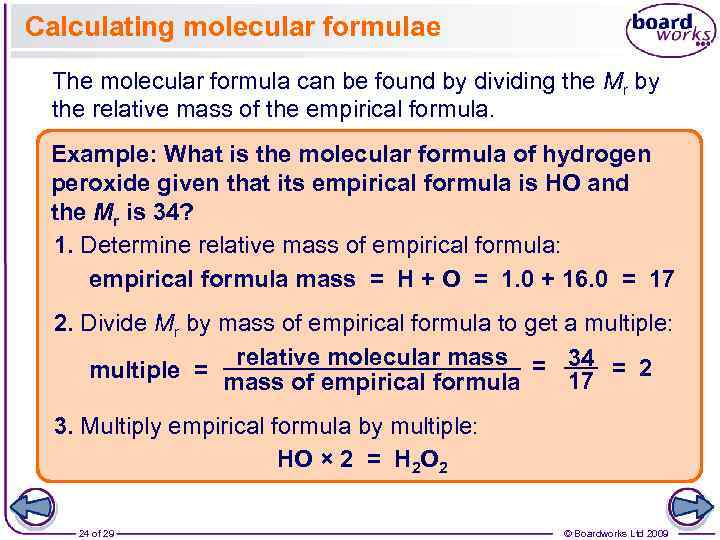
Calculating molecular formulae The molecular formula can be found by dividing the Mr by the relative mass of the empirical formula. Example: What is the molecular formula of hydrogen peroxide given that its empirical formula is HO and the Mr is 34? 1. Determine relative mass of empirical formula: empirical formula mass = H + O = 1. 0 + 16. 0 = 17 2. Divide Mr by mass of empirical formula to get a multiple: relative molecular mass = 34 = 2 multiple = 17 mass of empirical formula 3. Multiply empirical formula by multiple: HO × 2 = H 2 O 2 24 of 29 © Boardworks Ltd 2009
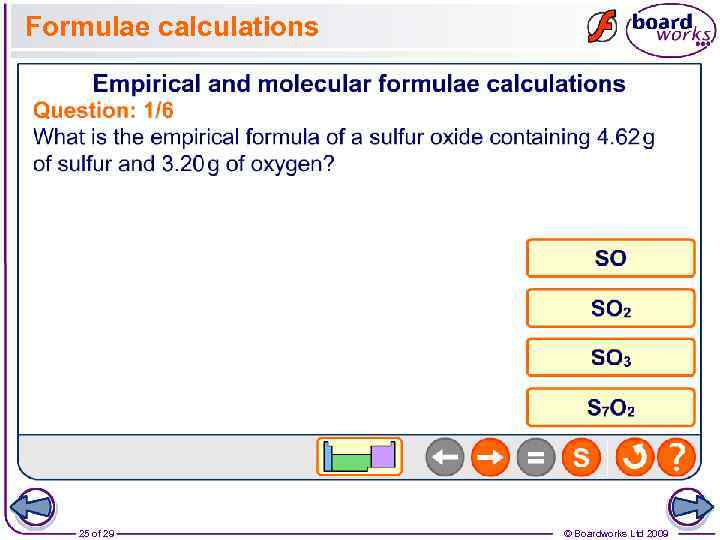
Formulae calculations 25 of 29 © Boardworks Ltd 2009
26 of 29 © Boardworks Ltd 2009
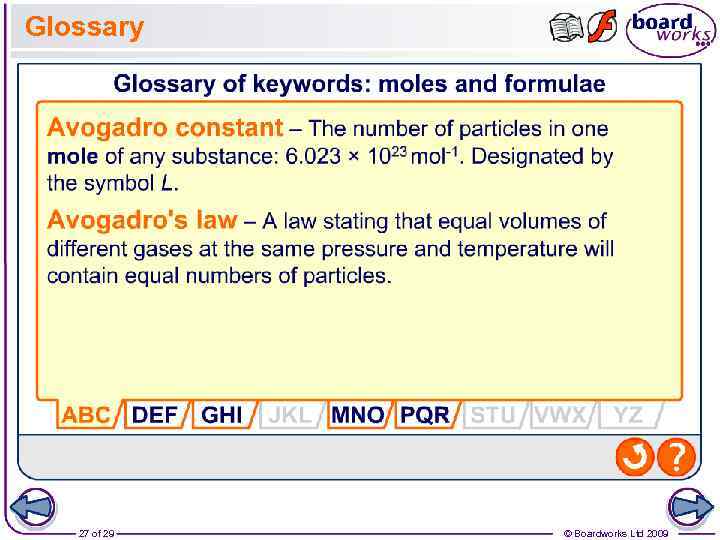
Glossary 27 of 29 © Boardworks Ltd 2009
What’s the keyword? 28 of 29 © Boardworks Ltd 2009
Multiple-choice quiz 29 of 29 © Boardworks Ltd 2009
