 Скачать презентацию 1 Objectives 1 To discover how and
897161f440c8aa1430b7d1096e4214a8.ppt
- Количество слайдов: 83



1
Objectives 1. To discover how and when the big computer companies came to be 2. To examine the progression of technology and computers throughout history 3. To look into the new and emerging technologies of the 21 st century 2
The Computer • Was originally nothing but a simple calculator or computing machine • Was developed and progressed through history by experimentation with current and previous technology – technology builds on itself at an increasing rate or exponentially 3
Timeline: The 30’s & 40’s • 1936 – Konrad Zuse on the Z 3 – the first electric computer – basically an automatic calculator 4
Timeline: The 30’s & 40’s • 1937 -John V. Atanasoff builds the Atanasoff-Berry Computer (ABC) – later was officially named the first electronic-digital computer – was the size of a desk – this innovation gave the modern computer: • a binary system • parallel processing • first form of memory or storage • separation of memory and computing functions 5
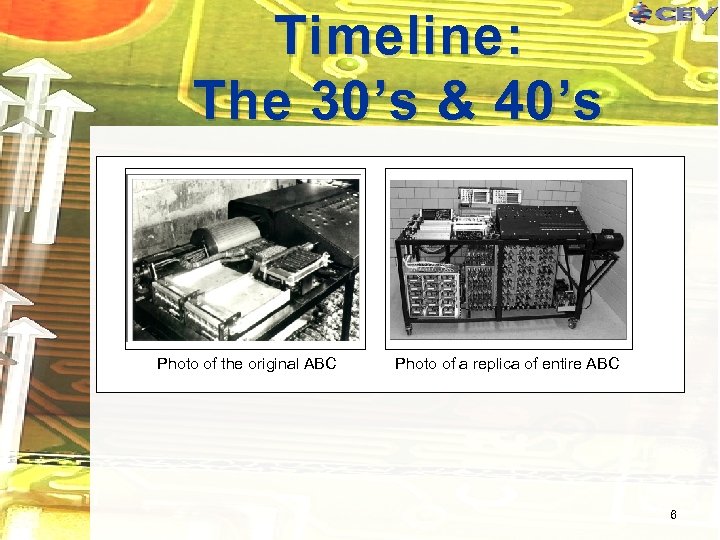
Timeline: The 30’s & 40’s Photo of the original ABC Photo of a replica of entire ABC 6
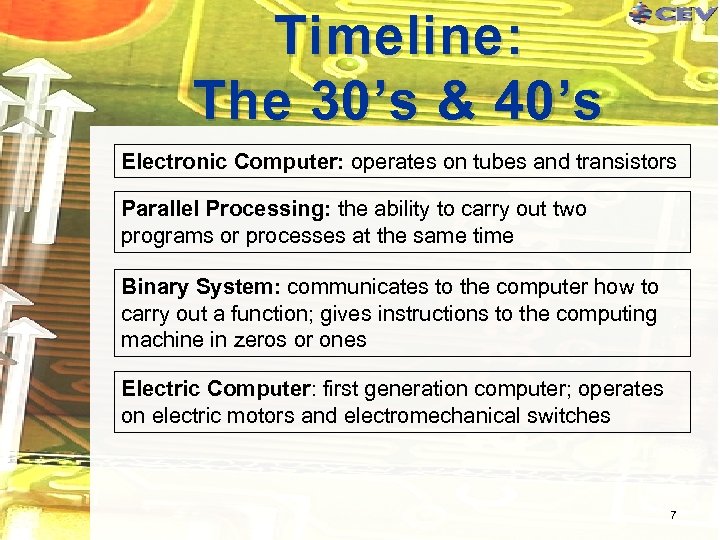
Timeline: The 30’s & 40’s Electronic Computer: operates on tubes and transistors Parallel Processing: the ability to carry out two programs or processes at the same time Binary System: communicates to the computer how to carry out a function; gives instructions to the computing machine in zeros or ones Electric Computer: first generation computer; operates on electric motors and electromechanical switches 7
Timeline: The 30’s & 40’s • 1943 - Thomas Flowers develops the Colossus – a British code-breaking computer – designed to decode secret messages encrypted by the German coding machines • 1946 – ENIAC was built by John Mauchly and J. Presper Eckert – the first computing machine with a storage device • this was the precursor to a computer’s memory or hard drive 8
Timeline: The 30’s & 40’s • 1948 - John Bardeen, Walter Brattain, William Shockley created the point contact transistor – a transistor is not a computer • it is a device designed to: – act as a transmitter by converting sound waves to electronic waves – act as a resistor by controlling electronic currents Transistor: a device designed to act as a transmitter by converting sound waves to electronic waves, and act as a resistor by controlling electronic currents 9
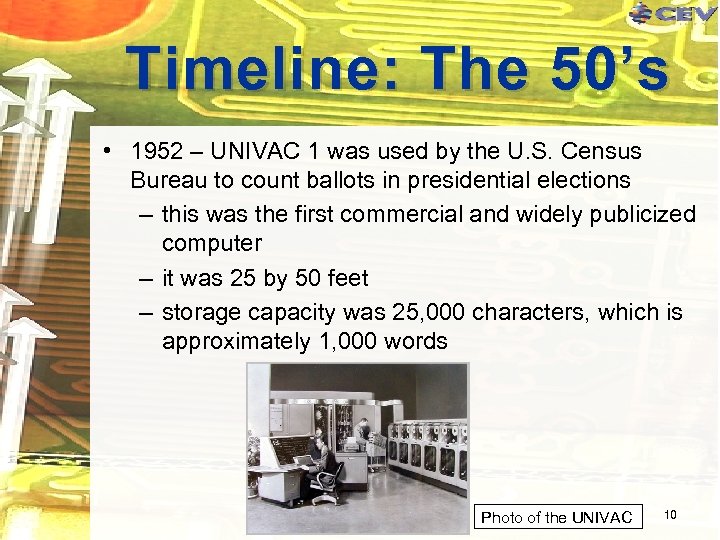
Timeline: The 50’s • 1952 – UNIVAC 1 was used by the U. S. Census Bureau to count ballots in presidential elections – this was the first commercial and widely publicized computer – it was 25 by 50 feet – storage capacity was 25, 000 characters, which is approximately 1, 000 words Photo of the UNIVAC 10
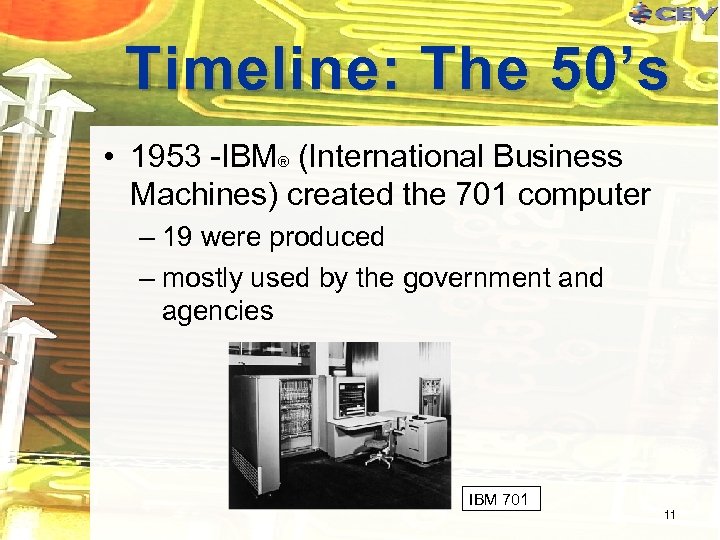
Timeline: The 50’s • 1953 -IBM® (International Business Machines) created the 701 computer – 19 were produced – mostly used by the government and agencies IBM 701 11
Timeline: The 50’s • 1958 – Jack Kilby and Robert Noyce simultaneously created the first miniaturized electric circuits – these were the first computer chips – the first chip had one transistor, three resistors and one capacitor • was the size of an adult's pinkie finger – Today computer chips can hold as many as 125 million transistors in a chip the size of a penny 12
Timeline: The 60’s • 1964 – Seymour Cray designed CDC's 6600® supercomputer – performs up to three million instructions per second – this processing speed was three times faster than its closest competitor ( the IBM Stretch®) • 1965 – PDP - 8® was manufactured by Digital Equipment Corp. – this was the first microcomputer 13
Timeline: The 60’s • 1966 – Hewlett Packard® introduced the HP-2115® – this computer had processing power equal to those twice or three times its size • the computer continues to get smaller • 1969 – the U. S. Department of Defense developed ARPAnet between four computers set up in different states – this was the predecessor to the Internet 14
Timeline: The 70’s • 1970 – Xerox® opened the Palo Alto Research Center (PARC) – this was the birthplace of many important innovations • 1971 - IBM® created the eight inch floppy disk – this was the first instance of portable storage 15
Timeline: The 70’s • 1971 – the Intel 4004® was the first microprocessor to be advertised to the public • 1974 – Xerox® Palo Alto Research Center designed the Alto – this was the first microprocessor with a built in mouse Microprocessor: the “brain” of the computer which processes all of the information and programs of the computer; also known as integrated circuit, microchip or central processing units(CPU) 16
Timeline: The 70’s • 1974 – Scelbi® (Scientific, Electronic and Biological) was the first “personal computer” introduced by Scelbi Computer Consulting Company – Came in a “kit” form, which means that the customer had to assemble the computer themselves • this is common for early computers – early computers such as this did not come with monitors 17
Timeline: The 70’s • 1975 – Telenet was formed – the first network used commercially and by civilians • 1975 – MITS, a company that manufactures calculators, created the Altair 8800® – this was the first personal computer that was comparable to commercially used computers 18
Timeline: The 70’s • 1976 – Steve Wozniak, a Hewlett-Packard® employee, created the Apple I® personal computer kit – it was at this time that Wozniak teamed up with Steve Jobs to start their computer business (Apple®) – used a video monitor (TV) for input and output functions – the computer consisted of a circuit board (a huge computer chip), a keyboard and a wooden case 19
Timeline: The 70’s • 1976 – The Queen of England Elizabeth II sent her first e-mail as a part of a demonstration • 1977 – Apple II® was introduced by Apple® with a built in video monitor, keyboard, case, built in cassette drives and a computer game known as “Breakout” • 1977 - The Commodore PET® was introduced along with many other personal computers 20
Timeline: The 70’s • 1979 - Daniel Bricklin and Robert Frankston created Visi. Calc® – this made the Apple II®, a personal computer, into a business machine – the program automated spreadsheets and allowed them to perform calculations 21
Timeline: The 80’s • 1981 – IBM® released their first personal computer (PC) the IBM 5150® – memory ranged from 16 k to 256 k (256 k = 0. 00024 GB) – sold for less than $1, 600 – at this time the personal computer market grew at a fast rate • 1981 – Bill Gates created MS-DOS®, or Microsoft Disk Operating System, which ran on IBM’s new PC – This created an important relationship between Bill Gates and IBM® 22
Timeline: The 80’s • 1981 – Xerox® introduced the Star® – it was a commercial computer • used by businesses – a GUI allows a computer to display graphics and images rather than just text on a monitor – computers are now in need of a mouse – up to 40 MB hard drive • modern computers have 750 GB hard drives • this is equal to 768000 MB • you would need to have 19, 200 Star® computers to get the processing capabilities of one modern day 23 computer
Timeline: The 80’s • 1983 – Apple® introduced the Lisa® – this is the first personal computer with (GUI) – the Lisa was sold for approximately $10, 000 • this high price attributed to the failure of the Lisa® – the development of this computer was important for PC users, because the GUI technology became available to them Graphical User Interface (GUI): allows a computer to display graphics and images to the user rather than just text on a monitor 24
Timeline: The 80’s • 1984 – Apple® Computer Co. came out with the Macintosh® – this was the first widely successful GUI enabled PC with a mouse 25
Timeline: The 90’s • 1990 – the World Wide Web (WWW) was developed when Tim Berners-Lee developed Hyper. Text Markup Language (HTML) – browser interprets HTML allowing users to view other’s Web pages and sites – the WWW allows users to view documents that are stored on another computer – available to the general public in 1991 Markup Language : a coding system used to structure text files in a document translating it into a Web document Hyper. Text Markup Language (HTML) : a complex authoring language which converts text to a language so that one may display materials (text, graphics, video) on a Web page 26
Timeline: The 90’s • 1993 - Intel® releases their Pentium processor® (a microchip) – contains more than a million transistors • remember the first computer only had one transistor • that was only 35 years at this point • 1994 – Yahoo!® was founded by Jerry Yang and David Filo – was originally named “Jerry's Guide to the World Wide Web” 27
Timeline: The 90’s • 1995 - Microsoft® released Windows 95® – extremely successful – first 32 -bit operating system • this refers to the amount of information and executions a computer can make at one time 28
Timeline: The 90’s Operating System: software that controls the major functions of a computer such as allocating memory to different programs, and protecting the computer and information on it from unauthorized access; example: Windows 2007® Bit: a binary digit, which is the smallest piece of data on a computer; the bit can contain one of two values: one or zero; these values are interpreted by the computer and give the computer instructions 29
Bit Operating System Example • Think of a computer’s motherboard or circuit board as having traffic lanes that allow it to process information. A computer can have 16, 32, 64 or 128 lanes (this illustrates the number of bits in the operating system). Similar to traffic lanes, if a computer’s OS has only 16 bits, it can only process about half the information that a computer with a 32 bit OS can; not as many cars are able to drive on a four lane highway opposed to a six lane highway. Previous to 2008, the major of OS software was only a 32 -bit software; however after 2008 OS will only be 64 -bit software, which will allow it to process twice the information as the previous OS’s. Circuit Board: or motherboard; the “heart” of every machine that all other components of the computer connect to and through to 30 each other
Timeline: The 90’s • Intel® kept releasing new, high level and smaller micro chips – 1995 – Pentium processor® – 1997 – Pentium II processor® – 1998 - Celeron® – 1999 – Pentium III processor® • 1998 - Microsoft® releases Windows 98® 31
Timeline : st Century The 21 • 2000 – Microsoft® released Windows 2000® • 2000 - Intel® releases Pentium 4® • 2001 – Computer Industry celebrated the 20 th anniversary of the first IBM® PC • 2003 – Advanced Micro Devices® (AMD) comes out with Athlon 64® – this is the first 64 -bit OS • 2004 - Intel® releases Pentium 4 Prescott® – a 64 -bit OS 32
Microminiaturization • Is the process of getting progressively smaller, and more capable (able to process more information) that integrated circuits or microprocessors have gone through • Has allowed computers to become smaller, lighter and able to process more – because the microchip is doing the same 33
Microminiaturization • Is illustrated by the progression of Intel® through history – Intel® is a major microchip industry player – other microchip companies include: • AMD® • Texas Instruments® (TI) • Samsung® Microprocessor: the “brain” of the computer, which processes all of the information and programs of the computer; also known as or integrated circuit, microchip or central processing units(CPU) 34
Microchips • Are comprised of several important elements: – transistors – microns – data width – MIPS 35
Microchips Transistor: a device designed to act as a transmitter by converting sound waves to electronic waves, and act as a resistor by controlling electronic currents Micron: a unit of measurement for the width of the smallest wire on a chip Data Width: refers to the amount of data calculations a microchip can perform at one time MIPS: stands for millions of instructions per second; or how many instructions a computer can translate into functions at one time 36
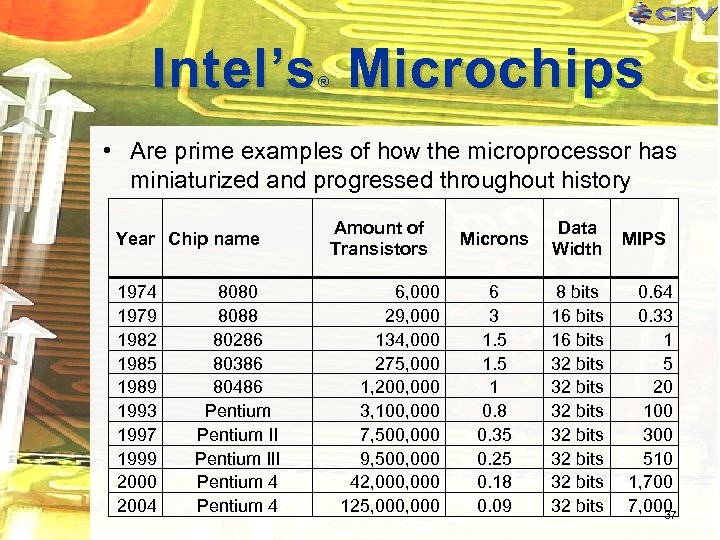
Intel’s Microchips ® • Are prime examples of how the microprocessor has miniaturized and progressed throughout history Year Chip name 1974 1979 1982 1985 1989 1993 1997 1999 2000 2004 8080 8088 80286 80386 80486 Pentium III Pentium 4 Amount of Transistors 6, 000 29, 000 134, 000 275, 000 1, 200, 000 3, 100, 000 7, 500, 000 9, 500, 000 42, 000 125, 000 Microns Data Width MIPS 6 3 1. 5 1 0. 8 0. 35 0. 25 0. 18 0. 09 8 bits 16 bits 32 bits 32 bits 0. 64 0. 33 1 5 20 100 300 510 1, 700 7, 000 37
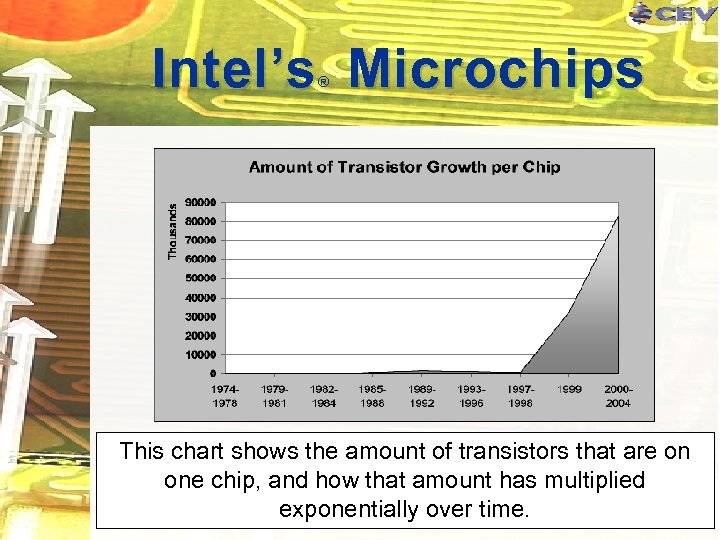
Intel’s Microchips ® This chart shows the amount of transistors that are on one chip, and how that amount has multiplied exponentially over time. 38
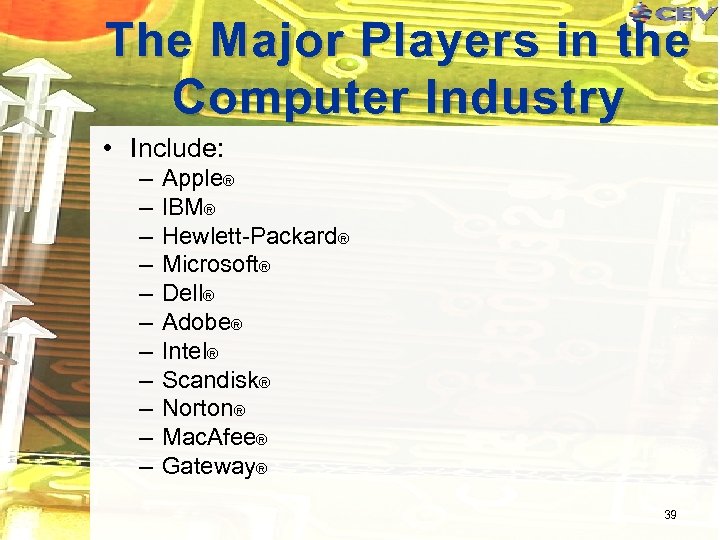
The Major Players in the Computer Industry • Include: – – – Apple® IBM® Hewlett-Packard® Microsoft® Dell® Adobe® Intel® Scandisk® Norton® Mac. Afee® Gateway® 39
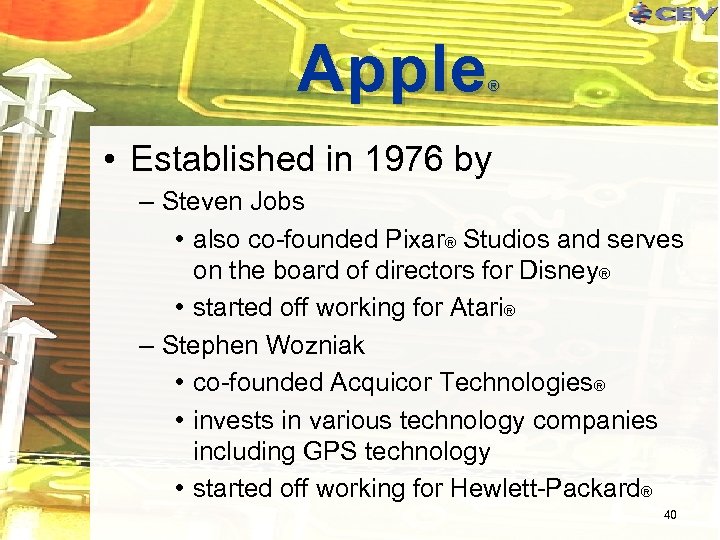
Apple ® • Established in 1976 by – Steven Jobs • also co-founded Pixar® Studios and serves on the board of directors for Disney® • started off working for Atari® – Stephen Wozniak • co-founded Acquicor Technologies® • invests in various technology companies including GPS technology • started off working for Hewlett-Packard® 40
Apple ® – Was founded in 1976 • Began with the Apple I® computer – designed by Wozniak and marketed by Jobs • Had several thousand employees by 1980 – this is when the company really began to take off and profits were significantly rising • Made significant strides with its first personal computer, the Macintosh® 41
Apple ® • In 1985 began to lose market share because: – Apple® hired John Sculley to become President and CEO – Sculley and Jobs had conflicting views – As a result of a power struggle, Jobs retired • Between 1985 and 1996 had two different CEO’s after Sculley retired and reported significant profit losses 42
Apple ® • Was rejuvenated in 1997 when Jobs began to take the company matters into his own hands – they released two new Apple® computers and began selling through e-commerce • In 2000, began expanding into different products such as: – – MP 3 players CD players digital cameras these all attributed to the comeback and success of Apple in the 21 st century E-commerce: the Internet commerce channel to sell and distribute items purchased online 43
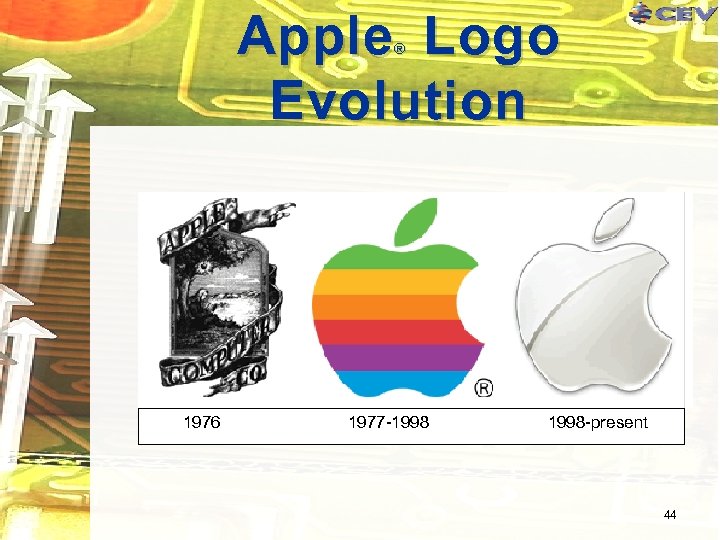
Apple Logo Evolution ® 1976 1977 -1998 1998 -present 44
Microsoft ® • Was developed by Paul Allen and Bill Gates – they first developed the program BASIC® for the Altair 8800 in 1975 • this was the first instance of computer software however it was not very sophisticated and could perform only a few functions – Allen and Gates presented BASIC to MITS (Micro Instrumentation and Telemetry Systems) • MITS bought the rights to BASIC – Gates dropped out of Harvard and formed Microsoft® 45
Microsoft ® • Released their first advertisement in 1976 titled “The Legend of Micro-Kid” • In 1977, BASIC was in high demand – Gates and Allen expanded their business • Gates became President of Microsoft® • Allen became Vice President • In 1978, announces the release of the software COBOL-80® • In 1979, Microsoft begins expanding and forming business relationships overseas 46
Microsoft ® • In 1979 demonstrates Visi. Calc at a tradeshow – this is the first spreadsheet software • In 1981, becomes the first company to design products for the Apple Macintosh® personal computer 47
Microsoft ® • In 1983 releases the first Microsoft Mouse® for the IBM PC • In 1984 release Microsoft Excel® spreadsheet application • In 1989 releases Microsoft Word® • In 1990, releases Microsoft Windows 3. 0® 48
Microsoft Logo Evolution ® 1975 -1987 -present 49
Microsoft ® • Continued to grow with profits reaching $36. 84 billion in only 30 years • Has recently released the Microsoft Surface® – this “coffee table computer” allows users to interact with the screen to manipulate different items with their hands – it does not require the user to connect any devices to transfer data file • the user can just set a camera on the top of the screen and drag pictures on and off their camera – allows for multiple interactions of the screen • a computer mouse only allows one interaction • Is ranked 49 on Fortune 500 list 50
Dell ® • Was started in 1984 by Michael Dell • In 1986 released the industry’s fastest computer • In 1989 releases the industry’s first notebook computer • By 2001 is ranked first as the company to hold the largest percentage of global market share • Is currently improving the area of power efficiency • Is currently trying to integrate Blu-Ray Disc(BD) technology into their computers • Is ranked 34 on Fortune 500 list 51
Blu-Ray Disc Technology • Is the next generation optical disc technology • Was developed to record, rewrite and play high definition (HD) video • Allows for a higher amount of storage capacity • Is compatible with many leading electronic devices and will become the new standard for optical discs – that is until someone comes up with something new Optical Disc: an electronic data storage device that is written with a low-powered laser 52
Adobe ® • Was founded in 1982 by John Warnock and Chuck Geschke • Released their first logo • In 1985 released Post. Script® – this is a programming language designed specifically to optimize graphics and text for users – many computer companies at this point began to integrate Post. Script® into their machines • In 1991 released Adobe Portable Document Format® (PDF) – this allows images to be replicated on a computer screen and printed – graphics are still commonly displayed in this format Post. Script: programming language designed specifically to optimize graphics and text for users 53
Hewlett-Packard ® • Was found in 1939 by Bill Hewlett and Dave Packard • In 1966 produced their first computer • In 1980, they produced their first personal computer the HP-85® • In 1983, they released the HP-150® the first touch screen computer • In 2006, they were ranked 14 by Fortune 500 • Is currently focusing their efforts on recycling computers, expanding into growing economies, and making acquisitions 54
IBM ® • Stands for International Business Machines • Was founded in 1911 as CTR (Computer. Tabulating-Recording Company) – the name was changed to IBM in 1924 • In 1953 created the 701 computer – this was one of the first computers used primarily by government agencies • In 1981 released their personal computer • In 1993 announced that the Think. Pad 750® will be the first modern notebook computer to travel to space – it assisted astronauts in repairing the Hubble Telescope 55
IBM ® • Is currently: – improving their mainframe computer systems for businesses – working on data server systems – working with astronomy research organizations for customized, mixed signal processing to help develop a new type of radio telescope – ranked 15 on the Fortune 500 list Mainframe Computer: a large, complex computer with enough processing capabilities to accommodate large businesses Radio Telescope: a telescope that gathers radio waves or emissions from stars, galaxies and other astronomical objects 56
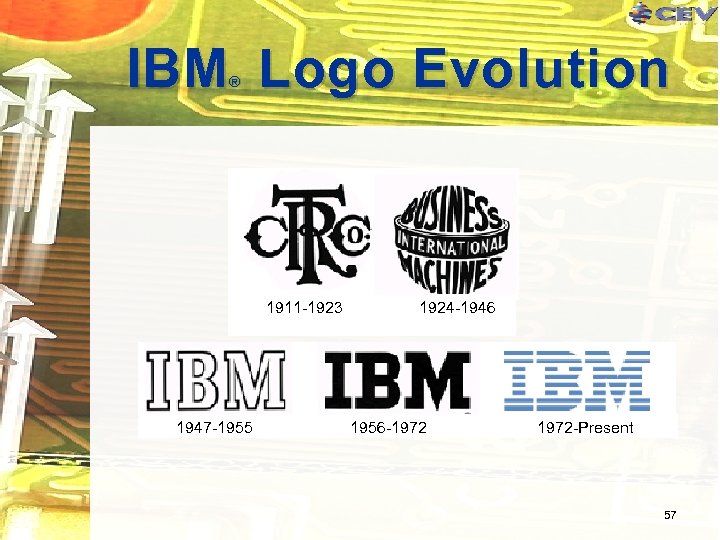
IBM Logo Evolution ® 1911 -1923 1924 -1946 1947 -1955 1956 -1972 1972 -Present 57
Other Major Computer Industry Players • Include: – Scandisk® – Symantec® – Mc. Afee® – Gateway® 58
Scandisk ® • Was founded in 1988 by Dr. Eli Harari • Created nonvolatile memory technology • Is the world’s largest supplier of flash memory products • Have facilitated the innovativeness of digital cameras, multi-function cell phones, flash drives, etc Flash Drive: a small memory storage device for a computer that uses flash memory Nonvolatile Memory : a memory source that retains information if power to the computer is removed 59
Symantec ® • Leads the software industry by providing content and network security programs for PCs • Created Norton Antivirus® – one of the most commonly used software for computer protection 60
Mc. Afee ® • Was founded in 1987 by John Mc. Afee • Has made a big impact in the area of operating systems such as: – Open Source software: • Linux® • Free. BSD® • Darwin® • Leads the software industry in the fields of firewall and file encryption technologies Open Source Software: a software for which the code used to write the software is made available to users, so they can manipulate it if they wish File Encryption: the use of mathematical formulas to scramble data for security purposes Firewall: a computer program that secures computers and networks from 61 access by unauthorized users
Gateway ® • Was founded in 1985 by Ted Waitt and Mike Hammond • Began with the TIPC network – this was a computer mail order business • Eventually furthered its product line by manufacturing personal computers • The computers are known as e. Machines® today and best known for the cow spot print packaging TIPC Network: a computer mail order business 62
Emerging Technologies • Include: – streaming video – multi-function mobile devices – security devices – data transfer – wireless communications 63
Streaming Video • Is the series of “moving images” that are sent in a compressed form over the Internet • Is combined with flash memory technology – this allows users to add metadata to the video stream • Allows users to view videos online without having to download because the data file is continuously flowing or “streaming” – this increases Internet speed because users no longer have to wait for an item to download 64
Streaming Video • Increases the amount and speed of information from user to user – this is important because video applications such as You. Tube® account for approximately 60 percent of all Internet traffic, this number is only getting larger Metadata: data that describes or further explains data such as closed captions on Internet TV 65
Mobile Devices • Are continually being improved and combined with other devices such as: – a cell phone – an MP 3 player – GPS device – computer functions • Are allowing information to travel faster between people, companies and countries • Equipped with GPS allow people to move around the world without the fear of being stranded 66
Mobile Example: You are a real estate agent. One of your primary duties is to drive to houses to show them to clients. With a GPS enabled phone, you are able to find your way to each house without having to call and get directions or going back to your office. You can also manage your time more efficiently by knowing exactly how fast you can get somewhere and coordinating this with the perspective owners and other clients. 67
Mobile Devices • Are able to process more and store larger amounts of data – this is because the microprocessor is continually getting smaller and more capable • Are incorporated touch screen technology – Example: iphone® is more functional as a phone AND a computer because the touch screen allows for more screen area without the need for buttons 68
Security Devices • Include technologies such as: – fingerprint security devices • are useful because fingerprints are completely unique • are being used more for security of all kinds such as: – computer security – authentification » for different devices such as: cars, cell phones, computers and data » makes theft less appealing and more difficult – built in GPS systems provide security for theft • able to locate device anywhere in the world 69
Security Devices • Such as: – retinal scanning machine • scan a person’s retina • provide a higher level of security that is difficult to replicate – cameras • are now able to detect what is underneath clothing – higher level of security to ensure safety • are able to scan a crowd of people and detect a certain person • are being placed on city streets around the world 70
Data Transfer • Is the process of sending and receiving data through a network • Is increasingly becoming wireless Example: Refer back to the Microsoft® Surface. It allows users with wireless devices to simply place them on the surface of the computer and drag files or pictures to the mobile device without connecting the device to the computer. 71
Wireless Communications • Allow for higher connectivity in all aspects of daily living – users are able to be increasingly mobile with their lives • opposed to being near a computer and Internet connection constantly 72
Wireless Communications • Are being applied to new aspects of everyday life such as: – Health • there are new mobile devices that track heart rate, blood pressure, body temperature, etc. • then wirelessly send the information to a computer to ensure safety – Stocks • stocks and financial profiles can be manipulated and monitored wirelessly 73
Quiz 1. A device designed to act as a transmitter, by converting sound waves to electronic waves, and act as a resistor, by controlling electronic currents is a(n) a. GUI b. transistor c. electric computer d. electronic computer 2. The speed and capacity of microprocessor chips doubles annually. a. true b. false 74
Quiz 3. The first “personal computer” was the a. Scelbi b. Apple I c. Apple II d. Commodore PET 4. The Atanasoff-Berry Computer (ABC) created all of the following capabilities for the modern computer except a. parallel processing b. first form of memory or storage c. disc drives d. separation of memory and computing functions 75
Quiz 5. When Tim Berners-Lee developed ________, this helped him create the World Wide Web. a. video monitors b. GUI c. HTML d. hard drives 6. What allows a computer to display graphics and images rather than just text on a monitor? a. HTML b. icrons c. MIPS d. GUI 76
Quiz 7. The process of getting progressively smaller, and more capable that integrated circuits or microprocessors have gone through is known as a. microminiaturization b. micron progression c. parallel processing d. metadata 8. Intel’s® first product released in 1969 that gives computers memory space for programs that are open or running is known as a. microprocessor b. RAM c. microchip d. the bit 77
Quiz 9. Paul Allen and Bill Gates first designed which program for the Altair 8800, which led them to start Microsoft® a. Windows® b. COBOL – 80 c. Visi. Calc d. BASIC 10. Adobe® created ______ which allows images to be replicated on a computer screen and printed. a. Visi. Calc b. Post. Script c. GUI d. PDF 78
Quiz 11. Nonvolatile memory technology was created by a. Intel® b. Apple® c. Scandisk® d. Adobe® 12. The Intel® Tera-scale Computing Research Program was developed to a. improve the functioning capabilities of the microprocessor in the next decade b. progress computing technology in the next decade c. decrease the size of computers and increase the amount processing capabilities in the next decade d. advance the amount of memory used by computer in the next decade 79
Quiz 13. Data that describes or further explains data is known as a. metadata b. flash technology c. data transfer d. streaming video 14. List two of the four important elements that comprise Micro chips. 15. TICP networking was created by a. Adobe® b. Intel® c. Gateway® d. Apple® 80
Sources • • Upgrading and Repairing PCs, 15 th Anniversary Edition by Scott Mueller Publisher: Que Pub Date: August 12, 2003 http: //pancybertronics. com/joomla/index. php? option=com_content&task=view&id=14&Itemid=29 • http: //inventors. about. com/library/blcoindex. htm • http: //www. computerhistory. org/timeline/? year=1952 • http: //www-03. ibm. com/ibm/history/exhibits/pc 25_intro. html • www. satech. com/glosofmemter. html • http: //kb. iu. edu/data/afrv. html • http: //finance. yahoo. com/q/co? s=intc • http: //computer. howstuffworks. com/microprocessor 1. htm • http: //www. apple-history. com/ 81
Sources • • • • • • • http: //www. thocp. net/companies/microsoft_company. htm http: //research. microsoft. com/search. aspx? qu=streaming+video&id=all http: //www. dell. com/content/topics/global. aspx/about_dell/company/history? c=us&l=en&s=corp http: //www. blu-ray. com/info/ http: //www. adobe. com/aboutadobe/history/ http: //www. hp. com/hpinfo/abouthp/histnfacts/timeline/ http: //www-03. ibm. com/ibm/history/year_2006. html http: //www. sandisk. com/corporate/about/ http: //www. associatedcontent. com/article/283729/the_history_of_mcafee. html http: //www. open 2. net/sciencetechnologynature/computing/glossary. html http: //www. intel. com/museum/corporatetimeline/index. htm http: //www. adobe. com/devnet/flashmediaserver/articles/metadata_video_streaming_04. html http: //www. technologyreview. com/read_article. aspx? ch=specialsections&sc=emerging&id=18284 http: //www. cnn. com/2008/WORLD/europe/04/16/camera. england/ 82
Acknowledgements Production Coordinator: Jessica House Production Manager: Project Coordinator: Meghan Blanek Dusty Moore Executive Producers: Graphic Designer: Gordon Davis, Ph. D. , Jeff Lansdell Ann Adams © MMVIII CEV Multimedia, Ltd. 83
Скачать презентацию 1 Objectives 1 To discover how and
897161f440c8aa1430b7d1096e4214a8.ppt