 Скачать презентацию 1 Object-Oriented Software Construction Bertrand Meyer Lecture 6
464c49c1d13dd32172d38e33509744c2.ppt
- Количество слайдов: 20



1 Object-Oriented Software Construction Bertrand Meyer Lecture 6: Genericity Chair of Software Engineering OOSC - Summer Semester 2005
![Genericity 2 Unconstrained LIST [G] e. g. LIST [INTEGER], LIST [PERSON] Constrained HASH_TABLE [G](https://present5.com/presentation/464c49c1d13dd32172d38e33509744c2/image-2.jpg "Genericity 2 Unconstrained LIST [G] e. g. LIST [INTEGER], LIST [PERSON] Constrained HASH_TABLE [G")
Genericity 2 Unconstrained LIST [G] e. g. LIST [INTEGER], LIST [PERSON] Constrained HASH_TABLE [G ―> HASHABLE] VECTOR [G ―> NUMERIC] Chair of Software Engineering OOSC - Summer Semester 2005
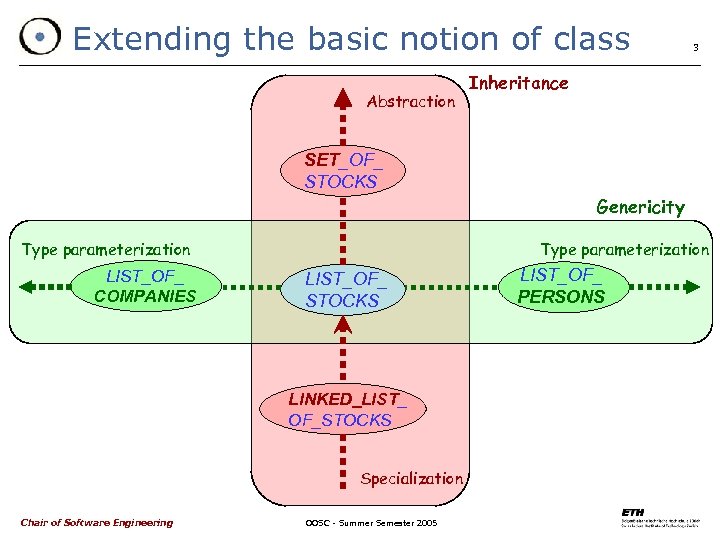
Extending the basic notion of class Abstraction 3 Inheritance SET_OF_ STOCKS Genericity Type parameterization LIST_OF_ COMPANIES Type parameterization LIST_OF_ STOCKS LINKED_LIST_ OF_STOCKS Specialization Chair of Software Engineering OOSC - Summer Semester 2005 LIST_OF_ PERSONS
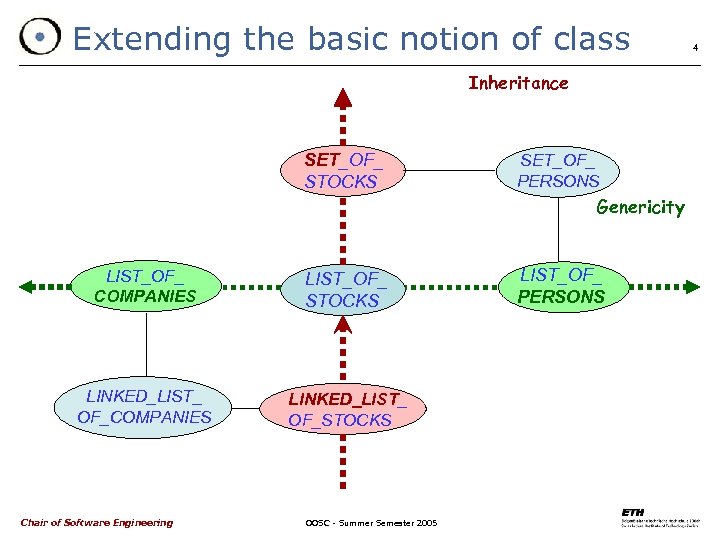
Extending the basic notion of class Inheritance SET_OF_ STOCKS SET_OF_ PERSONS Genericity LIST_OF_ COMPANIES LIST_OF_ STOCKS LINKED_LIST_ OF_COMPANIES LINKED_LIST_ OF_STOCKS Chair of Software Engineering OOSC - Summer Semester 2005 LIST_OF_ PERSONS 4
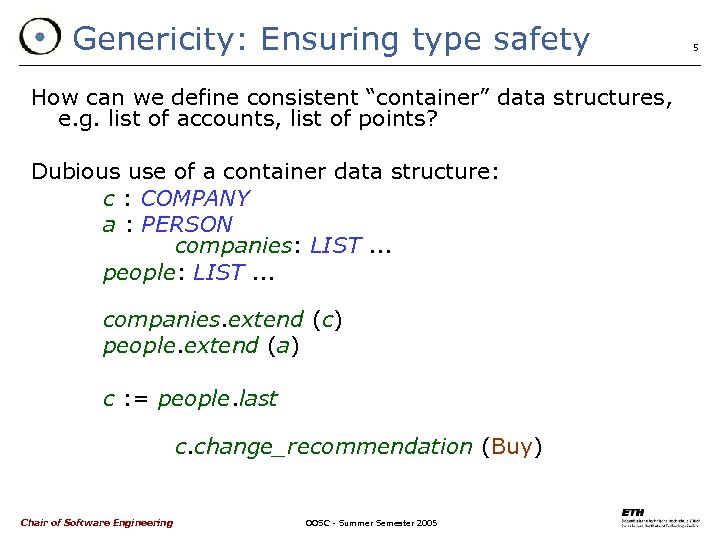
Genericity: Ensuring type safety How can we define consistent “container” data structures, e. g. list of accounts, list of points? Dubious use of a container data structure: c : COMPANY a : PERSON companies: LIST. . . people: LIST. . . companies. extend (c) people. extend (a) c : = people. last c. change_recommendation (Buy) Chair of Software Engineering OOSC - Summer Semester 2005 5
Possible approaches 6 § Wait until run time; if types don’t match, trigger a run-time failure. (Smalltalk) § Cast to a universal type, such as “pointer to void” in C. § Duplicate code, manually or with help of macro processor. § Parameterize the class, giving an explicit name G to the type of container elements. This is the Eiffel approach. Chair of Software Engineering OOSC - Summer Semester 2005
![A generic class 7 Formal generic parameter class LIST [G] feature extend (x: G)](https://present5.com/presentation/464c49c1d13dd32172d38e33509744c2/image-7.jpg "A generic class 7 Formal generic parameter class LIST [G] feature extend (x: G)")
A generic class 7 Formal generic parameter class LIST [G] feature extend (x: G) is. . . last: G is. . . end To use the class: obtain a generic derivation, e. g. companies: LIST [COMPANY] Actual generic parameter Chair of Software Engineering OOSC - Summer Semester 2005
![Conformance rule § B [U] conforms to A [T] if and only if B](https://present5.com/presentation/464c49c1d13dd32172d38e33509744c2/image-8.jpg "Conformance rule § B [U] conforms to A [T] if and only if B")
Conformance rule § B [U] conforms to A [T] if and only if B is a descendant of A and U conforms to T. Chair of Software Engineering OOSC - Summer Semester 2005 8
![Using generic derivations companies: LIST [COMPANY] people: LIST [PERSON] c: COMPANY p: PERSON. .](https://present5.com/presentation/464c49c1d13dd32172d38e33509744c2/image-9.jpg "Using generic derivations companies: LIST [COMPANY] people: LIST [PERSON] c: COMPANY p: PERSON. .")
Using generic derivations companies: LIST [COMPANY] people: LIST [PERSON] c: COMPANY p: PERSON. . . companies. extend (c) people. extend (p) c : = companies. last c. change_recommendation (Buy). . . Chair of Software Engineering OOSC - Summer Semester 2005 9
Genericity and static typing Compiler will reject people. extend (c) companies. extend (p) To define more flexible data structures (e. g. stack of figures): use inheritance, polymorphism and dynamic binding. Chair of Software Engineering OOSC - Summer Semester 2005 10
Typing in an O-O context An object-oriented language is statically typed if and only if it is possible to write a “static checker” which, if it accepts a system, guarantees that at run time, for any execution of a feature call x. f, the object attached to x (if any) will have at least one feature corresponding to f. Chair of Software Engineering OOSC - Summer Semester 2005 11
![Constrained genericity class VECTOR [G ] feature infix "+" (other: VECTOR [G]): VECTOR [G]](https://present5.com/presentation/464c49c1d13dd32172d38e33509744c2/image-12.jpg "Constrained genericity class VECTOR [G ] feature infix \"+\" (other: VECTOR [G]): VECTOR [G]")
Constrained genericity class VECTOR [G ] feature infix "+" (other: VECTOR [G]): VECTOR [G] is -- Sum of current vector and other require lower = other. lower upper = other. upper local a, b, c: G do. . . See next. . . end. . . Other features. . . end Chair of Software Engineering OOSC - Summer Semester 2005 12
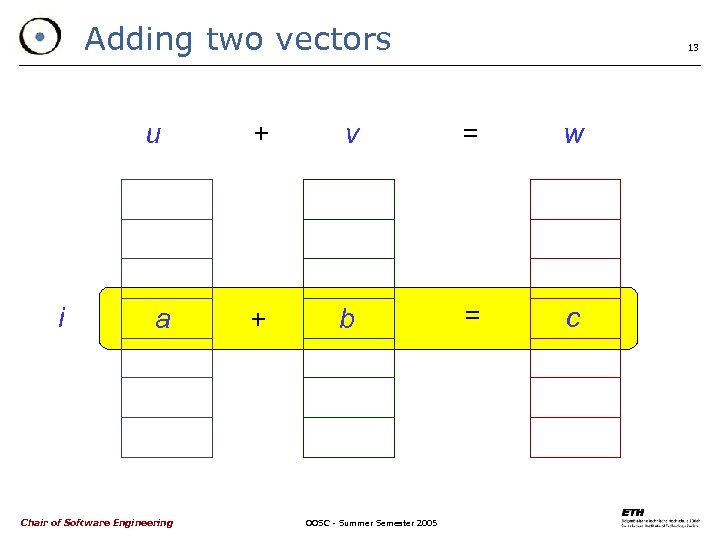
Adding two vectors u i a Chair of Software Engineering 13 + v = w + b = c OOSC - Summer Semester 2005
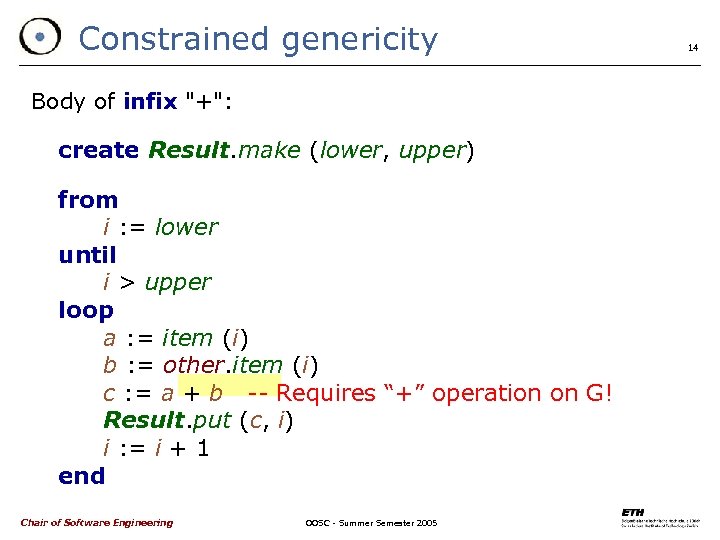
Constrained genericity Body of infix "+": create Result. make (lower, upper) from i : = lower until i > upper loop a : = item (i) b : = other. item (i) c : = a + b -- Requires “+” operation on G! Result. put (c, i) i : = i + 1 end Chair of Software Engineering OOSC - Summer Semester 2005 14
![The solution 15 Declare class VECTOR as class VECTOR [G –> NUMERIC] feature. .](https://present5.com/presentation/464c49c1d13dd32172d38e33509744c2/image-15.jpg "The solution 15 Declare class VECTOR as class VECTOR [G –> NUMERIC] feature. .")
The solution 15 Declare class VECTOR as class VECTOR [G –> NUMERIC] feature. . . The rest as before. . . end Class NUMERIC (from the Kernel Library) provides features infix "+", infix "*" and so on. Chair of Software Engineering OOSC - Summer Semester 2005
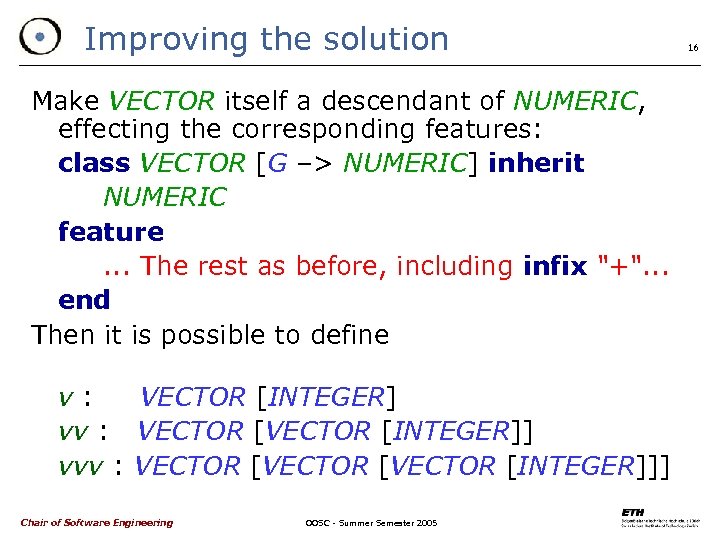
Improving the solution Make VECTOR itself a descendant of NUMERIC, effecting the corresponding features: class VECTOR [G –> NUMERIC] inherit NUMERIC feature. . . The rest as before, including infix "+". . . end Then it is possible to define v: VECTOR [INTEGER] vv : VECTOR [INTEGER]] vvv : VECTOR [VECTOR [INTEGER]]] Chair of Software Engineering OOSC - Summer Semester 2005 16
![A generic library class: Arrays Using arrays: a: ARRAY [REAL]. . . create a.](https://present5.com/presentation/464c49c1d13dd32172d38e33509744c2/image-17.jpg "A generic library class: Arrays Using arrays: a: ARRAY [REAL]. . . create a.")
A generic library class: Arrays Using arrays: a: ARRAY [REAL]. . . create a. make (1, 300) a. put (3. 5, 25) x : = a. item (i) -- Alternatively: x : = a @ i -- Using the function infix "@" Also: ARRAY 2 [G] etc. Chair of Software Engineering OOSC - Summer Semester 2005 17
![Class ARRAY (1) class ARRAY [G] create make feature lower, upper: INTEGER count: INTEGER](https://present5.com/presentation/464c49c1d13dd32172d38e33509744c2/image-18.jpg "Class ARRAY (1) class ARRAY [G] create make feature lower, upper: INTEGER count: INTEGER")
Class ARRAY (1) class ARRAY [G] create make feature lower, upper: INTEGER count: INTEGER make (min: INTEGER, max: INTEGER) is -- Allocate array with bounds min and max. do. . . end Chair of Software Engineering OOSC - Summer Semester 2005 18
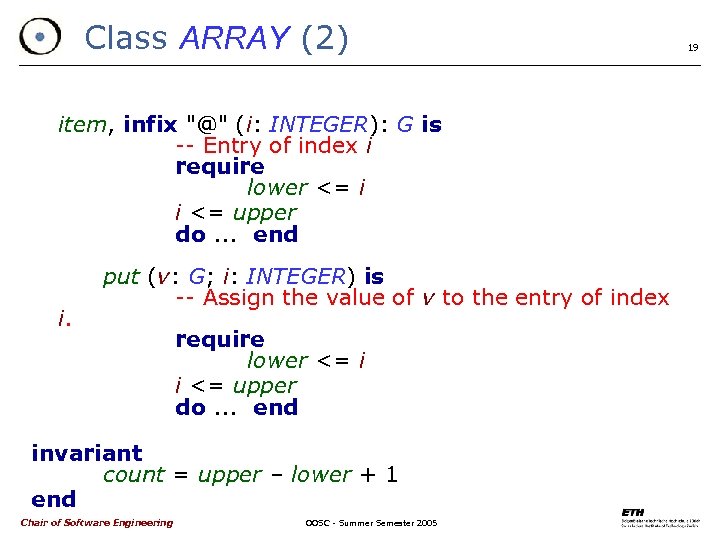
Class ARRAY (2) item, infix "@" (i: INTEGER): G is -- Entry of index i require lower <= i i <= upper do. . . end i. put (v: G; i: INTEGER) is -- Assign the value of v to the entry of index require lower <= i i <= upper do. . . end invariant count = upper – lower + 1 end Chair of Software Engineering OOSC - Summer Semester 2005 19
20 End of lecture 6 Chair of Software Engineering OOSC - Summer Semester 2005
Скачать презентацию 1 Object-Oriented Software Construction Bertrand Meyer Lecture 6
464c49c1d13dd32172d38e33509744c2.ppt