


 Скачать презентацию 1 Mc Graw-Hill Irwin 2006 The Mc Graw-Hill
ee4b79285c75c9729632ad9f54bfccf7.ppt
- Количество слайдов: 31
 1 Mc. Graw-Hill/Irwin © 2006 The Mc. Graw-Hill Companies, Inc. , All Rights Reserved.
 2 Technical Note 7 Waiting Line Management Mc. Graw-Hill/Irwin ©The Mc. Graw-Hill Companies, Inc. , 2006
 3 OBJECTIVES Waiting Line Characteristics Suggestions for Managing Queues Examples (Models 1, 2, 3, and 4) Mc. Graw-Hill/Irwin © 2006 The Mc. Graw-Hill Companies, Inc. , All Rights Reserved.
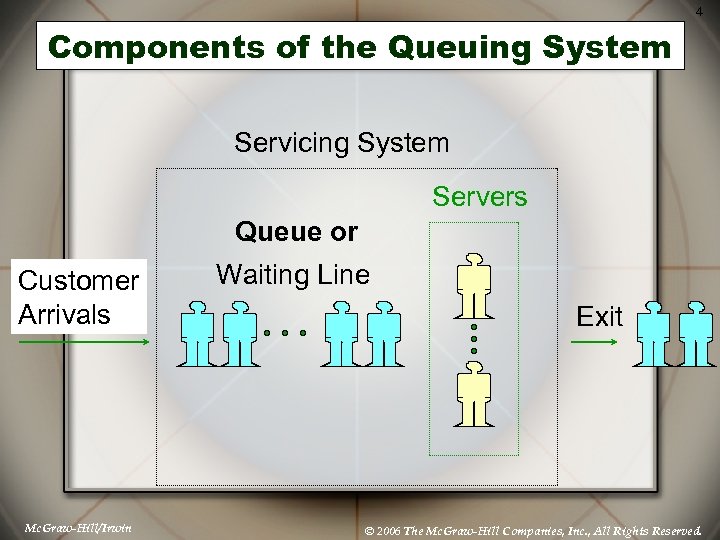 4 Components of the Queuing System Servicing System Servers Queue or Customer Arrivals Mc. Graw-Hill/Irwin Waiting Line Exit © 2006 The Mc. Graw-Hill Companies, Inc. , All Rights Reserved.
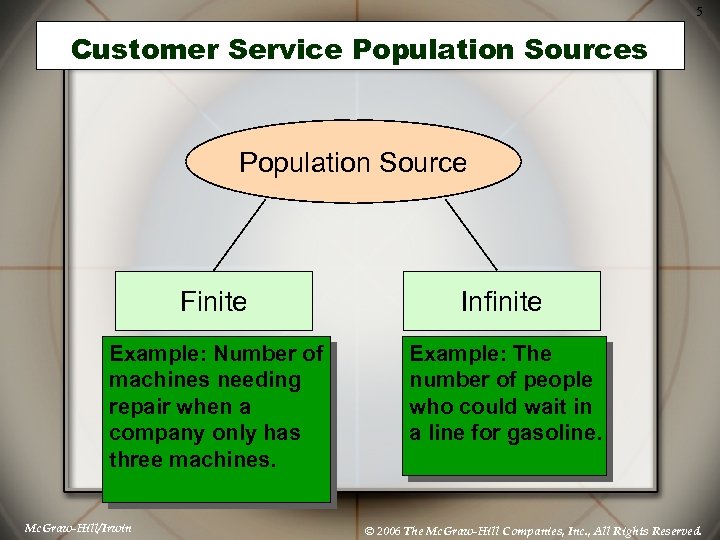 5 Customer Service Population Sources Population Source Finite Infinite Example: Number of machines needing repair when a company only has three machines. Example: The number of people who could wait in a line for gasoline. Mc. Graw-Hill/Irwin © 2006 The Mc. Graw-Hill Companies, Inc. , All Rights Reserved.
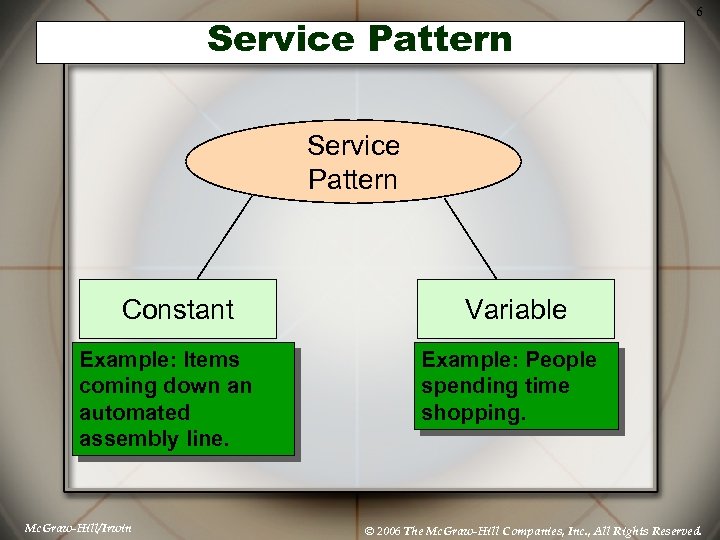 Service Pattern 6 Service Pattern Constant Example: Items coming down an automated assembly line. Mc. Graw-Hill/Irwin Variable Example: People spending time shopping. © 2006 The Mc. Graw-Hill Companies, Inc. , All Rights Reserved.
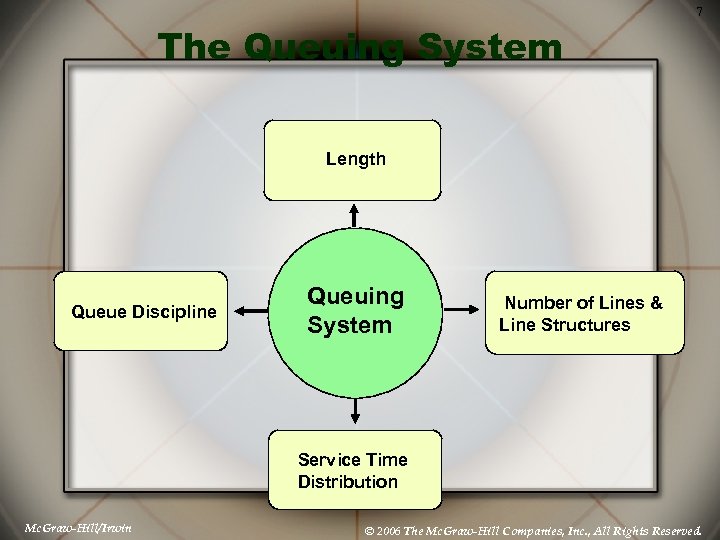 7 The Queuing System Length Queue Discipline Queuing System Number of Lines & Line Structures Service Time Distribution Mc. Graw-Hill/Irwin © 2006 The Mc. Graw-Hill Companies, Inc. , All Rights Reserved.
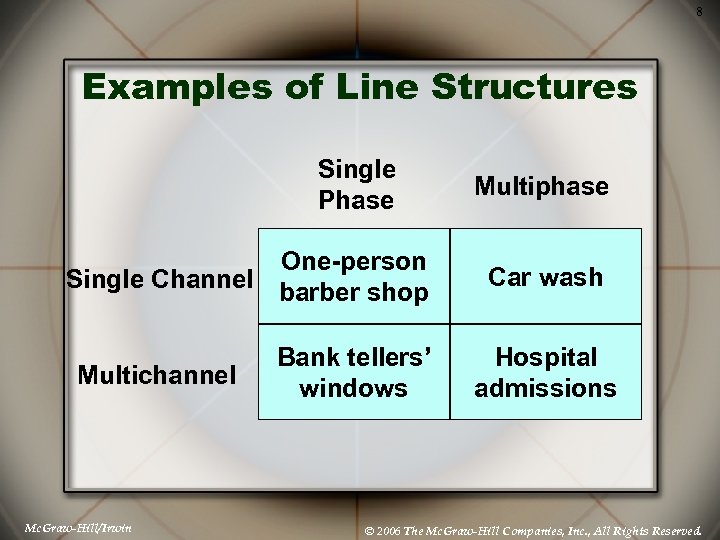 8 Examples of Line Structures Single Phase One-person Single Channel barber shop Multichannel Mc. Graw-Hill/Irwin Bank tellers’ windows Multiphase Car wash Hospital admissions © 2006 The Mc. Graw-Hill Companies, Inc. , All Rights Reserved.
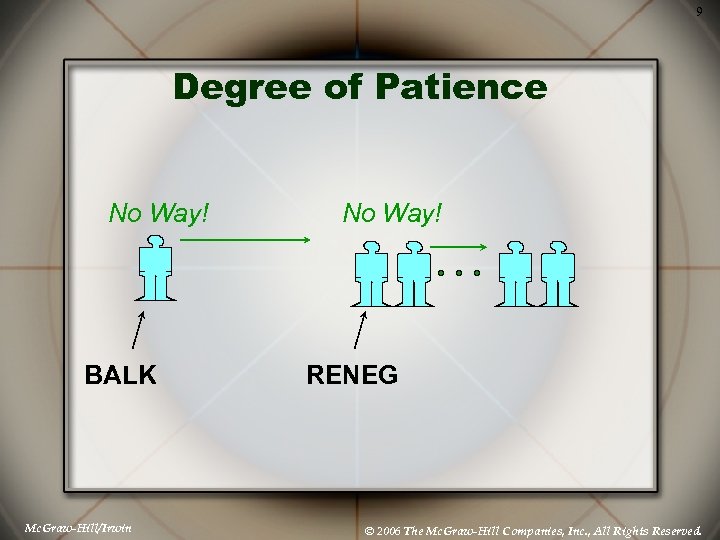 9 Degree of Patience No Way! BALK Mc. Graw-Hill/Irwin No Way! RENEG © 2006 The Mc. Graw-Hill Companies, Inc. , All Rights Reserved.
 10 Suggestions for Managing Queues 1. Determine an acceptable waiting time for your customers 2. Try to divert your customer’s attention when waiting 3. Inform your customers of what to expect 4. Keep employees not serving the customers out of sight 5. Segment customers Mc. Graw-Hill/Irwin © 2006 The Mc. Graw-Hill Companies, Inc. , All Rights Reserved.
 11 Suggestions for Managing Queues (Continued) 6. Train your servers to be friendly 7. Encourage customers to come during the slack periods 8. Take a long-term perspective toward getting rid of the queues Mc. Graw-Hill/Irwin © 2006 The Mc. Graw-Hill Companies, Inc. , All Rights Reserved.
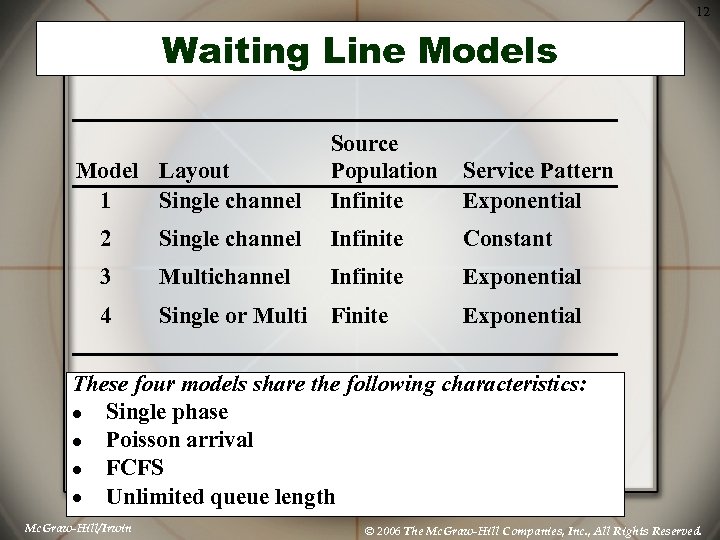 12 Waiting Line Models Model Layout 1 Single channel Source Population Infinite Service Pattern Exponential 2 Single channel Infinite Constant 3 Multichannel Infinite Exponential 4 Single or Multi Finite Exponential These four models share the following characteristics: · Single phase · Poisson arrival · FCFS · Unlimited queue length Mc. Graw-Hill/Irwin © 2006 The Mc. Graw-Hill Companies, Inc. , All Rights Reserved.
 13 Notation: Infinite Queuing: Models 1 -3 Mc. Graw-Hill/Irwin © 2006 The Mc. Graw-Hill Companies, Inc. , All Rights Reserved.
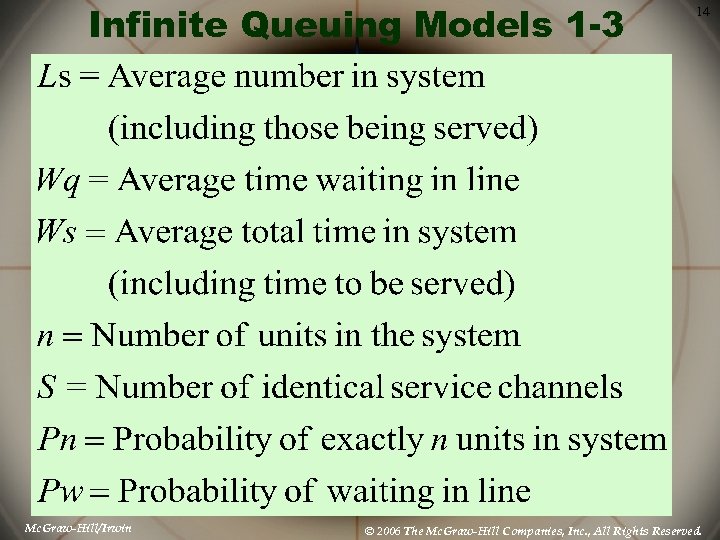 Infinite Queuing Models 1 -3 (Continued) Mc. Graw-Hill/Irwin 14 © 2006 The Mc. Graw-Hill Companies, Inc. , All Rights Reserved.
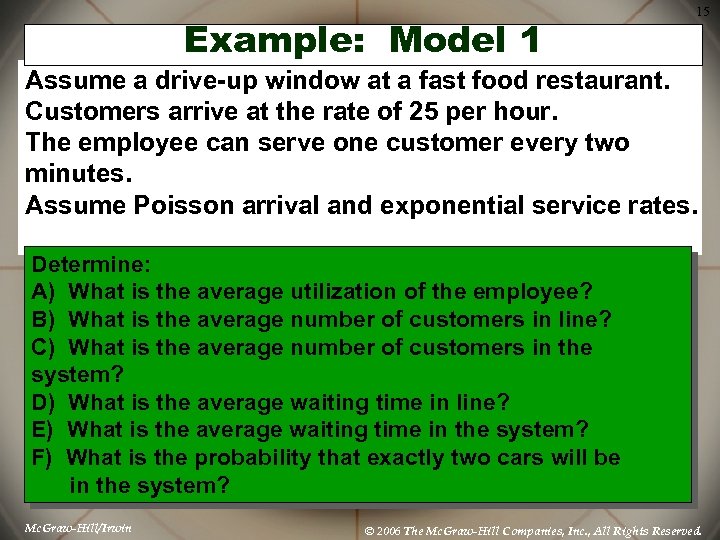 Example: Model 1 15 Assume a drive-up window at a fast food restaurant. Customers arrive at the rate of 25 per hour. The employee can serve one customer every two minutes. Assume Poisson arrival and exponential service rates. Determine: A) What is the average utilization of the employee? B) What is the average number of customers in line? C) What is the average number of customers in the system? D) What is the average waiting time in line? E) What is the average waiting time in the system? F) What is the probability that exactly two cars will be in the system? Mc. Graw-Hill/Irwin © 2006 The Mc. Graw-Hill Companies, Inc. , All Rights Reserved.
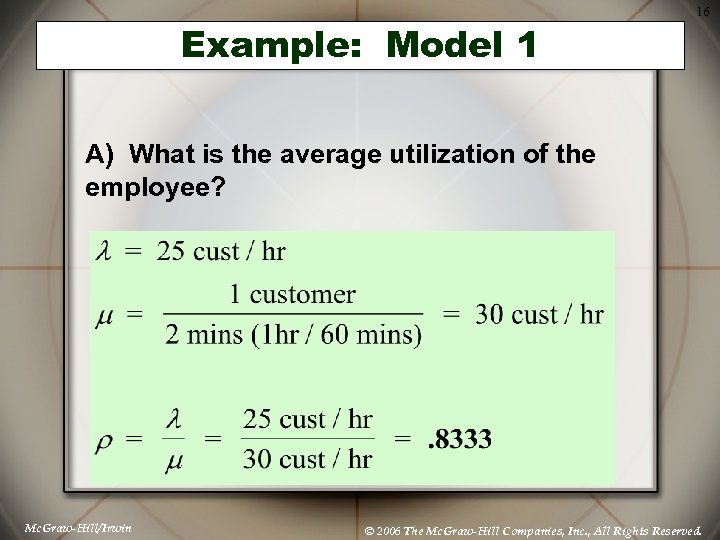 Example: Model 1 16 A) What is the average utilization of the employee? Mc. Graw-Hill/Irwin © 2006 The Mc. Graw-Hill Companies, Inc. , All Rights Reserved.
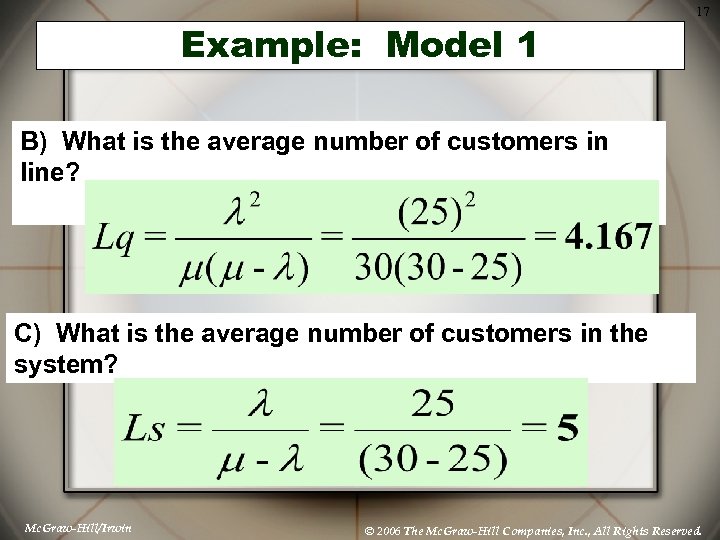 Example: Model 1 17 B) What is the average number of customers in line? C) What is the average number of customers in the system? Mc. Graw-Hill/Irwin © 2006 The Mc. Graw-Hill Companies, Inc. , All Rights Reserved.
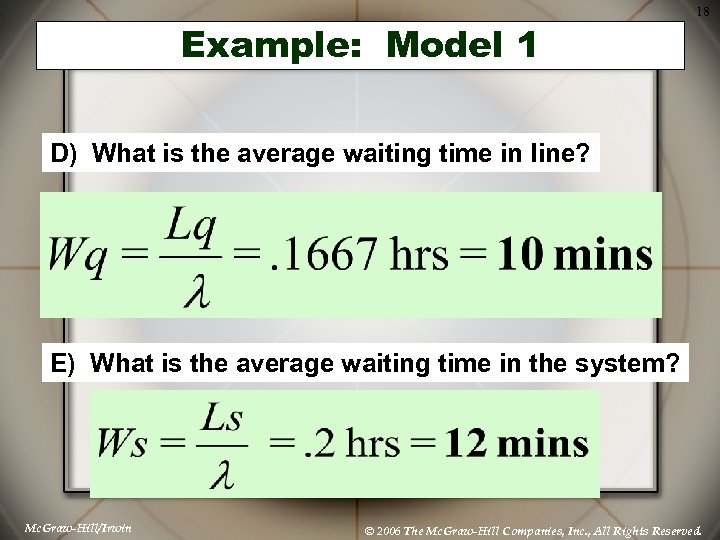 Example: Model 1 18 D) What is the average waiting time in line? E) What is the average waiting time in the system? Mc. Graw-Hill/Irwin © 2006 The Mc. Graw-Hill Companies, Inc. , All Rights Reserved.
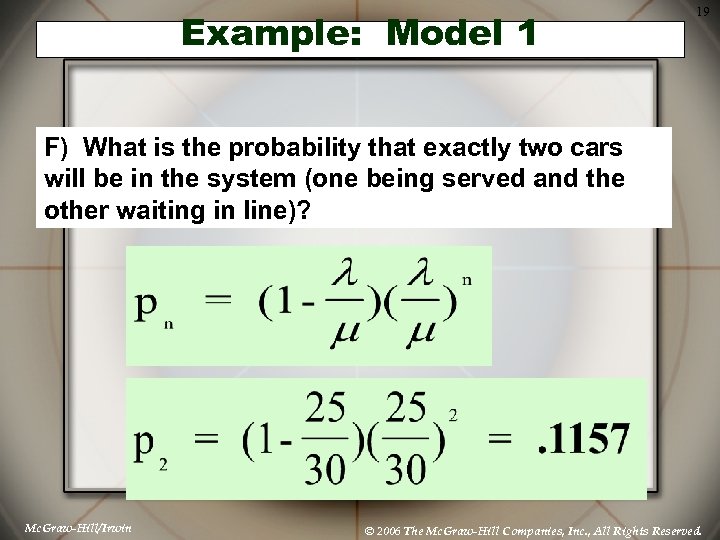 Example: Model 1 19 F) What is the probability that exactly two cars will be in the system (one being served and the other waiting in line)? Mc. Graw-Hill/Irwin © 2006 The Mc. Graw-Hill Companies, Inc. , All Rights Reserved.
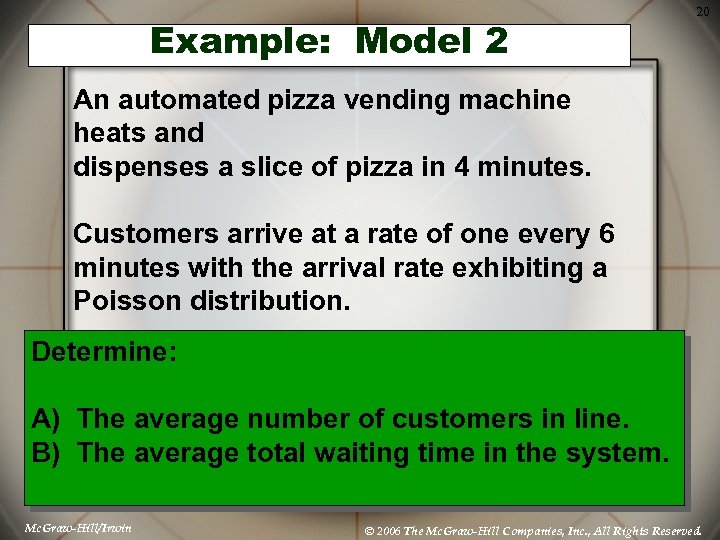 Example: Model 2 20 An automated pizza vending machine heats and dispenses a slice of pizza in 4 minutes. Customers arrive at a rate of one every 6 minutes with the arrival rate exhibiting a Poisson distribution. Determine: A) The average number of customers in line. B) The average total waiting time in the system. Mc. Graw-Hill/Irwin © 2006 The Mc. Graw-Hill Companies, Inc. , All Rights Reserved.
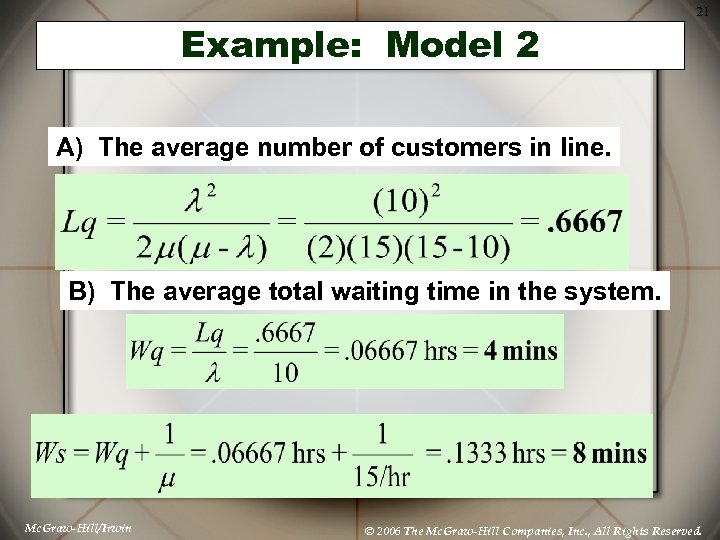 Example: Model 2 21 A) The average number of customers in line. B) The average total waiting time in the system. Mc. Graw-Hill/Irwin © 2006 The Mc. Graw-Hill Companies, Inc. , All Rights Reserved.
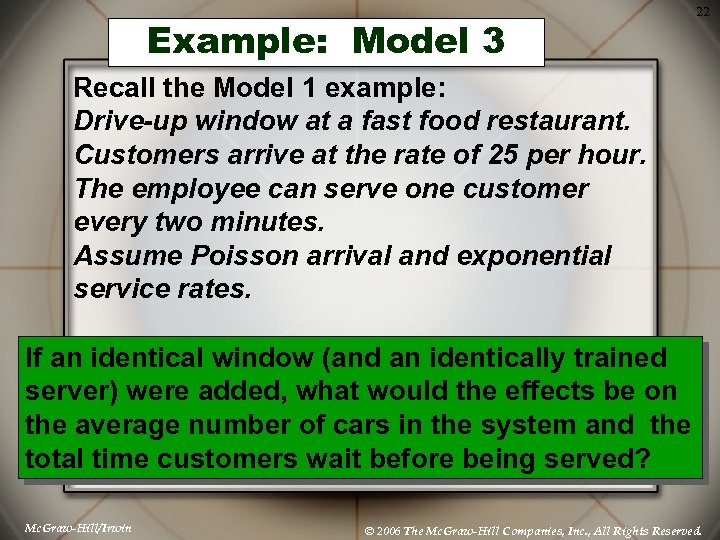 Example: Model 3 22 Recall the Model 1 example: Drive-up window at a fast food restaurant. Customers arrive at the rate of 25 per hour. The employee can serve one customer every two minutes. Assume Poisson arrival and exponential service rates. If an identical window (and an identically trained server) were added, what would the effects be on the average number of cars in the system and the total time customers wait before being served? Mc. Graw-Hill/Irwin © 2006 The Mc. Graw-Hill Companies, Inc. , All Rights Reserved.
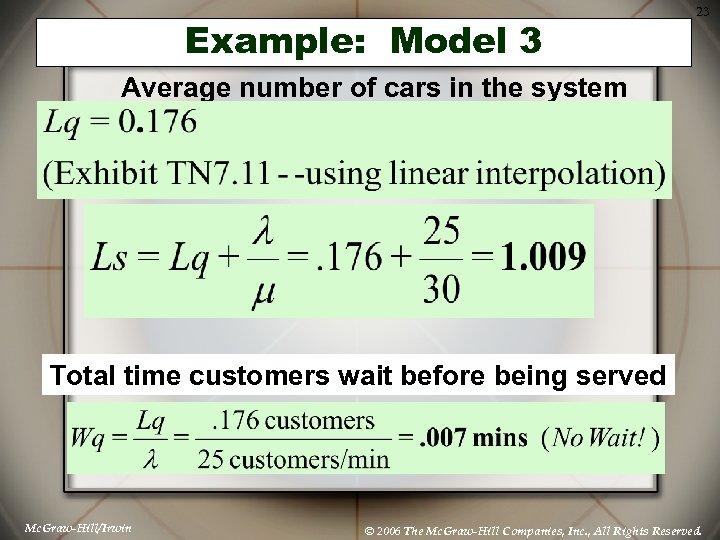 Example: Model 3 23 Average number of cars in the system Total time customers wait before being served Mc. Graw-Hill/Irwin © 2006 The Mc. Graw-Hill Companies, Inc. , All Rights Reserved.
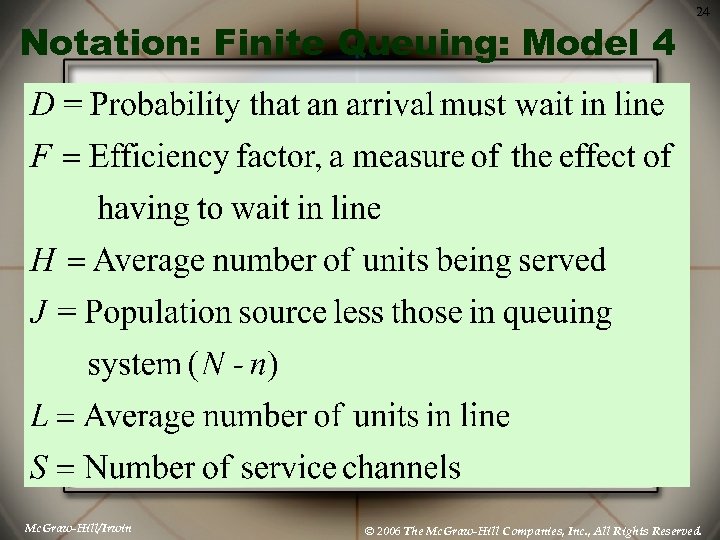 Notation: Finite Queuing: Model 4 Mc. Graw-Hill/Irwin 24 © 2006 The Mc. Graw-Hill Companies, Inc. , All Rights Reserved.
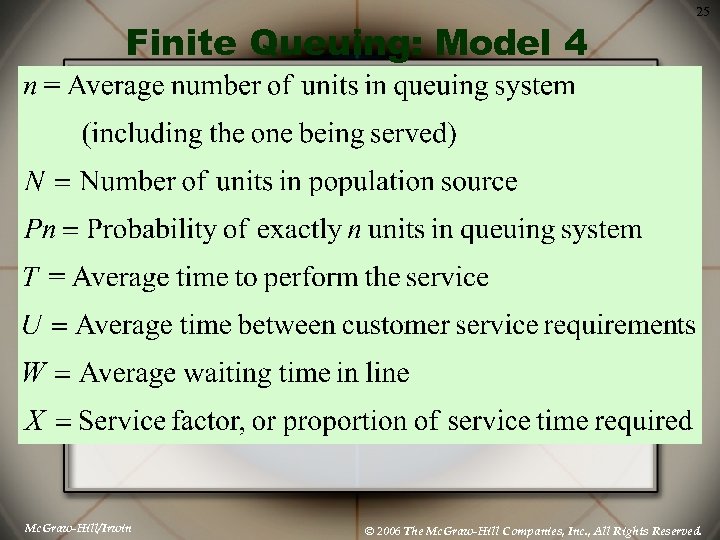 Finite Queuing: Model 4 (Continued) Mc. Graw-Hill/Irwin 25 © 2006 The Mc. Graw-Hill Companies, Inc. , All Rights Reserved.
 26 Example: Model 4 The copy center of an electronics firm has four copy machines that are all serviced by a single technician. Every two hours, on average, the machines require adjustment. The technician spends an average of 10 minutes per machine when adjustment is required. Assuming Poisson arrivals and exponential service, how many machines are “down” (on average)? Mc. Graw-Hill/Irwin © 2006 The Mc. Graw-Hill Companies, Inc. , All Rights Reserved.
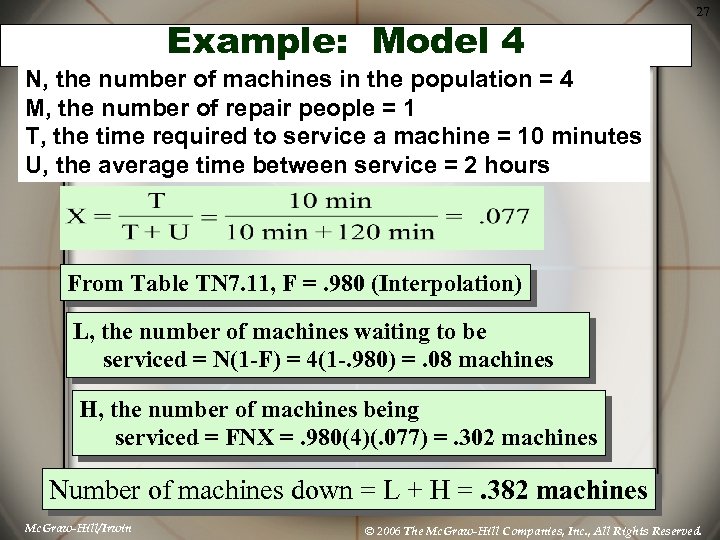 Example: Model 4 27 N, the number of machines in the population = 4 M, the number of repair people = 1 T, the time required to service a machine = 10 minutes U, the average time between service = 2 hours From Table TN 7. 11, F =. 980 (Interpolation) L, the number of machines waiting to be serviced = N(1 -F) = 4(1 -. 980) =. 08 machines H, the number of machines being serviced = FNX =. 980(4)(. 077) =. 302 machines Number of machines down = L + H =. 382 machines Mc. Graw-Hill/Irwin © 2006 The Mc. Graw-Hill Companies, Inc. , All Rights Reserved.
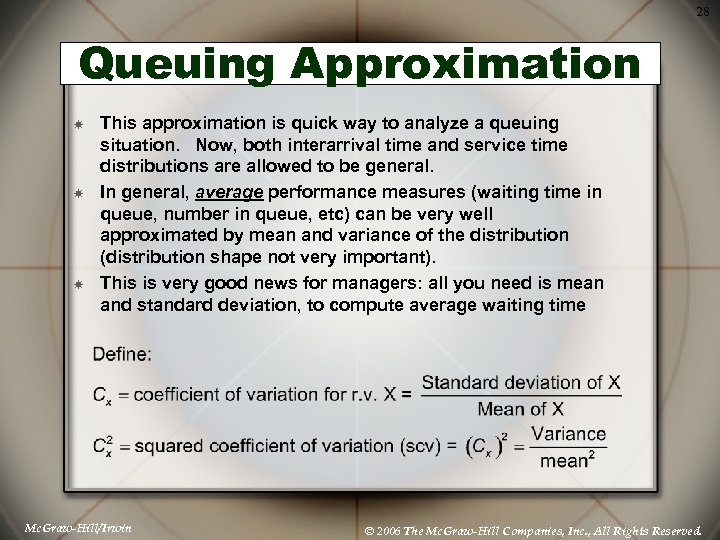 28 Queuing Approximation This approximation is quick way to analyze a queuing situation. Now, both interarrival time and service time distributions are allowed to be general. In general, average performance measures (waiting time in queue, number in queue, etc) can be very well approximated by mean and variance of the distribution (distribution shape not very important). This is very good news for managers: all you need is mean and standard deviation, to compute average waiting time Mc. Graw-Hill/Irwin © 2006 The Mc. Graw-Hill Companies, Inc. , All Rights Reserved.
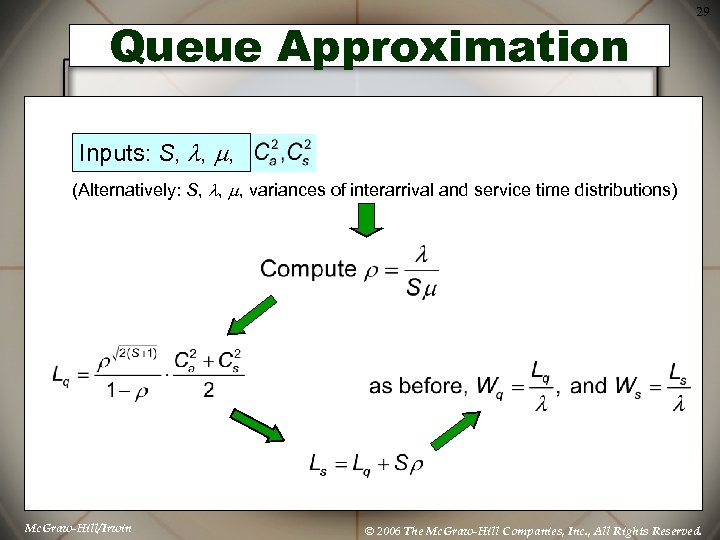 Queue Approximation 29 Inputs: S, , , (Alternatively: S, , , variances of interarrival and service time distributions) Mc. Graw-Hill/Irwin © 2006 The Mc. Graw-Hill Companies, Inc. , All Rights Reserved.
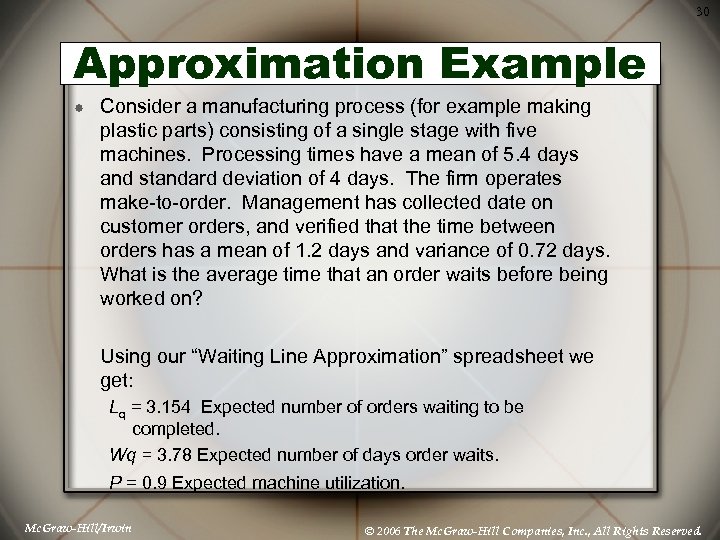 30 Approximation Example Consider a manufacturing process (for example making plastic parts) consisting of a single stage with five machines. Processing times have a mean of 5. 4 days and standard deviation of 4 days. The firm operates make-to-order. Management has collected date on customer orders, and verified that the time between orders has a mean of 1. 2 days and variance of 0. 72 days. What is the average time that an order waits before being worked on? Using our “Waiting Line Approximation” spreadsheet we get: Lq = 3. 154 Expected number of orders waiting to be completed. Wq = 3. 78 Expected number of days order waits. Ρ = 0. 9 Expected machine utilization. Mc. Graw-Hill/Irwin © 2006 The Mc. Graw-Hill Companies, Inc. , All Rights Reserved.
 31 End of Technical Note 7 Mc. Graw-Hill/Irwin ©The Mc. Graw-Hill Companies, Inc. , 2006