


 Скачать презентацию 1 Making change understanding software technology transfer Shari
ec997d0dd6e55d057efd255199814feb.ppt
- Количество слайдов: 44
 1 Making change: understanding software technology transfer Shari Lawrence Pfleeger Systems/Software, Inc. s. pfleeger@ieee. org http: //www. cs. umd. edu/~sharip Systems/Software, Inc. Copyright 1998 Shari Lawrence Pfleeger
 2 Overview • Models of technology transfer • Important variables • The need to evaluate evidence • Importance of organizational culture • Next steps for practitioners and researchers Systems/Software, Inc. Copyright 1998 Shari Lawrence Pfleeger
 3 What do we mean by “technology”? • Method or technique: formal procedure for producing some result • Tool: an instrument, language or automated system for accomplishing something in a better way • Procedure: like a recipe, a combination of tools and techniques that, in concert, produce a product • Paradigm: an approach or philosophy for building software • Technology: method, technique, tool, procedure or paradigm Systems/Software, Inc. Copyright 1998 Shari Lawrence Pfleeger
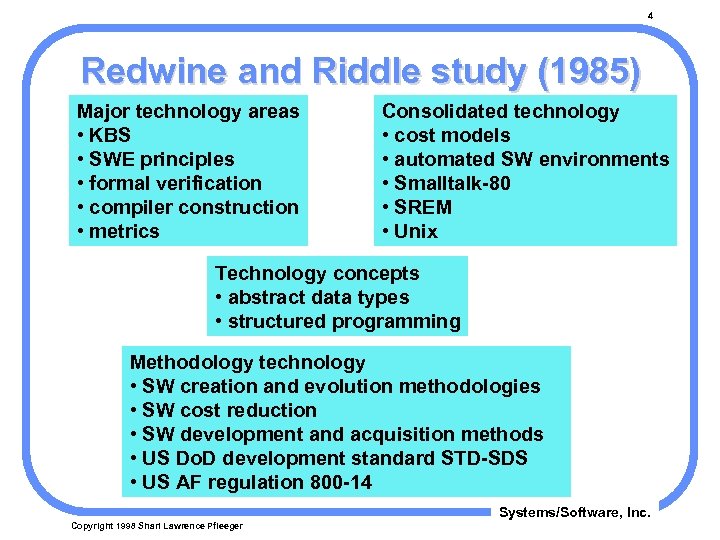 4 Redwine and Riddle study (1985) Major technology areas • KBS • SWE principles • formal verification • compiler construction • metrics Consolidated technology • cost models • automated SW environments • Smalltalk-80 • SREM • Unix Technology concepts • abstract data types • structured programming Methodology technology • SW creation and evolution methodologies • SW cost reduction • SW development and acquisition methods • US Do. D development standard STD-SDS • US AF regulation 800 -14 Systems/Software, Inc. Copyright 1998 Shari Lawrence Pfleeger
 5 Redwine-Riddle maturation model • • • Basic research Concept formulation Development and extension Enhancement and exploration (internal) Enhancement and exploration (external) Popularization – propagation through 40% of the community – propagation through 70% of the community Systems/Software, Inc. Copyright 1998 Shari Lawrence Pfleeger
 6 Adoption rate • Time to get from idea to “the point it can be popularized and disseminated to the technical community at large” • Worst case: 23 years • Best case: 11 years • Mean: 17 years • 7. 5 years from developed technology to wide availability Systems/Software, Inc. Copyright 1998 Shari Lawrence Pfleeger
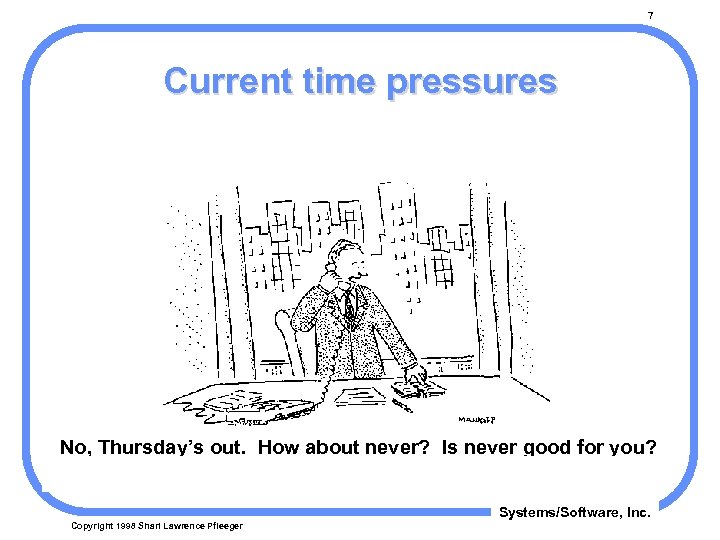 7 Current time pressures No, Thursday’s out. How about never? Is never good for you? Systems/Software, Inc. Copyright 1998 Shari Lawrence Pfleeger
 8 Accelerated adoption • • • SEI Capability Maturity Model Ada Reuse Java CASE tools UK Ministry of Defence use of formal methods Systems/Software, Inc. Copyright 1998 Shari Lawrence Pfleeger
 9 Finding the right audience • Potential users NOT = Population of software developers • Zelkowitz study at NASA: – distinguished technology producer from consumer – recognized role of the “gatekeeper” Systems/Software, Inc. Copyright 1998 Shari Lawrence Pfleeger
 10 Models to encourage transfer Berniker (1991): • People-mover: relies on personal contact between producer and consumer • Communication: report in print is noted by gatekeeper • On the shelf: packaging and ease of use encourage transfer • Vendor: primary software or hardware vendor is gatekeeper Zelkowitz: • Rule: Outside organization imposes technology Systems/Software, Inc. Copyright 1998 Shari Lawrence Pfleeger
 11 Rogers: Patterns of adoption Systems/Software, Inc. Copyright 1998 Shari Lawrence Pfleeger
 12 Adopter categories • Innovators: “venturesome, ” driven by doing something daring from outside organizational culture • Early adopters: integrated in organizational culture, respected by peers, want to decrease uncertainty • Early majority adopters: deliberate in their thinking, follow rather than lead • Late majority adopters: skeptical; adopt due to economic or peer pressure • Laggards: adopt only when certain the technology will not fail, or when forced to change Systems/Software, Inc. Copyright 1998 Shari Lawrence Pfleeger
 13 Relationship between audience and transfer model Systems/Software, Inc. Copyright 1998 Shari Lawrence Pfleeger
 14 Top transferred technologies (from Zelkowitz 1995) Systems/Software, Inc. Copyright 1998 Shari Lawrence Pfleeger
 15 Similar surveys Yourdon (1998) • declining interest in OO • growing interest in Y 2 K • linear decline in interest in CASE • initial peak but then decline in interest in reuse Glass and Howard (1998) • Top technologies in practice: 4 GLs, feasibility studies, prototyping, code inspections or walkthroughs • Little interest in: CASE, JAD, metrics Systems/Software, Inc. Copyright 1998 Shari Lawrence Pfleeger
 16 Example: problems with TT at NASA • No good infusion mechanism for bringing technology to the agency • Major NASA goal is transfer of products, not increases in quality or productivity • People-mover model rarely used • Most successful TT done outside of established NASA TT mechanisms (Zelkowitz) Systems/Software, Inc. Copyright 1998 Shari Lawrence Pfleeger
 17 Problems industry-wide • Most software professionals resist change. • Infusion mechanisms for other TT do not always work well for software technology, perhaps because the focus is more on producing than on transferring a product. • TT needs more than just understanding the new technology. • Quantitative data needed for understanding how and why the new technology will fit in or replace existing technologies. • TT is not free. • Personal contact is essential for change. • Timing is critical. (Zelkowitz) Systems/Software, Inc. Copyright 1998 Shari Lawrence Pfleeger
 18 Promoters and inhibitors • Need to identify TT promoters and inhibitors. • Promoter is a person, technique or activity that accelerates technology adoption. • Inhibitor is a person, technique or activity that interferes with or prevents technology adoption. • Example: Rai (1995) surveyed IS managers about CASE tools. Perceptions depended on whether the technology was in its infancy, being tried for the first time, or was a mature candidate for adoption. Thus, maturity was a promoter. Systems/Software, Inc. Copyright 1998 Shari Lawrence Pfleeger
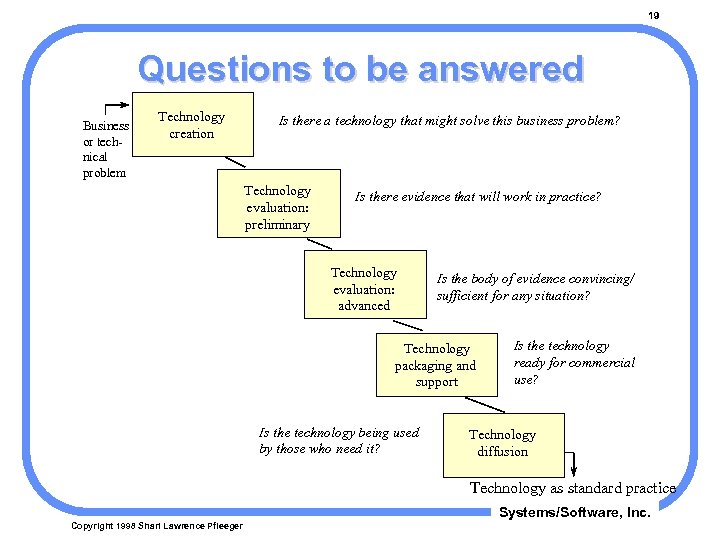 19 Questions to be answered Business or technical problem Technology creation Is there a technology that might solve this business problem? Technology evaluation: preliminary Is there evidence that will work in practice? Technology evaluation: advanced Is the body of evidence convincing/ sufficient for any situation? Technology packaging and support Is the technology being used by those who need it? Is the technology ready for commercial use? Technology diffusion Technology as standard practice Systems/Software, Inc. Copyright 1998 Shari Lawrence Pfleeger
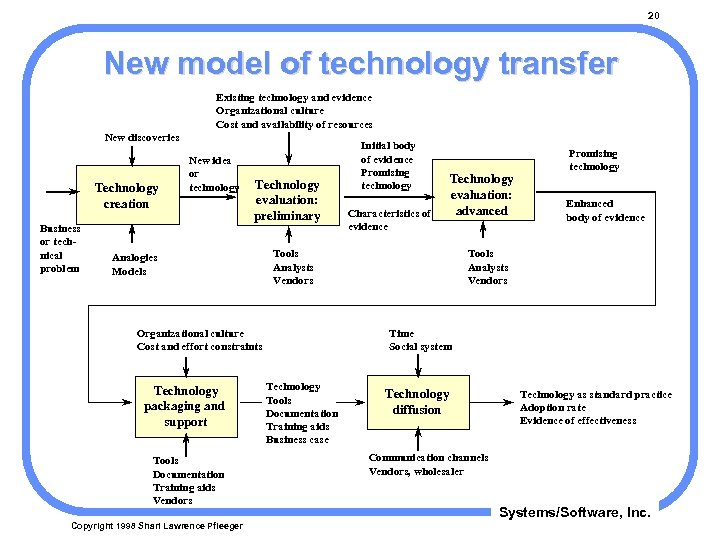 20 New model of technology transfer Existing technology and evidence Organizational culture Cost and availability of resources New discoveries Technology creation Business or technical problem New idea or technology Technology evaluation: preliminary Analogies Models Tools Documentation Training aids Vendors Copyright 1998 Shari Lawrence Pfleeger Characteristics of evidence Technology evaluation: advanced Tools Analysts Vendors Organizational culture Cost and effort constraints Technology packaging and support Initial body of evidence Promising technology Enhanced body of evidence Tools Analysts Vendors Time Social system Technology Tools Documentation Training aids Business case Technology diffusion Technology as standard practice Adoption rate Evidence of effectiveness Communication channels Vendors, wholesaler Systems/Software, Inc.
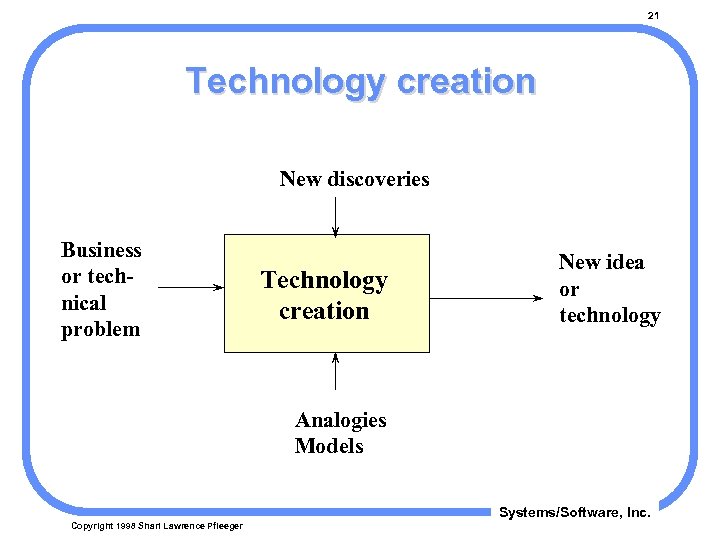 21 Technology creation New discoveries Business or technical problem Technology creation New idea or technology Analogies Models Systems/Software, Inc. Copyright 1998 Shari Lawrence Pfleeger
 22 For a new technology: • What problem does it solve? • Does it work properly? • Does it replace/extend/enhance an existing technology? • Does it fit easily in the existing development or maintenance process, without great disruption to established and effective activities? • Is it easy to understand? • Is it easy to learn? • Is it cost-effective? Systems/Software, Inc. Copyright 1998 Shari Lawrence Pfleeger
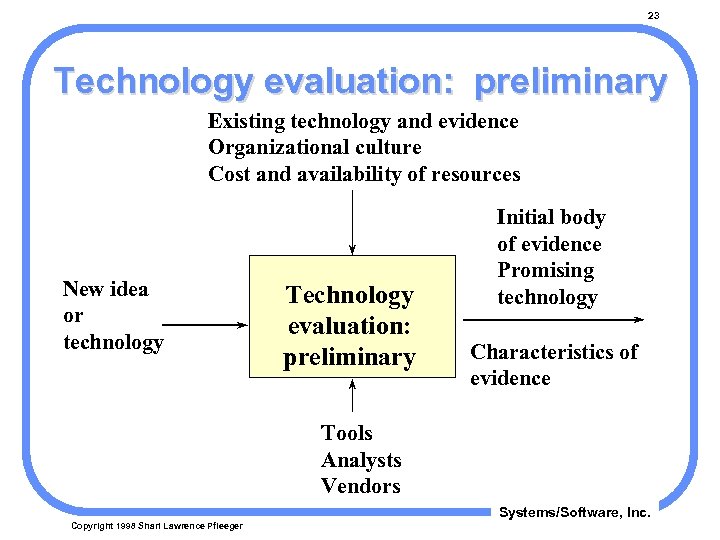 23 Technology evaluation: preliminary Existing technology and evidence Organizational culture Cost and availability of resources New idea or technology Technology evaluation: preliminary Initial body of evidence Promising technology Characteristics of evidence Tools Analysts Vendors Systems/Software, Inc. Copyright 1998 Shari Lawrence Pfleeger
 24 Goal of preliminary evaluation • Evaluating the technology relative to the organization’s existing technologies and processes • In other words, is there any benefit to using the new technology relative to what we already do? Systems/Software, Inc. Copyright 1998 Shari Lawrence Pfleeger
 25 Dealing with evidence Systems/Software, Inc. Copyright 1998 Shari Lawrence Pfleeger
 26 Forms of evidence (Schum) Systems/Software, Inc. Copyright 1998 Shari Lawrence Pfleeger
 27 The nature of the evidence Zelkowitz, Wallace and Binkley (1998): Practitioners value methods relevant to their environment: • Case studies • Field studies • Replicated controlled experiments Researchers valued reproducible validation methods: • Theoretical proof • Static analysis • Simulation Systems/Software, Inc. Copyright 1998 Shari Lawrence Pfleeger
 28 Questions addressed by evidence (Rogers) • Relative advantage: To what degree is the new technology better than what is already available? • Compatibility: To what degree is it consistent with existing values, past experiences, and the needs of potential adopters? • Complexity: To what degree is it easy to understand use? • Trialability: Can it be experimented with on a limited basis? • Observability: Are the results of using it visible to others? Systems/Software, Inc. Copyright 1998 Shari Lawrence Pfleeger
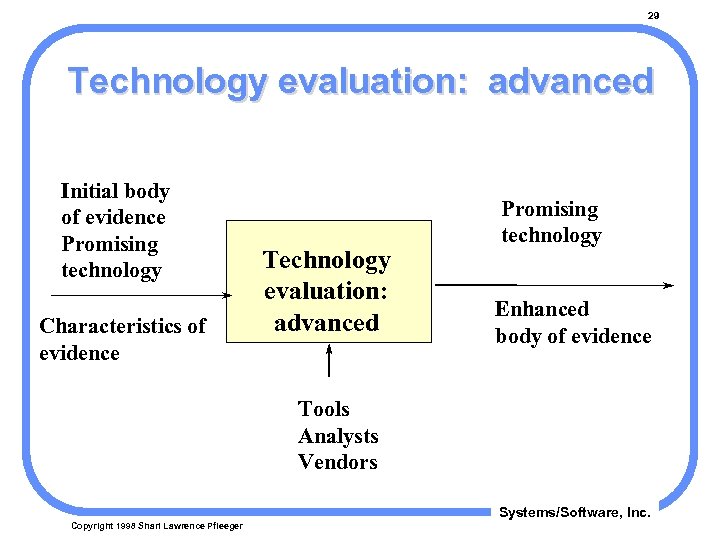 29 Technology evaluation: advanced Initial body of evidence Promising technology Characteristics of evidence Technology evaluation: advanced Promising technology Enhanced body of evidence Tools Analysts Vendors Systems/Software, Inc. Copyright 1998 Shari Lawrence Pfleeger
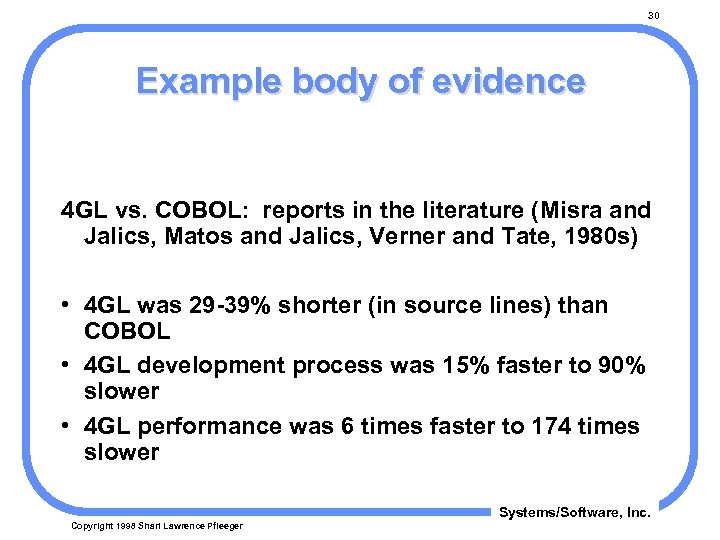 30 Example body of evidence 4 GL vs. COBOL: reports in the literature (Misra and Jalics, Matos and Jalics, Verner and Tate, 1980 s) • 4 GL was 29 -39% shorter (in source lines) than COBOL • 4 GL development process was 15% faster to 90% slower • 4 GL performance was 6 times faster to 174 times slower Systems/Software, Inc. Copyright 1998 Shari Lawrence Pfleeger
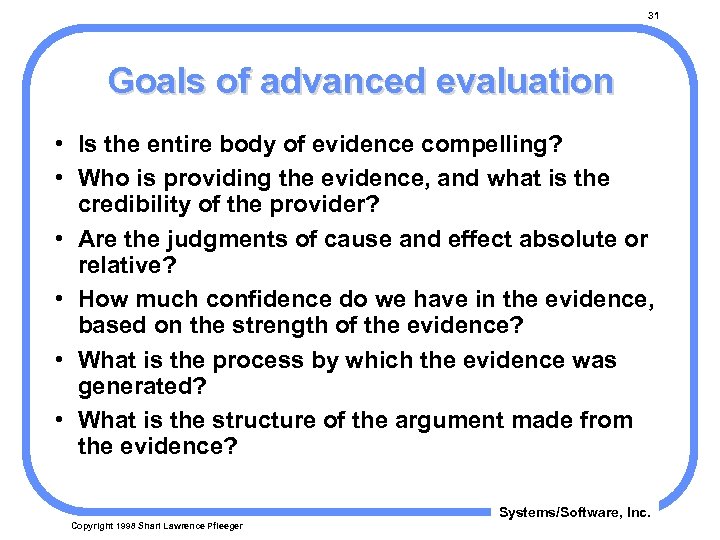 31 Goals of advanced evaluation • Is the entire body of evidence compelling? • Who is providing the evidence, and what is the credibility of the provider? • Are the judgments of cause and effect absolute or relative? • How much confidence do we have in the evidence, based on the strength of the evidence? • What is the process by which the evidence was generated? • What is the structure of the argument made from the evidence? Systems/Software, Inc. Copyright 1998 Shari Lawrence Pfleeger
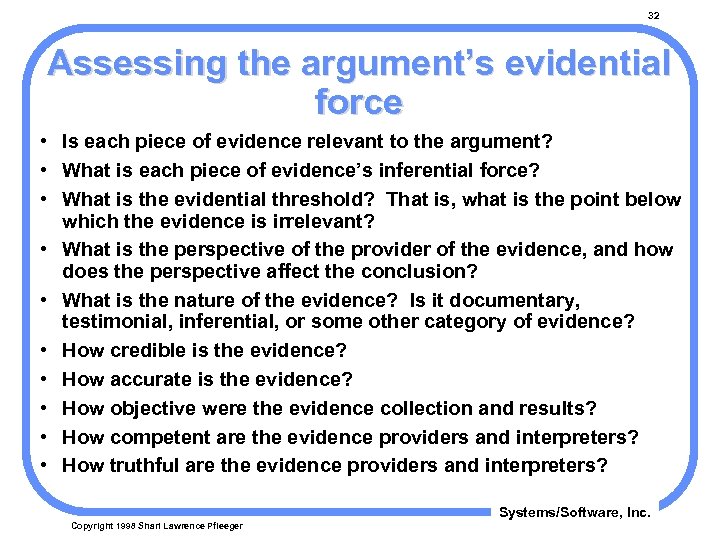 32 Assessing the argument’s evidential force • Is each piece of evidence relevant to the argument? • What is each piece of evidence’s inferential force? • What is the evidential threshold? That is, what is the point below which the evidence is irrelevant? • What is the perspective of the provider of the evidence, and how does the perspective affect the conclusion? • What is the nature of the evidence? Is it documentary, testimonial, inferential, or some other category of evidence? • How credible is the evidence? • How accurate is the evidence? • How objective were the evidence collection and results? • How competent are the evidence providers and interpreters? • How truthful are the evidence providers and interpreters? Systems/Software, Inc. Copyright 1998 Shari Lawrence Pfleeger
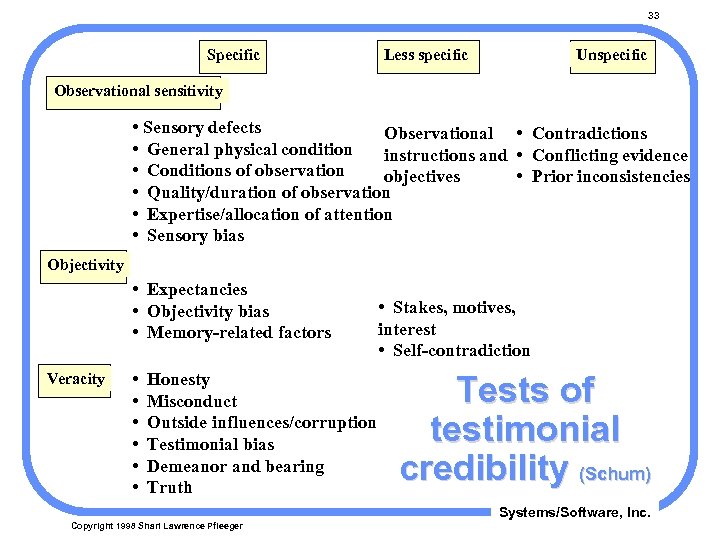 33 Specific Less specific Unspecific Observational sensitivity • Sensory defects Observational • Contradictions • General physical condition instructions and • Conflicting evidence • Conditions of observation objectives • Prior inconsistencies • Quality/duration of observation • Expertise/allocation of attention • Sensory bias Objectivity • Expectancies • Objectivity bias • Memory-related factors Veracity • • • Honesty Misconduct Outside influences/corruption Testimonial bias Demeanor and bearing Truth • Stakes, motives, interest • Self-contradiction Tests of testimonial credibility (Schum) Systems/Software, Inc. Copyright 1998 Shari Lawrence Pfleeger
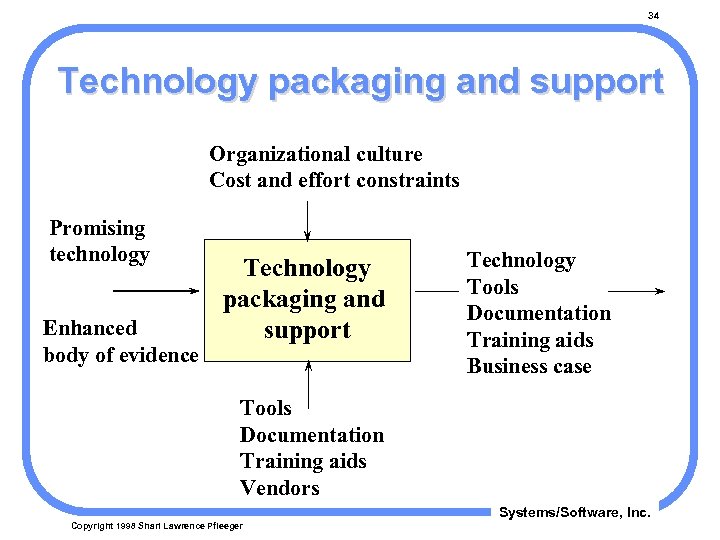 34 Technology packaging and support Organizational culture Cost and effort constraints Promising technology Enhanced body of evidence Technology packaging and support Technology Tools Documentation Training aids Business case Tools Documentation Training aids Vendors Systems/Software, Inc. Copyright 1998 Shari Lawrence Pfleeger
 35 Fichman and Kemerer study • Empirical study of 608 IT organizations using OO languages • Packaging and support needed to break “knowledge barriers” Systems/Software, Inc. Copyright 1998 Shari Lawrence Pfleeger
 36 Questions about packaging and support • Are there effective tools, documentation and training aids to assist learning and using the technology? • Is there institutional support? • Is there interference from existing techniques? That is, if a potential user already knows one technique, does that prevent him or her from learning the new one? • Has the technique been commercialized and marketed? • Is the technology used outside the group that developed it? Systems/Software, Inc. Copyright 1998 Shari Lawrence Pfleeger
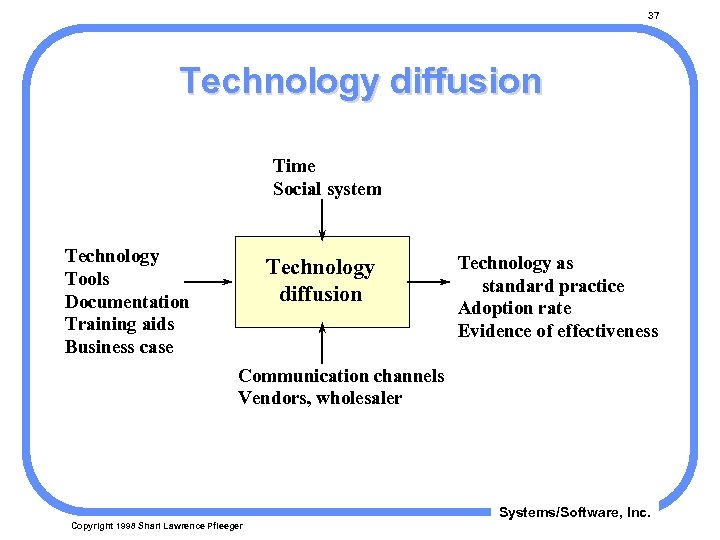 37 Technology diffusion Time Social system Technology Tools Documentation Training aids Business case Technology diffusion Technology as standard practice Adoption rate Evidence of effectiveness Communication channels Vendors, wholesaler Systems/Software, Inc. Copyright 1998 Shari Lawrence Pfleeger
 38 Studies from the literature (1) • Premkumar and Potter: IT managers and CASE tool adoption They found five variables distinguishing adopters from non-adopters: – – existence of a product champion strong top management support lower IS expertise a perception that CASE has an advantage over other technologies – a conviction that CASE is cost-effective Systems/Software, Inc. Copyright 1998 Shari Lawrence Pfleeger
 39 Studies from the literature (2) • Lai and Guynes: Business Week 1000 companies and ISDN Most receptive – – were larger had more slack resources, had more technology expansion options had fewer technology restrictions Systems/Software, Inc. Copyright 1998 Shari Lawrence Pfleeger
 40 Rogers’ suggestions • Determine if the technology changes as the user adopts and implements it. • Understand the potential audience, including similarities between those who have already adopted and those who might. • Understand the diffusion process itself: – – – knowledge persuasion decision implementation confirmation (leading to adoption or rejection) • Understand the role of the people who are promoters. Systems/Software, Inc. Copyright 1998 Shari Lawrence Pfleeger
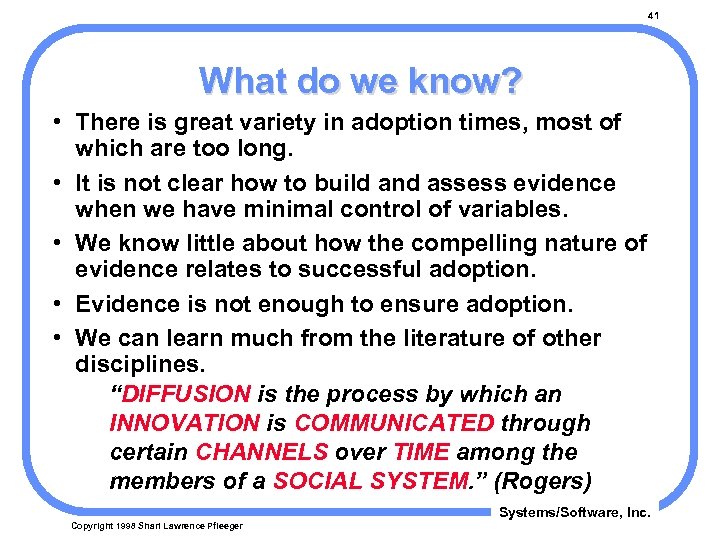 41 What do we know? • There is great variety in adoption times, most of which are too long. • It is not clear how to build and assess evidence when we have minimal control of variables. • We know little about how the compelling nature of evidence relates to successful adoption. • Evidence is not enough to ensure adoption. • We can learn much from the literature of other disciplines. “DIFFUSION is the process by which an INNOVATION is COMMUNICATED through certain CHANNELS over TIME among the members of a SOCIAL SYSTEM. ” (Rogers) Systems/Software, Inc. Copyright 1998 Shari Lawrence Pfleeger
 42 Inhibitors and promoters Systems/Software, Inc. Copyright 1998 Shari Lawrence Pfleeger
 43 Next steps • Collaborative work between practitioners and researchers. • Look for examples of TT; identify key variables. • Develop guidelines for – planning and organizing evidence – evaluating bodies of evidence (what is enough? ) • Learn from other disciplines and improve our models. Systems/Software, Inc. Copyright 1998 Shari Lawrence Pfleeger
 44 References Berniker, E. , “Models of technology transfer: a dialectical case study, ” Proceedings of the IEEE Conference: The New International Language, pp. 499 -502, July 1991. Fichman, R. G. and C. F. Kemerer, “The assimilation of software process innovations: an organizational learning perspective, ” Management Science, 43(10), pp. 1345 -1363, October 1997. Glass, Robert and Alan Howard, “Software development state-of-the-practice, ” Managing System Development, June 1998. Griss, Martin and Marty Wasser, Quality Time column, IEEE Software, January 1995. Lai, V. S. and J. L. Guynes, “An assessment of the influence of organizational characteristics on information technology adoption decision: a discriminative approach, ” IEEE Transactions on Engineering Management, 44(2), pp. 146 -157, May 1997. Pfleeger, Shari Lawrence, “Understanding and improving technology transfer in software engineering, ” Journal of Systems and Software, February 1999. Pfleeger, Shari Lawrence, Software Engineering: Theory and Practice, Prentice Hall, Englewood Cliffs, New Jersey, 1998. Pfleeger, Shari Lawrence and Les Hatton, “Investigating the influence of formal methods, ” IEEE Computer, February 1997. Premkumar, G. and M. Potter, “Adoption of computer-aided software engineering (CASE) technology: an innovative adoption perspective, ” Data Base for Advances in Information Systems 26(2 -3), pp. 105 -124, May-August 1995. Prescott, M. B. and S. A. Conger, “Information technology innovations: a classification by IT locus of impact and research approach, ” Data Base for Advances in Information Systems 26(2 -3), pp. 20 -41, May-August 1995. Rai, A. , “External information source and channel effectiveness and the diffusion of CASE innovations: an empirical study, ” European Journal of Information Systems, 4(2), pp. 93 -102, May 1995. Redwine, Samuel T. and William E. Riddle, “Software technology maturation, ” Proceedings of the Eighth International Conference on Software Engineering, IEEE Computer Society Press, Los Alamitos, California, pp. 189 -200, August 1985. Rogers, Everett M. , Diffusion of Innovations, fourth edition, Free Press, New York, 1995. Schum, David A. , Evidential Foundations of Probabilistic Reasoning, Wiley Series in Systems Engineering, John Wiley, New York, 1994. Yourdon, Edward, Application Development Strategies newsletter, February 1998. Zelkowitz, Marvin V. , “Assessing software engineering technology transfer within NASA, ” NASA technical report NASA-RPT 003095, National Aeronautics and Space Administration, Washington, DC, January 1995. Zelkowitz, Marvin V. , Dolores R. Wallace and David Binkley, “Understanding the culture clash in software engineering technology transfer, ” University of Maryland technical report, 2 June 1998. Systems/Software, Inc. Copyright 1998 Shari Lawrence Pfleeger