 Скачать презентацию 1 LEONTIEF CENTRE St Petersburg CORRUPTION PERCEPTION vs
ca9f954ef9df13add475a4603e0ff126.ppt
- Количество слайдов: 10



1 LEONTIEF CENTRE, St. Petersburg CORRUPTION: PERCEPTION vs. EXPERIENCE IN RUSSIA Professor RICHARD ROSE FBA Director, Centre for the Study of Public Policy From 1. 1. 12 U. of Strathclyde, Glasgow email: prof_r_rose@yahoo. co. uk www. abdn. ac. uk/cspp Thursday, 10 November 2012 16 -30 pm
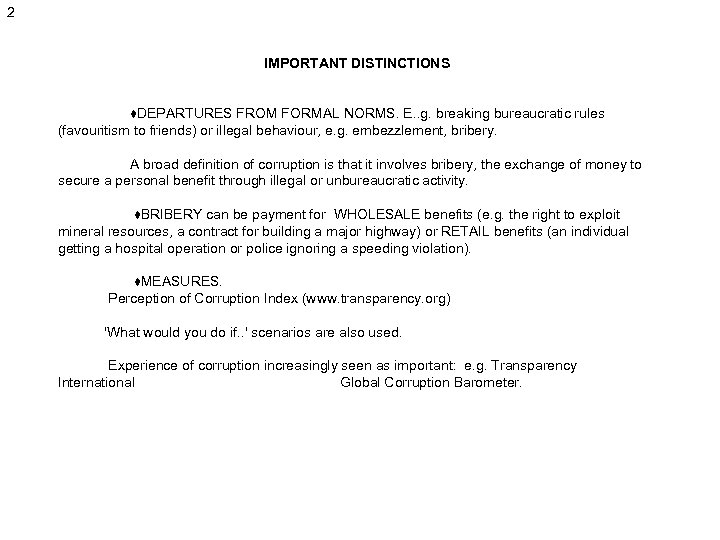
2 IMPORTANT DISTINCTIONS ♦DEPARTURES FROM FORMAL NORMS. E. . g. breaking bureaucratic rules (favouritism to friends) or illegal behaviour, e. g. embezzlement, bribery. A broad definition of corruption is that it involves bribery, the exchange of money to secure a personal benefit through illegal or unbureaucratic activity. ♦BRIBERY can be payment for WHOLESALE benefits (e. g. the right to exploit mineral resources, a contract for building a major highway) or RETAIL benefits (an individual getting a hospital operation or police ignoring a speeding violation). ♦MEASURES. Perception of Corruption Index (www. transparency. org) 'What would you do if. . ' scenarios are also used. Experience of corruption increasingly seen as important: e. g. Transparency International Global Corruption Barometer.
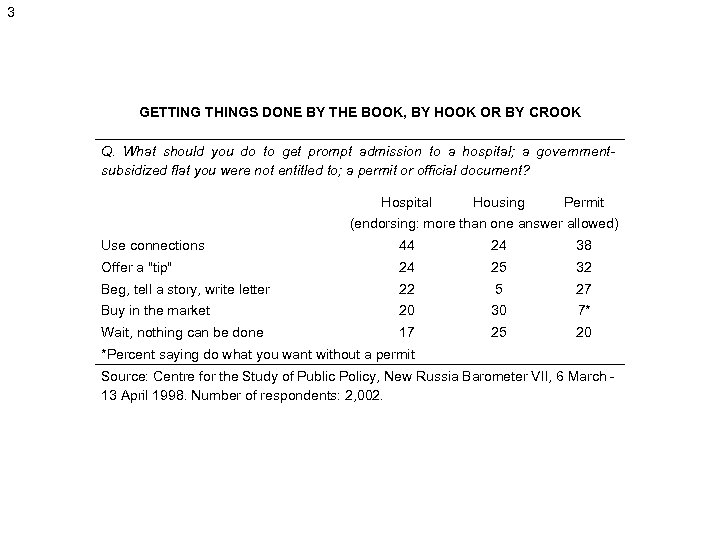
3 GETTING THINGS DONE BY THE BOOK, BY HOOK OR BY CROOK Q. What should you do to get prompt admission to a hospital; a governmentsubsidized flat you were not entitled to; a permit or official document? Hospital Housing Permit (endorsing: more than one answer allowed) Use connections 44 24 38 Offer a "tip" 24 25 32 Beg, tell a story, write letter 22 5 27 Buy in the market 20 30 7* Wait, nothing can be done 17 25 20 *Percent saying do what you want without a permit Source: Centre for the Study of Public Policy, New Russia Barometer VII, 6 March 13 April 1998. Number of respondents: 2, 002.
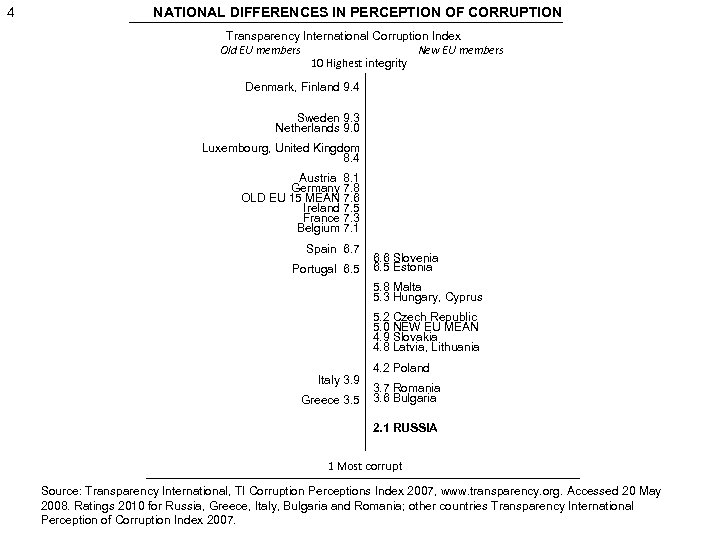
4 NATIONAL DIFFERENCES IN PERCEPTION OF CORRUPTION Transparency International Corruption Index Old EU members New EU members 10 Highest integrity Denmark, Finland 9. 4 Sweden 9. 3 Netherlands 9. 0 Luxembourg, United Kingdom 8. 4 Austria 8. 1 Germany 7. 8 OLD EU 15 MEAN 7. 6 Ireland 7. 5 France 7. 3 Belgium 7. 1 Spain 6. 7 Portugal 6. 5 6. 6 Slovenia 6. 5 Estonia 5. 8 Malta 5. 3 Hungary, Cyprus 5. 2 Czech Republic 5. 0 NEW EU MEAN 4. 9 Slovakia 4. 8 Latvia, Lithuania Italy 3. 9 Greece 3. 5 4. 2 Poland 3. 7 Romania 3. 6 Bulgaria 2. 1 RUSSIA 1 Most corrupt Source: Transparency International, TI Corruption Perceptions Index 2007, www. transparency. org. Accessed 20 May 2008. Ratings 2010 for Russia, Greece, Italy, Bulgaria and Romania; other countries Transparency International Perception of Corruption Index 2007.
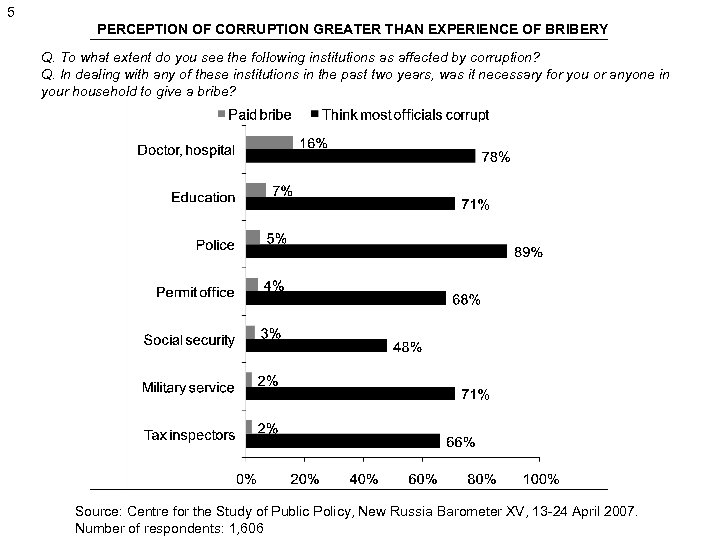
5 PERCEPTION OF CORRUPTION GREATER THAN EXPERIENCE OF BRIBERY Q. To what extent do you see the following institutions as affected by corruption? Q. In dealing with any of these institutions in the past two years, was it necessary for you or anyone in your household to give a bribe? Source: Centre for the Study of Public Policy, New Russia Barometer XV, 13 -24 April 2007. Number of respondents: 1, 606
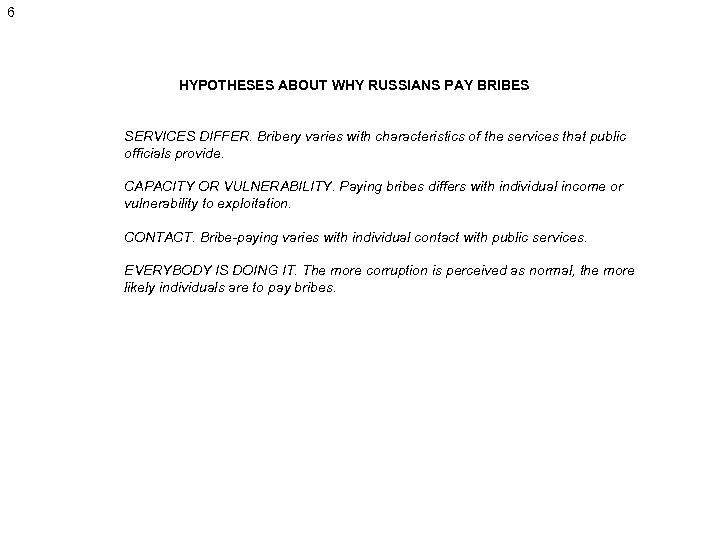
6 HYPOTHESES ABOUT WHY RUSSIANS PAY BRIBES SERVICES DIFFER. Bribery varies with characteristics of the services that public officials provide. CAPACITY OR VULNERABILITY. Paying bribes differs with individual income or vulnerability to exploitation. CONTACT. Bribe-paying varies with individual contact with public services. EVERYBODY IS DOING IT. The more corruption is perceived as normal, the more likely individuals are to pay bribes.
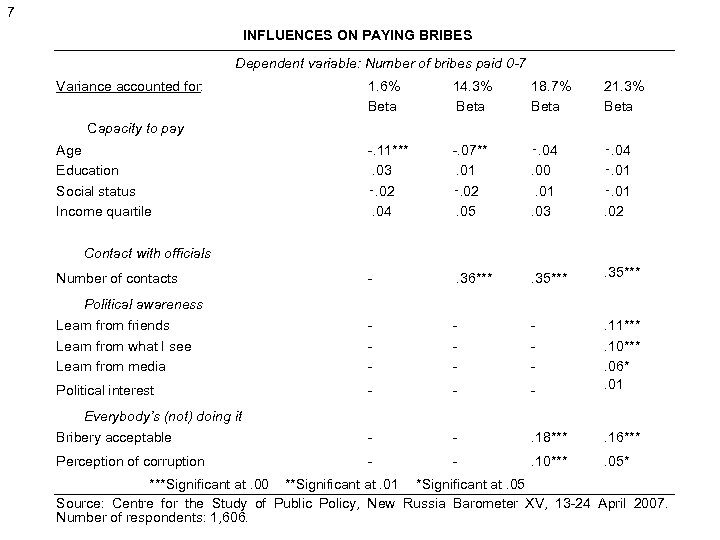
7 INFLUENCES ON PAYING BRIBES Dependent variable: Number of bribes paid 0 -7 Variance accounted for: 1. 6% Beta 14. 3% Beta 18. 7% Beta 21. 3% Beta -. 11***. 03 ‑. 02. 04 -. 07**. 01 ‑. 02. 05 ‑. 04. 00. 01. 03 ‑. 04 ‑. 01. 02 - . 36*** . 35*** Learn from friends Learn from what I see Learn from media - - - Political interest - - - . 11***. 10***. 06*. 01 Bribery acceptable - - . 18*** . 16*** Perception of corruption - - . 10*** . 05* Capacity to pay Age Education Social status Income quartile Contact with officials Number of contacts Political awareness Everybody’s (not) doing it ***Significant at. 00 **Significant at. 01 *Significant at. 05 Source: Centre for the Study of Public Policy, New Russia Barometer XV, 13 -24 April 2007. Number of respondents: 1, 606.
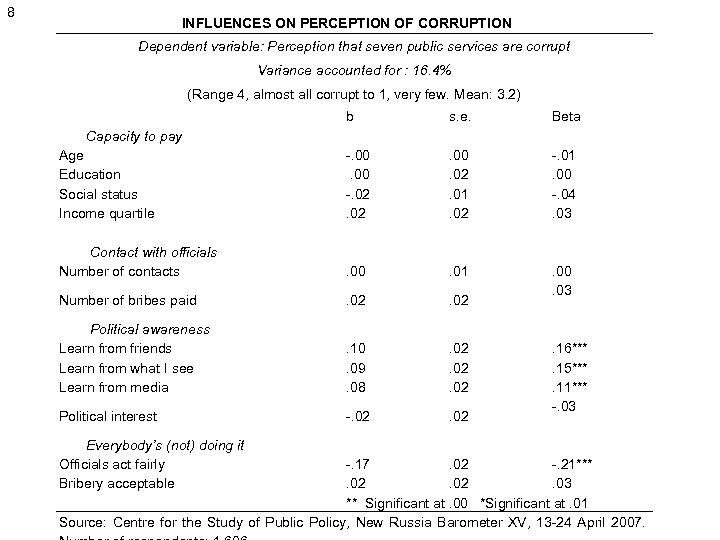
8 INFLUENCES ON PERCEPTION OF CORRUPTION Dependent variable: Perception that seven public services are corrupt Variance accounted for : 16. 4% (Range 4, almost all corrupt to 1, very few. Mean: 3. 2) b s. e. Beta Age Education Social status Income quartile -. 00 -. 02 . 00. 02. 01. 02 -. 01. 00 -. 04. 03 Contact with officials Number of contacts . 00 . 01 Number of bribes paid . 02 . 00. 03 Political awareness Learn from friends Learn from what I see Learn from media . 10. 09. 08 . 02. 02 Political interest -. 02 Capacity to pay Everybody’s (not) doing it Officials act fairly Bribery acceptable . 16***. 15***. 11*** -. 03 -. 17. 02 -. 21***. 02. 03 ** Significant at. 00 *Significant at. 01 Source: Centre for the Study of Public Policy, New Russia Barometer XV, 13 -24 April 2007.
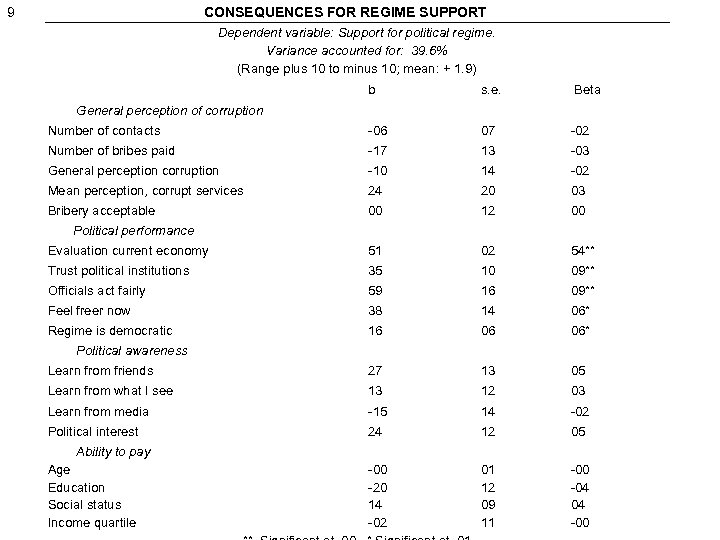
9 CONSEQUENCES FOR REGIME SUPPORT Dependent variable: Support for political regime. Variance accounted for: 39. 6% (Range plus 10 to minus 10; mean: + 1. 9) b s. e. Beta Number of contacts -06 07 -02 Number of bribes paid -17 13 -03 General perception corruption -10 14 -02 Mean perception, corrupt services 24 20 03 Bribery acceptable 00 12 00 Evaluation current economy 51 02 54** Trust political institutions 35 10 09** Officials act fairly 59 16 09** Feel freer now 38 14 06* Regime is democratic 16 06 06* Learn from friends 27 13 05 Learn from what I see 13 12 03 Learn from media -15 14 -02 Political interest 24 12 05 -00 -20 14 -02 01 12 09 11 -00 -04 04 -00 General perception of corruption Political performance Political awareness Ability to pay Age Education Social status Income quartile
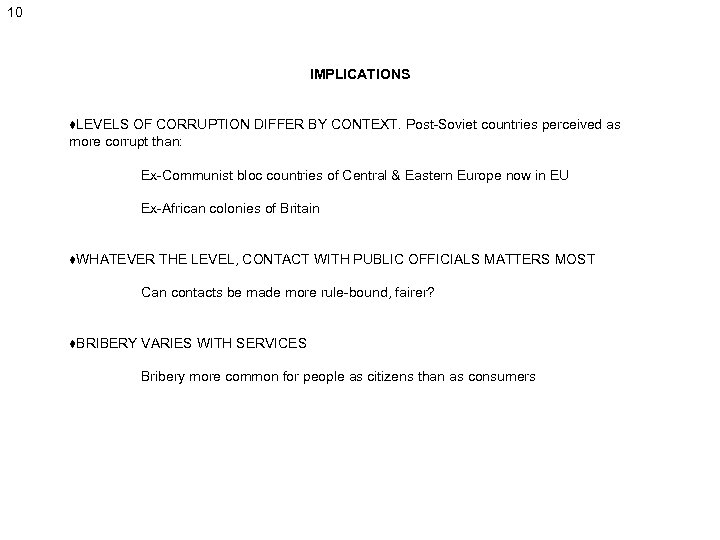
10 IMPLICATIONS ♦LEVELS OF CORRUPTION DIFFER BY CONTEXT. Post-Soviet countries perceived as more corrupt than: Ex-Communist bloc countries of Central & Eastern Europe now in EU Ex-African colonies of Britain ♦WHATEVER THE LEVEL, CONTACT WITH PUBLIC OFFICIALS MATTERS MOST Can contacts be made more rule-bound, fairer? ♦BRIBERY VARIES WITH SERVICES Bribery more common for people as citizens than as consumers
Скачать презентацию 1 LEONTIEF CENTRE St Petersburg CORRUPTION PERCEPTION vs
ca9f954ef9df13add475a4603e0ff126.ppt