


 Скачать презентацию 1 Lecture 3 Three-phase power circuits Instructor Dr
79fe70829730310f6c27ae8ff18a4ca9.ppt
- Количество слайдов: 31
 1 Lecture 3: Three-phase power circuits Instructor: Dr. Gleb V. Tcheslavski Contact: gleb@ee. lamar. edu Office Hours: TBD; Room 2030 Class web site: My. Lamar ELEN 3441 Fundamentals of Power Engineering Spring 2008
 2 Introduction Almost all electric power generation and most of the power transmission in the world is in the form of three-phase AC circuits. A three-phase AC system consists of three-phase generators, transmission lines, and loads. There are two major advantages of three-phase systems over a single-phase system: 1) More power per kilogram of metal form a three-phase machine; 2) Power delivered to a three-phase load is constant at all time, instead of pulsing as it does in a single-phase system. The first three-phase electrical system was patented in 1882 by John Hopkinson - British physicist, electrical engineer, Fellow of the Royal Society. ELEN 3441 Fundamentals of Power Engineering Spring 2008
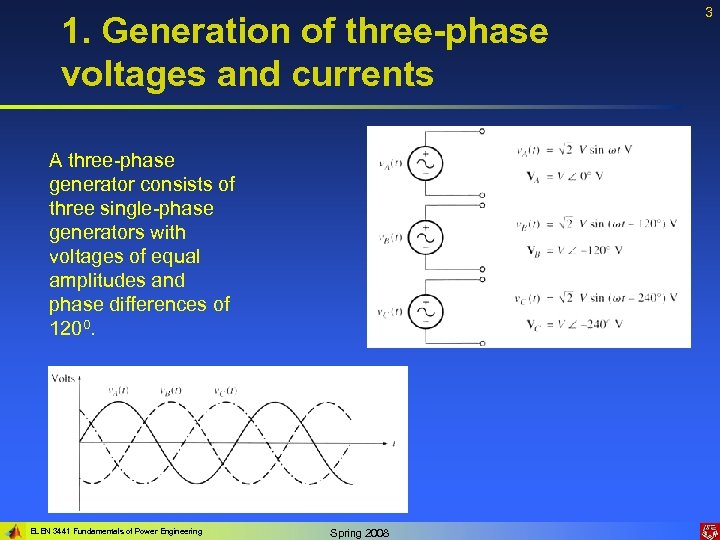 1. Generation of three-phase voltages and currents A three-phase generator consists of three single-phase generators with voltages of equal amplitudes and phase differences of 1200. ELEN 3441 Fundamentals of Power Engineering Spring 2008 3
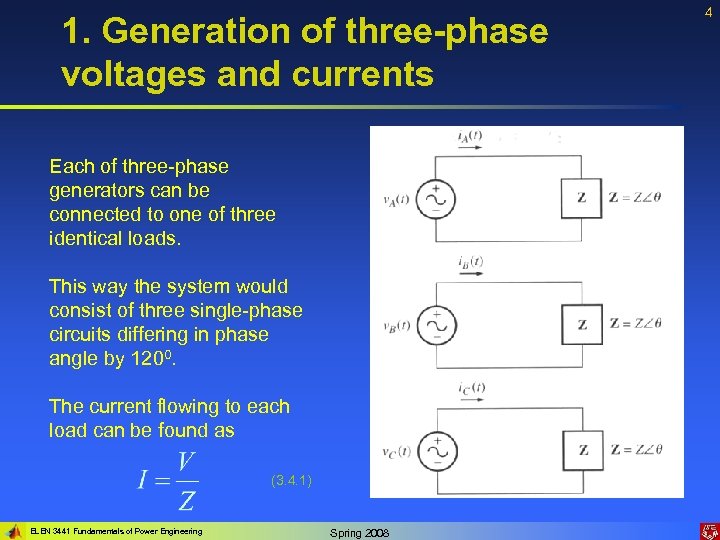 1. Generation of three-phase voltages and currents Each of three-phase generators can be connected to one of three identical loads. This way the system would consist of three single-phase circuits differing in phase angle by 1200. The current flowing to each load can be found as (3. 4. 1) ELEN 3441 Fundamentals of Power Engineering Spring 2008 4
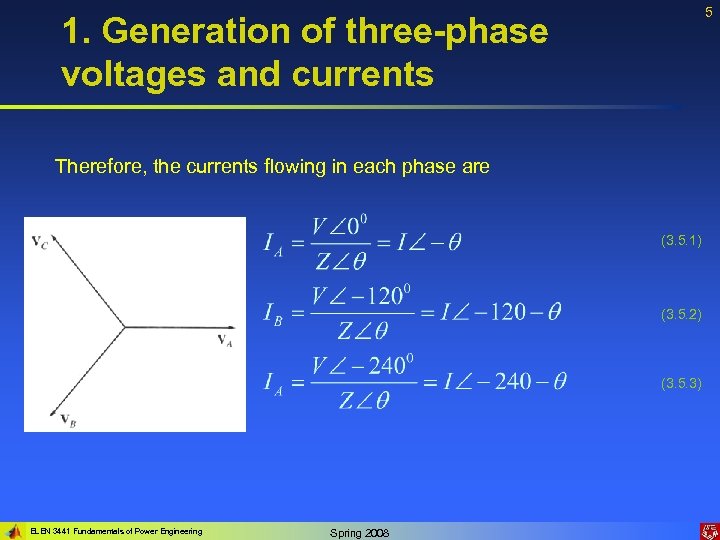 5 1. Generation of three-phase voltages and currents Therefore, the currents flowing in each phase are (3. 5. 1) (3. 5. 2) (3. 5. 3) ELEN 3441 Fundamentals of Power Engineering Spring 2008
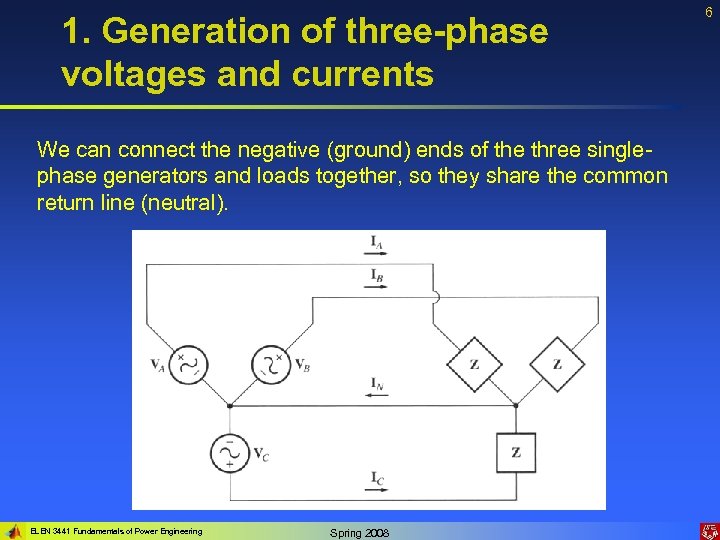 1. Generation of three-phase voltages and currents We can connect the negative (ground) ends of the three singlephase generators and loads together, so they share the common return line (neutral). ELEN 3441 Fundamentals of Power Engineering Spring 2008 6
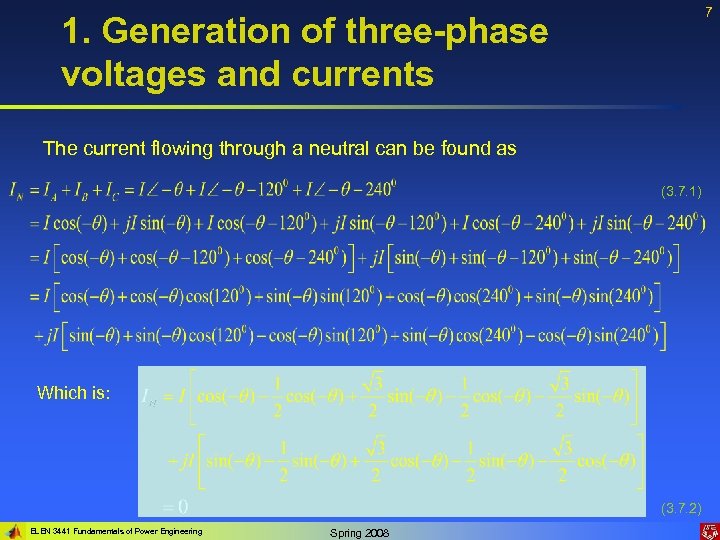 7 1. Generation of three-phase voltages and currents The current flowing through a neutral can be found as (3. 7. 1) Which is: (3. 7. 2) ELEN 3441 Fundamentals of Power Engineering Spring 2008
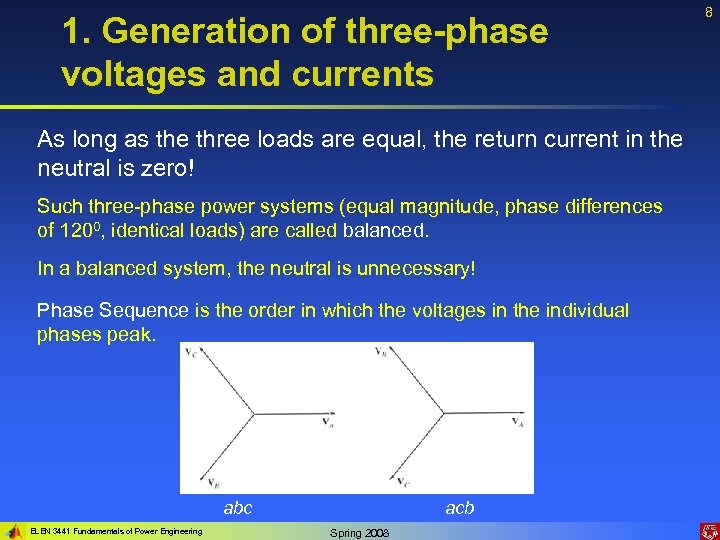 1. Generation of three-phase voltages and currents As long as the three loads are equal, the return current in the neutral is zero! Such three-phase power systems (equal magnitude, phase differences of 1200, identical loads) are called balanced. In a balanced system, the neutral is unnecessary! Phase Sequence is the order in which the voltages in the individual phases peak. abc ELEN 3441 Fundamentals of Power Engineering acb Spring 2008 8
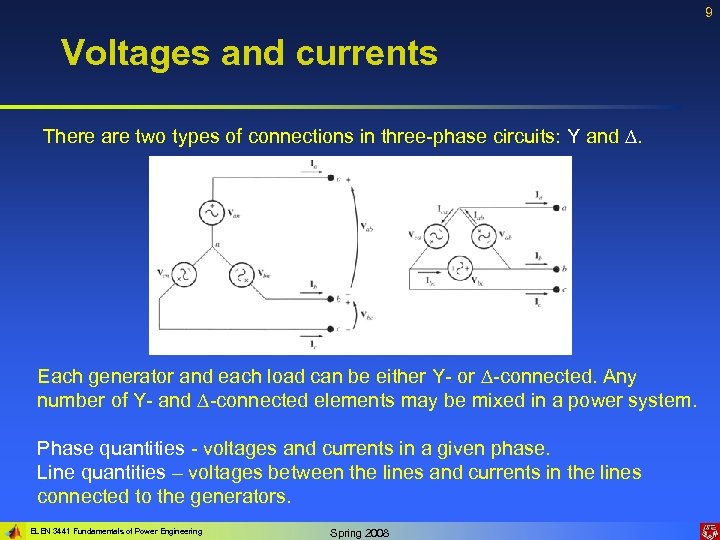 9 Voltages and currents There are two types of connections in three-phase circuits: Y and . Each generator and each load can be either Y- or -connected. Any number of Y- and -connected elements may be mixed in a power system. Phase quantities - voltages and currents in a given phase. Line quantities – voltages between the lines and currents in the lines connected to the generators. ELEN 3441 Fundamentals of Power Engineering Spring 2008
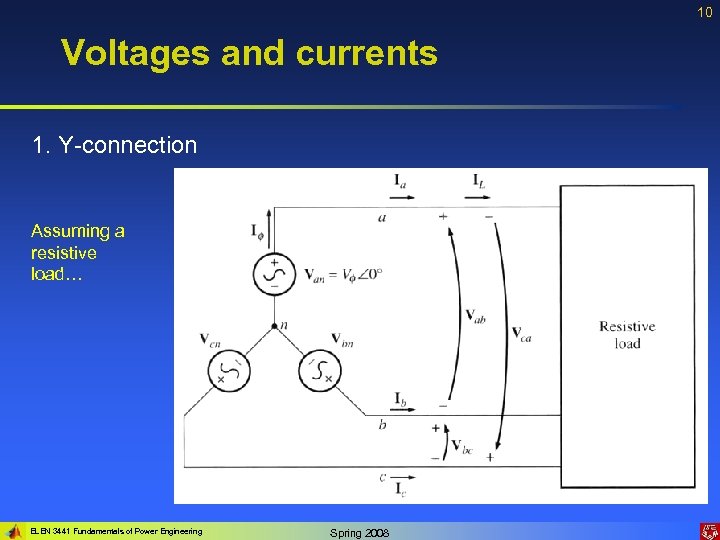 10 Voltages and currents 1. Y-connection Assuming a resistive load… ELEN 3441 Fundamentals of Power Engineering Spring 2008
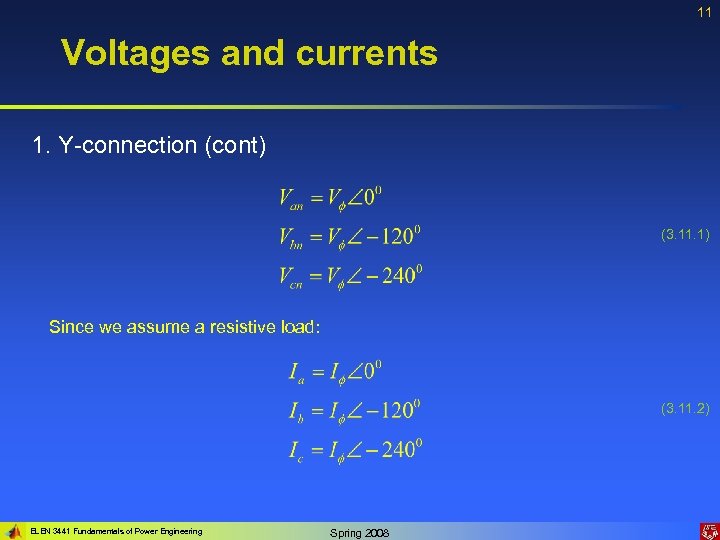 11 Voltages and currents 1. Y-connection (cont) (3. 11. 1) Since we assume a resistive load: (3. 11. 2) ELEN 3441 Fundamentals of Power Engineering Spring 2008
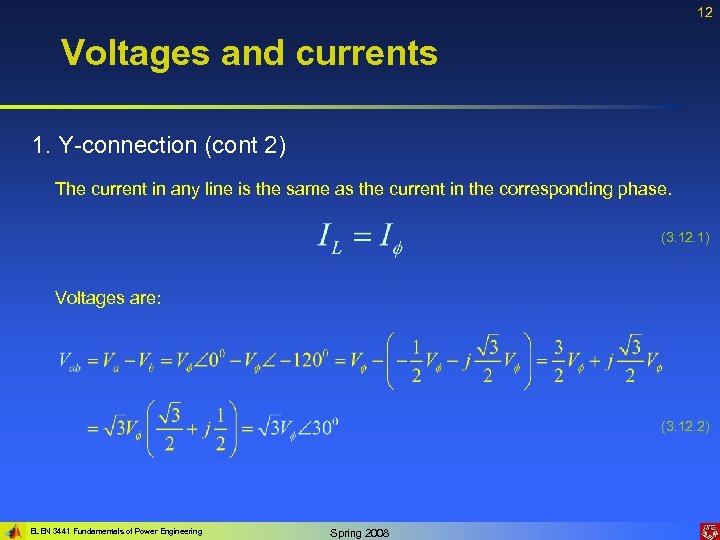 12 Voltages and currents 1. Y-connection (cont 2) The current in any line is the same as the current in the corresponding phase. (3. 12. 1) Voltages are: (3. 12. 2) ELEN 3441 Fundamentals of Power Engineering Spring 2008
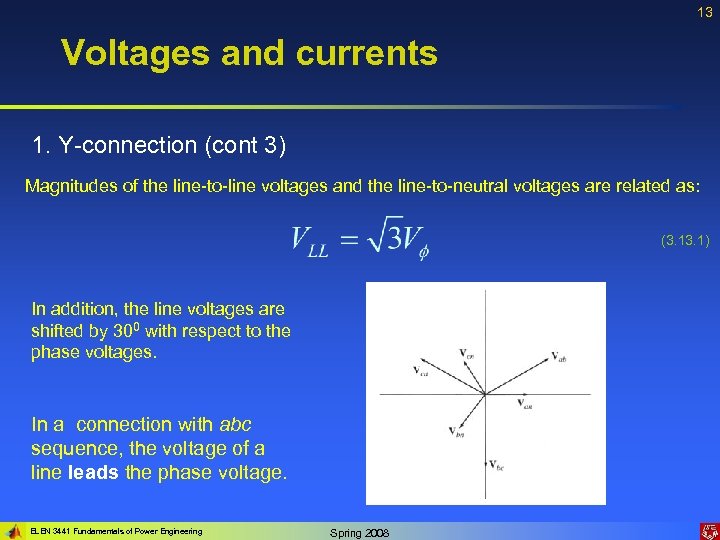 13 Voltages and currents 1. Y-connection (cont 3) Magnitudes of the line-to-line voltages and the line-to-neutral voltages are related as: (3. 1) In addition, the line voltages are shifted by 300 with respect to the phase voltages. In a connection with abc sequence, the voltage of a line leads the phase voltage. ELEN 3441 Fundamentals of Power Engineering Spring 2008
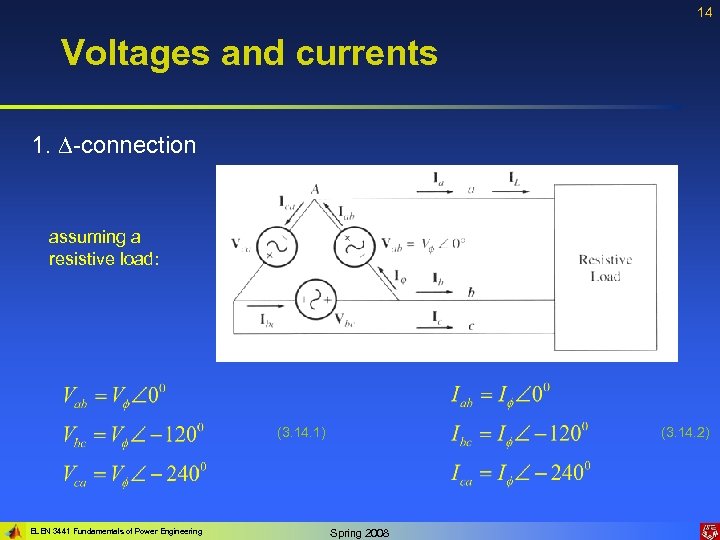 14 Voltages and currents 1. -connection assuming a resistive load: (3. 14. 1) ELEN 3441 Fundamentals of Power Engineering (3. 14. 2) Spring 2008
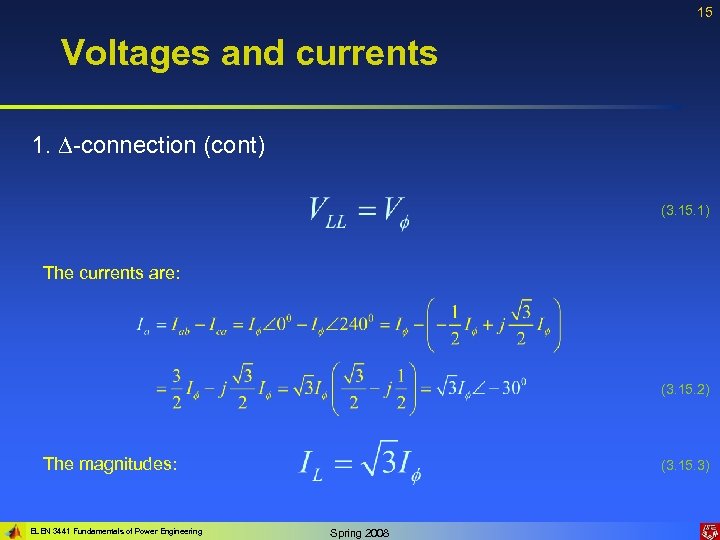 15 Voltages and currents 1. -connection (cont) (3. 15. 1) The currents are: (3. 15. 2) The magnitudes: ELEN 3441 Fundamentals of Power Engineering (3. 15. 3) Spring 2008
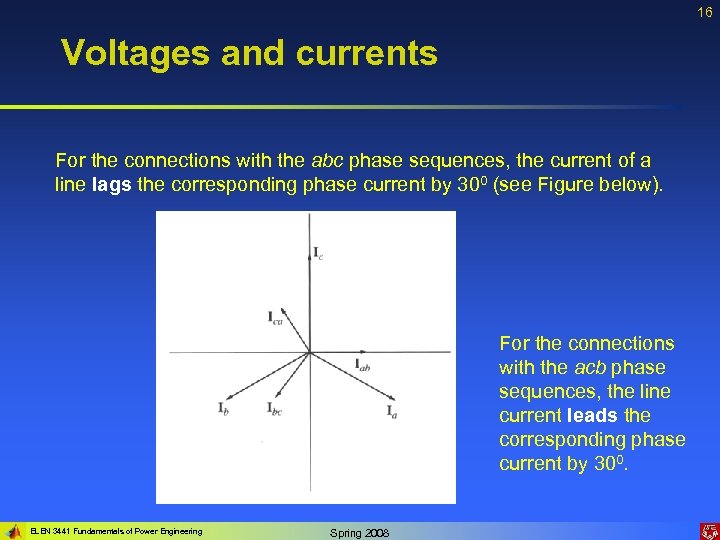 16 Voltages and currents For the connections with the abc phase sequences, the current of a line lags the corresponding phase current by 300 (see Figure below). For the connections with the acb phase sequences, the line current leads the corresponding phase current by 300. ELEN 3441 Fundamentals of Power Engineering Spring 2008
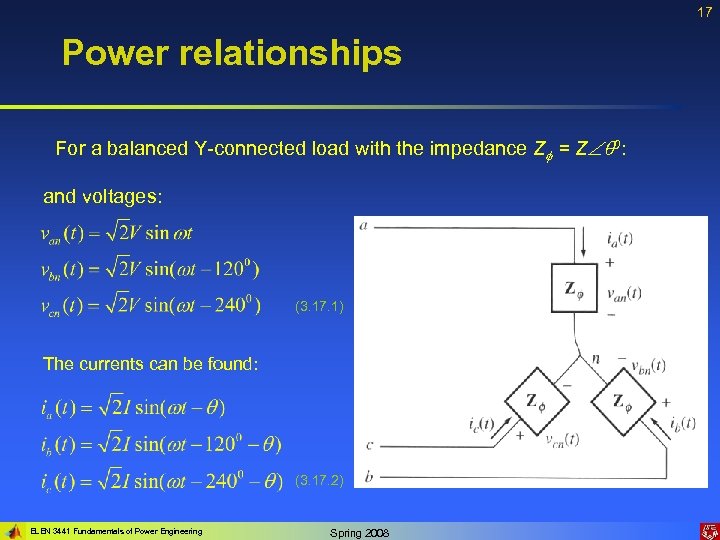 17 Power relationships For a balanced Y-connected load with the impedance Z = Z 0: and voltages: (3. 17. 1) The currents can be found: (3. 17. 2) ELEN 3441 Fundamentals of Power Engineering Spring 2008
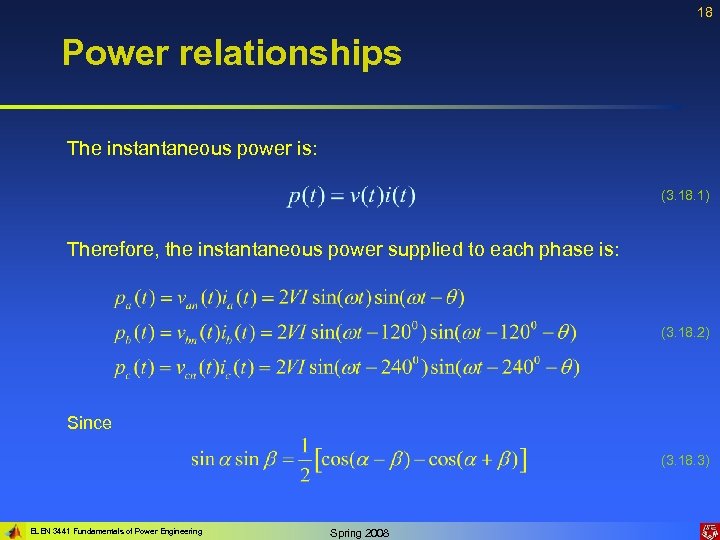 18 Power relationships The instantaneous power is: (3. 18. 1) Therefore, the instantaneous power supplied to each phase is: (3. 18. 2) Since (3. 18. 3) ELEN 3441 Fundamentals of Power Engineering Spring 2008
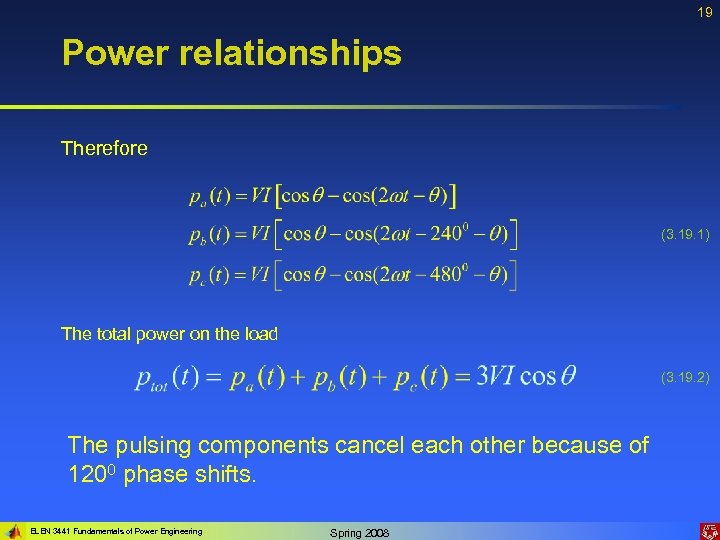 19 Power relationships Therefore (3. 19. 1) The total power on the load (3. 19. 2) The pulsing components cancel each other because of 1200 phase shifts. ELEN 3441 Fundamentals of Power Engineering Spring 2008
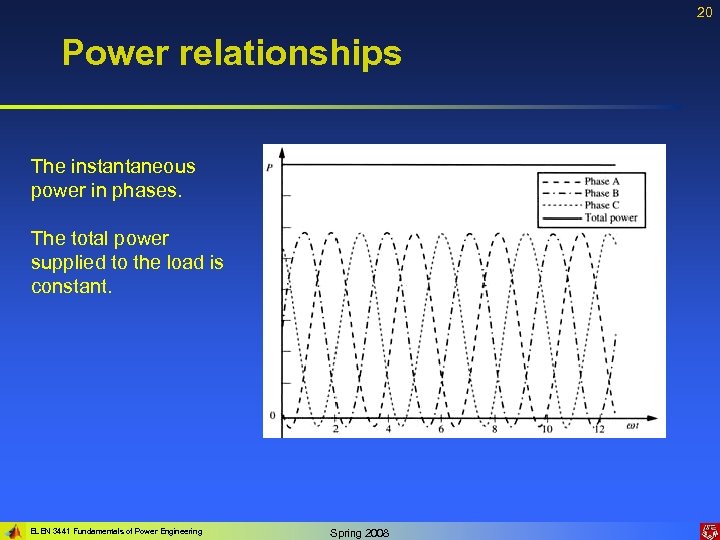 20 Power relationships The instantaneous power in phases. The total power supplied to the load is constant. ELEN 3441 Fundamentals of Power Engineering Spring 2008
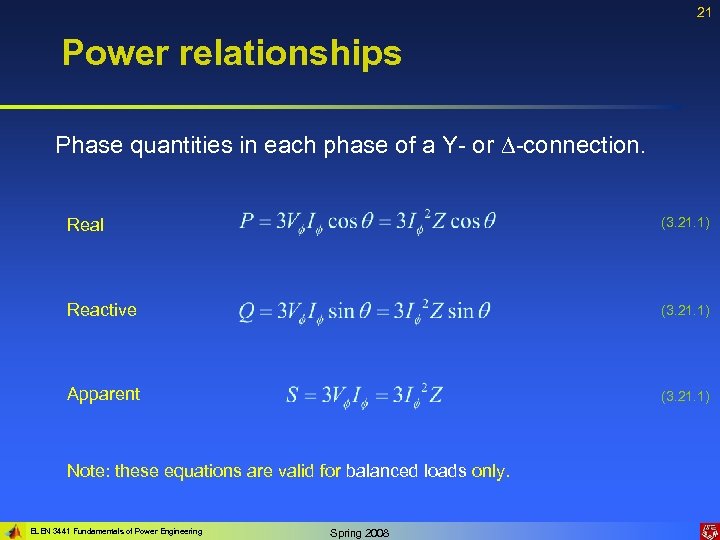 21 Power relationships Phase quantities in each phase of a Y- or -connection. Real (3. 21. 1) Reactive (3. 21. 1) Apparent (3. 21. 1) Note: these equations are valid for balanced loads only. ELEN 3441 Fundamentals of Power Engineering Spring 2008
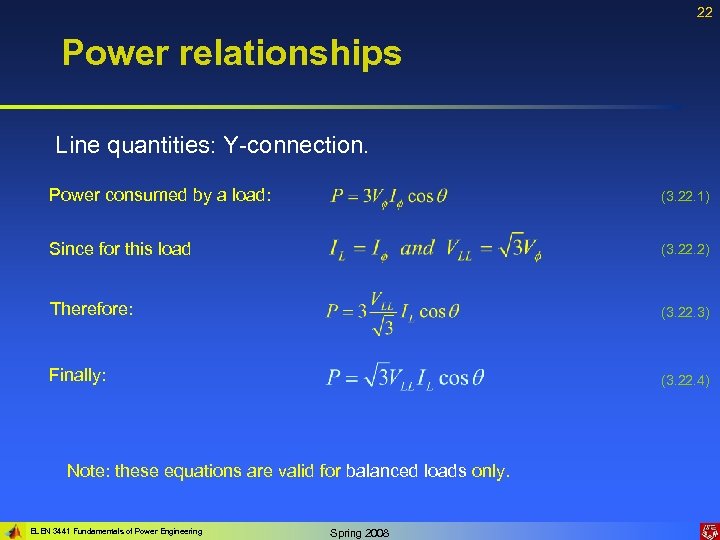 22 Power relationships Line quantities: Y-connection. Power consumed by a load: (3. 22. 1) Since for this load (3. 22. 2) Therefore: (3. 22. 3) Finally: (3. 22. 4) Note: these equations are valid for balanced loads only. ELEN 3441 Fundamentals of Power Engineering Spring 2008
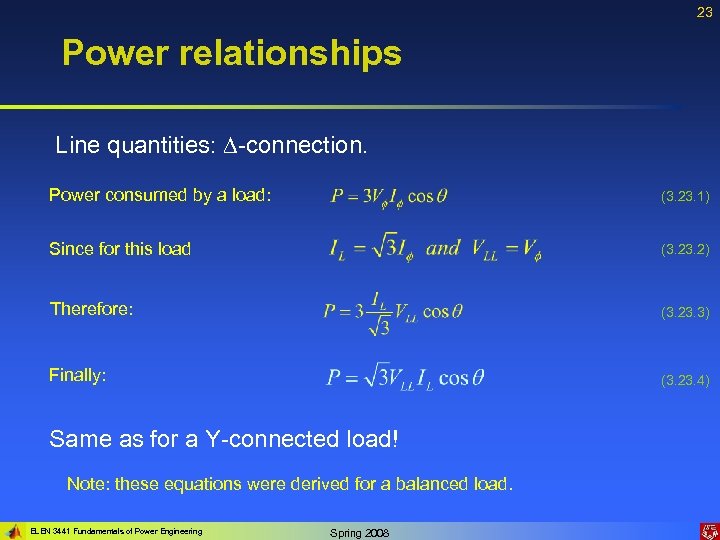 23 Power relationships Line quantities: -connection. Power consumed by a load: (3. 23. 1) Since for this load (3. 2) Therefore: (3. 23. 3) Finally: (3. 23. 4) Same as for a Y-connected load! Note: these equations were derived for a balanced load. ELEN 3441 Fundamentals of Power Engineering Spring 2008
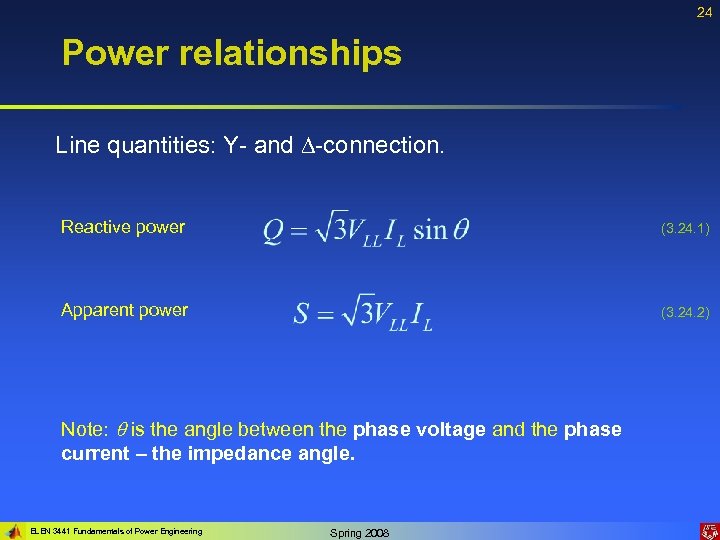 24 Power relationships Line quantities: Y- and -connection. Reactive power (3. 24. 1) Apparent power (3. 24. 2) Note: is the angle between the phase voltage and the phase current – the impedance angle. ELEN 3441 Fundamentals of Power Engineering Spring 2008
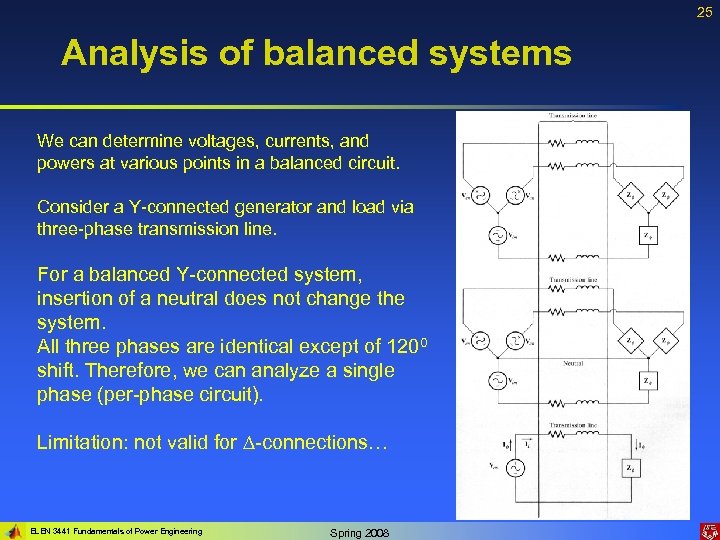 25 Analysis of balanced systems We can determine voltages, currents, and powers at various points in a balanced circuit. Consider a Y-connected generator and load via three-phase transmission line. For a balanced Y-connected system, insertion of a neutral does not change the system. All three phases are identical except of 1200 shift. Therefore, we can analyze a single phase (per-phase circuit). Limitation: not valid for -connections… ELEN 3441 Fundamentals of Power Engineering Spring 2008
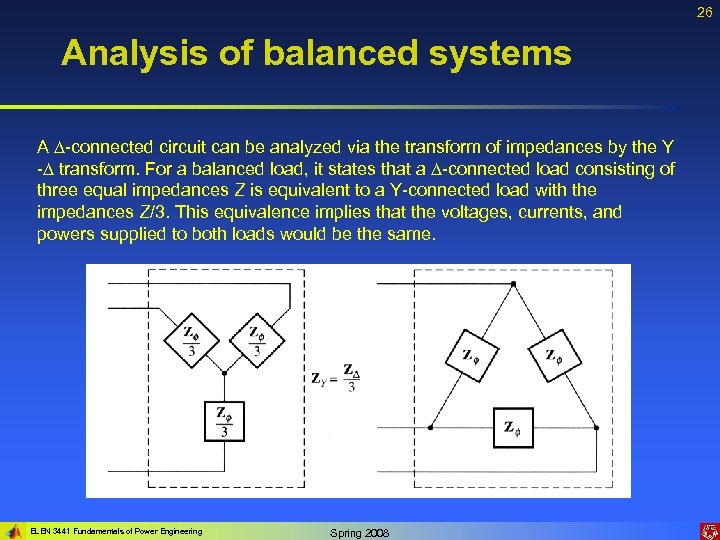 26 Analysis of balanced systems A -connected circuit can be analyzed via the transform of impedances by the Y - transform. For a balanced load, it states that a -connected load consisting of three equal impedances Z is equivalent to a Y-connected load with the impedances Z/3. This equivalence implies that the voltages, currents, and powers supplied to both loads would be the same. ELEN 3441 Fundamentals of Power Engineering Spring 2008
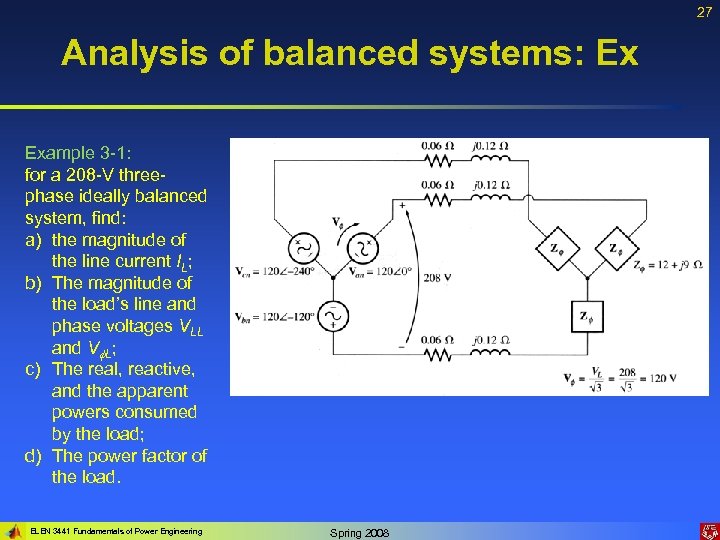 27 Analysis of balanced systems: Ex Example 3 -1: for a 208 -V threephase ideally balanced system, find: a) the magnitude of the line current IL; b) The magnitude of the load’s line and phase voltages VLL and V L; c) The real, reactive, and the apparent powers consumed by the load; d) The power factor of the load. ELEN 3441 Fundamentals of Power Engineering Spring 2008
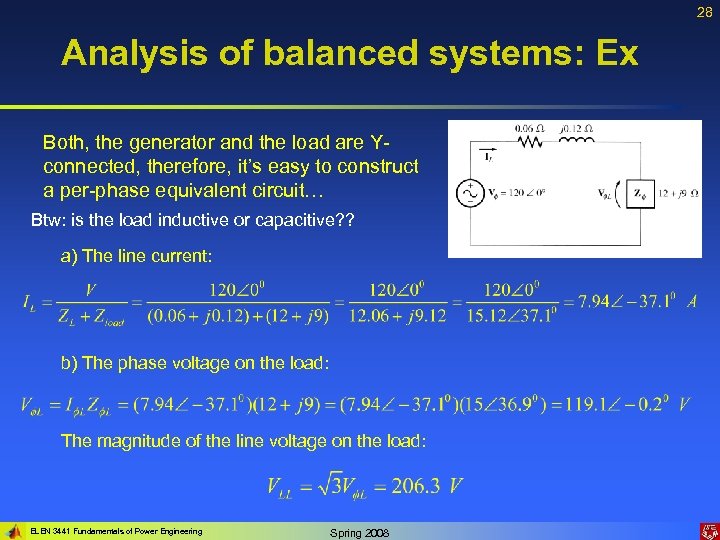 28 Analysis of balanced systems: Ex Both, the generator and the load are Yconnected, therefore, it’s easy to construct a per-phase equivalent circuit… Btw: is the load inductive or capacitive? ? a) The line current: b) The phase voltage on the load: The magnitude of the line voltage on the load: ELEN 3441 Fundamentals of Power Engineering Spring 2008
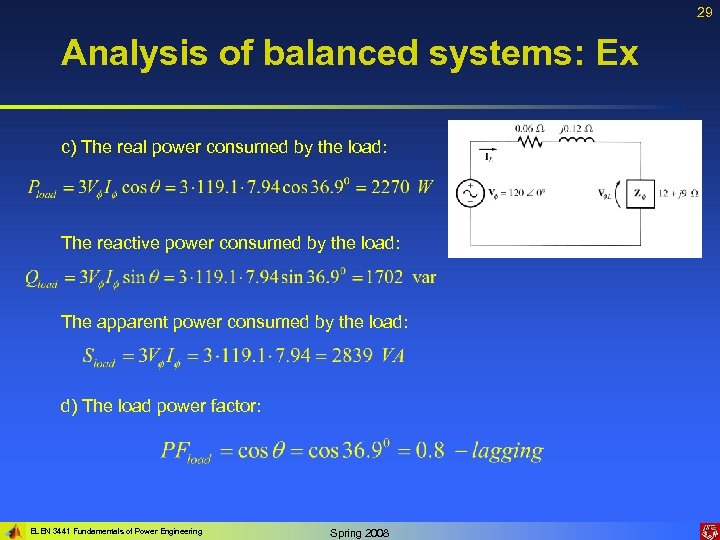 29 Analysis of balanced systems: Ex c) The real power consumed by the load: The reactive power consumed by the load: The apparent power consumed by the load: d) The load power factor: ELEN 3441 Fundamentals of Power Engineering Spring 2008
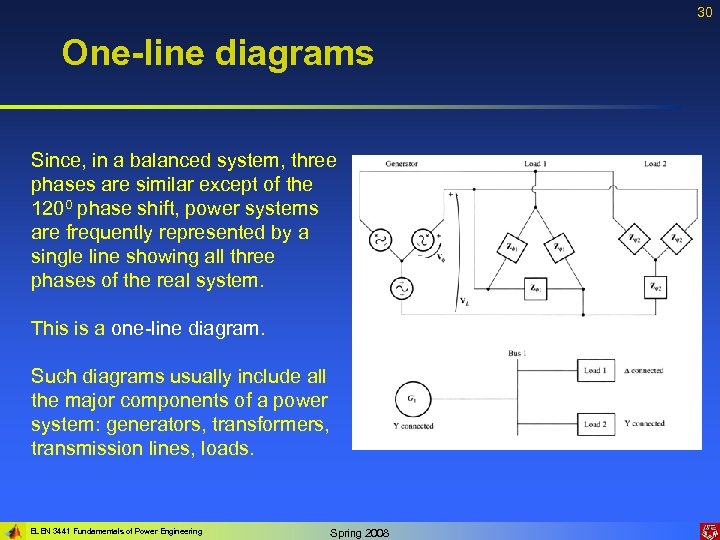 30 One-line diagrams Since, in a balanced system, three phases are similar except of the 1200 phase shift, power systems are frequently represented by a single line showing all three phases of the real system. This is a one-line diagram. Such diagrams usually include all the major components of a power system: generators, transformers, transmission lines, loads. ELEN 3441 Fundamentals of Power Engineering Spring 2008
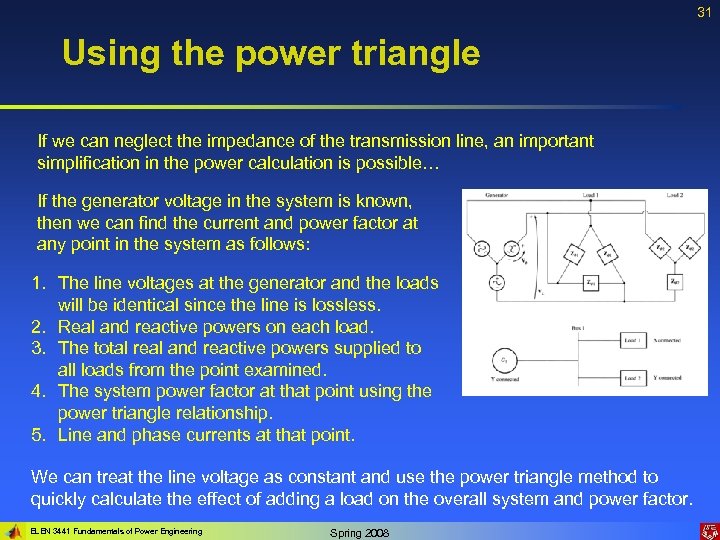 31 Using the power triangle If we can neglect the impedance of the transmission line, an important simplification in the power calculation is possible… If the generator voltage in the system is known, then we can find the current and power factor at any point in the system as follows: 1. The line voltages at the generator and the loads will be identical since the line is lossless. 2. Real and reactive powers on each load. 3. The total real and reactive powers supplied to all loads from the point examined. 4. The system power factor at that point using the power triangle relationship. 5. Line and phase currents at that point. We can treat the line voltage as constant and use the power triangle method to quickly calculate the effect of adding a load on the overall system and power factor. ELEN 3441 Fundamentals of Power Engineering Spring 2008