 Скачать презентацию 1 Last update 18 November 2009 1 Advanced
dfaddcac2bbcd82e0c2a674eae69b992.ppt
- Количество слайдов: 32



1 Last update: 18 November 2009 1 Advanced databases – Inferring implicit/new knowledge from data(bases): Text mining (used, e. g. , for Web content mining) Bettina Berendt Katholieke Universiteit Leuven, Department of Computer Science http: //www. cs. kuleuven. ac. be/~berendt/teaching/2009 -10 -1 stsemester/adb/ Berendt: Advanced databases, 2009, http: //www. cs. kuleuven. be/~berendt/teaching 1
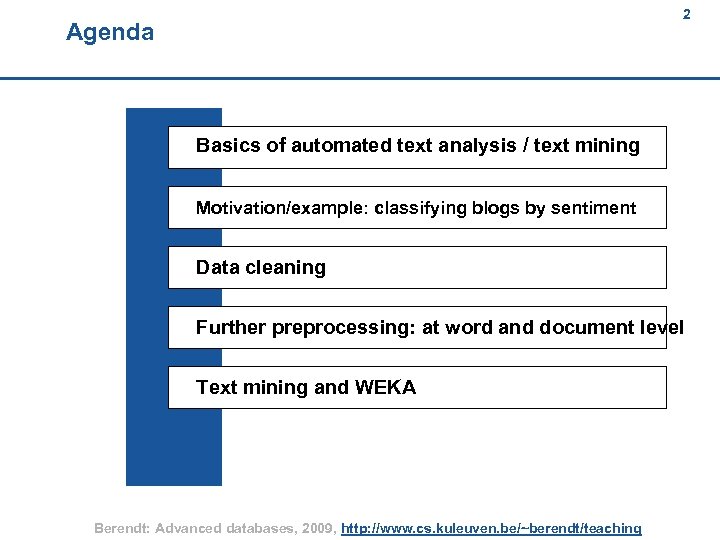
2 Agenda 2 Basics of automated text analysis / text mining Motivation/example: classifying blogs by sentiment Data cleaning Further preprocessing: at word and document level Text mining and WEKA Berendt: Advanced databases, 2009, http: //www. cs. kuleuven. be/~berendt/teaching 2
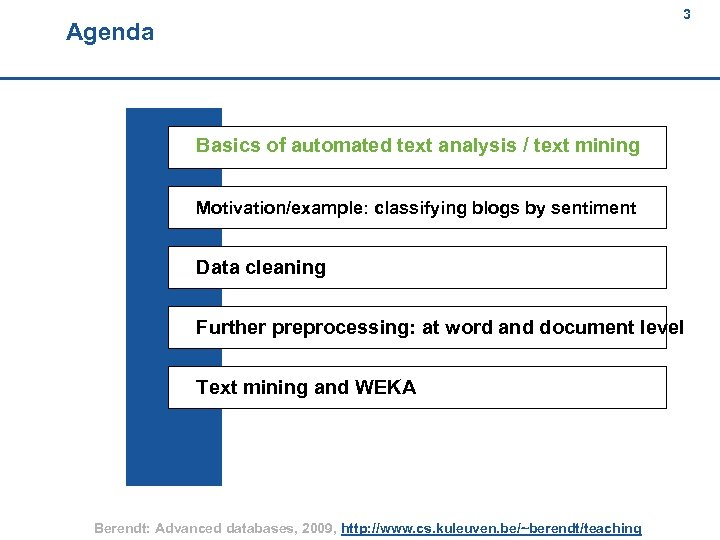
3 Agenda 3 Basics of automated text analysis / text mining Motivation/example: classifying blogs by sentiment Data cleaning Further preprocessing: at word and document level Text mining and WEKA Berendt: Advanced databases, 2009, http: //www. cs. kuleuven. be/~berendt/teaching 3
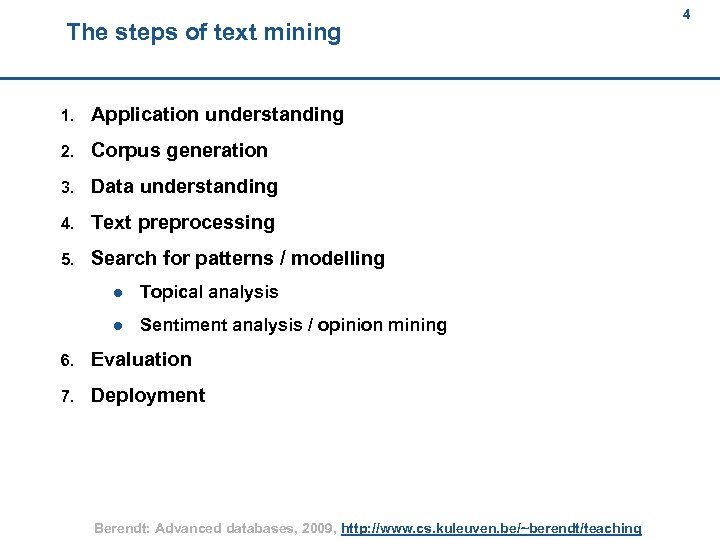
The steps of text mining 4 4 1. Application understanding 2. Corpus generation 3. Data understanding 4. Text preprocessing 5. Search for patterns / modelling l Topical analysis l Sentiment analysis / opinion mining 6. Evaluation 7. Deployment Berendt: Advanced databases, 2009, http: //www. cs. kuleuven. be/~berendt/teaching 4
Application understanding; Corpus generation 5 5 n What is the question? n What is the context? n What could be interesting sources, and where can they be found? n Crawl n Use a search engine and/or archive l Google blogs search l Technorati l Blogdigger l . . . Berendt: Advanced databases, 2009, http: //www. cs. kuleuven. be/~berendt/teaching 5
The goal: text representation 6 6 n Basic idea: l l n Keywords are extracted from texts. These keywords describe the (usually) topical content of Web pages and other text contributions. Based on the vector space model of document collections: l Each unique word in a corpus of Web pages = one dimension l Each page(view) is a vector with non-zero weight for each word in that page(view), zero weight for other words Words become “features” (in a data-mining sense) Berendt: Advanced databases, 2009, http: //www. cs. kuleuven. be/~berendt/teaching 6
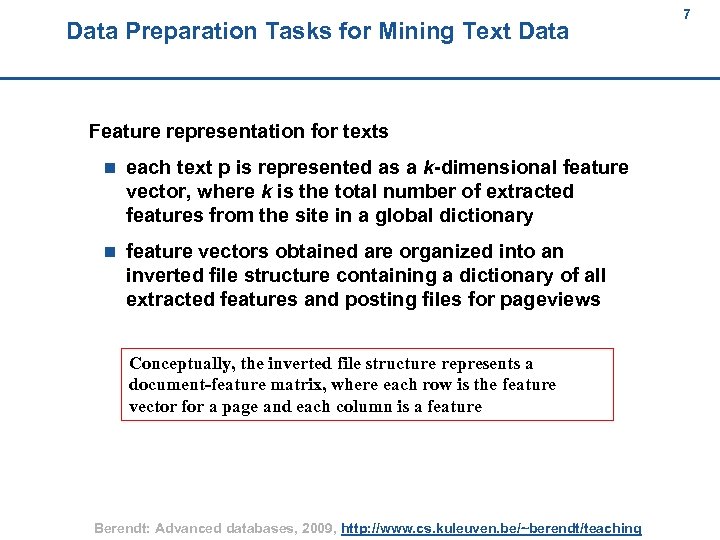
Data Preparation Tasks for Mining Text Data 7 7 Feature representation for texts n each text p is represented as a k-dimensional feature vector, where k is the total number of extracted features from the site in a global dictionary n feature vectors obtained are organized into an inverted file structure containing a dictionary of all extracted features and posting files for pageviews Conceptually, the inverted file structure represents a document-feature matrix, where each row is the feature vector for a page and each column is a feature Berendt: Advanced databases, 2009, http: //www. cs. kuleuven. be/~berendt/teaching 7
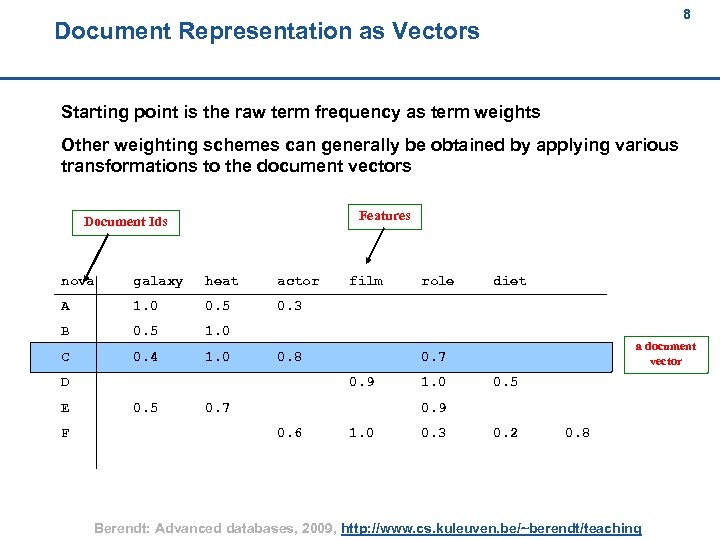
8 Document Representation as Vectors 8 Starting point is the raw term frequency as term weights Other weighting schemes can generally be obtained by applying various transformations to the document vectors Features Document Ids nova galaxy heat actor A 1. 0 0. 5 0. 3 B 0. 5 1. 0 C 0. 4 1. 0 0. 8 D E F film diet a document vector 0. 7 0. 9 0. 5 role 0. 7 1. 0 0. 5 0. 9 0. 6 1. 0 0. 3 0. 2 0. 8 Berendt: Advanced databases, 2009, http: //www. cs. kuleuven. be/~berendt/teaching 8
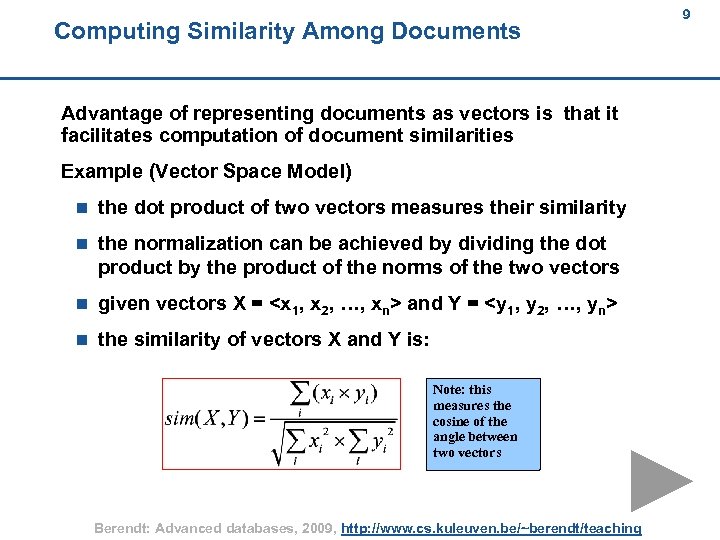
Computing Similarity Among Documents 9 9 Advantage of representing documents as vectors is that it facilitates computation of document similarities Example (Vector Space Model) n the dot product of two vectors measures their similarity n the normalization can be achieved by dividing the dot product by the product of the norms of the two vectors n given vectors X = <x 1, x 2, …, xn> and Y = <y 1, y 2, …, yn> n the similarity of vectors X and Y is: Note: this measures the cosine of the angle between two vectors Berendt: Advanced databases, 2009, http: //www. cs. kuleuven. be/~berendt/teaching 9
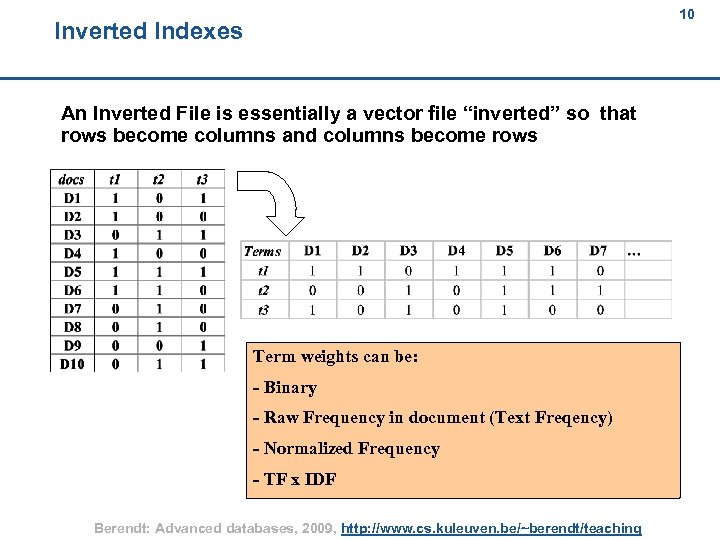
10 Inverted Indexes 10 An Inverted File is essentially a vector file “inverted” so that rows become columns and columns become rows Term weights can be: - Binary - Raw Frequency in document (Text Freqency) - Normalized Frequency - TF x IDF Berendt: Advanced databases, 2009, http: //www. cs. kuleuven. be/~berendt/teaching 10
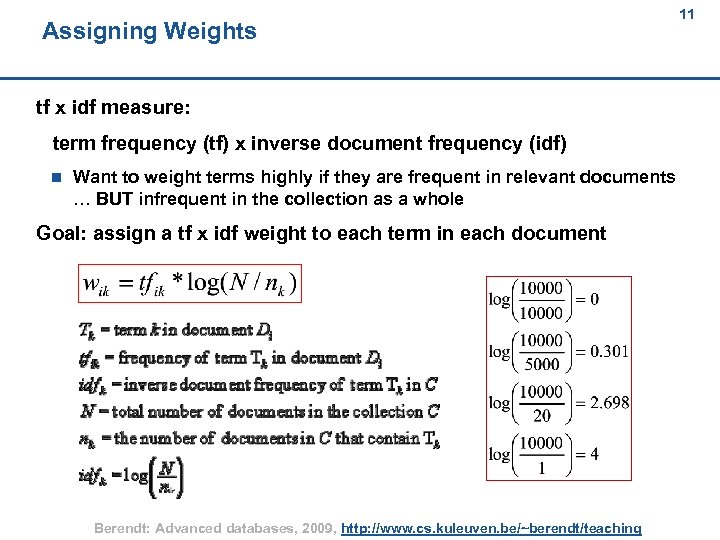
Assigning Weights 11 11 tf x idf measure: term frequency (tf) x inverse document frequency (idf) n Want to weight terms highly if they are frequent in relevant documents … BUT infrequent in the collection as a whole Goal: assign a tf x idf weight to each term in each document Berendt: Advanced databases, 2009, http: //www. cs. kuleuven. be/~berendt/teaching 11
12 Agenda 12 Basics of automated text analysis / text mining Motivation/example: classifying blogs by sentiment Data cleaning Further preprocessing: at word and document level Text mining and WEKA Berendt: Advanced databases, 2009, http: //www. cs. kuleuven. be/~berendt/teaching 12
What is text mining? 13 13 n The application of data mining to text data n „the discovery by computer of new, previously unknown information, by automatically extracting information from different written resources. n A key element is the linking together of the extracting information [. . . ] to form new facts or new hypotheses to be explored further by more conventional means of experimentation. n Text mining is different from [. . . ] web search. In search, the user is typically looking for something that is already known and has been written by someone else. [. . . ] In text mining, the goal is to discover heretofore unknown information, something that no one yet knows and so could not have yet written down. “ (Marti Hearst, What is Text Mining, 2003, http: //people. ischool. berkeley. edu/~hearst/text-mining. html) Berendt: Advanced databases, 2009, http: //www. cs. kuleuven. be/~berendt/teaching 13
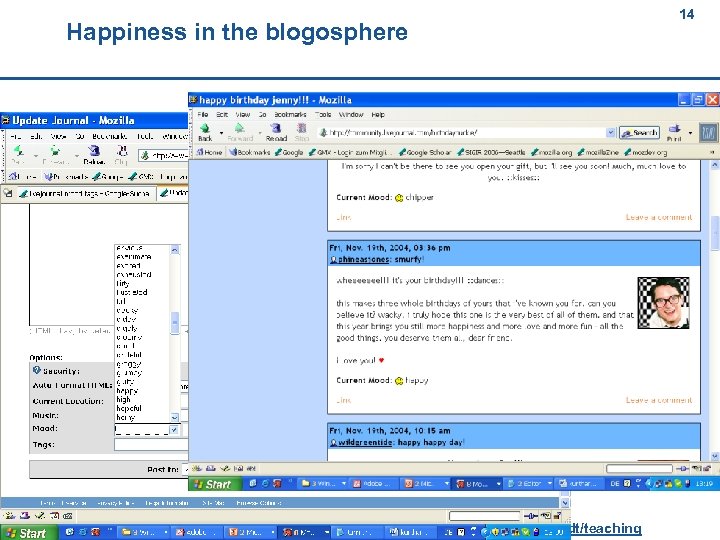
Happiness in the blogosphere 14 14 Berendt: Advanced databases, 2009, http: //www. cs. kuleuven. be/~berendt/teaching 14
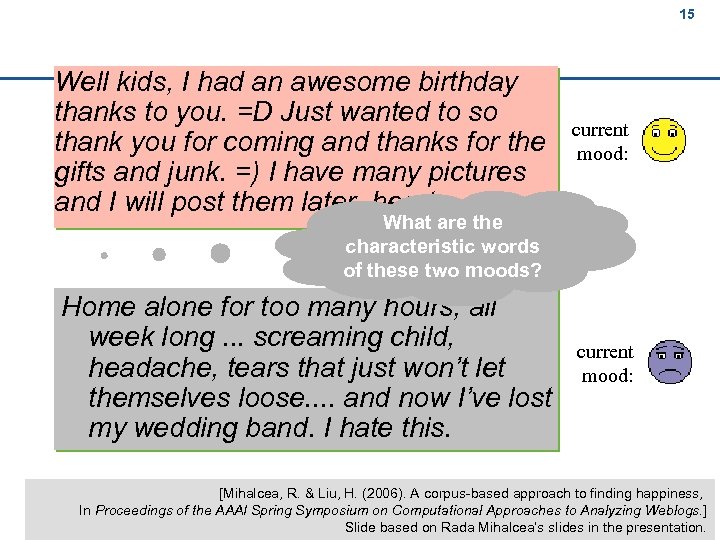
15 15 Well kids, I had an awesome birthday thanks to you. =D Just wanted to so thank you for coming and thanks for the gifts and junk. =) I have many pictures and I will post them later. hearts current mood: What are the characteristic words of these two moods? Home alone for too many hours, all week long. . . screaming child, headache, tears that just won’t let themselves loose. . and now I’ve lost my wedding band. I hate this. current mood: [Mihalcea, R. & Liu, H. (2006). A corpus-based approach to finding happiness, In Proceedings of the AAAI Spring Symposium on Computational Approaches to Analyzing Weblogs. ] Slide based on Rada Mihalcea‘s slides in the presentation. 15 Berendt: Advanced databases, 2009, http: //www. cs. kuleuven. be/~berendt/teaching
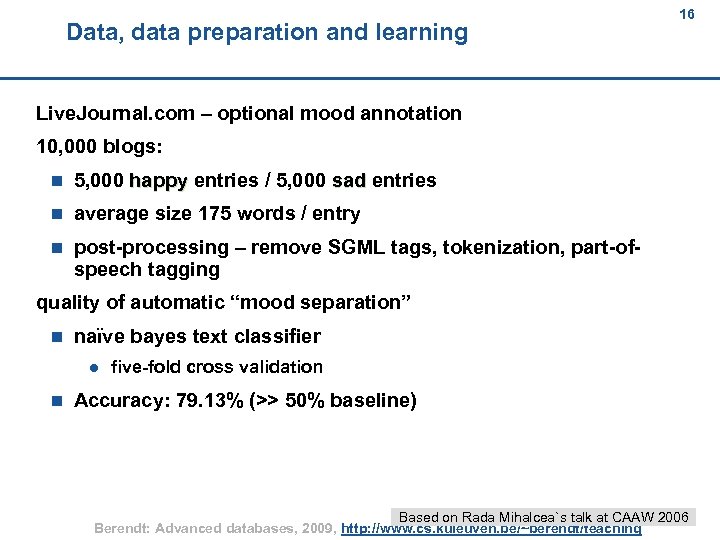
Data, data preparation and learning 16 16 Live. Journal. com – optional mood annotation 10, 000 blogs: n 5, 000 happy entries / 5, 000 sad entries n average size 175 words / entry n post-processing – remove SGML tags, tokenization, part-ofspeech tagging quality of automatic “mood separation” n naïve bayes text classifier l n five-fold cross validation Accuracy: 79. 13% (>> 50% baseline) Based on Rada Mihalcea`s talk at CAAW 2006 16 Berendt: Advanced databases, 2009, http: //www. cs. kuleuven. be/~berendt/teaching
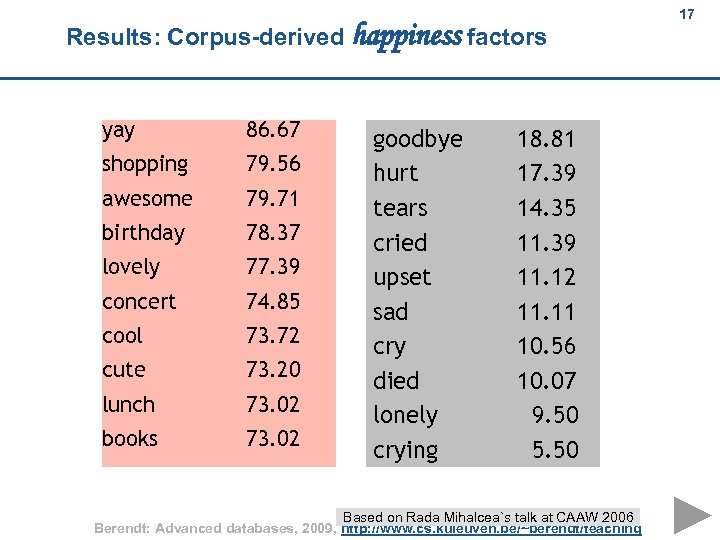
Results: Corpus-derived happiness factors 17 17 yay 86. 67 shopping 79. 56 awesome 79. 71 birthday 78. 37 lovely 77. 39 concert 74. 85 cool 73. 72 cute 73. 20 lunch 73. 02 books 73. 02 goodbye hurt tears cried upset sad cry died lonely crying 18. 81 17. 39 14. 35 11. 39 11. 12 11. 11 10. 56 10. 07 9. 50 5. 50 Based on Rada Mihalcea`s talk at CAAW 2006 Berendt: Advanced databases, 2009, http: //www. cs. kuleuven. be/~berendt/teaching 17
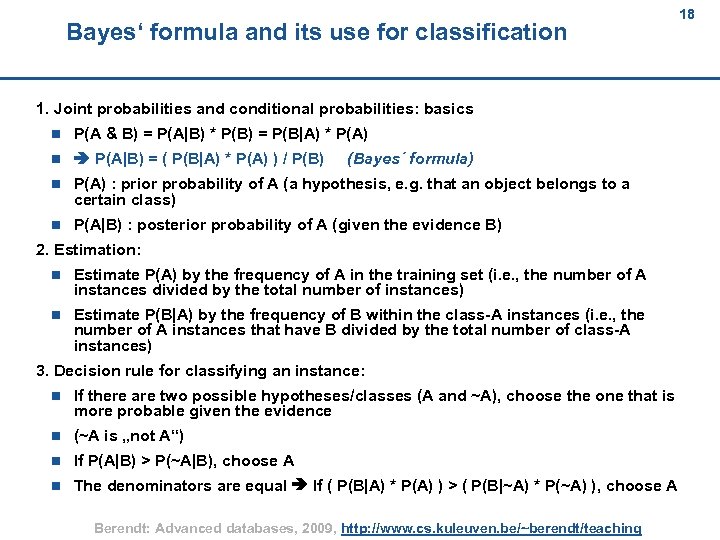
Bayes‘ formula and its use for classification 18 18 1. Joint probabilities and conditional probabilities: basics n P(A & B) = P(A|B) * P(B) = P(B|A) * P(A) n P(A|B) = ( P(B|A) * P(A) ) / P(B) n P(A) : prior probability of A (a hypothesis, e. g. that an object belongs to a certain class) n P(A|B) : posterior probability of A (given the evidence B) (Bayes´ formula) 2. Estimation: n Estimate P(A) by the frequency of A in the training set (i. e. , the number of A instances divided by the total number of instances) n Estimate P(B|A) by the frequency of B within the class-A instances (i. e. , the number of A instances that have B divided by the total number of class-A instances) 3. Decision rule for classifying an instance: n If there are two possible hypotheses/classes (A and ~A), choose the one that is more probable given the evidence n (~A is „not A“) n If P(A|B) > P(~A|B), choose A n The denominators are equal If ( P(B|A) * P(A) ) > ( P(B|~A) * P(~A) ), choose A Berendt: Advanced databases, 2009, http: //www. cs. kuleuven. be/~berendt/teaching 18
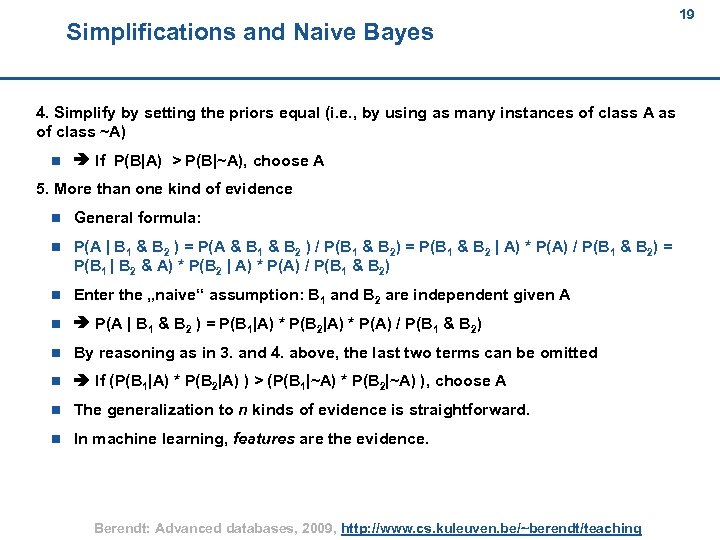
Simplifications and Naive Bayes 19 19 4. Simplify by setting the priors equal (i. e. , by using as many instances of class A as of class ~A) n If P(B|A) > P(B|~A), choose A 5. More than one kind of evidence n General formula: n P(A | B 1 & B 2 ) = P(A & B 1 & B 2 ) / P(B 1 & B 2) = P(B 1 & B 2 | A) * P(A) / P(B 1 & B 2) = P(B 1 | B 2 & A) * P(B 2 | A) * P(A) / P(B 1 & B 2) n Enter the „naive“ assumption: B 1 and B 2 are independent given A n P(A | B 1 & B 2 ) = P(B 1|A) * P(B 2|A) * P(A) / P(B 1 & B 2) n By reasoning as in 3. and 4. above, the last two terms can be omitted n If (P(B 1|A) * P(B 2|A) ) > (P(B 1|~A) * P(B 2|~A) ), choose A n The generalization to n kinds of evidence is straightforward. n In machine learning, features are the evidence. Berendt: Advanced databases, 2009, http: //www. cs. kuleuven. be/~berendt/teaching 19
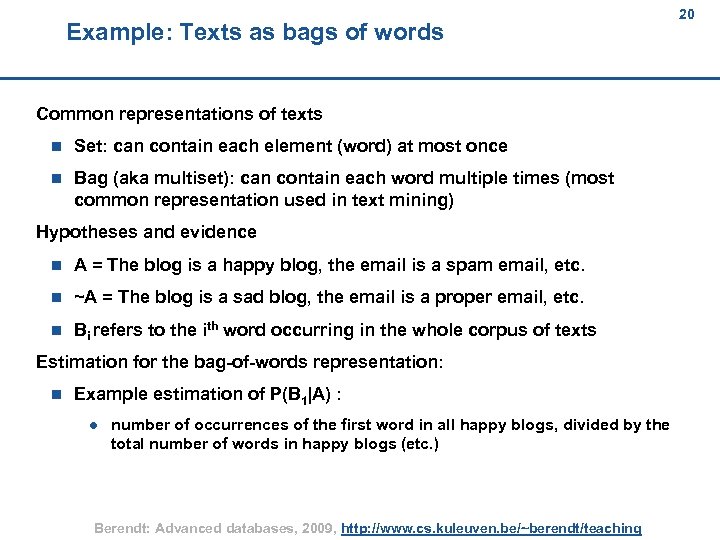
Example: Texts as bags of words 20 20 Common representations of texts n Set: can contain each element (word) at most once n Bag (aka multiset): can contain each word multiple times (most common representation used in text mining) Hypotheses and evidence n A = The blog is a happy blog, the email is a spam email, etc. n ~A = The blog is a sad blog, the email is a proper email, etc. n Bi refers to the ith word occurring in the whole corpus of texts Estimation for the bag-of-words representation: n Example estimation of P(B 1|A) : l number of occurrences of the first word in all happy blogs, divided by the total number of words in happy blogs (etc. ) Berendt: Advanced databases, 2009, http: //www. cs. kuleuven. be/~berendt/teaching 20
The „happiness factor“ 21 21 “Starting with the features identified as important by the Naïve Bayes classifier (a threshold of 0. 3 was used in the feature selection process), we selected all those features that had a total corpus frequency higher than 150, and consequently calculate the happiness factor of a word as the ratio between the number of occurrences in the happy blogposts and the total frequency in the corpus. ” What is the relation to the Naïve Bayes estimators? Berendt: Advanced databases, 2009, http: //www. cs. kuleuven. be/~berendt/teaching 21
22 Agenda 22 Basics of automated text analysis / text mining Motivation/example: classifying blogs by sentiment Data cleaning Further preprocessing: at word and document level Text mining and WEKA Berendt: Advanced databases, 2009, http: //www. cs. kuleuven. be/~berendt/teaching 22
Preprocessing (1) 23 23 Data cleaning n Goal: get clean ASCII text n Remove HTML markup*, pictures, advertisements, . . . n Automate this: wrapper induction * Note: HTML markup may carry information too (e. g. , <b> or <h 1> marks something important), which can be extracted! (Depends on the application) Berendt: Advanced databases, 2009, http: //www. cs. kuleuven. be/~berendt/teaching 23
24 Agenda 24 Basics of automated text analysis / text mining Motivation/example: classifying blogs by sentiment Data cleaning Further preprocessing: at word and document level Text mining and WEKA Berendt: Advanced databases, 2009, http: //www. cs. kuleuven. be/~berendt/teaching 24
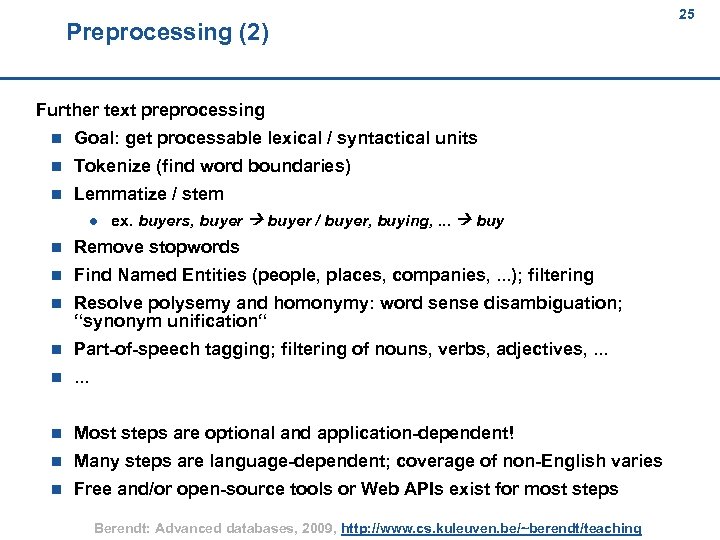
Preprocessing (2) 25 25 Further text preprocessing n Goal: get processable lexical / syntactical units n Tokenize (find word boundaries) n Lemmatize / stem l ex. buyers, buyer / buyer, buying, . . . buy n Remove stopwords n Find Named Entities (people, places, companies, . . . ); filtering n Resolve polysemy and homonymy: word sense disambiguation; “synonym unification“ n Part-of-speech tagging; filtering of nouns, verbs, adjectives, . . . n Most steps are optional and application-dependent! n Many steps are language-dependent; coverage of non-English varies n Free and/or open-source tools or Web APIs exist for most steps Berendt: Advanced databases, 2009, http: //www. cs. kuleuven. be/~berendt/teaching 25
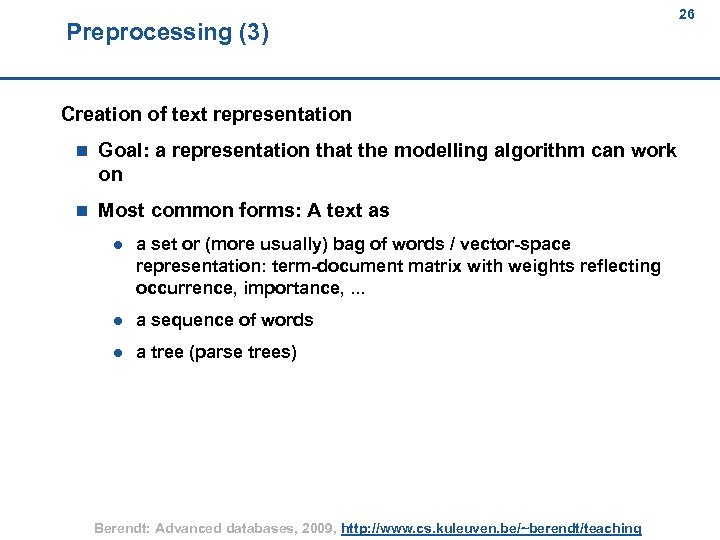
Preprocessing (3) 26 26 Creation of text representation n Goal: a representation that the modelling algorithm can work on n Most common forms: A text as l a set or (more usually) bag of words / vector-space representation: term-document matrix with weights reflecting occurrence, importance, . . . l a sequence of words l a tree (parse trees) Berendt: Advanced databases, 2009, http: //www. cs. kuleuven. be/~berendt/teaching 26
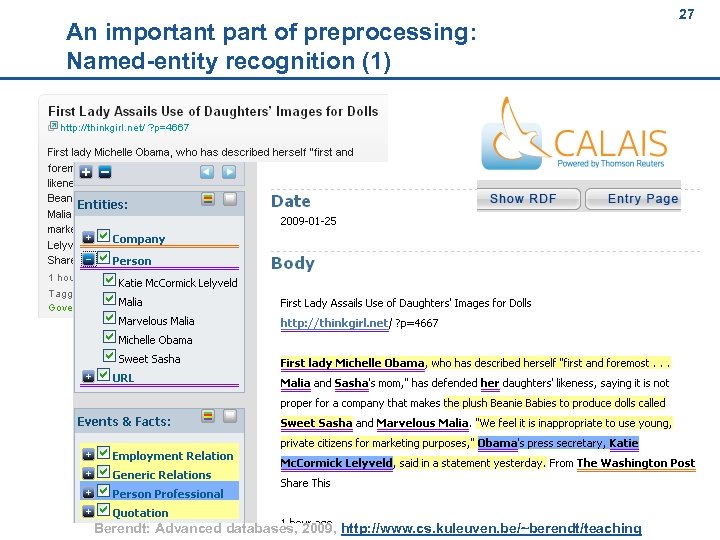
27 An important part of preprocessing: Named-entity recognition (1) Berendt: Advanced databases, 2009, http: //www. cs. kuleuven. be/~berendt/teaching 27 27
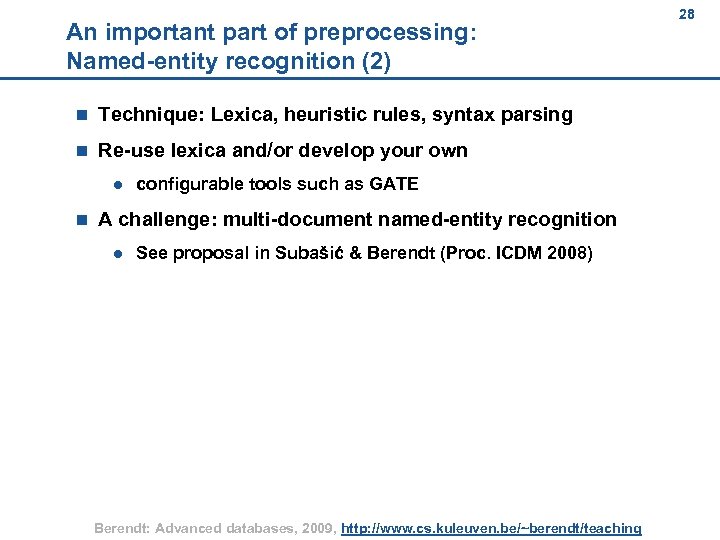
28 An important part of preprocessing: Named-entity recognition (2) n Technique: Lexica, heuristic rules, syntax parsing n 28 Re-use lexica and/or develop your own l n configurable tools such as GATE A challenge: multi-document named-entity recognition l See proposal in Subašić & Berendt (Proc. ICDM 2008) Berendt: Advanced databases, 2009, http: //www. cs. kuleuven. be/~berendt/teaching 28
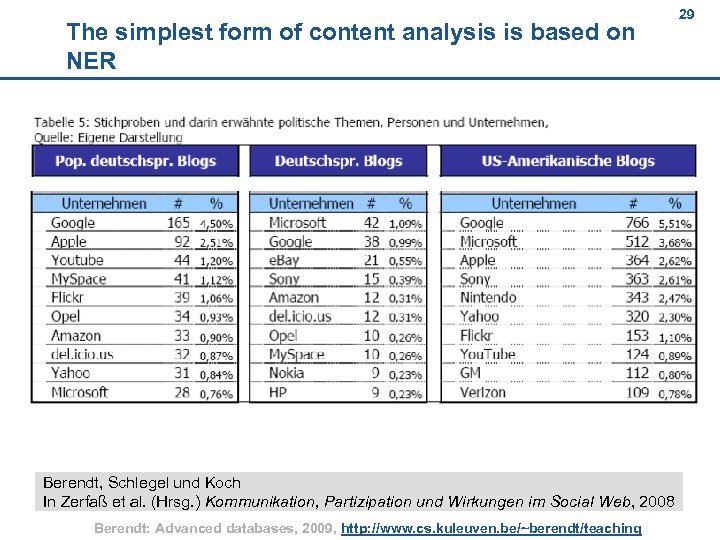
29 The simplest form of content analysis is based on NER 29 Berendt, Schlegel und Koch In Zerfaß et al. (Hrsg. ) Kommunikation, Partizipation und Wirkungen im Social Web, 2008 Berendt: Advanced databases, 2009, http: //www. cs. kuleuven. be/~berendt/teaching 29
30 Agenda 30 Basics of automated text analysis / text mining Motivation/example: classifying blogs by sentiment Data cleaning Further preprocessing: at word and document level Text mining and WEKA Berendt: Advanced databases, 2009, http: //www. cs. kuleuven. be/~berendt/teaching 30
From HTML to String to ARFF 31 31 Problem: Given a text file: How to get to an ARFF file? 1. Remove / use formatting l l 2. HTML: use html 2 text (google for it to find an implementation in your favourite language) or a similar filter XML: Use, e. g. , SAX, the API for XML in Java (www. saxproject. org) Convert text into a basic ARFF (one attribute: String): http: //weka. sourceforge. net/wiki/index. php/ARFF_files_from_Text_Collections 3. Convert String into bag of words (this filter is also available in WEKA‘s own preprocessing filters, look for filters – unsupervised – attribute – String. To. Word. Vector) l Documentation: http: //weka. sourceforge. net/doc. dev/weka/filters/unsupervised/attribute/String. To. Word. Vector. html Berendt: Advanced databases, 2009, http: //www. cs. kuleuven. be/~berendt/teaching 31
Next lecture 33 33 Basics of automated text analysis / text mining Motivation/example: classifying blogs by sentiment Data cleaning Further preprocessing: at word and document level Text mining and WEKA Combining Semantic Web / modelling and KDD Berendt: Advanced databases, 2009, http: //www. cs. kuleuven. be/~berendt/teaching 33
Скачать презентацию 1 Last update 18 November 2009 1 Advanced
dfaddcac2bbcd82e0c2a674eae69b992.ppt