


 Скачать презентацию 1 ITALIAN AND ENGLISH RULES ON JURISDICTION CHOICE
b905f54fb5dfbe88fea9903448ed1a9d.ppt
- Количество слайдов: 46
 1 ITALIAN AND ENGLISH RULES ON JURISDICTION CHOICE OF COURT AGREEMENTS Giovanni Zarra Adjunct Professor Naples, 20 th April 2017
 Domestic rules on jurisdiction • When do they apply?
 3 Italian Rule on Jurisdiction Law 218 of 1995, Art. 3 Ambito della giurisdizione. 1. La giurisdizione italiana sussiste quando il convenuto è domiciliato o residente in Italia o vi ha un rappresentante che sia autorizzato a stare in giudizio a norma dell'articolo 77 del codice di procedura civile e negli altri casi in cui è prevista dalla legge. 2. La giurisdizione sussiste inoltre in base ai criteri stabiliti dalle sezioni 2, 3 e 4 del titolo II della Convenzione concernente la competenza giurisdizionale e l'esecuzione delle decisioni in materia civile e commerciale e protocollo, firmati a Bruxelles il 27 settembre 1968, resi esecutivi con la legge 21 giugno 1971, n. 804 (2), e successive modificazioni in vigore per l'Italia, anche allorché il convenuto non sia domiciliato nel territorio di uno Stato contraente, quando si tratti di una delle materie comprese nel campo di applicazione della Convenzione. Rispetto alle altre materie la giurisdizione sussiste anche in base ai criteri stabiliti per la competenza per territorio.
 English Rules on Jurisdiction • Completely different perspective • Judge made common law • Case by case basis. It is often said that English judges feel to be the policemen of the world. • Jurisdiction has traditionally been seen only as a matter of procedure based on the PRESENCE of the defendant on the English territory.
 Original mechanism • Service of a writ of summons (today: claim form) to the defendant, in the queen’s name, ordering the defendant to attend court at a specified time and place. • Service was essential for the claim to proceed. No service: no action. Originally personally to the defendant. Today also post or fax. • Service was based upon presence. • Transitory presence in England. Service. Jurisdiction? Presence is a weak link. Mitigation: forum non conveniens.
 Colt Industries v. Sarlie (1966) • Defendant not resident in England. • Stayed there for few days in hotel for reasons unrelated to the litigation. • Service of a claim • Defendant said that England is not the appropriate forum.
 continued • Jurisdiction of a court has been traditionally based upon the principle of territorial dominion: persons within the territorial dominion owe their allegiance to sovereign power and obedience to its laws and to the lawful jurisdiction of its courts. • In the absence of fraud inducing the defendant to go in England just to be sued there, the defendant accepts spontaneously to be submitted to the principle of territorial dominion. • English jurisdiction.
 Maharanee of Baroda v. Wildenstein (1972) • Plaintiff: Indian Princess residing in France. • Defendant: art dealer residing in France. • Dispute: painting sold by the defendant to the plaintiff saying it was an original Boucher. It was not. The princess wanted money back and sued Wildenstein in England. The claim was served when he was at a horse race (just temporarily in England). • English Jurisdiction?
 continued • The Court of Appeal asked itself whether the fact that defendant is served during a visit in England is per se oppressive and justifies a stay. • The Court said this is not always true. • If a car accident happens in Rome and then the claim is brought in London, this is oppressive because a purely Italian dispute is started in London. • In the present case, we discuss about art. It is not solely a French issue. The art world is so international today that the dispute has an international character. English jurisdiction is justified…
 Service outside jurisdiction The plaintiff has to demonstrate that England is clearly the most appropriate forum to hear the dispute. If he does so, he will obtain a “leave” for servicing outside the territory of the country.
 Companies • A company is traditionally present in England if it was incorporated in England or if it had a place of business there. • The place of business must be a fixed location. • A representative who visits England travels about from place to place doing business would not be enough. • Theodohos (1977): service to the President of a company from Panama when he was temporarily in England. Not sufficient to sue the company.
 Dunlop Pneumatic Tyre v. Cudell • Defendant: German company which hired a cycle show at the Crystal Place in London to exhibit its products and take orders. • Stand managed by its employees. • Show lasted nine days. • Service of a claim during such nine days.
 continued • The business was not carried out through an agent but was of the company itself. • According to the Court of Appeal, the only complication was due to the fact that the show lasted nine days. • Length is an element to be considered. However, in this case, this is not an element which can lead us to exclude that for those nine days the company was resident in England. Nine days can be a very substantial period. During that show, the company could have done more business than in the rest of the year! English courts assumed jurisdiction….
 Other cases • South India Shipping v. Bank of Korea A representative office of a bank, not carrying out traditional bank activity, was sufficient to establish jurisdiction because it can be considered as a place of business. - Adams v. Cape Industries The fact that a representative never makes contracts in the name of the corporation, is sufficient to let us assume that there is no jurisdiction with respect to such corporation.
 Conclusion • Keep in mind cultural differences. • Keep in mind differences in legal traditions. • Keep in mind the difference between a kind of law based on the principle of certainty and another based on ideas such as discretion, convenience and opportunity.
 Choice of Court Agreements
 Definition • Agreements as to where litigation will take place. • If courts respect them, they enable the parties to know in advance where thecase will be brought. • Can regard a certain court (Naples), the courts of a particular country (Italy) and it is even possible to make the choice depend on which party brings the claim (Plaintiff: Napoli; Defendant: Paris).
 Other relevant info • Grant jurisdiction to a certain court (jurisdiction conferring function). • Deprive other courts of jurisdiction (jurisdiction depriving function). The selected court’s jurisdiction is exclusive. • Normally are contained in a certain contract and relate to disputes in relation to that contract. Parties may also agree differently. • SEPARABILITY: are to be considered as a separate agreement within the main contract. Why? Cannot be contested in their validity if the main contract is invalid!
 Art. 25 Regulation 1215/2012 • States that choice of court agreements shall be respected • Applies only if the chosen court is in a Member State • Applies to arisen and future disputes • Applies irrespective of the domicile of the parties • Provides that the law which governs the substantive validity of choice of court agreements is the one of the State the courts of which have been chosen
 continued • It lays down a rule on the form of choice of court agreement (see later) • Specifies that it does not apply to consumers, employees and insured people. These categories are protected by special provisions of the regulation.
 Consent and form • Consent seems easy but it is actually a complicated matter. • The question is: did the party concerned actually know what he was agreeing to or should he be regarded as bound even if he did not?
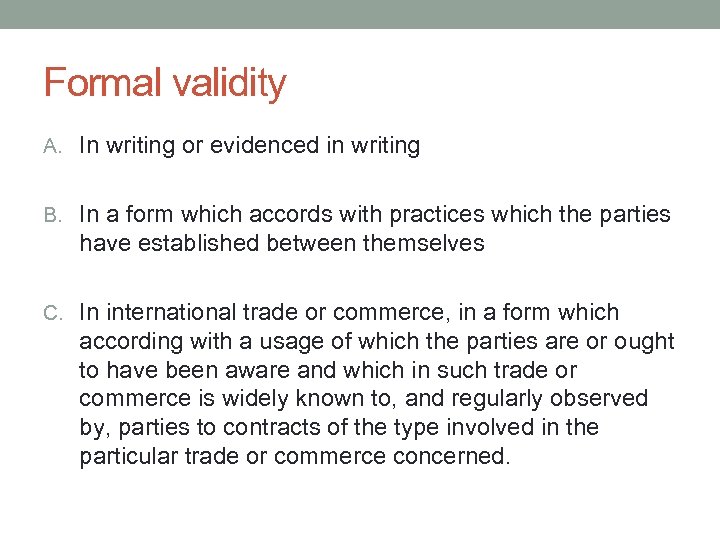 Formal validity A. In writing or evidenced in writing B. In a form which accords with practices which the parties have established between themselves C. In international trade or commerce, in a form which according with a usage of which the parties are or ought to have been aware and which in such trade or commerce is widely known to, and regularly observed by, parties to contracts of the type involved in the particular trade or commerce concerned.
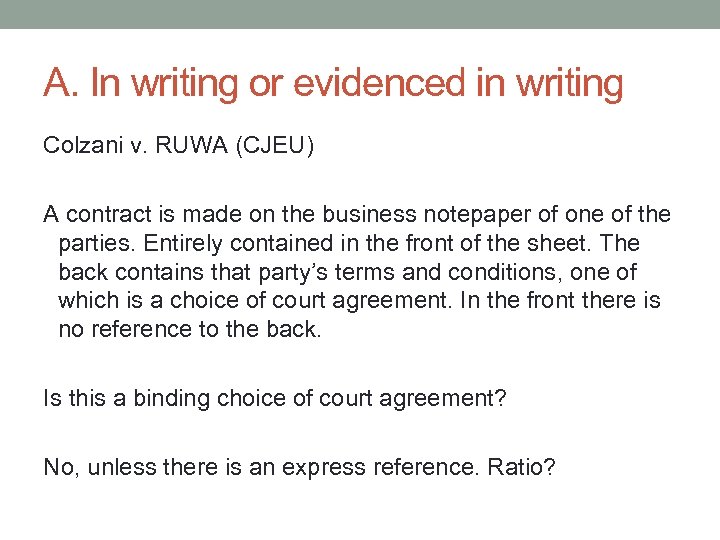 A. In writing or evidenced in writing Colzani v. RUWA (CJEU) A contract is made on the business notepaper of one of the parties. Entirely contained in the front of the sheet. The back contains that party’s terms and conditions, one of which is a choice of court agreement. In the front there is no reference to the back. Is this a binding choice of court agreement? No, unless there is an express reference. Ratio?
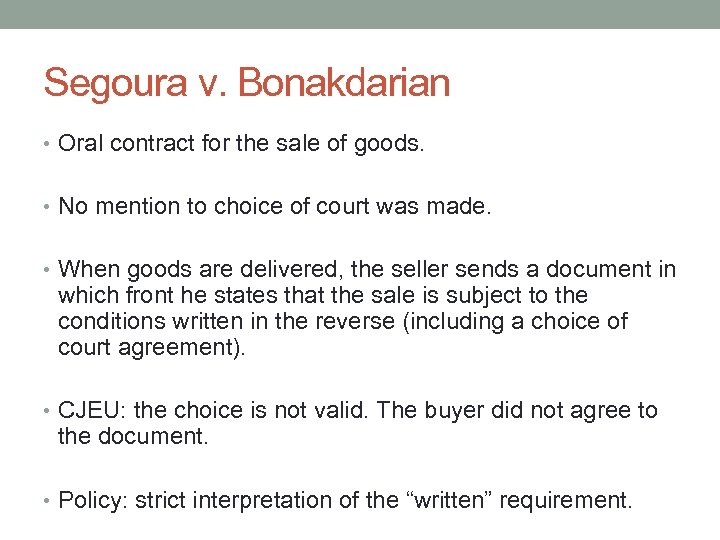 Segoura v. Bonakdarian • Oral contract for the sale of goods. • No mention to choice of court was made. • When goods are delivered, the seller sends a document in which front he states that the sale is subject to the conditions written in the reverse (including a choice of court agreement). • CJEU: the choice is not valid. The buyer did not agree to the document. • Policy: strict interpretation of the “written” requirement.
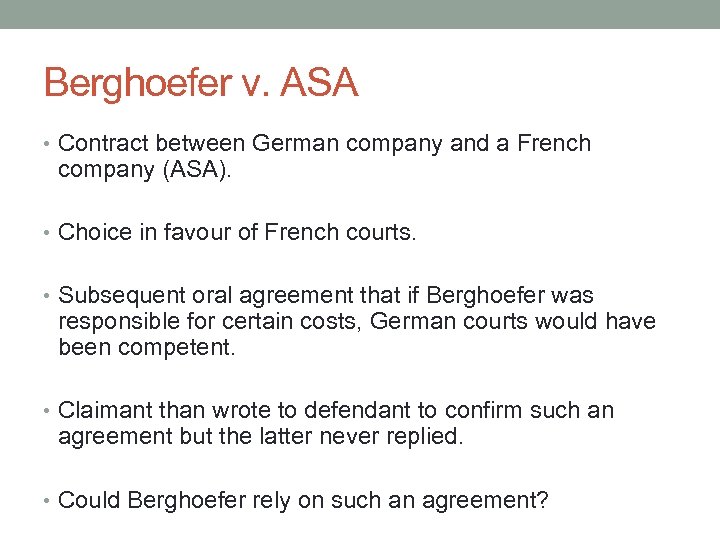 Berghoefer v. ASA • Contract between German company and a French company (ASA). • Choice in favour of French courts. • Subsequent oral agreement that if Berghoefer was responsible for certain costs, German courts would have been competent. • Claimant than wrote to defendant to confirm such an agreement but the latter never replied. • Could Berghoefer rely on such an agreement?
 CJEU in Berghoefer • If the parties orally agree on a court and then one of them write a confirmation (evidence in writing) and the other does not contest such a confirmation, we could say that there is consent. • Otherwisethere would be a breach of good faith. • Difference with Segoura: in that case, there was not mention to the chosen court in the prior oral agreement. The choice of court came as a surprise! • In Berghoefer, there was agreement and then confirmation.
 Sub-paragraph B. As stated by the CJEU in Segoura, if an oral agreement (or other form) is part of a continuing trading relationship between the parties, and if it was established that the dealings as a whole between the parties were governed by general conditions containing a choice of court agreement, that clause would be binding on the parties, since it would be contrary to good faith for either of them to deny that he had agreed to it.
 C. Trade Usages Mainschiffahrts-Genossenschaft (MSG) v. Les Gravières Rhénanes • Plaintiff domiciled in Germany • Chartered a vessel to the defendant by oral agreement. No choice of court. • Subsequently, MSG sent a letter of confirmation stating that future disputes should be brought before courts in Wurzburg. The same info was contained in the various invoices sent to the defendant and paid by it.
 CJEU in MSG • Consensus on the part of te contracting parties is presumed to exist where commercial practices in the relevant branch of international trade or commerce exist in this regard, of which the parties are or ought to have been aware. • This rule could apply to the present case, but we have to prove that: - there is an area of trade/commerce - there exist a practice - the parties are or should have been aware of it
 continued • The determination of such evidence is to be made by the national court involved • No reference to national law • No reference to trade or commerce in general • Reference to a specific area of trade/commerce in which the parties are operating. • Actual or presumptive awareness is made out where they previously had relationship between themselves or with other parties in the sector (and in such a sector the practice is usually followed)
 continued • The present disputes involves a case where it is possible that a practice exist and therefore the parties can be bound by a choice of court agreement taking place in such a way. • However the national judge shall establish the satisfaction of the test set forth before.
 Relationship with national laws • National laws cannot impose further requirements concerning the validity of choice of court agreements. Elefanten Schuh v. Jacqmain (CJEU) Belgian law imposed that an employment contract is valid only if it is written in the language of the region of Belgium where the work has to be performed. Can this provision render void a choice of court? NO
 Relationship with art. 7(1) • Jurisdiction to the court of place of performance. • Can the agreement on the place of performance act as a choice of court agreement? Zelger v. Salinitri (CJEU) They cannot be equalized – they are subject to different formal requirements. An agreement on the place of performance gives jurisdiction to the courts of such a place but does not have the jurisdiction depriving function with regard to others. However, this applies only to genuine place of performance clauses. Not to the ones inserted in bad faith (CJEU in MSG).
 Constitution of a company If in the bylaws of a company or in the deed of incorporation there is a choice of court agreement, it is perfectly valid. CJEU clarified (Powell Duffryn) that even if a shareholder did not vote for the bylaws or was not present, he is anyway bound by the contractual provision on choice of court.
 Effects on third parties Bill of lading (polizza di carico): Contract of carriage between the shipper and the shipowner. The bill of lading is given to the shipper as a proof of the contract (or contains the contract). The person phisically owning the bill of lading is entitled to receive the goods at arrival. The person entitled to receive the goods is named consignee. If the consignee is different from the shipper, there is an assignment of the bill of lading and (usually) of the rights contained therein. Is the consignee bound by the choice of court contained in the bill of lading signed by different parties? CJEU: YES (Tilly Russ v. Nova): all rights and obligations are assigned.
 The EU and the rest of the world What if a contract between an Italian and a Spanish contains a choice of court agreement for courts in Hong Kong? Shall Spanish courts be bound by it? Art. 25 does not apply if the chosen court are not in a Member State. There is, in principle, no reason why Spanish court should not give effect to such an agreement. Spanish courts (and all other courts) will apply their own law to decide the matter. (CJEU in Coreck Maritime v. Handelsveem). However, such a position is not settled because there are certain ambiguous successive decisions.
 Choice of Court Agr. in Italy Only in cases where the regulation does not apply. Law 218 of 1995. Art. 4. Accettazione e deroga della giurisdizione. 1. Quando non vi sia giurisdizione in base all'articolo 3, essa nondimeno sussiste se le parti l'abbiano convenzionalmente accettata e tale accettazione sia provata per iscritto, ovvero il convenuto compaia nel processo senza eccepire il difetto di giurisdizione nel primo atto difensivo. (CONFERRING JURISDICTION) 2. La giurisdizione italiana può essere convenzionalmente derogata a favore di un giudice straniero o di un arbitrato estero se la deroga è provata per iscritto e la causa verte su diritti disponibili. (DEPRIVING JURISDICTION) 3. La deroga è inefficace se il giudice o gli arbitri incaricati declinano la giurisdizione o comunque non possono conoscere della causa.
 England • Choice of court agreements traditionally were not considered by English judges. • Jurisdiction depended on the law and a private agreement could not affect it. • Courts have discretion in deciding when and how to give effect to a choice of court agreement. • They will make an evalutation of pros and cos. • Gradual change of attitude of English judges.
 The Fehrman • German ship to carry a cargo to England. • Shippers from the Soviet Union. • Bill of lading providing for Russian courts but action started in England. • A choice of court is something to which English judges usually shall give weight. However, nobody shall deprive an English court of a dispute which normally belongs to it.
 continued • “Is this dispute a matter which properly belongs to the courts in this country? ” • Goods surveyed in England; delivery in England; the vessel is a frequent visitor of England; and other… • The dispute belongs to English courts! • The choice for Russian courts (which know Russian law which has to be applied) is not decisive: the Russian element in the case is comparatively small.
 The Eleftheria • Carriage of goods from Romania to England on Greek ship. • Choice of court: Greek courts. • Dispute started in England.
 Continued – High court reasoning • The judge’s discretion should be exercised by granting a stay unless strong cause for not doing so is shown by the plaintiff. • Several elements shall be taken into account. • Inter alia: (-) where is evidence? (-) which sacrifice will be suffered by either party? (-) what is the country most connected with the dispute?
 continued Prima facie case for giving effectiveness to the agreement. However Elements pro England: evidence is in England, expenses to take witness to Greece and for translations. Wasting time. Elements pro Greece: Greek applicable law. Greek courts are better placed. Prejudice to the Greek plaintiff. Appropriate appellate court for matter of legitimacy There is a good case that Greek courts are better. Stay granted.
 Carvalho v. Hull Blyth What if the foreign courts in favour of which there is a choice are not capable of offering a fair trial to the parties? In this case the claimant was Portuguese and the defendant an English company. They co-owned certain companies in Angola and the English party then decided to buy out Carvalho. Agreement with choice of court: Angola (Luanda). The English party then did not pay him. Claim started by Carvalho in England.
 continued • Angola was a Portuguese colony when the contract was signed. • Portuguese law, Portuguese judges, Supreme Court in Lisbon. • When the dispute arose, Angola was subject to a revolution and the legal framework changed. • The court stated that at the time of the dispute the parties would not have chosen Angolan courts. Risks for fair trial. • English court upheld jurisdiction.
 46
46