 Скачать презентацию 1 Introduction to Information Technology Turban Rainer and
b6115aa1a1b315cd063abb3563124386.ppt
- Количество слайдов: 32




1 Introduction to Information Technology Turban, Rainer and Potter Chapter 4 Computer Software CHAPER 4 COMPUTER SOFTWARE
2 Introduction to Information Technology Turban, Rainer and Potter Chapter 4 Computer Software Learning Objectives Differentiate between the two major types of software Describe the general functions of the operating system Differentiate among the three types of operating systems and describe each type Identify three methods for developing application software Describe the major types of application software Explain how software has evolved and its future evolution Describe enterprise software
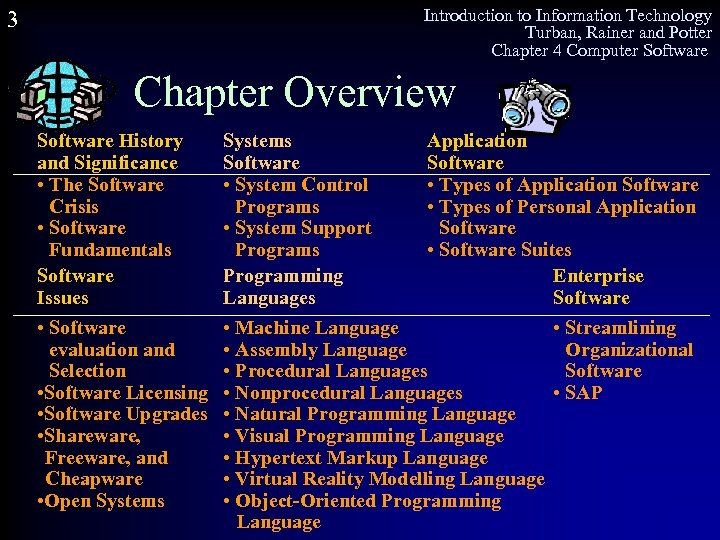
Introduction to Information Technology Turban, Rainer and Potter Chapter 4 Computer Software 3 Chapter Overview Software History and Significance • The Software Crisis • Software Fundamentals Software Issues Systems Software • System Control Programs • System Support Programs Programming Languages Application Software • Types of Personal Application Software • Software Suites Enterprise Software • Software evaluation and Selection • Software Licensing • Software Upgrades • Shareware, Freeware, and Cheapware • Open Systems • Machine Language • Streamlining • Assembly Language Organizational • Procedural Languages Software • Nonprocedural Languages • SAP • Natural Programming Language • Visual Programming Language • Hypertext Markup Language • Virtual Reality Modelling Language • Object-Oriented Programming Language
Introduction to Information Technology Turban, Rainer and Potter Chapter 4 Computer Software 4 Case: The IRS and the Millennium Bug The Problem î Y 2 K problem has resulted from the high cost of mainframe computations and data storage in the 1950 s and 1960 s î complex structure makes it almost impossible for the IRS to be Y 2 K compliant in time î agency changed its software in response to changes in the tax code
Introduction to Information Technology Turban, Rainer and Potter Chapter 4 Computer Software 5 Case (continued…) The Solution î IRS has spent more than $4 billion over the past decade to modernize its computer systems î the agency has $1 billion dollars and 600 people dedicated to the Y 2 K project The Results î no one will know until well into the year 2000
6 Introduction to Information Technology Turban, Rainer and Potter Chapter 4 Computer Software Case (continued…) What have we learned from this case? ? î Failure to budget for continuing maintenance of software programs can have devastating results î One programmer cannot begin with his portion of the problem until he receives another completed portion form someone else, as this other part or “module” may define the inputs or outputs that his own part must deal with
7 Introduction to Information Technology Turban, Rainer and Potter Chapter 4 Computer Software History and Significance When the first applications of computers in business were introduced in the early 1950 s, software was less important (and less costly) in computer systems Today, software comprises a much larger percentage of the cost of modern computer systems The Software Crisis î no software applications fast enough to keep up with rapidly changing business conditions and rapidly evolving technologies î not only must new applications be developed quickly, but existing software must also be maintained î increasing complexity, leads to the increased potential for “bugs” î testing and “debugging” software is expensive and timeconsuming
Introduction to Information Technology Turban, Rainer and Potter Chapter 4 Computer Software 8 Software History and Significance (continued …) Software Fundamentals î computer programs - sequences of instructions for the computer î programming - process of writing (or coding) programs î programmers - individuals who perform programming
Introduction to Information Technology Turban, Rainer and Potter Chapter 4 Computer Software 9 System Software System software î the class of programs that control and support the computer system and its information processing activities î facilitates the programming, testing, and debugging of computer programs î usually independent of any specific type of application î support application software by directing the basic functions of the computer
Introduction to Information Technology Turban, Rainer and Potter Chapter 4 Computer Software 10 System Software (continued …) System Control Program î programs that control the use of the hardware, software and data resources of a computer system î operating system (main system control program) » supervises the overall operation of the computer, including monitoring the computer’s status and scheduling operations, which include controlling the input and output processes » allocates CPU time and main memory to programs running on the computer, and also provides an interface between the user and the hardware
Introduction to Information Technology Turban, Rainer and Potter Chapter 4 Computer Software 11 System Software (continued …) System Control Program (continued …) î Process management » managing the program or programs running on the processor at a given time î Multitasking (or multiprogramming) » managing two or more tasks, programs, running on the computer system at the same time î Time-sharing » a number of users operate on-line with the same CPU, but each uses a different input/output terminal
Introduction to Information Technology Turban, Rainer and Potter Chapter 4 Computer Software 12 System Software (continued …) System Control Program (continued …) î Multithreading » a form of multitasking that focuses on running multiple tasks within a single application simultaneously î Multiprocessing » a computer system with two or more processors that can run more than one program or thread at a given time by assigning them to different processors î Virtual memory » simulates more main memory than actually exists in the computer system
Introduction to Information Technology Turban, Rainer and Potter Chapter 4 Computer Software 13 System Software (continued …) System Control Program (continued …) î File Management and Security » managing the arrangement of, and access to, files held in secondary storage î Fault Tolerance » the ability of a system to produce correct results and continue to operate even in the presence of faults or errors î Graphical User Interface (GUI) » allows users to have direct control of visible objects and actions that replace complex command syntax
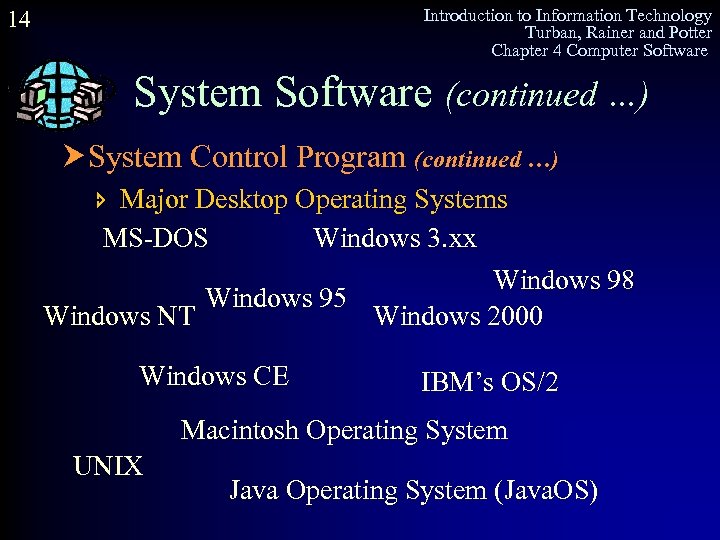
Introduction to Information Technology Turban, Rainer and Potter Chapter 4 Computer Software 14 System Software (continued …) System Control Program (continued …) î Major Desktop Operating Systems MS-DOS Windows 3. xx Windows 98 Windows 95 Windows NT Windows 2000 Windows CE IBM’s OS/2 Macintosh Operating System UNIX Java Operating System (Java. OS)
15 Introduction to Information Technology Turban, Rainer and Potter Chapter 4 Computer Software System Software (continued …) System Control Program (continued …) î Major Departmental Sever Operating System » UNIX, Windows NT Server, IBM’s OS/2 Warp Server, Novell Net. Ware, and IBM’s OS/400 î Major Enterprise Operating Systems » IBM’s MVS (Multiple Virtual Storage), IBM’s VM (Virtual Machine), IBM’s VSE (Virtual Storage Extended), and Digital Open VMS (Virtual machine System)
Introduction to Information Technology Turban, Rainer and Potter Chapter 4 Computer Software 16 System Software (continued …) System Support Programs î System support programs » support the operations, management, and users of a computer system î System utility programs » accomplish common tasks such as sorting records, checking the integrity of diskettes, creating directories and subdirectories, restoring accidentally erased files, locating files within the directory structure, managing memory usage, and redirecting output
Introduction to Information Technology Turban, Rainer and Potter Chapter 4 Computer Software 17 System Software (continued …) System Support Programs (continued …) î System performance monitors » monitor the processing of jobs on a computer system and produce reports containing detailed statistics concerning the use of system resources î System security monitors » monitor the use of a computer system to protect it and its resources from unauthorized use, fraud, or destruction
Introduction to Information Technology Turban, Rainer and Potter Chapter 4 Computer Software 18 Application Software î instructions that direct a computer system to perform specific information processing activities and provide functionality for users Types of Application Software î Proprietary application software » addresses a specific or unique business need for a company î Off-the-shelf application software » developed programs sold to many organizations » may be customizable or may be standard package
Introduction to Information Technology Turban, Rainer and Potter Chapter 4 Computer Software 19 Application Software (continued …) Personal Application Software î one of the off-the-shelf application programs that are not linked to any specific business function, but instead support general types of processing Encompassing spreadsheet Desktop publishing Graphics Data management Publishing Multimedia Speech recognition software Word processing Communications Group. Ware
Introduction to Information Technology Turban, Rainer and Potter Chapter 4 Computer Software 20 Application Software (continued …) Software Suites î collections of application software packages that integrate the functions of the packages î examples : Microsoft Office, Novell Perfect Office, and Lotus Smart. Suite î generally include : a spreadsheet program, word processor, database program, and graphics package with the ability to move document, data. And diagrams among them
Introduction to Information Technology Turban, Rainer and Potter Chapter 4 Computer Software 21 Software Issues Software Selection î Selection factors » size and location of the current and future user base » system administration tools » initial and subsequent costs » current and future system capabilities » existing computing environment » in-house technical skills
Introduction to Information Technology Turban, Rainer and Potter Chapter 4 Computer Software 22 Software Issues (continued …) Software Evaluation î evaluation checklist » ease of use in development » maintenance » graphic presentation » data handling » performance » environments and hardware » vendor support » learning » reporting capability » general functionality » output options » security » documentation
Introduction to Information Technology Turban, Rainer and Potter Chapter 4 Computer Software 23 Software Issues (continued …) Software Licensing î copyright - exclusive legal right to reproduce, publish, and sell the software î licenses - permission granted under the law to engage in an activity otherwise unlawful Software Upgrades î revised software may offer valuable enhancements but may offer little in terms of additional capabilities î revised software may contain bugs
Introduction to Information Technology Turban, Rainer and Potter Chapter 4 Computer Software 24 Software Issues (continued …) Shareware, Freeware, and Cheapware î Shareware - low price software î Freeware - free copyrighted software î Cheapware - free public-domain software Open Systems î a paradigm of computing products that work together î use the same operating system with compatible software on all the different computers in a system î to empower designers to choose the best computer hardware, operating system, and application software
25 Introduction to Information Technology Turban, Rainer and Potter Chapter 4 Computer Software Programming Languages Machine Language (first generation of programming languages) …. . î the lowest level computer language …… î composed of binary digits î all other languages are translated into machine language before the computer can run the instructions Assembly Language (second generation of computer languages) î a lower-level but more user-friendly language î assembler - translates an assembly language program into machine language
Introduction to Information Technology Turban, Rainer and Potter Chapter 4 Computer Software 26 Programming Languages (continued …) Procedural Languages (third generation languages) î much closer to natural language î use common words rather than abbreviated mnemonics î compiler - translates the entire program at once î interpreter - translates and executes one source program statement at a time
Introduction to Information Technology Turban, Rainer and Potter Chapter 4 Computer Software 27 Programming Languages (continued …) Nonprocedural Language (fourth generation languages) î a high-level language î allows the user to specify the desired result without having to specify the detailed procedures needed for achieving the result î can be used by non technical users Natural Language programming Languages (fifth generation languages) î translates natural languages into a structured, machinereadable from are extremely complex
Introduction to Information Technology Turban, Rainer and Potter Chapter 4 Computer Software 28 Programming Languages (continued …) Visual Programming Languages î used within a graphical environment î example : Visual Basic and Visual C++ î popular to non technical users Hypertext Markup Language (HTML) î standard language used in World Wide Web î contains text, images, and other types of information such as data files, audio, video, and executable computer programs
Introduction to Information Technology Turban, Rainer and Potter Chapter 4 Computer Software 29 Programming Languages (continued …) Virtual Reality Modeling Language (VRML) î a file format for describing three-dimensional interactive worlds and objects î can be used with the World Wide Web Object-Oriented Programming Languages (OOP) î based on the idea of taking a small amount of data and the instructions about what to do with that data and putting both of these together into what is called an object
30 Introduction to Information Technology Turban, Rainer and Potter Chapter 4 Computer Software Enterprise Software Difficulty in Most Organizations î the sheer complexity that arises from all the different types of hardware and software that they use Package Wanted by an Organization î support integration between functional (i. e. , human resource, operations, marketing, finance, accounting, etc. ) modules î be quickly changed or enhanced î present a common graphical look-and-feel î help to reduce training and operation costs
Introduction to Information Technology Turban, Rainer and Potter Chapter 4 Computer Software 31 Enterprise Software (continued …) Enterprise Software î manages a company’s vital operations, such as supply chain management (movement of raw material from suppliers through shipment of finished goods to customers), inventory replenishment, ordering, logistics coordination, human resource management, manufacturing, operations, accounting, and financial management
32 Introduction to Information Technology Turban, Rainer and Potter Chapter 4 Computer Software Enterprise Software (continued …) System Anwendung Produket (SAP) î one of the largest vendors (holds 30% of the enterprise software market) î strength : high degree of integration support for multi-site, multi-currency operations î R / 3 - flagship client/server product » has a high degree of functional integration across the enterprise » criticism : complex, time-consuming and expensive to install and integrate with other systems » decoupling the models of R/3 into separate components, each with its own database
Скачать презентацию 1 Introduction to Information Technology Turban Rainer and
b6115aa1a1b315cd063abb3563124386.ppt