


 Скачать презентацию 1 Introduction Measurement Units Quantities of oil
Теор-УВ_1.ppt
- Количество слайдов: 19
 1. Introduction
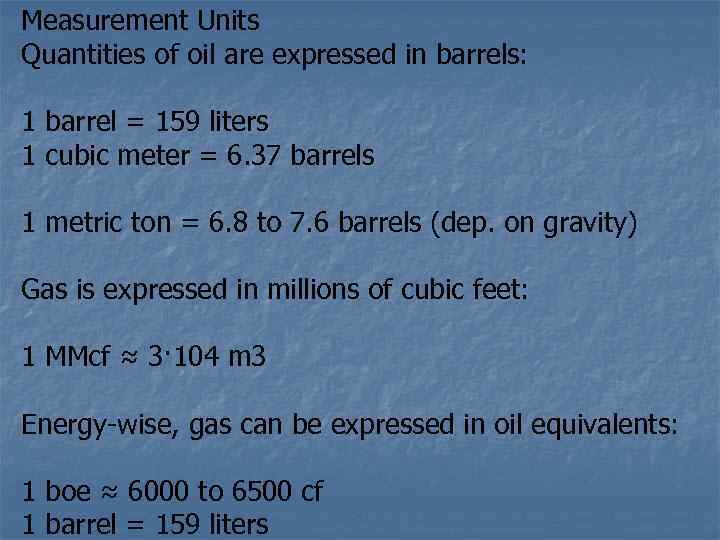 Measurement Units Quantities of oil are expressed in barrels: 1 barrel = 159 liters 1 cubic meter = 6. 37 barrels 1 metric ton = 6. 8 to 7. 6 barrels (dep. on gravity) Gas is expressed in millions of cubic feet: 1 MMcf ≈ 3· 104 m 3 Energy-wise, gas can be expressed in oil equivalents: 1 boe ≈ 6000 to 6500 cf 1 barrel = 159 liters
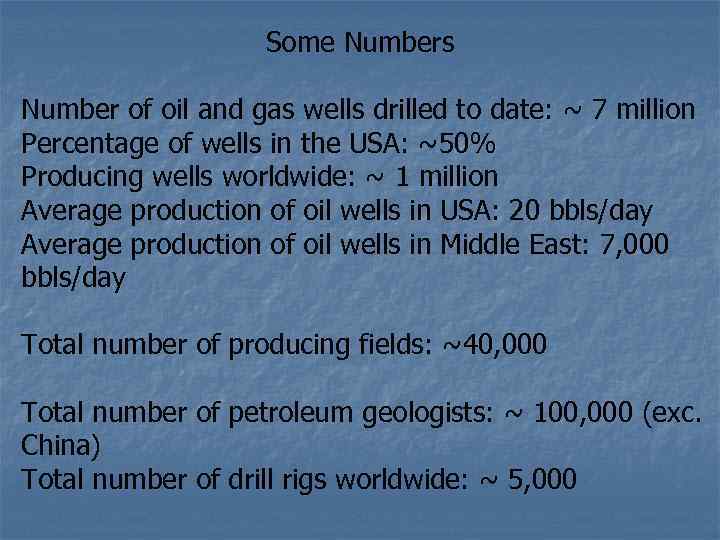 Some Numbers Number of oil and gas wells drilled to date: ~ 7 million Percentage of wells in the USA: ~50% Producing wells worldwide: ~ 1 million Average production of oil wells in USA: 20 bbls/day Average production of oil wells in Middle East: 7, 000 bbls/day Total number of producing fields: ~40, 000 Total number of petroleum geologists: ~ 100, 000 (exc. China) Total number of drill rigs worldwide: ~ 5, 000
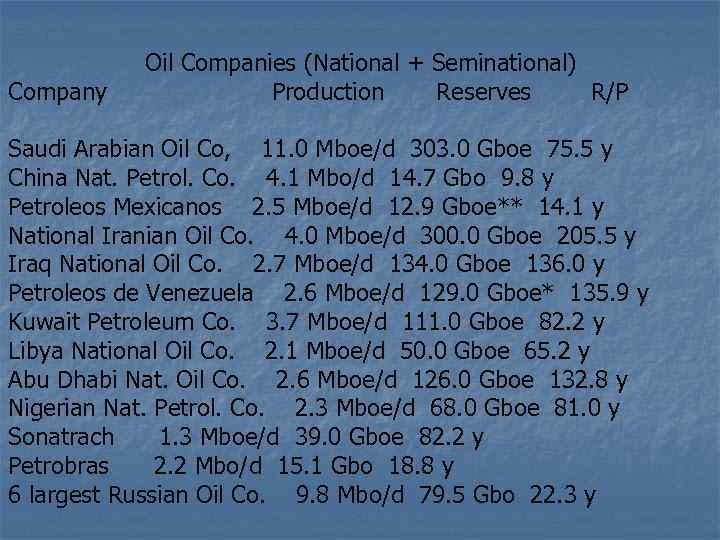 Company Oil Companies (National + Seminational) Production Reserves R/P Saudi Arabian Oil Co, 11. 0 Mboe/d 303. 0 Gboe 75. 5 y China Nat. Petrol. Co. 4. 1 Mbo/d 14. 7 Gbo 9. 8 y Petroleos Mexicanos 2. 5 Mboe/d 12. 9 Gboe** 14. 1 y National Iranian Oil Co. 4. 0 Mboe/d 300. 0 Gboe 205. 5 y Iraq National Oil Co. 2. 7 Mboe/d 134. 0 Gboe 136. 0 y Petroleos de Venezuela 2. 6 Mboe/d 129. 0 Gboe* 135. 9 y Kuwait Petroleum Co. 3. 7 Mboe/d 111. 0 Gboe 82. 2 y Libya National Oil Co. 2. 1 Mboe/d 50. 0 Gboe 65. 2 y Abu Dhabi Nat. Oil Co. 2. 6 Mboe/d 126. 0 Gboe 132. 8 y Nigerian Nat. Petrol. Co. 2. 3 Mboe/d 68. 0 Gboe 81. 0 y Sonatrach 1. 3 Mboe/d 39. 0 Gboe 82. 2 y Petrobras 2. 2 Mbo/d 15. 1 Gbo 18. 8 y 6 largest Russian Oil Co. 9. 8 Mbo/d 79. 5 Gbo 22. 3 y
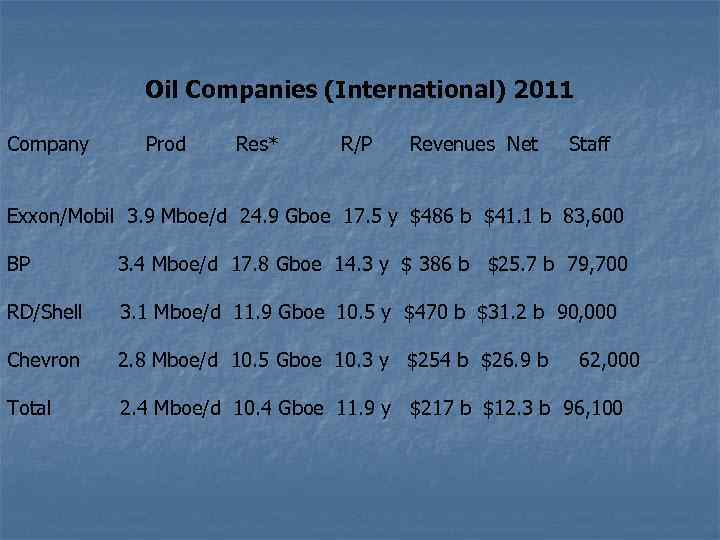 Oil Companies (International) 2011 Company Prod Res* R/P Revenues Net Staff Exxon/Mobil 3. 9 Mboe/d 24. 9 Gboe 17. 5 y $486 b $41. 1 b 83, 600 BP 3. 4 Mboe/d 17. 8 Gboe 14. 3 y $ 386 b $25. 7 b 79, 700 RD/Shell 3. 1 Mboe/d 11. 9 Gboe 10. 5 y $470 b $31. 2 b 90, 000 Chevron 2. 8 Mboe/d 10. 5 Gboe 10. 3 y $254 b $26. 9 b Total 2. 4 Mboe/d 10. 4 Gboe 11. 9 y $217 b $12. 3 b 96, 100 62, 000
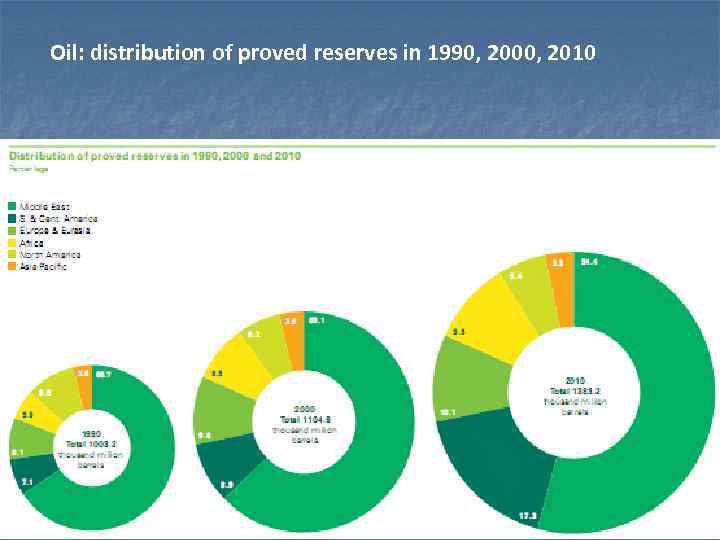 Oil: distribution of proved reserves in 1990, 2000, 2010
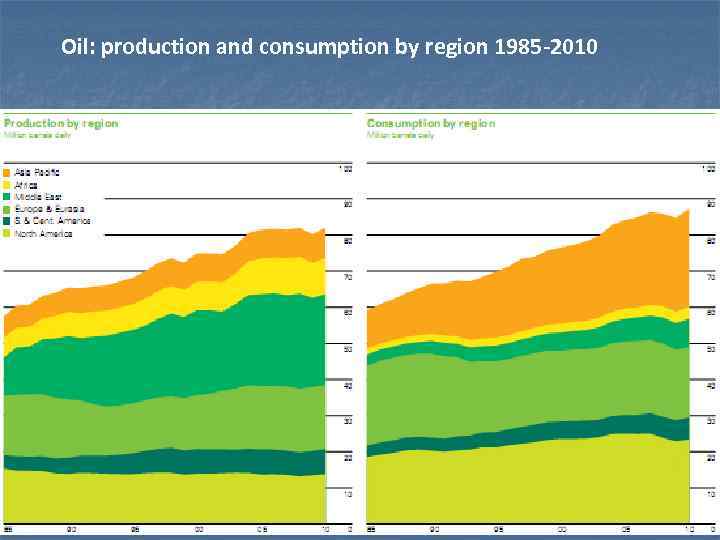 Oil: production and consumption by region 1985 -2010 7
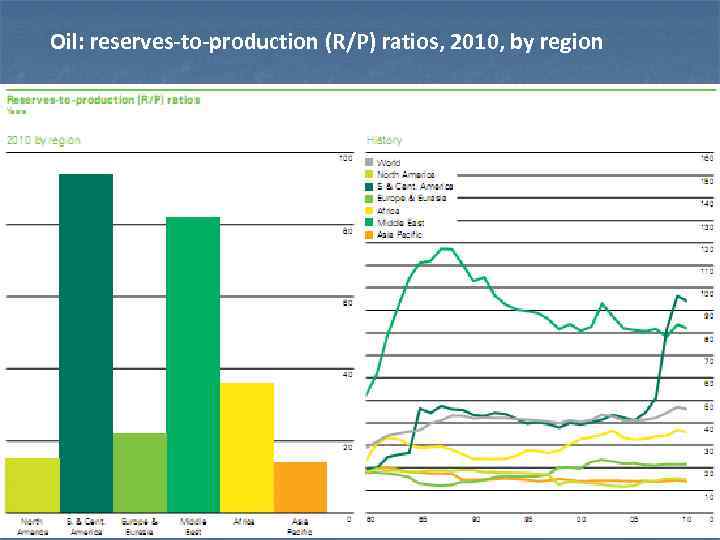 Oil: reserves-to-production (R/P) ratios, 2010, by region
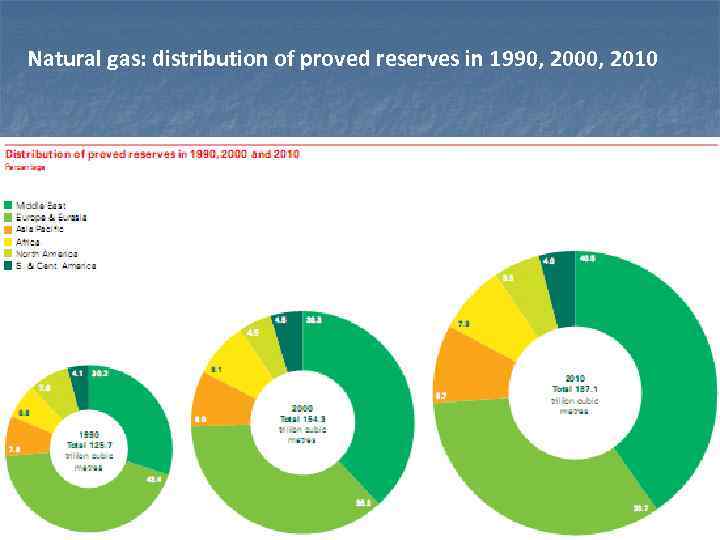 Natural gas: distribution of proved reserves in 1990, 2000, 2010
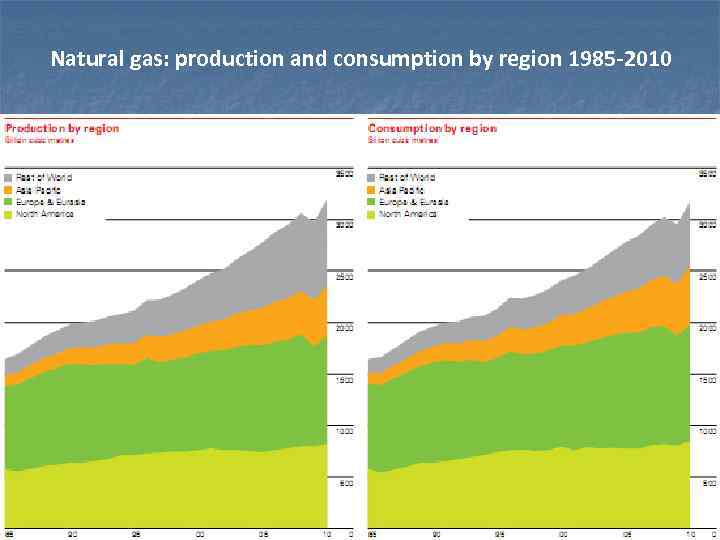 Natural gas: production and consumption by region 1985 -2010
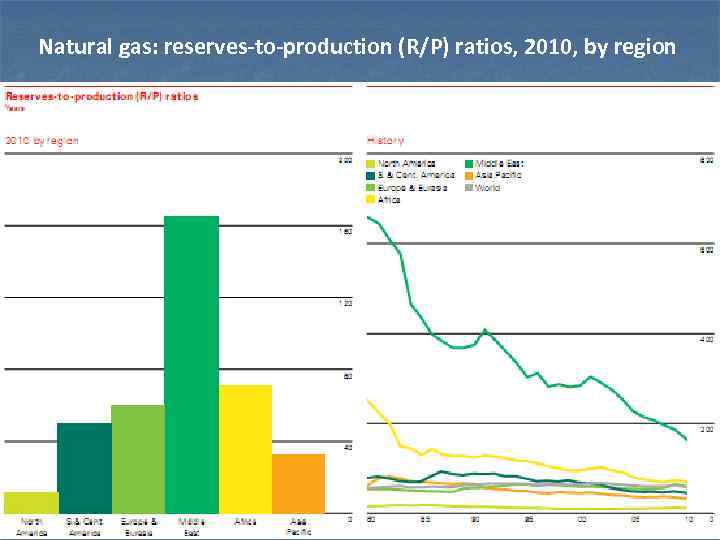 Natural gas: reserves-to-production (R/P) ratios, 2010, by region
 Historical Development Prior to 1900 No “petroleum geology”; all oil discovered through seepages (Appalachian, California, Baku, Ploesti, Peru, Egypt, Borneo. . . ) “Anticlinal theory” known but not used in practice Many fields located in so-called “geomorphic traps” (where the reservoir rock is truncated by a recent erosion surface) Drake well in 1859 first to discover oil (Pennsylvania)
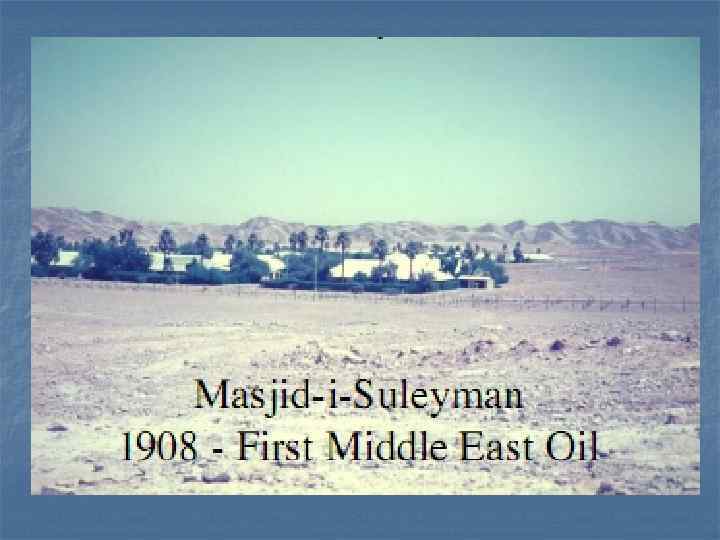
 Historical Development ctd. 1901 -1924 “Anticlinal theory” put in practice with Spindeltop well in Texas Important discoveries in Lake Maracaibo (Venezuela), Masjid-y. Suleiman (Iran), Trinidad, Borneo, Mexico, Oklahoma, San Joaquin Valley, California (all USA) Petroleum geology is “American”; foundation of AAPG Bolivar Coastal field: First in homoclinal trap, first offshore, first large field with heavy oil, launches SOC becomes first major oil company Automobiles! Gas stoves!
 Historical Development ctd. 1925 - 1945 Important discoveries in La Paz (Venezuela), Kirkuk (Iraq; carbonate reservoir!), numerous fields in Middle East (most also carbonates) Oil is organic, not inorganic; micropaleontology and organic geochemistry developed as important tools Technological breakthroughs: Rotary drilling, torsion balance, gravimeter, reflection seismology, electrical well logs, perforations; wells to 3000 meters depth (before: to 1000 m) World Petroleum Congress founded
 Historical Developments ctd. 1945 - 1960 Drilling boom, discovery of major oil fields in Middle East, USA, Western Canada, Russian platform Drilling depths reach 6000 meters; gas became important Important insights into hydrocarbon migration and accumulation (e. g. by King Hubbert; Levorsen) Sedimentology becomes important to understand reservoirs “Log-normal distribution” of oil fields
 Historical Developments ctd. 1960 - 1980 Offshore drilling technology developed Discovery of North Sea, Libya, Nigeria, Siberia, eastern Mexico oil provinces “Subtle traps” (e. g. North Dome in Qatar) Vast improvement of seismic acquisition and processing; becomes vital exploration tool. Further technological improvements in drilling, construction, and logging
 Historical Developments ctd. Since 1980 Passive margins plays discovered (Gulf of Mexico, West Africa, Brazil). Deep to ultra-deep drilling technology developed Huge carbonate fields in intra-cratonic setting discovered (Peri. Caspian oil province) 3 -D and 4 -D seismics provide volumetric and dynamic picture of reservoirs; leads to seismic stratigraphy Integration of petroleum disciplines; computerized workflows Half of the “easy oil” is produced
 Summary: Why it matters • e depend on energy: In the industrial world every person uses the energy corresponding to about 200 human powers 24 hours per day • Fossil energy constitutes ± 85% of our energy consumption • Fossil fuels have a high caloric value per volume • Fossil fuels are finite • The burning of fossil fuels has undesirable climatic consequences • But: Energy companies are important for the economy