


 Скачать презентацию 1 Introduction CSEP 545 Transaction Processing Philip A
91f7c041bae35c8dc508feff53e86a9f.ppt
- Количество слайдов: 56
 1. Introduction CSEP 545 Transaction Processing Philip A. Bernstein Copyright © 2003 Philip A. Bernstein 3/27/03 1
 Outline 1. The Basics 2. ACID Properties 3. Atomicity and Two-Phase Commit 4. Performance 5. Styles of System 3/27/03 2
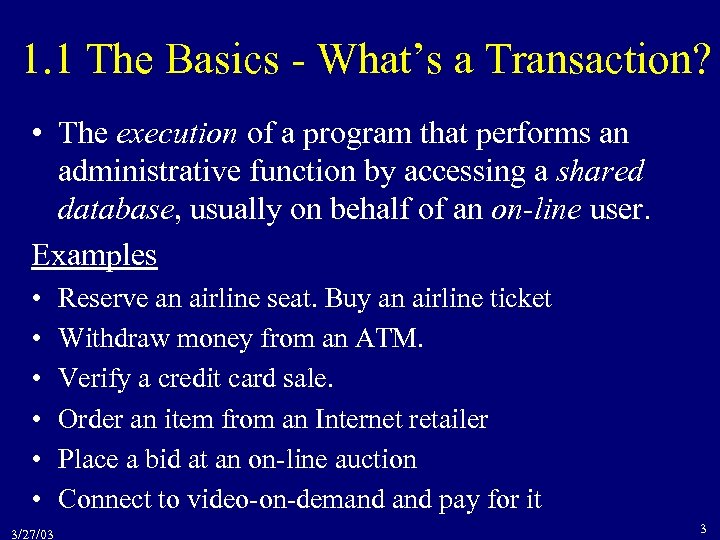 1. 1 The Basics - What’s a Transaction? • The execution of a program that performs an administrative function by accessing a shared database, usually on behalf of an on-line user. Examples • • • 3/27/03 Reserve an airline seat. Buy an airline ticket Withdraw money from an ATM. Verify a credit card sale. Order an item from an Internet retailer Place a bid at an on-line auction Connect to video-on-demand pay for it 3
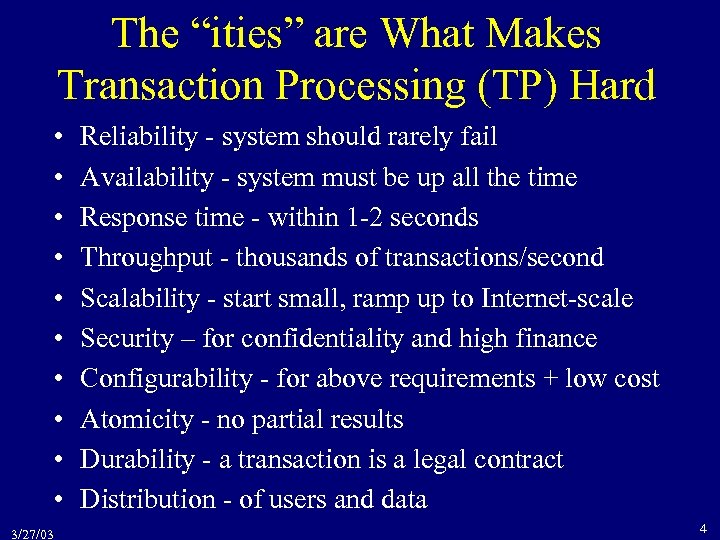 The “ities” are What Makes Transaction Processing (TP) Hard • • • 3/27/03 Reliability - system should rarely fail Availability - system must be up all the time Response time - within 1 -2 seconds Throughput - thousands of transactions/second Scalability - start small, ramp up to Internet-scale Security – for confidentiality and high finance Configurability - for above requirements + low cost Atomicity - no partial results Durability - a transaction is a legal contract Distribution - of users and data 4
 What Makes TP Important? • It’s at the core of electronic commerce • Most medium-to-large businesses use TP for their production systems. The business can’t operate without it. • It’s a huge slice of the computer system market. One of the largest applications of computers. 3/27/03 5
 TP System Infrastructure • User’s viewpoint – Enter a request from a browser or other display device – The system performs some application-specific work, which includes database accesses – Receive a reply (usually, but not always) • The TP system ensures that each transaction – is an independent unit of work – executes exactly once, and – produces permanent results. • TP system makes it easy to program transactions • TP system has tools to make it easy to manage 3/27/03 6
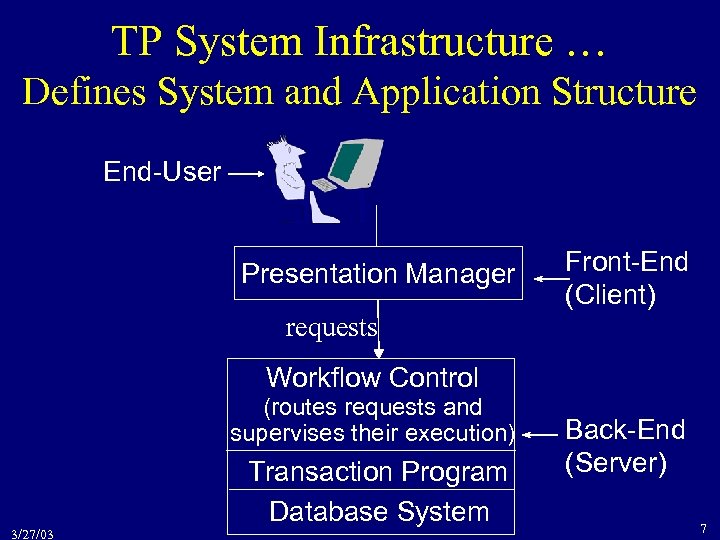 TP System Infrastructure … Defines System and Application Structure End-User Presentation Manager Front-End (Client) requests Workflow Control (routes requests and supervises their execution) 3/27/03 Transaction Program Database System Back-End (Server) 7
 System Characteristics • Typically < 100 transaction types per application • Transaction size has high variance. Typically, – 0 -30 disk accesses – 10 K - 1 M instructions executed – 2 -20 messages • A large-scale example: airline reservations – 150, 000 active display devices – plus indirect access via Internet travel agents – thousands of disk drives – 3000 transactions per second, peak 3/27/03 8
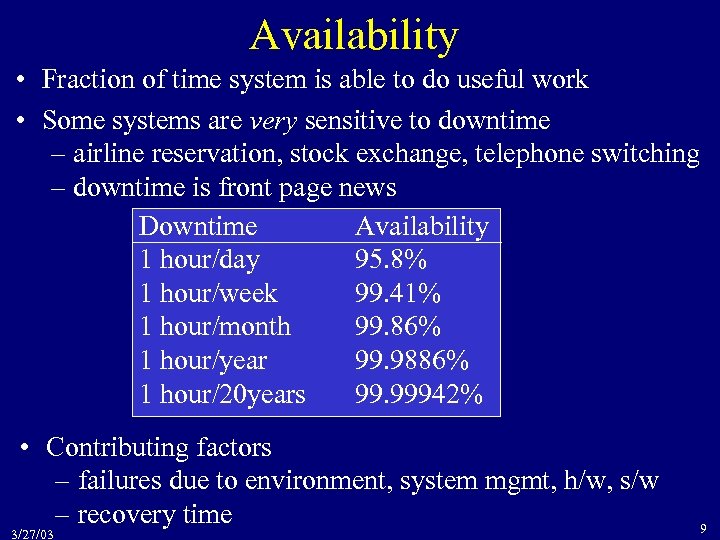 Availability • Fraction of time system is able to do useful work • Some systems are very sensitive to downtime – airline reservation, stock exchange, telephone switching – downtime is front page news Downtime Availability 1 hour/day 95. 8% 1 hour/week 99. 41% 1 hour/month 99. 86% 1 hour/year 99. 9886% 1 hour/20 years 99. 99942% • Contributing factors – failures due to environment, system mgmt, h/w, s/w – recovery time 3/27/03 9
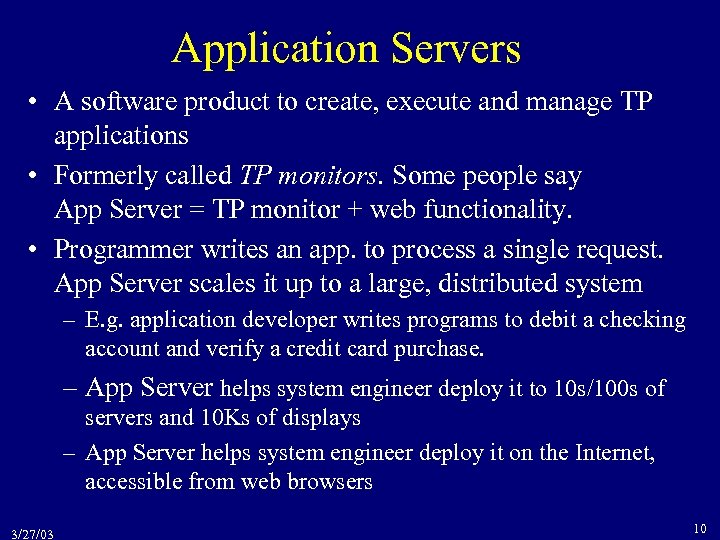 Application Servers • A software product to create, execute and manage TP applications • Formerly called TP monitors. Some people say App Server = TP monitor + web functionality. • Programmer writes an app. to process a single request. App Server scales it up to a large, distributed system – E. g. application developer writes programs to debit a checking account and verify a credit card purchase. – App Server helps system engineer deploy it to 10 s/100 s of servers and 10 Ks of displays – App Server helps system engineer deploy it on the Internet, accessible from web browsers 3/27/03 10
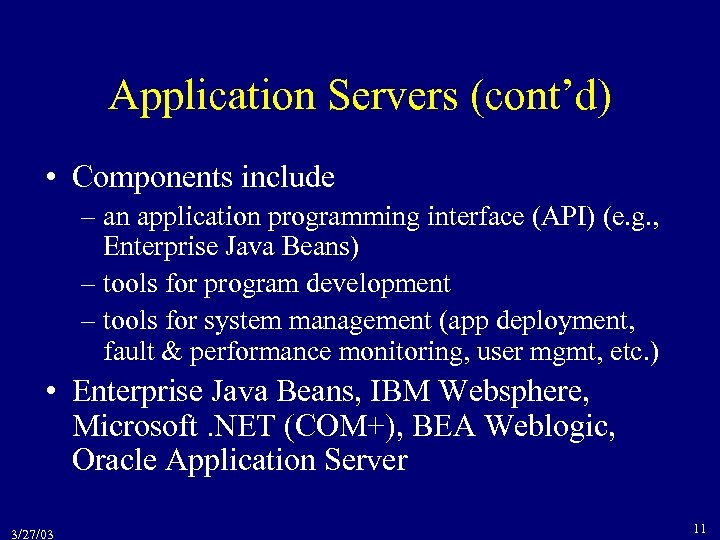 Application Servers (cont’d) • Components include – an application programming interface (API) (e. g. , Enterprise Java Beans) – tools for program development – tools for system management (app deployment, fault & performance monitoring, user mgmt, etc. ) • Enterprise Java Beans, IBM Websphere, Microsoft. NET (COM+), BEA Weblogic, Oracle Application Server 3/27/03 11
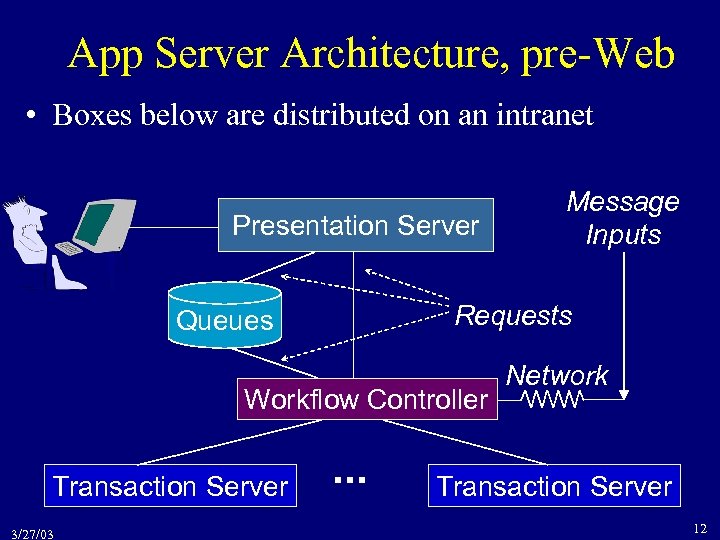 App Server Architecture, pre-Web • Boxes below are distributed on an intranet Presentation Server Queues Requests Workflow Controller Transaction Server 3/27/03 Message Inputs Network Transaction Server 12
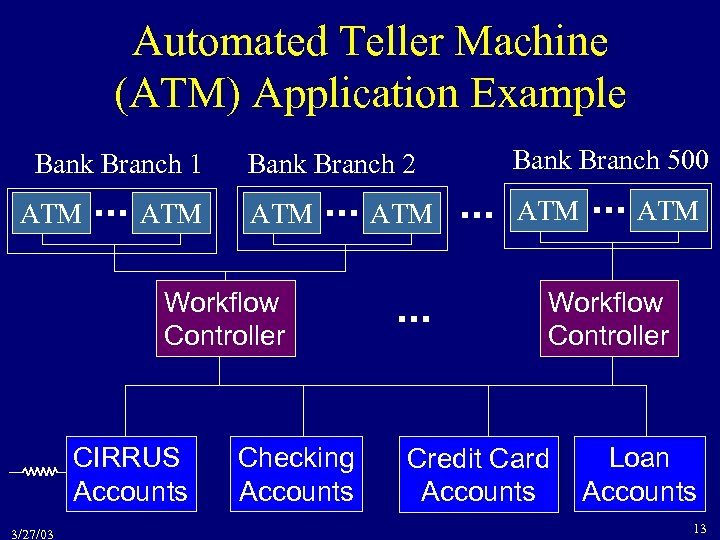 Automated Teller Machine (ATM) Application Example Bank Branch 1 ATM Bank Branch 2 Bank Branch 500 ATM Workflow Controller CIRRUS Accounts 3/27/03 Checking Accounts ATM Workflow Controller Credit Card Accounts Loan Accounts 13
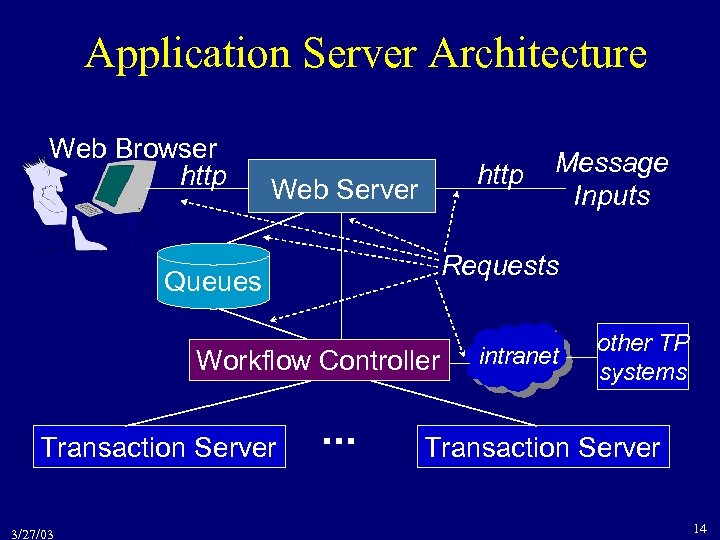 Application Server Architecture Web Browser http Web Server Requests Queues Workflow Controller Transaction Server 3/27/03 Message Inputs intranet other TP systems Transaction Server 14
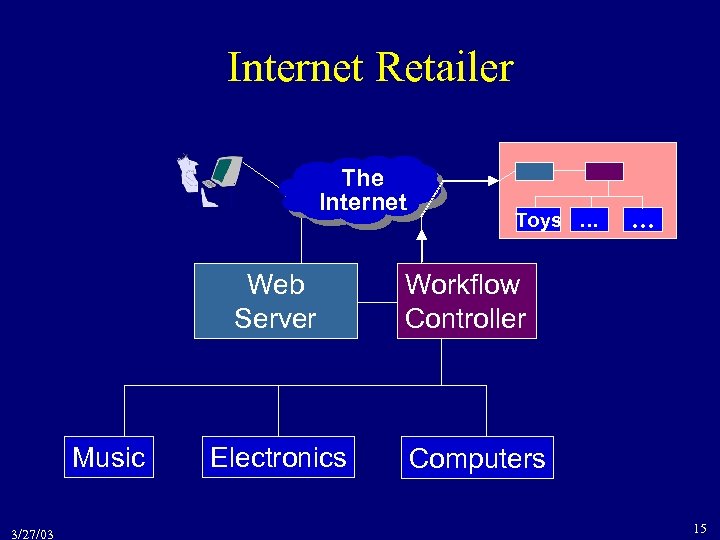 Internet Retailer The Internet Web Server Music 3/27/03 Electronics Toys … … Workflow Controller Computers 15
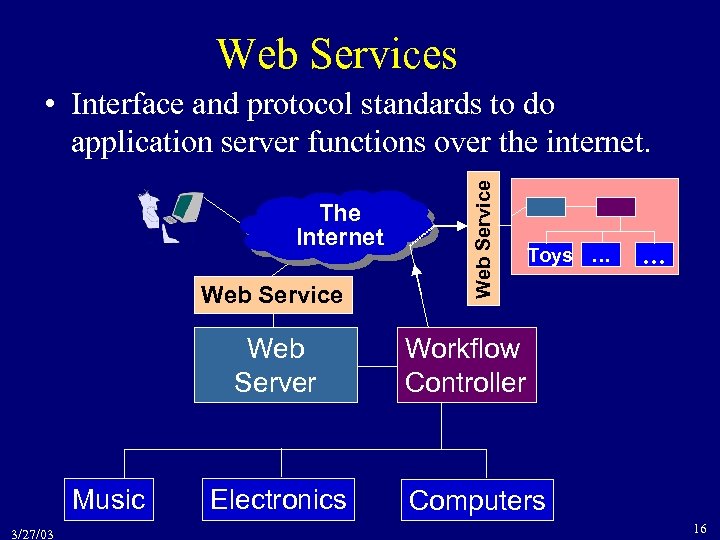 Web Services The Internet Web Service Web Server Music 3/27/03 Electronics Web Service • Interface and protocol standards to do application server functions over the internet. Toys … … Workflow Controller Computers 16
 Enterprise Application Integration • A software product to route requests between independent application systems. Often include – A queuing system – A message mapping system – Application adaptors (SAP, People. Soft, etc. ) • EAI and Application Servers address a similar problem, with different emphasis • IBM Websphere MQ, TIBCO, Vitria, See. Beyond 3/27/03 17
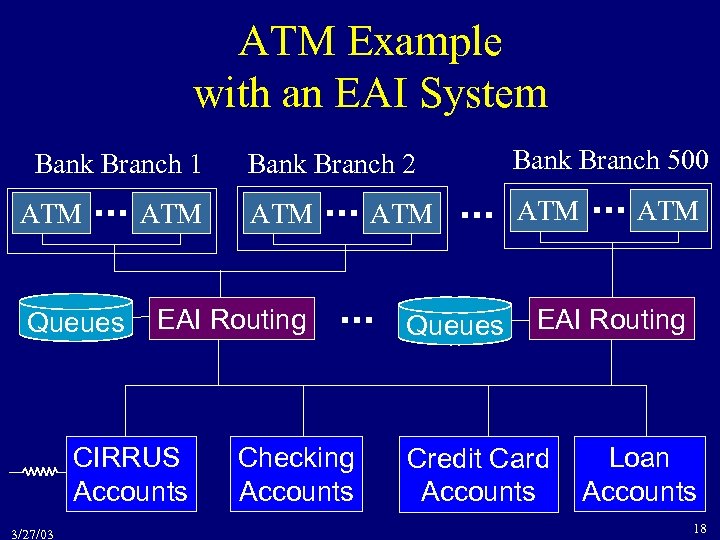 ATM Example with an EAI System Bank Branch 1 ATM Queues ATM Bank Branch 500 ATM EAI Routing CIRRUS Accounts 3/27/03 Bank Branch 2 Checking Accounts ATM Queues ATM EAI Routing Credit Card Accounts Loan Accounts 18
 Workflow Systems • A software product that executes multi-transaction longrunning scripts (e. g. process an order) • Product components – – – A workflow script language Workflow script interpreter and scheduler Workflow tracking Message translation Application and queue system adaptors • Transaction vs. document centric • Structured processes vs. case management • IBM Websphere MQ Workflow, Microsoft Biz. Talk, Vitria, Oracle Workflow, File. NET, Documentum 3/27/03 19
 System Software Vendor’s View • TP is partly a component product problem – Hardware – Operating system – Database system – Application Server • TP is partly a system engineering problem – Getting all those components to work together to produce a system with all those “ilities”. • This course focuses primarily on the Database System and Application Server 3/27/03 20
 Outline 1. The Basics 2. ACID Properties 3. Atomicity and Two-Phase Commit 4. Performance 5. Styles of System 3/27/03 21
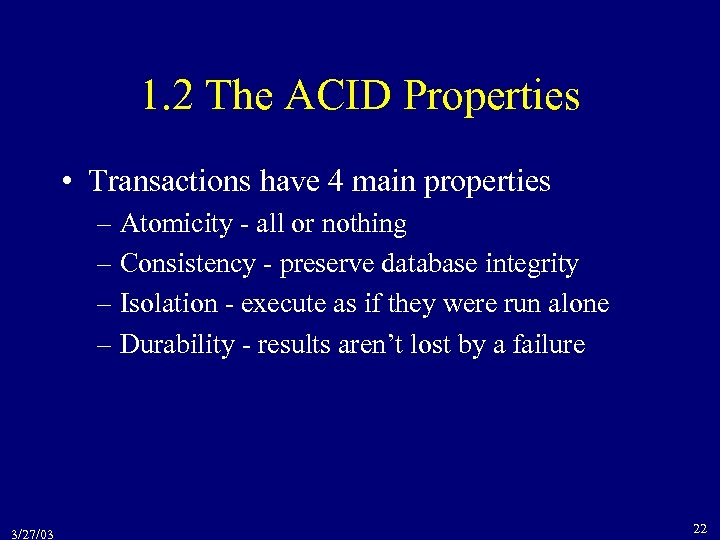 1. 2 The ACID Properties • Transactions have 4 main properties – Atomicity - all or nothing – Consistency - preserve database integrity – Isolation - execute as if they were run alone – Durability - results aren’t lost by a failure 3/27/03 22
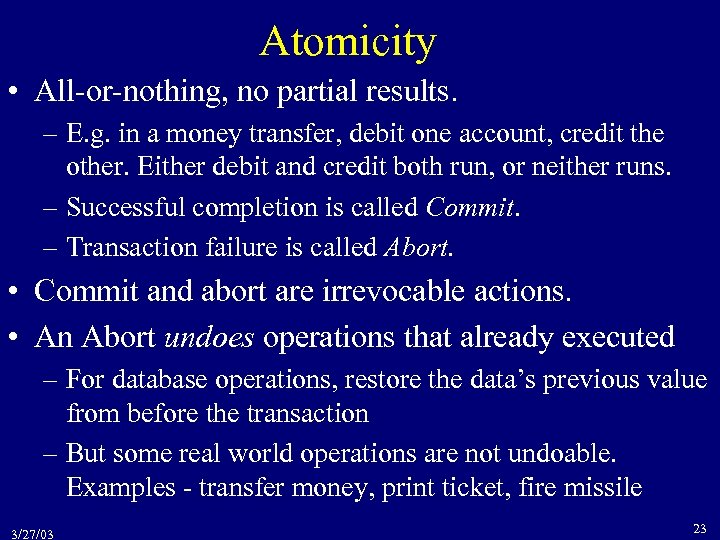 Atomicity • All-or-nothing, no partial results. – E. g. in a money transfer, debit one account, credit the other. Either debit and credit both run, or neither runs. – Successful completion is called Commit. – Transaction failure is called Abort. • Commit and abort are irrevocable actions. • An Abort undoes operations that already executed – For database operations, restore the data’s previous value from before the transaction – But some real world operations are not undoable. Examples - transfer money, print ticket, fire missile 3/27/03 23
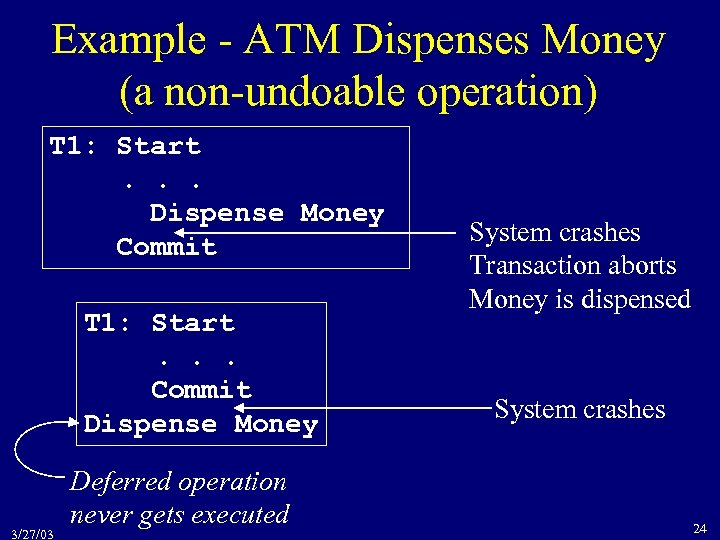 Example - ATM Dispenses Money (a non-undoable operation) T 1: Start. . . Dispense Money Commit T 1: Start. . . Commit Dispense Money 3/27/03 Deferred operation never gets executed System crashes Transaction aborts Money is dispensed System crashes 24
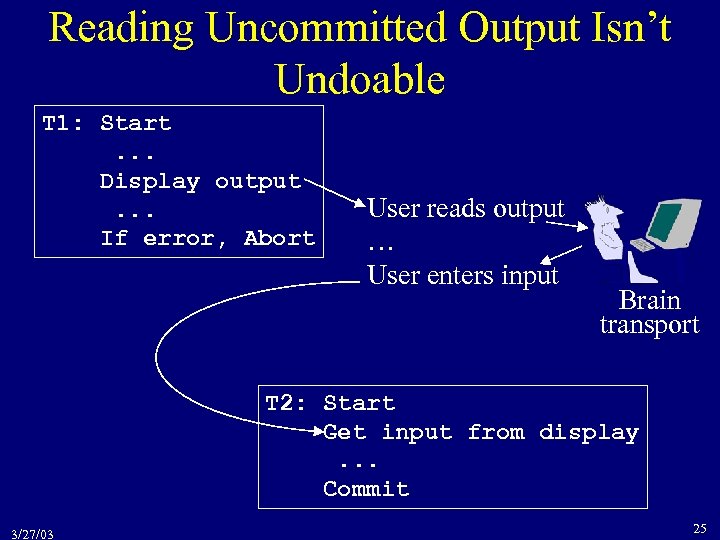 Reading Uncommitted Output Isn’t Undoable T 1: Start. . . Display output. . . If error, Abort User reads output … User enters input Brain transport T 2: Start Get input from display. . . Commit 3/27/03 25
 Compensating Transactions • A transaction that reverses the effect of another transaction (that committed). For example, – “Adjustment” in a financial system – Annul a marriage • Not all transactions have complete compensations – E. g. Certain money transfers (cf. “The Firm”) – E. g. Fire missile, cancel contract – Contract law talks a lot about appropriate compensations G A well-designed TP application should have a compensation for every transaction type 3/27/03 26
 Consistency Every transaction should maintain DB consistency – Referential integrity - E. g. each order references an existing customer number and existing part numbers – The books balance (debits = credits, assets = liabilities) G Consistency preservation is a property of a transaction, not of the TP system (unlike the A, I, and D of ACID) • If each transaction maintains consistency, then serial executions of transactions do too. 3/27/03 27
![Some Notation • • • 3/27/03 ri[x] = Read(x) by transaction Ti wi[x] =](https://present5.com/presentation/91f7c041bae35c8dc508feff53e86a9f/image-28.jpg "Some Notation • • • 3/27/03 ri[x] = Read(x) by transaction Ti wi[x] =") Some Notation • • • 3/27/03 ri[x] = Read(x) by transaction Ti wi[x] = Write(x) by transaction Ti ci = Commit by transaction Ti ai = Abort by transaction Ti A history is a sequence of such operations, in the order that the database system processed them. 28
Some Notation • • • 3/27/03 ri[x] = Read(x) by transaction Ti wi[x] = Write(x) by transaction Ti ci = Commit by transaction Ti ai = Abort by transaction Ti A history is a sequence of such operations, in the order that the database system processed them. 28
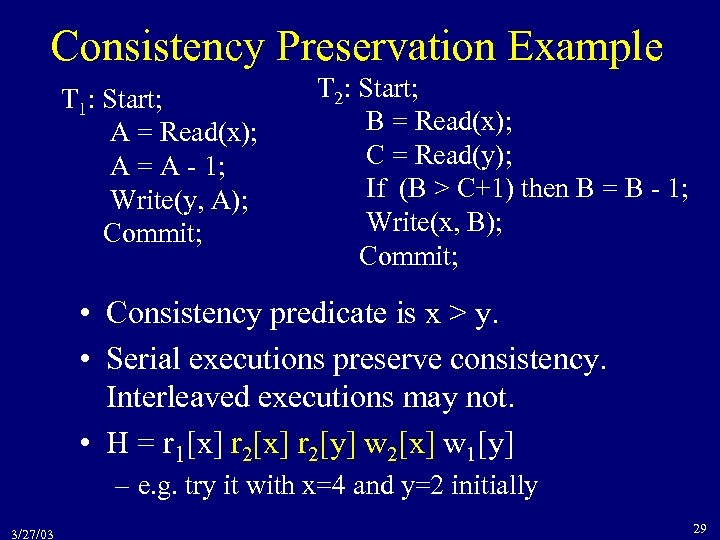 Consistency Preservation Example T 1: Start; A = Read(x); A = A - 1; Write(y, A); Commit; T 2: Start; B = Read(x); C = Read(y); If (B > C+1) then B = B - 1; Write(x, B); Commit; • Consistency predicate is x > y. • Serial executions preserve consistency. Interleaved executions may not. • H = r 1[x] r 2[y] w 2[x] w 1[y] – e. g. try it with x=4 and y=2 initially 3/27/03 29
 Isolation • Intuitively, the effect of a set of transactions should be the same as if they ran independently • Formally, an interleaved execution of transactions is serializable if its effect is equivalent to a serial one. • Implies a user view where the system runs each user’s transaction stand-alone. • Of course, transactions in fact run with lots of concurrency, to use device parallelism. 3/27/03 30
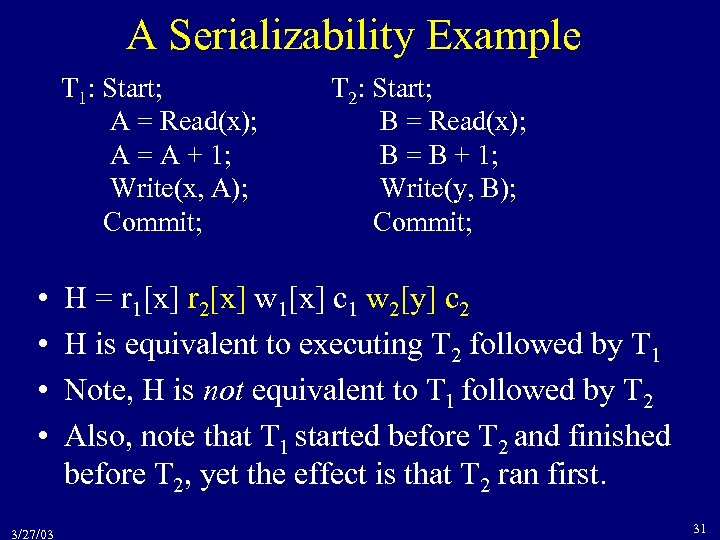 A Serializability Example T 1: Start; A = Read(x); A = A + 1; Write(x, A); Commit; • • 3/27/03 T 2: Start; B = Read(x); B = B + 1; Write(y, B); Commit; H = r 1[x] r 2[x] w 1[x] c 1 w 2[y] c 2 H is equivalent to executing T 2 followed by T 1 Note, H is not equivalent to T 1 followed by T 2 Also, note that T 1 started before T 2 and finished before T 2, yet the effect is that T 2 ran first. 31
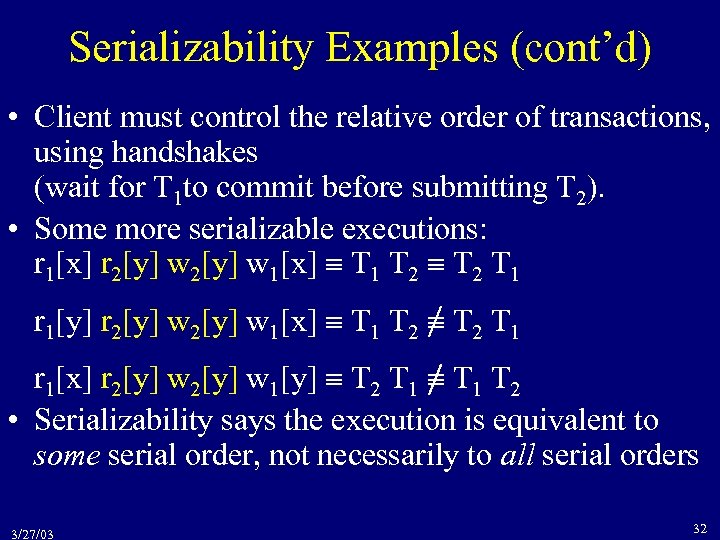 Serializability Examples (cont’d) • Client must control the relative order of transactions, using handshakes (wait for T 1 to commit before submitting T 2). • Some more serializable executions: r 1[x] r 2[y] w 1[x] T 1 T 2 T 1 r 1[y] r 2[y] w 1[x] T 1 T 2 T 1 r 1[x] r 2[y] w 1[y] T 2 T 1 T 2 • Serializability says the execution is equivalent to some serial order, not necessarily to all serial orders 3/27/03 32
![Non-Serializable Examples • r 1[x] r 2[x] w 1[x] (race condition) – e. g.](https://present5.com/presentation/91f7c041bae35c8dc508feff53e86a9f/image-33.jpg "Non-Serializable Examples • r 1[x] r 2[x] w 1[x] (race condition) – e. g.") Non-Serializable Examples • r 1[x] r 2[x] w 1[x] (race condition) – e. g. T 1 and T 2 are each adding 100 to x • r 1[x] r 2[y] w 2[x] w 1[y] – e. g. each transaction is trying to make x = y, but the interleaved effect is a swap • r 1[x] r 1[y] w 1[x] r 2[y] c 2 w 1[y] c 1 (inconsistent retrieval) – e. g. T 1 is moving $100 from x to y. – T 2 sees only half of the result of T 1 • Compare to the OS view of synchronization 3/27/03 33
Non-Serializable Examples • r 1[x] r 2[x] w 1[x] (race condition) – e. g. T 1 and T 2 are each adding 100 to x • r 1[x] r 2[y] w 2[x] w 1[y] – e. g. each transaction is trying to make x = y, but the interleaved effect is a swap • r 1[x] r 1[y] w 1[x] r 2[y] c 2 w 1[y] c 1 (inconsistent retrieval) – e. g. T 1 is moving $100 from x to y. – T 2 sees only half of the result of T 1 • Compare to the OS view of synchronization 3/27/03 33
 Durability • When a transaction commits, its results will survive failures (e. g. of the application, OS, DB system … even of the disk). • Makes it possible for a transaction to be a legal contract. • Implementation is usually via a log – DB system writes all transaction updates to its log – to commit, it adds a record “commit(Ti)” to the log – when the commit record is on disk, the transaction is committed. – system waits for disk ack before acking to user 3/27/03 34
 Outline 1. The Basics 2. ACID Properties 3. Atomicity and Two-Phase Commit 4. Performance 5. Styles of System 3/27/03 35
 1. 3 Atomicity and Two-Phase Commit • Distributed systems make atomicity harder • Suppose a transaction updates data managed by two DB systems. • One DB system could commit the transaction, but a failure could prevent the other system from committing. • The solution is the two-phase commit protocol. • Abstract “DB system” by resource manager (could be a SQL DBMS, message mgr, queue mgr, OO DBMS, etc. ) 3/27/03 36
 Two-Phase Commit • Main idea - all resource managers (RMs) save a durable copy of the transaction’s updates before any of them commit. • If one RM fails after another commits, the failed RM can still commit after it recovers. • The protocol to commit transaction T – Phase 1 - T’s coordinator asks all participant RMs to “prepare the transaction”. Participant RMs replies “prepared” after T’s updates are durable. – Phase 2 - After receiving “prepared” from all participant RMs, the coordinator tells all participant RMs to commit. 3/27/03 37
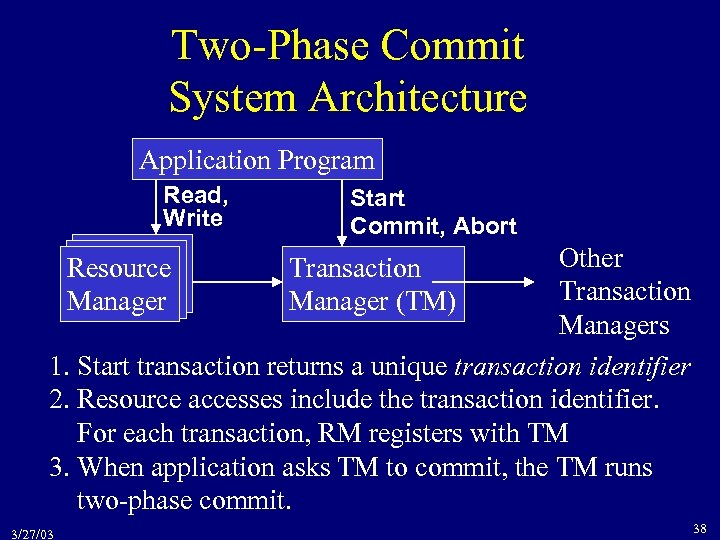 Two-Phase Commit System Architecture Application Program Read, Write Start Commit, Abort Other Transaction Managers 1. Start transaction returns a unique transaction identifier 2. Resource accesses include the transaction identifier. For each transaction, RM registers with TM 3. When application asks TM to commit, the TM runs two-phase commit. Resource Manager 3/27/03 Transaction Manager (TM) 38
 Outline 1. The Basics 2. ACID Properties 3. Atomicity and Two-Phase Commit 4. Performance 5. Styles of System 3/27/03 39
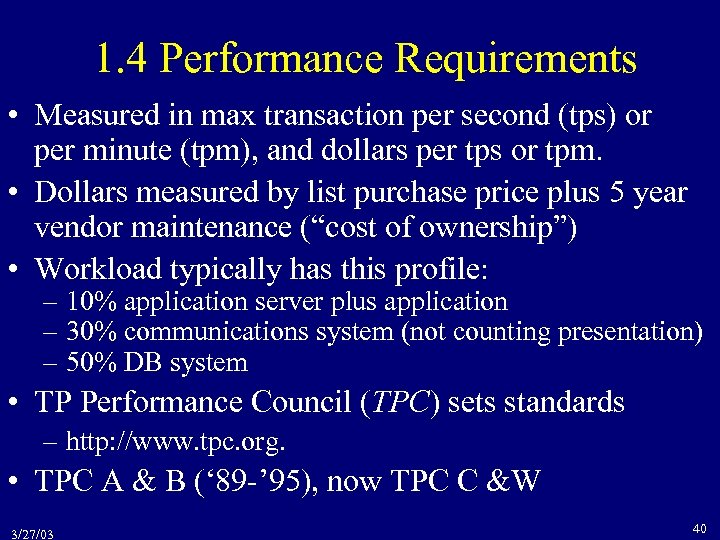 1. 4 Performance Requirements • Measured in max transaction per second (tps) or per minute (tpm), and dollars per tps or tpm. • Dollars measured by list purchase price plus 5 year vendor maintenance (“cost of ownership”) • Workload typically has this profile: – 10% application server plus application – 30% communications system (not counting presentation) – 50% DB system • TP Performance Council (TPC) sets standards – http: //www. tpc. org. • TPC A & B (‘ 89 -’ 95), now TPC C &W 3/27/03 40
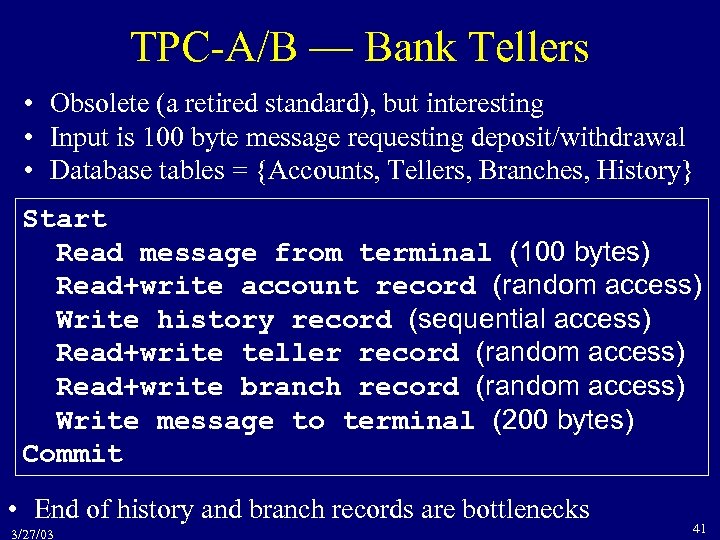 TPC-A/B — Bank Tellers • Obsolete (a retired standard), but interesting • Input is 100 byte message requesting deposit/withdrawal • Database tables = {Accounts, Tellers, Branches, History} Start Read message from terminal (100 bytes) Read+write account record (random access) Write history record (sequential access) Read+write teller record (random access) Read+write branch record (random access) Write message to terminal (200 bytes) Commit • End of history and branch records are bottlenecks 3/27/03 41
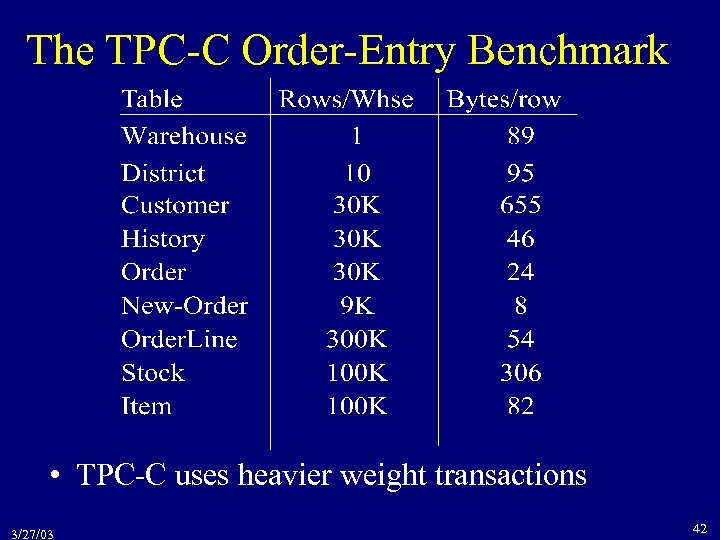 The TPC-C Order-Entry Benchmark • TPC-C uses heavier weight transactions 3/27/03 42
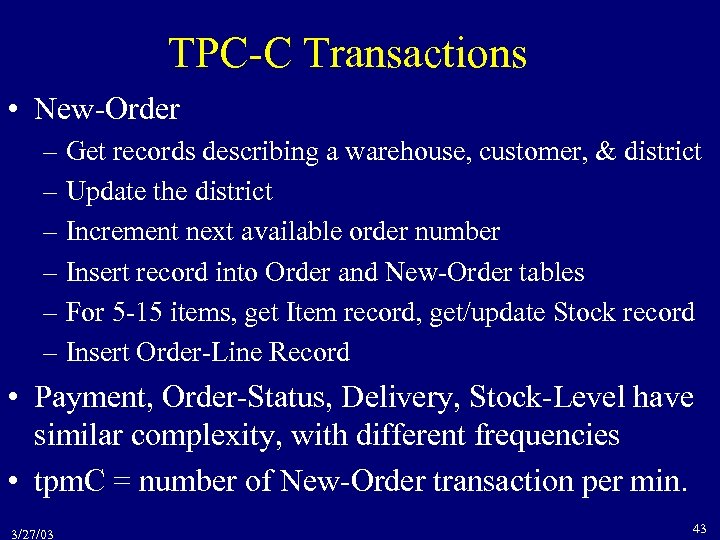 TPC-C Transactions • New-Order – Get records describing a warehouse, customer, & district – Update the district – Increment next available order number – Insert record into Order and New-Order tables – For 5 -15 items, get Item record, get/update Stock record – Insert Order-Line Record • Payment, Order-Status, Delivery, Stock-Level have similar complexity, with different frequencies • tpm. C = number of New-Order transaction per min. 3/27/03 43
 Comments on TPC-C • Enables apples-to-apples comparison of TP systems • Does not predict how your application will run, or how much hardware you will need, or which system will work best on your workload • Not all vendors optimize for TPC-C. – IBM has claimed DB 2 is optimized for a different workload, so they only started publishing TPC numbers a few years ago. 3/27/03 44
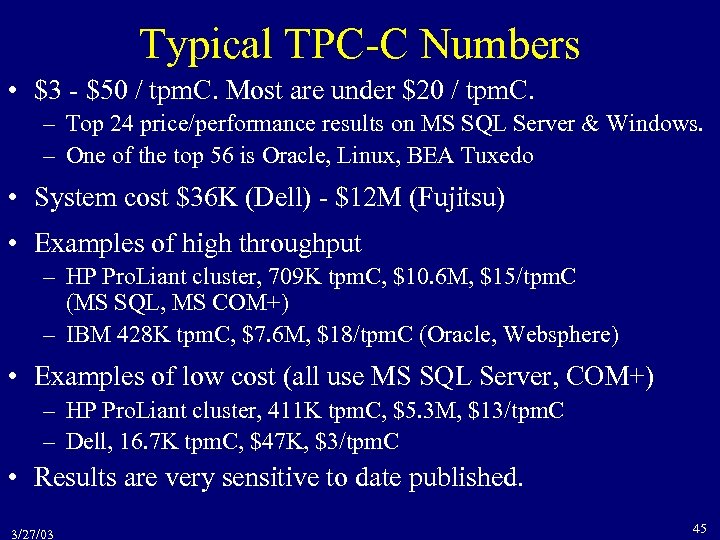 Typical TPC-C Numbers • $3 - $50 / tpm. C. Most are under $20 / tpm. C. – Top 24 price/performance results on MS SQL Server & Windows. – One of the top 56 is Oracle, Linux, BEA Tuxedo • System cost $36 K (Dell) - $12 M (Fujitsu) • Examples of high throughput – HP Pro. Liant cluster, 709 K tpm. C, $10. 6 M, $15/tpm. C (MS SQL, MS COM+) – IBM 428 K tpm. C, $7. 6 M, $18/tpm. C (Oracle, Websphere) • Examples of low cost (all use MS SQL Server, COM+) – HP Pro. Liant cluster, 411 K tpm. C, $5. 3 M, $13/tpm. C – Dell, 16. 7 K tpm. C, $47 K, $3/tpm. C • Results are very sensitive to date published. 3/27/03 45
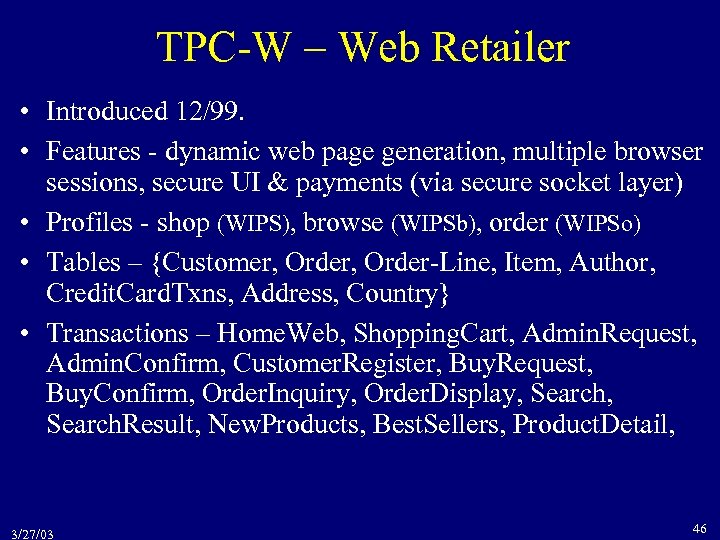 TPC-W – Web Retailer • Introduced 12/99. • Features - dynamic web page generation, multiple browser sessions, secure UI & payments (via secure socket layer) • Profiles - shop (WIPS), browse (WIPSb), order (WIPSo) • Tables – {Customer, Order-Line, Item, Author, Credit. Card. Txns, Address, Country} • Transactions – Home. Web, Shopping. Cart, Admin. Request, Admin. Confirm, Customer. Register, Buy. Request, Buy. Confirm, Order. Inquiry, Order. Display, Search. Result, New. Products, Best. Sellers, Product. Detail, 3/27/03 46
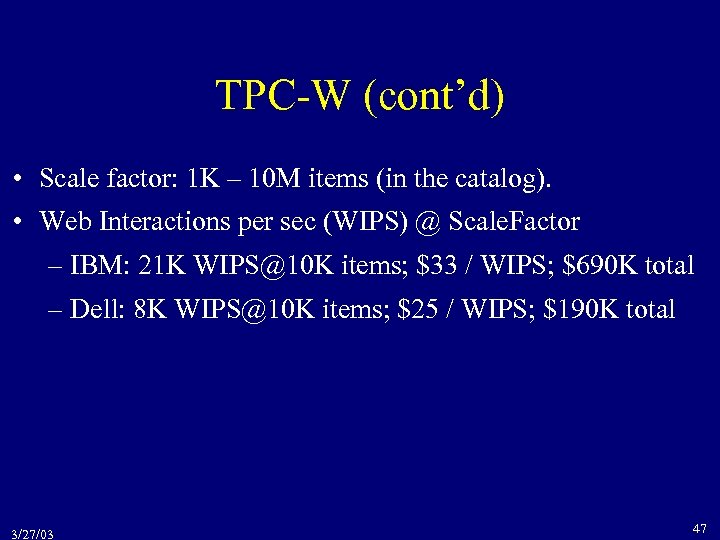 TPC-W (cont’d) • Scale factor: 1 K – 10 M items (in the catalog). • Web Interactions per sec (WIPS) @ Scale. Factor – IBM: 21 K WIPS@10 K items; $33 / WIPS; $690 K total – Dell: 8 K WIPS@10 K items; $25 / WIPS; $190 K total 3/27/03 47
 Outline 1. The Basics 2. ACID Properties 3. Atomicity and Two-Phase Commit 4. Performance 5. Styles of System 3/27/03 48
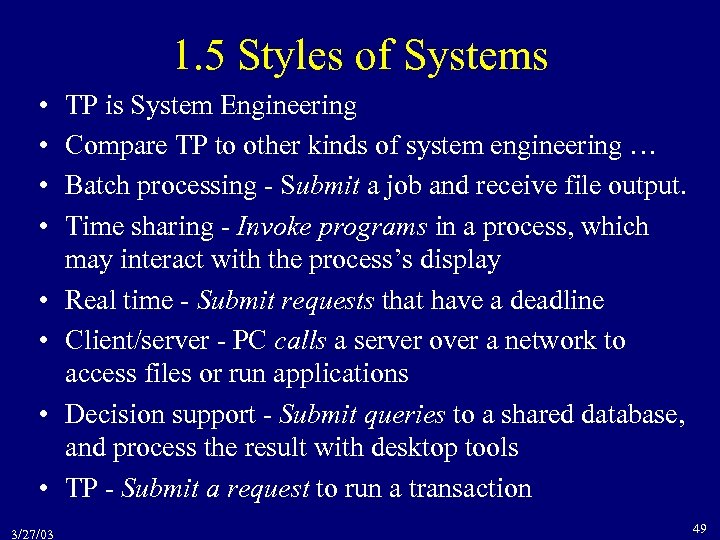 1. 5 Styles of Systems • • 3/27/03 TP is System Engineering Compare TP to other kinds of system engineering … Batch processing - Submit a job and receive file output. Time sharing - Invoke programs in a process, which may interact with the process’s display Real time - Submit requests that have a deadline Client/server - PC calls a server over a network to access files or run applications Decision support - Submit queries to a shared database, and process the result with desktop tools TP - Submit a request to run a transaction 49
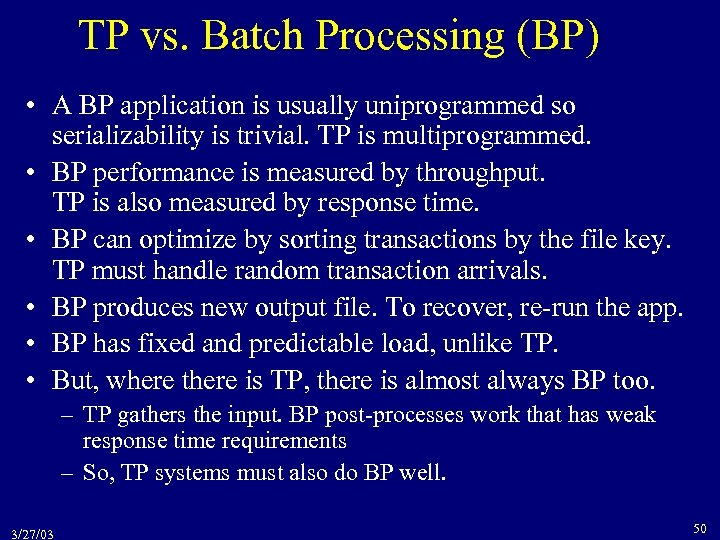 TP vs. Batch Processing (BP) • A BP application is usually uniprogrammed so serializability is trivial. TP is multiprogrammed. • BP performance is measured by throughput. TP is also measured by response time. • BP can optimize by sorting transactions by the file key. TP must handle random transaction arrivals. • BP produces new output file. To recover, re-run the app. • BP has fixed and predictable load, unlike TP. • But, where there is TP, there is almost always BP too. – TP gathers the input. BP post-processes work that has weak response time requirements – So, TP systems must also do BP well. 3/27/03 50
 TP vs. Timesharing (TS) • TS is a utility with highly unpredictable load. Different programs run each day, exercising features in new combinations. • By comparison, TP is highly regular. • TS has less stringent availability and atomicity requirements. Downtime isn’t as expensive. 3/27/03 51
 TP vs. Real Time (RT) • RT has more stringent response time requirements. It may control a physical process. • RT deals with more specialized devices. • RT doesn’t need or use a transaction abstraction – usually loose about atomicity and serializability • In RT, response time goals are usually more important than completeness or correctness. In TP, correctness is paramount. 3/27/03 52
 TP and Client/Server (C/S) • Is commonly used for TP, where client prepares requests and server runs transactions • In a sense, TP systems were the first C/S systems, where the client was a terminal 3/27/03 53
 TP and Decision Support Systems (DSSs) • DSSs run long queries, usually with lower data integrity requirements than TP. • A. k. a. data warehouse (DSS is the more generic term. ) • TP systems provide the raw data for DSSs. 3/27/03 54
 Outline 1. The Basics 2. ACID Properties 3. Atomicity and Two-Phase Commit 4. Performance 5. Styles of System 3/27/03 55
 What’s Next? • This chapter covered TP system structure and properties of transactions and TP systems • The rest of the course drills deeply into each of these areas, one by one. 3/27/03 56