


 Скачать презентацию 1 Introducing E-learning with Participatory Design Techniques Anders
49b5080e1d8965f766edc028cca80313.ppt
- Количество слайдов: 21
 1* Introducing E-learning with Participatory Design Techniques Anders Mørch CITE, The University of Hong Kong and Inter. Media, University of Oslo, Norway Email: anders. morch@intermedia. uio. no HKU, July 10 th, 2004
 2* Outline • • Three types of E-learning Participatory design (PD) The LAP project PD techniques used in LAP Findings Summary References HKU, July 10 th, 2004
 3* Three types of E-learning • E-learning in education – Learning activities; student assessment – Readymade systems (often for collaborative learning) – Focus seems to be on tools and infrastructure • E-learning in workplaces – Supporting specific (well defined) business domains – Readymade system (often with authoring tools) – Focus seems to be on learning objects and integration • E-learning introduced with PD techniques – Works well for poorly understood or new domains – Focus is users: getting them involved in designing their own systems HKU, July 10 th, 2004
 4* E-learning in education • Web-based environments for learning, teaching, and assessment – ILN, Web. CT, etc. • Multiple tools – Discussion forum for collaborative learning – White boards for real time interaction – Tools to compute grades and “rank” students • Reusable learning objects – Multimedia objects representing specific curricula to be taught HKU, July 10 th, 2004
 5* E-learning in workplaces • E-learning: – integral part the company’s information systems infrastructure – Authoring tools for production of multimedia content to teach critical knowledge to employees in cost effective ways • Learning on demand – Work is primary activity – Learning is secondary activity (to make work easier) • • The systems must be easy to use and allow maintenance by “super users”, advanced users with domain expertise but without formal computer training Several examples exists, but often for “drill & practice” HKU, July 10 th, 2004
 6* E-learning introduced with PD techniques • The goal of this presentation is to introduce this approach • PD = Participatory Design • What is PD? • How can it be useful for E-learning? HKU, July 10 th, 2004
 7* What is Participatory Design? • Techniques for involving workers in the design of systems that will affect their work • Has its roots in trade union activities in the 1970 s and some pioneering projects in the 1980 s, originated in Scandinavia • Sometimes referred to as “Scandinavian approach” or “democratic design” • A goal has been to make user participation design-oriented and leverage actual users’ domain expertise and skills HKU, July 10 th, 2004
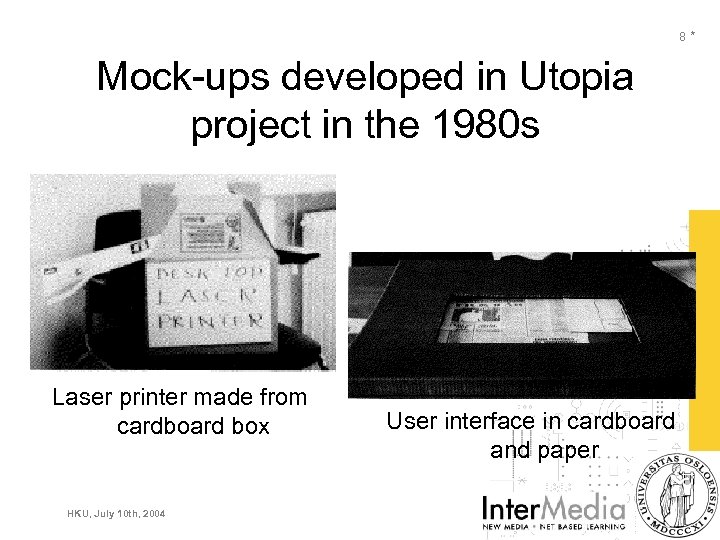 8* Mock-ups developed in Utopia project in the 1980 s Laser printer made from cardboard box HKU, July 10 th, 2004 User interface in cardboard and paper
 9* How can PD be useful for elearning? • “One size can’t fit all” • Complex problem domains (both for schools and workplaces) may require tailor-made Elearning • Workplaces and schools that can utilize domain expertise (super users) to maintain e -learning systems may gain competitive advantage over other approaches over time HKU, July 10 th, 2004
 10 * LAP project • Learning and Knowledge Building at Work (LKBW) • 3 year project among researchers and service industry companies in Norway • Goal: Introduce e-learning in two large corporations (Statoil and Visma) • Empirical studies of the adoption process HKU, July 10 th, 2004
 11 * PD Techniques: Case Statoil • Goal: develop an e-learning system for petrol station attendants • Techniques employed: – Design workshop (problem identification) – Drama techniques (learning scenarios) – Mock-ups (low-fidelity prototypes) – Intermediate abstractions (system design) – System (computer) prototypes HKU, July 10 th, 2004
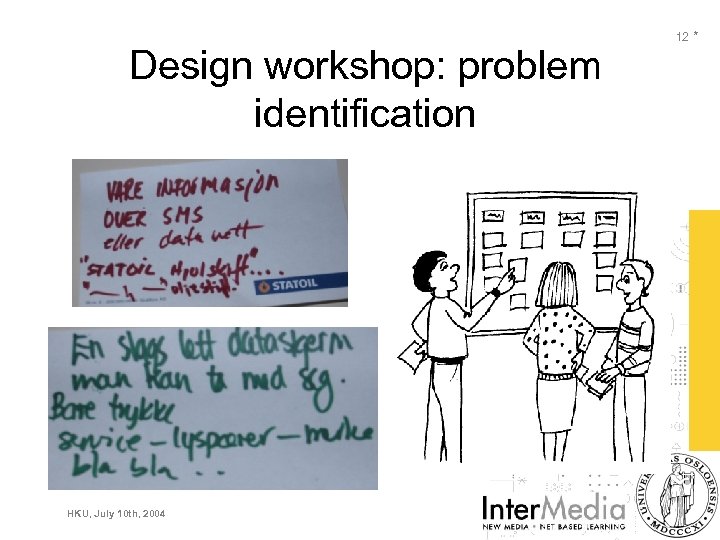 Design workshop: problem identification HKU, July 10 th, 2004 12 *
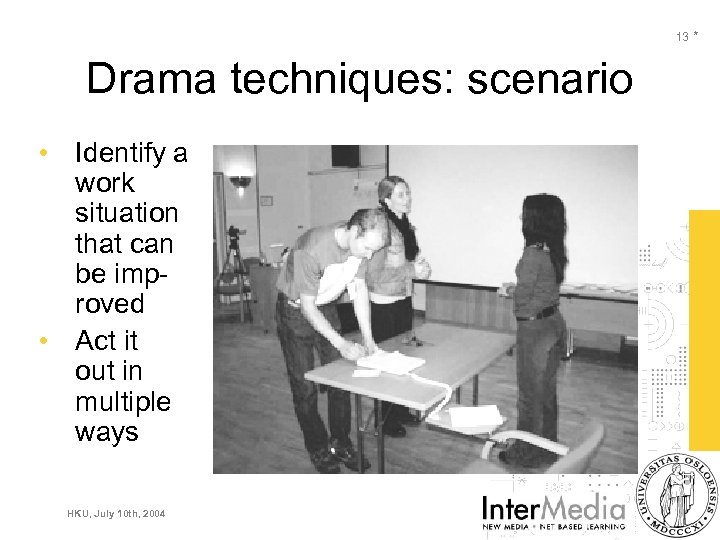 13 * Drama techniques: scenario • Identify a work situation that can be improved • Act it out in multiple ways HKU, July 10 th, 2004
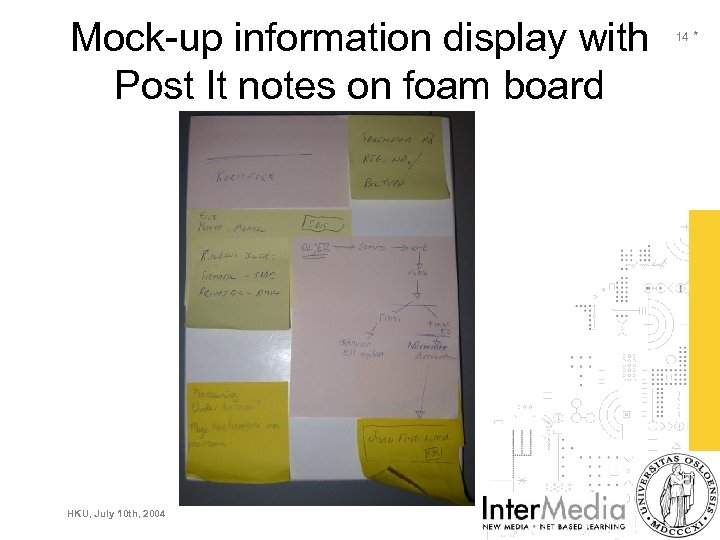 Mock-up information display with Post It notes on foam board HKU, July 10 th, 2004 14 *
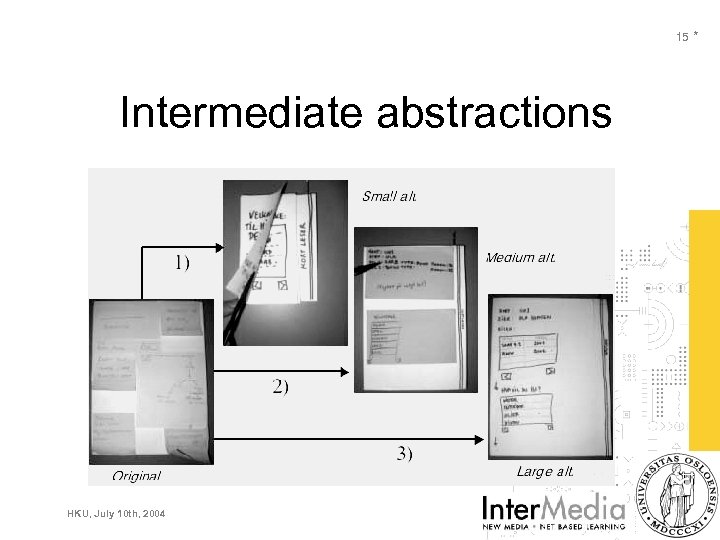 15 * Intermediate abstractions HKU, July 10 th, 2004
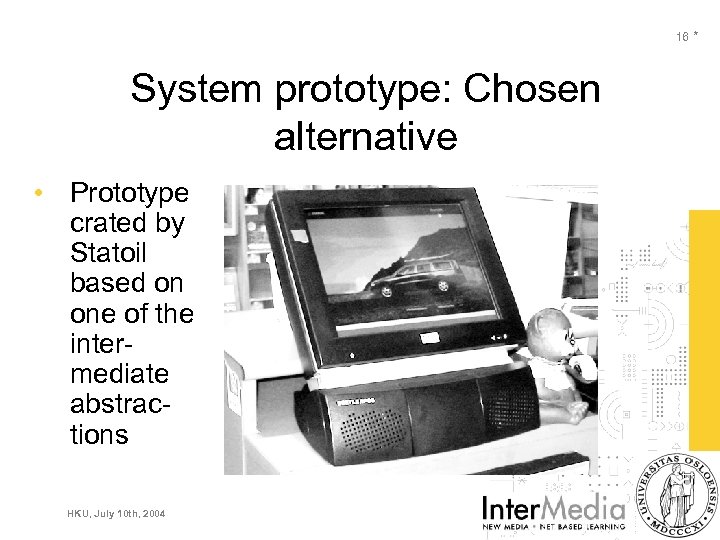 16 * System prototype: Chosen alternative • Prototype crated by Statoil based on one of the intermediate abstractions HKU, July 10 th, 2004
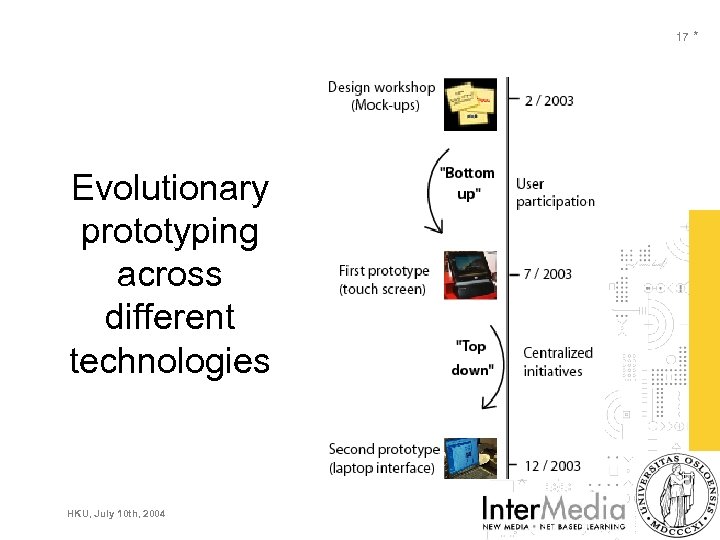 17 * Evolutionary prototyping across different technologies HKU, July 10 th, 2004
 18 * Findings • Mixed results: – Appropriateness of technology; – Co-existence of old and new technologies; – Information-seeking strategies; – Lateral cooperation. HKU, July 10 th, 2004
 19 * Why bother? • Some people ask: Why not start from best practice and best systems (e. g. using software engineering techniques)? – Such an approach (most common) will identify computer system faster but will requires mandated use and will not always fit all – It can be expensive to maintain (short term benefit) – When users can participate actively in the design and introduction process they will feel pride and ownership, which may make the system become self-sustainable (long term benefit) HKU, July 10 th, 2004
 20 * Summary • Participatory design as an alternative strategy for introducing e-learning technology in non-traditional settings • We have studied it in the context of workplace learning (LAP project) • It takes more time to complete but will get the users more motivated to use a new system, since they have “ownership” in it HKU, July 10 th, 2004
 21 * References • Mørch, A. I, Engen, B. K. and Åsand, H. -R. (2004). Workplace as Learning Laboratory: The Winding Road to E-learning in a Norwegian Service Company. Proceedings PDC-2004, Toronto, Canada, July 28 -31. • Contact me for copy of paper!! HKU, July 10 th, 2004