 Скачать презентацию 1 internet business models text and cases Everdream
3650c358cff4dd3c9fd8316a7e1ecd21.ppt
- Количество слайдов: 35



1 internet business models text and cases Everdream Donatas Sumyla © 2005 UMFK.
2 Content • • • Overview of the company; Goals & strategies; Sales and marketing; The Everdream product; Customer Service; Economics; Primary stakeholders; GBF analysis; Success or Failure? © 2005 UMFK.
3 Overview of the Company • Founders were brothers Russell and Lyndon Rives (born and raised in SA); • Russell saw an opportunity in he subscription computing market while working at Zip 2 in the US; • Attracted their first venture firm DFJ by willing to be flexible: – Allowed two board seats and agreed to bring in a CEO and a number of new managers from DFJ ; © 2005 UMFK.
4 Overview of the Company • Everdream was a pioneer in Internet-based subscription computing for very small businesses (up to 500 employees); • Target market – businesses with 20 or fewer desktop PCs; • The subscription computing (paying for a computer on a monthly basis) market was a relatively new one; • Was a primary vendor providing white-boxes (non -name brand) – 20% of all 1999 PC shipments; © 2005 UMFK.
5 Overview of the Company SOHO influence: – The best analogy – SOHO; – In 1998 5. 7 M very small businesses and 22. 2 M home-based businesses; – SOHO IT market $51 B, projected to grow to $71 B; – The average SOHO business spent roughly $7, 200 on IT annually, up from $2, 000 in 1996; © 2005 UMFK.
6 Overview of the Company • Everdream’s package included: – – PCs; Software; Internet access; One-stop service; • Everything for a monthly fee of $150 per computer, with a 30 -month commitment after a one-month trial; • By Spring 2000 it had 83 employees and had begun selling its systems; © 2005 UMFK.
7 Overview of the Company • Everdream offered “hassle-free” computing, viewed as “virtual computer expertise”: – Controlled the computing environment; – Provided services like daily backups (via the Internet); – Automatic downloads of software updates and patches; • Kept customer problems to a minimum; © 2005 UMFK.
8 Overview of the Company • When problems did occur: – The customers would never be handed off to another vendor; – If the Solution Analysts could not solve the problem, then a new hard drive, complete with the customer’s applications and data (from the previous night’s backup) would be sent to the customer via Federal Express; • This promised a large and loyal customer base on the strength of its core service offering; • In addition, the company planned to offer its customers access to a variety of small businessoriented goods and services through Biz. Center on its Internet portal; © 2005 UMFK.
9 Management Team • Gary Griffiths – CEO; • Andy Efron – Director of Customer Service (Stanford Business School); • Brian Golson – CFO (HBS ’ 97); • Russel Rive – CTO, co-founder; © 2005 UMFK.
10 Goals & Strategies • Everdream’s mission was: – To “simplify the computing experience for small business”. © 2005 UMFK.
11 Goals & Strategies • Strategies: – To provide service superior to its competitors by: • Reducing the number of problems encountered by customers; – Customers were not given dozens of options from which to choose; – PCs were manufactured with certain safeguards; » Hard disk: the Everdream-supplied software, mirror of that software, and room for other applications; • Resolving remaining customer inquiries and problems more quickly and more responsively than other firms; © 2005 UMFK.
12 Goals & Strategies Two target markets: 1. Small businesses with 20 or fewer computers; 2. Physically small, remote offices of large companies; The first target market had the biggest sales, however several Fortune 500 companies showed interest regarding serving their remote offices; Questions over targeting vertical markets (law firms) and completely excluding the consumer market; © 2005 UMFK.
13 Sales and Marketing • Management believed that direct sales force was too expensive; • Instead, they planned to use VARs (value added resellers); • VARs had excellent relationships with small business owners, but made only slim margins selling PCs (usually 6%); • VARs preferred installing networks – higher commissions and labor costs margins; • They were not really interested in dealing with calls about issues such as software problems; © 2005 UMFK.
14 Sales and Marketing • Everdream offered VARs a $250 sales fee plus an additional $75 installation fee (if the consumer chose to have the VAR install their machine); • Different VARs: – Small VARs had on average 100 to 160 SB customers, sold on avg 16 PCs/month; were focused on an immediate geographic area and delivered a high level of customer service; – Large VARs were less geographically focused; particular industry segment; shipped between 100 -500 PCs/month; © 2005 UMFK.
15 Sales and Marketing • Some shortcomings with VARs: – “VARs are very conservative and won’t sell our systems until it’s easier to sell an Everdream machine than what they are used to selling. ” (by Stavropoulos of DFJ). • Solutions: – Several employees worked directly with VARs; – Development of training programs to help VARs learn to sell the Everdream product; – High quality customer demonstration video; – VARs were loaned an Everdream PC for a month; © 2005 UMFK.
16 The Everdream Product • • • Hardware; Software; The Dream Side/Flip Side; Customer Support; Company Culture; © 2005 UMFK.
17 Hardware • Pre-configured, relatively high-end PC; • Large monitors or printers available for and additional fee; • Alternative PC would cost around $60/month, not including installation, customer support, or eservices (Biz. Center); • Everdream had automated system that, triggered by an order number, specified exactly what programs, email address and account ID were to be burned into customer’s HD; no human intervention; © 2005 UMFK.
18 Software • Included applications commonly used by SB owners, including MS Windows 98, IE, and Office 2000 Small Business Edition (Word, Excel, Power. Point, Publisher, and Outlook); • Also included were Adobe Acrobat Reader, Norton Anti. Virus, and Real. Player G 2; • Customers could add Quick. Books Pro, Act, and Access for an additional fee; • All these programs were supported by customer service; © 2005 UMFK.
19 Software (cont’d) • All machines also included: – six free online training courses for desktop applications such as Word (partnership with Headlight. com); – E-support software from Support. com: • Kept certain problems from occurring through use of a “healing agent”; • Enabled customers to help themselves through the use of self-service tools; • Facilitated remote problem diagnosis and resolution by service providers through the Internet; © 2005 UMFK.
20 The Dream Side/Flip Side • The “dream side” – where the pre-loaded, fully-supported software resided; • The “flip side” – where customers could load other programs, such as games; • Purposefully limited and protected the software that they supplied; • Everdream could fix dream side problems quickly, or send a replacement hard drive if necessary; • If there were problems with the flip side: – First Solution Analysts; – External sources of help; © 2005 UMFK.
21 The Dream Side/Flip Side (cont’d) • Problem: – It took 1. 5 min of reboot time to switch from the dream side to the flip side; – Customers were complaining; • The computer was reconfigured: – Two “virtual file systems”, allowing core programs to remain protected without making customers reboot to switch between sides; © 2005 UMFK.
22 Customer Support • Data back-up with unlimited storage; • Unlimited ISP connectivity (free DSL if >10 PCs; if not, available at extra fee); • 24/7 help desk support; not only problems, but how to use programs as well; • Automatically downloaded upgrades and patches; • A personalized email account; • In case CS wasn’t able to resolve a problem, quick and free replacement of any problem part; © 2005 UMFK.
23 Company Culture • Part typical Silicon Valley startup: – Fast-paced, open, and informal environment; – “First day” example; • Part Everdream-specific: – Belief Statement; – Mission Statement; – Statement of Values; © 2005 UMFK.
24 Customer Service • Everdream’s management believed that their “one-stop support” was unique, as was their emphasis on customer service personnel; • Pacific Call Center Solutions, Inc. (PCCSI) was hired to help set up the company’s call centers; • PCCSI also had a small equity investment; © 2005 UMFK.
25 Customer Service • Major factors to consider in developing a new call center: – Types of calls; – Volume or projected volume of inbound and outbound calls and emails; – Location of the center; • 50% of the cost of a call center is people; • Factors to consider: – Education levels (quality); – Tax rates (cost); – Type of infrastructure you need to build; • Need of Computer-telephony integration (CTI); • Need of Voice Response Unit (VRU); © 2005 UMFK.
26 Customer Service • Major tradeoff – cost of service vs Qo. S; • Call centers are expensive: – A 100 -seat call center – around $3 M; – Software capital would run hundreds of thousands of dollars; • The biggest chunk – services (customization); – Overall project management costs (15%); • Ongoing costs: – Labor (50%); – Operating costs - telephone charges, software depreciation (40%); – The last 10% - depreciation and occupancy; © 2005 UMFK.
27 The Mountain View Solutions Center • With Silicon Valley’s high labor costs, expensive real estate, and tight labor market – one of the worst places to locate a call center from a cost perspective; • Immediate feedback to any department; • The company wasn’t yet receiving calls in volume, so it was difficult to project the average cost per call or even average number of calls a customer might make over the life of 30 -month contract; © 2005 UMFK.
28 Everdream Economics • VARIABLE CONTRIBUTION PER PC OVER 30 MONTHS: – REVENUE = $4, 500 ($150/MONTH X 30 MONTHS. ); – COST OF PC HARDWARE AND SOFTWARE = $1, 800 ($60/MO. FOR EQUIVALENT LEASE); – COST OF ACCESS/BACKUP SERVICE = $300 ($10/MONTH, BASED ON NETWORK PORTION OF DIALUP ISP’S COST BASE); – COST OF CUSTOMER SERVICE = $640 (DERIVED IN THE NEXT PAGE); – VARIABLE CONTRIBUTION = $1, 760 (39% OF REVENUE); © 2005 UMFK.
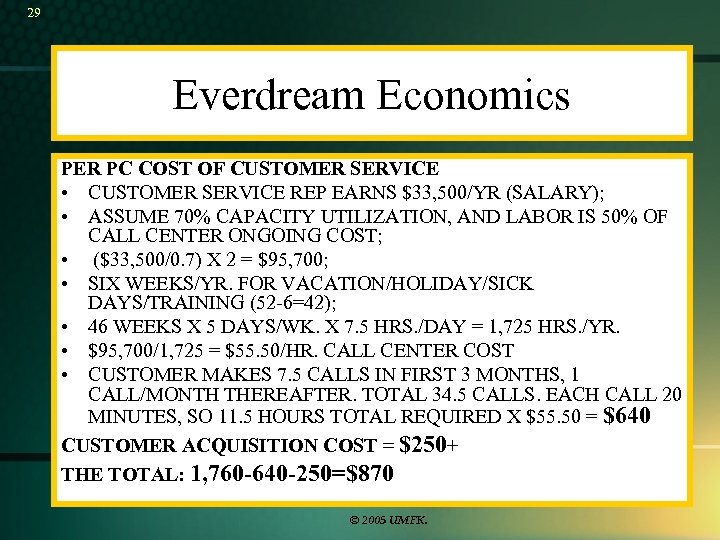
29 Everdream Economics PER PC COST OF CUSTOMER SERVICE • CUSTOMER SERVICE REP EARNS $33, 500/YR (SALARY); • ASSUME 70% CAPACITY UTILIZATION, AND LABOR IS 50% OF CALL CENTER ONGOING COST; • ($33, 500/0. 7) X 2 = $95, 700; • SIX WEEKS/YR. FOR VACATION/HOLIDAY/SICK DAYS/TRAINING (52 -6=42); • 46 WEEKS X 5 DAYS/WK. X 7. 5 HRS. /DAY = 1, 725 HRS. /YR. • $95, 700/1, 725 = $55. 50/HR. CALL CENTER COST • CUSTOMER MAKES 7. 5 CALLS IN FIRST 3 MONTHS, 1 CALL/MONTH THEREAFTER. TOTAL 34. 5 CALLS. EACH CALL 20 MINUTES, SO 11. 5 HOURS TOTAL REQUIRED X $55. 50 = $640 CUSTOMER ACQUISITION COST = $250+ THE TOTAL: 1, 760 -640 -250=$870 © 2005 UMFK.
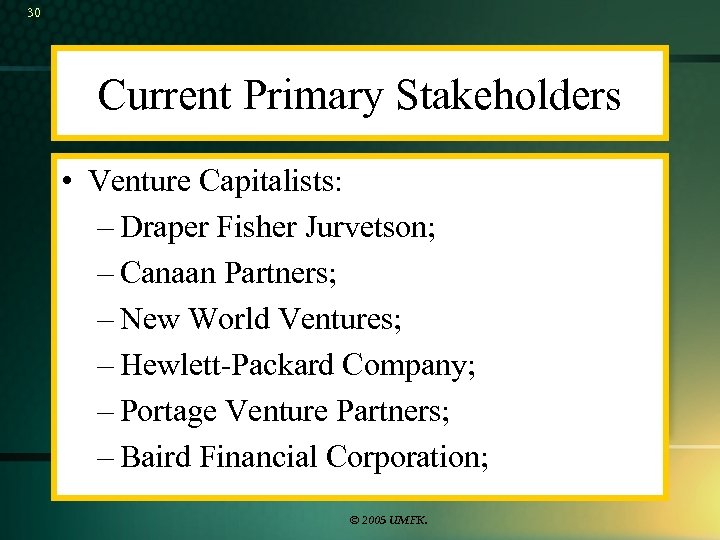
30 Current Primary Stakeholders • Venture Capitalists: – Draper Fisher Jurvetson; – Canaan Partners; – New World Ventures; – Hewlett-Packard Company; – Portage Venture Partners; – Baird Financial Corporation; © 2005 UMFK.
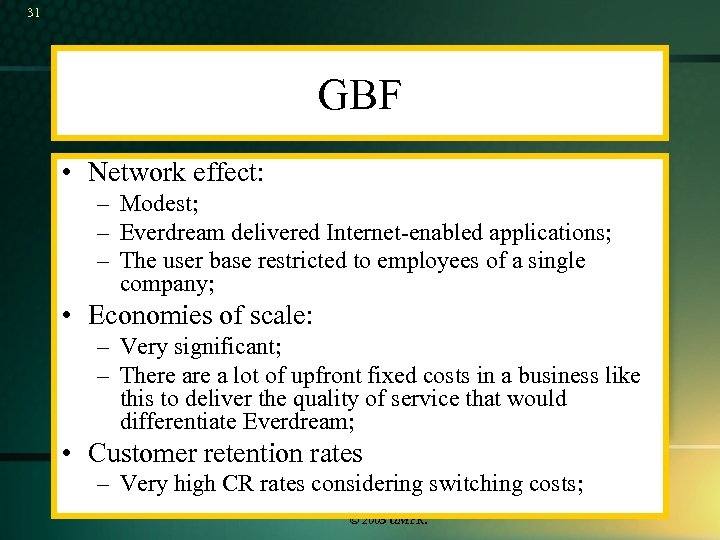
31 GBF • Network effect: – Modest; – Everdream delivered Internet-enabled applications; – The user base restricted to employees of a single company; • Economies of scale: – Very significant; – There a lot of upfront fixed costs in a business like this to deliver the quality of service that would differentiate Everdream; • Customer retention rates – Very high CR rates considering switching costs; © 2005 UMFK.
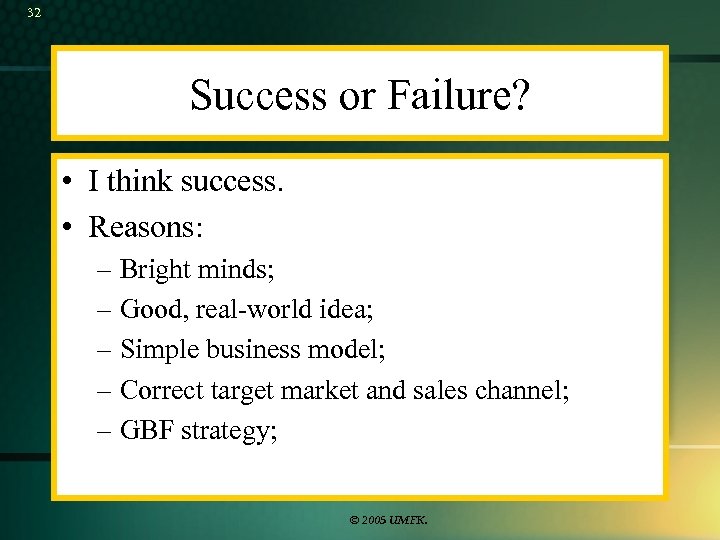
32 Success or Failure? • I think success. • Reasons: – Bright minds; – Good, real-world idea; – Simple business model; – Correct target market and sales channel; – GBF strategy; © 2005 UMFK.
33 Latest update • Everdream still exists. Overview from company’s website: – Founded in 1998, Everdream provides an integrated suite of web-hosted services to manage desktop and mobile computing devices for the medium-to-large enterprise; – Everdream’s proprietary technology platform integrates all manage enterprise computing functions, while providing a complete hosted IT service; – Everdream allows you to purchase software, hardware, and support for computing security and management as services; © 2005 UMFK.
34 Current Customers • • • Fed. Ex (automotive and transportation); Korean Air (automotive and transportation); Sylvan Learning Centers (education); Equity One (financial services); Premier (health care); © 2005 UMFK.
35 Questions? ? ? © 2005 UMFK.
Скачать презентацию 1 internet business models text and cases Everdream
3650c358cff4dd3c9fd8316a7e1ecd21.ppt