 Скачать презентацию 1 internet business models text and cases BMG
86e9c315dbe053c501a2e64c6236743f.ppt
- Количество слайдов: 24



1 internet business models text and cases BMG Entertainment Kristin Belanger © 2005 UMFK.
2 Development of a Global Music Industry © 2005 UMFK.

3 Overview • • • Introduction History Strategies Stakeholders Get Big Fast! 20 -20 Hindsight © 2005 UMFK.
4 Introduction • Music Industry – One of the fastest moving Industries • CEO – Strauss Zelnick (in 1998) • Brick and Mortar company gone Online • Two of the Six leading companies merged in the past year • Steered BMG towards online opportunities • Cautiously made strategic moves © 2005 UMFK.
5 Introduction cont. • Subsidiary of Bertelsmann AG (German company) • World 4 th largest media company (Billboard. com) • By 1999, $4. 6 billion music and entertainment company – More than 200 record labels and in over 53 countries (Billboard. com) • 1999 distributed 5 of the best selling albums • Cut money – losing divisions (apparel, video distribution) © 2005 UMFK.
6 Road Blocks • The ever changing Music Industry – Company able to keep up with changes – Predict upcoming problems • Five other competitive content providers © 2005 UMFK.
7 History of Music Industry • Sheet music to phonograph • Tin Pan Alley (NY, NY) • First popular song “After the ball” 1892 – then industry spiked • Numerous roadblocks – Broadcast radio – Sales dropped, radio’s soared – Depression (1920’s) Music Industry peaked – 1948 vinyl • Major compeditors RCA/Victor, EMI, and CBS Records © 2005 UMFK.
8 History (cont. ) • Rock and Roll – Hundreds of record companies • RCA/Victor and CBS were afraid of marketing to teenage market • 1960’s began merging multiple labels under one music corporation – Branding each into different genre’s of music • Industry decline between 1980’s and 1990’s • Music Industry mergers helped in the 1990’s © 2005 UMFK.
9 Music Industry Organization • Composers & Lyricists – People who wrote the music and words • Performing Artists – Performers of their own original songs or used some created by lyricists and composers • Music Publishers Bought rights to the pieces and promoted music through channels • Record Companies – Artists under contract, bought musical rights, managed recording, made CDs, distributed, promoted products • Independent Distributors – Distributed on behalf of independent labels and made crossregional mergers © 2005 UMFK.
10 Music Industry Organization (cont. ) • Retail Channels – Sold through brick & mortar, record clubs, mail order, online retailers • Consumers – Directed at individual consumers (by genre) • Promotion – Battled with radio stations to get new releases aired (equals more record sales) • Rights Agencies – Paid by royalties (payments tied to actual use of music) • Industry Economics – Divided profits among various players © 2005 UMFK.
11 Strategic Plans • Mergers in 1920’s helped in 1999 – BMG one of top 5 corporations • Manufacturing, distribution, music publishing, sales and marketing activities were centralized over the 200 labels • Labels responsible for individual promotion of artists • Launched first website in 1995 with many different website for different genre’s – Peeps. com for hip-hop (non – existent anymore) – Twang. This. com (country) © 2005 UMFK.
12 Strategic Plans cont. • Teamed up with Get. Music. com – comparable to CDnow. com or Amazon. com • Were first to experiment with downloads in 1997 • Had longer-term intentions © 2005 UMFK.
13 Strategic Partners • Microsoft, Liquid Audio, Real Networks, AT & T and IBM • Helped stream in audio clips, music video’s and more • All partners were needed to help set technological standards for downloading music • Had hundreds of files on potential deals © 2005 UMFK.
14 Don’t sell your copyrights or license them exclusively. Don’t make long-term deals that you can’t change. Once you’ve followed those rules, be willing to take risks and try things out. If God forbid you’re wrong, you still own your copyrights. -Strauss Zelnick © 2005 UMFK.
15 Competition • Universal Music Group – Still around today • Sony Music Entertainment – (merged with BMG – now called Sony BMG Music Entertainment) • Warner Music Group – Still around today • EMI – Still around today as well © 2005 UMFK.
16 Brands (Labels) • Some of the labels that were under BMG included: – – – Arista Ariola RCA BMG Records Red Seal Windham Hill Group • Had artists such as Christina Aguilera, DAVE MATTHEWS BAND, Grateful Dead, Kenny G, Barry Manilow, Notorious B. I. G. , Puff Daddy, Santana, Sarah Mc. Lachlan, Whitney Houston, ZZ Top © 2005 UMFK.
17 Serious Threats • Napster, Bear. Share, Limewire – All free* MP 3 download programs • Listen. com, Emusic. com, MP 3. com – Consumers sampled music for. 99 cents a song – downloaded an album for $8. 99 © 2005 UMFK.
18 Why Content Provider? • BMG Entertainment was clearly a Content Provider – Content included Artists, Songs, Lyrics, Downloads, Appearances, and much more. (Original Professional content) • Considered a horizontal content provider – Reached out to everyone – Reached out to people with different genre tastes (had a little something for everyone) © 2005 UMFK.
19 Stakeholders • Customers – Strategic Partners – Buying consumers • Employees – Employees of BMG – Shareholders (both employees of Bertelsmann AG and Sony) • Partnerships – Microsoft, Liquid Audio, Real Networks, etc. © 2005 UMFK.
20 Winner Takes All? • Customer Acquisition Costs – Low to moderate - people keep returning for the content (i. e. Music downloads, albums, information) • Network Effects – Strong the more people go to BMG music to see their favorite artists the more they can download songs & info • Scale Economies – Strong – the more people go to the webpage's the more people buy the more revenue they receive – The costs are fixed – ad companies add to scale economies (the more the exposure the more revenue) • Customer Retention – High – great discounts (get 12 free buy 3 CD’s) – Appearance information – Usernames – keep sending updates to customers e-mail accounts © 2005 UMFK.
21 Success? • I definitely think that BMG will be around for a long time. They have been through the music industry (fast moving industry) and have continued to release Top 10 Best Selling Albums © 2005 UMFK.
22 Update! • August 2004 Merger – Sony Corporation of America and Bertelsmann A. G. (Billboard, 9/24/2005, Vol. 117 Issue 39, p 5, 2 p) • Reason for merger – Music industry = global crisis (Billboard. com) – Costs risen and CDs fallen (Billboard. com) • Andrew Lack is CEO of Sony BMG Entertainment (previous jobs include President of NBC News, CBS News, West 57 th) (bmg. com) © 2005 UMFK.
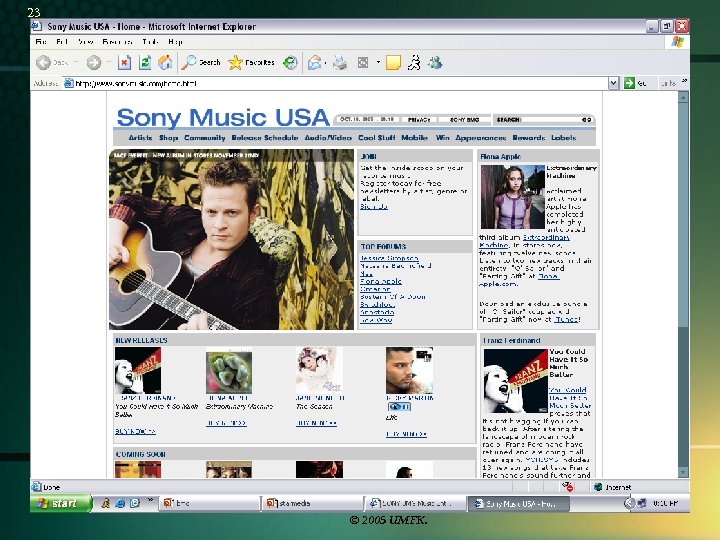
23 © 2005 UMFK.

24 Questions? ? © 2005 UMFK.
Скачать презентацию 1 internet business models text and cases BMG
86e9c315dbe053c501a2e64c6236743f.ppt