


 Скачать презентацию 1 IMS Architecture Past Present and Future
5854787bd371824b271b33c8d0115077.ppt
- Количество слайдов: 33
 1
1
 IMS Architecture: Past, Present and Future By Dhananjay Shukla and Vinay Rao Centillium Communications Inc.
 IMS Architecture: Past, Present and Future • Introduction – – – What is IMS? Convergence and IMS Drivers IMS Evolution IMS Origins Who is involved? ITU IMT-2000 Framework • 3 GPP – About 3 GPP – Standards Releases – IMS Reference Architecture • 3 GPP 2 3 – About 3 GPP 2 – Standards Releases – MMD Architecture
 IMS Architecture: Past, Present and Future • 3 GPP/3 GPP 2 – Differences – Harmonized Architecture • Evolution from Wireless to Wireline • NGN TISPAN – About TISPAN – Standards – Architecture 4
![What is IMS? • IP Multimedia Subsystem [IMS] is an architectural framework for delivering](https://present5.com/presentation/5854787bd371824b271b33c8d0115077/image-5.jpg "What is IMS? • IP Multimedia Subsystem [IMS] is an architectural framework for delivering") What is IMS? • IP Multimedia Subsystem [IMS] is an architectural framework for delivering IP multimedia services to end users. • IMS provides a network-independent, common service delivery environment for both wireless and fixed network users. • IMS standards define common signaling and media interfaces that are open, vendor independent, and abstract the underlying network complexities. 5
What is IMS? • IP Multimedia Subsystem [IMS] is an architectural framework for delivering IP multimedia services to end users. • IMS provides a network-independent, common service delivery environment for both wireless and fixed network users. • IMS standards define common signaling and media interfaces that are open, vendor independent, and abstract the underlying network complexities. 5
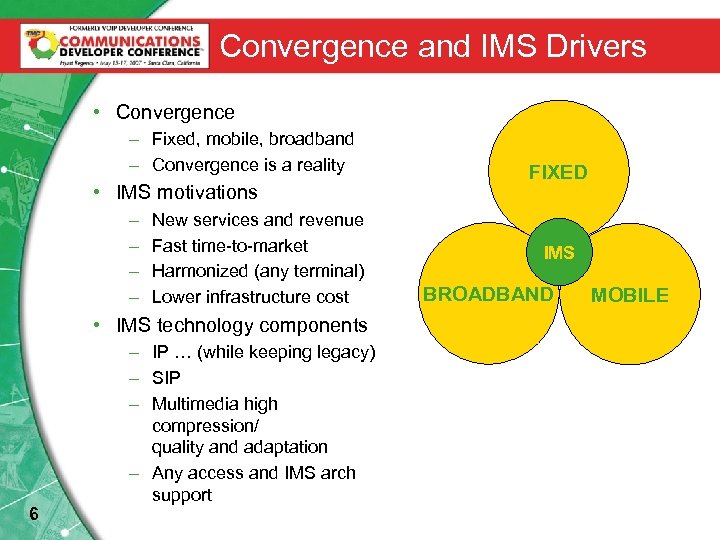 Convergence and IMS Drivers • Convergence – Fixed, mobile, broadband – Convergence is a reality • IMS motivations – – New services and revenue Fast time-to-market Harmonized (any terminal) Lower infrastructure cost • IMS technology components 6 – IP … (while keeping legacy) – SIP – Multimedia high compression/ quality and adaptation – Any access and IMS arch support FIXED IMS BROADBAND MOBILE
 IMS Evolution • IMS evolved from early packet data over mobile wireless architectures called 3 G. IP to provide internet services over mobile networks. • IMS was incorporated into 3 GPP standards efforts first appearing in Release 5. • IMS was incorporated into 3 GPP 2 standards efforts as part of Multimedia Domain [MMD]. • ETSI-TISPAN and ITU-T also incorporated IMS into their Next-Generation-Network [NGM] Wireline standards developments. • Other consortia such as OMA are involved in specifying IMS services. 7
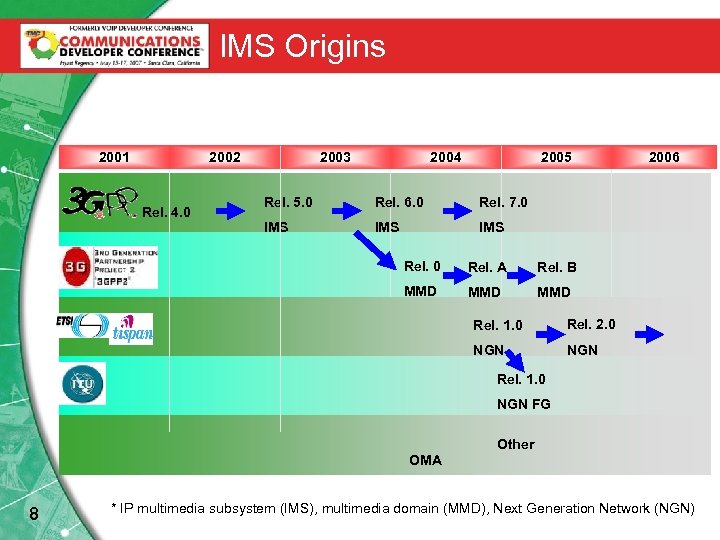 IMS Origins 2002 2001 Rel. 4. 0 2003 2004 2005 Rel. 5. 0 Rel. 6. 0 Rel. 7. 0 IMS 2006 IMS Rel. 0 Rel. A Rel. B MMD MMD Rel. 1. 0 Rel. 2. 0 NGN Rel. 1. 0 NGN FG Other OMA 8 * IP multimedia subsystem (IMS), multimedia domain (MMD), Next Generation Network (NGN)
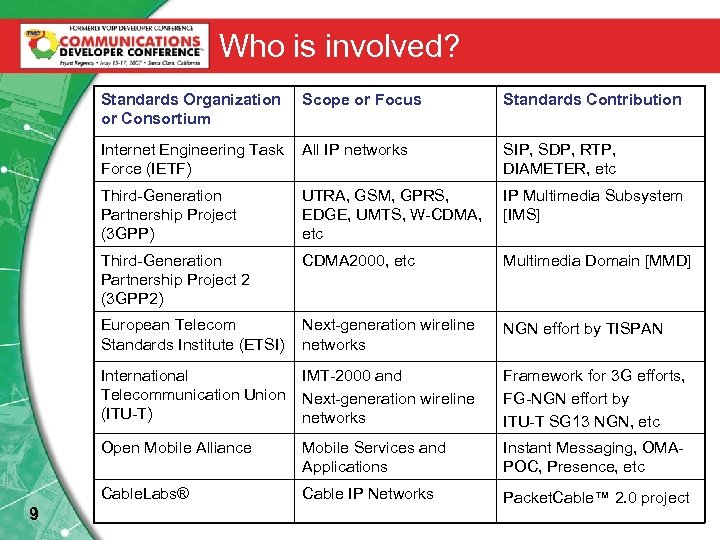 Who is involved? Standards Organization or Consortium Standards Contribution Internet Engineering Task Force (IETF) All IP networks SIP, SDP, RTP, DIAMETER, etc Third-Generation Partnership Project (3 GPP) UTRA, GSM, GPRS, EDGE, UMTS, W-CDMA, etc IP Multimedia Subsystem [IMS] Third-Generation Partnership Project 2 (3 GPP 2) CDMA 2000, etc Multimedia Domain [MMD] European Telecom Standards Institute (ETSI) Next-generation wireline networks NGN effort by TISPAN International Telecommunication Union (ITU-T) IMT-2000 and Next-generation wireline networks Framework for 3 G efforts, FG-NGN effort by ITU-T SG 13 NGN, etc Open Mobile Alliance Mobile Services and Applications Instant Messaging, OMAPOC, Presence, etc Cable. Labs® 9 Scope or Focus Cable IP Networks Packet. Cable™ 2. 0 project
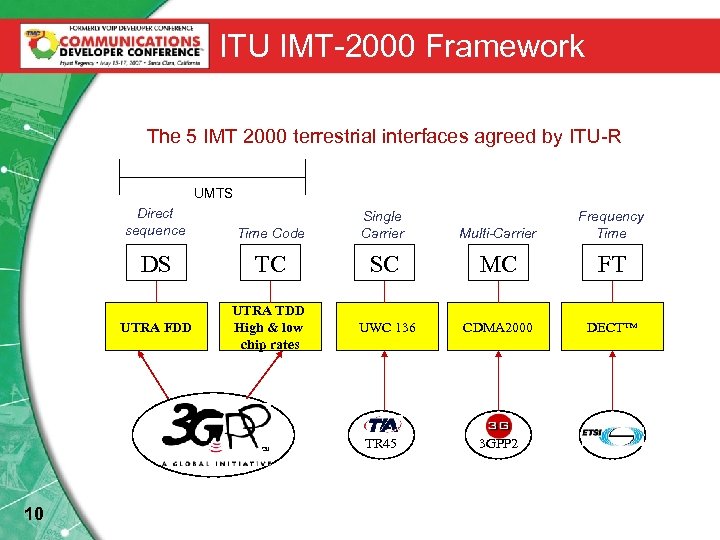 ITU IMT-2000 Framework The 5 IMT 2000 terrestrial interfaces agreed by ITU-R UMTS Direct sequence Time Code Single Carrier Multi-Carrier Frequency Time DS TC SC MC FT UTRA FDD UTRA TDD High & low chip rates UWC 136 CDMA 2000 DECT™ TR 45 10 3 GPP 2
 3 GPP: About 3 GPP • The 3 rd Generation Partnership Project (3 GPP) Collaboration agreement formalized in December 1998 by signing of “The 3 rd Generation Partnership Project Agreement”. – Collaboration agreement brings together as “Organizational Partners”, a number of telecommunications standards bodies from around the world, namely ETSI (Europe), ARIB/TTC (Japan), CCSA (China), ATIS (North America) and TTA (South Korea). • 3 GPP scope is to specify a global (3 G) mobile phone system under ITU's IMT-2000 framework. • 3 GPP specs are based on evolved GSM specs. • 3 GPP standardization encompasses Radio, Core Network and Service architectures. 11
 3 GPP: Standards Releases • Release '99 – functionally frozen December 1999. Defines UTRA and many other initial features • The basis for early 3 G deployment • Release 4 – functionally frozen March 2001. Enhancements to Release '99 plus separation of control plane from user plane in core network • First steps towards IP-based operation • Also defines the low chip rate TDD mode (TD-SCDMA) • Release 5 – functionally frozen March/June 2002. This release introduces: • IMS - IP-based Multimedia Services • HSDPA - High Speed Downlink Packet Access • Release 6 – functionality frozen September/ December 2004 • Includes 2 nd phase of IMS, High Speed Uplink, plus many other features designed to deliver the full 3 G experience • Release 7 – Stage 1: Dec 2005; Stage 2: 2 nd half 2006; Stage 3: mid-2007 • Enhanced uplink, other spectrum; multiple input multiple output antennas (MIMO), Advanced Global Navigation Satellite System concept, IMS emergency call handling, e-call, back-up algorithms (UEA 2 and UIA 2) 12
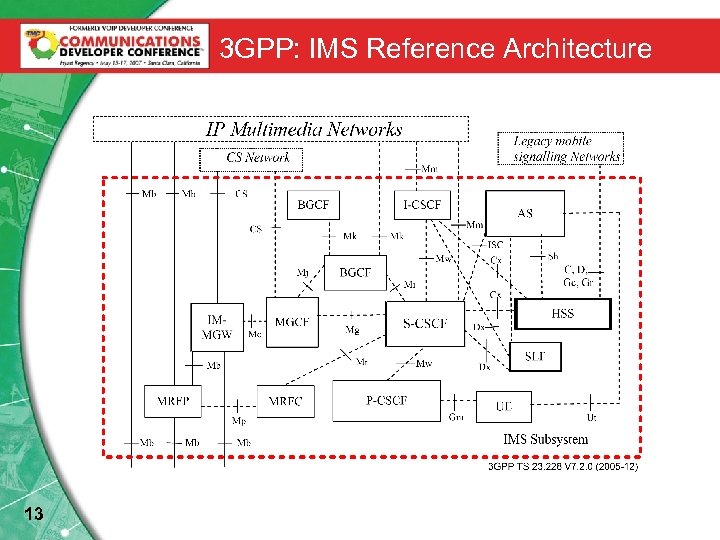 3 GPP: IMS Reference Architecture 13
 IMS Reference Architecture • IMS reference architecture is based on multi-standard and multiindustry architecture. • IMS reference architecture is being defined by all major wireless and wireline standards bodies including, 3 GPP 2, ETSITISPAN, IETF, Wi. MAX Forum, OAM and others. • IMS reference architecture unifies next-generation services across the user applications, user devices, access networks, and core network. • IMS provides an infrastructure for multimedia services such as telephony, video, multimedia messaging and games – for one-to -one or one-to-many multimedia communications. 14
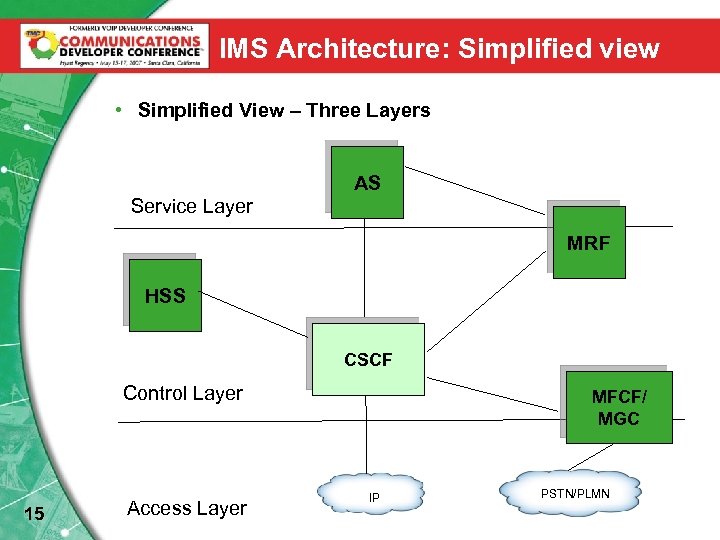 IMS Architecture: Simplified view • Simplified View – Three Layers Service Layer AS MRF HSS CSCF Control Layer 15 Access Layer MFCF/ MGC IP PSTN/PLMN
 IMS Architecture: Session Control Layer • Session Control Layer – consists of network control servers for managing calls, establishing sessions and making modifications. – two main elements: the call session control function (CSCF) and the home subscriber server (HSS). – the call session control function (CSCF) handles end-point registration and inspect/routing the SIP signaling messages to the application server. The CSCF is also responsible for interoperating with the access layers. – the home subscriber server (HSS) maintains the end user’s service profile. The service profile includes date such as registration information, roaming and end user’s preferences. 16
 IMS Architecture: Service Layer • Service/Application Layer – provides value-added services using application and content servers. – two main elements: the Application Server (AS) and the Media Resource Function (MRF). – the application server (AS) is responsible for call flows, database accesses and user interface interactions. – the MRF provides the media processing capability for the application layer. It has two componenets: media resource function controller (MRFC) and media resource function processor (MRFP). – the MRFC is a signaling plane node (SIP user agent to the S -CSCF) and the MRFP is a media plane node (provides all media-related functions). 17
 3 GPP 2: About 3 GPP 2 • The Third Generation Partnership Project 2 (3 GPP 2) is a collaboration of North American and Asian interests also under the framework of ITU’s IMT-2000. – Collaboration brings together as “Organizational Partners”, Five Standards Development Organizations, namely, ARIB (Japan); CCSA (China); TIA (North America); TTA (Korea) and TTC (Japan) with market representation by CDMA development group, IPv 6 forum, International 450 association. • 3 GPP 2 specs are based on evolving ANSI/TIA/EIA 41 specs commonly known as CDMA 2000 • Four Technical Specifications Groups 18 – – TSG-A (Access Network Interfaces) TSG-C (cdma 2000®) TSG-S (Services and Systems Aspects) TSG-X (Core Networks)
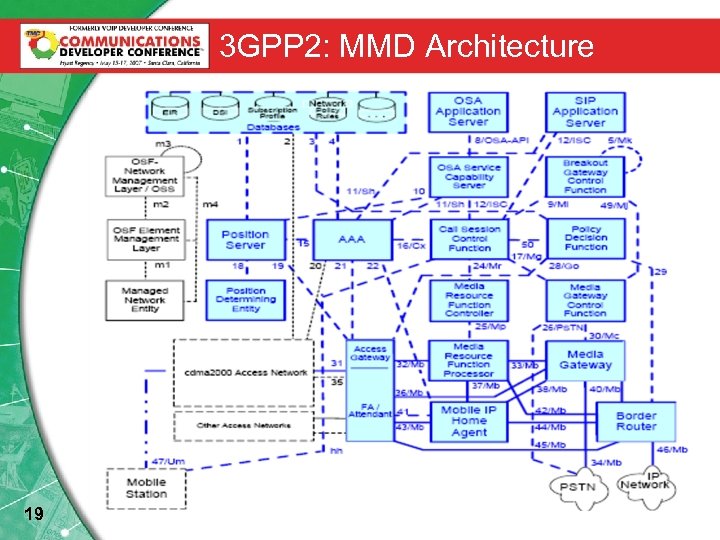 3 GPP 2: MMD Architecture 19
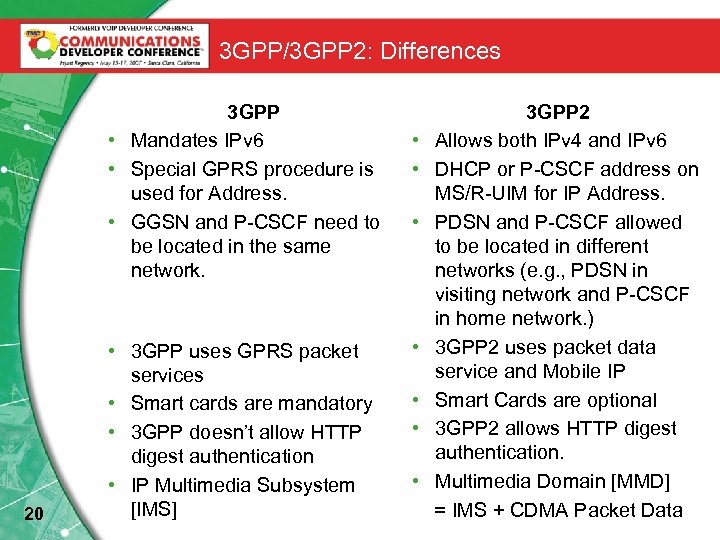 3 GPP/3 GPP 2: Differences 3 GPP • Mandates IPv 6 • Special GPRS procedure is used for Address. • GGSN and P-CSCF need to be located in the same network. 20 • 3 GPP uses GPRS packet services • Smart cards are mandatory • 3 GPP doesn’t allow HTTP digest authentication • IP Multimedia Subsystem [IMS] • • 3 GPP 2 Allows both IPv 4 and IPv 6 DHCP or P-CSCF address on MS/R-UIM for IP Address. PDSN and P-CSCF allowed to be located in different networks (e. g. , PDSN in visiting network and P-CSCF in home network. ) 3 GPP 2 uses packet data service and Mobile IP Smart Cards are optional 3 GPP 2 allows HTTP digest authentication. Multimedia Domain [MMD] = IMS + CDMA Packet Data
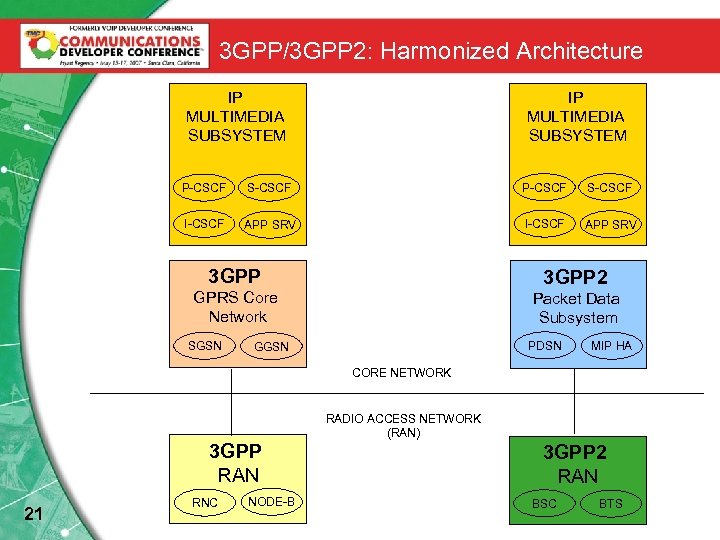 3 GPP/3 GPP 2: Harmonized Architecture IP MULTIMEDIA SUBSYSTEM P-CSCF S-CSCF I-CSCF APP SRV 3 GPP 2 GPRS Core Network Packet Data Subsystem SGSN PDSN GGSN MIP HA CORE NETWORK 3 GPP RAN 21 RNC NODE-B RADIO ACCESS NETWORK (RAN) 3 GPP 2 RAN BSC BTS
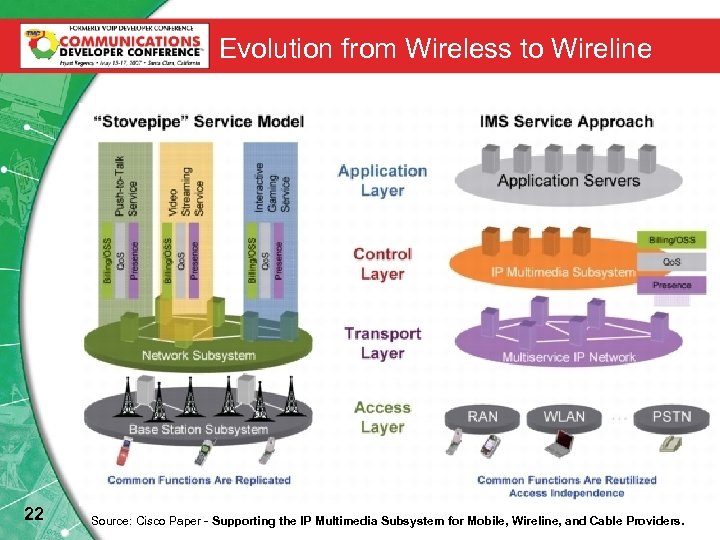 Evolution from Wireless to Wireline 22 Source: Cisco Paper - Supporting the IP Multimedia Subsystem for Mobile, Wireline, and Cable Providers.
 TISPAN: About TISPAN • Telecoms and Internet converged Services and Protocols for Advanced Networks [TISPAN] • ETSI core competence centre for fixed networks and for migration from switched circuit networks to packet-based networks with an architecture that can serve in both. • Responsible for all aspects of standardisation for present and future converged networks including the NGN (Next Generation Network) and including, service aspects, architectural aspects, protocol aspects, Qo. S studies, security related studies, mobility aspects within fixed networks, using existing and emerging technologies. 23
 TISPAN: 3 GPP Collaboration • Building upon the work already done by 3 GPP in creating the SIP-based IMS (IP Multimedia Subsystem), TISPAN and 3 GPP are now working together to define a harmonized IMS-centric core for both wireless and wireline networks. • This harmonized “All IP” network has the potential to provide a completely new telecom business model for both fixed and mobile network operators. • Access independent IMS will be a key enabler for fixed/mobile convergence, reducing network installation and maintenance costs, and allowing new services to be rapidly developed and deployed to satisfy new market demands. 24
 TISPAN: NGN Standards • NGN Release 1 was launched by TISPAN in December 2005, providing the robust and open standards that industry can use as a reliable basis for the development and implementation of the first generation of NGN systems. – Terminology, Strategy, Qo. S, Security, NNA & Identification, ENUM – Requirements, General architecture, Early services and protocols – Detailed architecture, Base services/protocols, 3 GPP endorsements – Operations Support Systems, Congestion control, NGN user data, PSTN/ISDN emulation • TISPAN is now working on NGN Release 2 (due sometime this year), with a focus on enhanced mobility, new services and content delivery with improved security and network management. 25 – Content delivery: Streaming, IP-TV, Vo. D – Optimized resource usage – Corporate users specific requirements
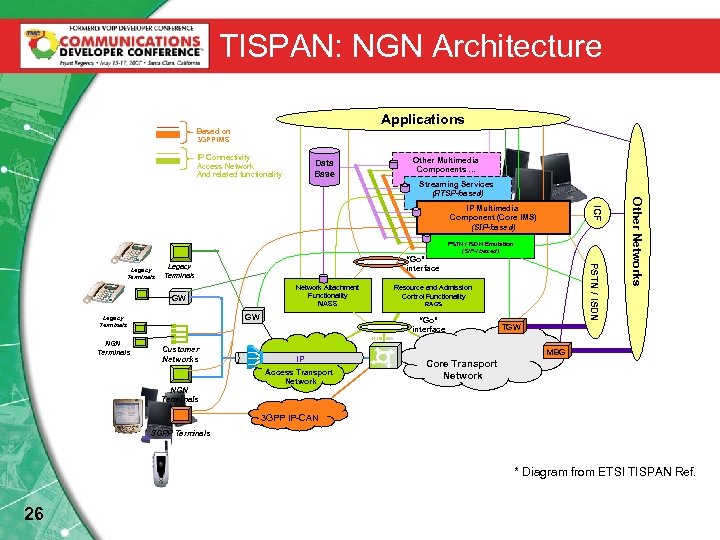 TISPAN: NGN Architecture Applications Based on 3 GPP IMS IP Connectivity Access Network And related functionality Data Base Other Multimedia Components … ICF IP Multimedia Component (Core IMS) (SIP-based) PSTN / ISDN Emulation (SIP-I based) “Go” interface Legacy Terminals Network Attachment Functionality NASS GW GW Legacy Terminals NGN Terminals Customer Networks NGN Terminals Resource and Admission Control Functionality RACS “Go” interface IP Access Transport Network PSTN / ISDN Legacy Terminals Other Networks Streaming Services (RTSP-based) TGW MBG Core Transport Network 3 GPP IP-CAN 3 GPP Terminals * Diagram from ETSI TISPAN Ref. 26
 TISPAN: New 3 G-NGN MGW Function v. TISPAN NGN functional architecture Rel. 1. • Media Gateway Function (MGF)* – The residential MGF (R-MGF) is located on customer premises. – The access MGF (A-MGF) resides on the network operator’s premises (IP access network or core network). – The trunking MGF (T-MGF)** resides in the boundary between an IP core network and the PSTN/ISDN. * From Rel 1. Doc ** Same as IMS-MGW in 3 GPP 27
 TISPAN: New 3 G-NGN MRFP Function v. TISPAN NGN functional architecture Rel. 1. • Media Resource Function Processor (MRFP) – Specialized resource processing functions beyond those available in media gateway functions – Multimedia conferences – Multimedia announcements – IVR capabilities – Media content analysis 28
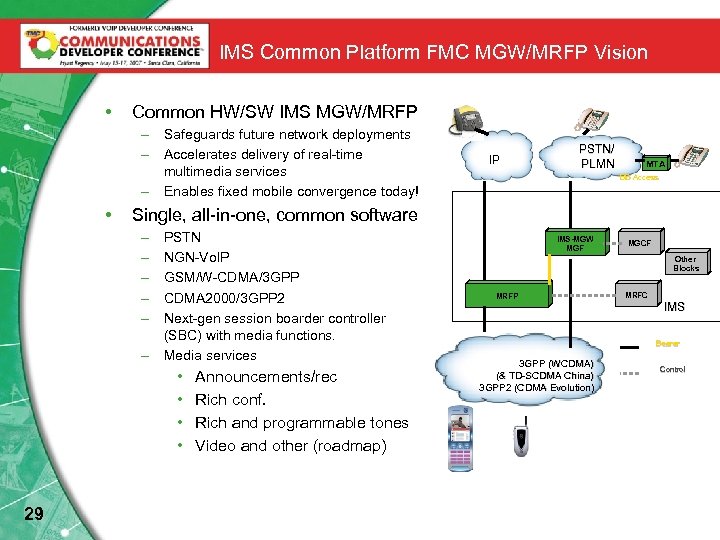 IMS Common Platform FMC MGW/MRFP Vision • Common HW/SW IMS MGW/MRFP – Safeguards future network deployments – Accelerates delivery of real-time multimedia services – Enables fixed mobile convergence today! • PSTN/ PLMN MTA BB Access Single, all-in-one, common software – – – PSTN NGN-Vo. IP GSM/W-CDMA/3 GPP CDMA 2000/3 GPP 2 Next-gen session boarder controller (SBC) with media functions. Media services • • 29 IP Announcements/rec Rich conf. Rich and programmable tones Video and other (roadmap) IMS-MGW MGF MGCF Other Blocks MRFP MRFC IMS Bearer 3 GPP (WCDMA) (& TD-SCDMA China) 3 GPP 2 (CDMA Evolution) Control
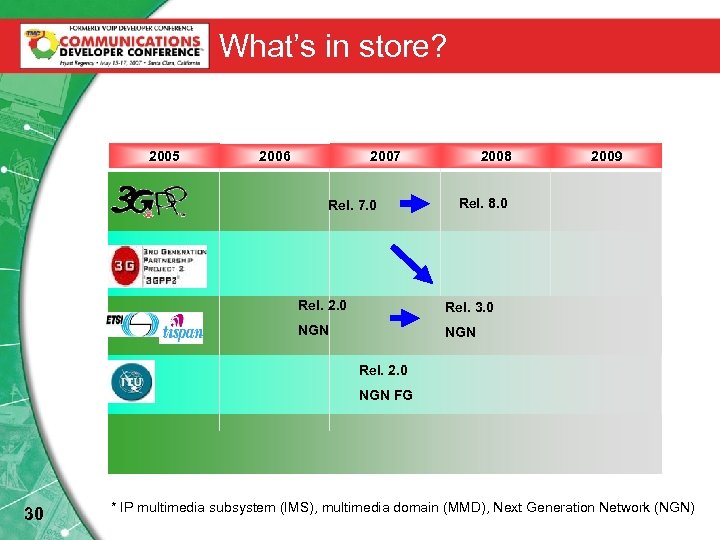 What’s in store? 2005 2007 2006 Rel. 7. 0 2008 2009 Rel. 8. 0 Rel. 2. 0 Rel. 3. 0 NGN Rel. 2. 0 NGN FG 30 * IP multimedia subsystem (IMS), multimedia domain (MMD), Next Generation Network (NGN)
 Standard updates in the works -1 • 3 GPP – Rel 7. 0 Stage 3 Mid-2007 • IMS Emergency Call handling, e. Call, Backup algorithms, etc. – Rel. 8. 0 • Security related updates: Multimedia Priority Service, Voice Group Call Service [VGCS] enhancements for public safety and public warning, • Emergency Calling Data transfer, etc; • IMS updates for Packet Cable, • 3 GPP 2 – IMS Bridge – IMS/MMD Superstructure 31
 Standard updates in the works -2 • ETSI – TISPAN NGN Release 3. 0 based on 3 GPP Rel. 7. 0 – – Inter-network domain nomadicity User-controlled roaming Higher bandwidth access Fully nomadic (Wi. MAX, VDSL. . ) • ITU NGN FG Release 2. 0 32
 Glossary of Terms 33 • • • CSCF = Call Session Control Function P-CSCF = Proxy Call Session Control Function I-CSCF = Interrogating Call Session Control Function S-CSCF = Serving Call Session Control Function GPRS = General Packet Radio Service GGSN = Gateway GPRS Support Node SGSN = Serving GPRS Support Node PDSN = Packet Data Serving Node MIP HA = Mobile IP Home Agent RNC = Radio Network Controller BTS = Base Transceiver Subsystem BSC = Base Station Controller