


 Скачать презентацию 1 How to use this module Introduction 1
8aa1e90d35e8d0ab5ddef329bab41cdc.ppt
- Количество слайдов: 36
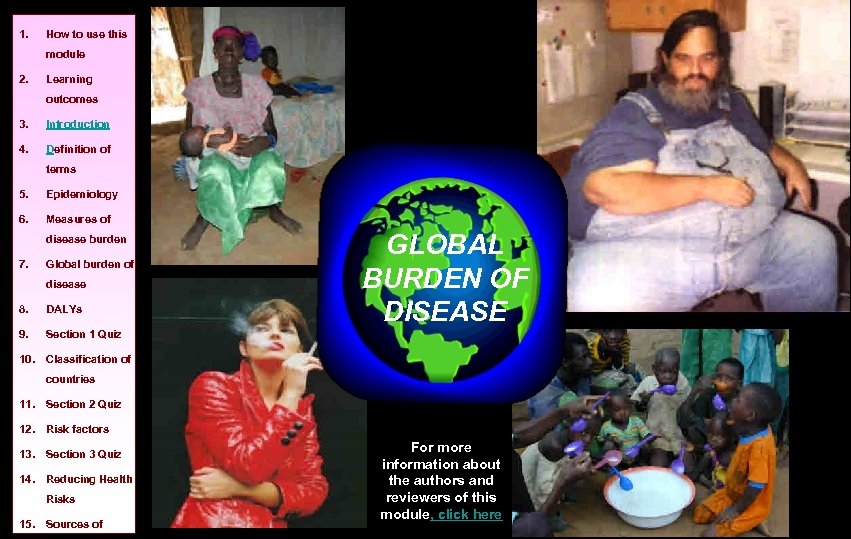 1. How to use this module Introduction 1 2. Learning Partners in Global Health Education outcomes 3. Introduction 4. Definition of terms 5. Epidemiology 6. Measures of disease burden 7. Global burden of disease 8. DALYs 9. GLOBAL BURDEN OF DISEASE Section 1 Quiz 10. Classification of countries 11. Section 2 Quiz 12. Risk factors 13. Section 3 Quiz 14. Reducing Health Risks 15. Sources of For more information about the authors and reviewers of this module, click here
 1. How to use this module 2. Learning outcomes 3. Introduction 4. Definition of terms 5. Epidemiology 6. Measures of disease burden 7. Global burden of disease 8. DALYs 9. Section 1 Quiz 10. Classification of countries 11. Section 2 Quiz 12. Risk factors 13. Section 3 Quiz 14. Reducing Health Risks 15. Sources of How to use this module Partners in Global Health Education • This self-directed learning (SDL) module has been designed for medical and other health care students • We suggest that you start with the learning outcomes and try to keep these in mind as you go through the module slide by slide and at your own pace. • Print-out the GBD SDL answer sheet. Write your answers to the questions as best you can before looking at the answers. • Repeat the module until you have achieved a mark of > 19/23 (>80%). • You should research any issues that you are unsure about. Look in your textbooks, access the on-line resources indicated at the end of the module and discuss with your peers and teachers. • Finally, enjoy your learning! We hope that this module will be complement your learning about Global Burden of Disease from other sources.
 n t r o d u c t i o n 1 1. How to use this module 2. Learning Outcomes Partners in Global Health Education outcomes 3. Introduction 4. Definition of By the end of this module, you should be able to : terms 5. Epidemiology 6. Measures of disease burden 7. Global burden of 1. Describe how disease burden is measured, including: • the definitions of 4 standardised mortality rates and their limitations • how DALYs attempt to capture overall disease burden disease 8. DALYs 9. 2. Discuss the rationale behind the Global Burden of Disease project Section 1 Quiz 10. Classification of countries 11. Section 2 Quiz 3. Identify in the different world regions: • the leading diseases • the leading risks to health 12. Risk factors 13. Section 3 Quiz 14. Reducing Health Risks 15. Sources of 4. Describe the concept of disease transition
 1. How to use this module 2. Learning Introduction Partners in Global Health Education outcomes 3. Introduction 4. Definition of terms 5. Epidemiology 6. Measures of disease burden 7. Global burden of disease 8. DALYs 9. Section 1 Quiz This module is concerned with taking an overview of disease or ill health in the world today. But how can we measure disease at the global level? 10. Classification of countries 11. Section 2 Quiz 12. Risk factors 13. Section 3 Quiz 14. Reducing Health Risks 15. Sources of The obvious and traditional approach is to measure overall mortality in different countries. The next slide shows some of the important, standardised mortality rates that are universally accepted and have specific definitions.
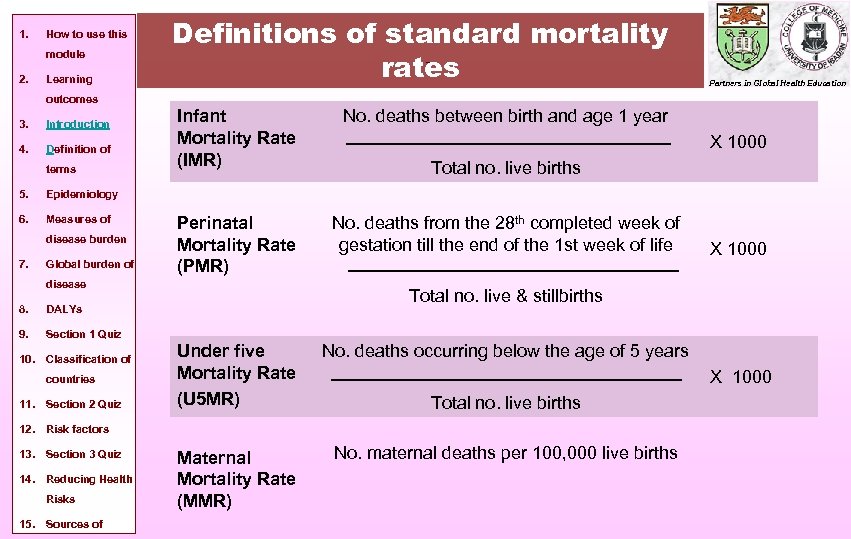 1. How to use this module Definitions of standard mortality rates Introduction 1 2. Learning Partners in Global Health Education outcomes 3. Introduction 4. Definition of terms 5. Measures of No. deaths between birth and age 1 year Perinatal Mortality Rate (PMR) No. deaths from the 28 th completed week of gestation till the end of the 1 st week of life X 1000 Total no. live births Epidemiology 6. Infant Mortality Rate (IMR) disease burden 7. Global burden of disease 8. Total no. live & stillbirths DALYs 9. X 1000 Section 1 Quiz 10. Classification of countries 11. Section 2 Quiz Under five Mortality Rate (U 5 MR) No. deaths occurring below the age of 5 years Maternal Mortality Rate (MMR) No. maternal deaths per 100, 000 live births X 1000 Total no. live births 12. Risk factors 13. Section 3 Quiz 14. Reducing Health Risks 15. Sources of
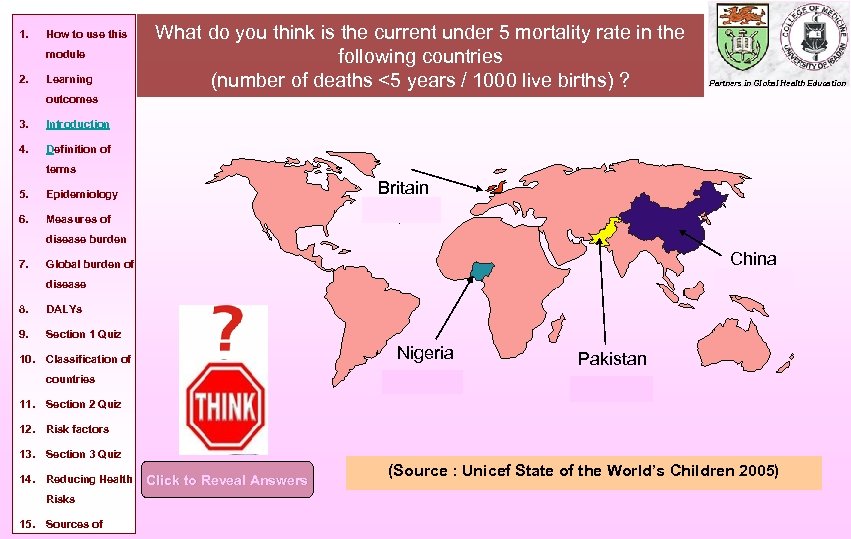 1. How to use this module 2. Learning What do you think is the current under 5 mortality rate in the following countries (number of deaths <5 years / 1000 live births) ? Partners in Global Health Education outcomes 3. Introduction 4. Definition of terms 5. 6. Britain 6/1, 000 Epidemiology Measures of disease burden 7. China 37/1, 000 Global burden of disease 8. DALYs 9. Section 1 Quiz Nigeria 10. Classification of 198/1, 000 countries 11. Section 2 Quiz Pakistan 103/1, 000 12. Risk factors 13. Section 3 Quiz 14. Reducing Health Risks 15. Sources of Click to Reveal Answers (Source : Unicef State of the World’s Children 2005)
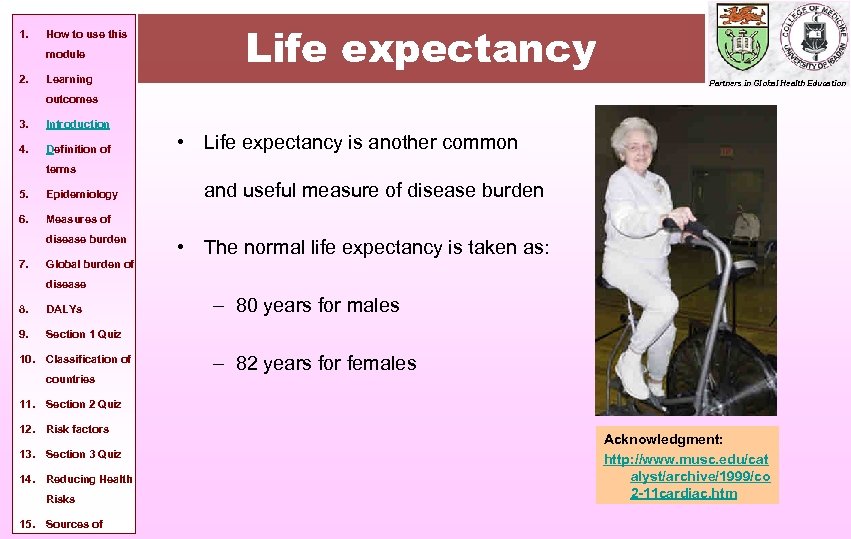 1. How to use this module 2. Learning Life expectancy Partners in Global Health Education outcomes 3. Introduction 4. Definition of • Life expectancy is another common terms 5. Epidemiology 6. and useful measure of disease burden Measures of disease burden 7. Global burden of • The normal life expectancy is taken as: disease 8. DALYs 9. – 80 years for males Section 1 Quiz 10. Classification of countries – 82 years for females 11. Section 2 Quiz 12. Risk factors 13. Section 3 Quiz 14. Reducing Health Risks 15. Sources of Acknowledgment: http: //www. musc. edu/cat alyst/archive/1999/co 2 -11 cardiac. htm
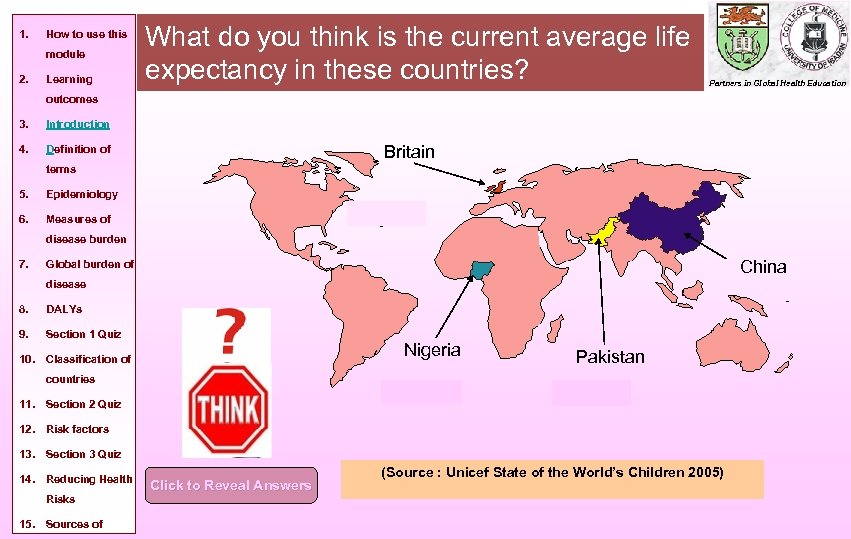 1. How to use this module 2. Learning What do you think is the current average life expectancy in these countries? Partners in Global Health Education outcomes 3. Introduction 4. Definition of Britain terms 5. Epidemiology 6. Measures of 78 years disease burden 7. China 71 years Global burden of disease 8. DALYs 9. Section 1 Quiz Nigeria 10. Classification of countries 51 years 11. Section 2 Quiz Pakistan 61 years 12. Risk factors 13. Section 3 Quiz 14. Reducing Health Risks 15. Sources of Click to Reveal Answers (Source : Unicef State of the World’s Children 2005)
 1. How to use this module 2. Learning Do we need other estimates of disease burden? Partners in Global Health Education outcomes 3. Introduction 4. Definition of terms 5. Epidemiology 6. Measures of disease burden 7. Global burden of disease 8. DALYs 9. Section 1 Quiz 10. Classification of countries 11. Section 2 Quiz 12. Risk factors 13. Section 3 Quiz 14. Reducing Health Risks 15. Sources of • Both mortality rates and life expectancy are useful – but do not tell us anything about disease burden in people living with diseases • This can best be captured by trying to assess quality of life • Another option to express disease burden is in terms of loss of productivity • This is the background to the Global Burden of Disease (GBD) project: attempting to estimate the total burden due to diseases A man with polio begging for money
 1. How to use this module What is the GBD (1)? Introduction 1 2. Learning Partners in Global Health Education outcomes 3. Introduction 4. Definition of terms 5. Epidemiology 6. Measures of disease burden 7. Global burden of disease 8. DALYs 9. There are some 6 billion people in the world, and hundreds of millions experience disease or injury each year. Taken as a whole, the combined pain, suffering, loss of productivity and unrealised hopes and dreams are our world’s burden of disease ! Section 1 Quiz 10. Classification of countries 11. Section 2 Quiz In other words, the burden of disease is a measurement of the gap between the current health of a population and an ideal scenario where everyone completes their full life expectancy in full health. 12. Risk factors 13. Section 3 Quiz 14. Reducing Health Risks 15. Sources of The Global Burden of Disease project attempts to measure this total disease burden.
 n t r o d u c t i o n 1 1. How to use this module 2. Learning What is the GBD (2) ? Partners in Global Health Education outcomes 3. Introduction 4. Definition of terms 5. Epidemiology 6. Measures of disease burden 7. Global burden of disease 8. DALYs 9. Section 1 Quiz 10. Classification of countries • The GBD study is a collaboration between the WHO, the World Bank and the Harvard School of Public Health. • GBD is a measure of the amount of disease, disability, and death in the world today. It is a product of complex and interwoven demographic, economic, social, political, religious and environmental factors. It refers to the collective impact of disease on the world population. • Disease burden can be attributed to either specific diseases (e. g. HIV, TB, obesity, diabetes) and also risks for ill health (unsafe sex, overcrowding, smoking, excess cholesterol). Therefore, the measurement of GBD allows us to address preventable diseases in each region of the world - how much of risks to health could be avoided in future years. 11. Section 2 Quiz 12. Risk factors 13. Section 3 Quiz 14. Reducing Health Risks 15. Sources of • An important development of this project was a single indicator of total disease burden – the DALY.
 n t r o d u c t i o n 1 1. How to use this module 2. Learning Disability-Adjusted Life Years (DALYs) Partners in Global Health Education outcomes 3. Introduction 4. DALY= YLL + YLD Definition of terms 5. Epidemiology 6. Years of Lost Life (due to premature mortality) Years Lost to Disability (due to injury or illness) Measures of disease burden 7. Global burden of disease 8. DALYs 9. Section 1 Quiz 10. Classification of countries 11. Section 2 Quiz 12. Risk factors 13. Section 3 Quiz 14. Reducing Health Risks 15. Sources of The DALY is the internationally-accepted measure of death and disability and is increasingly cited as a powerful tool for decision makers in international health. It is the sum of the number of years lost to premature mortality and the number of productive years lost to disability. One DALY is equivalent to one lost year of healthy life. Calculation of DALYs is based on the assumption that everyone in the world has a right to the best life expectancy in the world. The only differences in the rating of a death or disability should be due to age and sex and not to income, culture, location or social class. It’s attractiveness lies in the fact that it combines information about mortality and morbidity in a single number. DALY allows the losses due to disability and the losses due to premature death to be expressed in the same unit. Hence, DALYs facilitate comparisons of different health states or health outcomes.
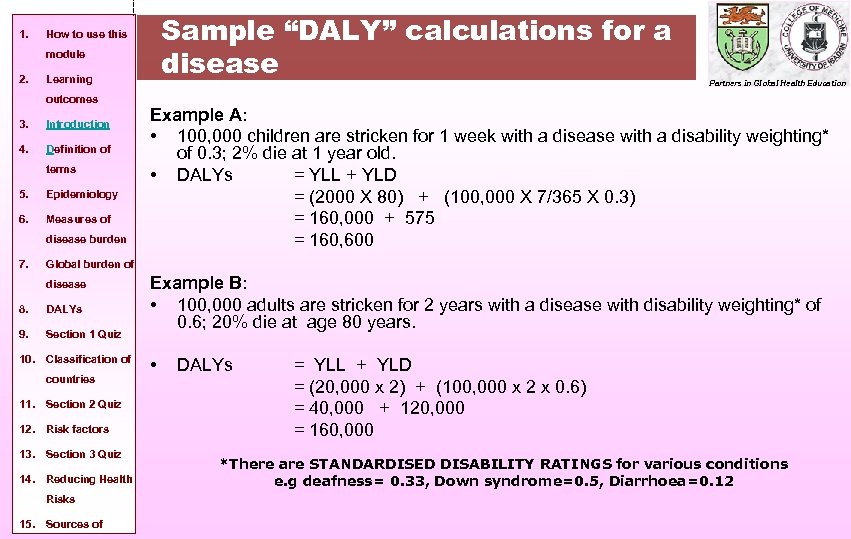 n t r o d u c t i o n 1 1. How to use this module 2. Learning outcomes 3. Introduction 4. Definition of terms 5. Epidemiology 6. Measures of disease burden 7. Sample “DALY” calculations for a disease Partners in Global Health Education Example A: • 100, 000 children are stricken for 1 week with a disease with a disability weighting* of 0. 3; 2% die at 1 year old. • DALYs = YLL + YLD = (2000 X 80) + (100, 000 X 7/365 X 0. 3) = 160, 000 + 575 = 160, 600 Global burden of disease 8. DALYs 9. Section 1 Quiz 10. Classification of countries 11. Section 2 Quiz 12. Risk factors 13. Section 3 Quiz 14. Reducing Health Risks 15. Sources of Example B: • 100, 000 adults are stricken for 2 years with a disease with disability weighting* of 0. 6; 20% die at age 80 years. • DALYs = YLL + YLD = (20, 000 x 2) + (100, 000 x 2 x 0. 6) = 40, 000 + 120, 000 = 160, 000 *There are STANDARDISED DISABILITY RATINGS for various conditions e. g deafness= 0. 33, Down syndrome=0. 5, Diarrhoea=0. 12
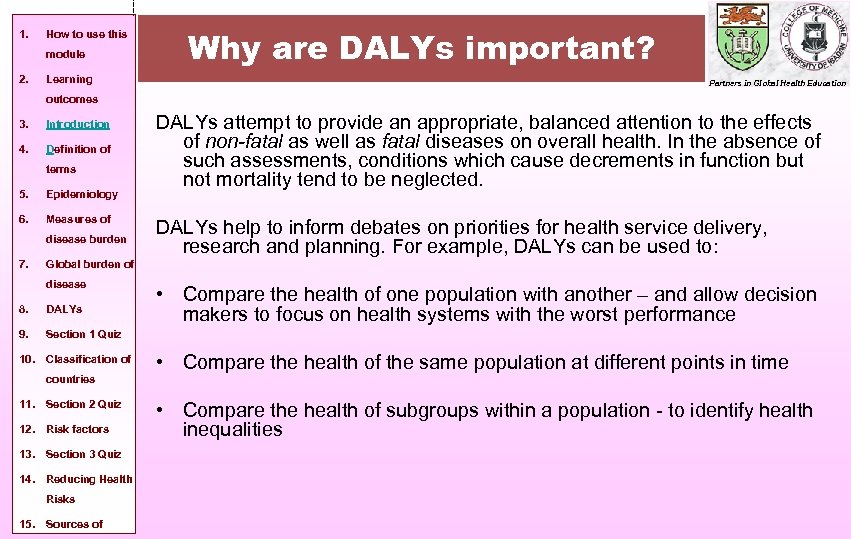 n t r o d u c t i o n 1 1. How to use this module 2. Learning Why are DALYs important? Partners in Global Health Education outcomes 3. Introduction 4. Definition of terms 5. Epidemiology 6. Measures of disease burden 7. DALYs attempt to provide an appropriate, balanced attention to the effects of non-fatal as well as fatal diseases on overall health. In the absence of such assessments, conditions which cause decrements in function but not mortality tend to be neglected. DALYs help to inform debates on priorities for health service delivery, research and planning. For example, DALYs can be used to: Global burden of disease 8. DALYs 9. • Compare the health of one population with another – and allow decision makers to focus on health systems with the worst performance Section 1 Quiz 10. Classification of countries 11. Section 2 Quiz 12. Risk factors 13. Section 3 Quiz 14. Reducing Health Risks 15. Sources of • Compare the health of the same population at different points in time • Compare the health of subgroups within a population - to identify health inequalities
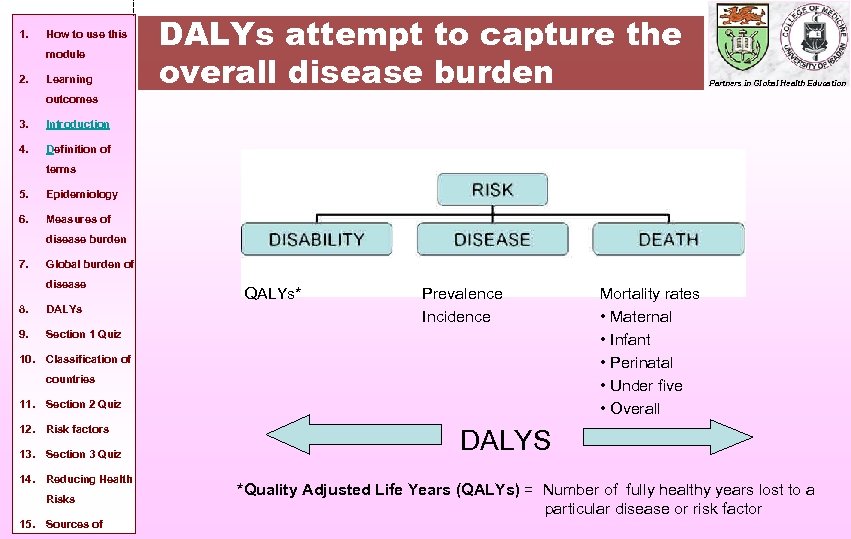 n t r o d u c t i o n 1 1. How to use this module 2. Learning outcomes 3. Definition of Partners in Global Health Education Introduction 4. DALYs attempt to capture the overall disease burden terms 5. Epidemiology 6. Measures of disease burden 7. Global burden of disease 8. DALYs 9. QALYs* Prevalence Incidence Section 1 Quiz 10. Classification of countries 11. Section 2 Quiz 12. Risk factors 13. Section 3 Quiz 14. Reducing Health Risks 15. Sources of Mortality rates • Maternal • Infant • Perinatal • Under five • Overall DALYS *Quality Adjusted Life Years (QALYs) = Number of fully healthy years lost to a particular disease or risk factor
 1. How to use this module 2. Learning End of Section 1 Partners in Global Health Education outcomes 3. Introduction 4. Definition of terms 5. Epidemiology 6. Well done! You have come to the end of the first section. Measures of disease burden 7. Global burden of disease 8. DALYs 9. Section 1 Quiz 10. Classification of countries 11. Section 2 Quiz 12. Risk factors 13. Section 3 Quiz 14. Reducing Health Risks 15. Sources of We suggest that you answer Questions 1 and then 2 to assess your learning so far. Please remember to write your answers on the mark sheet before looking at the correct answers!
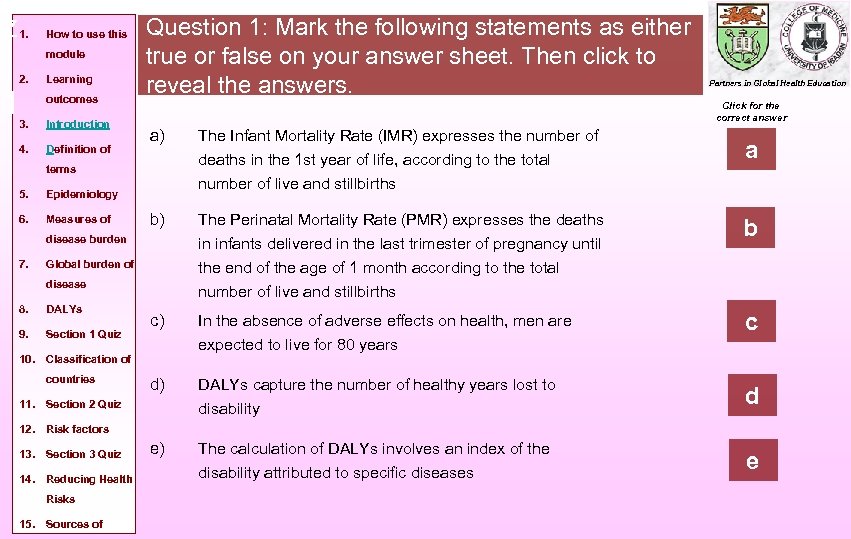 z 1 1. 2. How to use this module Learning outcomes 3. Introduction 4. Definition of Question 1: Mark the following statements as either true or false on your answer sheet. Then click to reveal the answers. Click for the correct answer a) terms 5. Measures of The Perinatal Mortality Rate (PMR) expresses the deaths in infants delivered in the last trimester of pregnancy until the end of the age of 1 month according to the total number of live and stillbirths b c) In the absence of adverse effects on health, men are expected to live for 80 years c d) DALYs capture the number of healthy years lost to disability d e) The calculation of DALYs involves an index of the disability attributed to specific diseases e Global burden of disease 8. DALYs 9. Section 1 Quiz 10. Classification of countries a b) disease burden 7. The Infant Mortality Rate (IMR) expresses the number of deaths in the 1 st year of life, according to the total number of live and stillbirths Epidemiology 6. Partners in Global Health Education 11. Section 2 Quiz 12. Risk factors 13. Section 3 Quiz 14. Reducing Health Risks 15. Sources of
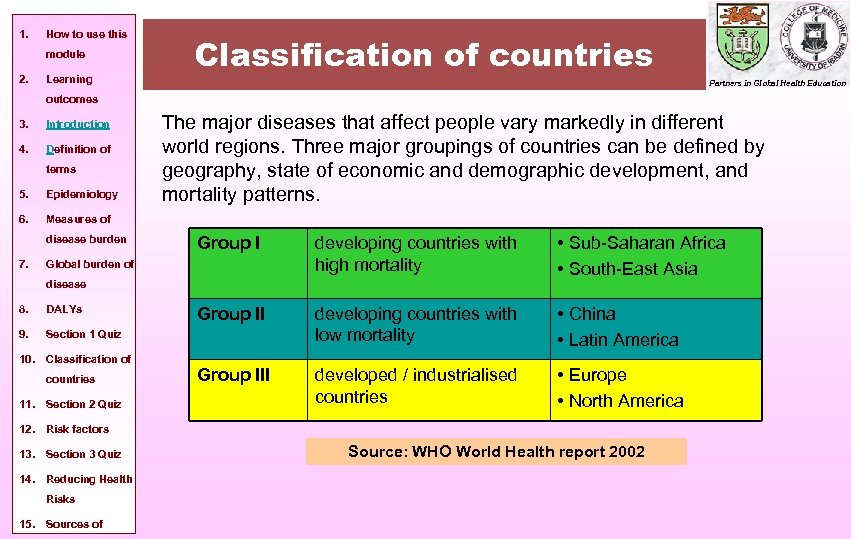 1. How to use this module 2. Learning Classification of countries Partners in Global Health Education outcomes 3. Introduction 4. Definition of terms 5. Epidemiology 6. The major diseases that affect people vary markedly in different world regions. Three major groupings of countries can be defined by geography, state of economic and demographic development, and mortality patterns. Measures of disease burden 7. Group I developing countries with high mortality • Sub-Saharan Africa • South-East Asia Group II developing countries with low mortality • China • Latin America Group III developed / industrialised countries • Europe • North America Global burden of disease 8. DALYs 9. Section 1 Quiz 10. Classification of countries 11. Section 2 Quiz 12. Risk factors 13. Section 3 Quiz 14. Reducing Health Risks 15. Sources of Source: WHO World Health report 2002
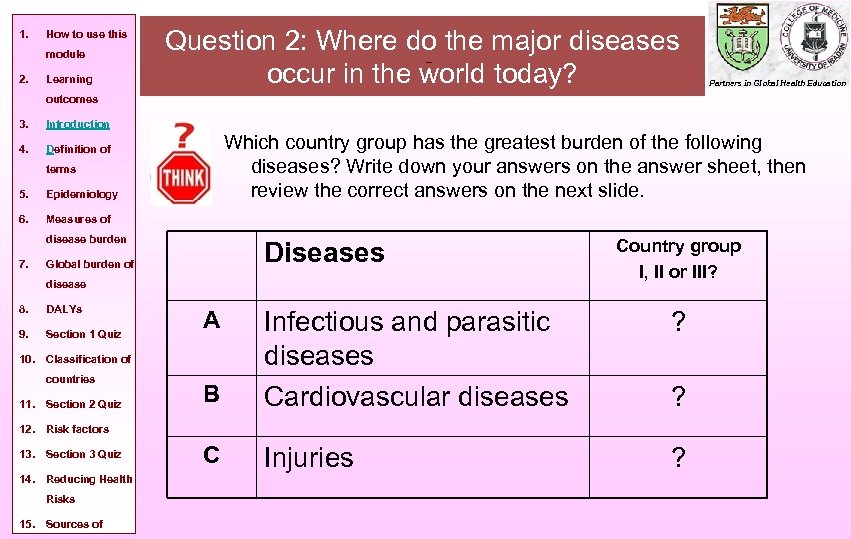 1. How to use this module Question 2: Where do the major diseases occur in the world today? Introduction 1 2. Learning Partners in Global Health Education outcomes 3. Introduction 4. Definition of Which country group has the greatest burden of the following diseases? Write down your answers on the answer sheet, then review the correct answers on the next slide. terms 5. Epidemiology 6. Measures of disease burden 7. Diseases Global burden of disease 8. DALYs 9. Section 1 Quiz A ? B Infectious and parasitic diseases Cardiovascular diseases C Injuries ? 10. Classification of countries 11. Section 2 Quiz Country group I, II or III? ? 12. Risk factors 13. Section 3 Quiz 14. Reducing Health Risks 15. Sources of
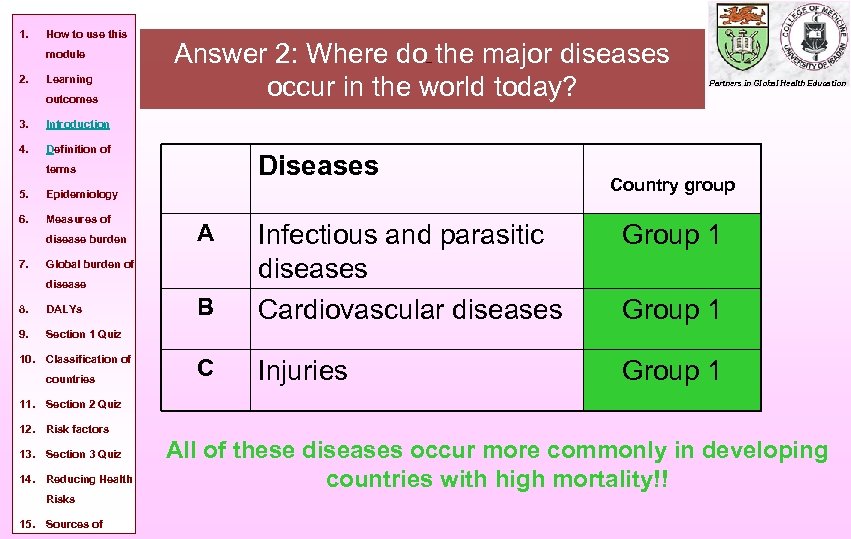 1. How to use this module Answer 2: Where do the major diseases occur in the world today? Introduction 1 2. Learning outcomes 3. Introduction 4. Definition of Partners in Global Health Education Diseases terms 5. Epidemiology 6. Measures of disease burden 7. A Group 1 B Infectious and parasitic diseases Cardiovascular diseases C Injuries Group 1 Global burden of disease 8. DALYs 9. Country group Group 1 Section 1 Quiz 10. Classification of countries 11. Section 2 Quiz 12. Risk factors 13. Section 3 Quiz 14. Reducing Health Risks 15. Sources of All of these diseases occur more commonly in developing countries with high mortality!!
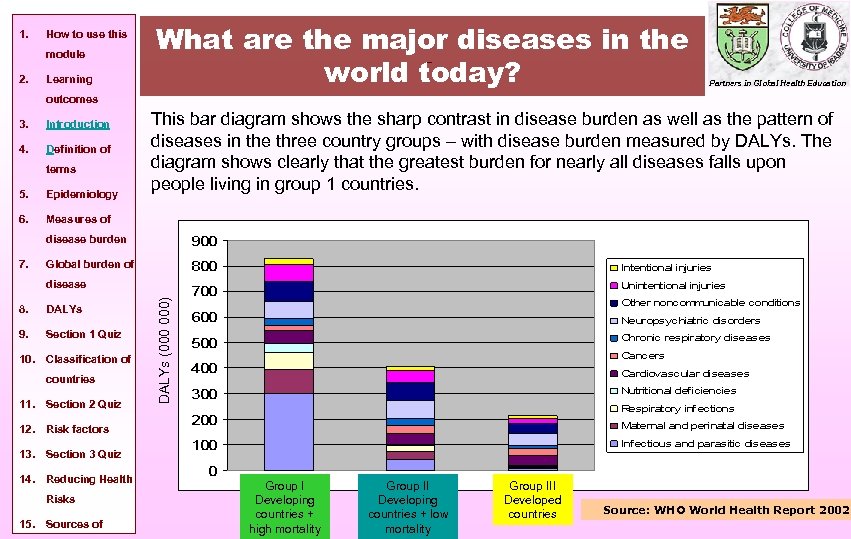 1. How to use this module What are the major diseases in the world today? Introduction 1 2. Learning Partners in Global Health Education outcomes 3. Introduction 4. Definition of terms 5. Epidemiology 6. This bar diagram shows the sharp contrast in disease burden as well as the pattern of diseases in the three country groups – with disease burden measured by DALYs. The diagram shows clearly that the greatest burden for nearly all diseases falls upon people living in group 1 countries. Measures of disease burden 7. Global burden of 8. DALYs 9. Section 1 Quiz 10. Classification of countries 11. Section 2 Quiz DALYs (000 000) disease 12. Risk factors 13. Section 3 Quiz 14. Reducing Health Risks 15. Sources of Group I Developing countries + high mortality Group II Developing countries + low mortality Group III Developed countries Source: WHO World Health Report 2002
 1. How to use this module 2. Learning End of Section 2 Partners in Global Health Education outcomes 3. Introduction 4. Definition of terms 5. Epidemiology 6. Well done! You have come to the end of the second section. Measures of disease burden 7. Global burden of disease 8. DALYs 9. Section 1 Quiz 10. Classification of countries 11. Section 2 Quiz 12. Risk factors 13. Section 3 Quiz 14. Reducing Health Risks 15. Sources of We suggest that you proceed to answer question 3 to assess your learning further. Do remember to write your answers on the mark sheet before looking at the right answer!
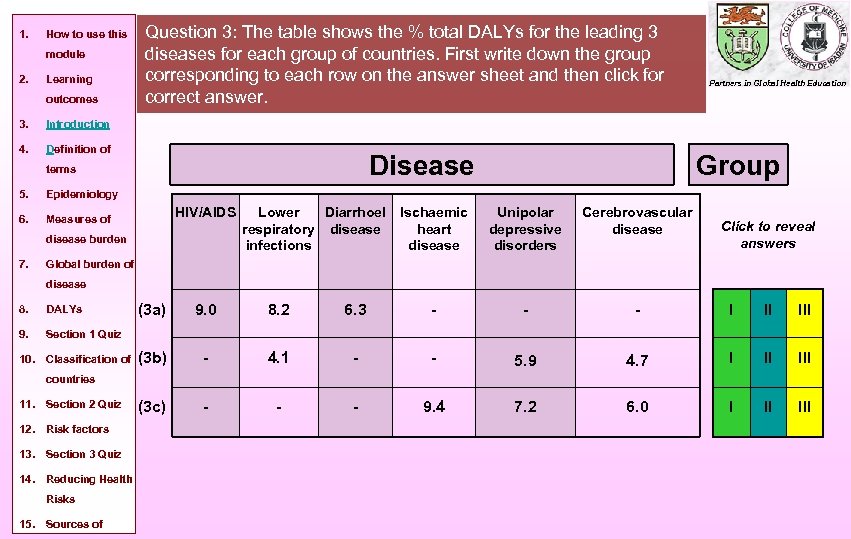 1. How to use this module 2. Learning outcomes 3. Definition of Partners in Global Health Education Introduction 4. Question 3: The table shows the % total DALYs for the leading 3 diseases for each group of countries. First write down the group corresponding to each row on the answer sheet and then click for correct answer. Disease terms 5. Epidemiology 6. Measures of Group HIV/AIDS disease burden 7. Lower Diarrhoel respiratory disease infections Ischaemic heart disease Unipolar depressive disorders Cerebrovascular disease Click to reveal answers Global burden of disease 8. DALYs 9. (3 a) 9. 0 8. 2 6. 3 - - - I II III (3 b) - 4. 1 - - 5. 9 4. 7 I II III (3 c) - - - 9. 4 7. 2 6. 0 I II III Section 1 Quiz 10. Classification of countries 11. Section 2 Quiz 12. Risk factors 13. Section 3 Quiz 14. Reducing Health Risks 15. Sources of
 1. How to use this module 2. Learning outcomes 3. Definition of Partners in Global Health Education Introduction 4. Risks rather than specific diseases terms 5. Epidemiology 6. Measures of disease burden 7. Global burden of disease 8. DALYs 9. Section 1 Quiz 10. Classification of countries 11. Section 2 Quiz 12. Risk factors 13. Section 3 Quiz 14. Reducing Health Risks 15. Sources of • An alternative way of looking at ill health is to consider risks for disease rather than diseases themselves • A risk is defined as the probability of an adverse health outcome or a factor that raises this probability • A single risk factor may underlie several diseases; e. g. unsafe sex is a risk for HIV/AIDS, many other sexually transmitted diseases and teenage pregnancy • It is often more useful to direct health interventions against risks rather than specific diseases • DALYs have been assigned to health risks as well as diseases
 1. How to use this module 2. Learning outcomes 3. Introduction 4. Definition of Relationship between risks to health and disease burden Partners in Global Health Education Factors which threaten health and are widely spread in populations have been identified in different regions of the world. These risks are strongly related to patterns of living and particularly to consumption. terms 5. Epidemiology 6. Measures of The vast majority of threats to health occur more frequently in the poor and in those with little education and lowly occupations. Therefore, the leading risks to health identified in developing countries are also the leading health risks at the global level: Introduction 1 disease burden 7. Global burden of disease 8. DALYs 9. Section 1 Quiz 10. Classification of countries 11. Section 2 Quiz 12. Risk factors 13. Section 3 Quiz 14. Reducing Health Risks 15. Sources of • • • Underweight – the leading risk factor for disease and death in the world today. Particularly affects young children, women during pregnancy and the elderly. Unsafe sex - the main factor in the spread of HIV/AIDS. > 99% of HIV infections in Africa are attributable to unsafe sex. Unsafe water. Poor sanitation and hygiene - about 2 million deaths from childhood infectious diarrhoea still occur every year in the developing countries of the world. Iron deficiency. In-door smoke. Half of the world’s population is exposed to in-door pollution, mainly the result of burning solid fuels for cooking and heating. Globally, it is estimated that 36% of all lower respiratory infections and 22% of chronic obstructive pulmonary disease are associated with in-door pollution.
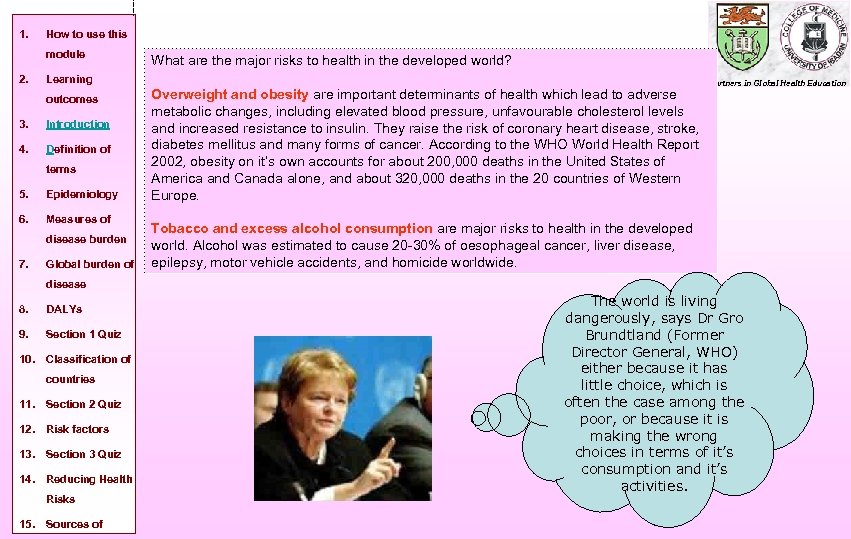 n t r o d u c t i o n 1 1. How to use this module 2. Learning outcomes 3. Introduction 4. Definition of terms 5. Epidemiology 6. Measures of disease burden 7. What are the major risks to health in the developed world? Global burden of Overweight and obesity are important determinants of health which lead to adverse metabolic changes, including elevated blood pressure, unfavourable cholesterol levels and increased resistance to insulin. They raise the risk of coronary heart disease, stroke, diabetes mellitus and many forms of cancer. According to the WHO World Health Report 2002, obesity on it’s own accounts for about 200, 000 deaths in the United States of America and Canada alone, and about 320, 000 deaths in the 20 countries of Western Europe. Partners in Global Health Education Tobacco and excess alcohol consumption are major risks to health in the developed world. Alcohol was estimated to cause 20 -30% of oesophageal cancer, liver disease, epilepsy, motor vehicle accidents, and homicide worldwide. disease 8. DALYs 9. Section 1 Quiz 10. Classification of countries 11. Section 2 Quiz 12. Risk factors 13. Section 3 Quiz 14. Reducing Health Risks 15. Sources of The world is living dangerously, says Dr Gro Brundtland (Former Director General, WHO) either because it has little choice, which is often the case among the poor, or because it is making the wrong choices in terms of it’s consumption and it’s activities.
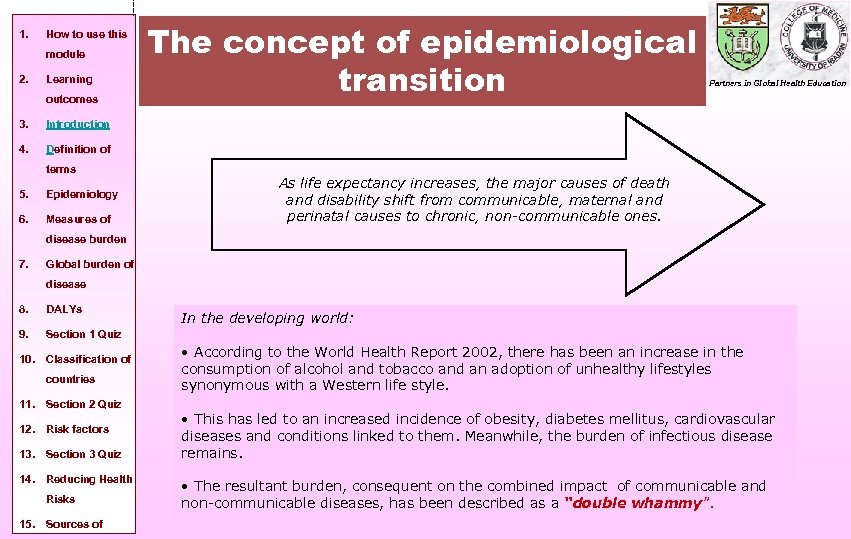 n t r o d u c t i o n 1 1. How to use this module 2. Learning outcomes 3. Partners in Global Health Education Introduction 4. The concept of epidemiological transition Definition of terms 5. Epidemiology 6. Measures of As life expectancy increases, the major causes of death and disability shift from communicable, maternal and perinatal causes to chronic, non-communicable ones. disease burden 7. Global burden of disease 8. DALYs 9. Section 1 Quiz 10. Classification of countries 11. Section 2 Quiz 12. Risk factors 13. Section 3 Quiz 14. Reducing Health Risks 15. Sources of In the developing world: • According to the World Health Report 2002, there has been an increase in the consumption of alcohol and tobacco and an adoption of unhealthy lifestyles synonymous with a Western life style. • This has led to an increased incidence of obesity, diabetes mellitus, cardiovascular diseases and conditions linked to them. Meanwhile, the burden of infectious disease remains. • The resultant burden, consequent on the combined impact of communicable and non-communicable diseases, has been described as a “double whammy”.
 1. How to use this module 2. Learning outcomes 3. Definition of Partners in Global Health Education Introduction 4. Health risks in different world regions terms 5. Epidemiology 6. Measures of disease burden 7. Global burden of disease 8. DALYs 9. Section 1 Quiz 10. Classification of countries 11. Section 2 Quiz 12. Risk factors 13. Section 3 Quiz 14. Reducing Health Risks 15. Sources of • The next 3 slides show the disease burden (measured by DALYs) attributable to 10 leading health risks according to country group • Note how single risks underlie several diseases and how these relationships differ in different regions • Note that the total number of DALYs (x axis) is much greater in the developing than the developed worlds
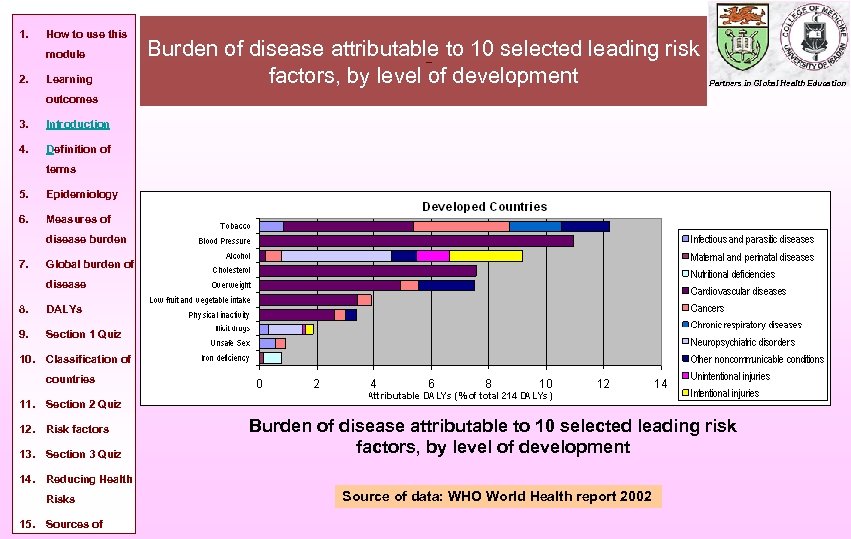 1. How to use this module Burden of disease attributable to 10 selected leading risk factors, by level of development Introduction 1 2. Learning Partners in Global Health Education outcomes 3. Introduction 4. Definition of terms 5. Epidemiology 6. Measures of disease burden 7. Global burden of disease 8. DALYs 9. Section 1 Quiz 10. Classification of countries 11. Section 2 Quiz 12. Risk factors 13. Section 3 Quiz Burden of disease attributable to 10 selected leading risk factors, by level of development 14. Reducing Health Risks 15. Sources of Source of data: WHO World Health report 2002
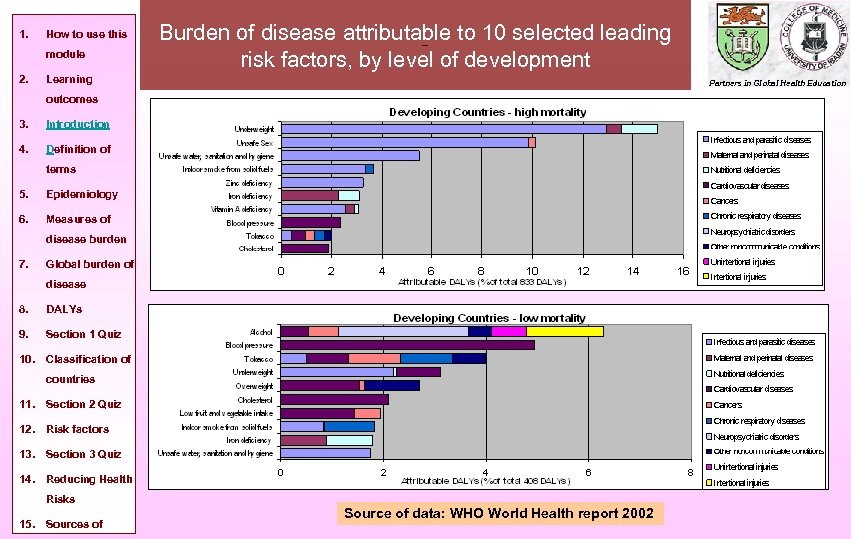 1. How to use this Burden of disease attributable to 10 selected leading risk factors, by level of development Introduction 1 module 2. Learning Partners in Global Health Education outcomes 3. Introduction 4. Definition of terms 5. Epidemiology 6. Measures of disease burden 7. Global burden of disease 8. DALYs 9. Section 1 Quiz 10. Classification of countries 11. Section 2 Quiz 12. Risk factors 13. Section 3 Quiz 14. Reducing Health Risks 15. Sources of Source of data: WHO World Health report 2002
 1. How to use this module 2. Learning End of Section 3 Partners in Global Health Education outcomes 3. Introduction 4. Definition of terms 5. This is the last of the sections. Epidemiology 6. You have come a long way! Measures of disease burden 7. Global burden of disease 8. DALYs 9. Section 1 Quiz 10. Classification of countries 11. Section 2 Quiz 12. Risk factors 13. Section 3 Quiz 14. Reducing Health Risks 15. Sources of For the section just ended, answer Questions 4 - 6 to assess what you have learnt. It is still required that you put down your answers on the mark sheet before looking at the right answer!
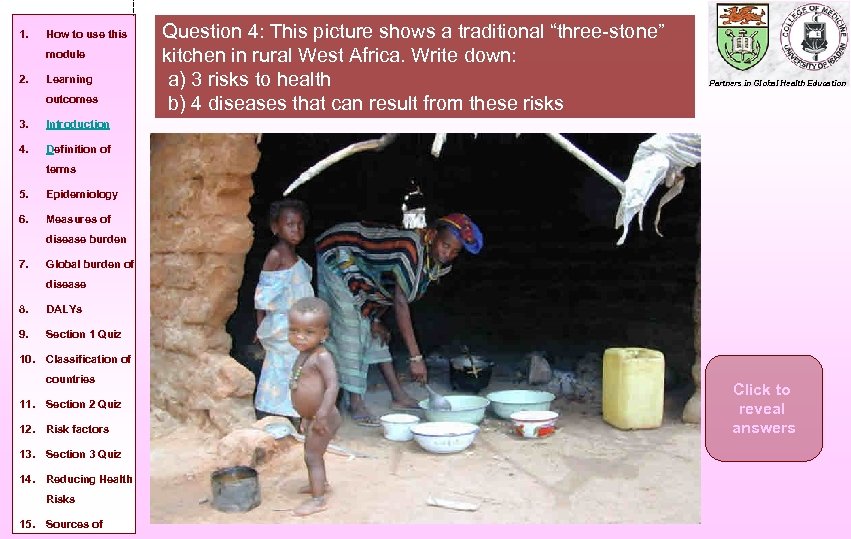 n t r o d u c t i o n 1 1. How to use this module 2. Learning outcomes 3. Partners in Global Health Education Introduction 4. Question 4: This picture shows a traditional “three-stone” kitchen in rural West Africa. Write down: a) 3 risks to health b) 4 diseases that can result from these risks Definition of terms 5. Epidemiology 6. Measures of disease burden 7. Global burden of disease 8. DALYs 9. Section 1 Quiz 10. Classification of countries 11. Section 2 Quiz 12. Risk factors 13. Section 3 Quiz 14. Reducing Health Risks 15. Sources of Click to reveal answers
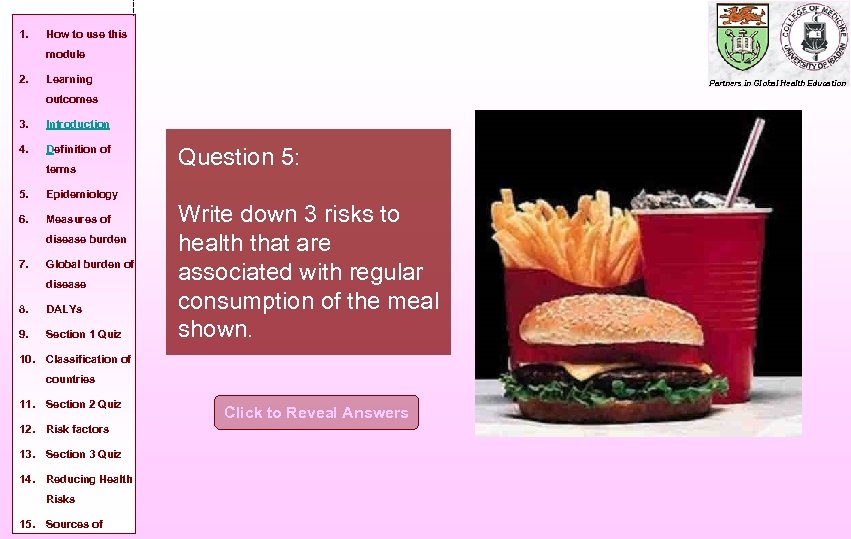 n t r o d u c t i o n 1 1. How to use this module 2. Learning Partners in Global Health Education outcomes 3. Introduction 4. Definition of terms 5. Epidemiology 6. Measures of Question 5: disease burden 7. Global burden of disease 8. DALYs 9. Section 1 Quiz Write down 3 risks to health that are associated with regular consumption of the meal shown. 10. Classification of countries 11. Section 2 Quiz 12. Risk factors 13. Section 3 Quiz 14. Reducing Health Risks 15. Sources of Click to Reveal Answers
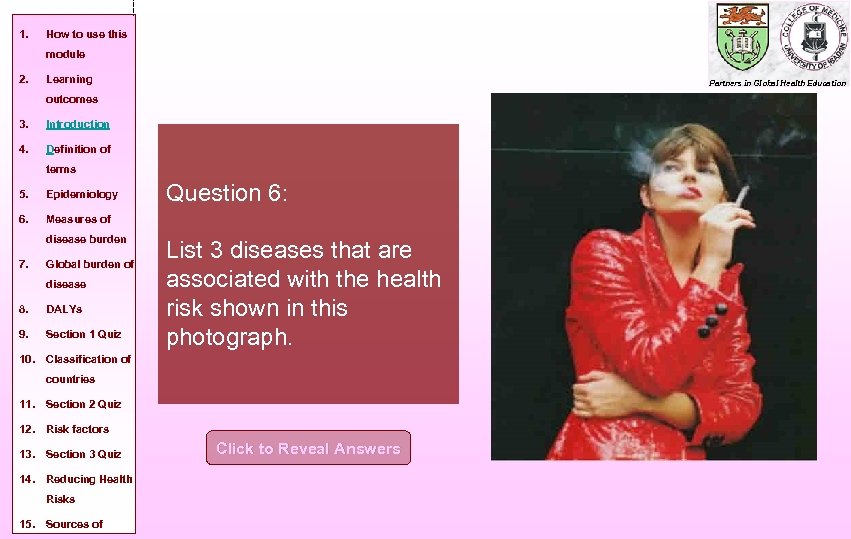 n t r o d u c t i o n 1 1. How to use this module 2. Learning Partners in Global Health Education outcomes 3. Introduction 4. Definition of terms 5. Epidemiology 6. Question 6: Measures of disease burden 7. Global burden of disease 8. DALYs 9. Section 1 Quiz List 3 diseases that are associated with the health risk shown in this photograph. 10. Classification of countries 11. Section 2 Quiz 12. Risk factors 13. Section 3 Quiz 14. Reducing Health Risks 15. Sources of Click to Reveal Answers
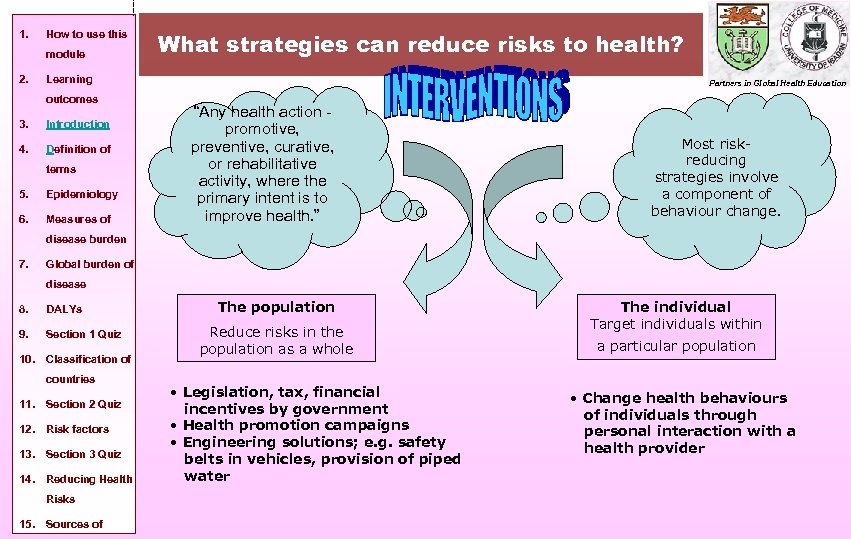 n t r o d u c t i o n 1 1. How to use this module 2. What strategies can reduce risks to health? Learning outcomes 3. Introduction 4. Definition of terms 5. Epidemiology 6. Measures of Partners in Global Health Education “Any health action - promotive, preventive, curative, or rehabilitative activity, where the primary intent is to improve health. ” Most riskreducing strategies involve a component of behaviour change. disease burden 7. Global burden of disease 8. DALYs 9. Section 1 Quiz 10. Classification of countries 11. Section 2 Quiz 12. Risk factors 13. Section 3 Quiz 14. Reducing Health Risks 15. Sources of The population Reduce risks in the population as a whole • Legislation, tax, financial incentives by government • Health promotion campaigns • Engineering solutions; e. g. safety belts in vehicles, provision of piped water The individual Target individuals within a particular population • Change health behaviours of individuals through personal interaction with a health provider
 1. How to use this module 2. Learning Sources of information Partners in Global Health Education outcomes 3. Introduction 4. Definition of terms 5. Epidemiology 6. Measures of Copy and paste these links into your browser to access these information resources: • The World Health report 2002 – Reducing Risks, Promoting Healthy Life; http: //www. who. int/whr/2002/en/ • Unicef State of the World’s Children 2005; http: //www. unicef. org/sowc 05/english/ disease burden 7. Global burden of disease 8. DALYs 9. Other resources: • Section 1 Quiz Selected major risk factors and global and regional burden of disease Ezzati M, Lopez AD, Rodgers A, Vander Hoorn S, Murray CJ. The Lancet 2002; 360: 1347 -1360 10. Classification of countries 11. Section 2 Quiz 12. Risk factors 13. Section 3 Quiz 14. Reducing Health Risks 15. Sources of • Regional patterns of disability-free life expectancy and disability-adjusted life expectancy: Global Burden of Disease Study; Murray CJ, Lopez AD. The Lancet 1997; 349: 1347 -1352