 Скачать презентацию 1 GEDC global engineering deans council 2013 -2015
e2028905a1ed2b8d962b528ba57cda1e.ppt
- Количество слайдов: 34



1 GEDC global engineering deans council 2013 -2015 Strategic Plan Singapore October, 2010 updated Chicago, October 2013
2 Vision & Mission 2013 -2015 Strategic Direction GEDC global engineering deans council
3 GEDC global engineering deans council Vision Empower and equip deans* in advancing their college or school’s mission in preparing the next generation of engineers to successfully tackle the challenges of the 21 st century and serve society more effectively. * For the purposes of the Global Engineering Deans Council, a dean is defined as a person in charge of an engineering college or school in a university, or a person in charge of an education institution of higher learning that is primarily focused on engineering education and research.
4 GEDC global engineering deans council Mission Serve as a global network of engineering deans*, and leverage collective strengths for the advancement of engineering education and research * For the purposes of the Global Engineering Deans Council, a dean is defined as a person in charge of an engineering college or school in a university, or a person in charge of an education institution of higher learning that is primarily focused on engineering education and research.
5 General Objectives & Strategies 2013 -2015 Strategic Direction GEDC global engineering deans council
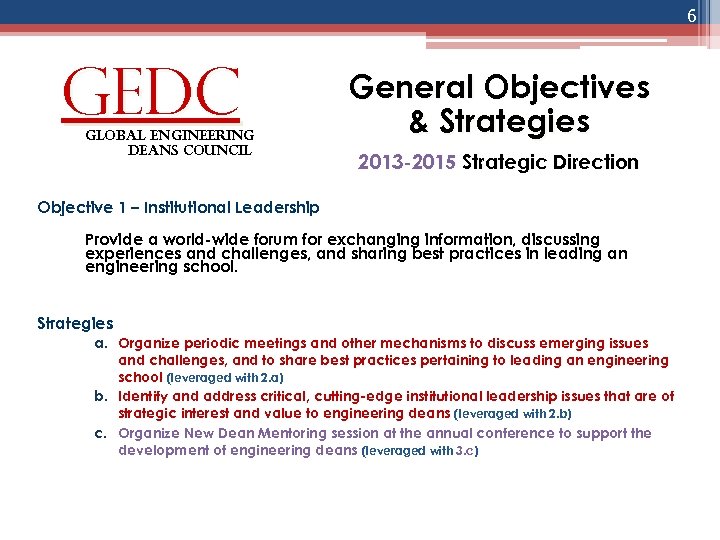
6 GEDC global engineering deans council General Objectives & Strategies 2013 -2015 Strategic Direction Objective 1 – Institutional Leadership Provide a world-wide forum for exchanging information, discussing experiences and challenges, and sharing best practices in leading an engineering school. Strategies a. Organize periodic meetings and other mechanisms to discuss emerging issues and challenges, and to share best practices pertaining to leading an engineering school (leveraged with 2. a) b. Identify and address critical, cutting-edge institutional leadership issues that are of strategic interest and value to engineering deans (leveraged with 2. b) c. Organize New Dean Mentoring session at the annual conference to support the development of engineering deans (leveraged with 3. c)
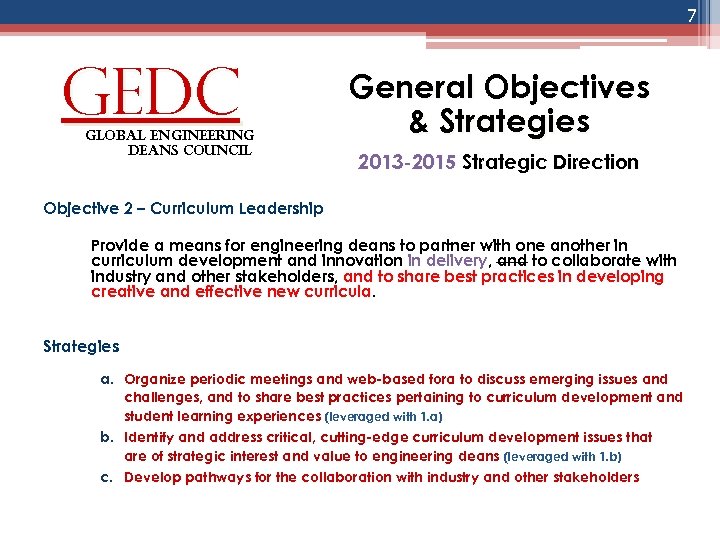
7 GEDC global engineering deans council General Objectives & Strategies 2013 -2015 Strategic Direction Objective 2 – Curriculum Leadership Provide a means for engineering deans to partner with one another in curriculum development and innovation in delivery, and to collaborate with industry and other stakeholders, and to share best practices in developing creative and effective new curricula. Strategies a. Organize periodic meetings and web-based fora to discuss emerging issues and challenges, and to share best practices pertaining to curriculum development and student learning experiences (leveraged with 1. a) b. Identify and address critical, cutting-edge curriculum development issues that are of strategic interest and value to engineering deans (leveraged with 1. b) c. Develop pathways for the collaboration with industry and other stakeholders
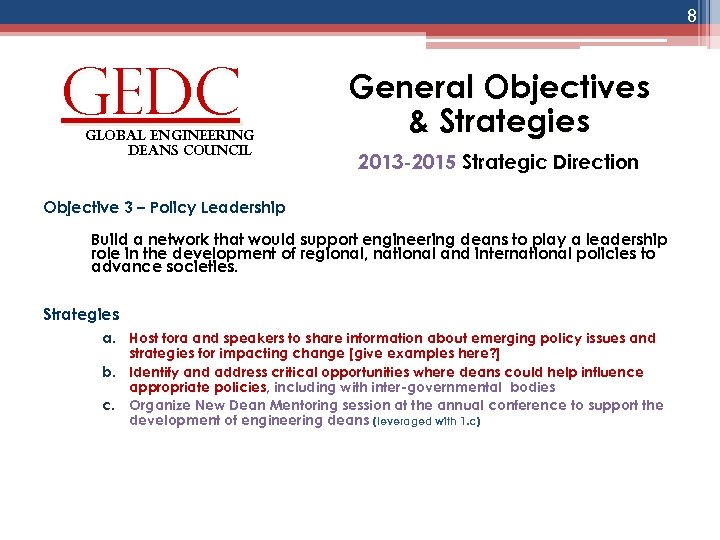
8 GEDC global engineering deans council General Objectives & Strategies 2013 -2015 Strategic Direction Objective 3 – Policy Leadership Build a network that would support engineering deans to play a leadership role in the development of regional, national and international policies to advance societies. Strategies a. Host fora and speakers to share information about emerging policy issues and strategies for impacting change [give examples here? ] b. Identify and address critical opportunities where deans could help influence appropriate policies, including with inter-governmental bodies c. Organize New Dean Mentoring session at the annual conference to support the development of engineering deans (leveraged with 1. c)
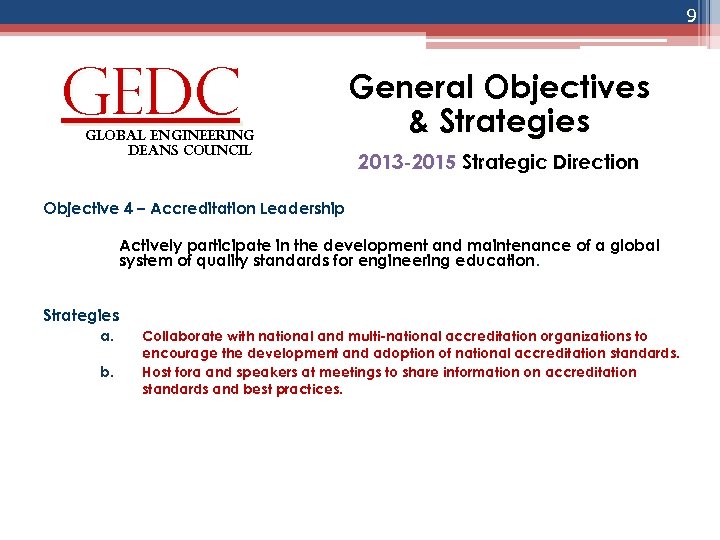
9 GEDC global engineering deans council General Objectives & Strategies 2013 -2015 Strategic Direction Objective 4 – Accreditation Leadership Actively participate in the development and maintenance of a global system of quality standards for engineering education. Strategies a. b. Collaborate with national and multi-national accreditation organizations to encourage the development and adoption of national accreditation standards. Host fora and speakers at meetings to share information on accreditation standards and best practices.
10 Strategic Direction Summary 2013 -2015 GEDC global engineering deans council
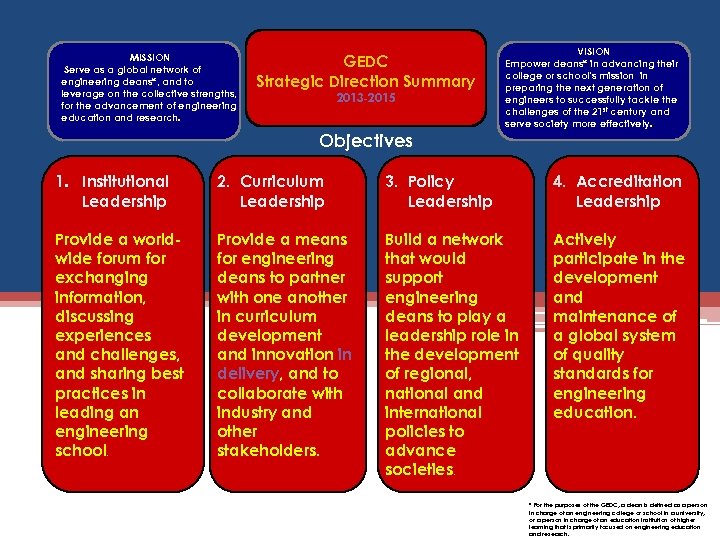
MISSION Serve as a global network of engineering deans*, and to leverage on the collective strengths, for the advancement of engineering education and research. GEDC Strategic Direction Summary 2013 -2015 Objectives VISION Empower deans* in advancing their college or school’s mission in preparing the next generation of engineers to successfully tackle the challenges of the 21 st century and serve society more effectively. . 1. Institutional Leadership 2. Curriculum Leadership 3. Policy Leadership 4. Accreditation Leadership Provide a worldwide forum for exchanging information, discussing experiences and challenges, and sharing best practices in leading an engineering school. Provide a means for engineering deans to partner with one another in curriculum development and innovation in delivery, and to collaborate with industry and other stakeholders. Build a network that would support engineering deans to play a leadership role in the development of regional, national and international policies to advance societies. Actively participate in the development and maintenance of a global system of quality standards for engineering education. * For the purposes of the GEDC, a dean is defined as a person in charge of an engineering college or school in a university, or a person in charge of an education institution of higher learning that is primarily focused on engineering education and research.
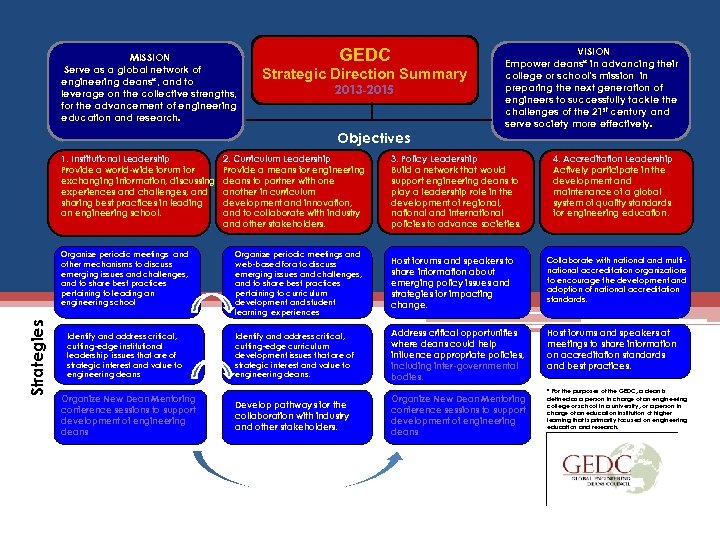
MISSION Serve as a global network of engineering deans*, and to leverage on the collective strengths, for the advancement of engineering education and research. GEDC Strategic Direction Summary 2013 -2015 Objectives 1. Institutional Leadership Provide a world-wide forum for exchanging information, discussing experiences and challenges, and sharing best practices in leading an engineering school. Strategies Organize periodic meetings and other mechanisms to discuss emerging issues and challenges, and to share best practices pertaining to leading an engineering school Identify and address critical, cutting-edge institutional leadership issues that are of strategic interest and value to engineering deans Organize New Dean Mentoring conference sessions to support development of engineering deans 2. Curriculum Leadership Provide a means for engineering deans to partner with one another in curriculum development and innovation, and to collaborate with industry and other stakeholders. VISION Empower deans* in advancing their college or school’s mission in preparing the next generation of engineers to successfully tackle the challenges of the 21 st century and serve society more effectively. . 3. Policy Leadership Build a network that would support engineering deans to play a leadership role in the development of regional, national and international policies to advance societies. 4. Accreditation Leadership Actively participate in the development and maintenance of a global system of quality standards for engineering education. Organize periodic meetings and web-based fora to discuss emerging issues and challenges, and to share best practices pertaining to curriculum development and student learning experiences Host forums and speakers to share information about emerging policy issues and strategies for impacting change. Collaborate with national and multinational accreditation organizations to encourage the development and adoption of national accreditation standards. Identify and address critical, cutting-edge curriculum development issues that are of strategic interest and value to engineering deans. Address critical opportunities where deans could help influence appropriate policies, including inter-governmental bodies. Host forums and speakers at meetings to share information on accreditation standards and best practices. Develop pathways for the collaboration with industry and other stakeholders. Organize New Dean Mentoring conference sessions to support development of engineering deans * For the purposes of the GEDC, a dean is defined as a person in charge of an engineering college or school in a university, or a person in charge of an education institution of higher learning that is primarily focused on engineering education and research.
13 Core Organizational Values 2013 -2015 Strategic Direction GEDC global engineering deans council
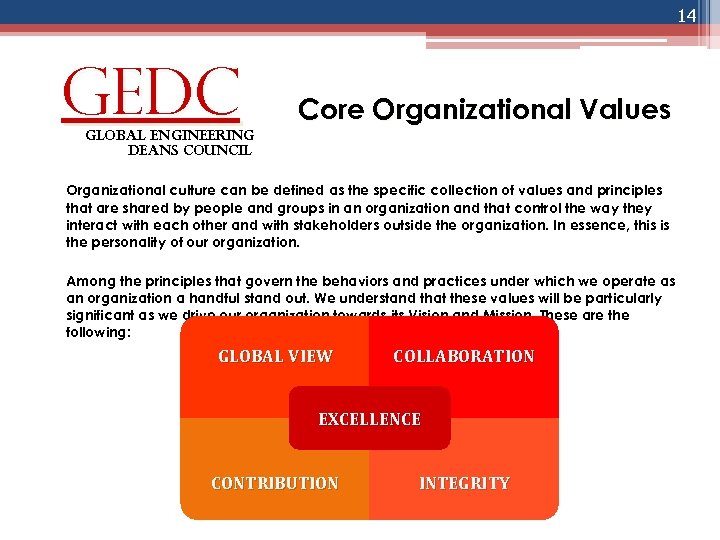
14 GEDC Core Organizational Values global engineering deans council Organizational culture can be defined as the specific collection of values and principles that are shared by people and groups in an organization and that control the way they interact with each other and with stakeholders outside the organization. In essence, this is the personality of our organization. Among the principles that govern the behaviors and practices under which we operate as an organization a handful stand out. We understand that these values will be particularly significant as we drive our organization towards its Vision and Mission. These are the following: GLOBAL VIEW COLLABORATION EXCELLENCE CONTRIBUTION INTEGRITY
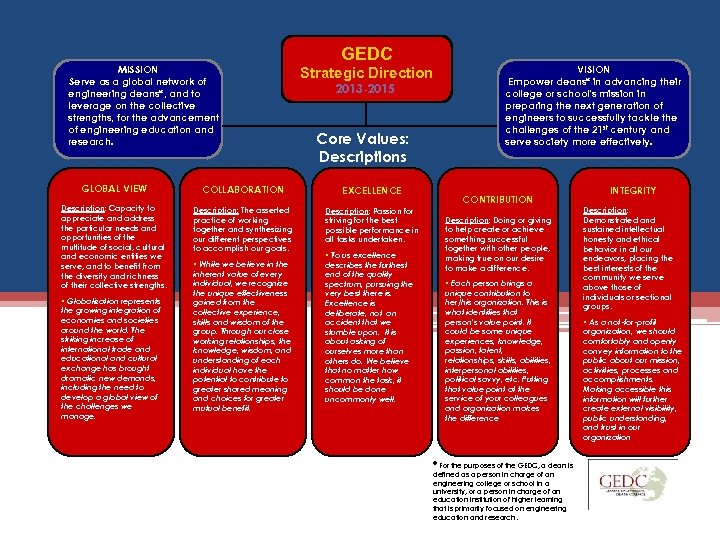
GEDC MISSION Serve as a global network of engineering deans*, and to leverage on the collective strengths, for the advancement of engineering education and research. Strategic Direction 2013 -2015 Core Values: Descriptions GLOBAL VIEW COLLABORATION EXCELLENCE Description: Capacity to appreciate and address the particular needs and opportunities of the multitude of social, cultural and economic entities we serve, and to benefit from the diversity and richness of their collective strengths. Description: The asserted practice of working together and synthesizing our different perspectives to accomplish our goals. Description: Passion for striving for the best possible performance in all tasks undertaken. § While we believe in the describes the furthest end of the quality spectrum, pursuing the very best there is. Excellence is deliberate, not an accident that we stumble upon. It is about asking of ourselves more than others do. We believe that no matter how common the task, it should be done uncommonly well. § Globalization represents the growing integration of economies and societies around the world. The striking increase of international trade and educational and cultural exchange has brought dramatic new demands, including the need to develop a global view of the challenges we manage. inherent value of every individual, we recognize the unique effectiveness gained from the collective experience, skills and wisdom of the group. Through our close working relationships, the knowledge, wisdom, and understanding of each individual have the potential to contribute to greater shared meaning and choices for greater mutual benefit. § To us excellence VISION Empower deans* in advancing their college or school’s mission in preparing the next generation of engineers to successfully tackle the challenges of the 21 st century and serve society more effectively. . CONTRIBUTION Description: Doing or giving to help create or achieve something successful together with other people, making true on our desire to make a difference. § Each person brings a unique contribution to her/his organization. This is what identifies that person’s value point. It could be some unique experiences, knowledge, passion, talent, relationships, skills, abilities, interpersonal abilities, political savvy, etc. Putting that value point at the service of your colleagues and organization makes the difference. * For the purposes of the GEDC, a dean is defined as a person in charge of an engineering college or school in a university, or a person in charge of an education institution of higher learning that is primarily focused on engineering education and research. INTEGRITY Description: Demonstrated and sustained intellectual honesty and ethical behavior in all our endeavors, placing the best interests of the community we serve above those of individuals or sectional groups. § As a not-for-profit organization, we should comfortably and openly convey information to the public about our mission, activities, processes and accomplishments. Making accessible this information will further create external visibility, public understanding, and trust in our organization.
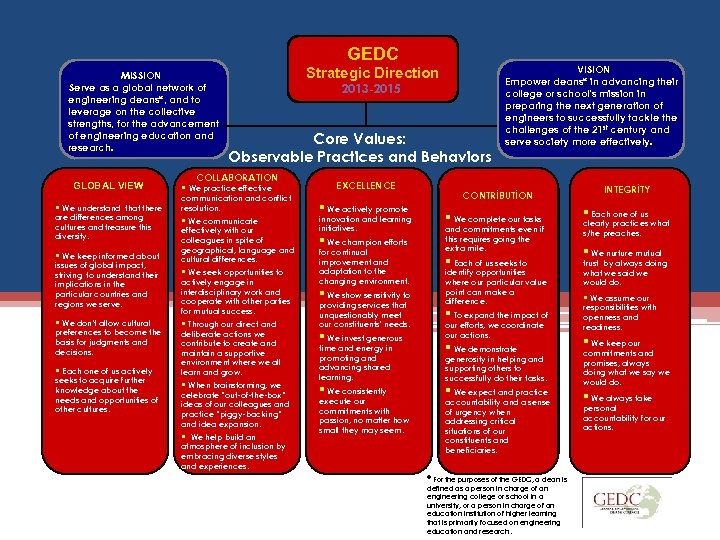
GEDC MISSION Serve as a global network of engineering deans*, and to leverage on the collective strengths, for the advancement of engineering education and research. GLOBAL VIEW § We understand that there are differences among cultures and treasure this diversity. § We keep informed about issues of global impact, striving to understand their implications in the particular countries and regions we serve. § We don’t allow cultural preferences to become the basis for judgments and decisions. § Each one of us actively seeks to acquire further knowledge about the needs and opportunities of other cultures. Strategic Direction 2013 -2015 Core Values: Observable Practices and Behaviors COLLABORATION § We practice effective communication and conflict resolution. § We communicate effectively with our colleagues in spite of geographical, language and cultural differences. § We seek opportunities to actively engage in interdisciplinary work and cooperate with other parties for mutual success. § Through our direct and deliberate actions we contribute to create and maintain a supportive environment where we all learn and grow. § When brainstorming, we celebrate “out-of-the-box” ideas of our colleagues and practice “piggy-backing” and idea expansion. § We help build an atmosphere of inclusion by embracing diverse styles and experiences. EXCELLENCE § We actively promote innovation and learning initiatives. § We champion efforts for continual improvement and adaptation to the changing environment. § We show sensitivity to providing services that unquestionably meet our constituents’ needs. § We invest generous VISION Empower deans* in advancing their college or school’s mission in preparing the next generation of engineers to successfully tackle the challenges of the 21 st century and serve society more effectively. . CONTRİBUTİON § We complete our tasks and commitments even if this requires going the extra mile. § Each of us seeks to identify opportunities where our particular value point can make a difference. § To expand the impact of our efforts, we coordinate our actions. INTEGRİTY § Each one of us clearly practices what s/he preaches. § We nurture mutual trust by always doing what we said we would do. § We assume our responsibilities with openness and readiness. time and energy in promoting and advancing shared learning. § We demonstrate § We keep our § We consistently § We expect and practice § We always take execute our commitments with passion, no matter how small they may seem. generosity in helping and supporting others to successfully do their tasks. accountability and a sense of urgency when addressing critical situations of our constituents and beneficiaries. * For the purposes of the GEDC, a dean is defined as a person in charge of an engineering college or school in a university, or a person in charge of an education institution of higher learning that is primarily focused on engineering education and research. commitments and promises, always doing what we say we would do. personal accountability for our actions.
17 Strategies, Key Action Plans & Expected Results by Objective (1 -Page Summaries) 2013 -2015 Strategic Direction GEDC global engineering deans council
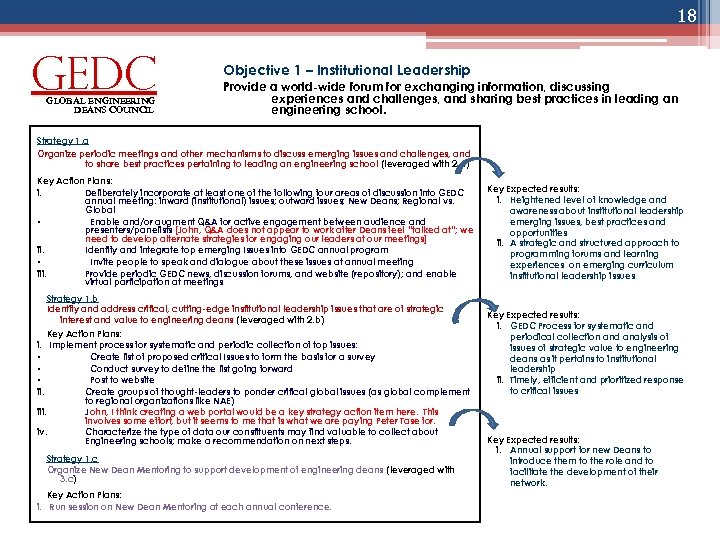
18 GEDC global engineering deans council Objective 1 – Institutional Leadership Provide a world-wide forum for exchanging information, discussing experiences and challenges, and sharing best practices in leading an engineering school. Strategy 1. a Organize periodic meetings and other mechanisms to discuss emerging issues and challenges, and to share best practices pertaining to leading an engineering school (leveraged with 2. a) Key Action Plans: i. Deliberately incorporate at least one of the following four areas of discussion into GEDC annual meeting: inward (institutional) issues; outward issues; New Deans; Regional vs. Global • Enable and/or augment Q&A for active engagement between audience and presenters/panelists [John, Q&A does not appear to work after Deans feel “talked at”; we need to develop alternate strategies for engaging our leaders at our meetings] ii. Identify and integrate top emerging Issues into GEDC annual program • Invite people to speak and dialogue about these issues at annual meeting iii. Provide periodic GEDC news, discussion forums, and website (repository); and enable virtual participation at meetings Strategy 1. b Identify and address critical, cutting-edge institutional leadership issues that are of strategic interest and value to engineering deans (leveraged with 2. b) Key Action Plans: i. Implement process for systematic and periodic collection of top issues: • Create list of proposed critical Issues to form the basis for a survey • Conduct survey to define the list going forward • Post to website ii. Create groups of thought-leaders to ponder critical global issues (as global complement to regional organizations like NAE) iii. John, I think creating a web portal would be a key strategy action item here. This involves some effort, but it seems to me that is what we are paying Peter Tase for. iv. Characterize the type of data our constituents may find valuable to collect about Engineering schools; make a recommendation on next steps. Strategy 1. c Organize New Dean Mentoring to support development of engineering deans (leveraged with 3. c) Key Action Plans: i. Run session on New Dean Mentoring at each annual conference. Key Expected results: i. Heightened level of knowledge and awareness about institutional leadership emerging issues, best practices and opportunities ii. A strategic and structured approach to programming forums and learning experiences on emerging curriculum institutional leadership issues Key Expected results: i. GEDC Process for systematic and periodical collection and analysis of issues of strategic value to engineering deans as it pertains to institutional leadership ii. Timely, efficient and prioritized response to critical issues Key Expected results: i. Annual support for new Deans to introduce them to the role and to facilitate the development of their network.
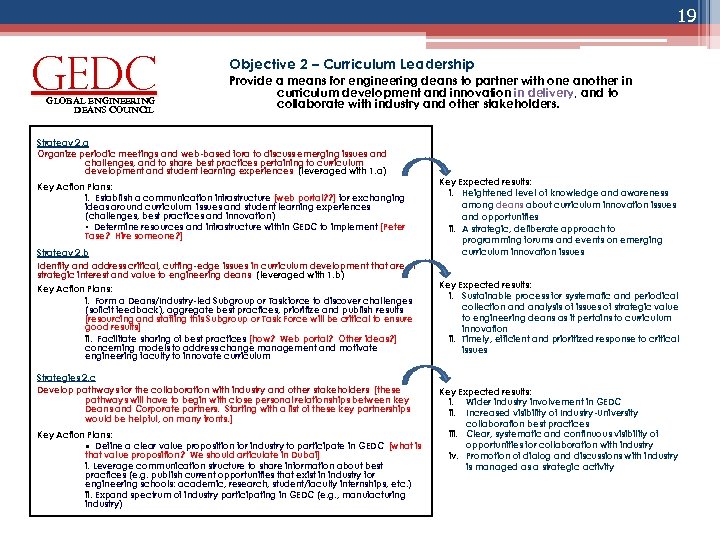
19 GEDC global engineering deans council Objective 2 – Curriculum Leadership Provide a means for engineering deans to partner with one another in curriculum development and innovation in delivery, and to collaborate with industry and other stakeholders. Strategy 2. a Organize periodic meetings and web-based fora to discuss emerging issues and challenges, and to share best practices pertaining to curriculum development and student learning experiences (leveraged with 1. a) Key Action Plans: i. Establish a communication infrastructure [web portal? ? ] for exchanging ideas around curriculum issues and student learning experiences (challenges, best practices and innovation) • Determine resources and infrastructure within GEDC to implement [Peter Tase? Hire someone? ] Strategy 2. b Identify and address critical, cutting-edge issues in curriculum development that are of strategic interest and value to engineering deans (leveraged with 1. b) Key Action Plans: i. Form a Deans/Industry-led Subgroup or Taskforce to discover challenges (solicit feedback), aggregate best practices, prioritize and publish results [resourcing and staffing this Subgroup or Task Force will be critical to ensure good results] ii. Facilitate sharing of best practices [how? Web portal? Other ideas? ] concerning models to address change management and motivate engineering faculty to innovate curriculum Strategies 2. c Develop pathways for the collaboration with industry and other stakeholders [these pathways will have to begin with close personal relationships between key Deans and Corporate partners. Starting with a list of these key partnerships would be helpful, on many fronts. ] Key Action Plans: • Define a clear value proposition for industry to participate in GEDC [what is that value proposition? We should articulate in Dubai] i. Leverage communication structure to share information about best practices (e. g. publish current opportunities that exist in industry for engineering schools: academic, research, student/faculty internships, etc. ) ii. Expand spectrum of industry participating in GEDC (e. g. , manufacturing industry) Key Expected results: i. Heightened level of knowledge and awareness among deans about curriculum innovation issues and opportunities ii. A strategic, deliberate approach to programming forums and events on emerging curriculum innovation issues Key Expected results: i. Sustainable process for systematic and periodical collection and analysis of issues of strategic value to engineering deans as it pertains to curriculum innovation ii. Timely, efficient and prioritized response to critical issues Key Expected results: i. Wider industry involvement in GEDC ii. Increased visibility of Industry-University collaboration best practices iii. Clear, systematic and continuous visibility of opportunities for collaboration with industry iv. Promotion of dialog and discussions with industry is managed as a strategic activity
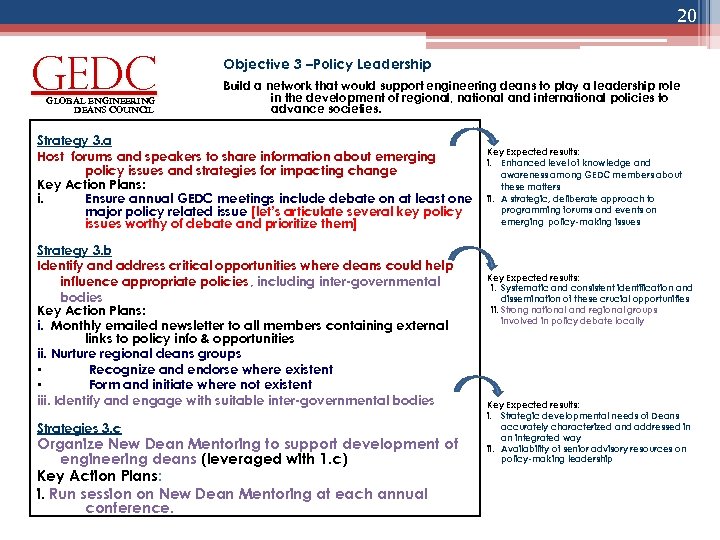
20 GEDC global engineering deans council Objective 3 –Policy Leadership Build a network that would support engineering deans to play a leadership role in the development of regional, national and international policies to advance societies. Strategy 3. a Host forums and speakers to share information about emerging policy issues and strategies for impacting change Key Action Plans: i. Ensure annual GEDC meetings include debate on at least one major policy related issue [let’s articulate several key policy issues worthy of debate and prioritize them] Strategy 3. b Identify and address critical opportunities where deans could help influence appropriate policies, including inter-governmental bodies Key Action Plans: i. Monthly emailed newsletter to all members containing external links to policy info & opportunities ii. Nurture regional deans groups • Recognize and endorse where existent • Form and initiate where not existent iii. Identify and engage with suitable inter-governmental bodies Strategies 3. c Organize New Dean Mentoring to support development of engineering deans (leveraged with 1. c) Key Action Plans: i. Run session on New Dean Mentoring at each annual conference. Key Expected results: i. Enhanced level of knowledge and awareness among GEDC members about these matters ii. A strategic, deliberate approach to programming forums and events on emerging policy-making issues Key Expected results: i. Systematic and consistent identification and dissemination of these crucial opportunities ii. Strong national and regional groups involved in policy debate locally Key Expected results: i. Strategic developmental needs of Deans accurately characterized and addressed in an integrated way ii. Availability of senior advisory resources on policy-making leadership
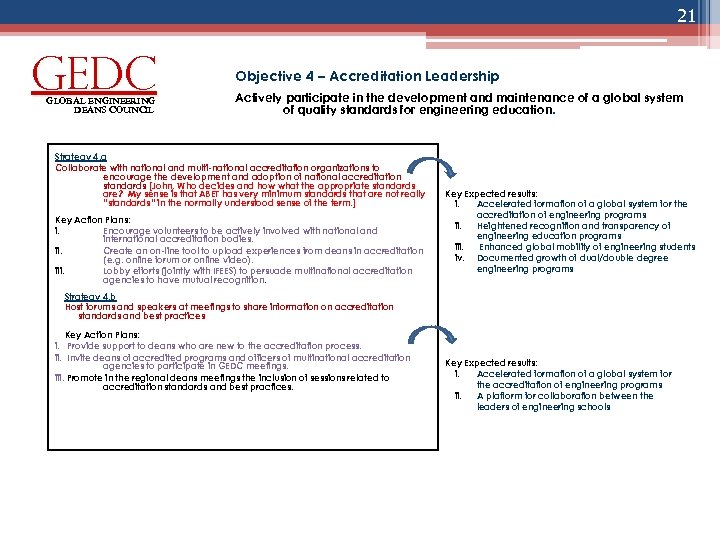
21 GEDC global engineering deans council Objective 4 – Accreditation Leadership Actively participate in the development and maintenance of a global system of quality standards for engineering education. Strategy 4. a Collaborate with national and multi-national accreditation organizations to encourage the development and adoption of national accreditation standards [John, Who decides and how what the appropriate standards are? My sense is that ABET has very minimum standards that are not really “standards” in the normally understood sense of the term. ] Key Action Plans: i. Encourage volunteers to be actively involved with national and international accreditation bodies. ii. Create an on-line tool to upload experiences from deans in accreditation (e. g. online forum or online video). iii. Lobby efforts (jointly with IFEES) to persuade multinational accreditation agencies to have mutual recognition. Key Expected results: i. Accelerated formation of a global system for the accreditation of engineering programs ii. Heightened recognition and transparency of engineering education programs iii. Enhanced global mobility of engineering students iv. Documented growth of dual/double degree engineering programs Strategy 4. b Host forums and speakers at meetings to share information on accreditation standards and best practices Key Action Plans: i. Provide support to deans who are new to the accreditation process. ii. Invite deans of accredited programs and officers of multinational accreditation agencies to participate in GEDC meetings. iii. Promote in the regional deans meetings the inclusion of sessions related to accreditation standards and best practices. Key Expected results: i. Accelerated formation of a global system for the accreditation of engineering programs ii. A platform for collaboration between the leaders of engineering schools

22 Detailed Action Plans 2013 -2015 Strategic Direction GEDC global engineering deans council
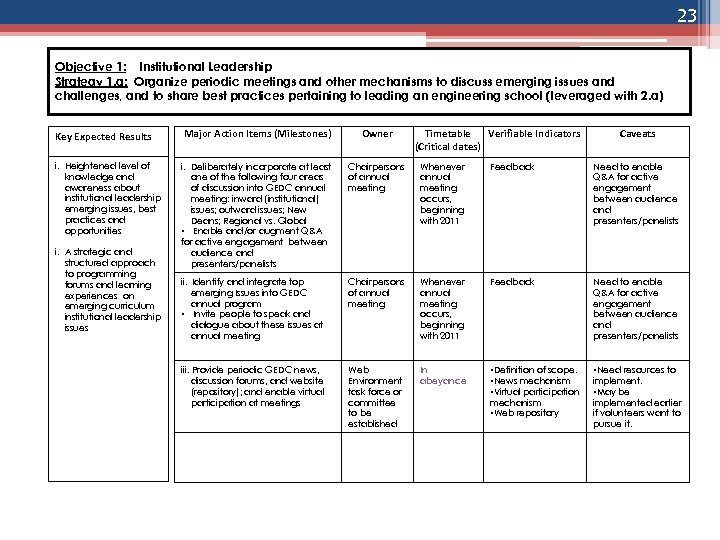
23 Objective 1: Institutional Leadership Strategy 1. a: Organize periodic meetings and other mechanisms to discuss emerging issues and challenges, and to share best practices pertaining to leading an engineering school (leveraged with 2. a) Key Expected Results Major Action Items (Milestones) Owner i. Heightened level of i. Deliberately incorporate at least Chairpersons of annual meeting Whenever annual meeting occurs, beginning with 2011 Feedback Need to enable Q&A for active engagement between audience and presenters/panelists ii. Identify and integrate top emerging Issues into GEDC annual program • Invite people to speak and dialogue about these issues at annual meeting Chairpersons of annual meeting Whenever annual meeting occurs, beginning with 2011 Feedback Need to enable Q&A for active engagement between audience and presenters/panelists iii. Provide periodic GEDC news, discussion forums, and website (repository); and enable virtual participation at meetings Web Environment task force or committee to be established In abeyance • Definition of scope. • News mechanism • Virtual participation • Need resources to knowledge and awareness about institutional leadership emerging issues, best practices and opportunities i. A strategic and structured approach to programming forums and learning experiences on emerging curriculum institutional leadership issues one of the following four areas of discussion into GEDC annual meeting: inward (institutional) issues; outward issues; New Deans; Regional vs. Global • Enable and/or augment Q&A for active engagement between audience and presenters/panelists Timetable Verifiable Indicators (Critical dates) mechanism • Web repository Caveats implement. • May be implemented earlier if volunteers want to pursue it.
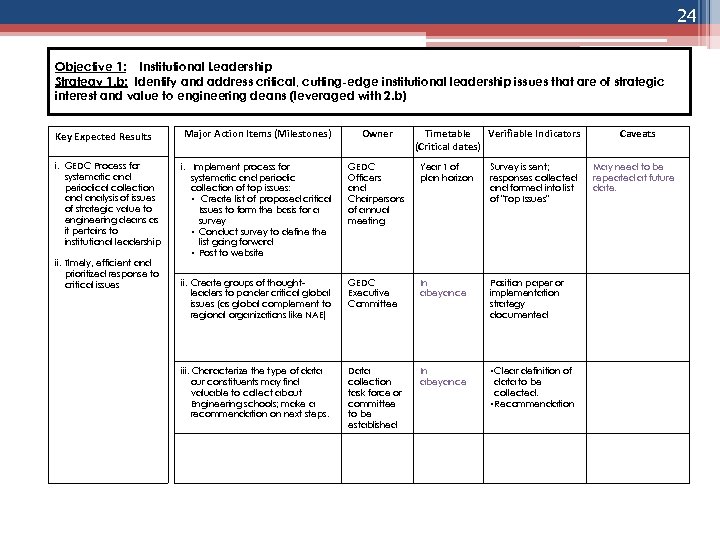
24 Objective 1: Institutional Leadership Strategy 1. b: Identify and address critical, cutting-edge institutional leadership issues that are of strategic interest and value to engineering deans (leveraged with 2. b) Key Expected Results Major Action Items (Milestones) i. GEDC Process for i. Implement process for GEDC Officers and Chairpersons of annual meeting Year 1 of plan horizon Survey is sent; responses collected and formed into list of "Top Issues" ii. Create groups of thought- GEDC Executive Committee In abeyance Position paper or implementation strategy documented iii. Characterize the type of data our constituents may find valuable to collect about Engineering schools; make a recommendation on next steps. Data collection task force or committee to be established In abeyance • Clear definition of systematic and periodical collection and analysis of issues of strategic value to engineering deans as it pertains to institutional leadership ii. Timely, efficient and prioritized response to critical issues systematic and periodic collection of top issues: • Create list of proposed critical Issues to form the basis for a survey • Conduct survey to define the list going forward • Post to website leaders to ponder critical global issues (as global complement to regional organizations like NAE) Owner Timetable Verifiable Indicators (Critical dates) data to be collected. • Recommendation Caveats May need to be repeated at future date.
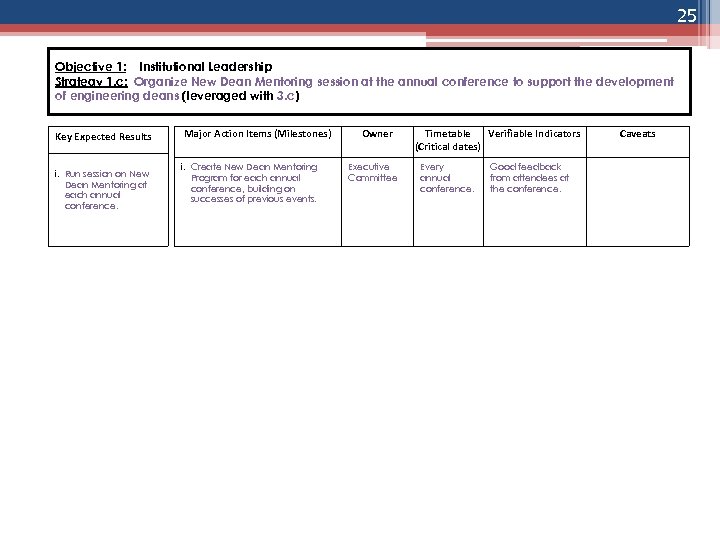
25 Objective 1: Institutional Leadership Strategy 1. c: Organize New Dean Mentoring session at the annual conference to support the development of engineering deans (leveraged with 3. c) Key Expected Results i. Run session on New Dean Mentoring at each annual conference. Major Action Items (Milestones) i. Create New Dean Mentoring Program for each annual conference, building on successes of previous events. Owner Executive Committee Timetable Verifiable Indicators (Critical dates) Every annual conference. Good feedback from attendees at the conference. Caveats
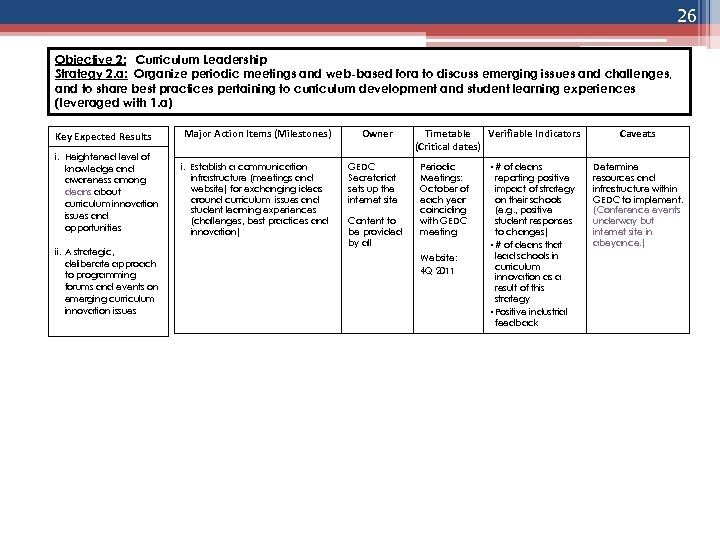
26 Objective 2: Curriculum Leadership Strategy 2. a: Organize periodic meetings and web-based fora to discuss emerging issues and challenges, and to share best practices pertaining to curriculum development and student learning experiences (leveraged with 1. a) Key Expected Results i. Heightened level of knowledge and awareness among deans about curriculum innovation issues and opportunities ii. A strategic, deliberate approach to programming forums and events on emerging curriculum innovation issues Major Action Items (Milestones) i. Establish a communication infrastructure (meetings and website) for exchanging ideas around curriculum issues and student learning experiences (challenges, best practices and innovation) Owner GEDC Secretariat sets up the internet site Content to be provided by all Timetable Verifiable Indicators (Critical dates) Periodic Meetings: October of each year coinciding with GEDC meeting Website: 4 Q 2011 • # of deans reporting positive impact of strategy on their schools (e. g. , positive student responses to changes) • # of deans that lead schools in curriculum innovation as a result of this strategy • Positive industrial feedback Caveats Determine resources and infrastructure within GEDC to implement. (Conference events underway but internet site in abeyance. )
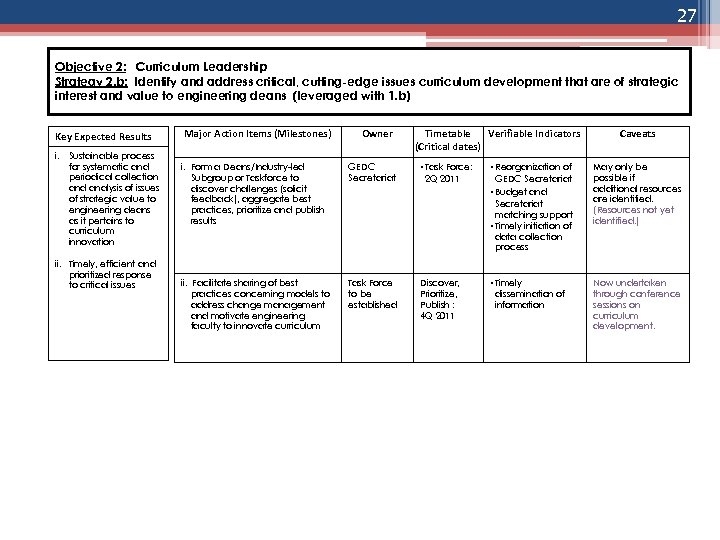
27 Objective 2: Curriculum Leadership Strategy 2. b: Identify and address critical, cutting-edge issues curriculum development that are of strategic interest and value to engineering deans (leveraged with 1. b) Key Expected Results i. Sustainable process for systematic and periodical collection and analysis of issues of strategic value to engineering deans as it pertains to curriculum innovation Major Action Items (Milestones) i. Form a Deans/Industry-led Subgroup or Taskforce to discover challenges (solicit feedback), aggregate best practices, prioritize and publish results Owner GEDC Secretariat Timetable Verifiable Indicators (Critical dates) • Task Force: 2 Q 2011 • Reorganization of GEDC Secretariat • Budget and Secretariat matching support • Timely initiation of data collection process Caveats May only be possible if additional resources are identified. (Resources not yet identified. ) ii. Timely, efficient and prioritized response to critical issues ii. Facilitate sharing of best practices concerning models to address change management and motivate engineering faculty to innovate curriculum Task Force to be established Discover, Prioritize, Publish : 4 Q 2011 • Timely dissemination of information Now undertaken through conference sessions on curriculum development.
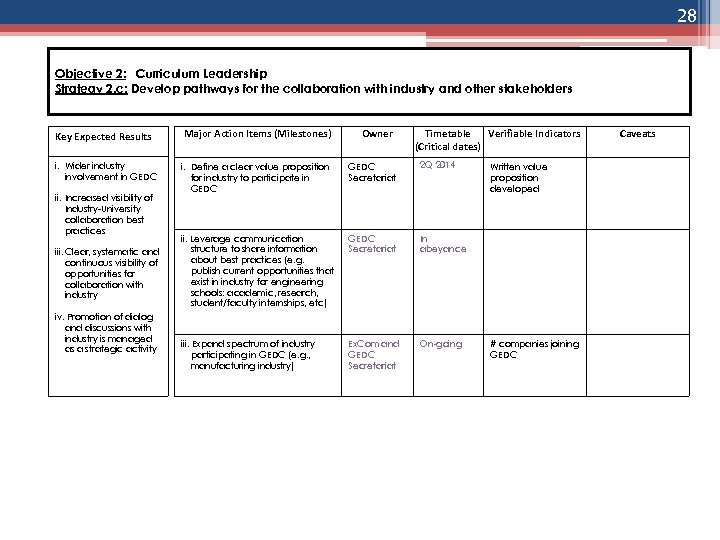
28 Objective 2: Curriculum Leadership Strategy 2. c: Develop pathways for the collaboration with industry and other stakeholders Key Expected Results Major Action Items (Milestones) i. Wider industry i. Define a clear value proposition GEDC Secretariat 2 Q 2014 ii. Leverage communication structure to share information about best practices (e. g. publish current opportunities that exist in industry for engineering schools: academic, research, student/faculty internships, etc) GEDC Secretariat In abeyance iii. Expand spectrum of industry participating in GEDC (e. g. , manufacturing industry) Ex. Com and GEDC Secretariat On-going involvement in GEDC ii. Increased visibility of Industry-University collaboration best practices iii. Clear, systematic and continuous visibility of opportunities for collaboration with industry iv. Promotion of dialog and discussions with industry is managed as a strategic activity for industry to participate in GEDC Owner Timetable Verifiable Indicators (Critical dates) Written value proposition developed # companies joining GEDC Caveats
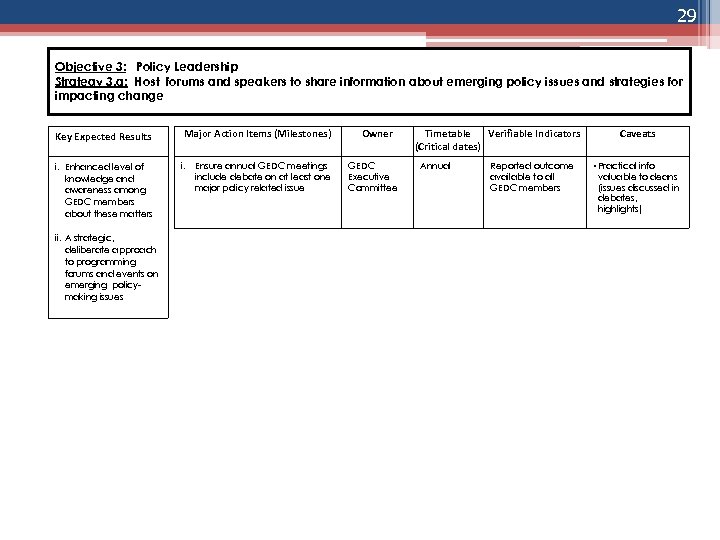
29 Objective 3: Policy Leadership Strategy 3. a: Host forums and speakers to share information about emerging policy issues and strategies for impacting change Key Expected Results Major Action Items (Milestones) i. Enhanced level of i. Ensure annual GEDC meetings knowledge and awareness among GEDC members about these matters ii. A strategic, deliberate approach to programming forums and events on emerging policymaking issues include debate on at least one major policy related issue Owner GEDC Executive Committee Timetable Verifiable Indicators (Critical dates) Annual Reported outcome available to all GEDC members Caveats • Practical info valuable to deans (issues discussed in debates, highlights)
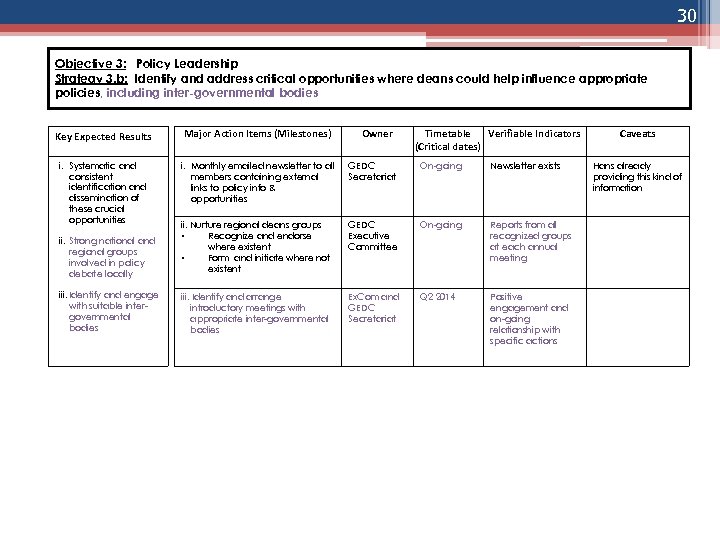
30 Objective 3: Policy Leadership Strategy 3. b: Identify and address critical opportunities where deans could help influence appropriate policies, including inter-governmental bodies Key Expected Results i. Systematic and consistent identification and dissemination of these crucial opportunities ii. Strong national and regional groups involved in policy debate locally iii. Identify and engage with suitable intergovernmental bodies Major Action Items (Milestones) Owner Timetable Verifiable Indicators (Critical dates) i. Monthly emailed newsletter to all GEDC Secretariat On-going Newsletter exists ii. Nurture regional deans groups • Recognize and endorse where existent • Form and initiate where not existent GEDC Executive Committee On-going Reports from all recognized groups at each annual meeting iii. Identify and arrange introductory meetings with appropriate inter-governmental bodies Ex. Com and GEDC Secretariat Q 2 2014 Positive engagement and on-going relationship with specific actions members containing external links to policy info & opportunities Caveats Hans already providing this kind of information
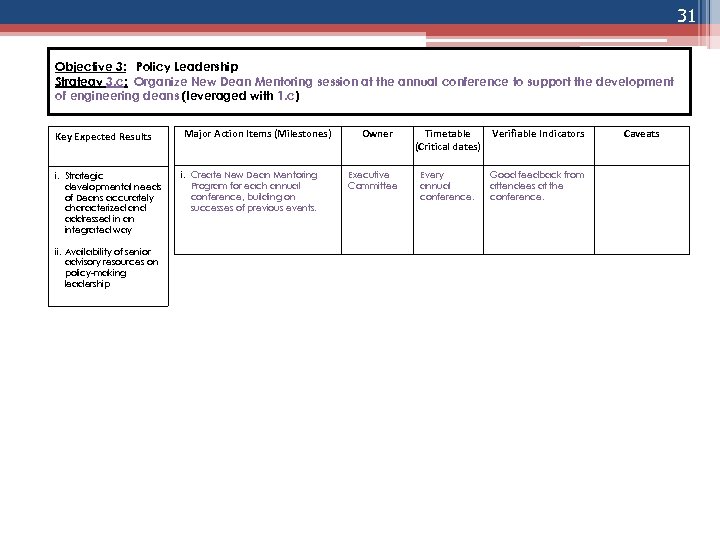
31 Objective 3: Policy Leadership Strategy 3. c: Organize New Dean Mentoring session at the annual conference to support the development of engineering deans (leveraged with 1. c) Key Expected Results Major Action Items (Milestones) i. Strategic i. Create New Dean Mentoring developmental needs of Deans accurately characterized and addressed in an integrated way ii. Availability of senior advisory resources on policy-making leadership Program for each annual conference, building on successes of previous events. Owner Executive Committee Timetable (Critical dates) Verifiable Indicators Every annual conference. Good feedback from attendees at the conference. Caveats
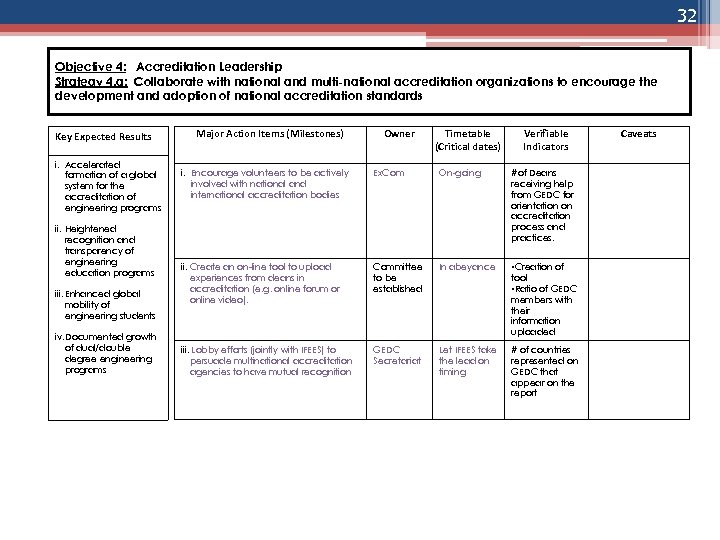
32 Objective 4: Accreditation Leadership Strategy 4. a: Collaborate with national and multi-national accreditation organizations to encourage the development and adoption of national accreditation standards Key Expected Results i. Accelerated formation of a global system for the accreditation of engineering programs Major Action Items (Milestones) Owner Timetable (Critical dates) i. Encourage volunteers to be actively Ex. Com On-going #of Deans receiving help from GEDC for orientation on accreditation process and practices. ii. Create an on-line tool to upload experiences from deans in accreditation (e. g. online forum or online video). Committee to be established In abeyance • Creation of iii. Lobby efforts (jointly with IFEES) to persuade multinational accreditation agencies to have mutual recognition GEDC Secretariat Let IFEES take the lead on timing involved with national and international accreditation bodies ii. Heightened recognition and transparency of engineering education programs iii. Enhanced global mobility of engineering students tool • Ratio of GEDC members with their information uploaded iv. Documented growth of dual/double degree engineering programs Verifiable Indicators # of countries represented on GEDC that appear on the report Caveats
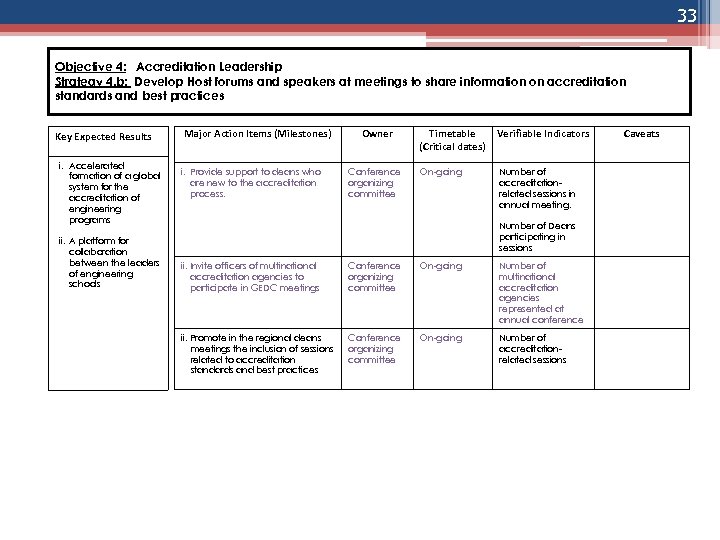
33 Objective 4: Accreditation Leadership Strategy 4. b: Develop Host forums and speakers at meetings to share information on accreditation standards and best practices Key Expected Results i. Accelerated formation of a global system for the accreditation of engineering programs Major Action Items (Milestones) i. Provide support to deans who are new to the accreditation process. Owner Conference organizing committee Timetable (Critical dates) Verifiable Indicators On-going Number of accreditationrelated sessions in annual meeting. Number of Deans participating in sessions ii. A platform for collaboration between the leaders of engineering schools ii. Invite officers of multinational accreditation agencies to participate in GEDC meetings Conference organizing committee On-going Number of multinational accreditation agencies represented at annual conference ii. Promote in the regional deans meetings the inclusion of sessions related to accreditation standards and best practices Conference organizing committee On-going Number of accreditationrelated sessions Caveats
34 GEDC global engineering deans council 2013 -2015 Strategic Direction
Скачать презентацию 1 GEDC global engineering deans council 2013 -2015
e2028905a1ed2b8d962b528ba57cda1e.ppt