


 Скачать презентацию 1 Formulating Strategy to Fill Identified Needs 2
edd08653409caf9a9a49f276e032e0a8.ppt
- Количество слайдов: 20
 1. Formulating Strategy to Fill Identified Needs 2. Segmentation and Positioning MARK 430 WEEK 4
 What we will cover this week. . . § Now we have all that information about customer behaviour and customer needs. . what are we going to do with it? 1. Formulate a strategy to fill the needs that we have identified 2. Determine which customers to target, and how to position our product/service vis a vis the competition
 Main strategy tool: SWOT analysis § Goal is to pursue opportunities that use your company’s strengths, while avoiding threats and overcoming weaknesses (Urban p 45)
 Strategy formulation § Identify and rank strengths and weaknesses in your company / organization § Technique: § list key marketing success factors eg. § high product quality § customer loyalty § patent protection § rank your position relative to that of your competition against these factors § much worse, equal, better, much better § Objective is to recognize, then build on your strengths and overcome your weaknesses
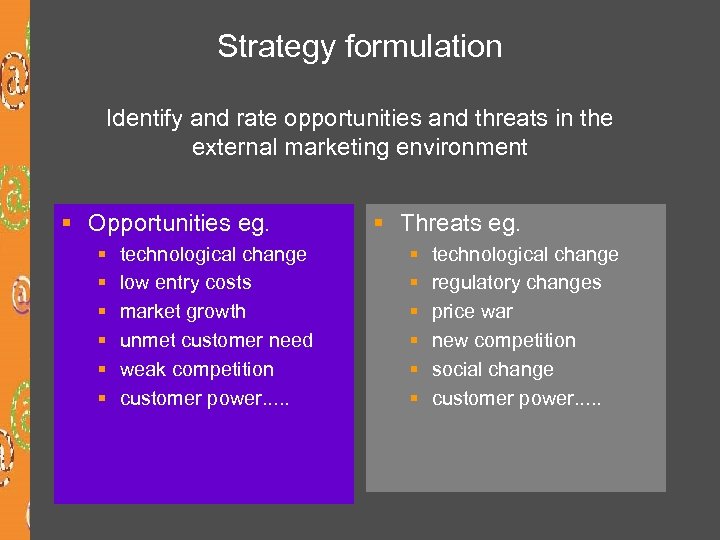 Strategy formulation Identify and rate opportunities and threats in the external marketing environment § Opportunities eg. § § § technological change low entry costs market growth unmet customer need weak competition customer power. . . § Threats eg. § § § technological change regulatory changes price war new competition social change customer power. . .
 Customer power: both threat and opportunity § More information, more options, simpler transactions § More knowledge, more sophistication § Threat to traditional marketing tactics - push based, one-way § marketers must “make” customers buy § Opportunity to attract the “new” customer § trust-based marketing § build mutually beneficial relationship
 Which strategic approach to follow? § Which one to use: § what kind of customers do you have? § what kind of product/service are you providing? § Push-based strategy § commodities § price sensitive § deal seekers § Pull (trust-based) strategy § expensive / complex product § information seeking customers § customers that value long-term relationship § The web is fundamentally a pull medium rather than a push medium § Agree?
 Trust based marketing § The web is really good an enabling trust building (a paradox? ) § HPs Online Advisor § Acts as an online advisor, that helps people acquire products and services for their home. § How does HP benefit?
 Benefits of trust-based marketing § Fits the nature of the web medium § Ebay - ratings of buyers and sellers without interference from EBay § Amazon - customer ratings of products (does Amazon censor? ) § Collaborative filtering § Reviews, customer ratings sites, blogs § Less churn (cheaper to keep a customer than acquire a new one) § Cheaper to serve.
 What we will cover this week. . . § Now we have all that information about customer behaviour and customer needs. . what are we going to do with it? 1. Formulate a strategy to fill the needs that we have identified 2. Determine which customers to target, and how to position our product/service vis a vis the competition
 Which customers will you serve? Segmentation and Targeting § Marketing segmentation § the process of aggregating individuals or businesses with similar characteristics § that relate to the use, consumption, or benefits of a product or service. § Targeting § the process of selecting the market segments that are most attractive to the firm
 Why segment? § Customers prefer “custom” products § § The market of one? Cost How many segments should we deliver? What characteristics do we use to group people into market segments § How do we know we are reaching those segments?
 Traditional marketing complaint § I know I am wasting 50% of my advertising budget, but I don’t know which 50% § Did the right segment see the ad? § Internet technologies can answer that question much more effectively than traditional advertising media
 The Internet advantage § The Internet is the marketer’s dream § Ad server companies (eg. Double. Click) compile and serve much narrower consumer segments than mass media § Cost to deliver an ad is much smaller § User registration info and cookies provide specific user data § including what they did after they saw the ad § immediately § later
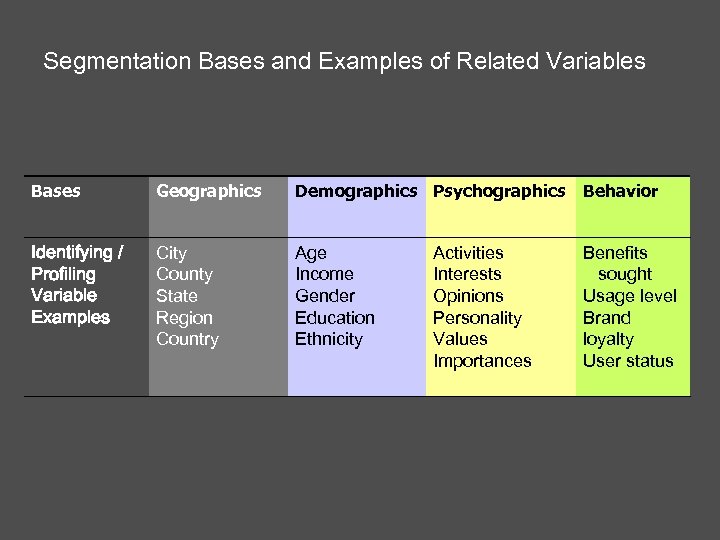 Segmentation Bases and Examples of Related Variables Bases Geographics Demographics Psychographics Behavior Identifying / Profiling Variable Examples City County State Region Country Age Income Gender Education Ethnicity Benefits sought Usage level Brand loyalty User status Activities Interests Opinions Personality Values Importances
 VALS § An example of a Marketing strategy tool (VALS stands for values and lifestyle, but now focuses on personality) § segments the market on the basis of personality traits § traits assumed to drive consumer behaviour § uses a survey instrument § The VALS personality types § Primary and secondary types
 After Segmentation > Positioning § Product positioning takes place within a target market segment § Position is based on consumer perception § What we need to know: § What product dimensions/attributes do consumers use to evaluate? § How important are these when decisions are made? § How do we and our competitors sit relative to these dimensions § One tool we can use is a Perceptual Map
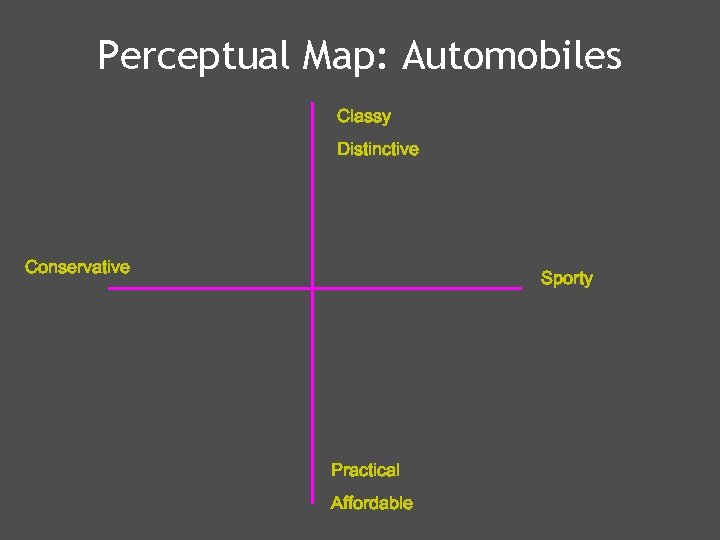 Perceptual Map: Automobiles Classy Distinctive Conservative Sporty Practical Affordable
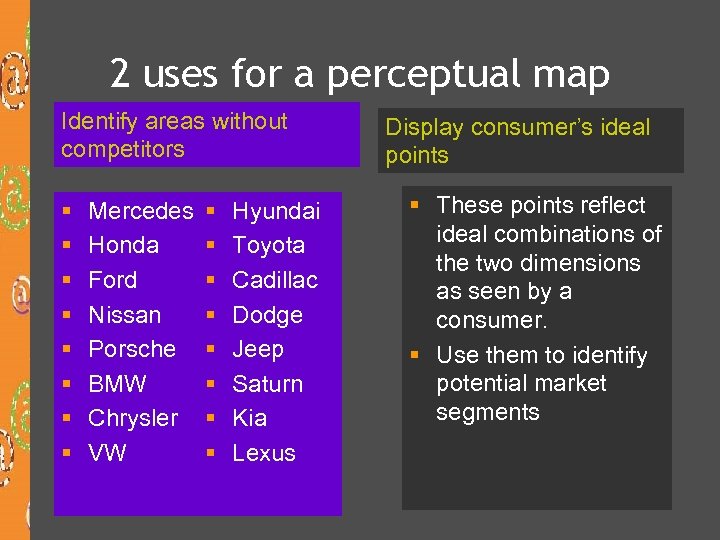 2 uses for a perceptual map Identify areas without competitors § § § § Mercedes Honda Ford Nissan Porsche BMW Chrysler VW § § § § Hyundai Toyota Cadillac Dodge Jeep Saturn Kia Lexus Display consumer’s ideal points § These points reflect ideal combinations of the two dimensions as seen by a consumer. § Use them to identify potential market segments
 § The Internet’s big promise is individualized targeting giving individual consumers exactly what they want at the right time and place.