 Скачать презентацию 1 Fiscal Decentralisation in Ukraine 2 Table
355e6e87cc2ab3f06d98690e25ac256d.ppt
- Количество слайдов: 28



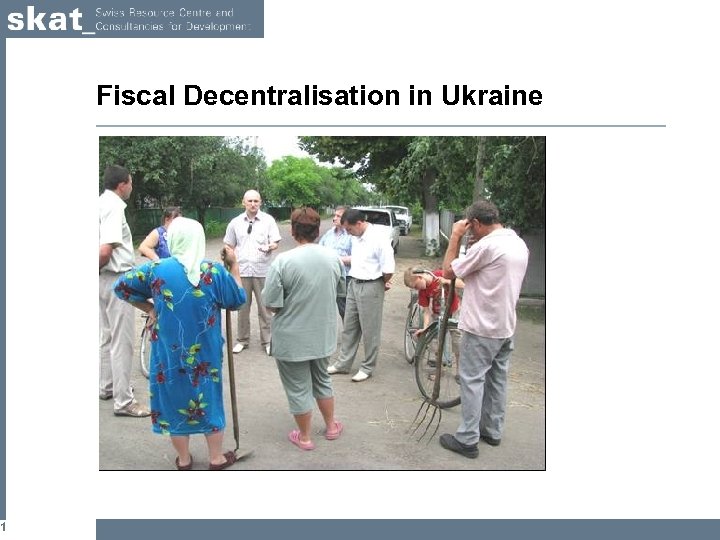
1 Fiscal Decentralisation in Ukraine
2 Table of Contents n Shortly about Skat. . . n Our mandate in Ukraine n Fiscal Decentralisation in Ukraine – the situation n Project Des. Pro – Swiss Decentralisation Support Programme in Ukraine n First results n Outlook into the future
3 Shortly about Skat. . . n Skat is an independent Swiss resource centre and consultancy company n Work for 30 years in developing countries and countries in transition (CIS & South- East Europe) n Work in: Governance & decentralisation, knowledge management, water supply & environmental sanitation, building & settlements, mobility & transport, and solid waste management n Strategy development, assessments & evaluations, project planning, backstopping, implementation, trainings, applied research
4 Shortly about Skat. . . n 16 professionals in CH n 20 local staff members abroad n Partners: SDC & other bilateral agencies, UN, international NGOs (Helvetas, Caritas) n HQ based in St. Gallen n 5 large implementation projects abroad n 80 consultancies per year
5 Our mandate in Ukraine n For 8 years, we have been active in Ukraine with advisory services on behalf of SDC n Main clients/partners are SDC and UNDP n Since 2006, we implement a decentralisation support project, funded by SDC Political, administrative and fiscal decentralisation
6 Fiscal Decentralisation in Ukraine Situation: n Generally centralised system n Yet, there attempts to decentralise n In 2001, Ukraine‘s Budget Code was introduced n Brought in rules & principles of public expenditure management which demanded a highly decentralised government system n With significant autonomy of oblasts, rayons and cities (of oblast category)
7 Fiscal Decentralisation in Ukraine Situation: n The Budget reforms were designed in a political environment, which was highly hostile to the idea of decentralisation n There was lack of clear political vision and motivation for such reforms n It was all about loosing political & financial influence n Political uncertainty around division of responsibilities among levels of government
8 Fiscal Decentralisation in Ukraine Situation: n Only a ‘light’ version of the Budget reform survived (new equalisation scheme without defined expenditure responsibilities) n Fiscal decentralisation since 2001 remains incomplete: Mismatch between centrally imposed input norms & budget allocation rules Insufficient local revenue autonomy Insufficient administrative autonomy of decision at sub-national level
9 Fiscal Decentralisation in Ukraine Situation: Inefficiency of the current transfer formula, which is open to manipulation and stimulates inefficient budget spending Need to clarify and improve division of functions between governmental levels Weaknesses in regulation of investment budgets and sub-national borrowing
10 Fiscal Decentralisation in Ukraine Situation: n Current uncertain & contradictory system creates major and growing stress to all levels of government; they have to cope somehow. Central government is stressed by an increase of responsibility to calculate budget transfers to local governmental levels (intermediary role of the oblast level was given up) Local governments are stressed; are not able to fund services adequately; lack of funds
11 Fiscal Decentralisation in Ukraine Situation: n All levels of government use different strategies of how to deal with the system n This brings fiscal decentralisation back to times before the 2001 Budget Code reform n Recently, various members of the central government back up this trend and lobby for laws & regulations which support a highly centralised system again
12 Fiscal Decentralisation in Ukraine Situation: n Difficult taxation and revenue sharing situation: Unclear intergovernmental division of responsibilities – insufficient revenue sharing scheme which does not compensate local governments for central policies Local governments depend totally on central budget transfers They have very little possibilities to raise local taxes
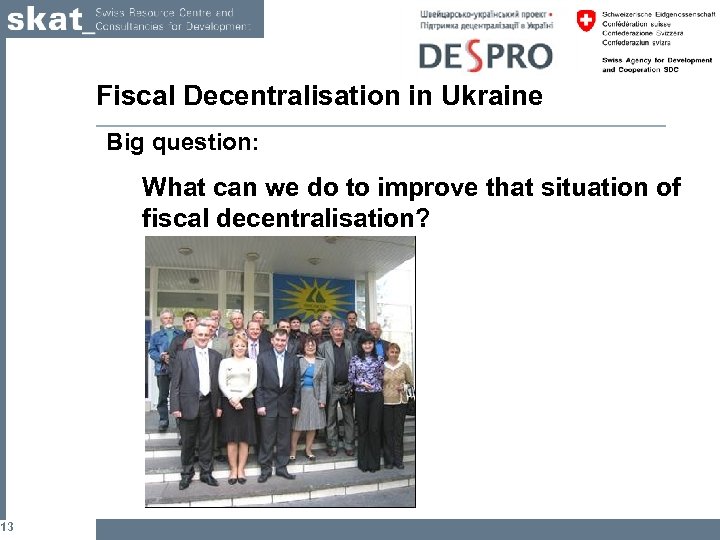
13 Fiscal Decentralisation in Ukraine Big question: What can we do to improve that situation of fiscal decentralisation?
14 Swiss Decentralisation Support Programme General information: Official request from the President of Ukraine for support in decentralisation to Switzerland Project funded by SDC - Swiss Agency for Development and Cooperation Build-up project phase 2007 – 2009; next phase from 2010 Assessment and concept of combined approach – systemic & sectoral In the past, positive experiences with “social mobilisation” to improve water supply at local level (village communities)
15 Swiss Decentralisation Support Programme Project goal: To ensure the provision of effective, efficient, and affordable services in the area of water supply and social services in the frame of decentralised structures. Overall objective: To strengthen good governance and effective local development in Ukraine; To enhance democratic processes and to improve the quality of services.
16 Swiss Decentralisation Support Programme How does it have a positive impact on the conditions in Ukraine? n. Capacity building for policy implementation / service delivery n. Focus on decentralisation (political, fiscal, administrative) n. Working together closely with existing local governments to implement project activities (no parallel project structure) n. Bottlenecks become visible & are addressed
17 Swiss Decentralisation Support Programme n. Working at several administrative / political levels: National Oblast Rayon Villages and communities
18 Swiss Decentralisation Support Programme At national level To support the Government of Ukraine in its efforts to form and strengthen a ‘National Agenda’ on decentralisation and its task to coordinate and harmonise national policy initiatives: Decentralisation Coordination Network, which meets regularly. It includes non-state experts and ministerial representatives It looks into concrete technical issues for implementing reforms Support to NAPA (National Academy of Public Administration) for developing specialised courses for public servants
19 Swiss Decentralisation Support Programme At regional level To improve the ability of oblast, rayon, and village authorities to plan, finance, implement and coordinate affordable services in a participatory & innovative manner. 2 pilot regions: Crimea and Vinnytsia (western Ukraine)
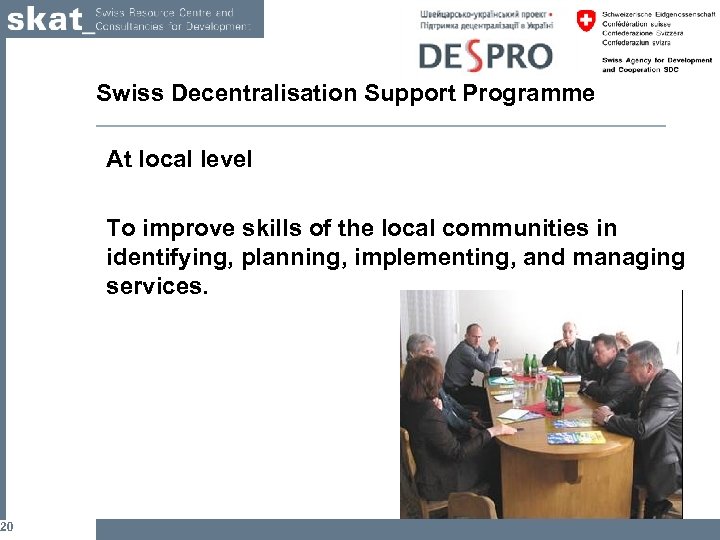
20 Swiss Decentralisation Support Programme At local level To improve skills of the local communities in identifying, planning, implementing, and managing services.
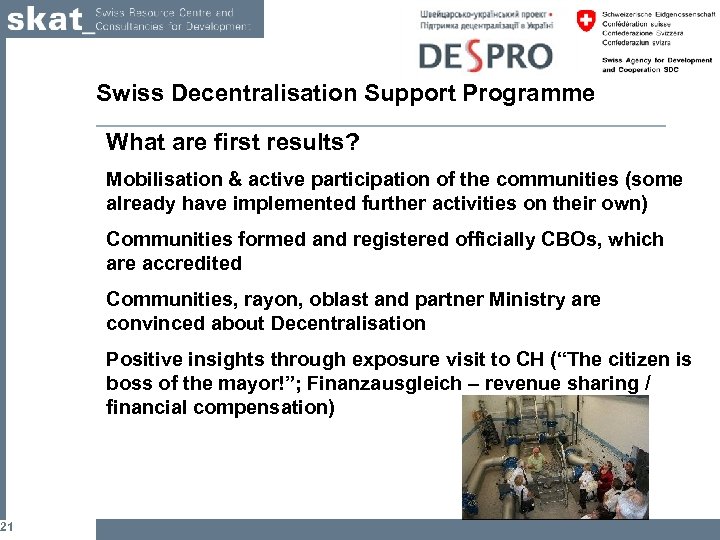
21 Swiss Decentralisation Support Programme What are first results? Mobilisation & active participation of the communities (some already have implemented further activities on their own) Communities formed and registered officially CBOs, which are accredited Communities, rayon, oblast and partner Ministry are convinced about Decentralisation Positive insights through exposure visit to CH (“The citizen is boss of the mayor!”; Finanzausgleich – revenue sharing / financial compensation)
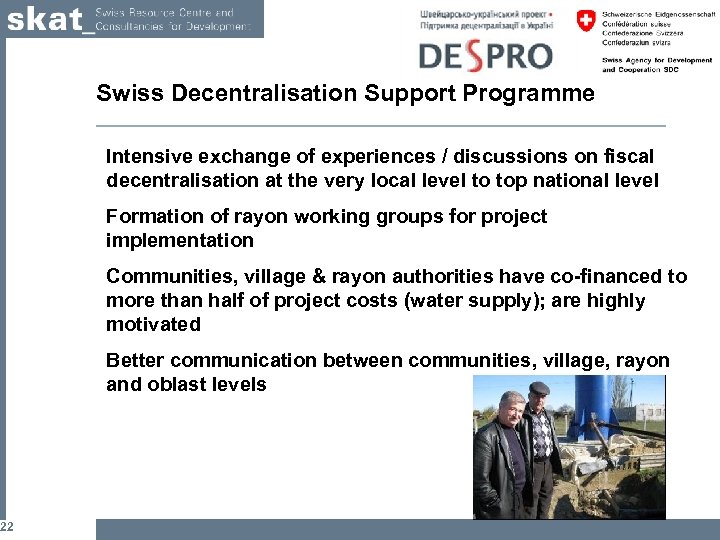
22 Swiss Decentralisation Support Programme Intensive exchange of experiences / discussions on fiscal decentralisation at the very local level to top national level Formation of rayon working groups for project implementation Communities, village & rayon authorities have co-financed to more than half of project costs (water supply); are highly motivated Better communication between communities, village, rayon and oblast levels
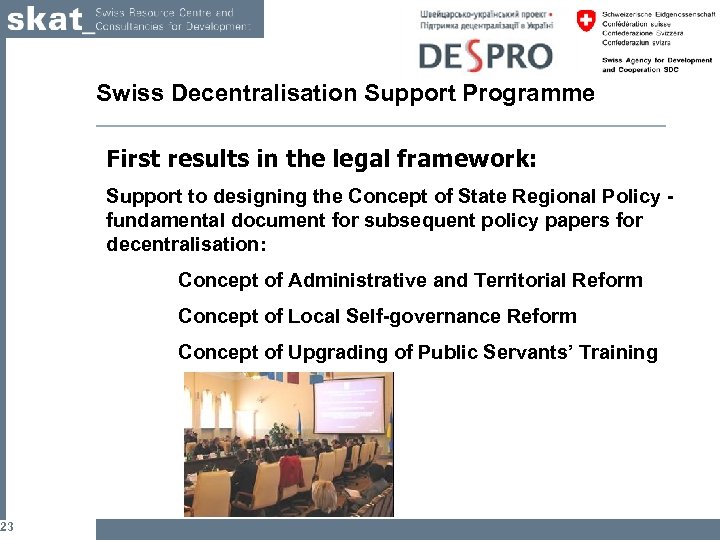
23 Swiss Decentralisation Support Programme First results in the legal framework: Support to designing the Concept of State Regional Policy fundamental document for subsequent policy papers for decentralisation: Concept of Administrative and Territorial Reform Concept of Local Self-governance Reform Concept of Upgrading of Public Servants’ Training
24 Fiscal Decentralisation in Ukraine Outlook into the future: Ukraine‘s public administration suffers from a heavy centralisation Attempts to decentralise have rather failed Any change processes have to tackle the route causes of failure in the political process Politicians should introduce a participation process, whereby Ukrainians have a say in how to best decentralise public functions to sub-national governments to improve services delivery
25 Fiscal Decentralisation in Ukraine Outlook into the future: The needs of decentralisation reform are less “technological”, but rather “political”: most stakeholders have access to information about theoretical principles of decentralisation & good international examples, but their capacity to cooperate in the decentralisation process is lagging behind. Top-down communication of decision-makers; manipulating manner Inter-ministerial working groups with high-rank officials rarely function and produce constructive outputs
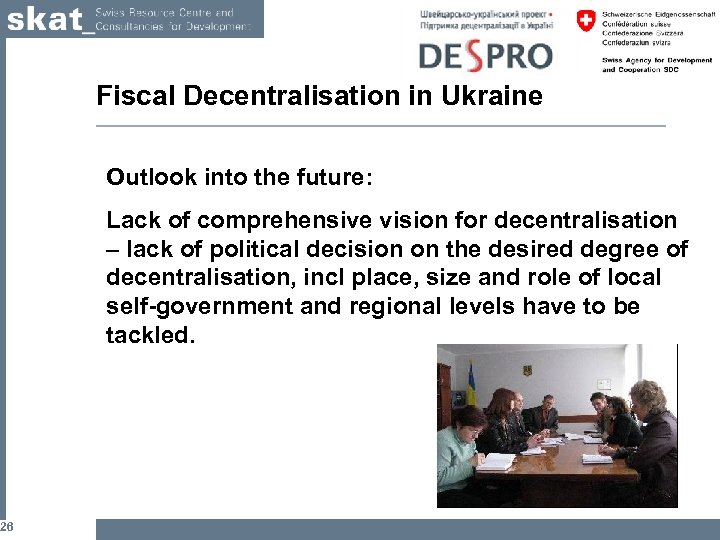
26 Fiscal Decentralisation in Ukraine Outlook into the future: Lack of comprehensive vision for decentralisation – lack of political decision on the desired degree of decentralisation, incl place, size and role of local self-government and regional levels have to be tackled.
27 Fiscal Decentralisation in Ukraine Conclusion: n Fiscal decentralisation is not only a question of transferring resources to the different levels of local government. It is also about the extent to which local governments are empowered, about how much authority and control they exercise over the use and management of devolved financial resources, measured in terms of their control over (1) the provision of the basket of local services for which they are responsible; (2) the level of local taxes and revenues (base, rates & collection); and (3) the grant resources with which they finance the delivery of local public services. (UNDP: Fiscal Decentralisation and Poverty Reduction, 2005)
28 Contact: Claudia Schneider Institutional Development Specialist, Skat claudia. schneider@skat. ch www. skat. ch
Скачать презентацию 1 Fiscal Decentralisation in Ukraine 2 Table
355e6e87cc2ab3f06d98690e25ac256d.ppt