 Скачать презентацию 1 ESMBA 06 Finance 5405 Financial Management
bc76c4057a4a36823a6e81c1773e395f.ppt
- Количество слайдов: 44



1 ESMBA 06 Finance 5405 Financial Management
2 Team 07 Sushil Bhattachan Christina Danver Ben Gumpert Adan Montoya Gurinder Virdi
3 Case 7 Make or Buy Analysis Dixie Holdings n Introduction n Assumptions n Analysis n Conclusions n Recommendations
4 I. Introduction n Company Overview n Current Situation n Analysis’ Objectives n Financial theory applied in case
5 Company Overview n Dixie Holding l Dixie Air l Dixie Properties l Dixie Support n Dixie Support provides support services to Holding, including print services
6 Current Situation n Dixie Support not capable of accommodating printing needs of Holding n $830, 000 in 2003 for commercial print services n $293, 000 can be brought in-house n EBIT of $50, 000 in 2004 and EBIT of $75, 000 in 2005 in local commercial printing (external business)
7 Analysis’ Objectives n Should Dixie Support outsource or expand print shop? n 3 Alternatives for Dixie Support l Close print shop completely and use outside vendors for all printing. l Expand print shop and perform all feasible printing in-house. l Expand print shop as above and enter commercial printing business.
8 Financial Theory n Make vs. Buy Analysis l Purpose l Choosing a discount rate (riskiness) or cost of capital (CC) n Project financial indicators l NPV (dollar contribution of project) l IRR (expected rate of return) l MIRR (forces reinvestment at cost of capital)
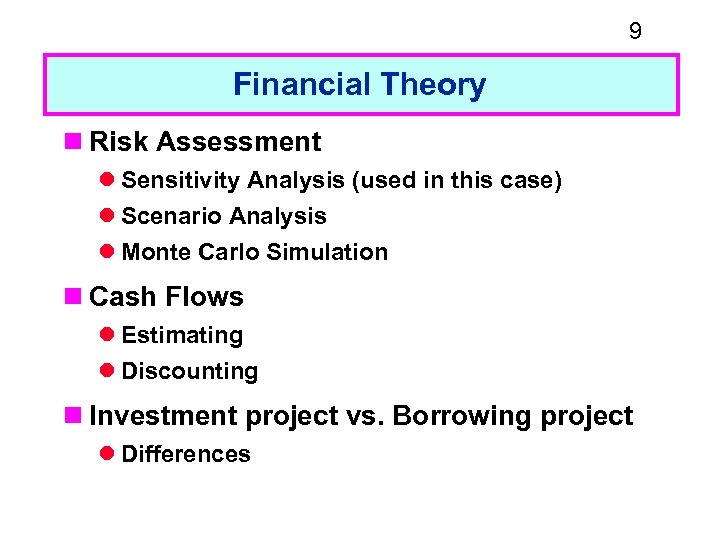
9 Financial Theory n Risk Assessment l Sensitivity Analysis (used in this case) l Scenario Analysis l Monte Carlo Simulation n Cash Flows l Estimating l Discounting n Investment project vs. Borrowing project l Differences
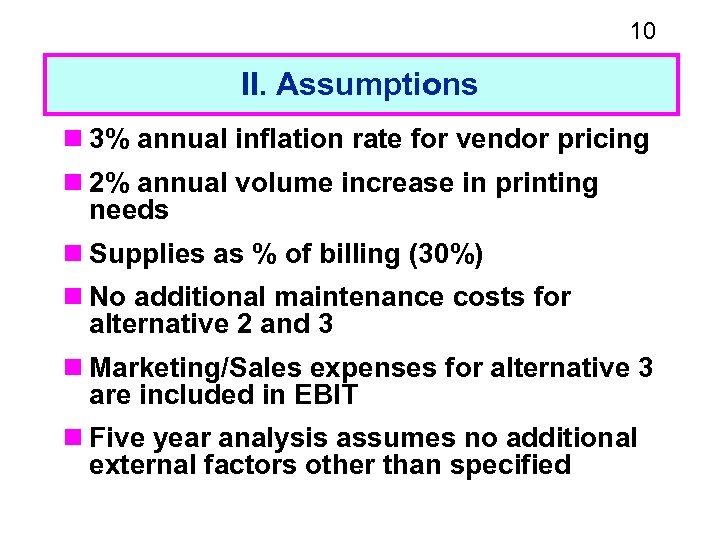
10 II. Assumptions n 3% annual inflation rate for vendor pricing n 2% annual volume increase in printing needs n Supplies as % of billing (30%) n No additional maintenance costs for alternative 2 and 3 n Marketing/Sales expenses for alternative 3 are included in EBIT n Five year analysis assumes no additional external factors other than specified
11 III. Analysis n Overview n Summary of case information n Alternatives’ analysis
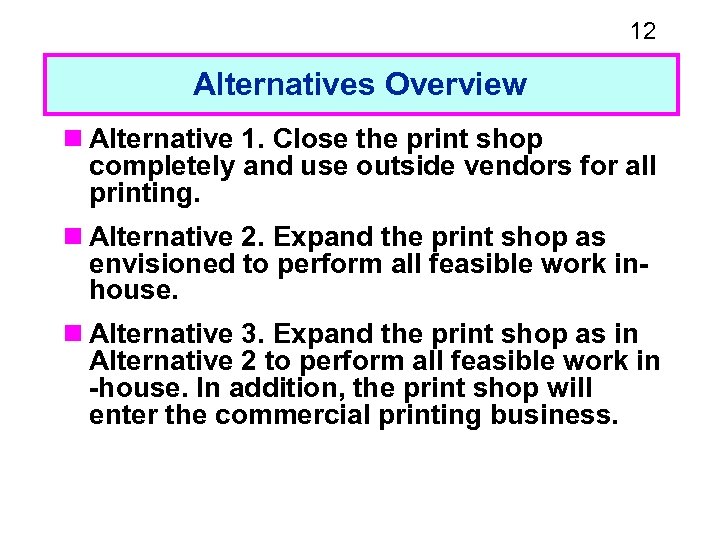
12 Alternatives Overview n Alternative 1. Close the print shop completely and use outside vendors for all printing. n Alternative 2. Expand the print shop as envisioned to perform all feasible work inhouse. n Alternative 3. Expand the print shop as in Alternative 2 to perform all feasible work in -house. In addition, the print shop will enter the commercial printing business.
13 Case Information n General l Cost of Capital l Assumptions n Current costs and values for alternatives 1, 2 and 3 n New costs for alternatives 2 and 3 n Incremental savings for alternatives 2 and 3 n External Revenues for alternative 3
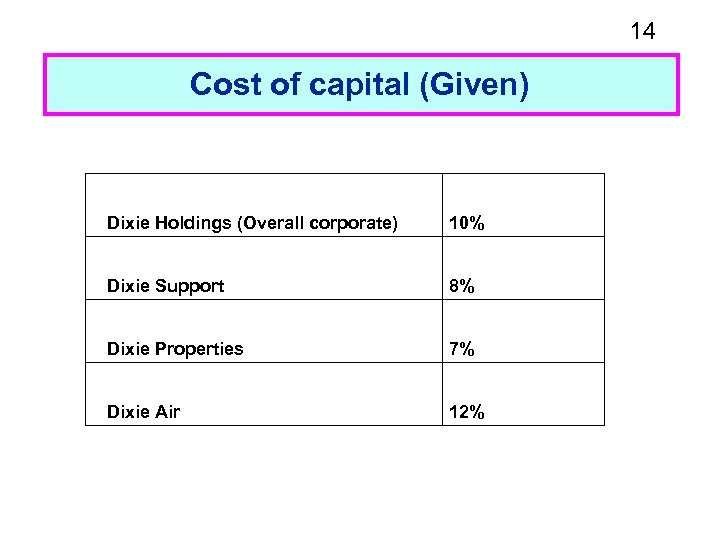
14 Cost of capital (Given) Dixie Holdings (Overall corporate) 10% Dixie Support 8% Dixie Properties 7% Dixie Air 12%
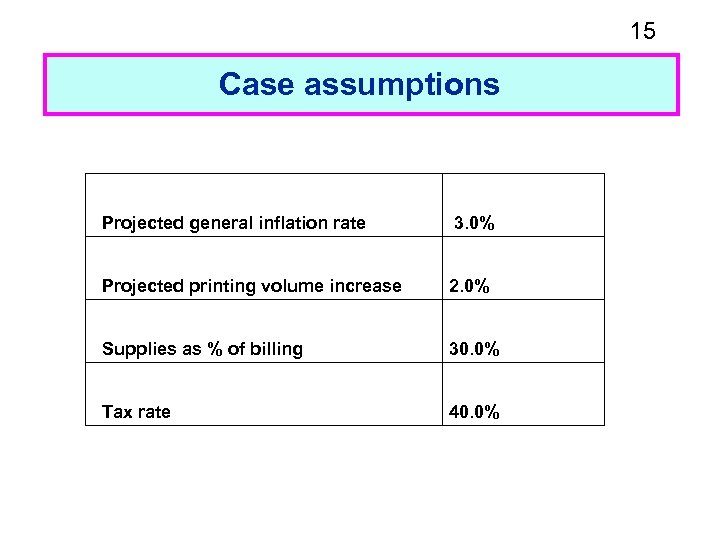
15 Case assumptions Projected general inflation rate 3. 0% Projected printing volume increase 2. 0% Supplies as % of billing 30. 0% Tax rate 40. 0%
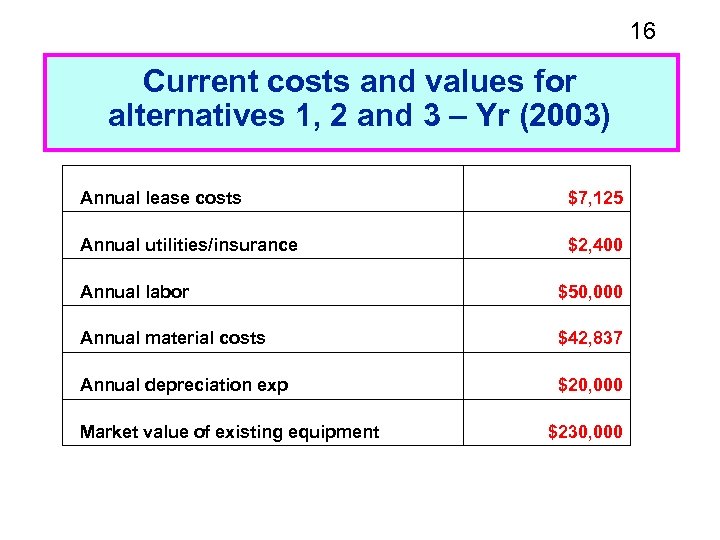
16 Current costs and values for alternatives 1, 2 and 3 – Yr (2003) Annual lease costs $7, 125 Annual utilities/insurance $2, 400 Annual labor $50, 000 Annual material costs $42, 837 Annual depreciation exp $20, 000 Market value of existing equipment $230, 000
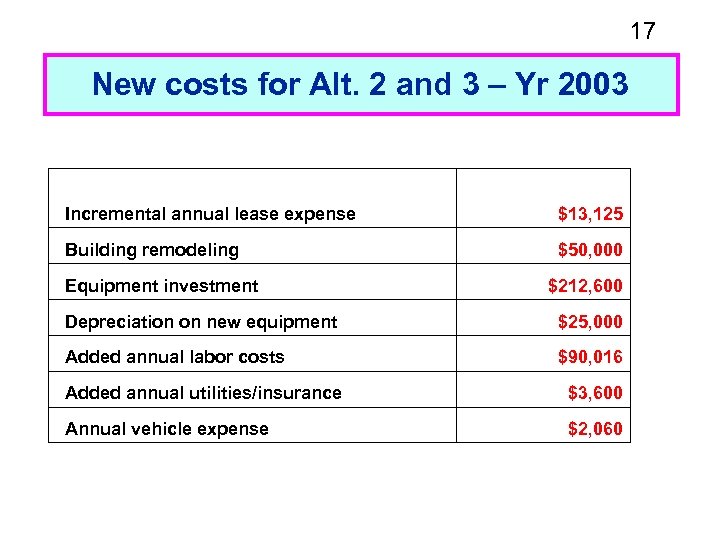
17 New costs for Alt. 2 and 3 – Yr 2003 Incremental annual lease expense $13, 125 Building remodeling $50, 000 Equipment investment $212, 600 Depreciation on new equipment $25, 000 Added annual labor costs $90, 016 Added annual utilities/insurance $3, 600 Annual vehicle expense $2, 060
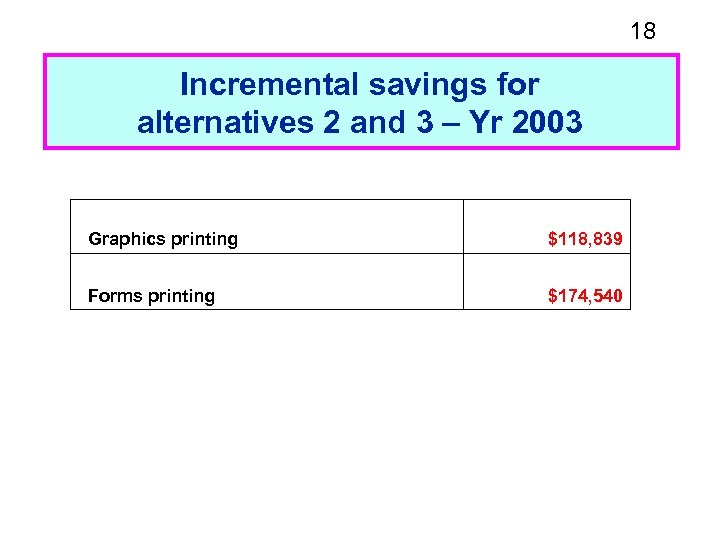
18 Incremental savings for alternatives 2 and 3 – Yr 2003 Graphics printing $118, 839 Forms printing $174, 540
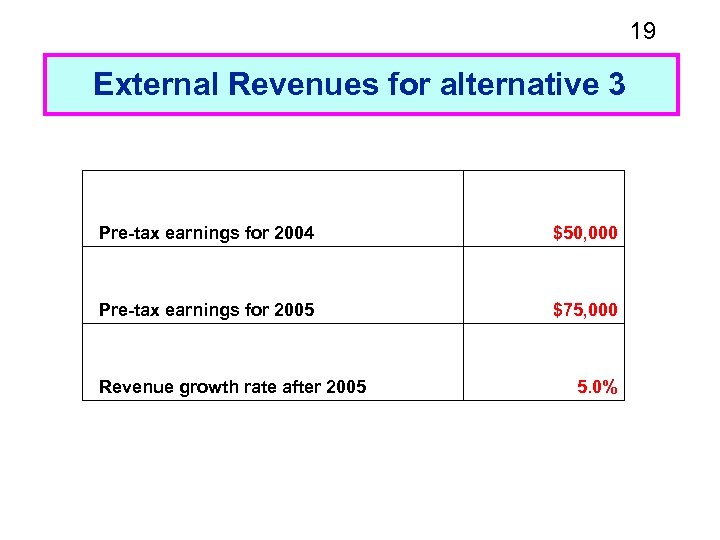
19 External Revenues for alternative 3 Pre-tax earnings for 2004 $50, 000 Pre-tax earnings for 2005 $75, 000 Revenue growth rate after 2005 5. 0%
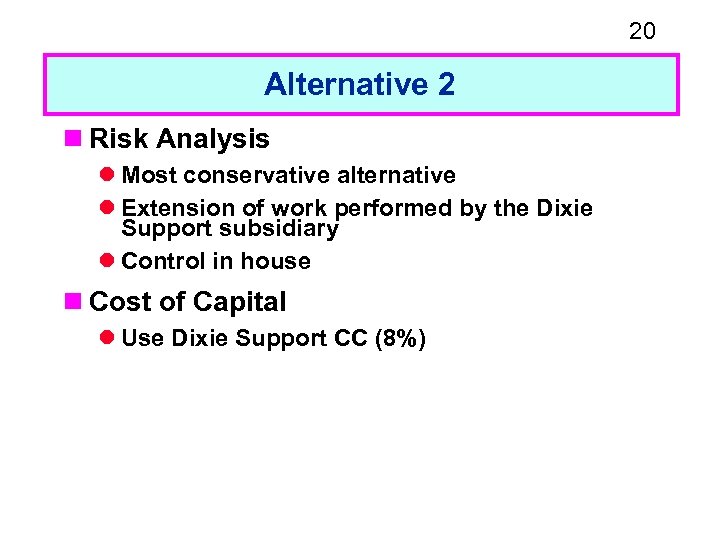
20 Alternative 2 n Risk Analysis l Most conservative alternative l Extension of work performed by the Dixie Support subsidiary l Control in house n Cost of Capital l Use Dixie Support CC (8%)
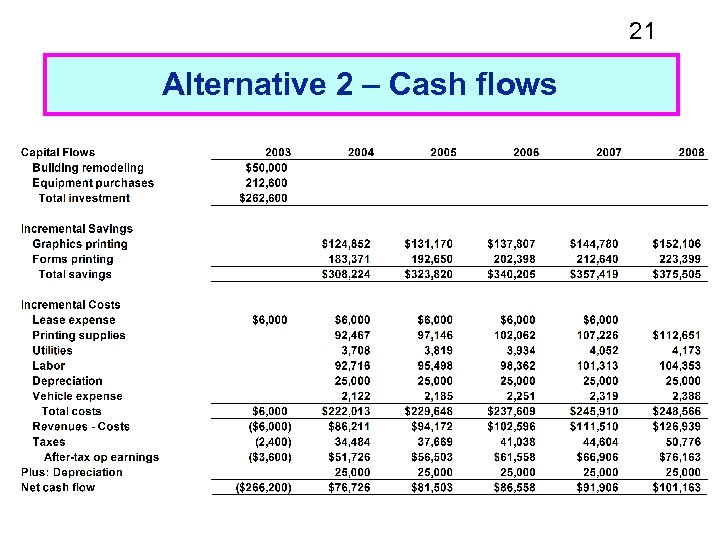
21 Alternative 2 – Cash flows
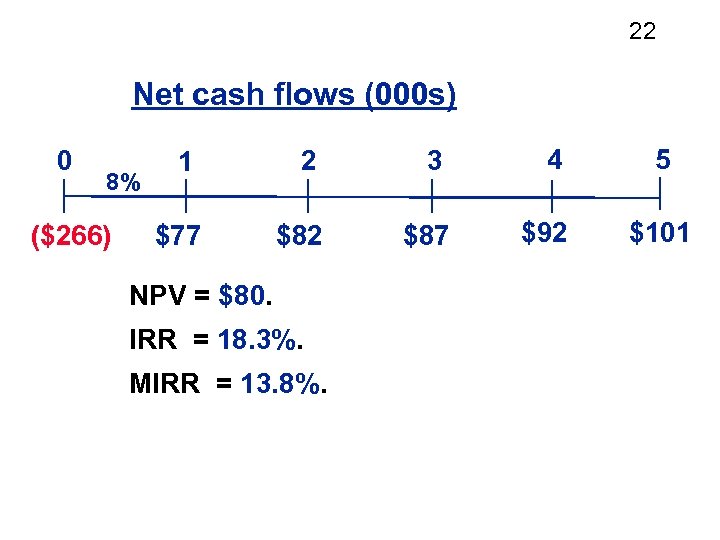
22 Net cash flows (000 s) 0 ($266) 2 3 4 $77 8% 1 $82 $87 $92 NPV = $80. IRR = 18. 3%. MIRR = 13. 8%. 5 $101
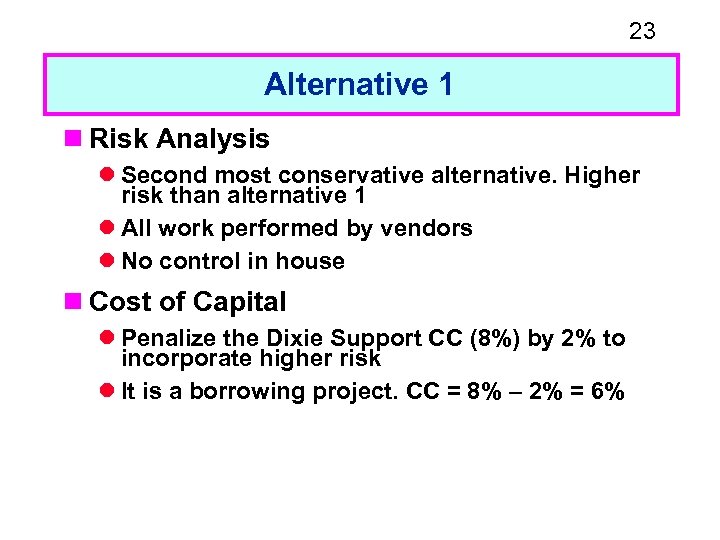
23 Alternative 1 n Risk Analysis l Second most conservative alternative. Higher risk than alternative 1 l All work performed by vendors l No control in house n Cost of Capital l Penalize the Dixie Support CC (8%) by 2% to incorporate higher risk l It is a borrowing project. CC = 8% – 2% = 6%
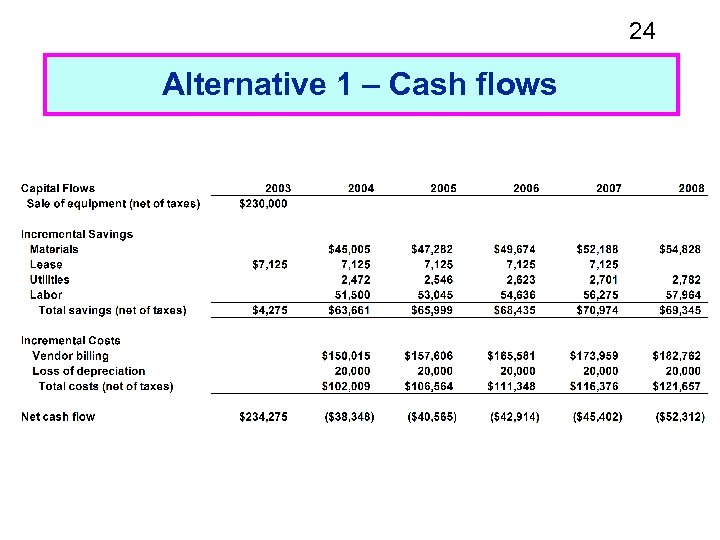
24 Alternative 1 – Cash flows
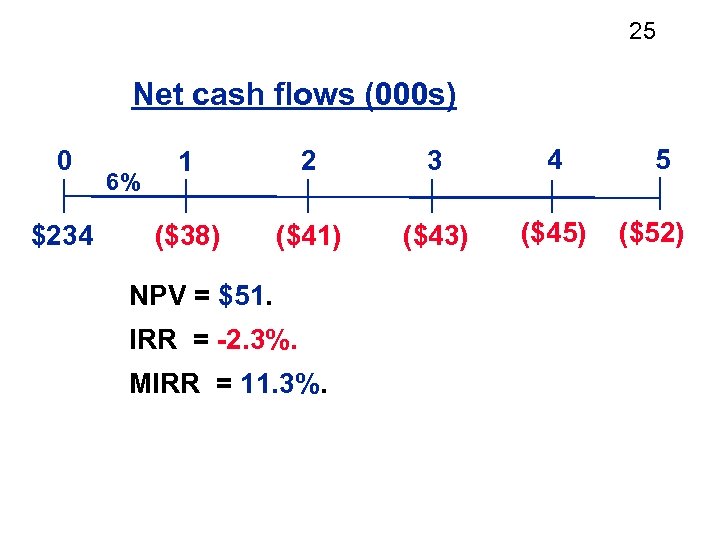
25 Net cash flows (000 s) 0 $234 2 3 4 ($38) 6% 1 ($41) ($43) ($45) NPV = $51. IRR = -2. 3%. MIRR = 11. 3%. 5 ($52)
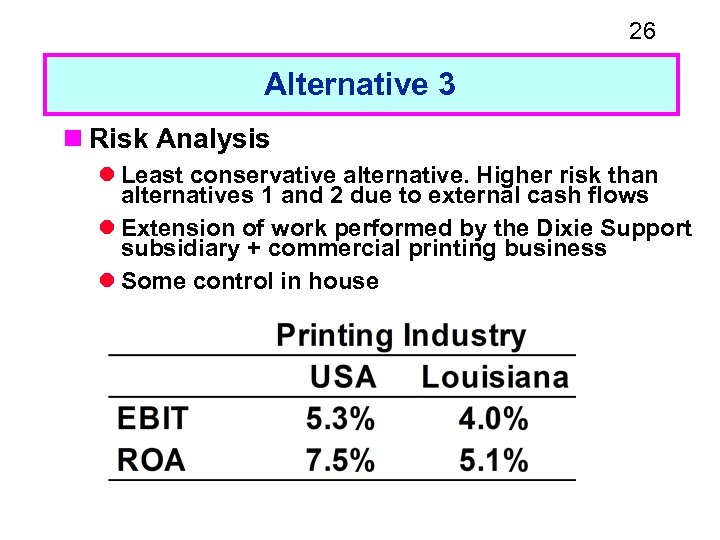
26 Alternative 3 n Risk Analysis l Least conservative alternative. Higher risk than alternatives 1 and 2 due to external cash flows l Extension of work performed by the Dixie Support subsidiary + commercial printing business l Some control in house
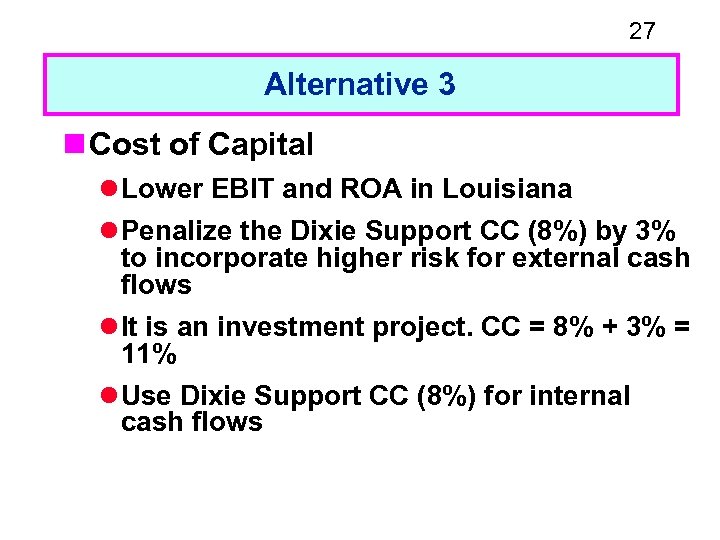
27 Alternative 3 n Cost of Capital l Lower EBIT and ROA in Louisiana l Penalize the Dixie Support CC (8%) by 3% to incorporate higher risk for external cash flows l It is an investment project. CC = 8% + 3% = 11% l Use Dixie Support CC (8%) for internal cash flows
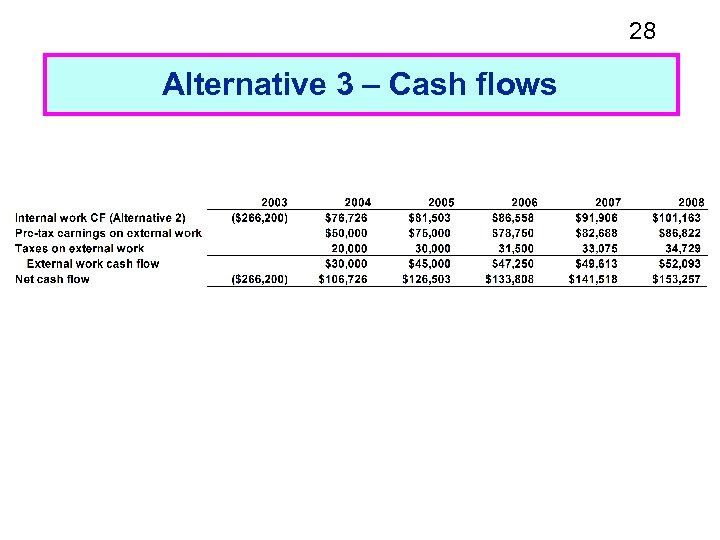
28 Alternative 3 – Cash flows
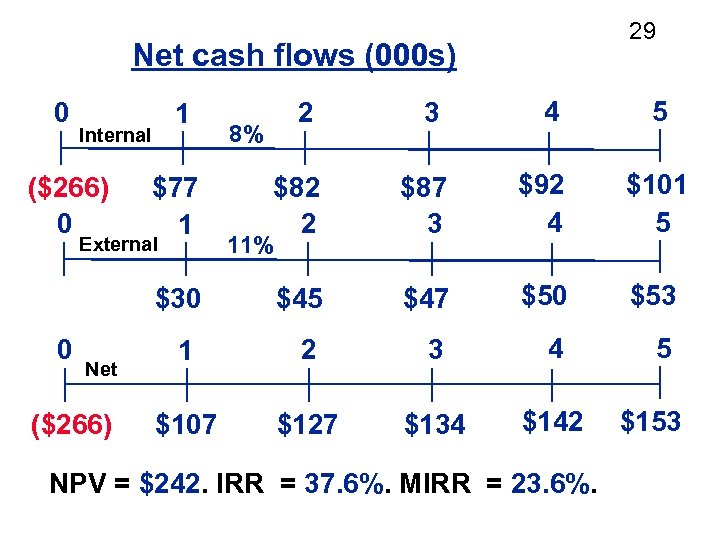
29 Net cash flows (000 s) 2 3 4 $82 2 $87 3 $92 4 $101 5 $30 0 $45 $47 $50 $53 1 2 3 4 5 $107 $127 $134 $142 1 Internal ($266) 0 $77 1 External 0 Net ($266) 8% 11% NPV = $242. IRR = 37. 6%. MIRR = 23. 6%. 5 $153
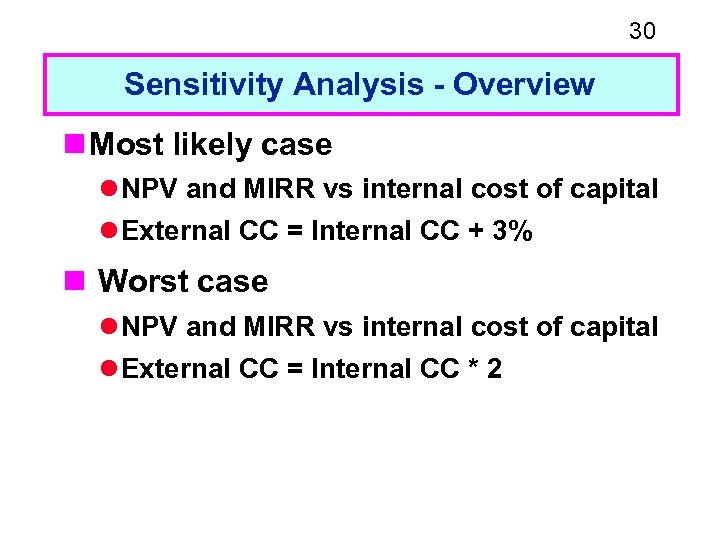
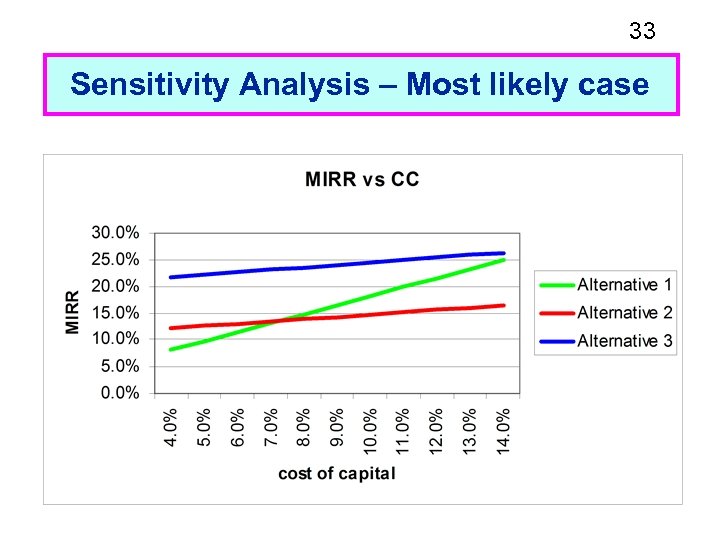
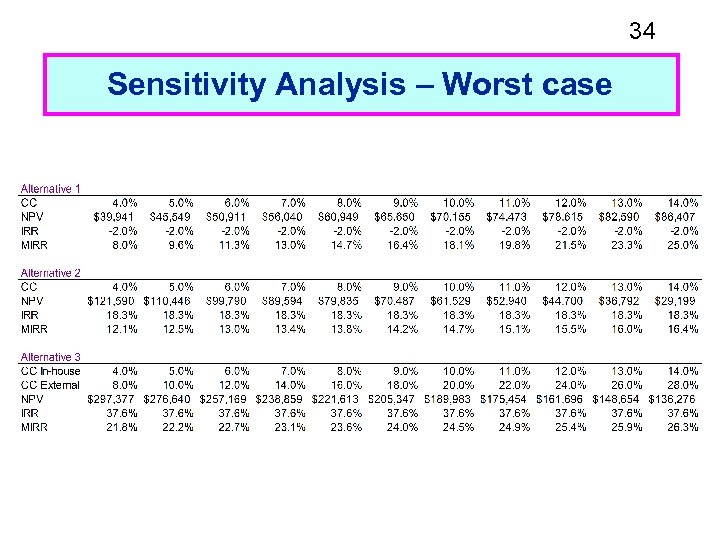
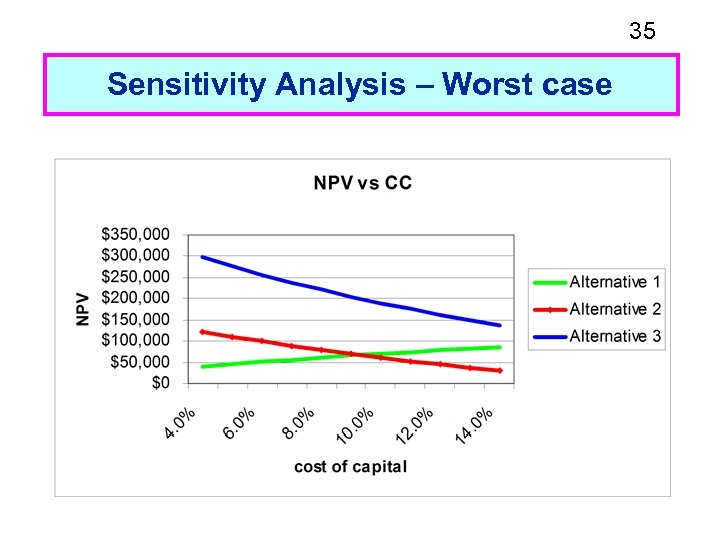
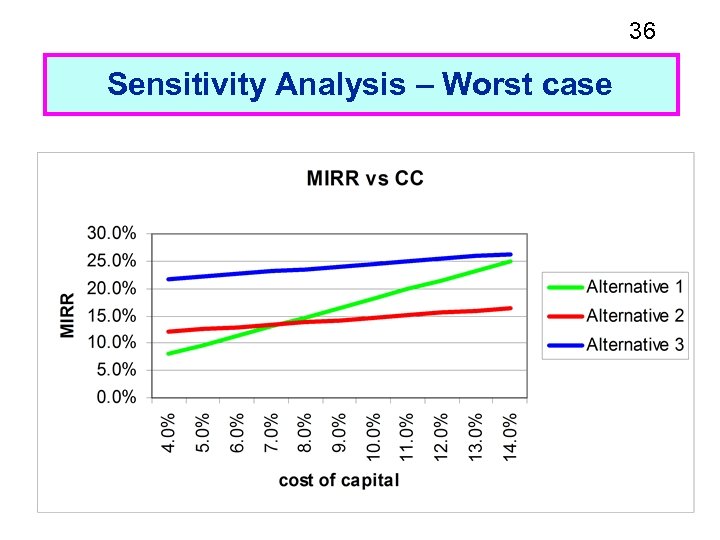
30 Sensitivity Analysis - Overview n Most likely case l NPV and MIRR vs internal cost of capital l External CC = Internal CC + 3% n Worst case l NPV and MIRR vs internal cost of capital l External CC = Internal CC * 2
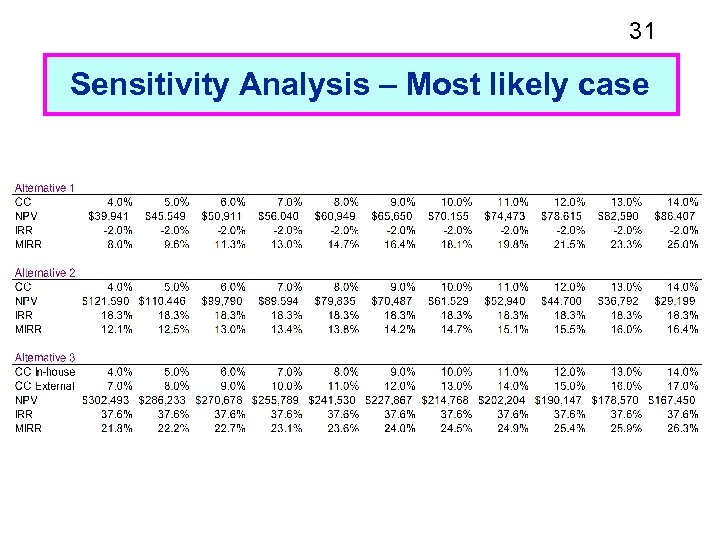
31 Sensitivity Analysis – Most likely case
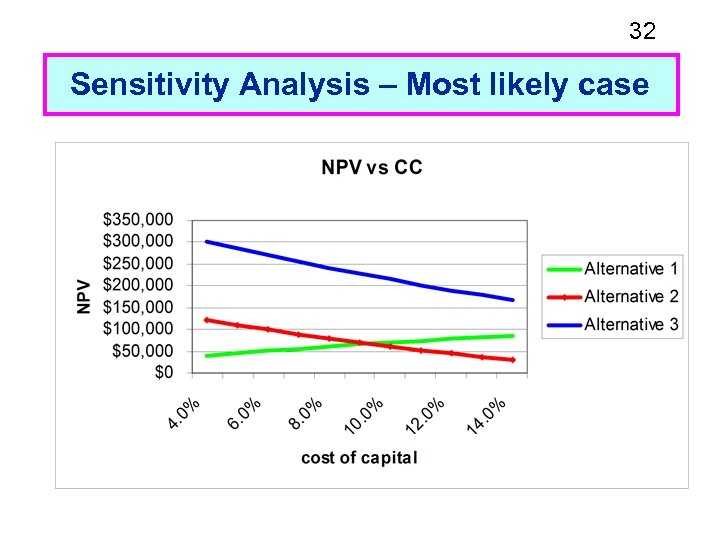
32 Sensitivity Analysis – Most likely case
33 Sensitivity Analysis – Most likely case
34 Sensitivity Analysis – Worst case
35 Sensitivity Analysis – Worst case
36 Sensitivity Analysis – Worst case
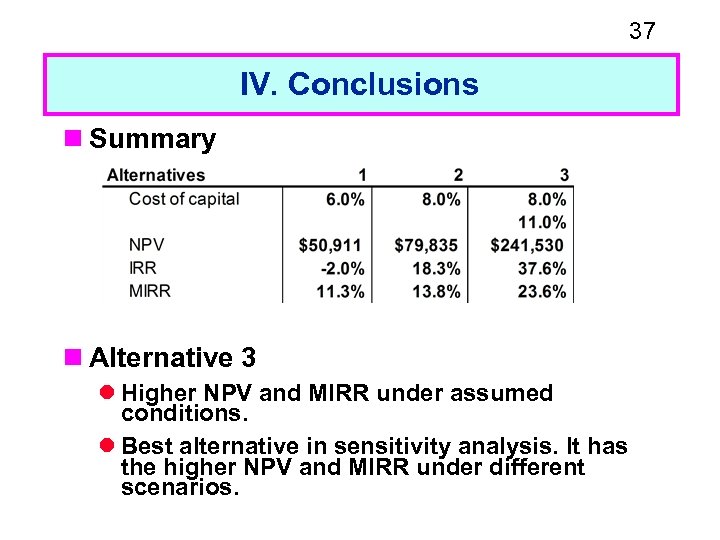
37 IV. Conclusions n Summary n Alternative 3 l Higher NPV and MIRR under assumed conditions. l Best alternative in sensitivity analysis. It has the higher NPV and MIRR under different scenarios.
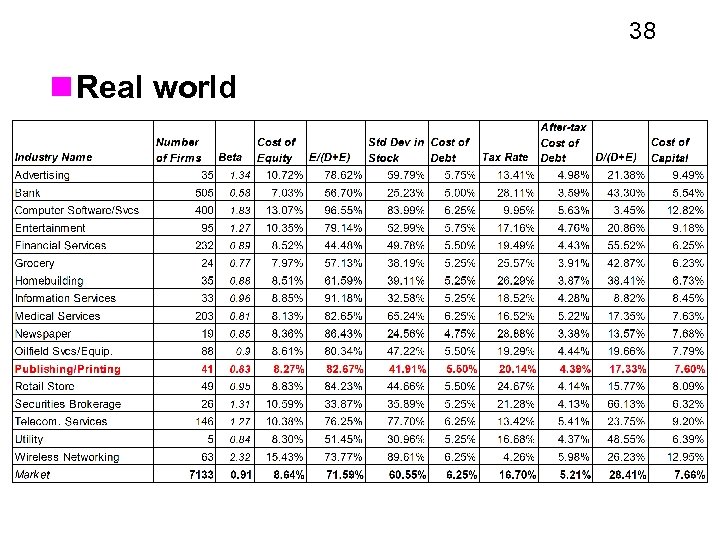
38 n Real world
39 V. Recommendations n Alternative 3 l Expand the print shop as envisioned to perform all feasible work in-house. In addition, the print shop will enter the commercial printing business. l NPV($241, 530) and MIRR(23. 6%)
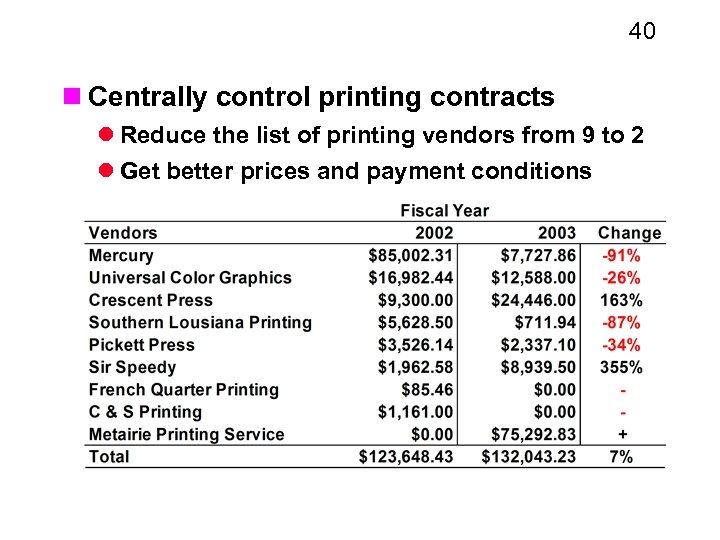
40 n Centrally control printing contracts l Reduce the list of printing vendors from 9 to 2 l Get better prices and payment conditions
41 n Improve assumptions by using industry or historic data n Expand cash flow analysis to more than 5 years l Pro: higher precision in our results if future flows are know, otherwise it will increase uncertainty. l Con: more difficult to calculate results. Unlikely to change recommendation.
42 n Perform lease vs. buy analysis l for building l for equipment n Buy additional equipment to perform 100% of work in-house instead of l 90% of graphics printing l 25% of forms printing n Explore ways to reduce cost and improve productivity l Recycling cartridges and paper l Print same colors in batch to reduce rollers’ wash-up charges
43 n Perform additional analysis as part of business plan for alternative 3 l Window of opportunity l Market environment (demand supply) l Competitor analysis l Market positioning l Risk recognition l Risk reduction strategies l Financial Plan
44 Questions and Answers n Any questions
Скачать презентацию 1 ESMBA 06 Finance 5405 Financial Management
bc76c4057a4a36823a6e81c1773e395f.ppt