 Скачать презентацию 1 Early inhabitants and population characteristics The
Prezentatsia_People_Britain.pptx
- Количество слайдов: 25



1. Early inhabitants and population characteristics. • The UK is inhabited by the English, the Scots, the Welsh, and the Irish who constitute the British nation. • The British are the descendents of different peoples who settled in the British Isles at different times. • The earliest known people are of Iberian origin. Iberians had been absorbed by the Celts. • Then followed a long succession of invaders including the Romans, the Picts, the Jutes, the Anglo-Saxons, the Danes and at last in 1066 Normans. • Britain’s predominant historical stock is called Anglo. Saxon.
The Romans • The Roman relations with Britain began with Julius Caesar’s expeditions, but the actual conquest took place in 43 AD, when the army of Emperor Claudius of some 40, 000 men invaded Britain. He decided to make Britain a Roman province, and the Romans rapidly overran southern Britain. Emperor Claudius called the new territory Britannia was the most northern outpost of the Roman Empire. • Between 79 and 85 AD, Roman forces commanded by Julius Agricola moved through the northern section of the island extended Roman rule to the Firth of Forth (the Gulf on the north coast of Great Britain, situated in Scotland).
• When the Romans arrived in ancient Britain, they found a land full of warlike Celtic tribes. The Celts were an Iron Age people who lacked the organizational skills of the Romans and were soon conquered by the Roman army who were better armed and more skilled in the field of battle. • The Romans started building settlements for themselves, Londinium (now London) among them. England was rapidly Romanized. • The people of Britain benefited from Roman technology and culture.
• The native tribes became familiar with many features of Roman civilization, including its legal and political systems, architecture and engineering. • Romans roads were remarkable feats of engineering, they comprises various layers of building materials. • Roman houses were masterly constructed of blocks of stone and clay bricks held together with mortar. • Public buildings were even more impressive. They featured pillars and arches which enabled the Romans to build very large structures without using enormous amounts of material.
• In the 4 th century, Roman Britain was threatened not only by the Picts and Scots from the North, but also by the Germanic peoples from Europe – the Angles, the Saxons, and the Jutes. • In 367 there was a combined attack on Britain by Picts, Scots and Saxons. • When Rome itself was threatened by enemies, the Roman armies had to abandon the outlying parts of the empire. In 410 Roman army withdrew. Without Roman military might, Roman civilization in Britain disintegrated.
• In 449 the Jutes (from the peninsula of Jutland in Denmark) crossed the North Sea and settled in what is now the county of Kent. They also conquered the Isle of Wight. • The picts (from Latin Picti, “painted”) were one of an ancient people who lived in what is now eastern and northeastern Scotland. Their name may refer to their custom of body painting. They spoke a Celtic language. • The Scots were inhabitants of Scotland. Originally the Scots were a Celtic (Gaelic) people of Northern Ireland who migrated to Scotland in the 5 th century.
The Saxons • The Saxons were a Germanic people who in ancient times lived in the area of modern Schleswig and along the Baltic coast. During the early part of the 5 th century, the Saxons spread rapidly along the coasts of Gaul and Britain. (Angles fell to the invaders). • The Roman way of life was abandoned. Saxons were excellent farmers. They cleared much of the forest using a heavy plough, which remained basically unchanged until the industrial revolution (1750 -1850). • They lived in strong family and tribal units. The Germanic tribes brought with them a common language, the ancestor of the present-day English or Anglo-Saxon.
• A substantial number of Vikings raided and settled in Great Britain in the 8 th century. • Viking rule was established in the Orkneys, Shetlands, Hebrides, parts of north and western Scotland, in parts of Ireland, in England where the Vikings controlled most of the Anglo-Saxon kingdoms. York (Yorvik) became the capital.
The Normans • The last major group of invaders were the Normans (French-speaking invaders, who in large part descended from the Vikings who had seized and then remained in northwestern France, which became known as Normandy). • They invaded the country in 1066. • Harold Godwin was defeated by William the Conqueror, Duke of Normandy in the battle of Hastings in 1066.
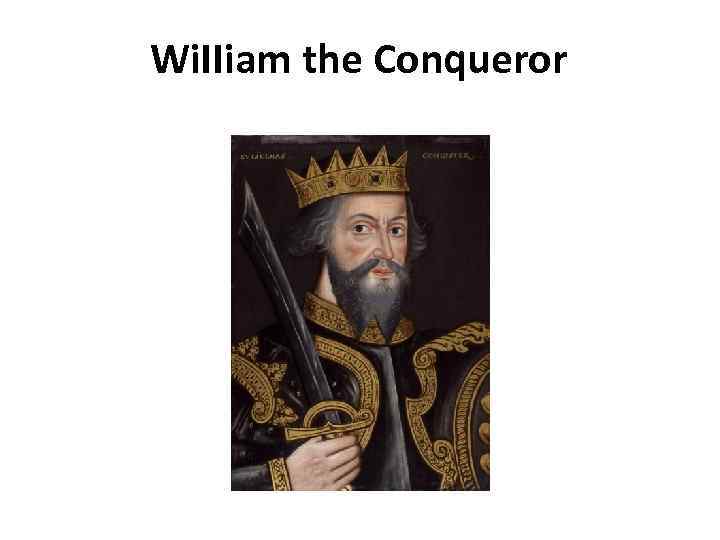
Wi. IIiam the Conqueror
• Most British people attribute their origins to the early invaders, calling themselves English, Scottish, Irish, Welsh, or Ulsterites. • So, the British nation is constituted by the English, the Welsh, the Scots and the Irish. • More than 94 percent of the today population is described as white. • The Race Relations Act of 1976 makes it illegal to discriminate against any person because of race, colour, nationality, or origin, and it is a criminal offence to incite racial hatred.
2. Distribution of the population • The population is over 60 million people. Britain’s population is mostly urban, with 89. 2 percent living in urban areas and 10. 8 percent living in rural areas. • The distribution of the population is rather uneven. About 50 million people live in England, over 3 million in Wales. A little over 5 million in Scotland about 1. 7 in Northern Ireland. • Greater London, the south and the southeast are the most densely populated areas. Most of the mountainous parts of the UK including much of Scotland, Wales, Northern Ireland the Pennine Chain in northern England are very sparsely populated.
3. Languages • English is the official language of the UK and is the first language of the majority of its citizens. Besides standard literary English there are many regional and social dialects. A well-known example is the cockney of East Londoners. • The Scottish and Irish forms of Gaelic survive in some parts of Scotland Ireland. Approximately 80, 000 Scots speak Scottish Gaelic, a type of Celtic language. • Scottish Gaelic is restricted to the Hebrides and to a narrow border in the North and West of Scotland.
• Years ago all Irish people spoke Gaelic, and this language is still spoken in some parts of Ireland. Evidence of Gaelic is still found in place-names, for example • ‘bally’ – town, ‘slieve’ – mountain, ‘lough’ – lake, inis – island, ‘drum’ – mountain top, ‘glen’ – valley. • The influence of Irish Gaelic is also found in the names of people Sean – same as John, Seamus – same as James, Liam – same as William, Seanna – same as Joanna.
• • • Many Irish surnames begin with: ‘O’ meaning ‘from the family of’; ‘Fitz’ meaning ‘son of’; Mac meaning ‘son of’ Gil meaning ‘son of’ Some of the Roman Catholic minority speak Irish.
• In 1993 Welsh was made a joint official language with English in Wales. • Welsh is officially bilingual, Welsh is spoken by over 20 per cent of its population. Welsh is the first language in most of the western counties of Wales and at least formally has the same status as English. Welsh is a Celtic language. It belongs to a separate subfamily of the Indo-European family of languages. Nowadays there is a growing movement in Wales and Scotland for a revival of national culture and languages.
4. A devolved Britain • Devolved power is power that is passed from the central government to smaller governing units. • One of the British debates is about how independent and separate the different parts of the UK should be. • The Scots, the Welsh and the Northern Irish have been more explicit than the English about the distinct cultures of their countries.
• Scotland has a long history of vigorous independence. When the Romans marched northwards across the country in 55 A. D. they found it impossible to subdue the pictish tribes who lived in the north. • Eventually they built a wall (Hadrian’s wall, some of it still stands today) right across the country, separating Roman Britain from an area which roughly corresponds to presentday Scotland.
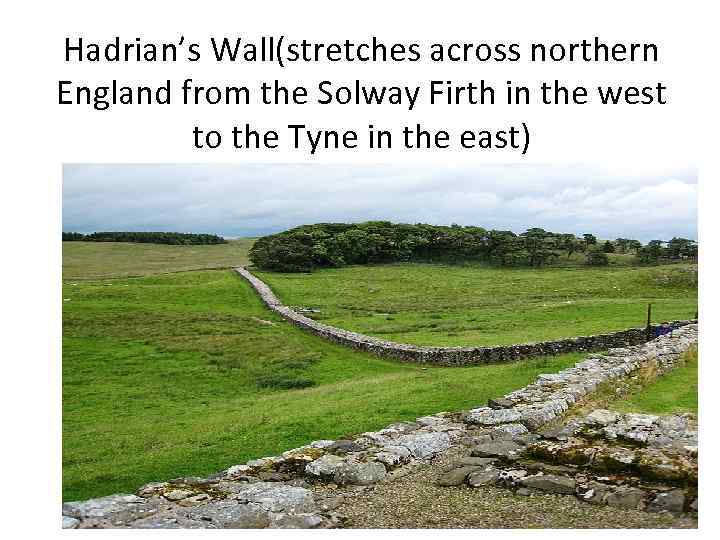
Hadrian’s Wall(stretches across northern England from the Solway Firth in the west to the Tyne in the east)
• Despite repeated attempts by the English at conquest, the 2 countries were eventually united peacefully. • The Scottish King James inherited the English throne in 1603. Scotland England joined in a political union in 1707, when the Parliament at Westminster in London became the Parliament for both countries. • But Scotland already had a long history of independent foreign policy. It had developed its own religious and legal institutions and was much more advanced than England in educating its population.
Wales • Wales was conquered by the English in the Middle Ages but was never absorbed into England. • Economically, Wales needs the greater wealth of England could never be effectively independent of its big neighbour, but the Welsh people like to point out that they may be a small nation but they have a strong national identity. • The Welsh language is the only indigenous (местный) language in these islands, apart from English, which is widely known and spoken. About 600, 000 people claim to speak it, out of a population of nearly three million. • So the Englishman who crosses the border into Scotland or into Wales is soon aware that he is in a new country because of hundreds of small social and cultural differences.
Northern Ireland • The one-and-half million people who live in Northern Ireland struggled for eighty years. The political problems in NI have a long history and are based on the bitterness of opposing religious groups. • At present the “Protestants” who want to remain as part of the UK are in the majority while the “Catholics” who want to be united with the completely independent Republic of Ireland are in the minority.
• Recently the situation in Scotland Wales has also changed strikingly. • In 1997 the government arranged for everyone in Scotland Wales to vote on whether they wanted their country to have greater independence from the Westminster which is the name they give to the Government-plus. Parliament of the UK. • The voters were not too sure about this idea. • They feared that they might get less money from the centre and be forgotten by the government. • But in the end, of those who actually voted, more than two-thirds in each country agreed that they wanted more “devolved” powers.
• Scotland (population 5 million) acquired its own Parliament, and Wales (population 3 million) acquired a Welsh Assembly since 1999 has meant, for example, that the Scots pay for their higher education, and the Welsh organize their hospitals in different ways from the English. • More over, as the Scots have been enjoying their devolved power for a decade, the movement for separation from the Union, and Scottish independence has gained ground.
4. Religion • The United Kingdom has two established (an established church is the legally recognized official church of the state) churches: the Church of England (or the Anglican Church) and the Church of Scotland. • The Church of England is a Protestant Episcopal church. About 20 percent of 8. 4 million active churchgoers in Britain are Anglicans. • The Church of Scotland is Presbyterian and is governed by courts of ministers and elders. • One out of ten British citizens claims to be Roman Catholic. Other religious communities are Muslim, Jewish, Hindus, Sikhs, and Buddhists. •
Скачать презентацию 1 Early inhabitants and population characteristics The
Prezentatsia_People_Britain.pptx