


 Скачать презентацию 1 DT 014 1 TT 821 Computer Networks I
afed6b45cfbb0558c3c1a7ec991c7e35.ppt
- Количество слайдов: 66
 1 DT 014/1 TT 821 Computer Networks I Chapter 5 Link Layer and LANs Introduction 1 -1
 Link Layer r 5. 1 Introduction and r r services 5. 2 Error detection and correction 5. 3 Multiple access protocols 5. 4 Link-Layer Addressing 5. 5 Ethernet r 5. 6 Link-layer switches r 5. 7 PPP r 5. 8 Link Virtualization: ATM, MPLS 5: Data. Link Layer 5 -2
 MAC Addresses and ARP r 32 -bit IP address: m network-layer address m used to get datagram to destination IP subnet r MAC (or LAN or physical or Ethernet) address: m function: get frame from one interface to another physically-connected interface (same network) m 48 bit MAC address (for most LANs) • burned in NIC ROM, also sometimes software settable 5: Data. Link Layer 5 -3
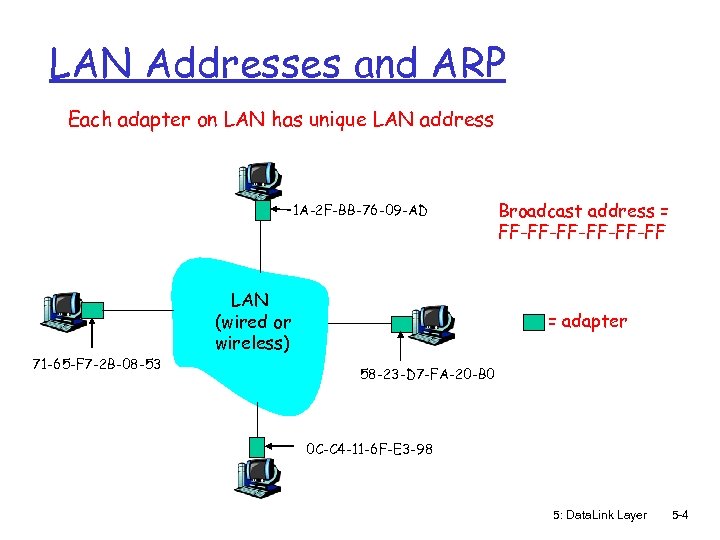 LAN Addresses and ARP Each adapter on LAN has unique LAN address 1 A-2 F-BB-76 -09 -AD 71 -65 -F 7 -2 B-08 -53 LAN (wired or wireless) Broadcast address = FF-FF-FF-FF = adapter 58 -23 -D 7 -FA-20 -B 0 0 C-C 4 -11 -6 F-E 3 -98 5: Data. Link Layer 5 -4
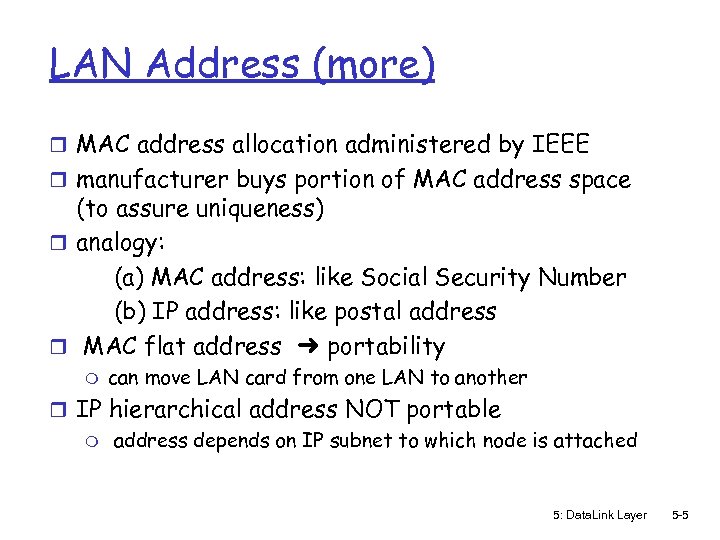 LAN Address (more) r MAC address allocation administered by IEEE r manufacturer buys portion of MAC address space (to assure uniqueness) r analogy: (a) MAC address: like Social Security Number (b) IP address: like postal address r MAC flat address ➜ portability m can move LAN card from one LAN to another r IP hierarchical address NOT portable m address depends on IP subnet to which node is attached 5: Data. Link Layer 5 -5
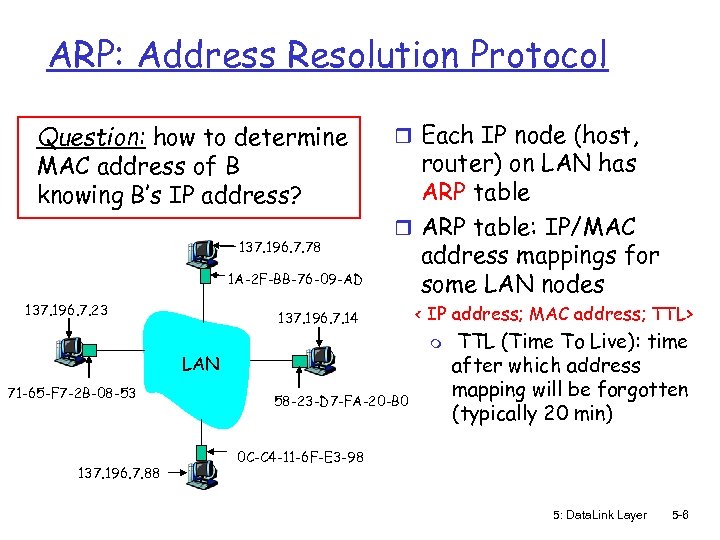 ARP: Address Resolution Protocol Question: how to determine MAC address of B knowing B’s IP address? 137. 196. 7. 78 1 A-2 F-BB-76 -09 -AD 137. 196. 7. 23 r Each IP node (host, router) on LAN has ARP table r ARP table: IP/MAC address mappings for some LAN nodes 137. 196. 7. 14 m LAN 71 -65 -F 7 -2 B-08 -53 137. 196. 7. 88 < IP address; MAC address; TTL> 58 -23 -D 7 -FA-20 -B 0 TTL (Time To Live): time after which address mapping will be forgotten (typically 20 min) 0 C-C 4 -11 -6 F-E 3 -98 5: Data. Link Layer 5 -6
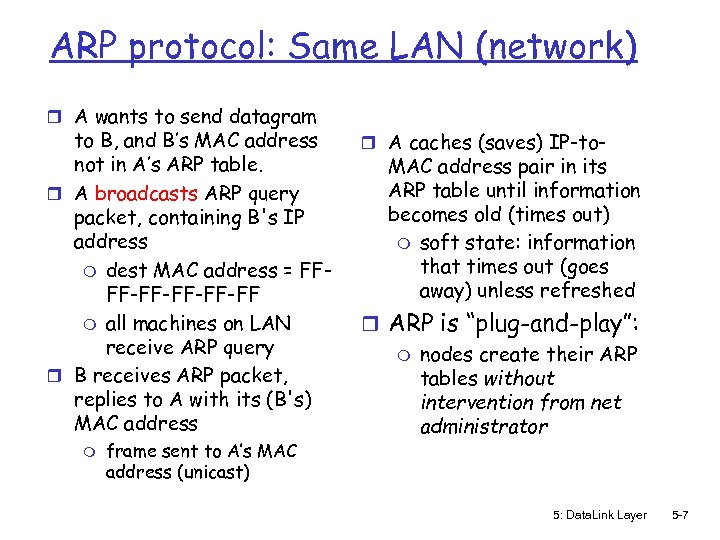 ARP protocol: Same LAN (network) r A wants to send datagram to B, and B’s MAC address not in A’s ARP table. r A broadcasts ARP query packet, containing B's IP address m dest MAC address = FFFF-FF-FF m all machines on LAN receive ARP query r B receives ARP packet, replies to A with its (B's) MAC address m frame sent to A’s MAC address (unicast) r A caches (saves) IP-to- MAC address pair in its ARP table until information becomes old (times out) m soft state: information that times out (goes away) unless refreshed r ARP is “plug-and-play”: m nodes create their ARP tables without intervention from net administrator 5: Data. Link Layer 5 -7
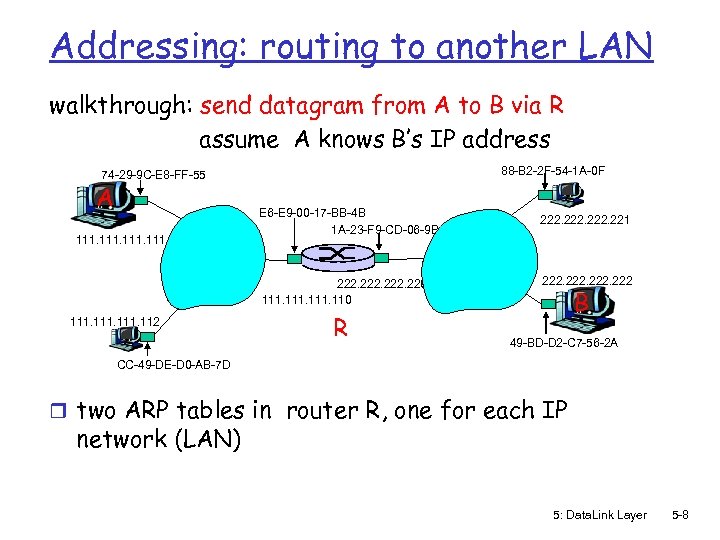 Addressing: routing to another LAN walkthrough: send datagram from A to B via R assume A knows B’s IP address 88 -B 2 -2 F-54 -1 A-0 F 74 -29 -9 C-E 8 -FF-55 A 111 E 6 -E 9 -00 -17 -BB-4 B 1 A-23 -F 9 -CD-06 -9 B 222. 220 111. 112 R 222. 221 222 B 49 -BD-D 2 -C 7 -56 -2 A CC-49 -DE-D 0 -AB-7 D r two ARP tables in router R, one for each IP network (LAN) 5: Data. Link Layer 5 -8
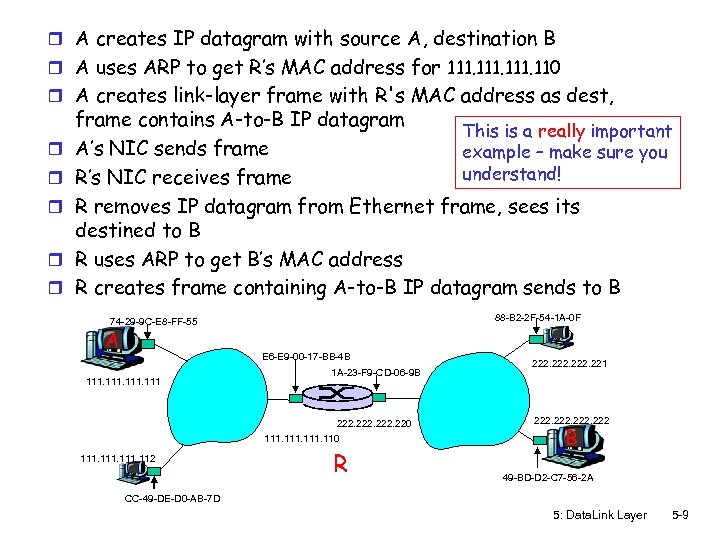 r A creates IP datagram with source A, destination B r A uses ARP to get R’s MAC address for 111. 110 r A creates link-layer frame with R's MAC address as dest, r r r frame contains A-to-B IP datagram This is a really important A’s NIC sends frame example – make sure you understand! R’s NIC receives frame R removes IP datagram from Ethernet frame, sees its destined to B R uses ARP to get B’s MAC address R creates frame containing A-to-B IP datagram sends to B 88 -B 2 -2 F-54 -1 A-0 F 74 -29 -9 C-E 8 -FF-55 A E 6 -E 9 -00 -17 -BB-4 B 111 1 A-23 -F 9 -CD-06 -9 B 222. 220 111. 112 R 222. 221 222 B 49 -BD-D 2 -C 7 -56 -2 A CC-49 -DE-D 0 -AB-7 D 5: Data. Link Layer 5 -9
 Link Layer r 5. 1 Introduction and r r services 5. 2 Error detection and correction 5. 3 Multiple access protocols 5. 4 Link-Layer Addressing 5. 5 Ethernet r 5. 6 Link-layer switches r 5. 7 PPP r 5. 8 Link Virtualization: ATM and MPLS 5: Data. Link Layer 5 -10
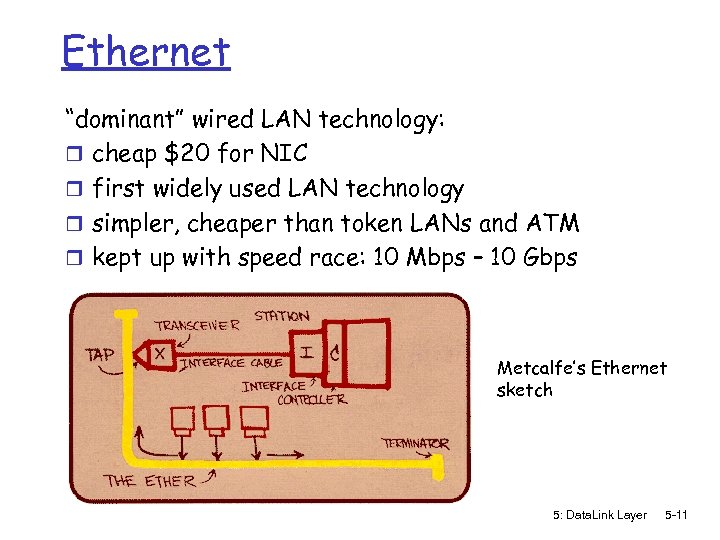 Ethernet “dominant” wired LAN technology: r cheap $20 for NIC r first widely used LAN technology r simpler, cheaper than token LANs and ATM r kept up with speed race: 10 Mbps – 10 Gbps Metcalfe’s Ethernet sketch 5: Data. Link Layer 5 -11
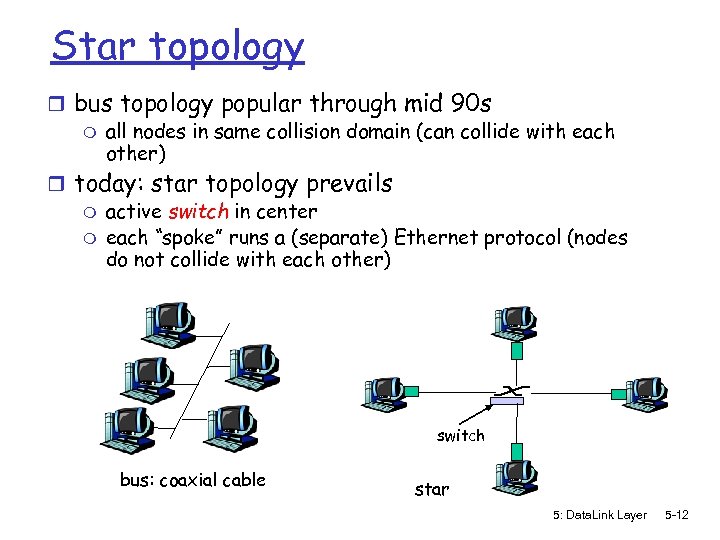 Star topology r bus topology popular through mid 90 s m all nodes in same collision domain (can collide with each other) r today: star topology prevails m active switch in center m each “spoke” runs a (separate) Ethernet protocol (nodes do not collide with each other) switch bus: coaxial cable star 5: Data. Link Layer 5 -12
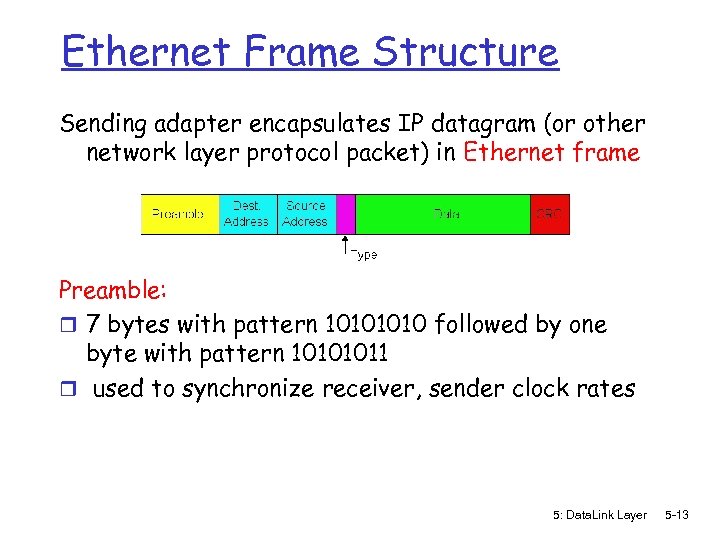 Ethernet Frame Structure Sending adapter encapsulates IP datagram (or other network layer protocol packet) in Ethernet frame Preamble: r 7 bytes with pattern 1010 followed by one byte with pattern 10101011 r used to synchronize receiver, sender clock rates 5: Data. Link Layer 5 -13
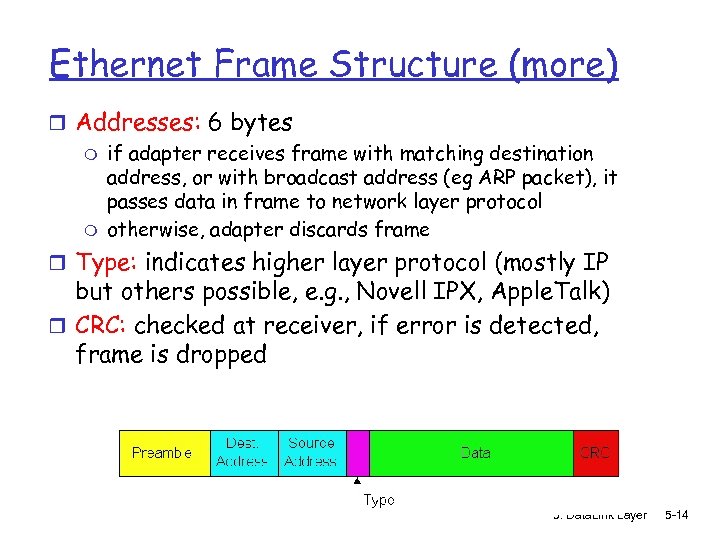 Ethernet Frame Structure (more) r Addresses: 6 bytes m if adapter receives frame with matching destination address, or with broadcast address (eg ARP packet), it passes data in frame to network layer protocol m otherwise, adapter discards frame r Type: indicates higher layer protocol (mostly IP but others possible, e. g. , Novell IPX, Apple. Talk) r CRC: checked at receiver, if error is detected, frame is dropped 5: Data. Link Layer 5 -14
 Ethernet: Unreliable, connectionless r connectionless: No handshaking between sending and receiving NICs r unreliable: receiving NIC doesn’t send acks or nacks to sending NIC m m m stream of datagrams passed to network layer can have gaps (missing datagrams) gaps will be filled if app is using TCP otherwise, app will see gaps r Ethernet’s MAC protocol: unslotted CSMA/CD 5: Data. Link Layer 5 -15
 Ethernet CSMA/CD algorithm 1. NIC receives datagram 4. If NIC detects another from network layer, transmission while creates frame transmitting, aborts and sends jam signal 2. If NIC senses channel idle, starts frame transmission 5. After aborting, NIC If NIC senses channel enters exponential busy, waits until channel backoff: after mth idle, then transmits collision, NIC chooses K at random from 3. If NIC transmits entire {0, 1, 2, …, 2 m-1}. NIC waits frame without detecting K·512 bit times, returns to another transmission, NIC Step 2 is done with frame ! 5: Data. Link Layer 5 -16
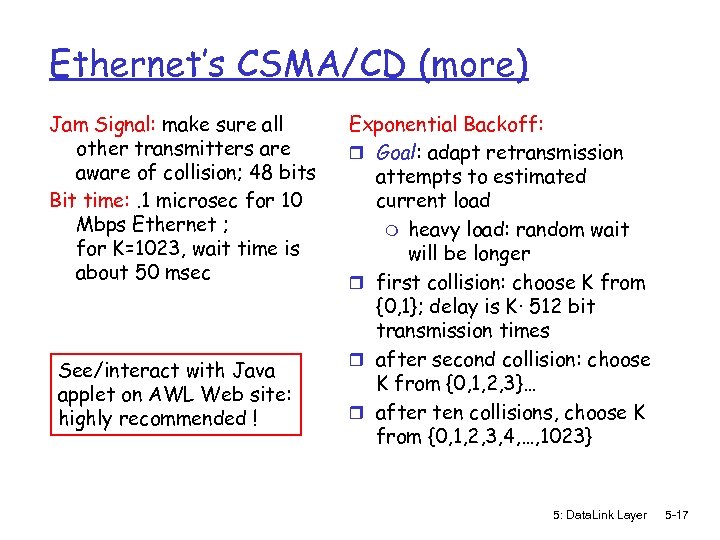 Ethernet’s CSMA/CD (more) Jam Signal: make sure all other transmitters are aware of collision; 48 bits Bit time: . 1 microsec for 10 Mbps Ethernet ; for K=1023, wait time is about 50 msec See/interact with Java applet on AWL Web site: highly recommended ! Exponential Backoff: r Goal: adapt retransmission attempts to estimated current load m heavy load: random wait will be longer r first collision: choose K from {0, 1}; delay is K· 512 bit transmission times r after second collision: choose K from {0, 1, 2, 3}… r after ten collisions, choose K from {0, 1, 2, 3, 4, …, 1023} 5: Data. Link Layer 5 -17
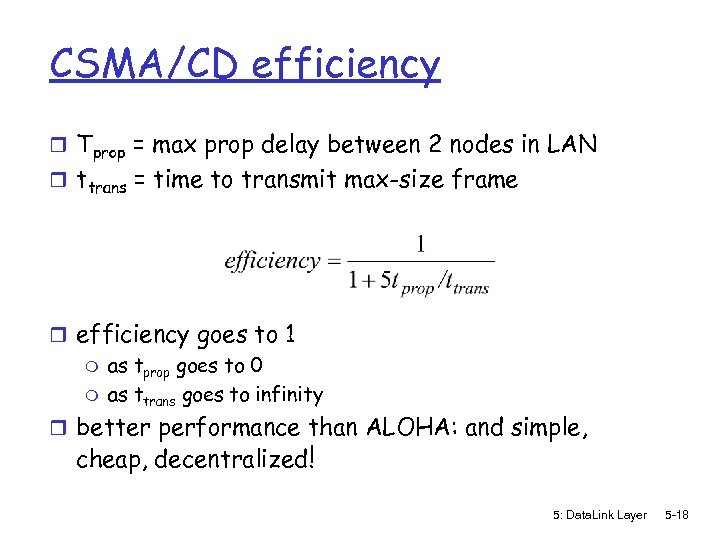 CSMA/CD efficiency r Tprop = max prop delay between 2 nodes in LAN r ttrans = time to transmit max-size frame r efficiency goes to 1 m as tprop goes to 0 m as ttrans goes to infinity r better performance than ALOHA: and simple, cheap, decentralized! 5: Data. Link Layer 5 -18
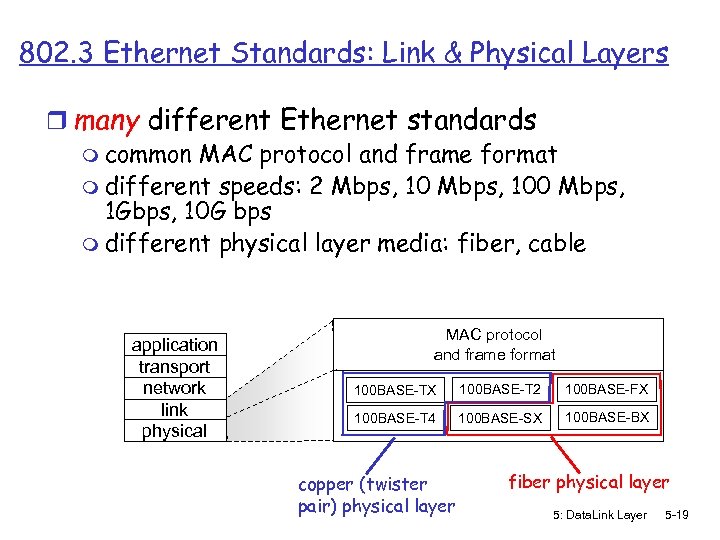 802. 3 Ethernet Standards: Link & Physical Layers r many different Ethernet standards m common MAC protocol and frame format m different speeds: 2 Mbps, 100 Mbps, 1 Gbps, 10 G bps m different physical layer media: fiber, cable application transport network link physical MAC protocol and frame format 100 BASE-TX 100 BASE-T 2 100 BASE-FX 100 BASE-T 4 100 BASE-SX 100 BASE-BX copper (twister pair) physical layer fiber physical layer 5: Data. Link Layer 5 -19
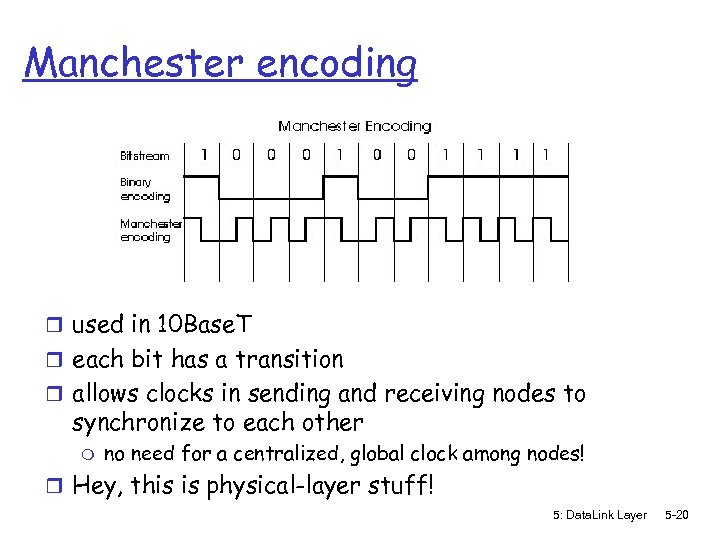 Manchester encoding r used in 10 Base. T r each bit has a transition r allows clocks in sending and receiving nodes to synchronize to each other m no need for a centralized, global clock among nodes! r Hey, this is physical-layer stuff! 5: Data. Link Layer 5 -20
 Link Layer r 5. 1 Introduction and r r services 5. 2 Error detection and correction 5. 3 Multiple access protocols 5. 4 Link-layer Addressing 5. 5 Ethernet r 5. 6 Link-layer switches r 5. 7 PPP r 5. 8 Link Virtualization: ATM, MPLS 5: Data. Link Layer 5 -21
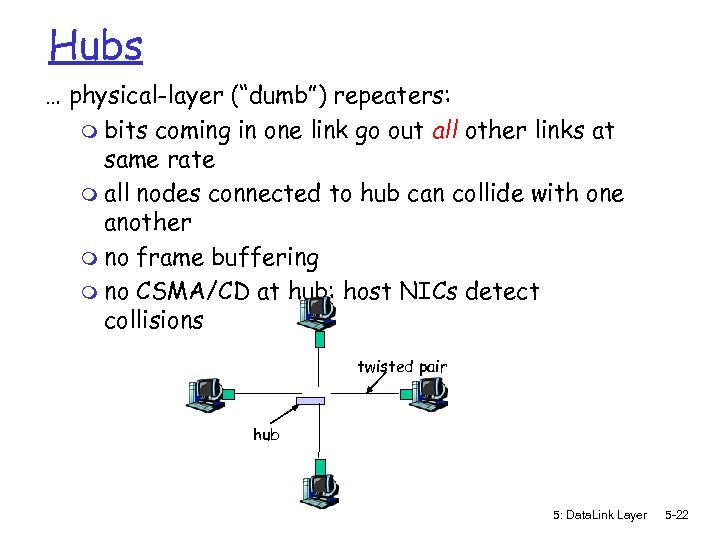 Hubs … physical-layer (“dumb”) repeaters: m bits coming in one link go out all other links at same rate m all nodes connected to hub can collide with one another m no frame buffering m no CSMA/CD at hub: host NICs detect collisions twisted pair hub 5: Data. Link Layer 5 -22
 Switch r link-layer device: smarter than hubs, take active role m store, forward Ethernet frames m examine incoming frame’s MAC address, selectively forward frame to one-or-more outgoing links when frame is to be forwarded on segment, uses CSMA/CD to access segment r transparent m hosts are unaware of presence of switches r plug-and-play, self-learning m switches do not need to be configured 5: Data. Link Layer 5 -23
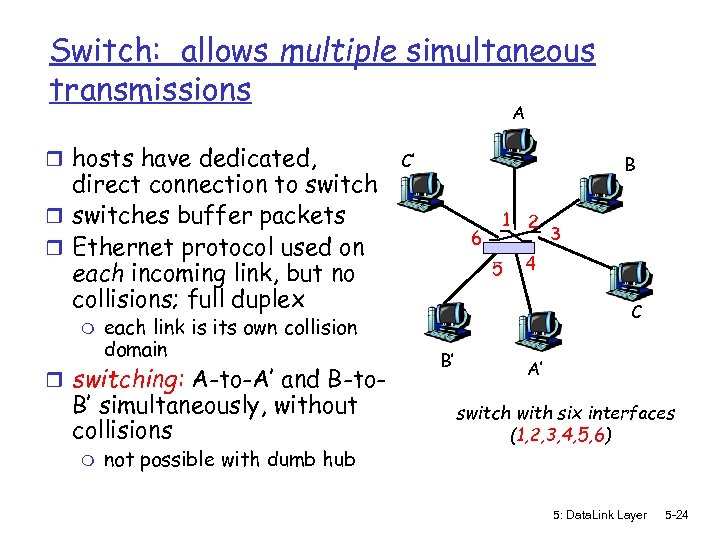 Switch: allows multiple simultaneous transmissions A r hosts have dedicated, direct connection to switch r switches buffer packets r Ethernet protocol used on each incoming link, but no collisions; full duplex m each link is its own collision domain r switching: A-to-A’ and B-to- B’ simultaneously, without collisions m not possible with dumb hub C’ B 6 1 5 2 3 4 C B’ A’ switch with six interfaces (1, 2, 3, 4, 5, 6) 5: Data. Link Layer 5 -24
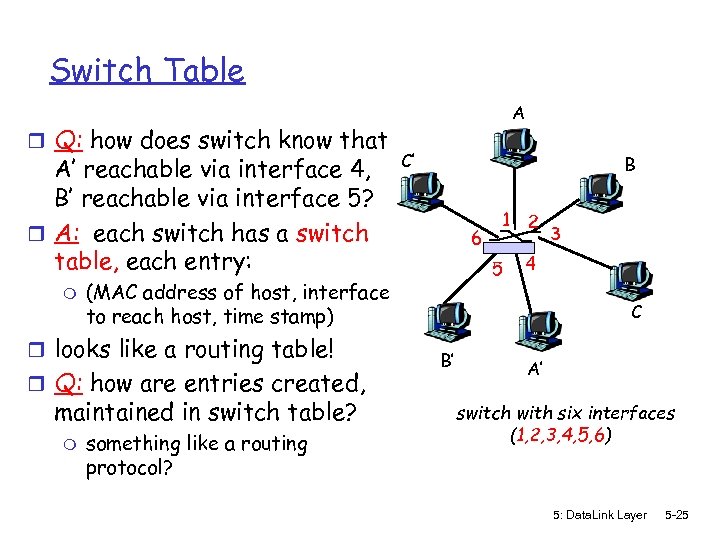 Switch Table r Q: how does switch know that A’ reachable via interface 4, B’ reachable via interface 5? r A: each switch has a switch table, each entry: m C’ B 6 r Q: how are entries created, maintained in switch table? something like a routing protocol? 1 5 (MAC address of host, interface to reach host, time stamp) r looks like a routing table! m A 2 3 4 C B’ A’ switch with six interfaces (1, 2, 3, 4, 5, 6) 5: Data. Link Layer 5 -25
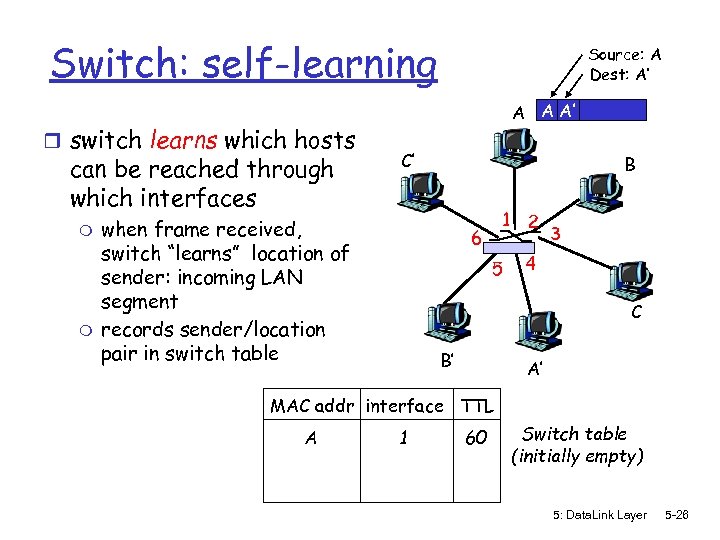 Switch: self-learning r switch learns which hosts can be reached through which interfaces m m Source: A Dest: A’ A A A’ C’ when frame received, switch “learns” location of sender: incoming LAN segment records sender/location pair in switch table B 1 6 5 2 3 4 C B’ A’ MAC addr interface TTL A 1 60 Switch table (initially empty) 5: Data. Link Layer 5 -26
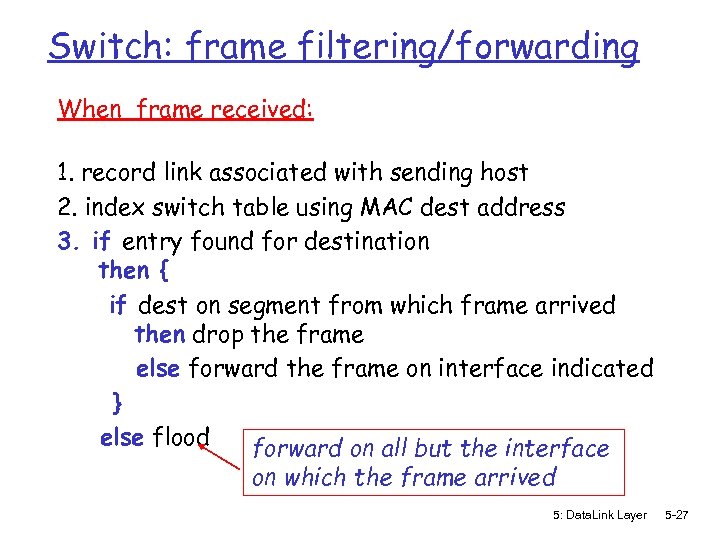 Switch: frame filtering/forwarding When frame received: 1. record link associated with sending host 2. index switch table using MAC dest address 3. if entry found for destination then { if dest on segment from which frame arrived then drop the frame else forward the frame on interface indicated } else flood forward on all but the interface on which the frame arrived 5: Data. Link Layer 5 -27
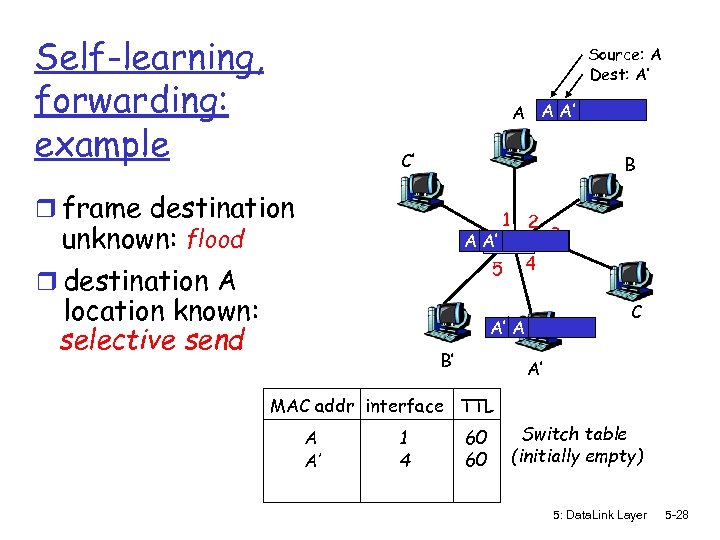 Self-learning, forwarding: example Source: A Dest: A’ A A A’ C’ B r frame destination unknown: flood 6 A A’ 1 2 4 5 r destination A location known: selective send C A’ A B’ 3 A’ MAC addr interface TTL A A’ 1 4 60 60 Switch table (initially empty) 5: Data. Link Layer 5 -28
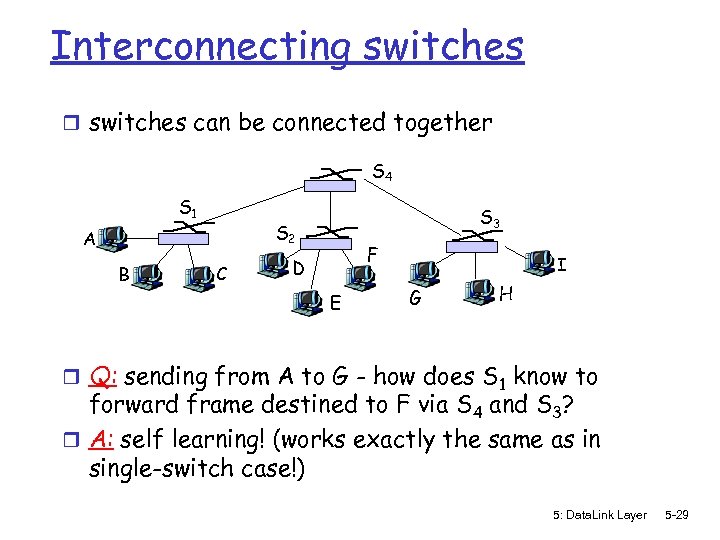 Interconnecting switches r switches can be connected together S 4 S 1 S 2 A B S 3 C F D E I G H r Q: sending from A to G - how does S 1 know to forward frame destined to F via S 4 and S 3? r A: self learning! (works exactly the same as in single-switch case!) 5: Data. Link Layer 5 -29
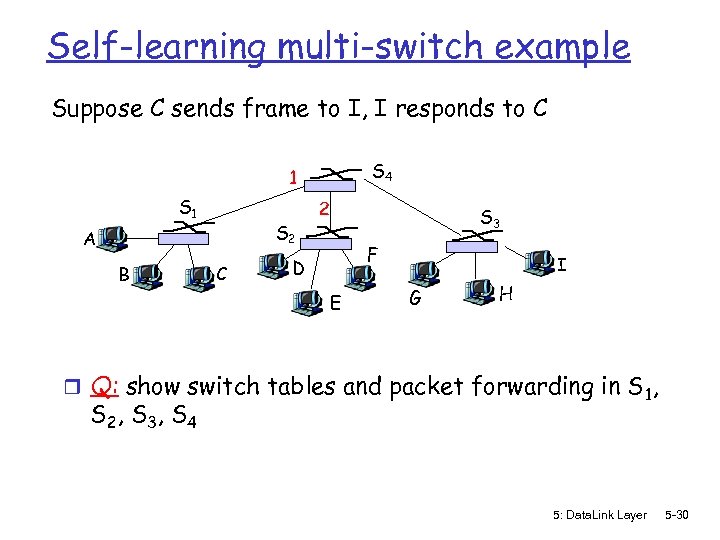 Self-learning multi-switch example Suppose C sends frame to I, I responds to C S 4 1 S 2 A B C 2 S 3 F D E I G H r Q: show switch tables and packet forwarding in S 1, S 2, S 3, S 4 5: Data. Link Layer 5 -30
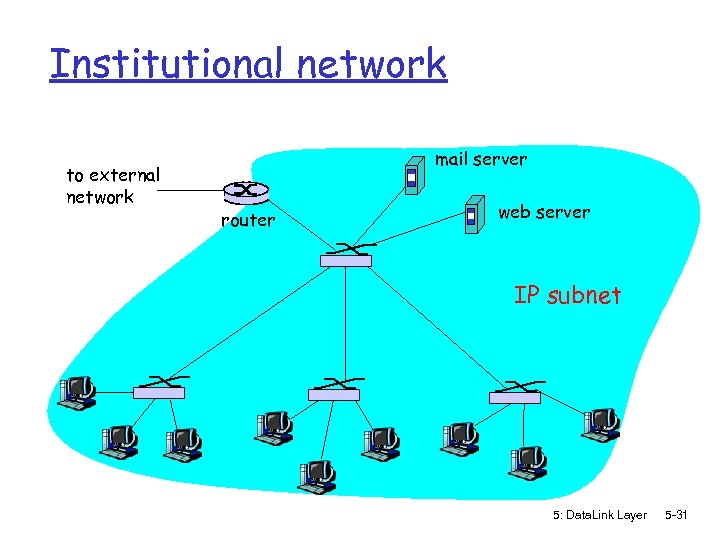 Institutional network to external network mail server router web server IP subnet 5: Data. Link Layer 5 -31
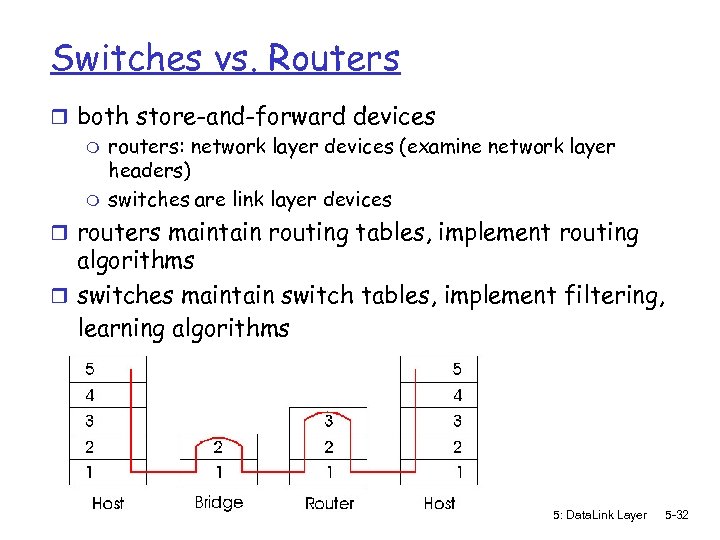 Switches vs. Routers r both store-and-forward devices m routers: network layer devices (examine network layer headers) m switches are link layer devices r routers maintain routing tables, implement routing algorithms r switches maintain switch tables, implement filtering, learning algorithms 5: Data. Link Layer 5 -32
 Link Layer r 5. 1 Introduction and r r services 5. 2 Error detection and correction 5. 3 Multiple access protocols 5. 4 Link-Layer Addressing 5. 5 Ethernet r 5. 6 Hubs and switches r 5. 7 PPP r 5. 8 Link Virtualization: ATM 5: Data. Link Layer 5 -33
 Point to Point Data Link Control r one sender, one receiver, one link: easier than broadcast link: m no Media Access Control m no need for explicit MAC addressing m e. g. , dialup link, ISDN line r popular point-to-point DLC protocols: m PPP (point-to-point protocol) m HDLC: High level data link control (Data link used to be considered “high layer” in protocol stack! 5: Data. Link Layer 5 -34
![PPP Design Requirements [RFC 1557] r packet framing: encapsulation of network-layer r r datagram](https://present5.com/presentation/afed6b45cfbb0558c3c1a7ec991c7e35/image-35.jpg "PPP Design Requirements [RFC 1557] r packet framing: encapsulation of network-layer r r datagram") PPP Design Requirements [RFC 1557] r packet framing: encapsulation of network-layer r r datagram in data link frame m carry network layer data of any network layer protocol (not just IP) at same time m ability to demultiplex upwards bit transparency: must carry any bit pattern in the data field error detection (no correction) connection liveness: detect, signal link failure to network layer address negotiation: endpoint can learn/configure each other’s network address 5: Data. Link Layer 5 -35
PPP Design Requirements [RFC 1557] r packet framing: encapsulation of network-layer r r datagram in data link frame m carry network layer data of any network layer protocol (not just IP) at same time m ability to demultiplex upwards bit transparency: must carry any bit pattern in the data field error detection (no correction) connection liveness: detect, signal link failure to network layer address negotiation: endpoint can learn/configure each other’s network address 5: Data. Link Layer 5 -35
 PPP non-requirements r no error correction/recovery r no flow control r out of order delivery OK r no need to support multipoint links (e. g. , polling) Error recovery, flow control, data re-ordering all relegated to higher layers! 5: Data. Link Layer 5 -36
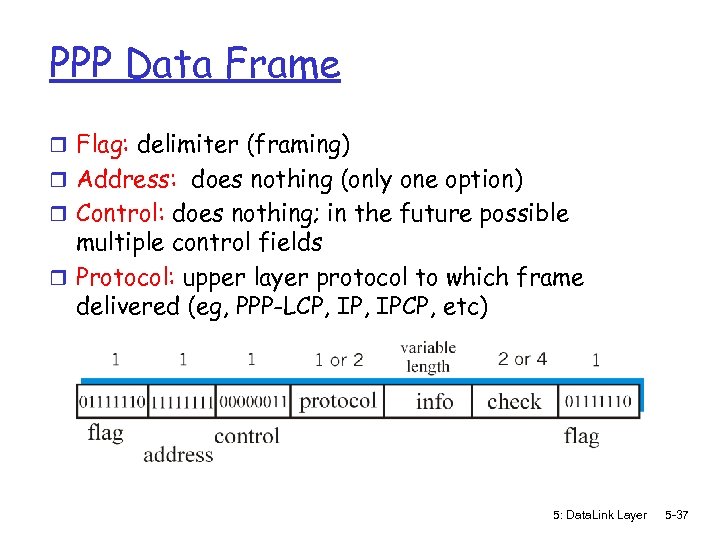 PPP Data Frame r Flag: delimiter (framing) r Address: does nothing (only one option) r Control: does nothing; in the future possible multiple control fields r Protocol: upper layer protocol to which frame delivered (eg, PPP-LCP, IPCP, etc) 5: Data. Link Layer 5 -37
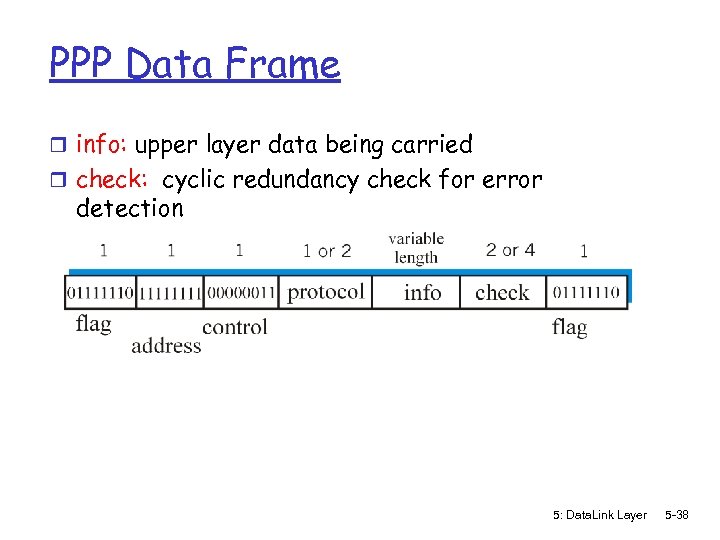 PPP Data Frame r info: upper layer data being carried r check: cyclic redundancy check for error detection 5: Data. Link Layer 5 -38
 Byte Stuffing r “data transparency” requirement: data field must be allowed to include flag pattern <01111110> m Q: is received <01111110> data or flag? r Sender: adds (“stuffs”) extra < 01111110> byte after each < 01111110> data byte r Receiver: m two 01111110 bytes in a row: discard first byte, continue data reception m single 01111110: flag byte 5: Data. Link Layer 5 -39
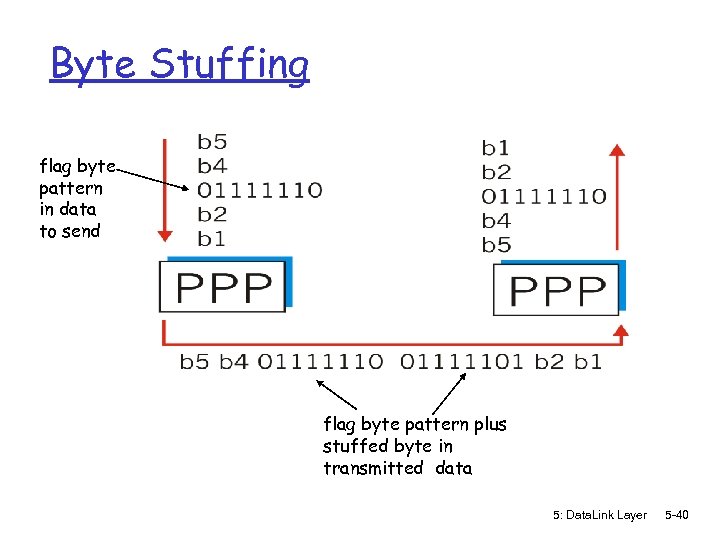 Byte Stuffing flag byte pattern in data to send flag byte pattern plus stuffed byte in transmitted data 5: Data. Link Layer 5 -40
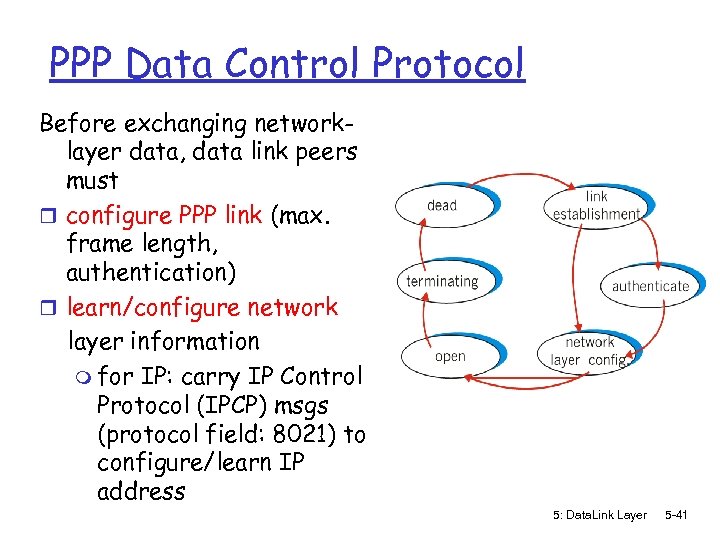 PPP Data Control Protocol Before exchanging networklayer data, data link peers must r configure PPP link (max. frame length, authentication) r learn/configure network layer information m for IP: carry IP Control Protocol (IPCP) msgs (protocol field: 8021) to configure/learn IP address 5: Data. Link Layer 5 -41
 Link Layer r 5. 1 Introduction and r r services 5. 2 Error detection and correction 5. 3 Multiple access protocols 5. 4 Link-Layer Addressing 5. 5 Ethernet r 5. 6 Hubs and switches r 5. 7 PPP r 5. 8 Link Virtualization: ATM and MPLS 5: Data. Link Layer 5 -42
 Virtualization of networks Virtualization of resources: powerful abstraction in systems engineering: r computing examples: virtual memory, virtual devices m Virtual machines: e. g. , java m IBM VM os from 1960’s/70’s r layering of abstractions: don’t sweat the details of the lower layer, only deal with lower layers abstractly 5: Data. Link Layer 5 -43
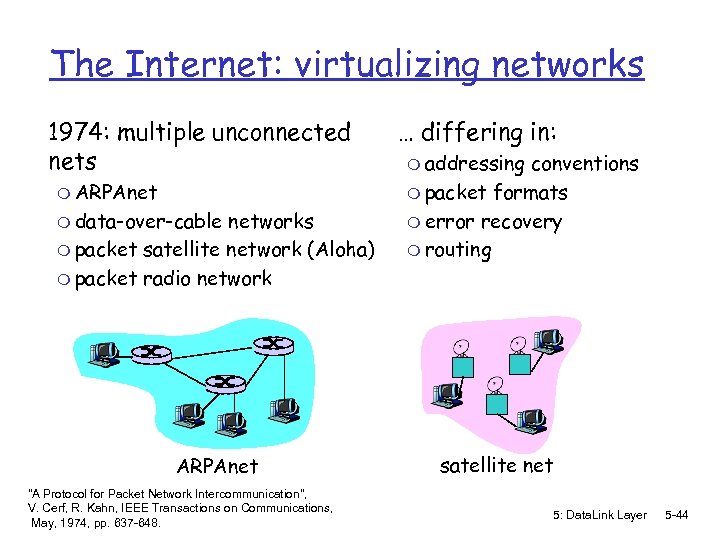 The Internet: virtualizing networks 1974: multiple unconnected nets m ARPAnet m data-over-cable networks m packet satellite network (Aloha) m packet radio network ARPAnet "A Protocol for Packet Network Intercommunication", V. Cerf, R. Kahn, IEEE Transactions on Communications, May, 1974, pp. 637 -648. … differing in: m addressing conventions m packet formats m error recovery m routing satellite net 5: Data. Link Layer 5 -44
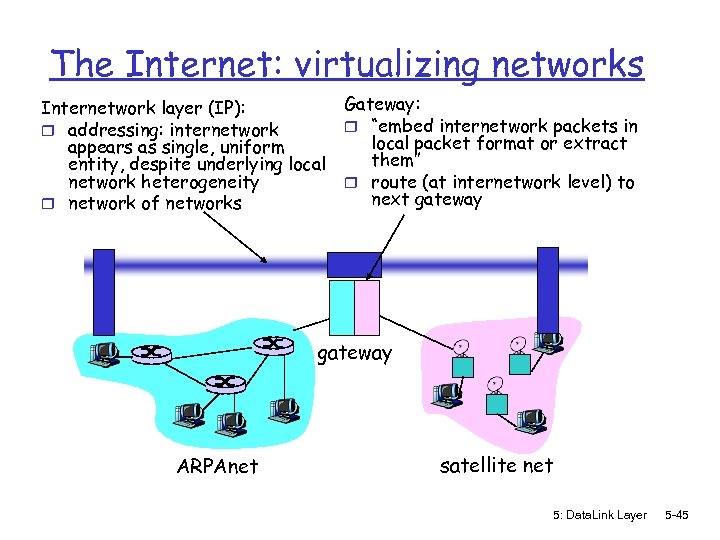 The Internet: virtualizing networks Internetwork layer (IP): r addressing: internetwork appears as single, uniform entity, despite underlying local network heterogeneity r network of networks Gateway: r “embed internetwork packets in local packet format or extract them” r route (at internetwork level) to next gateway ARPAnet satellite net 5: Data. Link Layer 5 -45
 Cerf & Kahn’s Internetwork Architecture What is virtualized? r two layers of addressing: internetwork and local network r new layer (IP) makes everything homogeneous at internetwork layer r underlying local network technology m cable m satellite m 56 K telephone modem m today: ATM, MPLS … “invisible” at internetwork layer. Looks like a link layer technology to IP! 5: Data. Link Layer 5 -46
 ATM and MPLS r ATM, MPLS separate networks in their own right m different service models, addressing, routing from Internet r viewed by Internet as logical link connecting IP routers m just like dialup link is really part of separate network (telephone network) r ATM, MPLS: of technical interest in their own right 5: Data. Link Layer 5 -47
 Asynchronous Transfer Mode: ATM r 1990’s/00 standard for high-speed (155 Mbps to 622 Mbps and higher) Broadband Integrated Service Digital Network architecture r Goal: integrated, end-end transport of carry voice, video, data m meeting timing/Qo. S requirements of voice, video (versus Internet best-effort model) m “next generation” telephony: technical roots in telephone world m packet-switching (fixed length packets, called “cells”) using virtual circuits 5: Data. Link Layer 5 -48
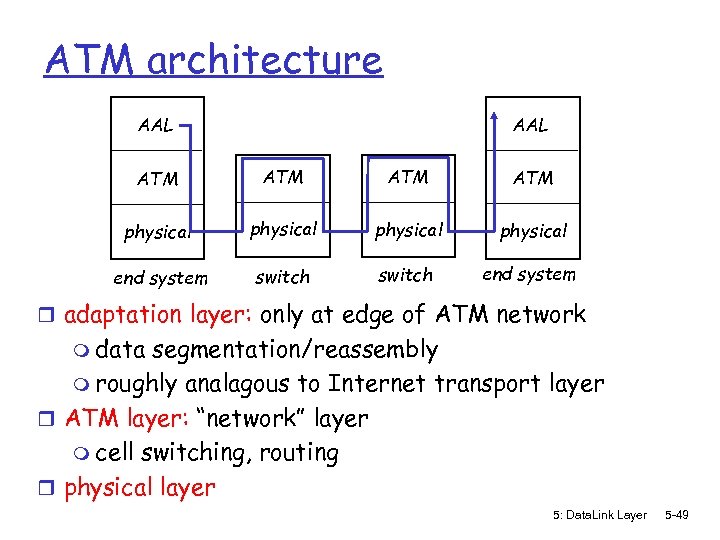 ATM architecture AAL ATM ATM physical end system switch end system r adaptation layer: only at edge of ATM network m data segmentation/reassembly m roughly analagous to Internet transport layer r ATM layer: “network” layer m cell switching, routing r physical layer 5: Data. Link Layer 5 -49
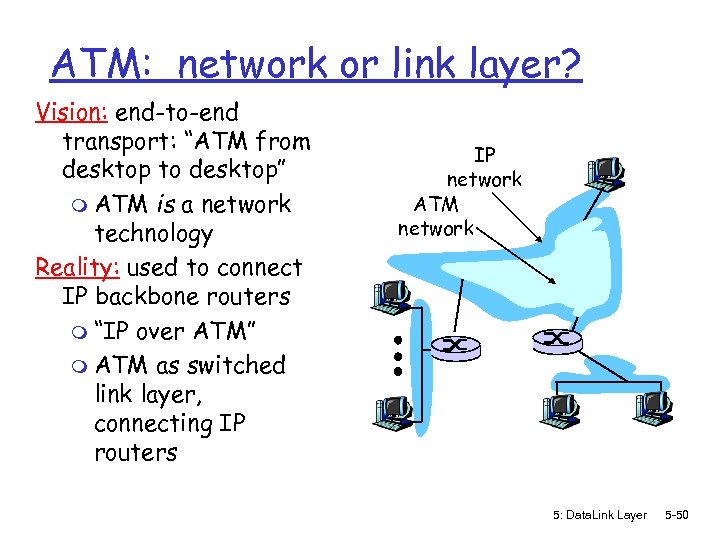 ATM: network or link layer? Vision: end-to-end transport: “ATM from desktop to desktop” m ATM is a network technology Reality: used to connect IP backbone routers m “IP over ATM” m ATM as switched link layer, connecting IP routers IP network ATM network 5: Data. Link Layer 5 -50
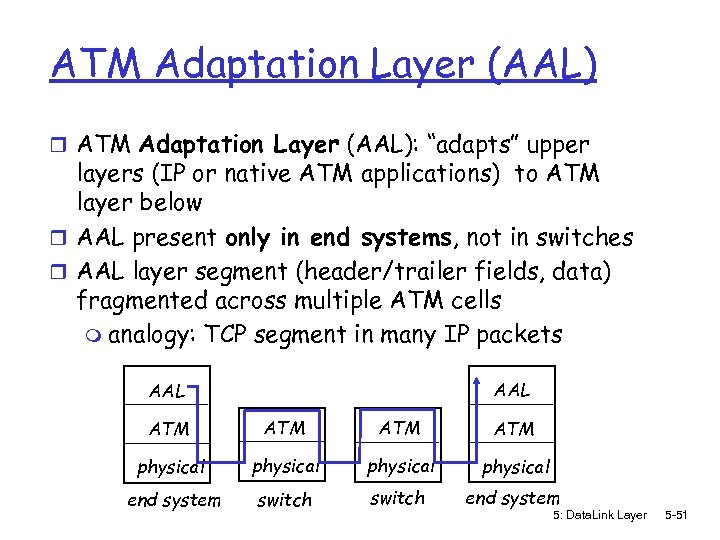 ATM Adaptation Layer (AAL) r ATM Adaptation Layer (AAL): “adapts” upper layers (IP or native ATM applications) to ATM layer below r AAL present only in end systems, not in switches r AAL layer segment (header/trailer fields, data) fragmented across multiple ATM cells m analogy: TCP segment in many IP packets AAL ATM ATM physical end system switch end system 5: Data. Link Layer 5 -51
![ATM Adaptation Layer (AAL) [more] Different versions of AAL layers, depending on ATM service](https://present5.com/presentation/afed6b45cfbb0558c3c1a7ec991c7e35/image-52.jpg "ATM Adaptation Layer (AAL) [more] Different versions of AAL layers, depending on ATM service") ATM Adaptation Layer (AAL) [more] Different versions of AAL layers, depending on ATM service class: r AAL 1: for CBR (Constant Bit Rate) services, e. g. circuit emulation r AAL 2: for VBR (Variable Bit Rate) services, e. g. , MPEG video r AAL 5: for data (eg, IP datagrams) User data AAL PDU ATM cell 5: Data. Link Layer 5 -52
ATM Adaptation Layer (AAL) [more] Different versions of AAL layers, depending on ATM service class: r AAL 1: for CBR (Constant Bit Rate) services, e. g. circuit emulation r AAL 2: for VBR (Variable Bit Rate) services, e. g. , MPEG video r AAL 5: for data (eg, IP datagrams) User data AAL PDU ATM cell 5: Data. Link Layer 5 -52
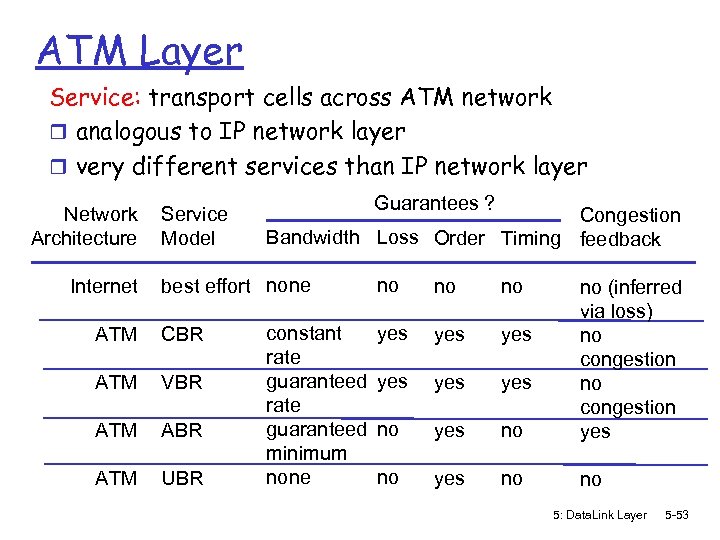 ATM Layer Service: transport cells across ATM network r analogous to IP network layer r very different services than IP network layer Network Architecture Internet Service Model Guarantees ? Congestion Bandwidth Loss Order Timing feedback best effort none ATM CBR ATM VBR ATM ABR ATM UBR constant rate guaranteed minimum none no no no yes yes yes no no (inferred via loss) no congestion yes no no 5: Data. Link Layer 5 -53
 ATM Layer: Virtual Circuits r VC transport: cells carried on VC from source to dest m call setup, teardown for each call before data can flow m each packet carries VC identifier (not destination ID) m every switch on source-dest path maintain “state” for each passing connection m link, switch resources (bandwidth, buffers) may be allocated to VC: to get circuit-like perf. r Permanent VCs (PVCs) m long lasting connections m typically: “permanent” route between to IP routers r Switched VCs (SVC): m dynamically set up on per-call basis 5: Data. Link Layer 5 -54
 ATM VCs r Advantages of ATM VC approach: m Qo. S performance guarantee for connection mapped to VC (bandwidth, delay jitter) r Drawbacks of ATM VC approach: m Inefficient support of datagram traffic m one PVC between each source/dest pair) does not scale (N*2 connections needed) m SVC introduces call setup latency, processing overhead for short lived connections 5: Data. Link Layer 5 -55
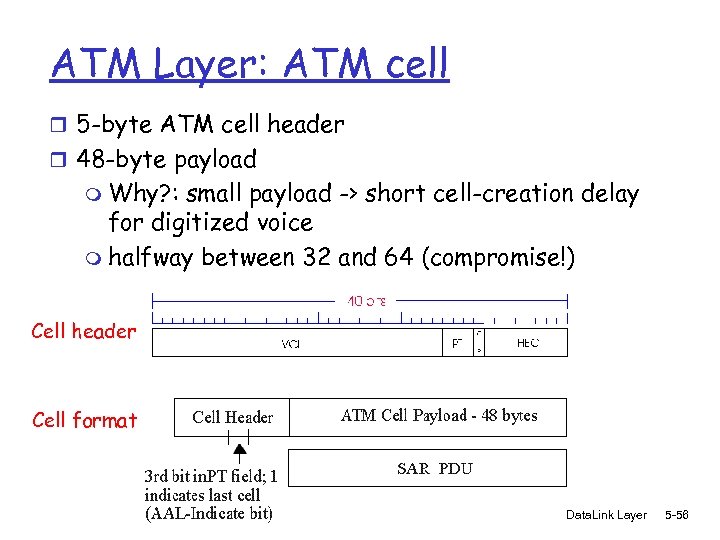 ATM Layer: ATM cell r 5 -byte ATM cell header r 48 -byte payload m Why? : small payload -> short cell-creation delay for digitized voice m halfway between 32 and 64 (compromise!) Cell header Cell format 5: Data. Link Layer 5 -56
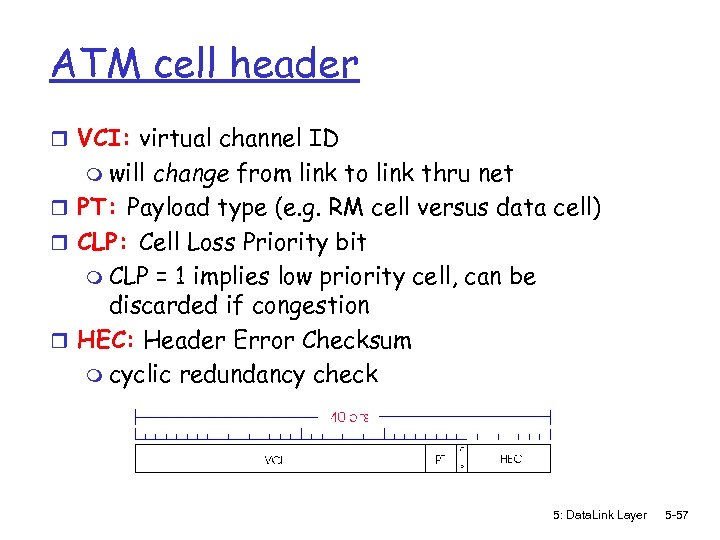 ATM cell header r VCI: virtual channel ID m will change from link to link thru net r PT: Payload type (e. g. RM cell versus data cell) r CLP: Cell Loss Priority bit m CLP = 1 implies low priority cell, can be discarded if congestion r HEC: Header Error Checksum m cyclic redundancy check 5: Data. Link Layer 5 -57
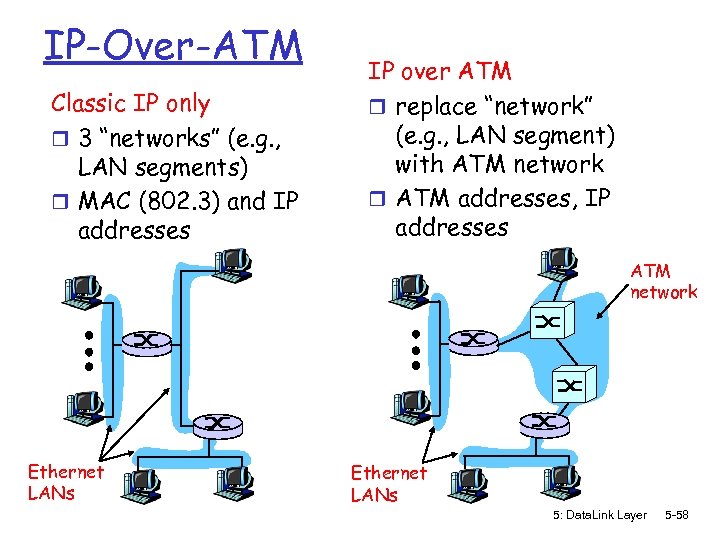 IP-Over-ATM Classic IP only r 3 “networks” (e. g. , LAN segments) r MAC (802. 3) and IP addresses IP over ATM r replace “network” (e. g. , LAN segment) with ATM network r ATM addresses, IP addresses ATM network Ethernet LANs 5: Data. Link Layer 5 -58
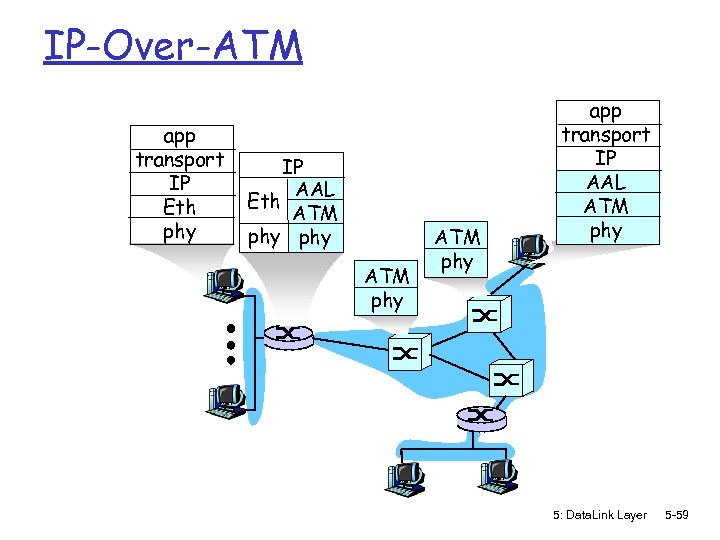 IP-Over-ATM app transport IP Eth phy IP AAL Eth ATM phy app transport IP AAL ATM phy 5: Data. Link Layer 5 -59
 Datagram Journey in IP-over-ATM Network r at Source Host: m IP layer maps between IP, ATM dest address (using ARP) m passes datagram to AAL 5 m AAL 5 encapsulates data, segments cells, passes to ATM layer r ATM network: moves cell along VC to destination r at Destination Host: m AAL 5 reassembles cells into original datagram m if CRC OK, datagram is passed to IP 5: Data. Link Layer 5 -60
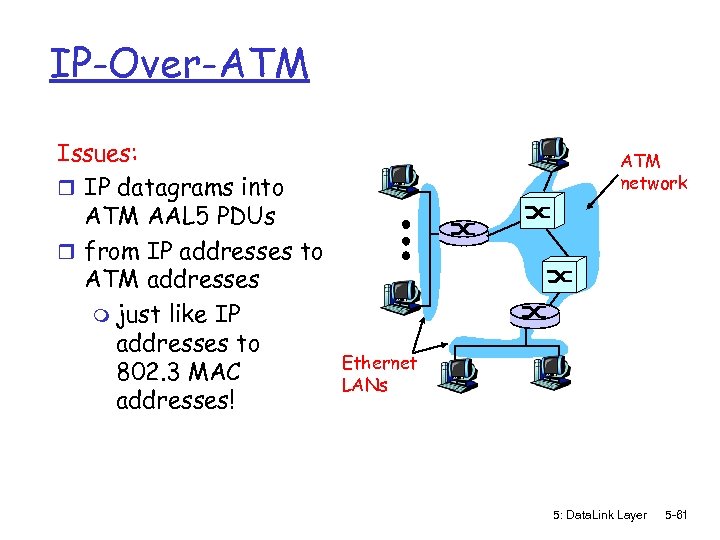 IP-Over-ATM Issues: r IP datagrams into ATM AAL 5 PDUs r from IP addresses to ATM addresses m just like IP addresses to 802. 3 MAC addresses! ATM network Ethernet LANs 5: Data. Link Layer 5 -61
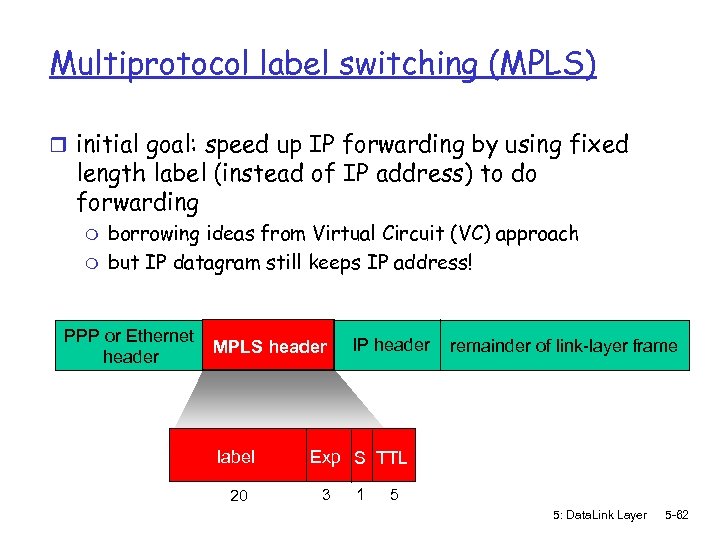 Multiprotocol label switching (MPLS) r initial goal: speed up IP forwarding by using fixed length label (instead of IP address) to do forwarding m m borrowing ideas from Virtual Circuit (VC) approach but IP datagram still keeps IP address! PPP or Ethernet header MPLS header label 20 IP header remainder of link-layer frame Exp S TTL 3 1 5 5: Data. Link Layer 5 -62
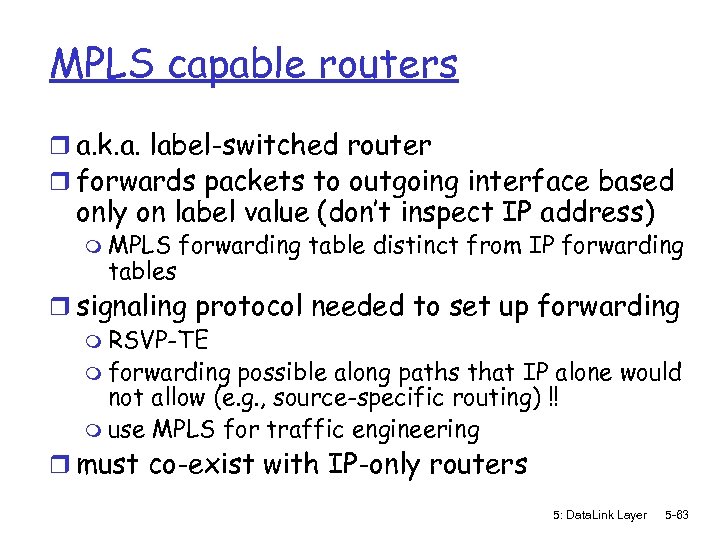 MPLS capable routers r a. k. a. label-switched router r forwards packets to outgoing interface based only on label value (don’t inspect IP address) m MPLS tables forwarding table distinct from IP forwarding r signaling protocol needed to set up forwarding m RSVP-TE m forwarding possible along paths that IP alone would not allow (e. g. , source-specific routing) !! m use MPLS for traffic engineering r must co-exist with IP-only routers 5: Data. Link Layer 5 -63
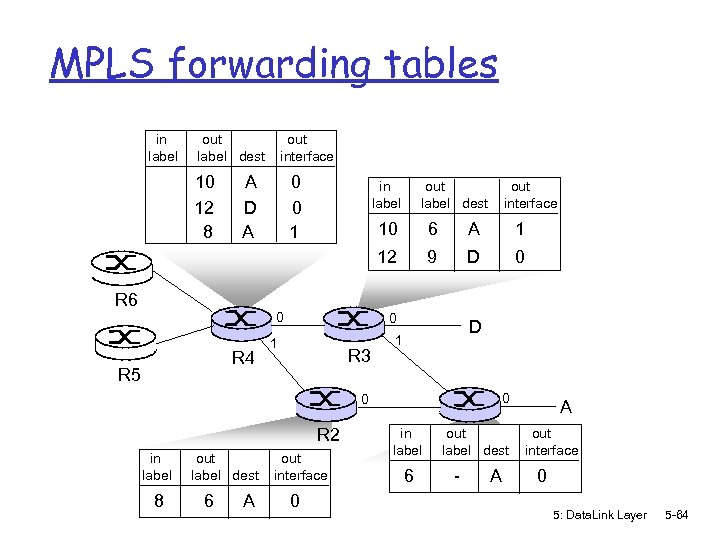 MPLS forwarding tables in label out label dest 10 12 8 out interface A D A 0 0 1 in label out label dest out interface 0 R 4 R 5 6 A 1 12 R 6 10 9 D 0 0 1 R 3 D 1 0 0 R 2 in label 8 out label dest 6 A out interface 0 in label 6 out. R 1 label dest - A A out interface 0 5: Data. Link Layer 5 -64
 Chapter 5: Summary r principles behind data link layer services: m error detection, correction m sharing a broadcast channel: multiple access m link layer addressing r instantiation and implementation of various link layer technologies m Ethernet m switched LANS m PPP m virtualized networks as a link layer: ATM, MPLS 5: Data. Link Layer 5 -65
 Chapter 5: let’s take a breath r journey down protocol stack complete (except PHY) r solid understanding of networking principles, practice r …. . could stop here …. but lots of interesting topics! m wireless m multimedia m security m network management 5: Data. Link Layer 5 -66