 Скачать презентацию 1 Distributed Systems Prof Dr Alexander Schill Dresden
1f4029af429a649f5d45817262946c09.ppt
- Количество слайдов: 16



1 Distributed Systems Prof. Dr. Alexander Schill Dresden Technical University Computer Networks Dept. http: //www. rn. inf. tu-dresden. de
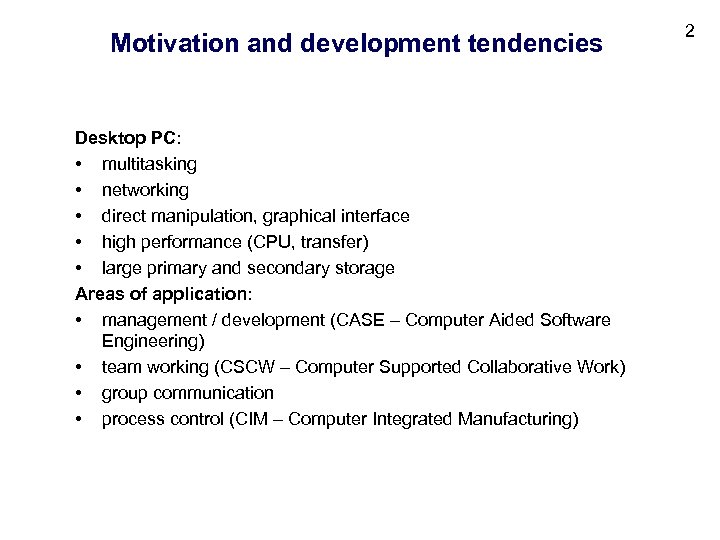
Motivation and development tendencies Desktop PC: • multitasking • networking • direct manipulation, graphical interface • high performance (CPU, transfer) • large primary and secondary storage Areas of application: • management / development (CASE – Computer Aided Software Engineering) • team working (CSCW – Computer Supported Collaborative Work) • group communication • process control (CIM – Computer Integrated Manufacturing) 2
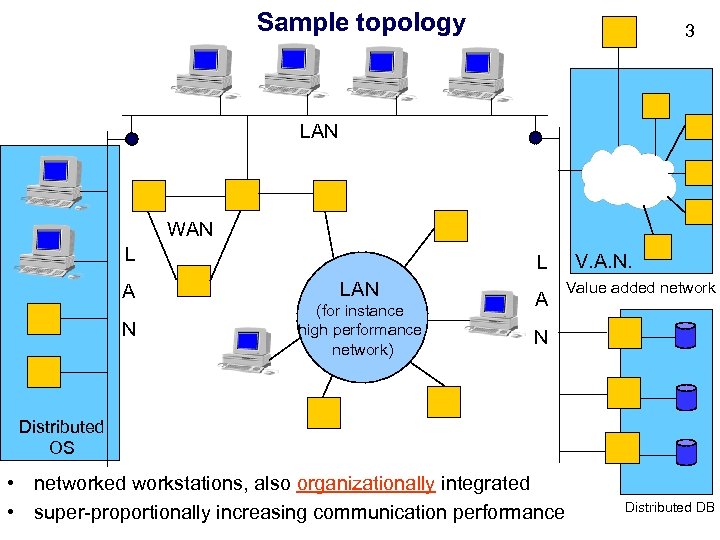
Sample topology 3 LAN WAN L A N L LAN (for instance high performance network) A V. A. N. Value added network N Distributed OS • networked workstations, also organizationally integrated • super-proportionally increasing communication performance Distributed DB
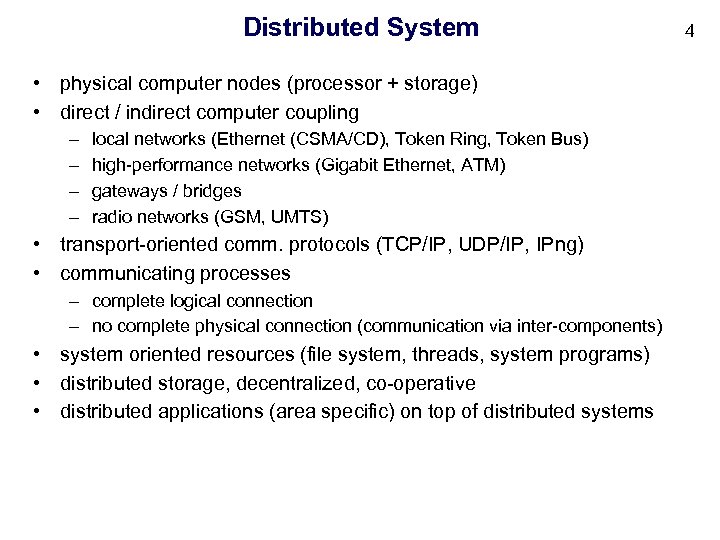
Distributed System • physical computer nodes (processor + storage) • direct / indirect computer coupling – – local networks (Ethernet (CSMA/CD), Token Ring, Token Bus) high-performance networks (Gigabit Ethernet, ATM) gateways / bridges radio networks (GSM, UMTS) • transport-oriented comm. protocols (TCP/IP, UDP/IP, IPng) • communicating processes – complete logical connection – no complete physical connection (communication via inter-components) • system oriented resources (file system, threads, system programs) • distributed storage, decentralized, co-operative • distributed applications (area specific) on top of distributed systems 4
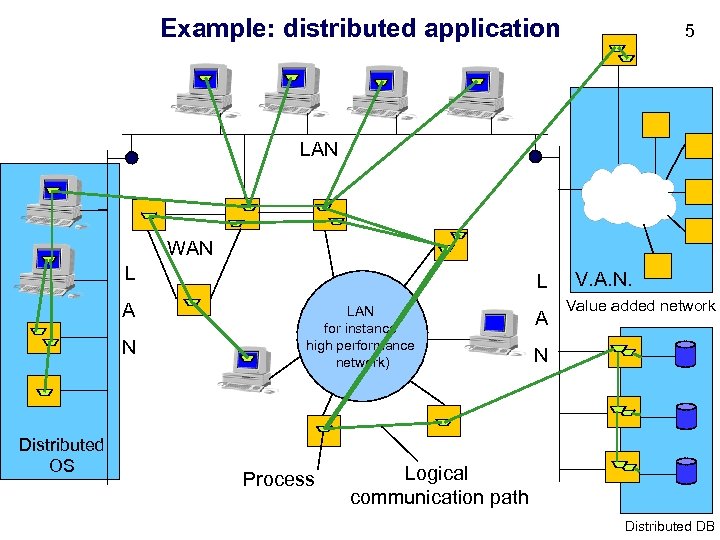
Example: distributed application 5 LAN WAN L A N Distributed OS L LAN for instance high performance network) Process A V. A. N. Value added network N Logical communication path Distributed DB
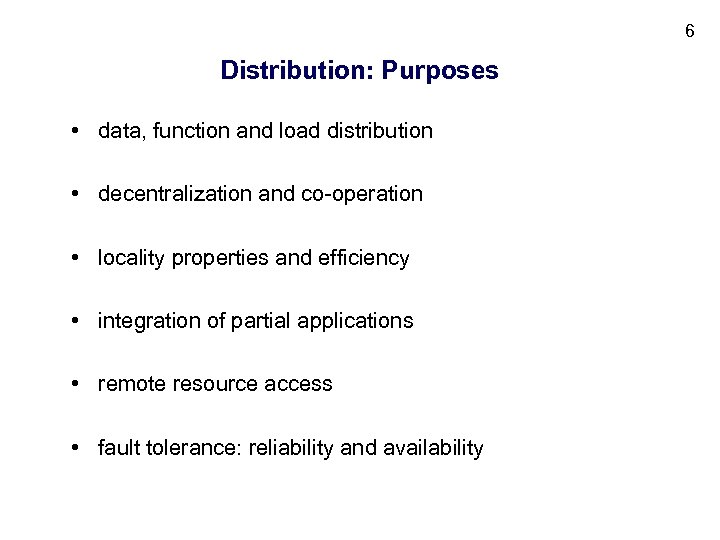
6 Distribution: Purposes • data, function and load distribution • decentralization and co-operation • locality properties and efficiency • integration of partial applications • remote resource access • fault tolerance: reliability and availability
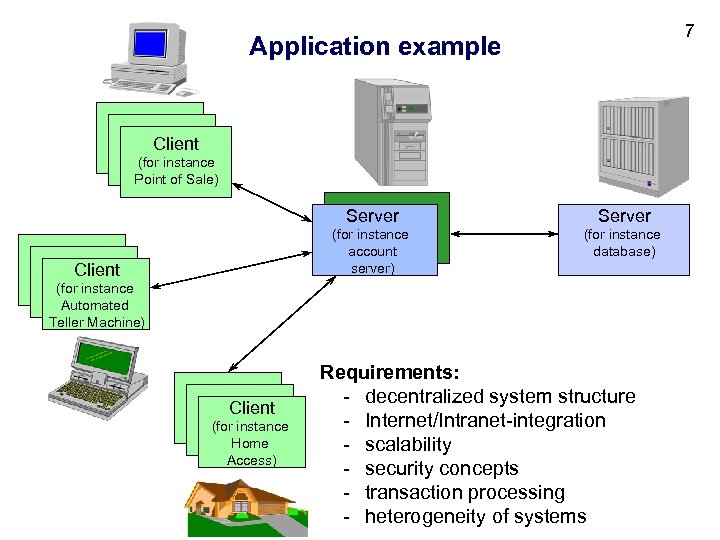
7 Application example Client (for instance Point of Sale) Server (for instance account server) Client Server (for instance database) (for instance Automated Teller Machine) Client (for instance Home Access) Requirements: - decentralized system structure - Internet/Intranet-integration - scalability - security concepts - transaction processing - heterogeneity of systems
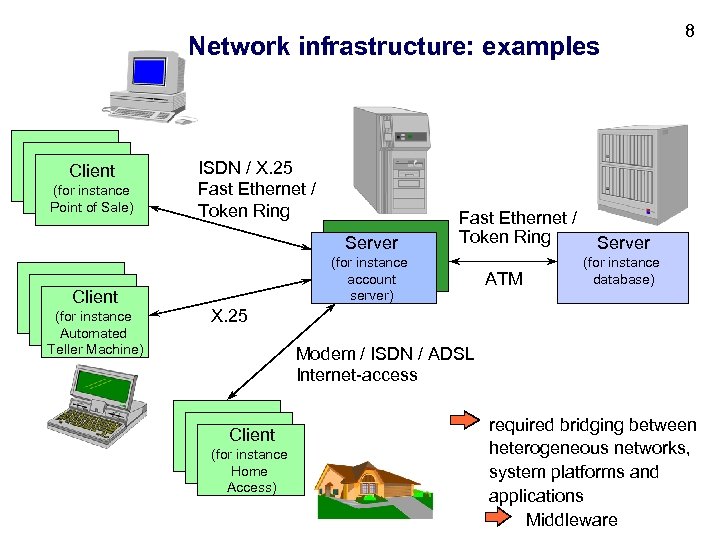
Network infrastructure: examples Client (for instance Point of Sale) ISDN / X. 25 Fast Ethernet / Token Ring Server Client (for instance Automated Teller Machine) Fast Ethernet / Token Ring (for instance account server) ATM 8 Server (for instance database) X. 25 Modem / ISDN / ADSL Internet-access Client (for instance Home Access) required bridging between heterogeneous networks, system platforms and applications Middleware
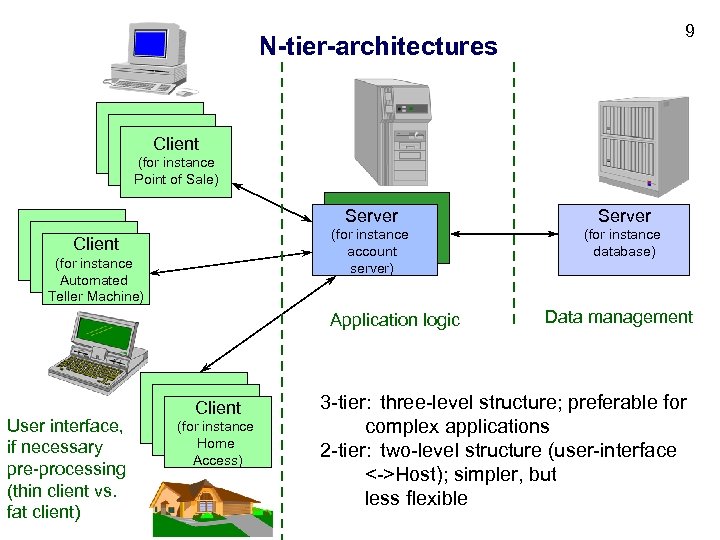
9 N-tier-architectures Client (for instance Point of Sale) Server (for instance account server) Client (for instance Automated Teller Machine) Server (for instance database) Application logic User interface, if necessary pre-processing (thin client vs. fat client) Client (for instance Home Access) Data management 3 -tier: three-level structure; preferable for complex applications 2 -tier: two-level structure (user-interface <->Host); simpler, but less flexible
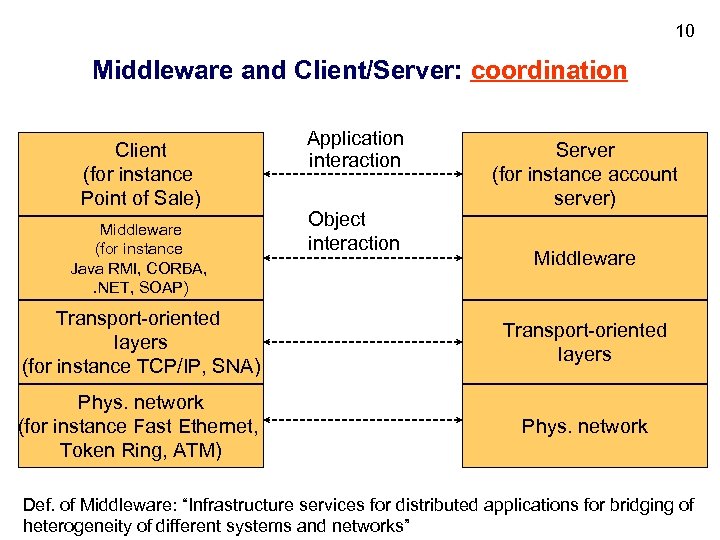
10 Middleware and Client/Server: coordination Client (for instance Point of Sale) Middleware (for instance Java RMI, CORBA, . NET, SOAP) Application interaction Object interaction Server (for instance account server) Middleware Transport-oriented layers (for instance TCP/IP, SNA) Transport-oriented layers Phys. network (for instance Fast Ethernet, Token Ring, ATM) Phys. network Def. of Middleware: “Infrastructure services for distributed applications for bridging of heterogeneity of different systems and networks”
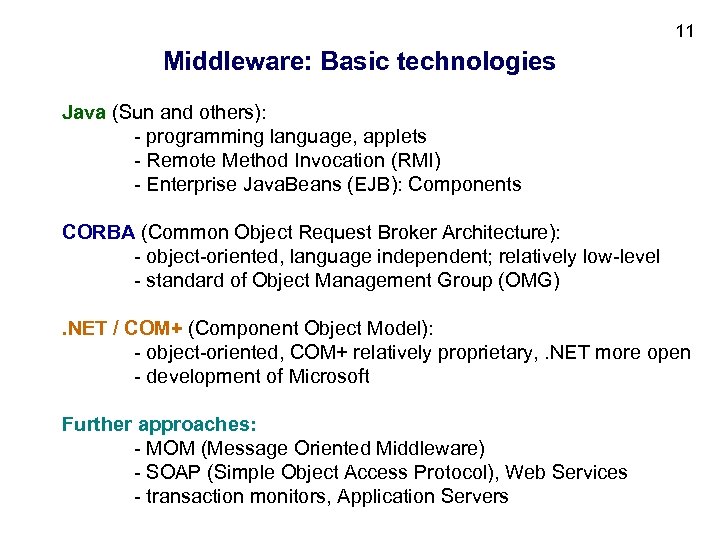
11 Middleware: Basic technologies Java (Sun and others): - programming language, applets - Remote Method Invocation (RMI) - Enterprise Java. Beans (EJB): Components CORBA (Common Object Request Broker Architecture): - object-oriented, language independent; relatively low-level - standard of Object Management Group (OMG). NET / COM+ (Component Object Model): - object-oriented, COM+ relatively proprietary, . NET more open - development of Microsoft Further approaches: - MOM (Message Oriented Middleware) - SOAP (Simple Object Access Protocol), Web Services - transaction monitors, Application Servers
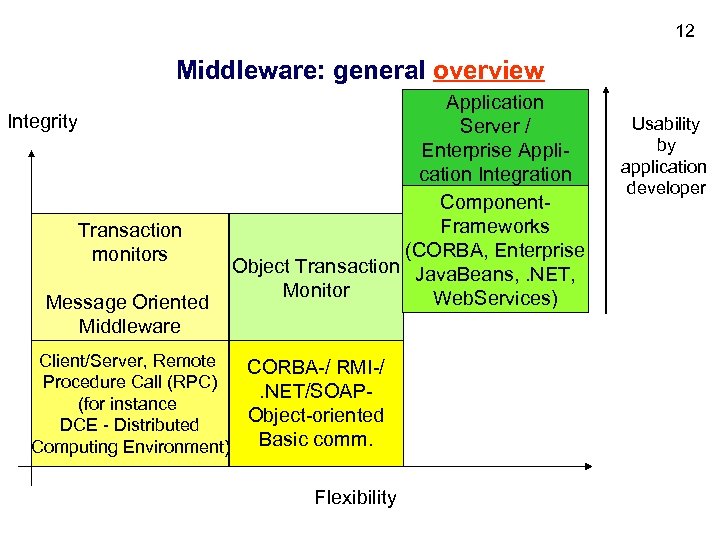
12 Middleware: general overview Integrity Transaction monitors Message Oriented Middleware Application Server / Enterprise Application Integration Component. Frameworks (CORBA, Enterprise Object Transaction Java. Beans, . NET, Monitor Web. Services) Client/Server, Remote CORBA-/ RMI-/ Procedure Call (RPC). NET/SOAP(for instance Object-oriented DCE - Distributed Basic comm. Computing Environment) Flexibility Usability by application developer
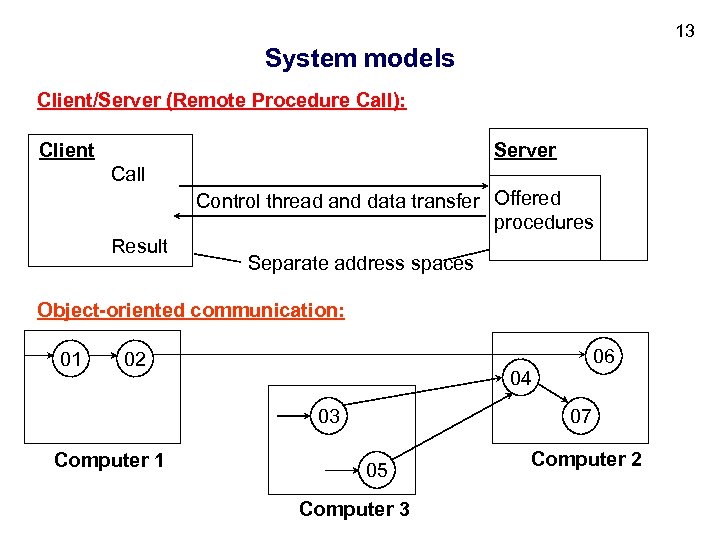
13 System models Client/Server (Remote Procedure Call): Client Server Call Control thread and data transfer Offered procedures Result Separate address spaces Object-oriented communication: 01 02 04 03 Computer 1 06 07 05 Computer 3 Computer 2
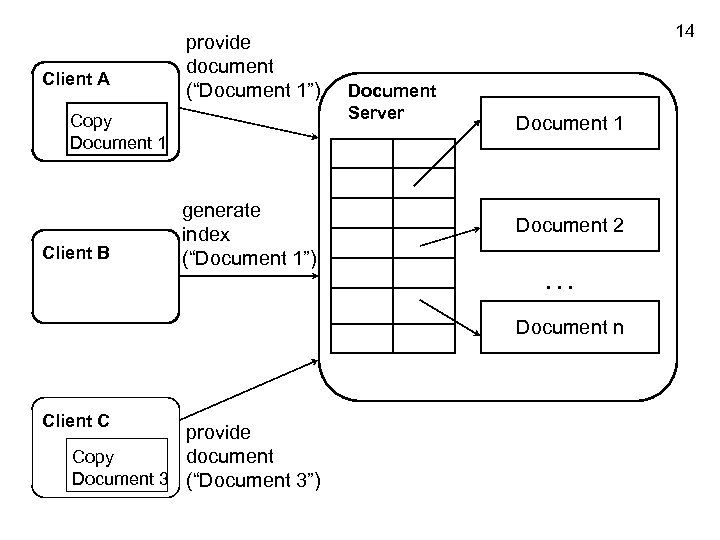
Client A provide document (“Document 1”) Copy Document 1 Client B generate index (“Document 1”) 14 Document Server Document 1 Document 2. . . Document n Client C provide Copy document Document 3 (“Document 3”)
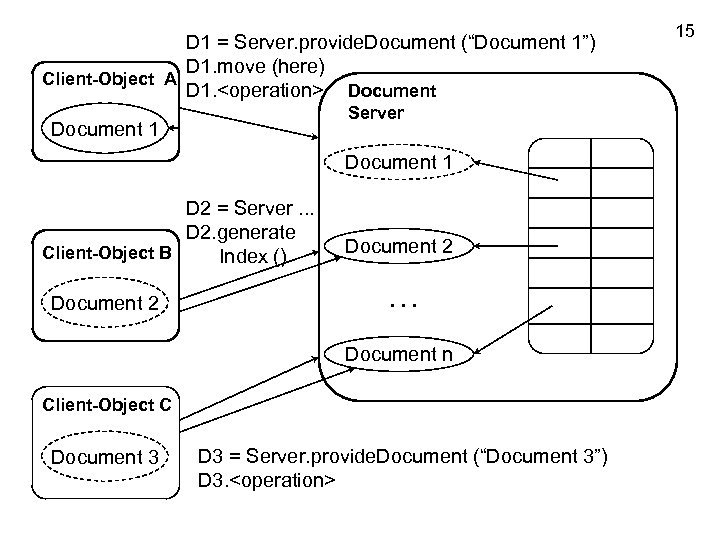
D 1 = Server. provide. Document (“Document 1”) D 1. move (here) Client-Object A D 1. <operation> Document Server Document 1 D 2 = Server. . . D 2. generate Client-Object B Index () Document 2. . . Document n Client-Object C Document 3 D 3 = Server. provide. Document (“Document 3”) D 3. <operation> 15
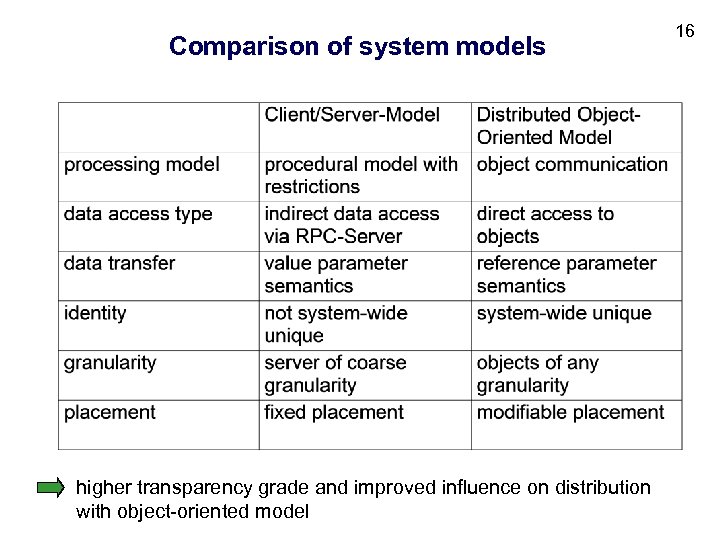
Comparison of system models higher transparency grade and improved influence on distribution with object-oriented model 16
Скачать презентацию 1 Distributed Systems Prof Dr Alexander Schill Dresden
1f4029af429a649f5d45817262946c09.ppt