


 Скачать презентацию 1 Depositional ice nucleation efficiencies of sea surface
5c7dcba6ddbed099407cb7dd5614e494.ppt
- Количество слайдов: 20
 1 Depositional ice nucleation efficiencies of sea surface microlayer aerosol particles L. A. Ladino 1, J. D. Yakobi-Hancock 1, R. Mason 2, L. Miller 3, E. Polishchuck 2, O. Wurl 4, M. Si 2, Y. Li 5, J. Wong 1, D. J. Cziczo 6, C. Schiller 7, A. Huffman 5, A. K. Bertram 2, and J. P. D. Abbatt 1 Annual NETCARE Workshop, November 18, 2013 1 Department of Chemistry, University of Toronto, 80 St. George St. , Toronto, Ontario, M 5 S 3 H 6, Canada; 2 Chemistry Department, University of British Columbia; 3 Institute of Ocean Sciences, Fisheries and Oceans Canada; 4 Leibniz Institute for Baltic Sea Research, Department of Biological Oceanography; 5 Department of Chemistry and Biochemistry, University of Denver, CO, USA
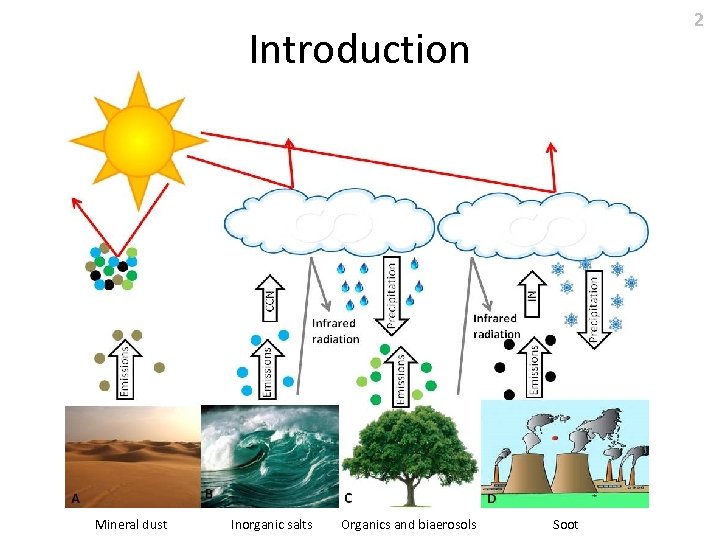 2 Introduction Mineral dust Inorganic salts Organics and biaerosols Soot
 Introduction 3 üThe global marine emissions of submicron primary organic aerosols particles by sea spray have been estimated to be 8. 2 Tg yr− 1 (mineral dust 1678 Tg yr− 1 ). ü The ice nuclei abilities of marine aerosols have not been well investigated although the oceans cover 70% of the planet. ü For example, Bigg 1973, Schnell (1982) and Rosinski et al. (1988) measured the IN concentration in different locations (SPO and GM). ü More recently, Rogers et al. (2001) and Prenni et al. (2009) conducted airborne measurements in the Arctic and Knopf et al. (2011) investigated the IN properties of marine diatoms and phytoplankton species in the laboratory. Vagnati et al. Atmos. Environ (2010); Dentener et al. ACP (2006), Burrows et al. ACP (2013)
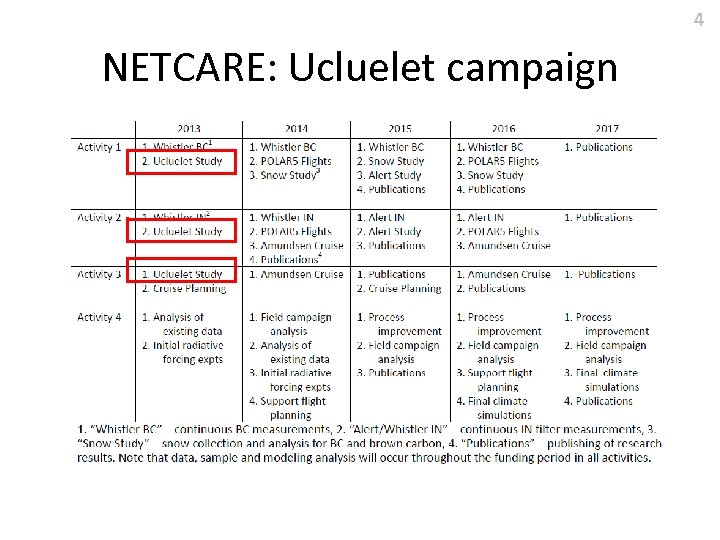 4 NETCARE: Ucluelet campaign
 5 Goals 1. Characterize the physical and chemical properties of aerosols in a marine environment 2. Measure the ice nuclei concentrations in a marine environment 3. Identify the presence and concentrations of biological material in marine aerosol 4. Investigate the ice crystal and liquid cloud droplet nucleating properties of the sea surface microlayer
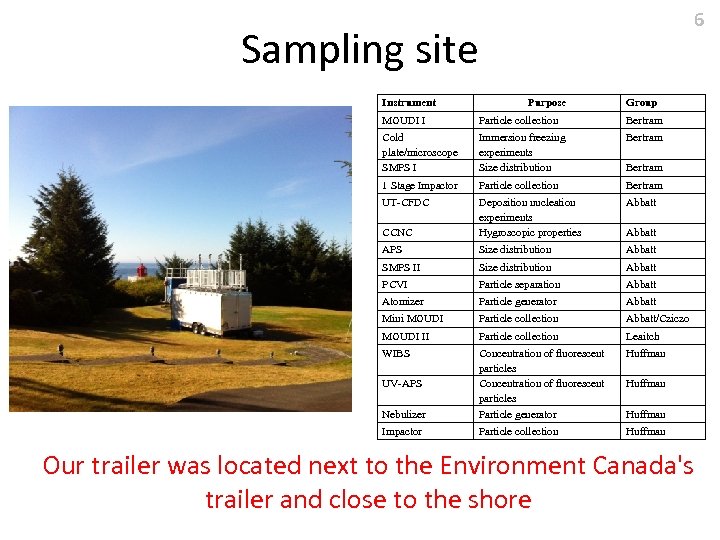 6 Sampling site Instrument Purpose Group MOUDI I Particle collection Bertram Cold plate/microscope SMPS I Immersion freezing experiments Size distribution Bertram 1 Stage Impactor Particle collection Bertram UT-CFDC Abbatt CCNC Deposition nucleation experiments Hygroscopic properties APS Size distribution Abbatt SMPS II Size distribution Abbatt PCVI Particle separation Abbatt Atomizer Particle generator Abbatt Mini MOUDI Particle collection Abbatt/Cziczo MOUDI II Particle collection Leaitch WIBS Huffman Nebulizer Concentration of fluorescent particles Particle generator Impactor Particle collection Huffman UV-APS Bertram Abbatt Huffman Our trailer was located next to the Environment Canada's trailer and close to the shore
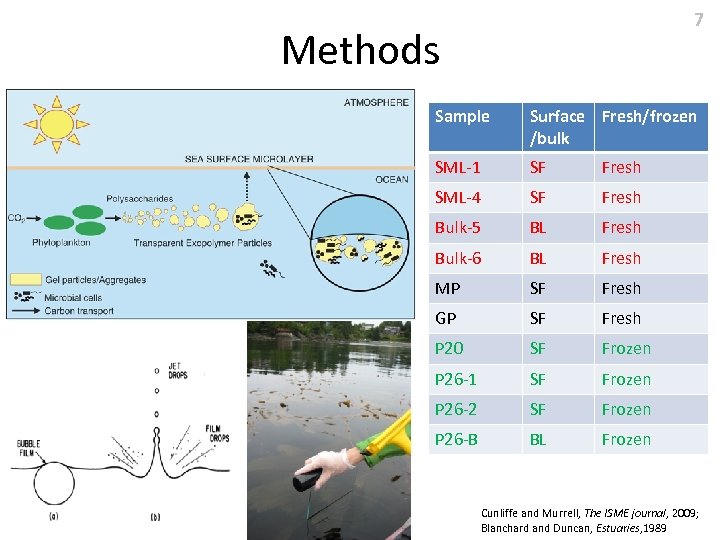 7 Methods Sample Surface Fresh/frozen /bulk SML-1 SF Fresh SML-4 SF Fresh Bulk-5 BL Fresh Bulk-6 BL Fresh MP SF Fresh GP SF Fresh P 20 SF Frozen P 26 -1 SF Frozen P 26 -2 SF Frozen P 26 -B BL Frozen Cunliffe and Murrell, The ISME journal, 2009; Blanchard and Duncan, Estuaries, 1989
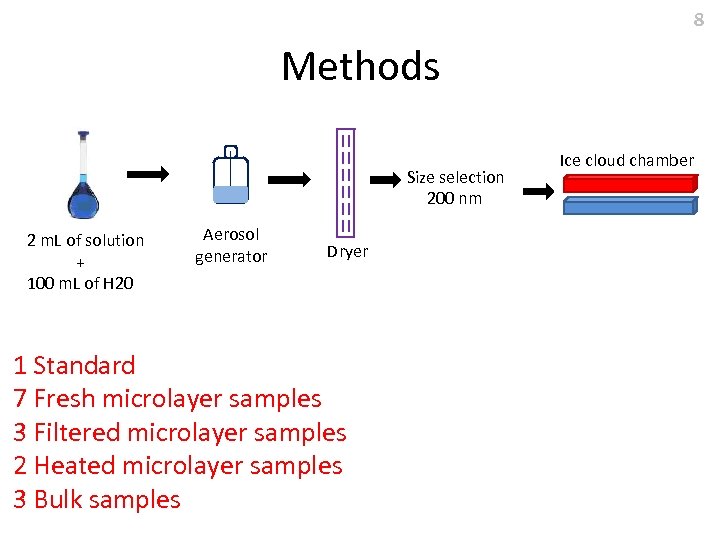 8 Methods Size selection 200 nm 2 m. L of solution + 100 m. L of H 20 Aerosol generator Dryer 1 Standard 7 Fresh microlayer samples 3 Filtered microlayer samples 2 Heated microlayer samples 3 Bulk samples Ice cloud chamber
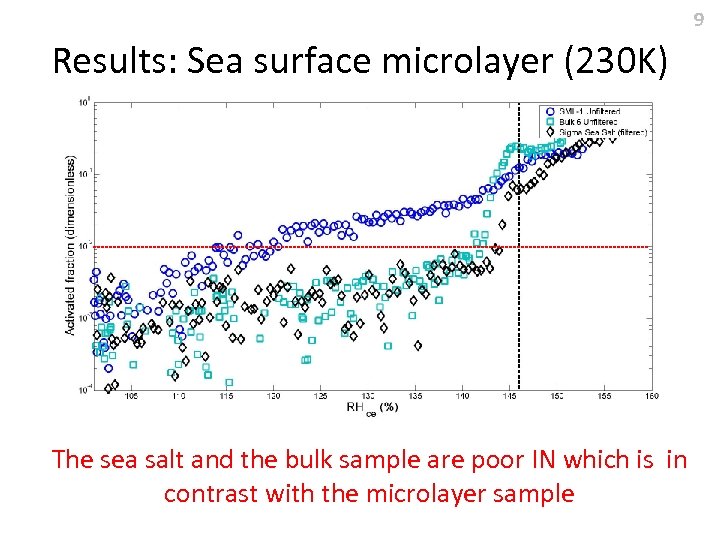 9 Results: Sea surface microlayer (230 K) The sea salt and the bulk sample are poor IN which is in contrast with the microlayer sample
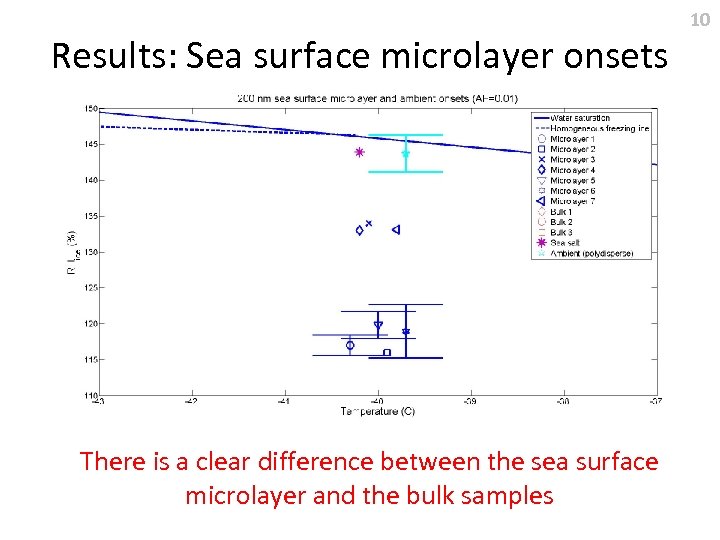 Results: Sea surface microlayer onsets There is a clear difference between the sea surface microlayer and the bulk samples 10
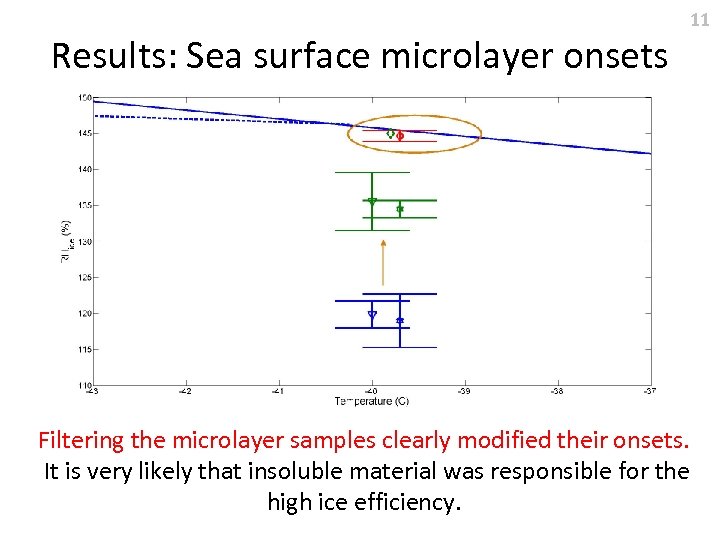 Results: Sea surface microlayer onsets 11 Filtering the microlayer samples clearly modified their onsets. It is very likely that insoluble material was responsible for the high ice efficiency.
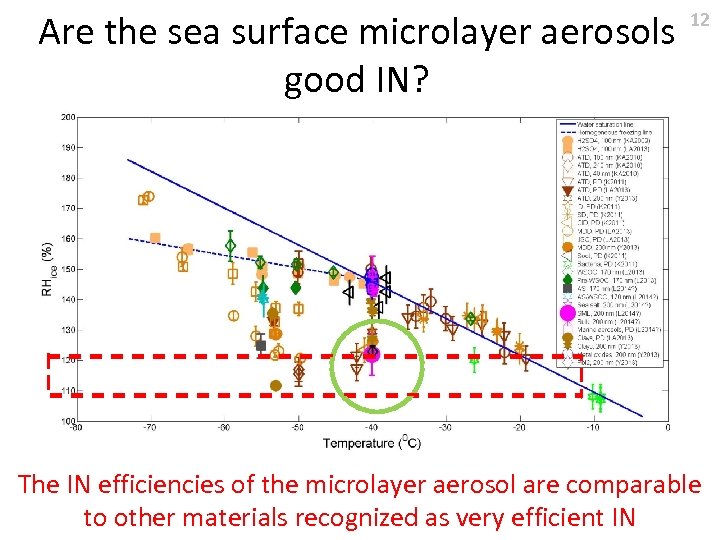 Are the sea surface microlayer aerosols good IN? 12 The IN efficiencies of the microlayer aerosol are comparable to other materials recognized as very efficient IN
 Conclusions • The SML were found to be active in the deposition nucleation mode at -40 C. • The bulk samples are less efficient than the SML samples. • We observed a strong effect from filtering the SML. • The present results could be atmospherically relevant in the upper troposphere of remote marine areas. 13
 Open Questions • Are the main properties of the microlayer samples preserved at 4 C and dark conditions? • Is it possible that the biological material degrade after couple of months? • Is the chemical composition of the sea surface microlayer and bulk solutions comparable (is it just a dilution factor)? • Is it possible that the sea surface microlayer particles reach the upper troposphere (incloud and below cloud-scavenging)?
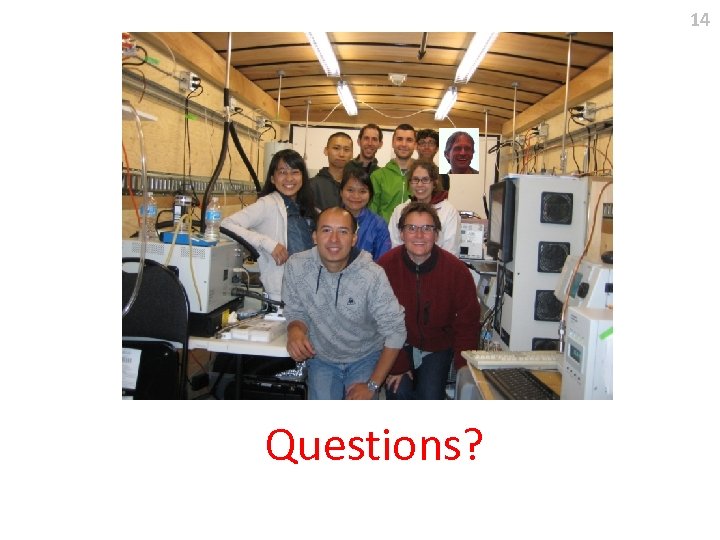 14 Questions?

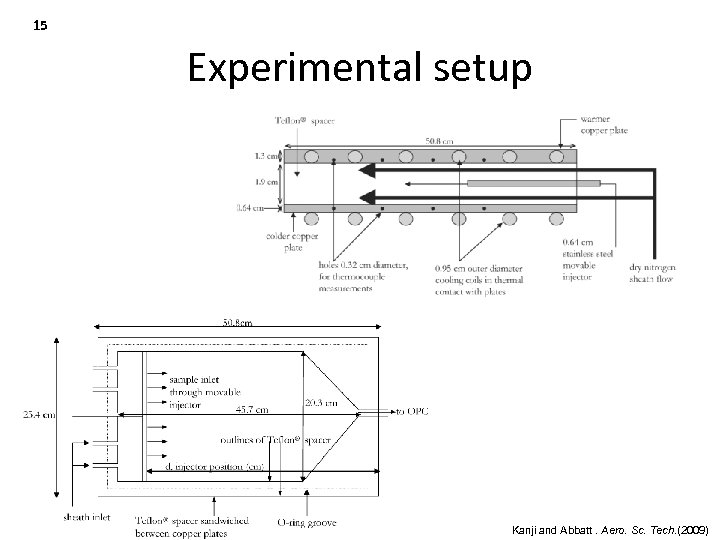 15 Experimental setup Kanji and Abbatt. Aero. Sc. Tech. (2009)
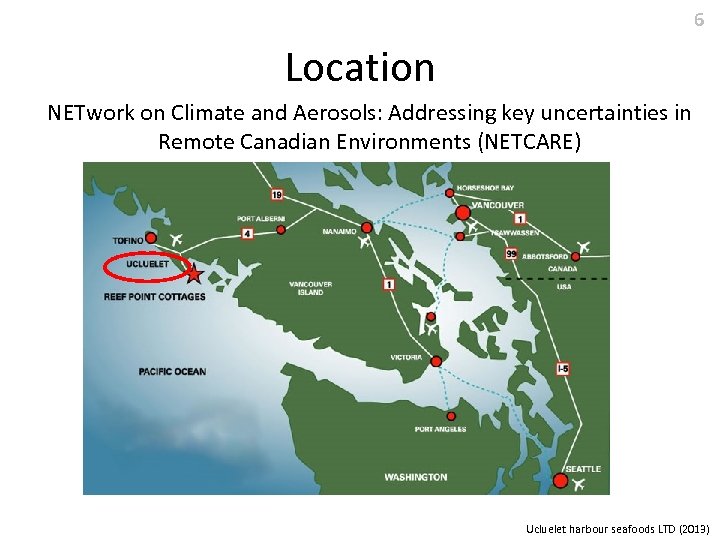 6 Location NETwork on Climate and Aerosols: Addressing key uncertainties in Remote Canadian Environments (NETCARE) Ucluelet harbour seafoods LTD (2013)
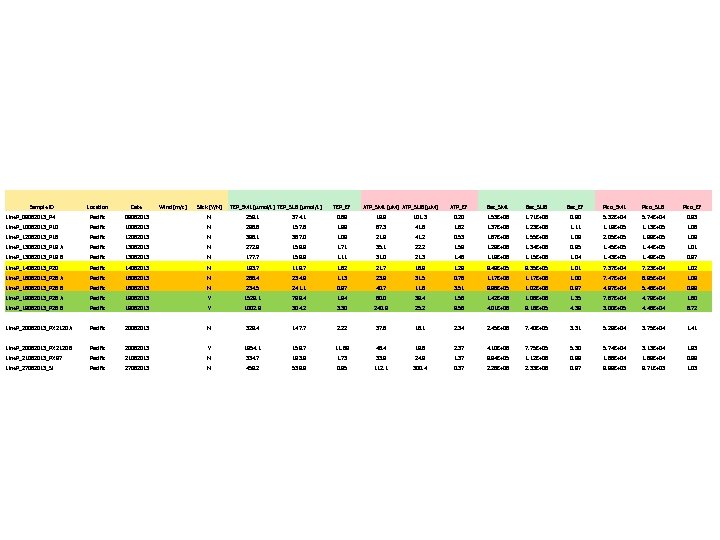 Location Date ATP_EF Bac_SML Bac_SUB Bac_EF Pico_SML Pico_SUB Pico_EF Line. P_09062013_P 4 Sample ID Pacific 09062013 Wind [m/s] Slick [Y/N] N TEP_SML [mmol/L] TEP_SUB [mmol/L] 258. 1 374. 1 TEP_EF 0. 69 ATP_SML [m. M] ATP_SUB [m. M] 19. 8 101. 3 0. 20 1. 53 E+06 1. 71 E+06 0. 90 5. 32 E+04 5. 74 E+04 0. 93 Line. P_10062013_P 10 Pacific 10062013 N 296. 6 157. 6 1. 88 67. 3 41. 62 1. 37 E+06 1. 23 E+06 1. 11 1. 19 E+05 1. 13 E+05 1. 06 Line. P_12062013_P 16 Pacific 12062013 N 396. 1 367. 0 1. 08 21. 8 41. 2 0. 53 1. 67 E+06 1. 55 E+06 1. 08 2. 05 E+05 1. 89 E+05 1. 08 Line. P_13062013_P 18 A Pacific 13062013 N 272. 8 159. 8 1. 71 35. 1 22. 2 1. 58 1. 28 E+06 1. 34 E+06 0. 95 1. 45 E+05 1. 44 E+05 1. 01 Line. P_13062013_P 18 B Pacific 13062013 N 177. 7 159. 9 1. 11 31. 0 21. 3 1. 46 1. 19 E+06 1. 15 E+06 1. 04 1. 43 E+05 1. 48 E+05 0. 97 Line. P_14062013_P 20 Pacific 14062013 N 193. 7 119. 7 1. 62 21. 7 16. 8 1. 29 9. 48 E+05 9. 35 E+05 1. 01 7. 37 E+04 7. 23 E+04 1. 02 Line. P_16062013_P 26 A Pacific 16062013 N 266. 4 234. 8 1. 13 23. 9 31. 5 0. 76 1. 17 E+06 1. 00 7. 47 E+04 6. 85 E+04 1. 09 Line. P_16062013_P 26 B Pacific 16062013 N 234. 5 241. 1 0. 97 40. 7 11. 6 3. 51 9. 86 E+05 1. 02 E+06 0. 97 4. 87 E+04 5. 46 E+04 0. 89 Line. P_19062013_P 26 A Pacific 19062013 Y 1528. 1 788. 4 1. 94 60. 0 38. 4 1. 56 1. 42 E+06 1. 06 E+06 1. 35 7. 67 E+04 4. 78 E+04 1. 60 Line. P_19062013_P 26 B Pacific 19062013 Y 1002. 9 304. 2 3. 30 240. 8 25. 2 9. 56 4. 01 E+06 9. 16 E+05 4. 38 3. 00 E+05 4. 46 E+04 6. 72 Line. P_20062013_PX 2120 A Pacific 20062013 N 328. 4 147. 7 2. 22 37. 6 16. 1 2. 34 2. 45 E+06 7. 40 E+05 3. 31 5. 29 E+04 3. 75 E+04 1. 41 Line. P_20062013_PX 2120 B Pacific 20062013 Y 1854. 1 158. 7 11. 68 46. 4 19. 6 2. 37 4. 10 E+06 7. 75 E+05 5. 30 5. 74 E+04 3. 13 E+04 1. 83 Line. P_21062013_PX 87 Pacific 21062013 N 334. 7 193. 8 1. 73 33. 9 24. 8 1. 37 9. 94 E+05 1. 12 E+06 0. 89 1. 66 E+04 1. 68 E+04 0. 99 Line. P_27062013_SI Pacific 27062013 N 459. 2 539. 9 0. 85 112. 1 300. 4 0. 37 2. 26 E+06 2. 33 E+06 0. 97 8. 99 E+03 8. 71 E+03 1. 03