


 Скачать презентацию 1 CONTENTS Lesson 1 Chinese
ff05d8ebed0c9d8ff292715e9945b8a8.ppt
- Количество слайдов: 45
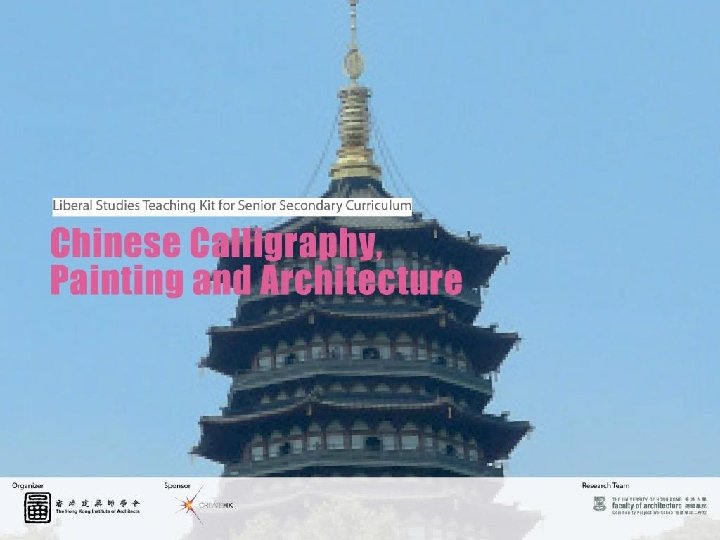 1
1
 CONTENTS • Lesson 1 – Chinese Calligraphy, Painting and Architecture • Introduction – How do you appreciate Chinese architecture • Tse Ha’s Six Principles § § § | Chinese Calligraphy, Painting and Architecture| ‘Spirit resonance’ ‘Heaviness and lightness of brush stroke’ ‘Correspondence to the object’ ‘Applying colours in accordance with the type’ ‘Be particular about the composition’ ‘Following prototype with adaptation’ Lesson 1 – Chinese Calligraphy, Painting and Architecture 2
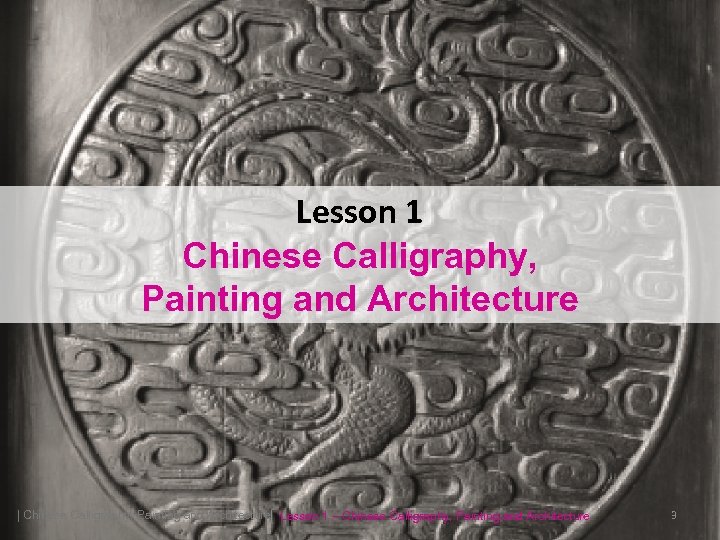 Lesson 1 Chinese Calligraphy, Painting and Architecture | Chinese Calligraphy, Painting and Architecture| Lesson 1 – Chinese Calligraphy, Painting and Architecture 3
 Introduction — How do you appreciate Chinese architecture? | Chinese Calligraphy, Painting and Architecture| Lesson 1 – Introduction 4
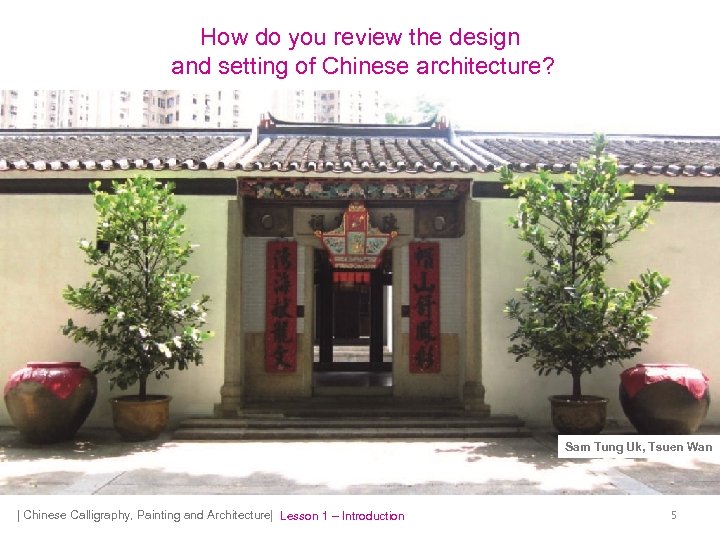 How do you review the design and setting of Chinese architecture? Sam Tung Uk, Tsuen Wan | Chinese Calligraphy, Painting and Architecture| Lesson 1 – Introduction 5
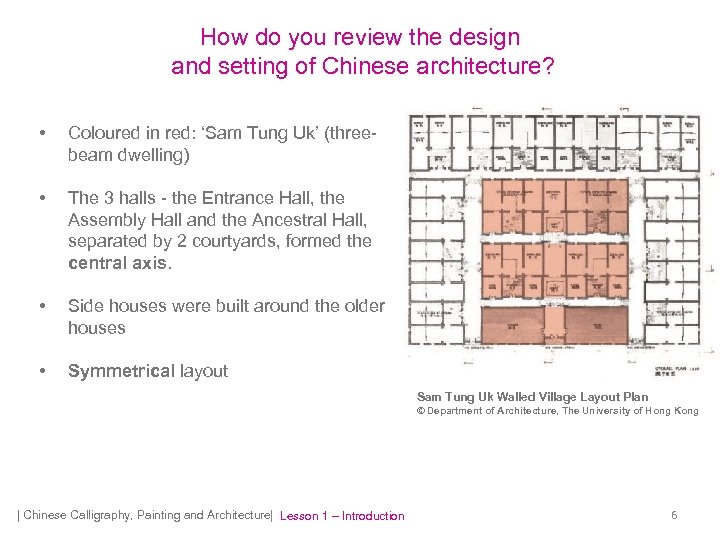 How do you review the design and setting of Chinese architecture? • Coloured in red: ‘Sam Tung Uk’ (threebeam dwelling) • The 3 halls - the Entrance Hall, the Assembly Hall and the Ancestral Hall, separated by 2 courtyards, formed the central axis. • Side houses were built around the older houses • Symmetrical layout Sam Tung Uk Walled Village Layout Plan © Department of Architecture, The University of Hong Kong | Chinese Calligraphy, Painting and Architecture| Lesson 1 – Introduction 6
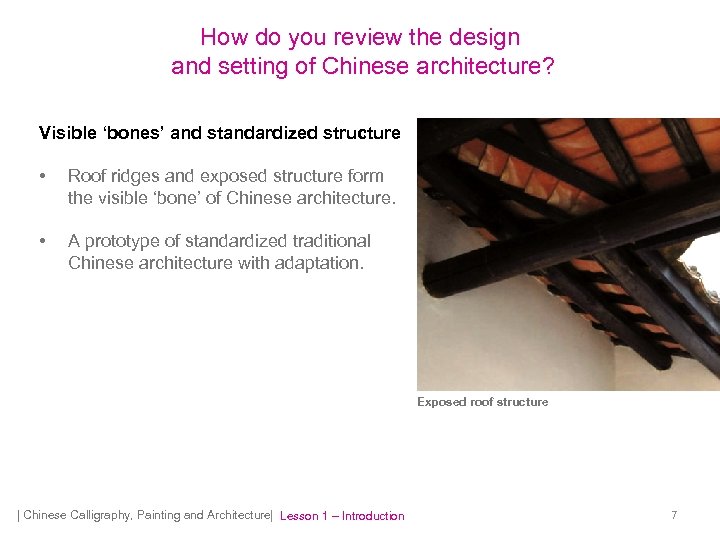 How do you review the design and setting of Chinese architecture? Visible ‘bones’ and standardized structure • Roof ridges and exposed structure form the visible ‘bone’ of Chinese architecture. • A prototype of standardized traditional Chinese architecture with adaptation. Exposed roof structure | Chinese Calligraphy, Painting and Architecture| Lesson 1 – Introduction 7
 Relationship between Chinese Calligraphy, Painting and Architecture Chinese architecture is an artistic expression that has been shaped by the development of Chinese culture, lifestyles, traditions and beliefs over an extended period of time. • Great harmony between heaven, earth and human (天、地、人) beings. • In traditional Chinese buildings, the site context, building forms and spatial layouts are developed in relation to each other. | Chinese Calligraphy, Painting and Architecture| Lesson 1 – Introduction 8
 Methodology of Chinese Calligraphy, Painting and Architecture Appreciation The first systematic methodology of Chinese painting appreciation: The Southern Qi painter Tse Ha’s “Six Principles in the Category of Ancient Paintings“ (謝赫古畫品錄中之六法) The six principles: an aesthetic-political standard that can be applied to historic paintings or to the appreciation of Chinese art and architecture even today. | Chinese Calligraphy, Painting and Architecture| Lesson 1 – Introduction 9
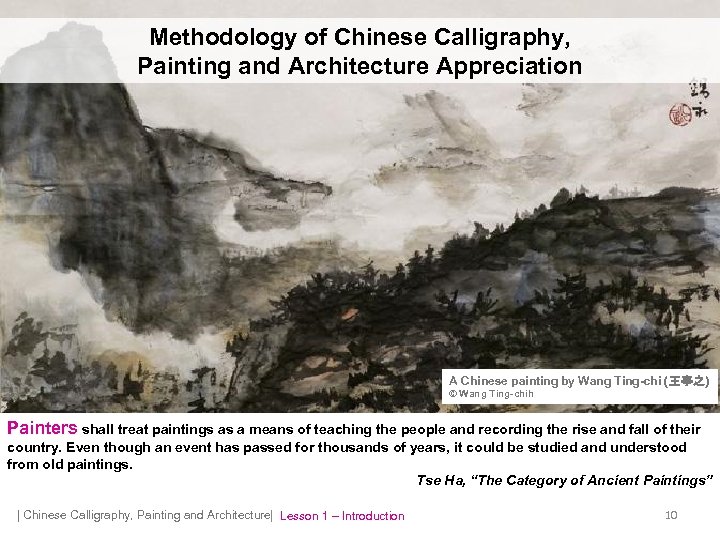 Methodology of Chinese Calligraphy, Painting and Architecture Appreciation A Chinese painting by Wang Ting-chi (王亭之) © Wang Ting-chih Painters shall treat paintings as a means of teaching the people and recording the rise and fall of their country. Even though an event has passed for thousands of years, it could be studied and understood from old paintings. Tse Ha, “The Category of Ancient Paintings” | Chinese Calligraphy, Painting and Architecture| Lesson 1 – Introduction 10
 Six Principles in the Category of Ancient Paintings | Chinese Calligraphy, Painting and Architecture| Lesson 1 – Tse Ha’s Six Principles 11
 Tse Ha’s ‘Six Principles in the Category of Ancient Paintings’ 1. Spirit resonance (氣韻生動); 2. Heaviness and lightness of brush stroke (骨法用筆); 3. Correspondence to the object (應物象形); 4. Applying colours in accordance with the type (隨類賦彩); 5. Be particular about the composition (經營位置) 6. Following prototype with adaptation (傳移摸寫). The first principal is spiritual connection while the others are technical skills. Chinese architecture can be reviewed in the same way. | Chinese Calligraphy, Painting and Architecture| Lesson 1 – Tse Ha’s Six Principles 12
 ‘Spirit resonance’ (氣韻生動) Principle Vibrancy forms the spiritual basis of a painting. During the Period of Disunity, painters paid special attention to: • Shan shui (mountain-water), • figure • flowers-and-birds | Chinese Calligraphy, Painting and Architecture| Lesson 1 – Tse Ha’s Six Principles 13
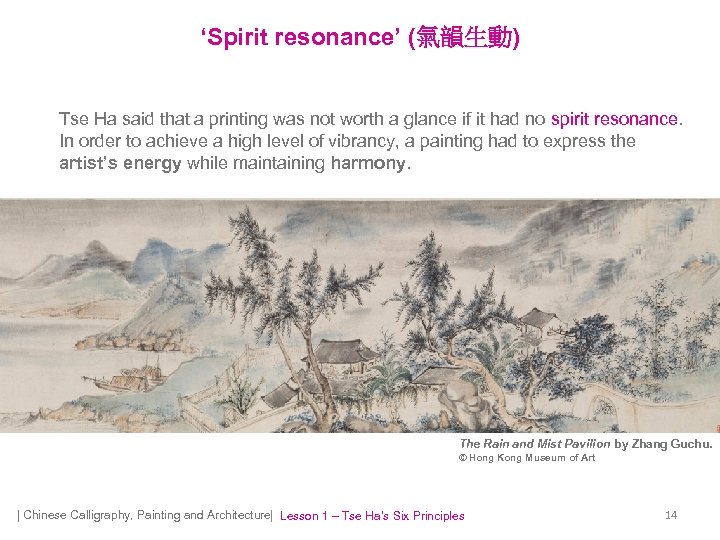 ‘Spirit resonance’ (氣韻生動) Tse Ha said that a printing was not worth a glance if it had no spirit resonance. In order to achieve a high level of vibrancy, a painting had to express the artist’s energy while maintaining harmony. The Rain and Mist Pavilion by Zhang Guchu. © Hong Kong Museum of Art | Chinese Calligraphy, Painting and Architecture| Lesson 1 – Tse Ha’s Six Principles 14
 ‘Spirit resonance’ (氣韻生動) Application in Chinese Architecture • • Vibrancy is established through planning of spatial sequences. Spatial experience is always emphasized in Chinese architecture. This is the essence on the underlying conceptual thoughts behind art and architecture to achieve “delight” that is passed to the audience. Paintings of architecture was a subject that received minimal respect until the Song Dynasty. From these old paintings, we can see how ancient architecture sought to achieve a spatial vibrancy. | Chinese Calligraphy, Painting and Architecture| Lesson 1 – Tse Ha’s Six Principles 15
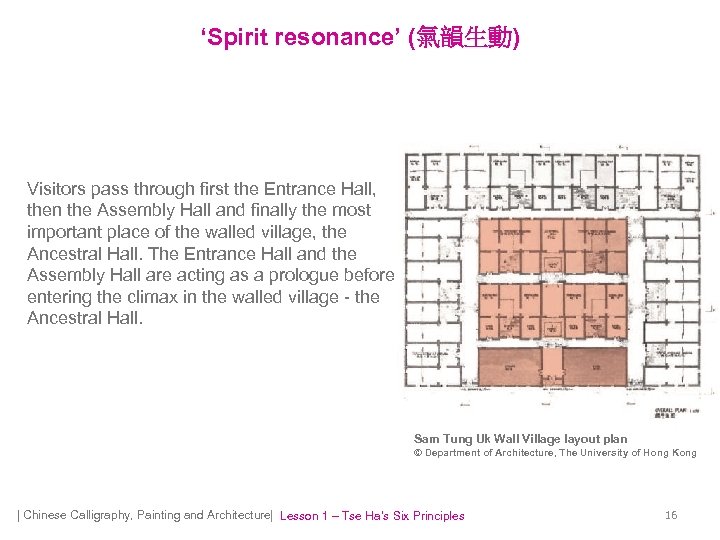 ‘Spirit resonance’ (氣韻生動) Visitors pass through first the Entrance Hall, then the Assembly Hall and finally the most important place of the walled village, the Ancestral Hall. The Entrance Hall and the Assembly Hall are acting as a prologue before entering the climax in the walled village - the Ancestral Hall. Sam Tung Uk Wall Village layout plan © Department of Architecture, The University of Hong Kong | Chinese Calligraphy, Painting and Architecture| Lesson 1 – Tse Ha’s Six Principles 16
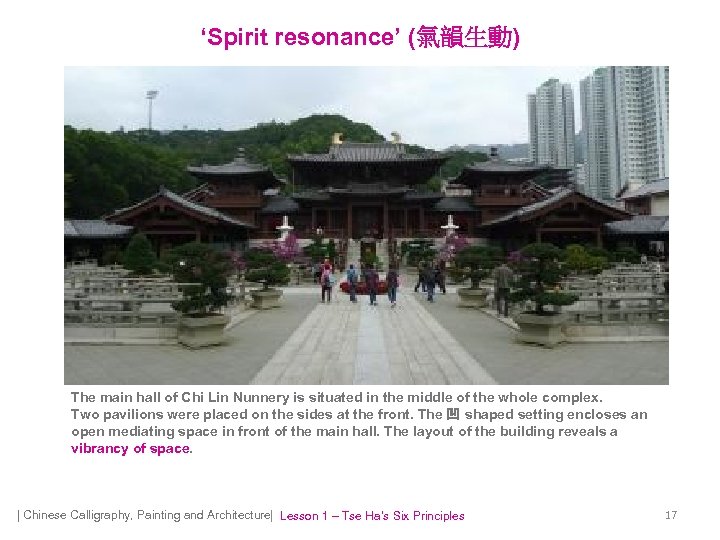 ‘Spirit resonance’ (氣韻生動) The main hall of Chi Lin Nunnery is situated in the middle of the whole complex. Two pavilions were placed on the sides at the front. The 凹 shaped setting encloses an open mediating space in front of the main hall. The layout of the building reveals a vibrancy of space. | Chinese Calligraphy, Painting and Architecture| Lesson 1 – Tse Ha’s Six Principles 17
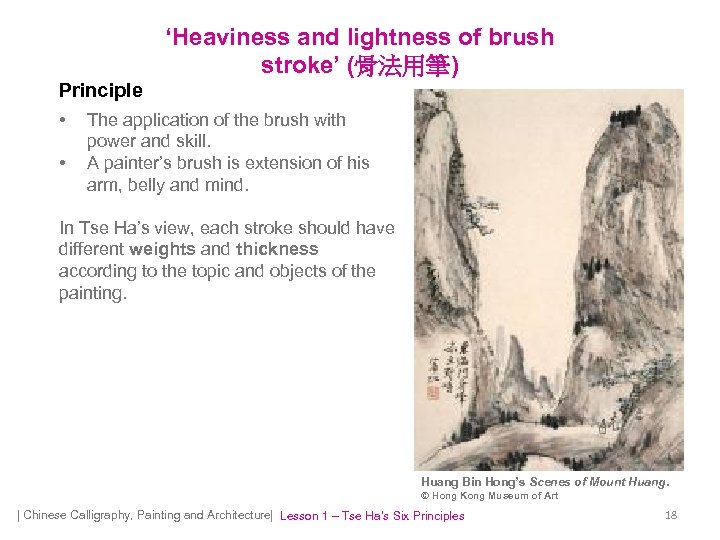 Principle • • ‘Heaviness and lightness of brush stroke’ (骨法用筆) The application of the brush with power and skill. A painter’s brush is extension of his arm, belly and mind. In Tse Ha’s view, each stroke should have different weights and thickness according to the topic and objects of the painting. Huang Bin Hong’s Scenes of Mount Huang. © Hong Kong Museum of Art | Chinese Calligraphy, Painting and Architecture| Lesson 1 – Tse Ha’s Six Principles 18
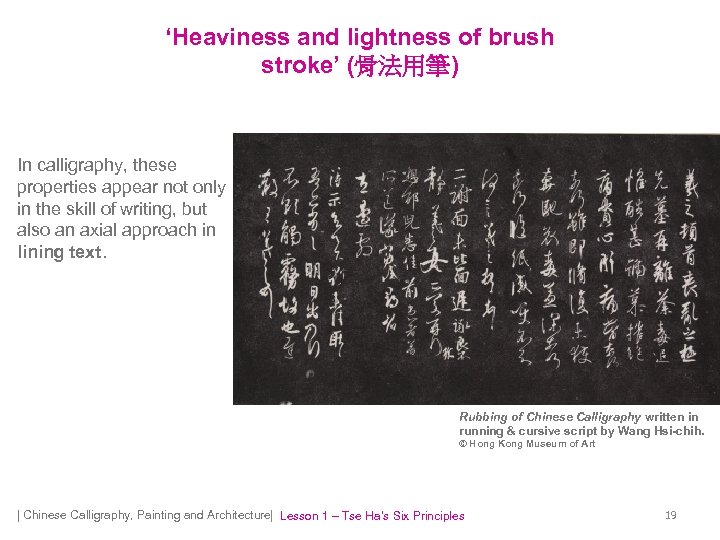 ‘Heaviness and lightness of brush stroke’ (骨法用筆) In calligraphy, these properties appear not only in the skill of writing, but also an axial approach in lining text. Rubbing of Chinese Calligraphy written in running & cursive script by Wang Hsi-chih. © Hong Kong Museum of Art | Chinese Calligraphy, Painting and Architecture| Lesson 1 – Tse Ha’s Six Principles 19
 ‘Heaviness and lightness of brush stroke’ (骨法用筆) Application in Chinese Architecture • • The painterly gesture lies in the use of an axis, local symmetry and expression of structure. Visible gestures can be seen in roof ridges, brackets and exposed structures. Spatial hierarchy and structural importance are shown in a systematic way, like a skeleton. | Chinese Calligraphy, Painting and Architecture| Lesson 1 – Tse Ha’s Six Principles 20
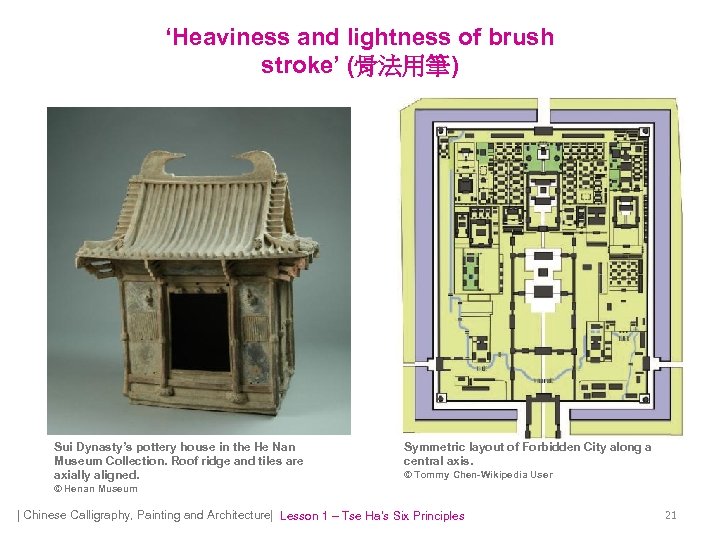 ‘Heaviness and lightness of brush stroke’ (骨法用筆) Sui Dynasty’s pottery house in the He Nan Museum Collection. Roof ridge and tiles are axially aligned. Symmetric layout of Forbidden City along a central axis. © Tommy Chen-Wikipedia User © Henan Museum | Chinese Calligraphy, Painting and Architecture| Lesson 1 – Tse Ha’s Six Principles 21
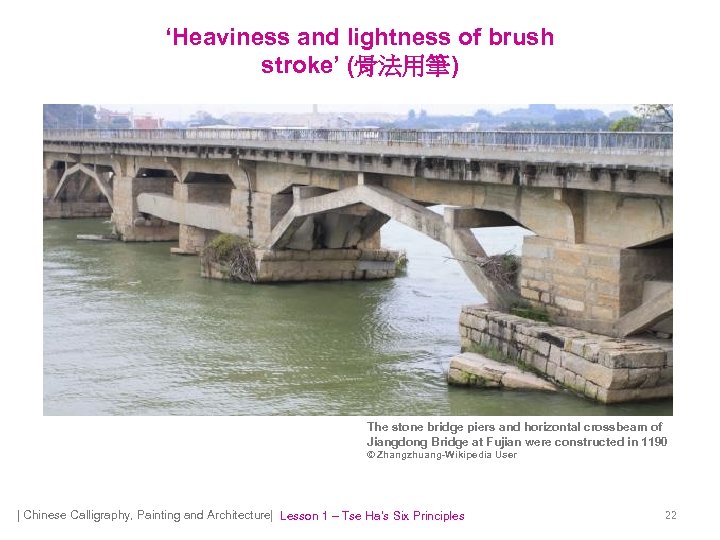 ‘Heaviness and lightness of brush stroke’ (骨法用筆) The stone bridge piers and horizontal crossbeam of Jiangdong Bridge at Fujian were constructed in 1190 © Zhangzhuang-Wikipedia User | Chinese Calligraphy, Painting and Architecture| Lesson 1 – Tse Ha’s Six Principles 22
 ‘Correspondence to the object’ (應物象形) Principle A painting should show the spirit and life of people through their appearances and gestures. Application in Chinese Architecture Specific building forms are created for different functions and for specific groups of users. This principal is also find in the motto of modern architecture “Form Follow Functions”. | Chinese Calligraphy, Painting and Architecture| Lesson 1 – Tse Ha’s Six Principles 23
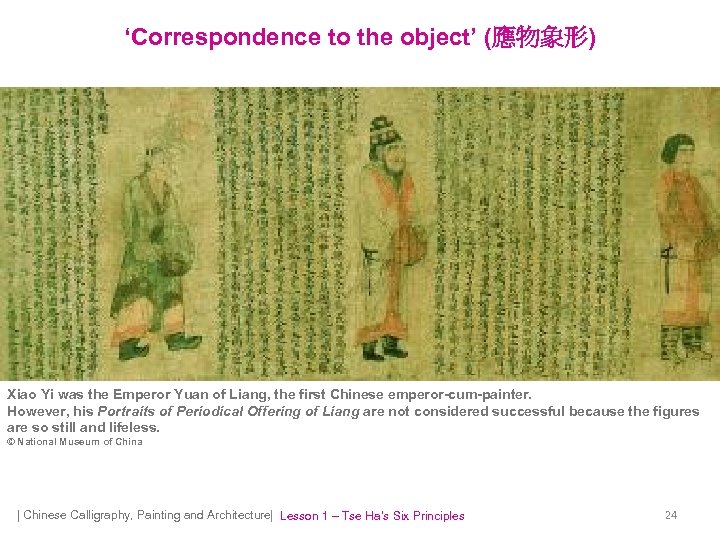 ‘Correspondence to the object’ (應物象形) Xiao Yi was the Emperor Yuan of Liang, the first Chinese emperor-cum-painter. However, his Portraits of Periodical Offering of Liang are not considered successful because the figures are so still and lifeless. © National Museum of China | Chinese Calligraphy, Painting and Architecture| Lesson 1 – Tse Ha’s Six Principles 24
![[Discussion] In terms of architecture, specific forms of buildings are created for different functions.](https://present5.com/presentation/ff05d8ebed0c9d8ff292715e9945b8a8/image-25.jpg "[Discussion] In terms of architecture, specific forms of buildings are created for different functions.") [Discussion] In terms of architecture, specific forms of buildings are created for different functions. Do you think the following buildings fulfil the principle of “Correspondence to the object“? (Keywords: Reaching heaven, place of gathering) Giant Wild Goose Pagoda, Shaanxi © Bobak Ha’Eri - Wikipedia User Shaxi theatre, Yunnan © Li Li-Wikipedia User | Chinese Calligraphy, Painting and Architecture| Lesson 1 – Tse Ha’s Six Principles 25
[Discussion] In terms of architecture, specific forms of buildings are created for different functions. Do you think the following buildings fulfil the principle of “Correspondence to the object“? (Keywords: Reaching heaven, place of gathering) Giant Wild Goose Pagoda, Shaanxi © Bobak Ha’Eri - Wikipedia User Shaxi theatre, Yunnan © Li Li-Wikipedia User | Chinese Calligraphy, Painting and Architecture| Lesson 1 – Tse Ha’s Six Principles 25
 ‘Applying colours in accordance with the type’ (隨類賦彩) Principle Colours should be selected either to match an object’s natural appearance or to emphasize some symbolic meaning. For example, a painter paints leaves in red to represent autumn In Shan shui painting, water and fog make up large, evenly coloured areas of the image. Application in Chinese Architecture Specific colours and ornamental details are set in accordance with rank and symbolism. | Chinese Calligraphy, Painting and Architecture| Lesson 1 – Tse Ha’s Six Principles 26
![[Discussion] How do the colours influence the atmosphere in the following drawings? Parts of](https://present5.com/presentation/ff05d8ebed0c9d8ff292715e9945b8a8/image-27.jpg "[Discussion] How do the colours influence the atmosphere in the following drawings? Parts of") [Discussion] How do the colours influence the atmosphere in the following drawings? Parts of the leaves are red in Autumn Landscape, a very realistic scene. The color of white is used in Visiting a Friend in Snow by Li Guixin to represent the snow © Hong Kong Museum of Art | Chinese Calligraphy, Painting and Architecture| Lesson 1 – Tse Ha’s Six Principles 27
[Discussion] How do the colours influence the atmosphere in the following drawings? Parts of the leaves are red in Autumn Landscape, a very realistic scene. The color of white is used in Visiting a Friend in Snow by Li Guixin to represent the snow © Hong Kong Museum of Art | Chinese Calligraphy, Painting and Architecture| Lesson 1 – Tse Ha’s Six Principles 27
 ‘Applying colours in accordance with the type’ (隨類賦彩) Calligraphy can be done in different styles, which are guided by different geometries and forms. Each style and geometry has its own meaning, just as in architecture. © Ngan Siu-Mu | Chinese Calligraphy, Painting and Architecture| Lesson 1 – Tse Ha’s Six Principles 28
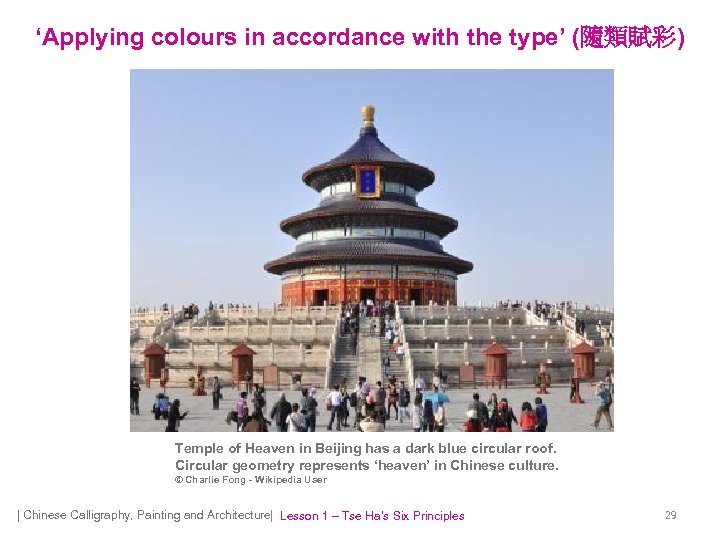 ‘Applying colours in accordance with the type’ (隨類賦彩) Temple of Heaven in Beijing has a dark blue circular roof. Circular geometry represents ‘heaven’ in Chinese culture. © Charlie Fong - Wikipedia User | Chinese Calligraphy, Painting and Architecture| Lesson 1 – Tse Ha’s Six Principles 29
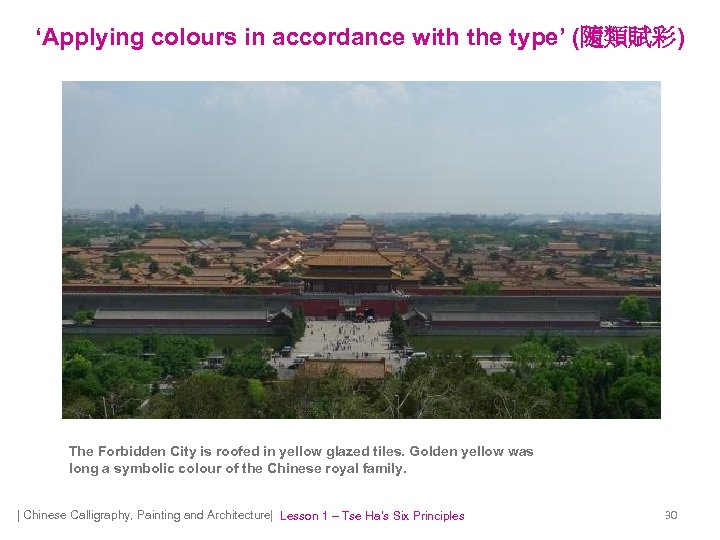 ‘Applying colours in accordance with the type’ (隨類賦彩) The Forbidden City is roofed in yellow glazed tiles. Golden yellow was long a symbolic colour of the Chinese royal family. | Chinese Calligraphy, Painting and Architecture| Lesson 1 – Tse Ha’s Six Principles 30
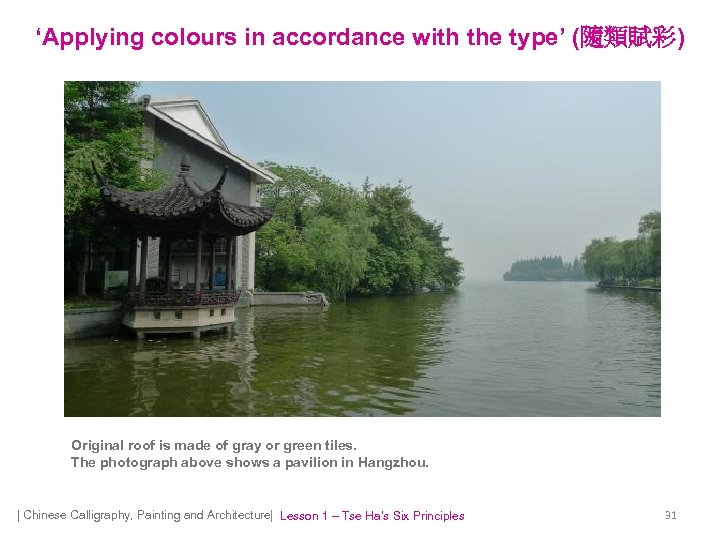 ‘Applying colours in accordance with the type’ (隨類賦彩) Original roof is made of gray or green tiles. The photograph above shows a pavilion in Hangzhou. | Chinese Calligraphy, Painting and Architecture| Lesson 1 – Tse Ha’s Six Principles 31
 ‘Be particular about the composition’ (經營位置) Principle Composition is about the relationship between space and form. A painter renders three-dimensional space two-dimensionally on paper. Depth of field - to express the distance between objects. The painter ‘s priority is that the image’s subject matter and proportion be pleasing to the eye. The left-over white space forms an important part of the composition of Chinese painting. | Chinese Calligraphy, Painting and Architecture| Lesson 1 – Tse Ha’s Six Principles 32
 ‘Be particular about the composition’ (經營位置) Application in Chinese Architecture • • • the importance of proportion of elements; solid-and-void relationship; and spatial composition. In architecture, function and space are always in dialogue. Space enclosed by buildings is always an important element. | Chinese Calligraphy, Painting and Architecture| Lesson 1 – Tse Ha’s Six Principles 33
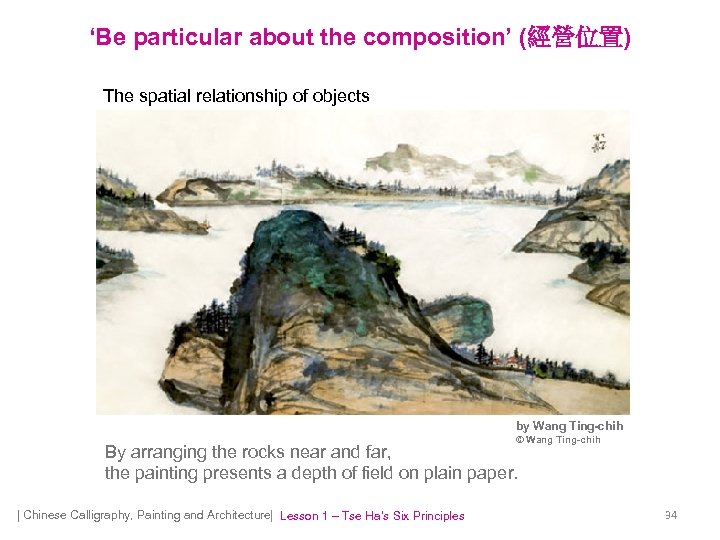 ‘Be particular about the composition’ (經營位置) The spatial relationship of objects by Wang Ting-chih © Wang Ting-chih By arranging the rocks near and far, the painting presents a depth of field on plain paper. | Chinese Calligraphy, Painting and Architecture| Lesson 1 – Tse Ha’s Six Principles 34
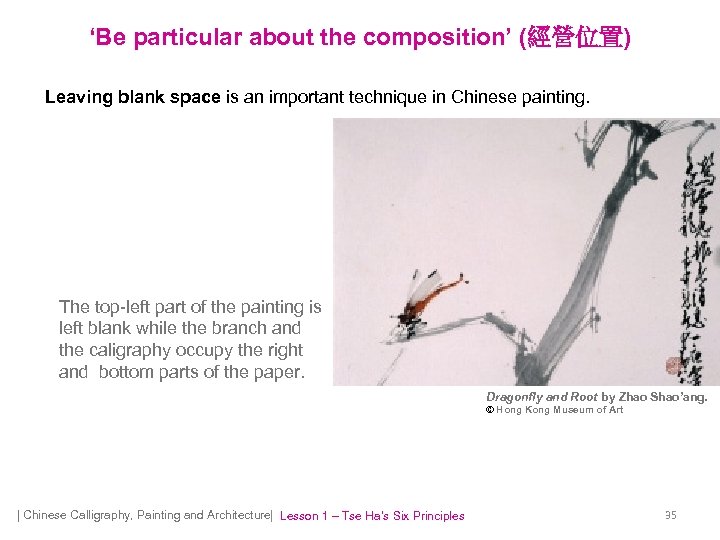 ‘Be particular about the composition’ (經營位置) Leaving blank space is an important technique in Chinese painting. The top-left part of the painting is left blank while the branch and the caligraphy occupy the right and bottom parts of the paper. Dragonfly and Root by Zhao Shao’ang. © Hong Kong Museum of Art | Chinese Calligraphy, Painting and Architecture| Lesson 1 – Tse Ha’s Six Principles 35
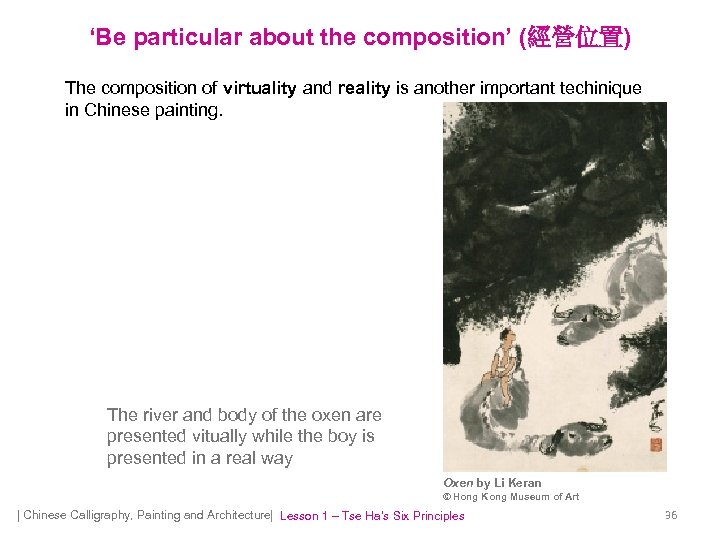 ‘Be particular about the composition’ (經營位置) The composition of virtuality and reality is another important techinique in Chinese painting. The river and body of the oxen are presented vitually while the boy is presented in a real way Oxen by Li Keran © Hong Kong Museum of Art | Chinese Calligraphy, Painting and Architecture| Lesson 1 – Tse Ha’s Six Principles 36
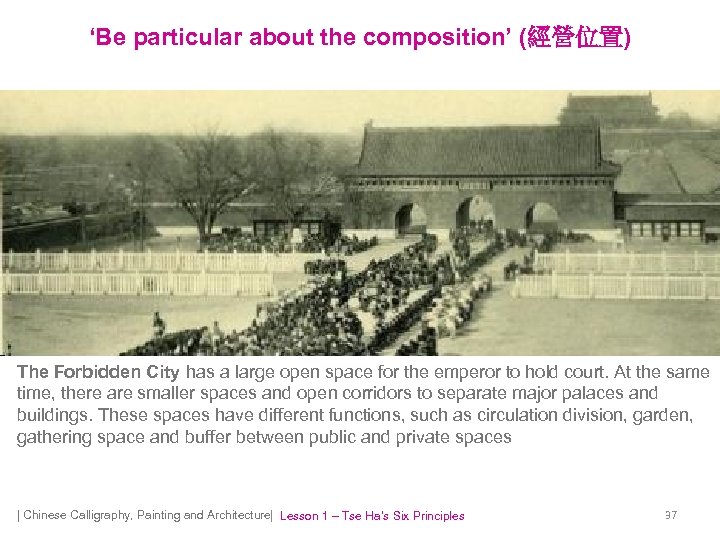 ‘Be particular about the composition’ (經營位置) The Forbidden City has a large open space for the emperor to hold court. At the same time, there are smaller spaces and open corridors to separate major palaces and buildings. These spaces have different functions, such as circulation division, garden, gathering space and buffer between public and private spaces | Chinese Calligraphy, Painting and Architecture| Lesson 1 – Tse Ha’s Six Principles 37
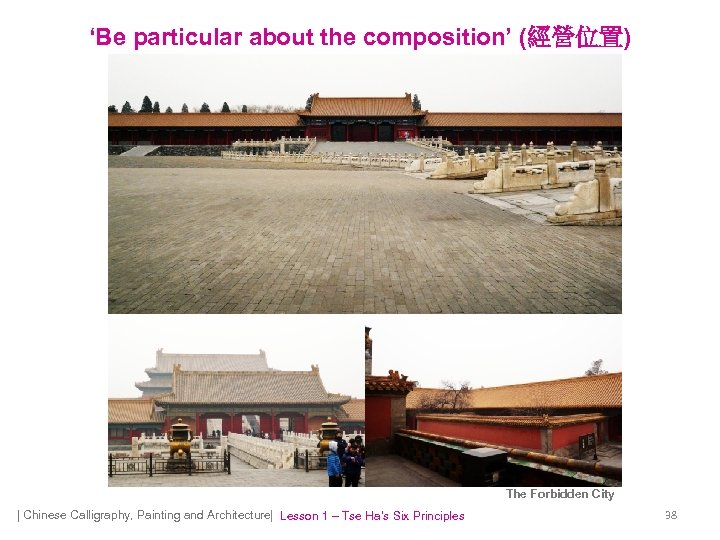 ‘Be particular about the composition’ (經營位置) The Forbidden City | Chinese Calligraphy, Painting and Architecture| Lesson 1 – Tse Ha’s Six Principles 38
 ‘Following prototype with adaptation’ (傳移摸寫) Principle • Though a painter should observe and follow the natural environment, Tse Ha put imitation of predecessors as the sixth principle because the technical skill of painting can be learnt easily from teachers. • The spirit of the prototype could never be copied. • A good painter could adapt an old work in a creative manner, giving new life to the tradition of painting. • By imitating an old painting, a student can slowly master Chinese painting and achieve a high level of taste. | Chinese Calligraphy, Painting and Architecture| Lesson 1 – Tse Ha’s Six Principles 39
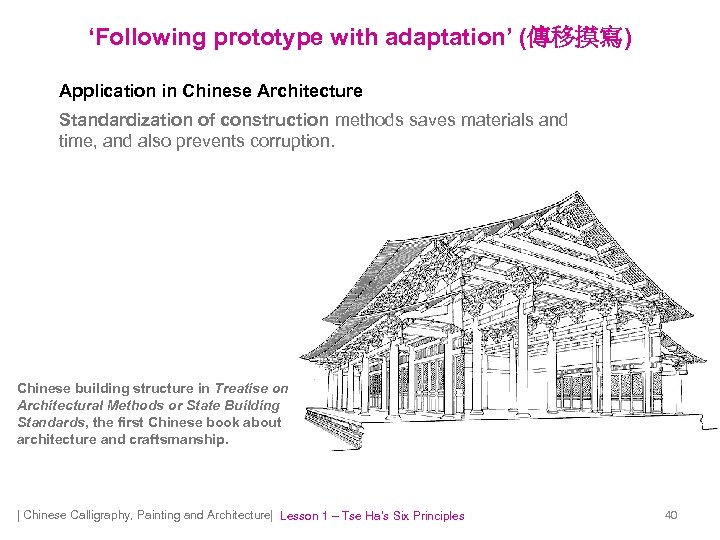 ‘Following prototype with adaptation’ (傳移摸寫) Application in Chinese Architecture Standardization of construction methods saves materials and time, and also prevents corruption. Chinese building structure in Treatise on Architectural Methods or State Building Standards, the first Chinese book about architecture and craftsmanship. | Chinese Calligraphy, Painting and Architecture| Lesson 1 – Tse Ha’s Six Principles 40
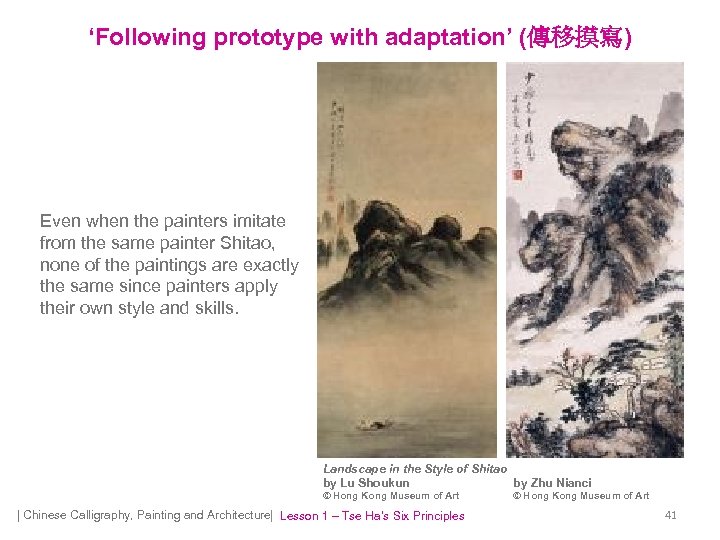 ‘Following prototype with adaptation’ (傳移摸寫) Even when the painters imitate from the same painter Shitao, none of the paintings are exactly the same since painters apply their own style and skills. Landscape in the Style of Shitao by Lu Shoukun by Zhu Nianci © Hong Kong Museum of Art | Chinese Calligraphy, Painting and Architecture| Lesson 1 – Tse Ha’s Six Principles © Hong Kong Museum of Art 41
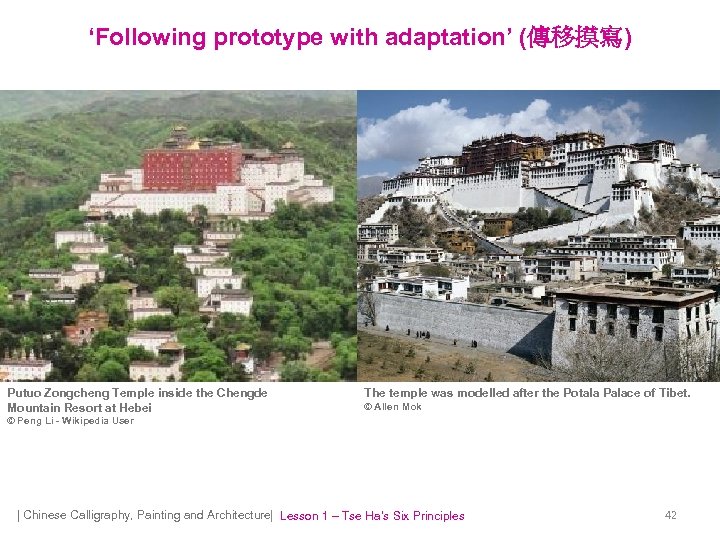 ‘Following prototype with adaptation’ (傳移摸寫) Putuo Zongcheng Temple inside the Chengde Mountain Resort at Hebei The temple was modelled after the Potala Palace of Tibet. © Allen Mok © Peng Li - Wikipedia User | Chinese Calligraphy, Painting and Architecture| Lesson 1 – Tse Ha’s Six Principles 42
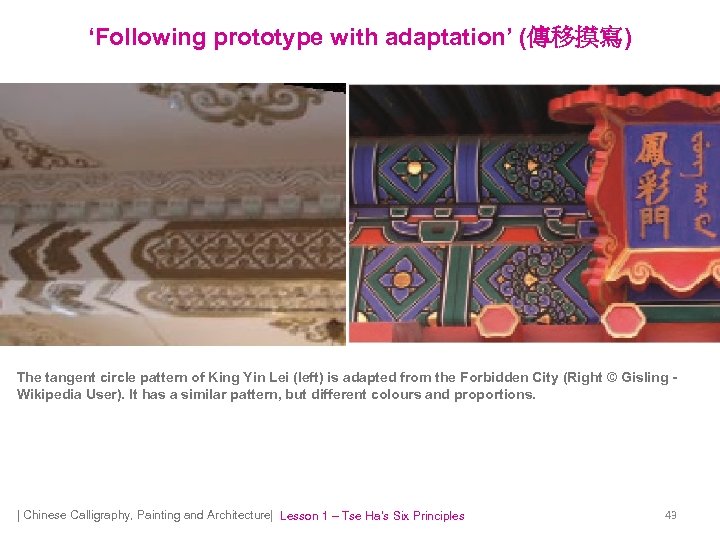 ‘Following prototype with adaptation’ (傳移摸寫) The tangent circle pattern of King Yin Lei (left) is adapted from the Forbidden City (Right © Gisling Wikipedia User). It has a similar pattern, but different colours and proportions. | Chinese Calligraphy, Painting and Architecture| Lesson 1 – Tse Ha’s Six Principles 43
![[Discussion] We have learnt Tse Ha’s ‘Six Principles in the Category of Ancient Paintings’.](https://present5.com/presentation/ff05d8ebed0c9d8ff292715e9945b8a8/image-44.jpg "[Discussion] We have learnt Tse Ha’s ‘Six Principles in the Category of Ancient Paintings’.") [Discussion] We have learnt Tse Ha’s ‘Six Principles in the Category of Ancient Paintings’. Do you think Tse Ha’s principles could be applied to Western painting or not? Why or why not? | Chinese Calligraphy, Painting and Architecture| Lesson 1 – Tse Ha’s Six Principles 44
[Discussion] We have learnt Tse Ha’s ‘Six Principles in the Category of Ancient Paintings’. Do you think Tse Ha’s principles could be applied to Western painting or not? Why or why not? | Chinese Calligraphy, Painting and Architecture| Lesson 1 – Tse Ha’s Six Principles 44
 Summary • Chinese architecture can be evaluated using many of the same principles that were traditionally used to evaluate painting. Both forms of art are concerned with nature, tradition, and skill. • Tse Ha’s six principles are – – – Spirit resonance; Heaviness and lightness of brush stroke; Correspondence to the object; Applying colours in accordance with the type; Be particular about the composition; and Following prototype with adaptation. | Chinese Calligraphy, Painting and Architecture| 45