


 Скачать презентацию 1 Chapter 9 Quality Management 1 -1
54f8828de049772889315762f4a13b6e.ppt
- Количество слайдов: 27
 1 Chapter 9 Quality Management 1 -1
 2 Total Quality Management (TQM) • Total quality management is defined as managing the entire organization so that it excels on all dimensions of products and services that are important to the customer 1 -2
 3 Quality Specifications • Design quality: Inherent value of the product in the marketplace – Dimensions include: Performance, Features, Reliability/Durability, Serviceability, Aesthetics, and Perceived Quality. • Conformance quality: Degree to which the product or service design specifications are met 1 -3
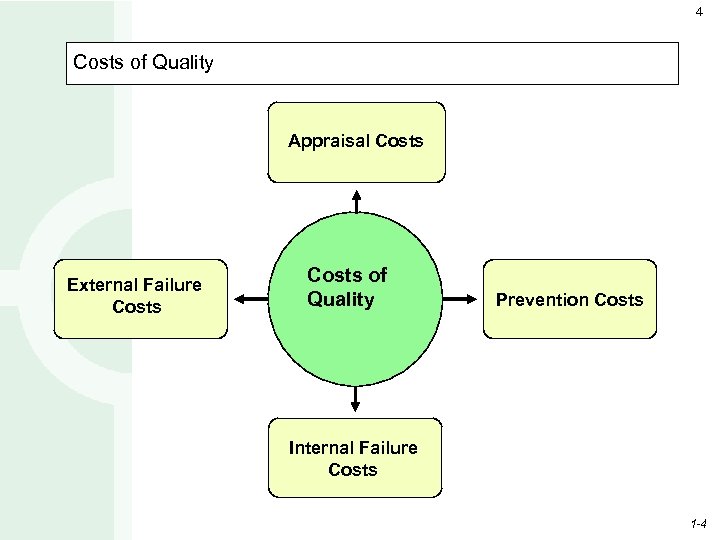 4 Costs of Quality Appraisal Costs External Failure Costs of Quality Prevention Costs Internal Failure Costs 1 -4
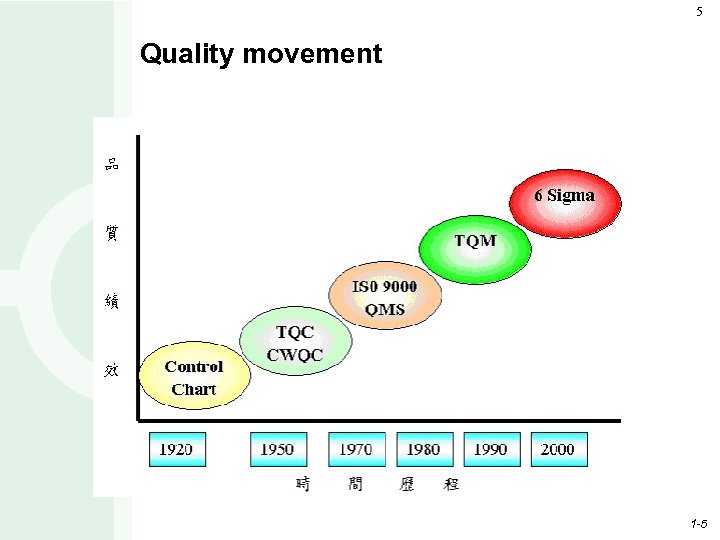 5 Quality movement 1 -5
 6 The birth of 6 Sigma • In 1980, Motorola involved in Japanese BB Call market • Through the use of statistical tools • On Jan. 15, 1987, Motorola launched ‘Six Sigma Quality Program’ 1 -6
 7 Six Sigma Quality • A philosophy and set of methods companies use to eliminate defects in their products and processes • Seeks to reduce variation in the processes that lead to product defects 1 -7
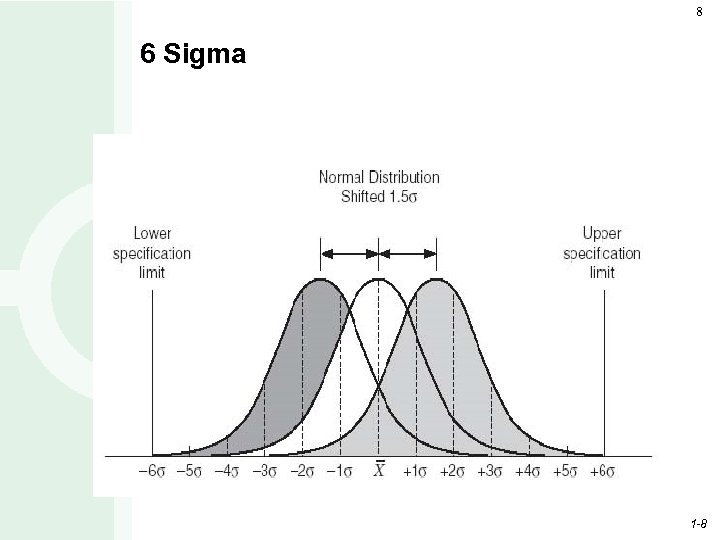 8 6 Sigma 1 -8
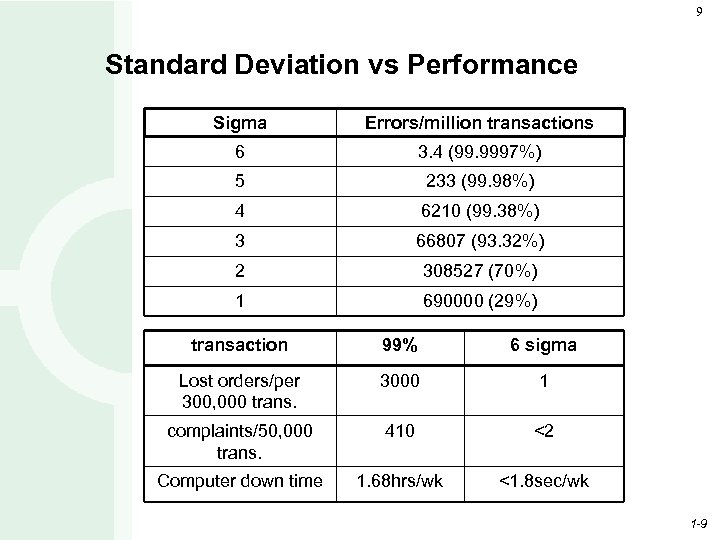 9 Standard Deviation vs Performance Sigma Errors/million transactions 6 3. 4 (99. 9997%) 5 233 (99. 98%) 4 6210 (99. 38%) 3 66807 (93. 32%) 2 308527 (70%) 1 690000 (29%) transaction 99% 6 sigma Lost orders/per 300, 000 trans. 3000 1 complaints/50, 000 trans. 410 <2 Computer down time 1. 68 hrs/wk <1. 8 sec/wk 1 -9
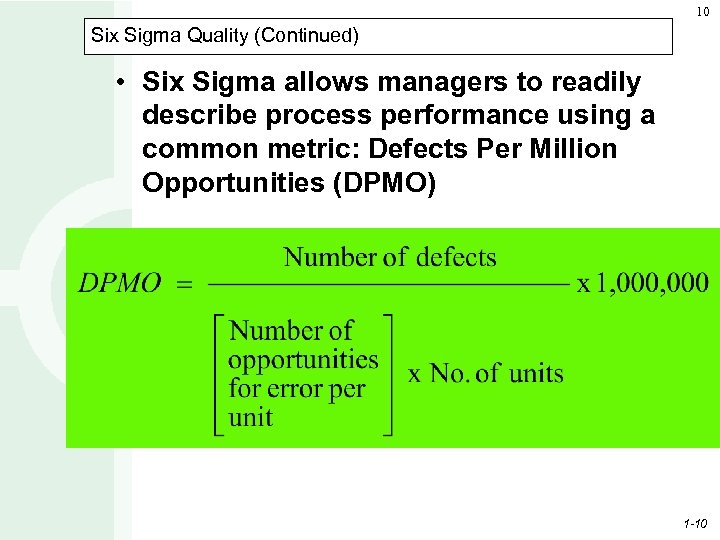 10 Six Sigma Quality (Continued) • Six Sigma allows managers to readily describe process performance using a common metric: Defects Per Million Opportunities (DPMO) 1 -10
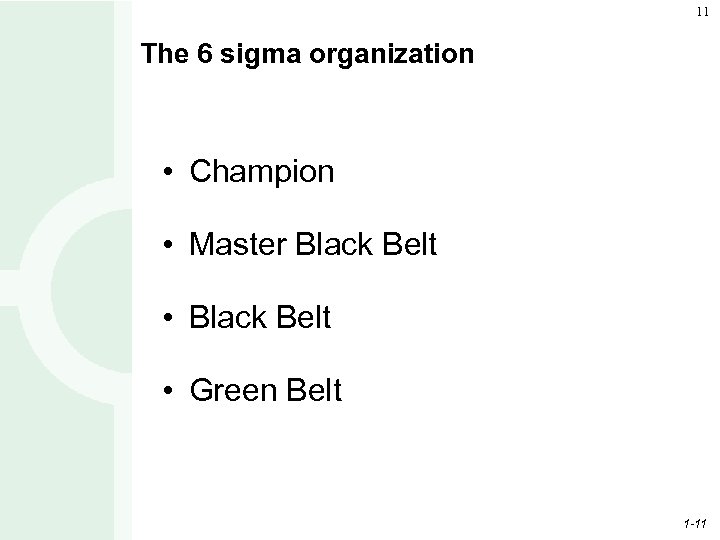 11 The 6 sigma organization • Champion • Master Black Belt • Green Belt 1 -11
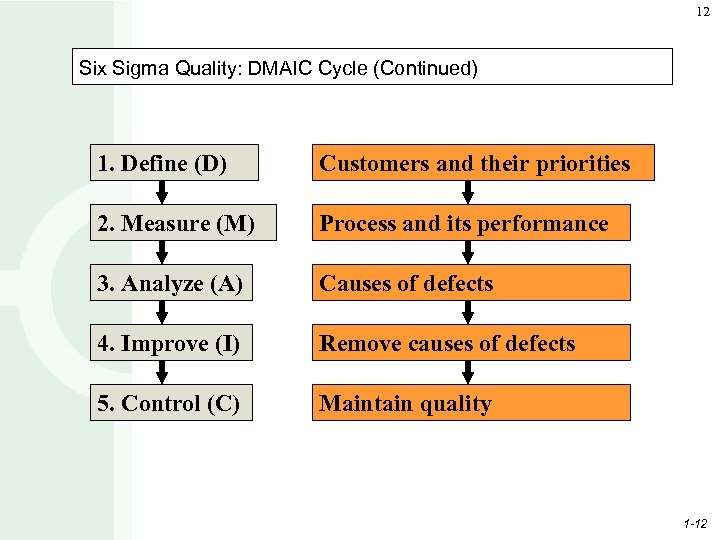 12 Six Sigma Quality: DMAIC Cycle (Continued) 1. Define (D) Customers and their priorities 2. Measure (M) Process and its performance 3. Analyze (A) Causes of defects 4. Improve (I) Remove causes of defects 5. Control (C) Maintain quality 1 -12
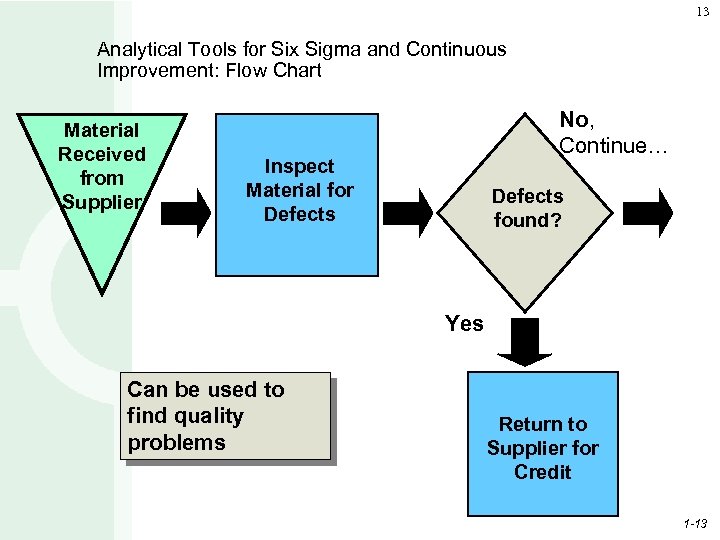 13 Analytical Tools for Six Sigma and Continuous Improvement: Flow Chart Material Received from Supplier No, Continue… Inspect Material for Defects found? Yes Can be used to find quality problems Return to Supplier for Credit 1 -13
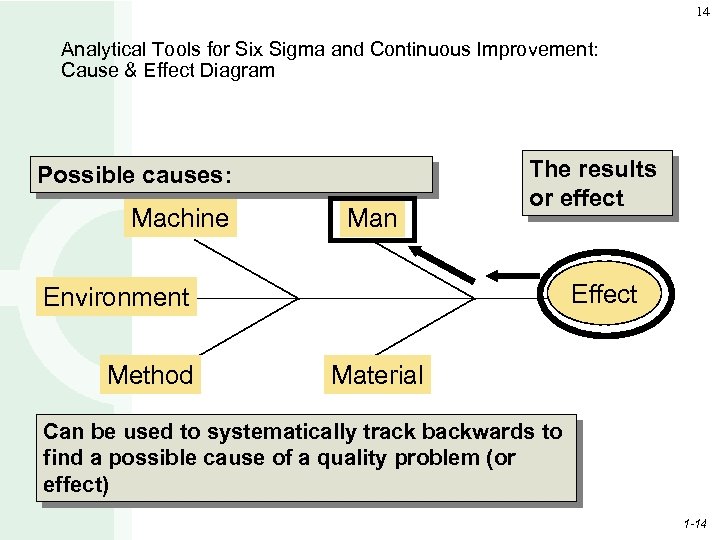 14 Analytical Tools for Six Sigma and Continuous Improvement: Cause & Effect Diagram Possible causes: Machine Man The results or effect Environment Method Material Can be used to systematically track backwards to find a possible cause of a quality problem (or effect) 1 -14
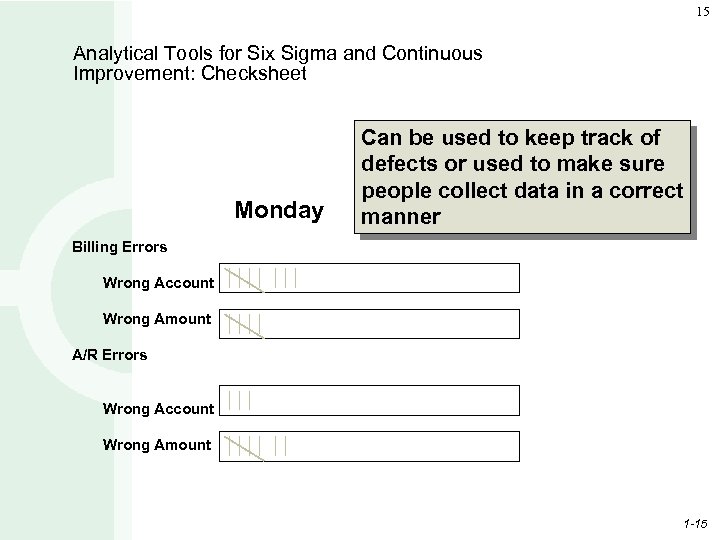 15 Analytical Tools for Six Sigma and Continuous Improvement: Checksheet Monday Can be used to keep track of defects or used to make sure people collect data in a correct manner Billing Errors Wrong Account Wrong Amount A/R Errors Wrong Account Wrong Amount 1 -15
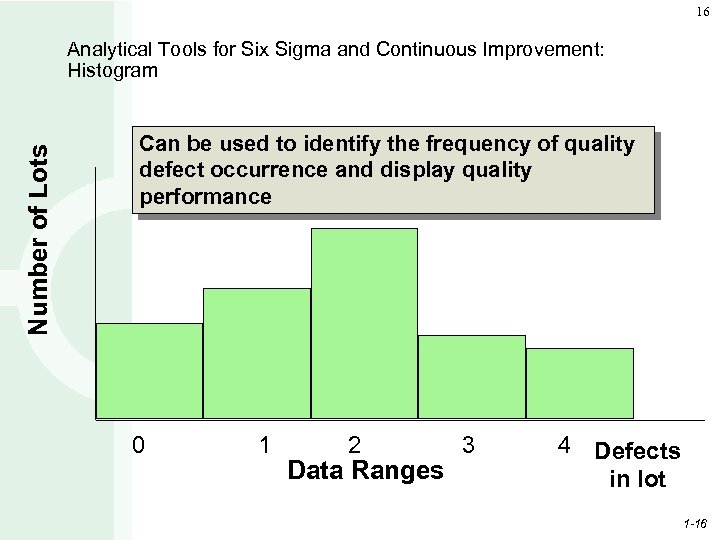 16 Number of Lots Analytical Tools for Six Sigma and Continuous Improvement: Histogram Can be used to identify the frequency of quality defect occurrence and display quality performance 0 1 2 Data Ranges 3 4 Defects in lot 1 -16
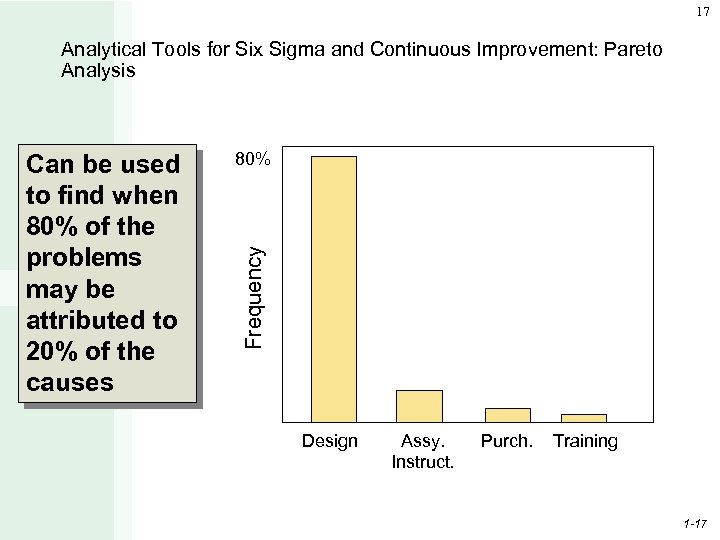 17 Analytical Tools for Six Sigma and Continuous Improvement: Pareto Analysis 80% Frequency Can be used to find when 80% of the problems may be attributed to 20% of the causes Design Assy. Instruct. Purch. Training 1 -17
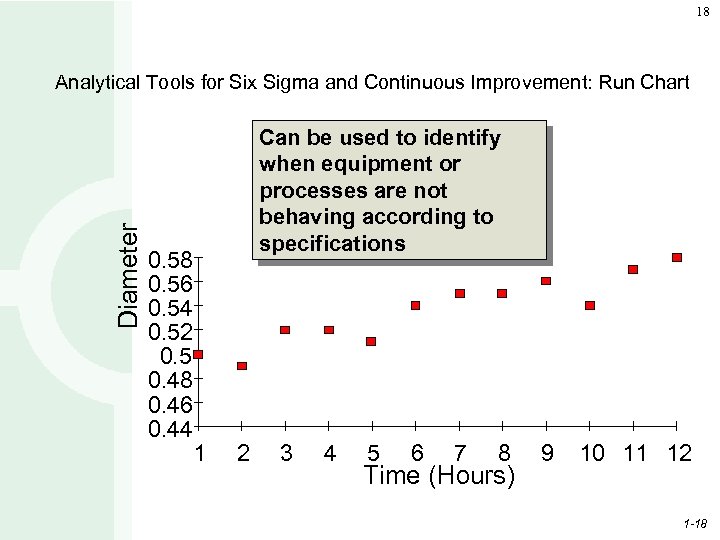 18 Diameter Analytical Tools for Six Sigma and Continuous Improvement: Run Chart 0. 58 0. 56 0. 54 0. 52 0. 5 0. 48 0. 46 0. 44 Can be used to identify when equipment or processes are not behaving according to specifications 1 2 3 4 5 6 7 8 Time (Hours) 9 10 11 12 1 -18
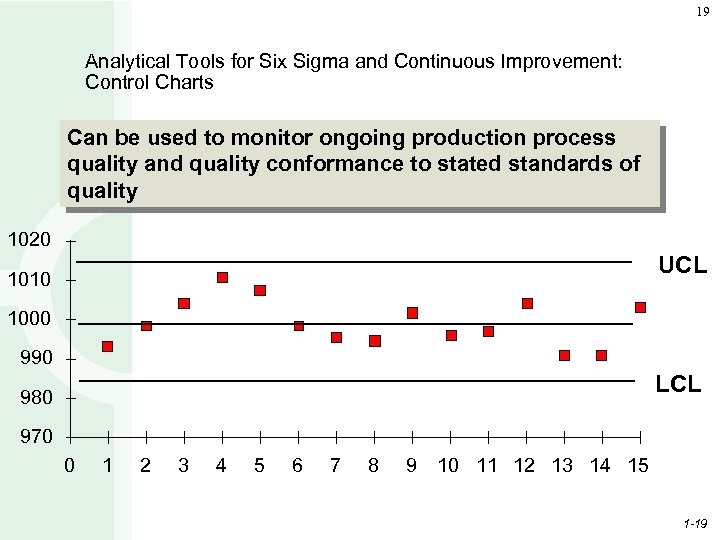 19 Analytical Tools for Six Sigma and Continuous Improvement: Control Charts Can be used to monitor ongoing production process quality and quality conformance to stated standards of quality 1020 UCL 1010 1000 990 LCL 980 970 0 1 2 3 4 5 6 7 8 9 10 11 12 13 14 15 1 -19
 20 Six Sigma Roles and Responsibilities 1. Executive leaders must champion the process of improvement 2. Corporation-wide training in Six Sigma concepts and tools 3. Setting stretch objectives for improvement 4. Continuous reinforcement and rewards 1 -20
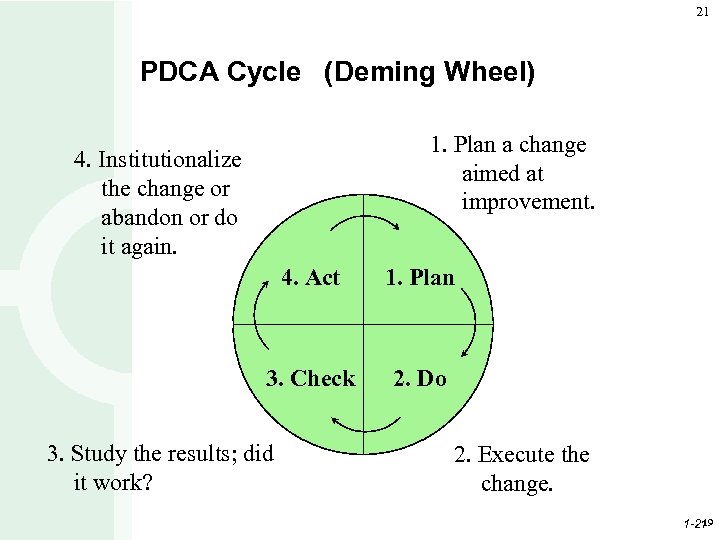 21 PDCA Cycle (Deming Wheel) 1. Plan a change aimed at improvement. 4. Institutionalize the change or abandon or do it again. 4. Act 1. Plan 3. Check 2. Do 3. Study the results; did it work? 2. Execute the change. 19 1 -21
 22 Continuous Improvement (CI) • Management's view of performance standards of the organization – performance level of the firm as something to be "continuously challenged and incrementally upgraded. " • The way management views the contribution and role of its workforce – believe employee involvement and team efforts are the key to improvement 10 1 -22
 23 ISO 9000 and ISO 14000 • Series of standards agreed upon by the International Organization for Standardization (ISO) • Adopted in 1987 • More than 160 countries • A prerequisite for global competition? • ISO 9000 an international reference for quality, ISO 14000 is primarily concerned with environmental management 1 -23
 24 ISO 9000 Series • 9001 – Model for Quality Assurance in Design, Production Installation, and Servicing. • 9002 – Model for Quality Assurance in Production and Installation • 9003 – Model for Quality Assurance in Final Inspection Test 25 1 -24
 25 Guidelines for Use • 9000 – Quality Management and Quality Assurance Standards: Guidelines for Selection and Use • 9004 – Quality Management and Quality System Elements--Guidelines 26 1 -25
 26 Three Forms of ISO Certification 1. First party: A firm audits itself against ISO 9000 standards 2. Second party: A customer audits supplier 3. Third party: A "qualified" national or international standards or certifying agency serves as auditor 1 -26
 27 External Benchmarking Steps 1. Identify those processes needing improvement 2. Identify a firm that is the world leader in performing the process 3. Contact the managers of that company and make a personal visit to interview managers and workers 4. Analyze data 1 -27