 Скачать презентацию 1 Carbon Trading Designing the Canadian Market
e1aabe247b551674d2ef20a7927c8ef1.ppt
- Количество слайдов: 32



1
Carbon Trading Designing the Canadian Market Presented by Léon Bitton, VP R&D Montreal Exchange Winnipeg, March 14 th, 2003 2
Montréal Exchange (MX) Sole Financial Derivative Exchange in Canada • Bourse Trades all $CDN Interest Rate Derivatives • Bourse Trades all Canadian Equity Derivatives 3
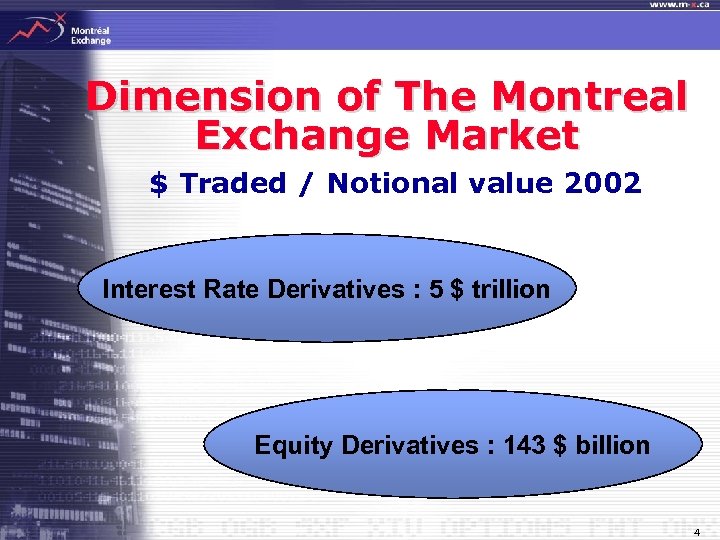
Dimension of The Montreal Exchange Market $ Traded / Notional value 2002 Interest Rate Derivatives : 5 $ trillion Equity Derivatives : 143 $ billion 4
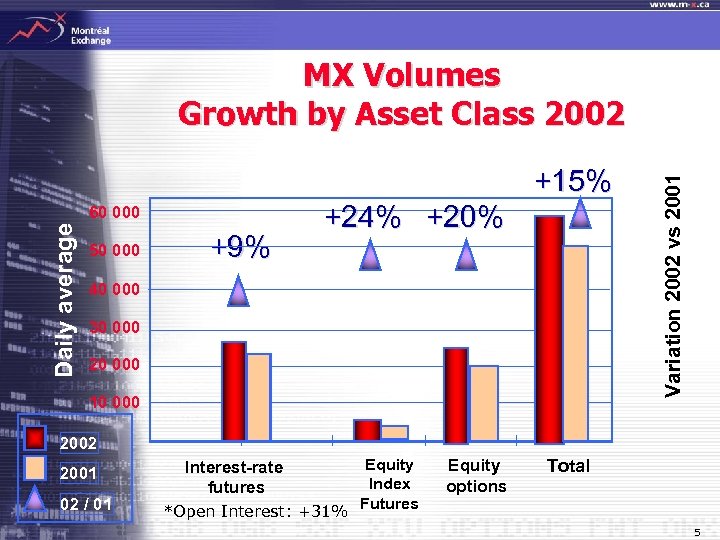
+15% Daily average 60 000 50 000 +9% +24% +20% 40 000 30 000 20 000 10 000 Variation 2002 vs 2001 MX Volumes Growth by Asset Class 2002 2001 02 / 01 Interest-rate futures *Open Interest: +31% Equity Index Futures Equity options Total 5
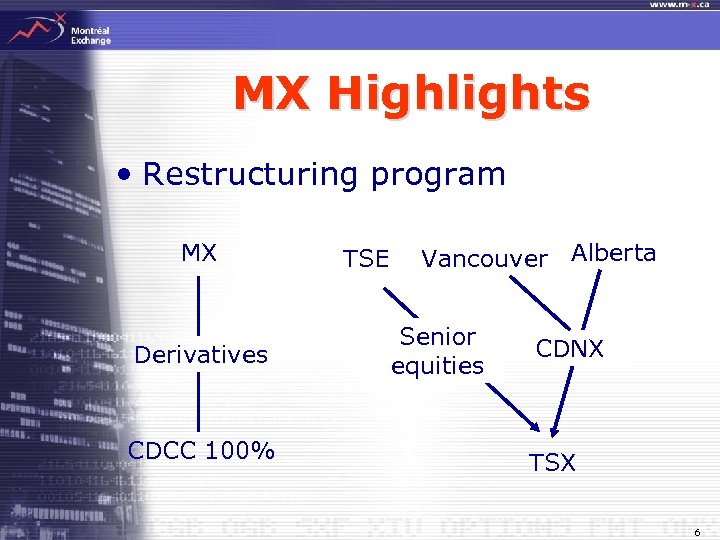
MX Highlights • Restructuring program MX Derivatives CDCC 100% TSE Vancouver Alberta Senior equities CDNX TSX 6
MX Highlights • Demutualization • First North American Traditional Derivative exchange to be fully electronic • Creation of an on-line Training Institute • Remote Access USA / UK • BOX – New US option Exchange 7
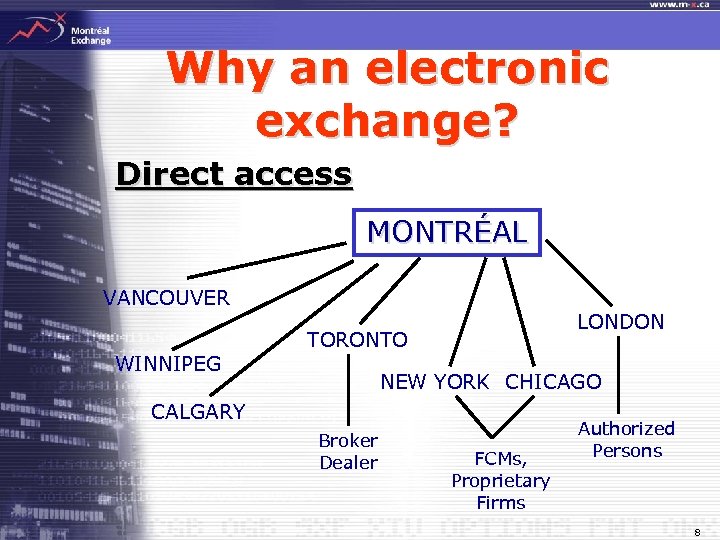
Why an electronic exchange? Direct access MONTRÉAL VANCOUVER WINNIPEG LONDON TORONTO NEW YORK CHICAGO CALGARY Broker Dealer FCMs, Proprietary Firms Authorized Persons 8
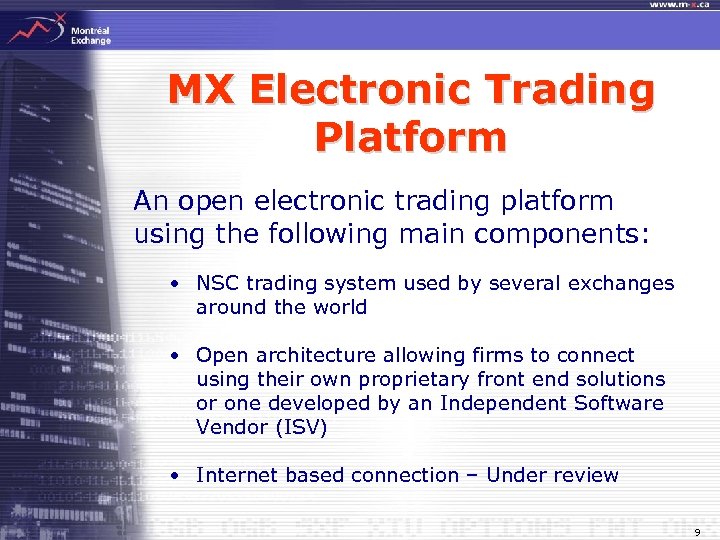
MX Electronic Trading Platform An open electronic trading platform using the following main components: • NSC trading system used by several exchanges around the world • Open architecture allowing firms to connect using their own proprietary front end solutions or one developed by an Independent Software Vendor (ISV) • Internet based connection – Under review 9
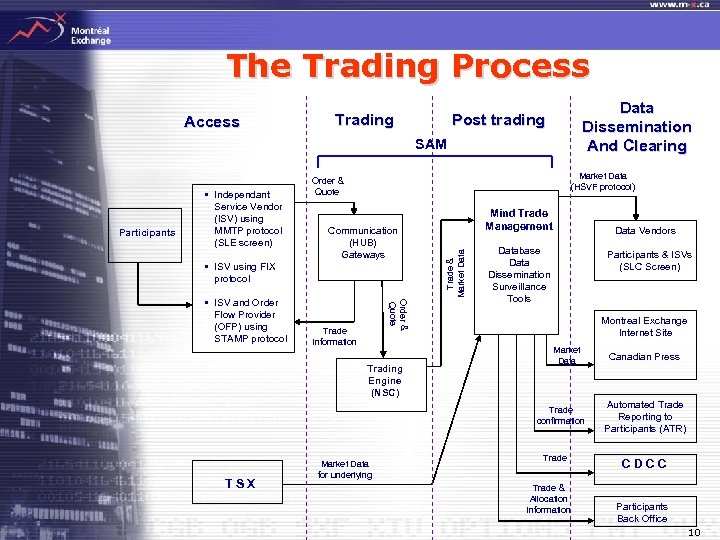
The Trading Process Access Trading Data Dissemination And Clearing Post trading SAM Communication (HUB) Gateways • ISV using FIX protocol Order & Quote • ISV and Order Flow Provider (OFP) using STAMP protocol Trade information Trading Engine (NSC) Mind Trade Management Trade & Market Data Participants • Independant Service Vendor (ISV) using MMTP protocol (SLE screen) Market Data (HSVF protocol) Order & Quote Data Vendors Database Data Dissemination Surveillance Tools Participants & ISVs (SLC Screen) Montreal Exchange Internet Site Market Data Trade confirmation TSX Market Data for underlying Trade & Allocation information Canadian Press Automated Trade Reporting to Participants (ATR) CDCC Participants Back Office 10
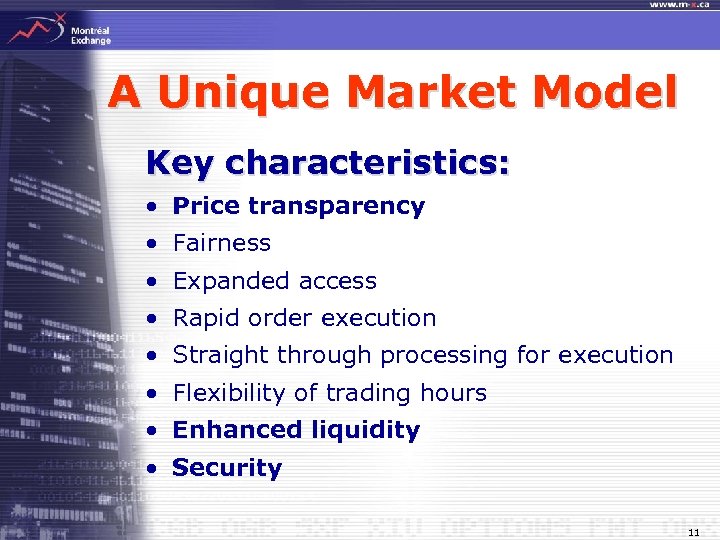
A Unique Market Model Key characteristics: • Price transparency • Fairness • Expanded access • Rapid order execution • Straight through processing for execution • Flexibility of trading hours • Enhanced liquidity • Security 11
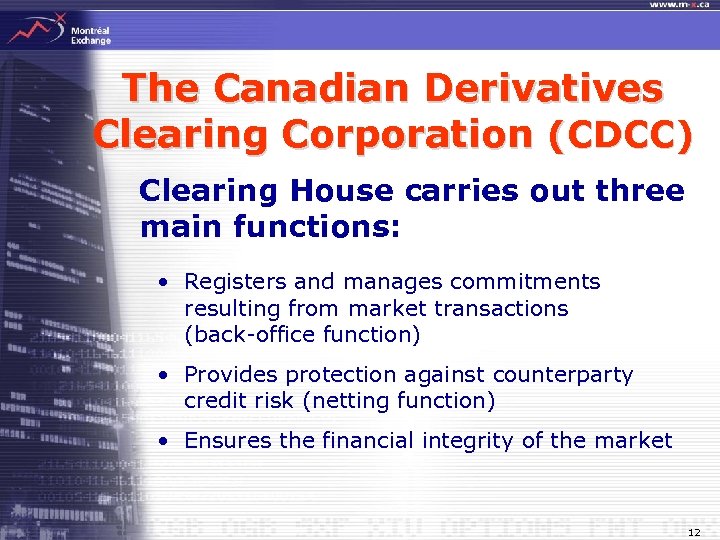
The Canadian Derivatives Clearing Corporation (CDCC) Clearing House carries out three main functions: • Registers and manages commitments resulting from market transactions (back-office function) • Provides protection against counterparty credit risk (netting function) • Ensures the financial integrity of the market 12
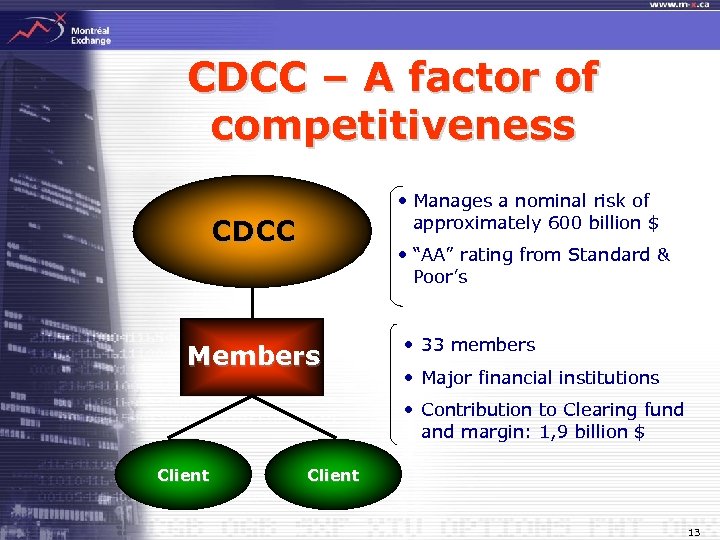
CDCC – A factor of competitiveness • Manages a nominal risk of approximately 600 billion $ CDCC • “AA” rating from Standard & Poor’s Members • 33 members • Major financial institutions • Contribution to Clearing fund and margin: 1, 9 billion $ Client 13
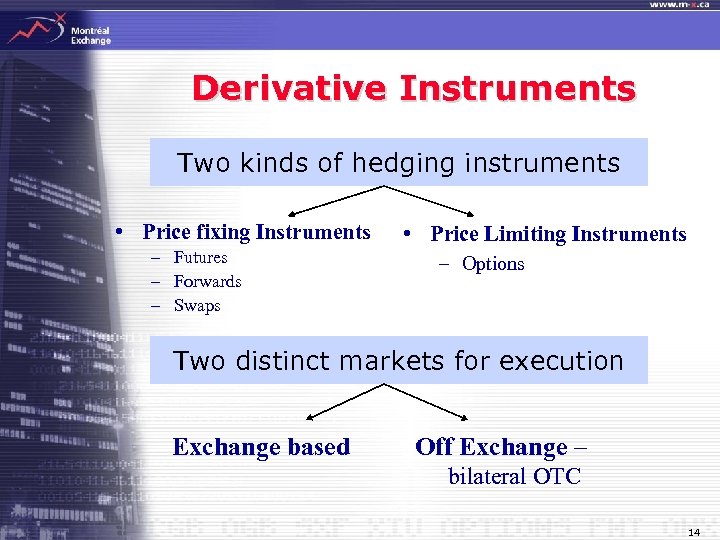
Derivative Instruments Two kinds of hedging instruments • Price fixing Instruments – Futures – Forwards – Swaps • Price Limiting Instruments – Options Two distinct markets for execution Exchange based Off Exchange – bilateral OTC 14
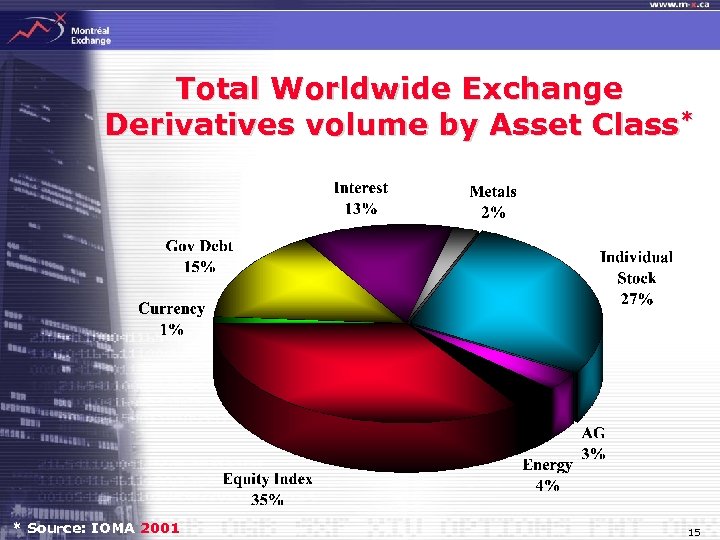
Total Worldwide Exchange Derivatives volume by Asset Class* * Source: IOMA 2001 15
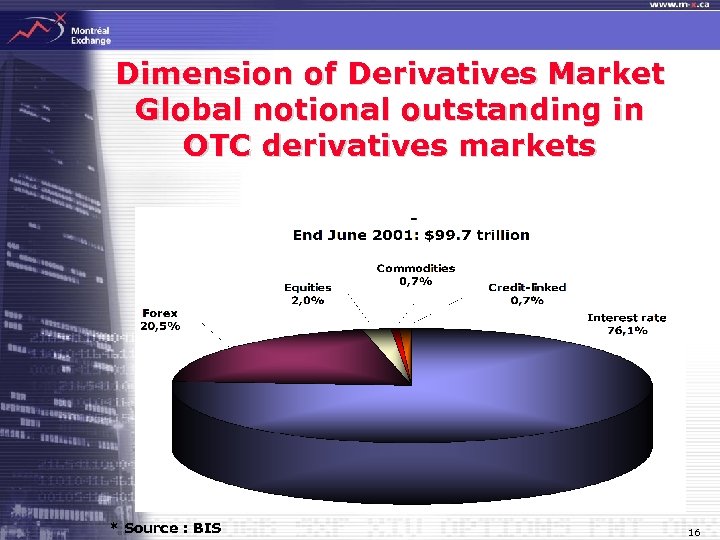
Dimension of Derivatives Market Global notional outstanding in OTC derivatives markets * Source : BIS 16
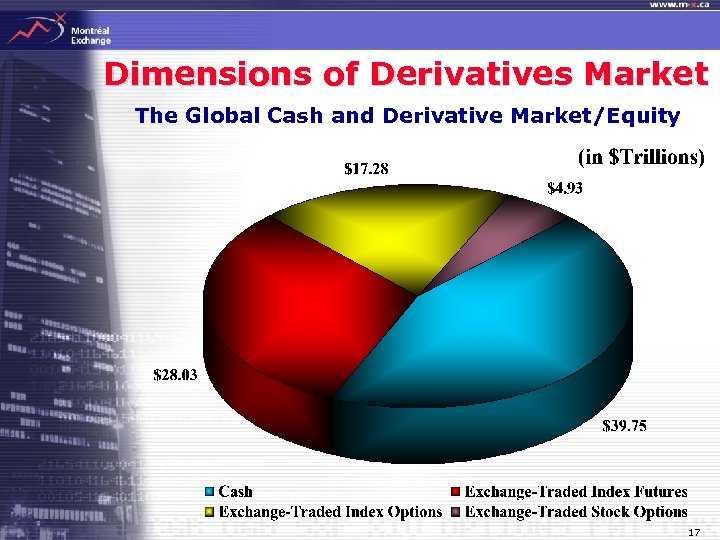
Dimensions of Derivatives Market The Global Cash and Derivative Market/Equity 17
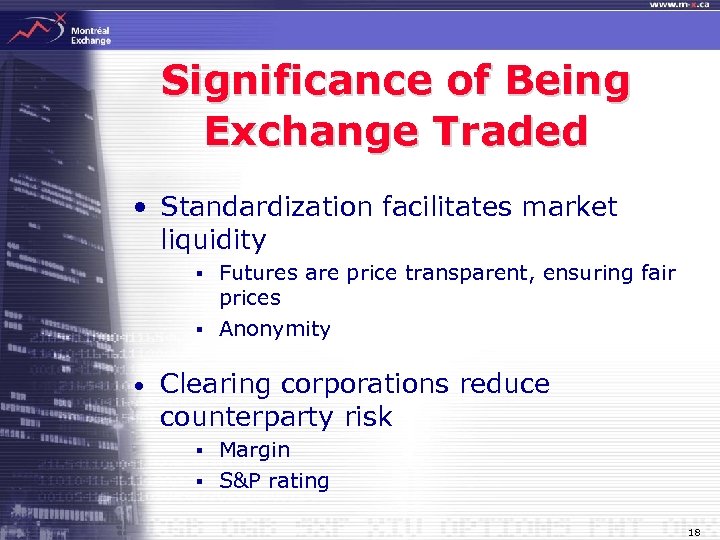
Significance of Being Exchange Traded • Standardization facilitates market liquidity § § • Futures are price transparent, ensuring fair prices Anonymity Clearing corporations reduce counterparty risk § § Margin S&P rating 18
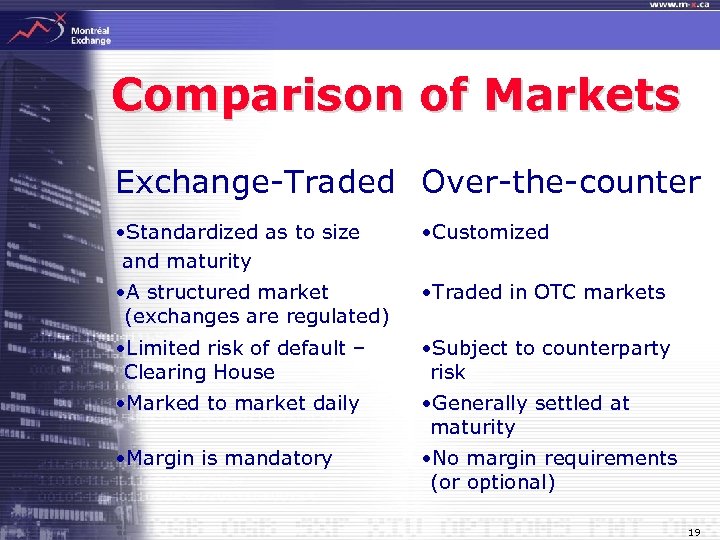
Comparison of Markets Exchange-Traded Over-the-counter • Standardized as to size and maturity • Customized • A structured market (exchanges are regulated) • Traded in OTC markets • Limited risk of default – Clearing House • Subject to counterparty risk • Marked to market daily • Generally settled at maturity • Margin is mandatory • No margin requirements (or optional) 19
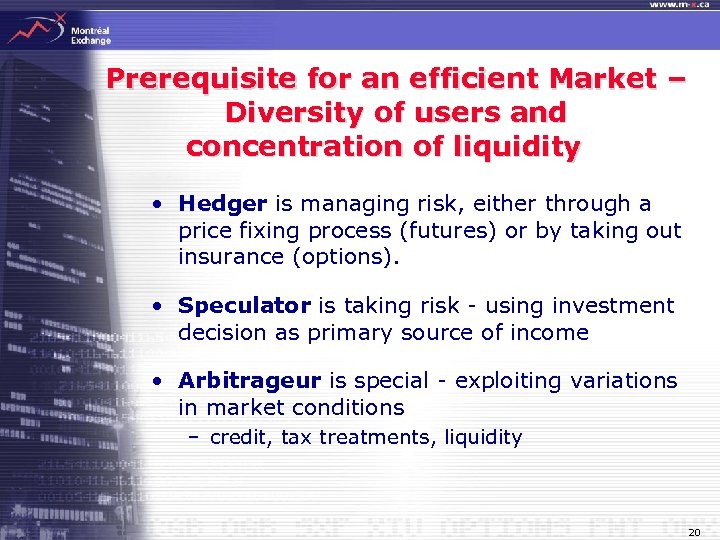
Prerequisite for an efficient Market – Diversity of users and concentration of liquidity • Hedger is managing risk, either through a price fixing process (futures) or by taking out insurance (options). • Speculator is taking risk - using investment decision as primary source of income • Arbitrageur is special - exploiting variations in market conditions – credit, tax treatments, liquidity 20
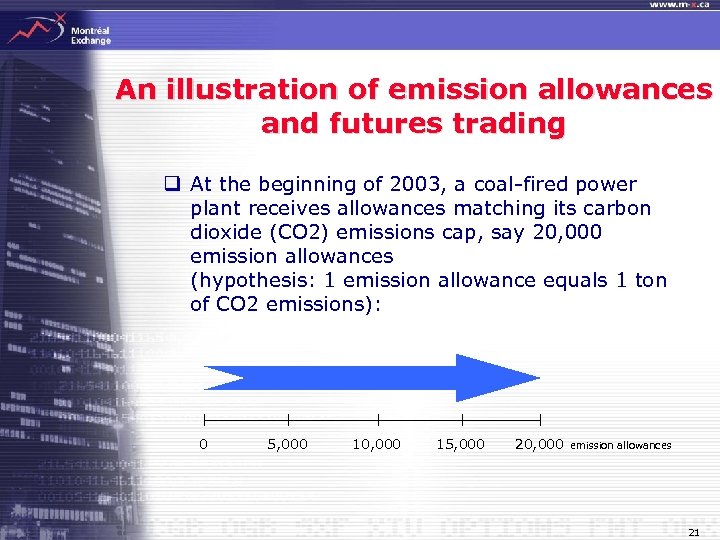
An illustration of emission allowances and futures trading q At the beginning of 2003, a coal-fired power plant receives allowances matching its carbon dioxide (CO 2) emissions cap, say 20, 000 emission allowances (hypothesis: 1 emission allowance equals 1 ton of CO 2 emissions): 0 5, 000 10, 000 15, 000 20, 000 emission allowances 21
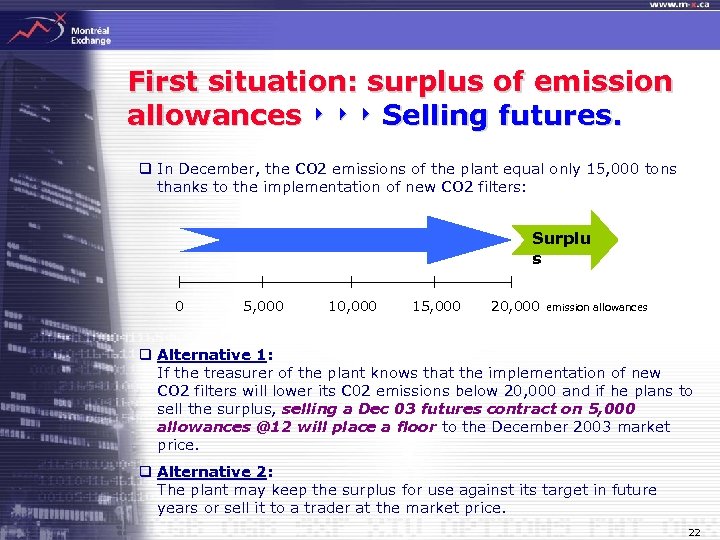
First situation: surplus of emission allowances ‣ ‣ ‣ Selling futures. q In December, the CO 2 emissions of the plant equal only 15, 000 tons thanks to the implementation of new CO 2 filters: Surplu s 0 5, 000 10, 000 15, 000 20, 000 emission allowances q Alternative 1: If the treasurer of the plant knows that the implementation of new CO 2 filters will lower its C 02 emissions below 20, 000 and if he plans to sell the surplus, selling a Dec 03 futures contract on 5, 000 allowances @12 will place a floor to the December 2003 market price. q Alternative 2: The plant may keep the surplus for use against its target in future years or sell it to a trader at the market price. 22
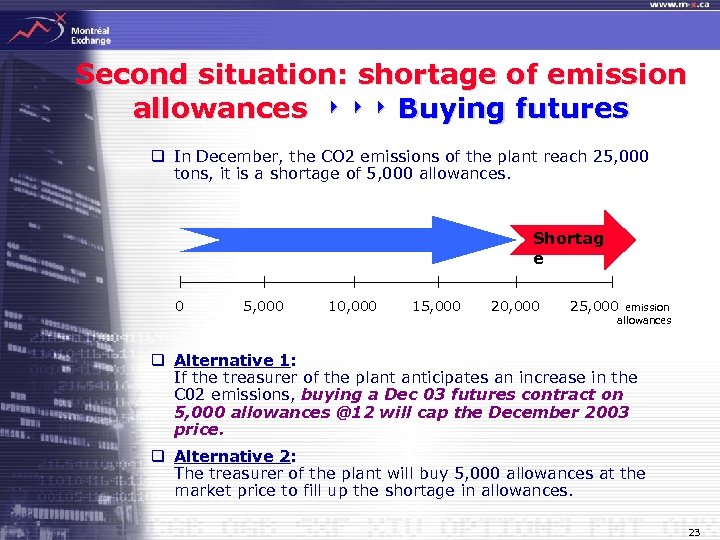
Second situation: shortage of emission allowances ‣ ‣ ‣ Buying futures q In December, the CO 2 emissions of the plant reach 25, 000 tons, it is a shortage of 5, 000 allowances. Shortag e 0 5, 000 10, 000 15, 000 20, 000 25, 000 emission allowances q Alternative 1: If the treasurer of the plant anticipates an increase in the C 02 emissions, buying a Dec 03 futures contract on 5, 000 allowances @12 will cap the December 2003 price. q Alternative 2: The treasurer of the plant will buy 5, 000 allowances at the market price to fill up the shortage in allowances. 23
Benefits of the futures market • The futures market improves risk transfer by enhancing the ability of investors to hedge or assume risk. • The futures market contributes to the overall efficiency and liquidity of the cash market. • The futures market improves the transparency of the market. 24
Using Derivatives = Good Business Practice • Flexible • Cost-Effective • Maximize Returns • Manage Risk 25
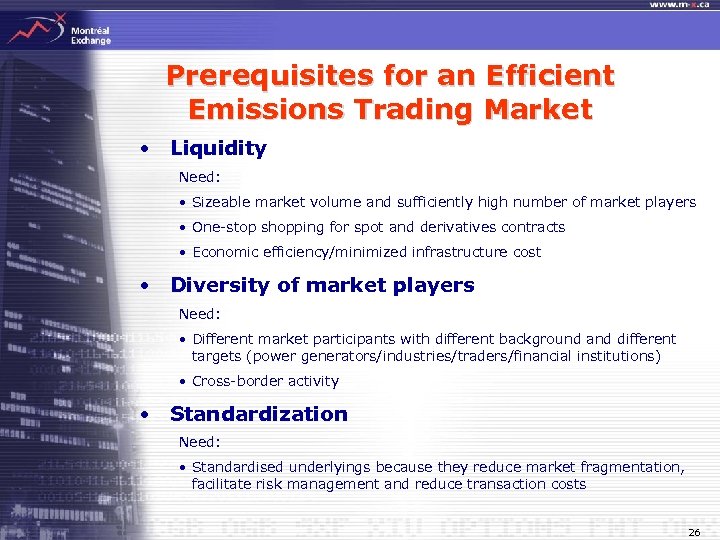
Prerequisites for an Efficient Emissions Trading Market • Liquidity Need: • Sizeable market volume and sufficiently high number of market players • One-stop shopping for spot and derivatives contracts • Economic efficiency/minimized infrastructure cost • Diversity of market players Need: • Different market participants with different background and different targets (power generators/industries/traders/financial institutions) • Cross-border activity • Standardization Need: • Standardised underlyings because they reduce market fragmentation, facilitate risk management and reduce transaction costs 26
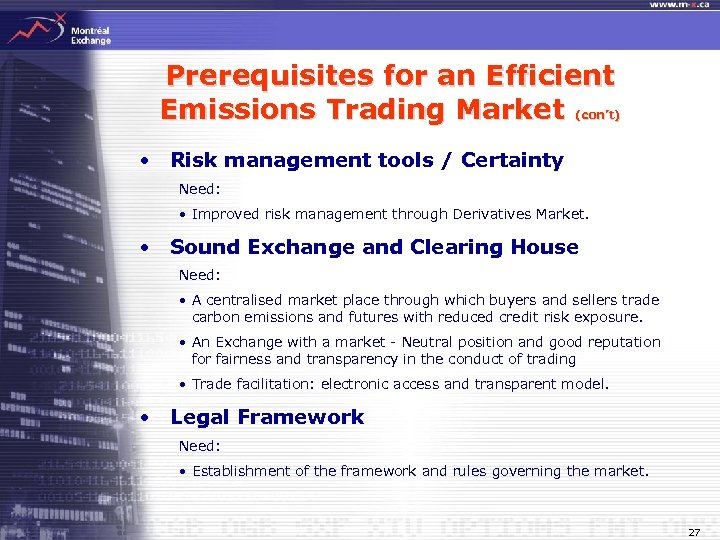
Prerequisites for an Efficient Emissions Trading Market (con’t) • Risk management tools / Certainty Need: • Improved risk management through Derivatives Market. • Sound Exchange and Clearing House Need: • A centralised market place through which buyers and sellers trade carbon emissions and futures with reduced credit risk exposure. • An Exchange with a market - Neutral position and good reputation for fairness and transparency in the conduct of trading • Trade facilitation: electronic access and transparent model. • Legal Framework Need: • Establishment of the framework and rules governing the market. 27
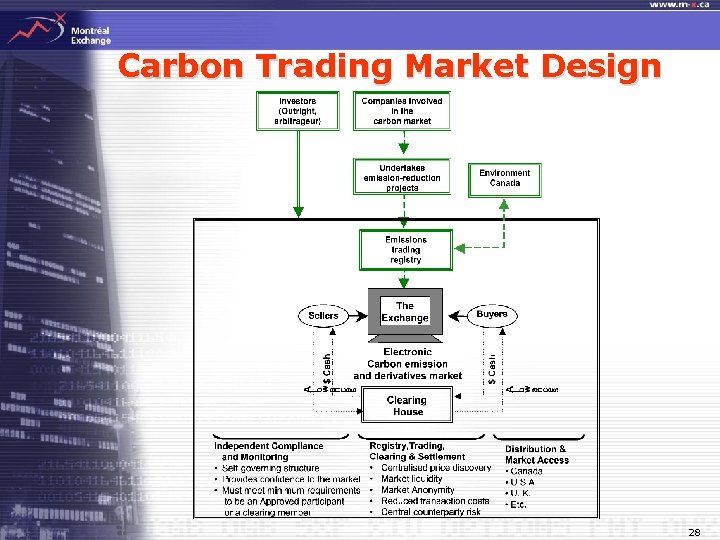
Carbon Trading Market Design 28
The Mission of a Carbon Exchange • To provide a one stop shopping for spot and derivative contracts on Canadian environment products. • Early launch to enable Canadian business to gain practical experience of emissions trading ahead of the implementation of the Kyoto Protocol (2008 -2012). 29
Benefits of an Exchange • Trading emission allowances is no different from trading any other commodity. Anyone who holds an account in a central registry will be able to buy and sell allowances. • An electronic emission trading system will provide industry, governments and other organizations in Canada with the opportunity to buy and sell emission reductions at a reduced overall cost. 30
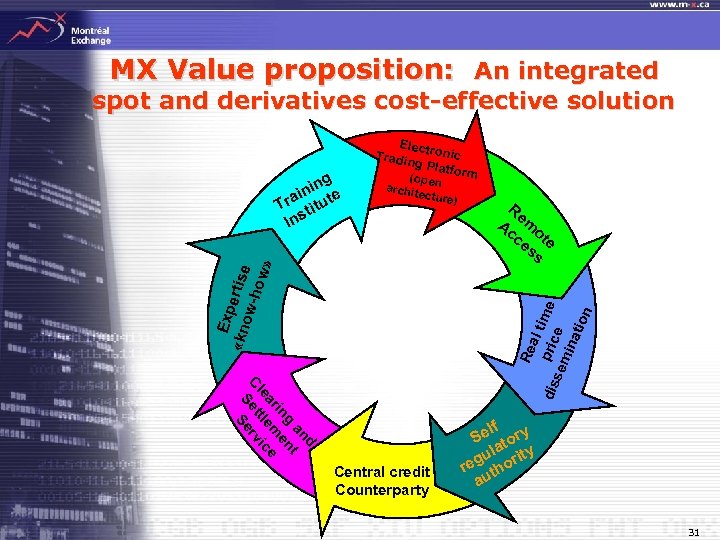
MX Value proposition: An integrated spot and derivatives cost-effective solution ope archit n ecture ) Re Ac mo ce te ss d an g nt rin me ea tle ice Cl t v Se Ser Re al t dis pric ime sem e ina tion Exp «kn ertise owhow » ng ini te Tra titu Ins Elec Tradin tronic g Plat form ( Central credit Counterparty lf Se tory la y gu orit re th au 31
For more information • Bourse de Montréal • www. m-x. ca • Derivatives Institute • www. derivatives-institute. com • Léon Bitton • lbitton@m-x. ca 32
Скачать презентацию 1 Carbon Trading Designing the Canadian Market
e1aabe247b551674d2ef20a7927c8ef1.ppt