 Скачать презентацию 1 Birth Of Rock Cultural Imperialism Nationalism and
rock in Korea Anna's part.pptx
- Количество слайдов: 14



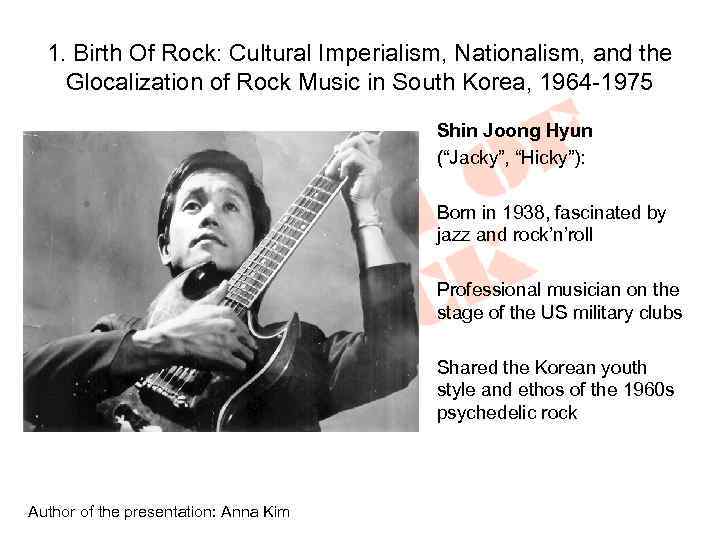
1. Birth Of Rock: Cultural Imperialism, Nationalism, and the Glocalization of Rock Music in South Korea, 1964 -1975 Shin Joong Hyun (“Jacky”, “Hicky”): Born in 1938, fascinated by jazz and rock’n’roll Professional musician on the stage of the US military clubs Shared the Korean youth style and ethos of the 1960 s psychedelic rock Author of the presentation: Anna Kim
1 -2. Birth Of Rock: Cultural Imperialism, Nationalism, and the Glocalization of Rock Music in South Korea, 1964 -1975 Intro: “The Lady in the Rain” https: //www. youtube. com/watch? v=ALDo. WCcpa 7 k https: //www. youtube. com/watch? v=1 Qx. Hee. Sfb. S 0&list=RDALDo. WCcp a 7 k&index=2 https: //www. youtube. com/watch? v=a 1 lb. Ixy. Do 94&list=RDALDo. WCcpa 7 k&index=9 “The unforgettable lady in the rain” + exotic “yellow raincoat” metaphor of Korean musicians yearning for “foreign music”
2. American Pop in Korea: Cultural Imperialism Deconstructed • Impact of the US military in Korea and US “zone of influence in East Asia”. Living playing music of the occupiers • Cultural imperialism? Yes/no? Definition: creation and maintenance of unequal relationships, therefore promoting and imposing a culture, usually of politically powerful nations over less potent societies” Skepticism about cultural imperialism in the popular music studies literature. “When it comes to music and songs, cultural interactions between metropole and colony are far from unilateral or unidirectional.
2 -2 Cultural imperialism For one, the language between Anglophone and non-Anglophone worlds should be an impediment to whatever ideological message Anglo-Americal pop songs supposedly deliver to local mass audiences For another, modern Western popular music owes a great deal to the input from other musical cultures, particularly African and Afro Caribbean cultural imperialism is not wholly adequate to capture the great diversity and autonomy of local cultures vis-à-vis global Anglo-American pop “Counterarguments against cultural imperialism do not necessary deny the global dominance of American pop culture” “The US music still maintains a privileged status as the originator of most, if not all, global pop styles and genres”
3. Cradle of rock: US Military Camp Shows • Clubs of the US Army 24 th Division (later expanded to Eight Army Corps) the main source of American popular music • Chyasu – music played at that clubs, refers to jazz but encompasses all kinds of non classical Western music from swing jazz to French chanson to Argentine tango Growth of camps number of performances increased growth of professionalism in business and performance Preaudition agency, creation of show troupe (ssyodan): singers, orchestra, dancers and other performers Competition between performers Hierarchy among the bands: “floor bands” (part of ssyodan), “house bands” (committed to a particular club), “open bands” (playing in private clubs) Different kinds of the scenes: “migun mudae” American military scene, “ilban mudae” General public scene
4. Pioneers of Rock and “Fatherland Modernization” • The typical rock band formation: Beatles or the Rolling Stones style a “vocal group” (pokol kurup), since these band did their own singing • Korean Pioneers of Rock: Add Four led by Shin Joong Hyun (debut “Lady in the Rain”), Key Boys by Kim Hong Tak and Yun Hang Gi BUT: - Still US Military camp shows did not do much to win Korean audiences. Only small number of people could understand rock - Limited places to listen to the music (umak kamsangsil, camps, clubs) - Rock as novelty, singing all songs by the group and playing at the same time. - Needed more time (later in 1960 s and 70 s Korea began to open up to American popular culture during modernization period)
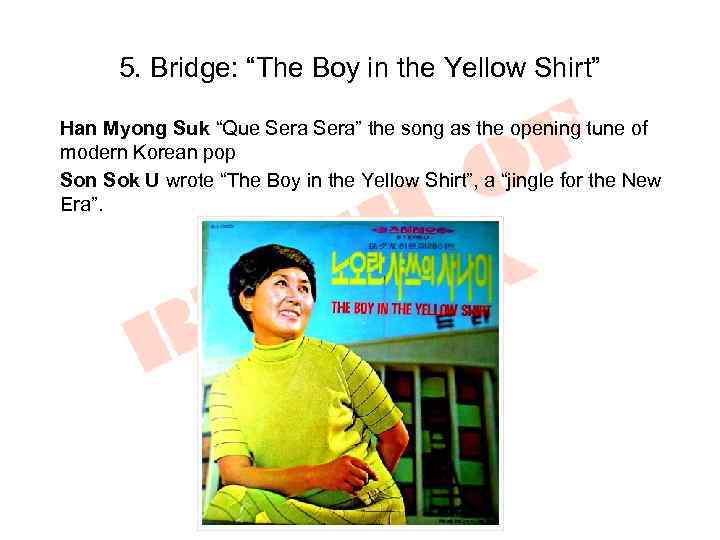
5. Bridge: “The Boy in the Yellow Shirt” Han Myong Suk “Que Sera” the song as the opening tune of modern Korean pop Son Sok U wrote “The Boy in the Yellow Shirt”, a “jingle for the New Era”.
6. Modernity Glocalized: Kayo Meets Pop “Modernity is inherently globalizing” – misleading. “It can be interpreted as a weak version of cultural imperialism; global modernization means homogenization, or more specifically, Westernization of non-Western cultures” (p. 209) AS an alternative approach is to focus on the “local” end of the process *Park Chung Hee used to refer to his political vision as glocalized democracy, which turned out to be an extreme deviation from the stated ideals of Western liberal democracy
7. Kayo and Rock 70’s While kayo and pop were competing against each other for mass media spots and larger venues, rock was steadily gaining ground as an underground club culture • Kayo indicated the national origin of certain musical styles rather than the nationality of the composer or performer. Migun Mudae (US military scene) musicians spread fast through mass media created a new trend of Korean popular songs kayo • Rock: Beatles + the Rolling Stones + The Ventures + The Beach Boys Number of places to hear music grows: music cafes, music salons, Myongdong and GI clubs in Itaewon BUT still little public attraction Era of festivals and contests (obsessed by long hair, recreational drug use, antiauthority attitude etc. – liberals called it “youth culture”)
7. Crackdown on “Decadent Culture” and the Go-Go Midnight Revolt Park Cheong Hee regime against “vulgar” (chosok) and “decadent” (toepye): Inspection “changbal tansok” for hair and skirts length Popular music purge campaign to liquidate the legacy of Japanese colonialism by wiping out the corrupting “waesaek” (Japanese influence) on Korean popular music Promoted wholesome songs “konjon kayo” Government control over popular music, censorship of broadcast, performance, film and audio recording. Banned around 223 Korean songs and 261 Western pop songs between 1965 and 1975 Festivals and concerts were canceled, hemp control By 1972 loud and noisy rock almost disappeared from the downtown live music salons survived in go-go clubs (kogojang)
7 -2. Crackdown on “Decadent Culture” and the Go-Go Midnight Revolt The problems of Rock: • Aesthetics of rock limited • Lack of musical originality or creativity Shin Joong Hyun was able to spread rock’s push to the national mainstream because of his fame as the creator of soul kayo. Famous song “Miin” but this song was banned https: //www. youtube. com/watch? v=Igy 88 BMm 5 t. A (2006 concert) Shin Joong Hyun organized a new band called “Yoptchondul” (songs included Western rock beat + karak traditional Korean melody)
8. Rock the Nation: Conflicting Visions of the Imagined Community Assasination of Park Chung Hee in 1979 Second wave of rock together with new generation raised under American hegemony Musicians began to add more a nationalist flavor to their music (as Shin’s experiment with “Miin”) the line between alien and national had already been blurred Rock music and other American cultural imports were not imposed but more or less spontaneously accepted and glocalized by the Koreans themselves. • Eight beat go-go rhythm, nasal voice drips • Shift from Japanese to American postcolonial patronage. • 1980 s decade of Cho Yong Pil “Too Short”:
9. Conclusion Efforts to glocalize Anglo-American rock: 1 st generation (60 s ~ early 70 s). Vulnerable to the accusation of peddling “decandent alien culture” because of their US military camp show origin Next generations (mid and late 70 s). Rock music came from placed different from US military camps, ex. Colleges, high schools etc. Late 1970 mid 1980 s “campus group songs”

Thank you!
Скачать презентацию 1 Birth Of Rock Cultural Imperialism Nationalism and
rock in Korea Anna's part.pptx