 Скачать презентацию 1 Audio Conference December 12 2007 Anatomy of Fraud
645724e2170d383a55d0b57d8c4ab62d.ppt
- Количество слайдов: 47



1 Audio Conference—December 12, 2007 Anatomy of Fraud: Case Examples of Greed, Collusion and Override of Controls Dave Cotton, CPA, CFE, CGFM Cotton & Company LLP Alexandria, Virginia www. cottoncpa. com David R. Hancox, CGFM, CIA Siena College USDA Graduate School NYS Comptroller’s Office
2 Case Examples of Greed, Collusion and Override of Controls Ø The FBI’s Grave Concern Ø Mr. Travel Voucher Ø Statewide Care and Maintenance Ø IRS = J. R. Stevens
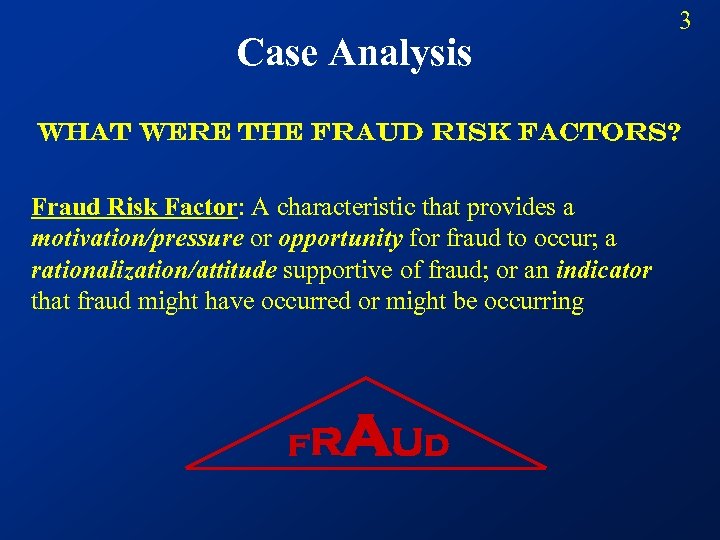
Case Analysis 3 What were the Fraud risk factors? Fraud Risk Factor: A characteristic that provides a motivation/pressure or opportunity for fraud to occur; a rationalization/attitude supportive of fraud; or an indicator that fraud might have occurred or might be occurring FR AUD
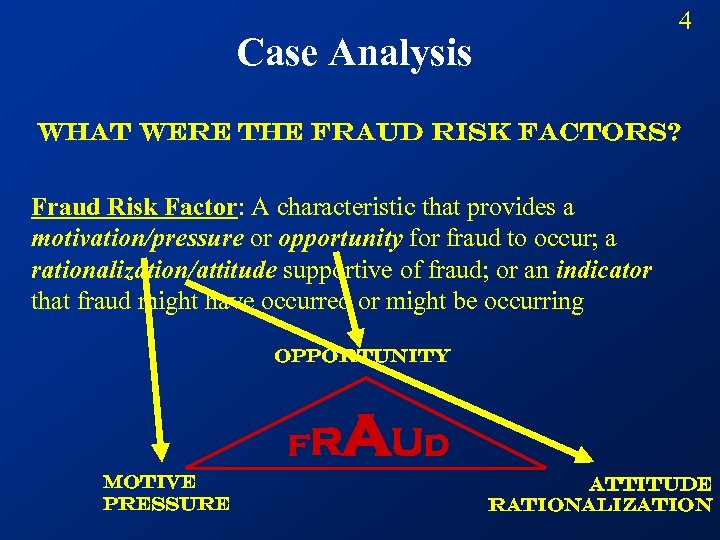
4 Case Analysis What were the Fraud risk factors? Fraud Risk Factor: A characteristic that provides a motivation/pressure or opportunity for fraud to occur; a rationalization/attitude supportive of fraud; or an indicator that fraud might have occurred or might be occurring opportunity FR Motive Pressure AUD Attitude rationalization
5 Case Study The FBI’s Grave Concern
6 Case Study The FBI’s Grave Concern Ø Ø Ø J. Edgar Hoover is buried in Congressional Cemetery; along with John Phillips Souza, former Matthew Brady, and 90 members of Congressional Cemetery is operated by a not-forprofit corporation The corporation was managed by a volunteer board of directors
7 Case Study The FBI’s Grave Concern Ø Ø Ø John Hanley, a retiree, was superintendent, daily administrator, executive director, and a member of the board of the cemetery from 1988 to 1997 He was paid $24, 000 per year The board trusted Hanley and exercised little to no supervisory oversight
8 Case Study The FBI’s Grave Concern Ø Ø Hanley managed the cemetery, sold burial plots and headstones, collected contributions and fees, deposited funds, and maintained the accounting ledger The board became concerned in 1996 when they received a complaint about a purchased headstone that was missing, and then learned of an IRS lien for non-payment of taxes
9 Case Study The FBI’s Grave Concern Ø Ø The subsequent investigation revealed that Hanley had embezzled (at least) $175, 342 by depositing cemetery revenue into a bank account in the name of “Stones on All c/o John S. Hanley” Among the deposits stolen by Hanley was a $4, 545. 80 check from The Society of Former Special Agents of the FBI intended to pay for a memorial to J. Edgar Hoover
10 Case Study The FBI’s Grave Concern Ø Ø Hanley used the embezzled funds to buy racehorses, gamble, and “support his lifestyle” Hanley had told the cemetery board that he was a retired banker, independently wealthy, and owned racehorses
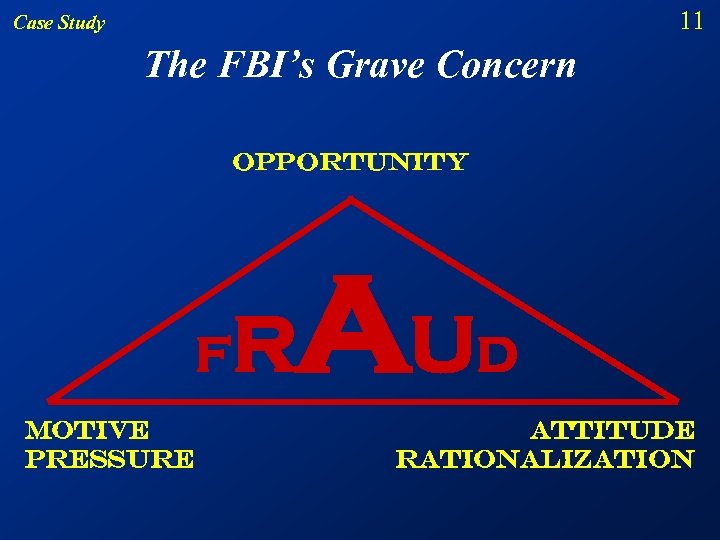
11 Case Study The FBI’s Grave Concern opportunity F Motive Pressure R AU D Attitude rationalization
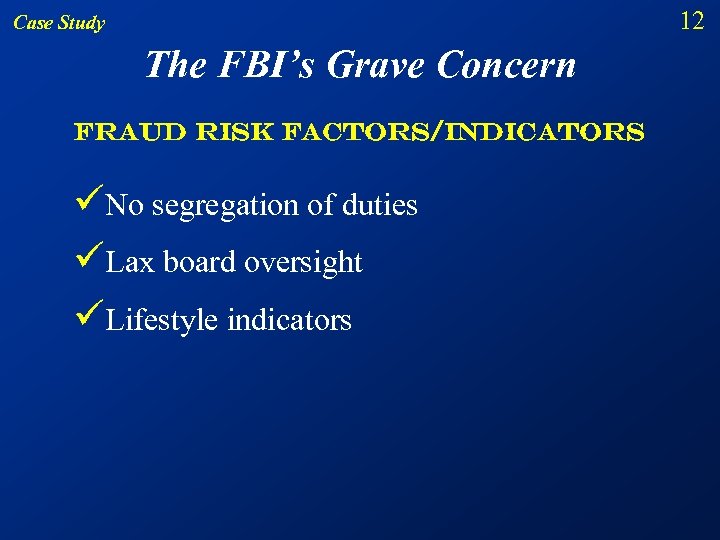
12 Case Study The FBI’s Grave Concern Fraud risk factors/indicators üNo segregation of duties üLax board oversight üLifestyle indicators

13 Case Study Mr. Travel Voucher
14 Case Study William John Burns Ø Ø Ø Supervisor of USAID’s Fiscal Services Office FSO disbursed about $74 million per year of USAID’s $6. 5 billion budget FSO disbursed about $4 million per year for travel expense reimbursements
15 Case Study William John Burns Ø Ø USAID bureau chiefs authorized obligations for travel expenses They tended to estimate high when deciding how much to obligate § Ø This allowed them to avoid having to add to an obligation; and also tended to ‘support’ future year budget requests Bureau chiefs were usually careful to de-obligate and reprogram unspent funds in the current year
16 Case Study William John Burns Ø Ø Ø But, obligated amounts were often spent in subsequent years rather than in the current year De-obligated prior-year money reverts to the US Treasury and cannot be reprogrammed for agency use; hence, bureau chiefs did not track it or care about it FSO’s top priority was de-obligating current-year funds
17 Case Study William John Burns Ø Ø Ø Burns began his crime spree in 1982; it ended in 1988; he stole more than $1. 2 million Burns took upon himself the accounting chore no one else wanted--reconciling prior year unliquidated obligations Burns established a false identity--Vincent Kauffman--and diverted unexpended travel money to ‘Kauffman’s’ bank account
18 Case Study William John Burns Ø Ø Ø Burns plead guilty to embezzlement, fraud, and evading taxes on August 11, 1988 He forfeited nearly all of his assets and agreed to repay the balance of his estimated $1. 2 million theft On October 11, 1988, Burns was sentenced to 6 years in prison
19 Case Study William John Burns Ø Ø Ø Despite longstanding concerns about weak accounting controls, Burns’ crimes were not discovered by any IG audits or reviews During a routine security check for renewing Burns’ clearance, an investigator decided to drive by Burns’ home He found the home and expensive cars to be inconsistent with Burns’ salary
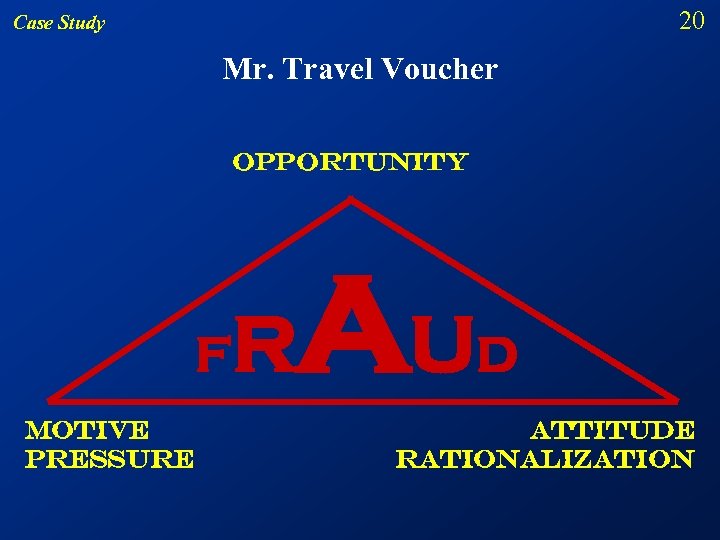
20 Case Study Mr. Travel Voucher opportunity F Motive Pressure R AU D Attitude rationalization
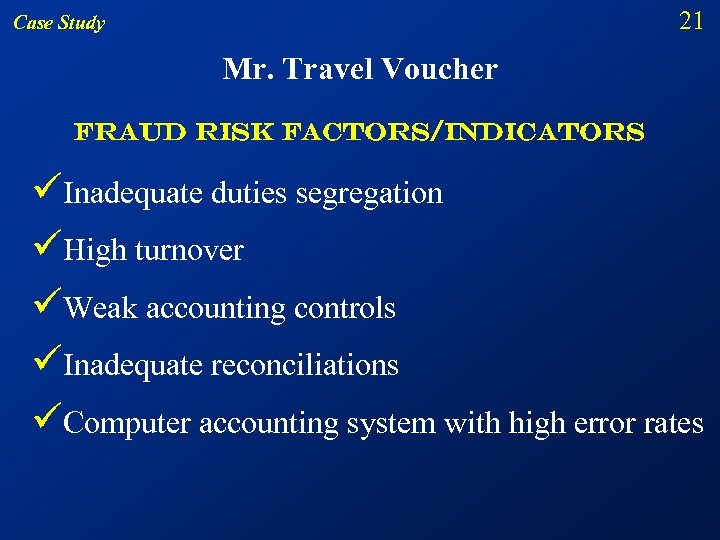
21 Case Study Mr. Travel Voucher Fraud risk factors/indicators üInadequate duties segregation üHigh turnover üWeak accounting controls üInadequate reconciliations üComputer accounting system with high error rates

22 Case Study Statewide Care and Maintenance
23 Case Study NOTE Ø Ø This case study was derived from the findings of an actual quality control review. All names, numbers, and other identifying information have been changed to prevent the identification of the actual organizations and individuals involved.
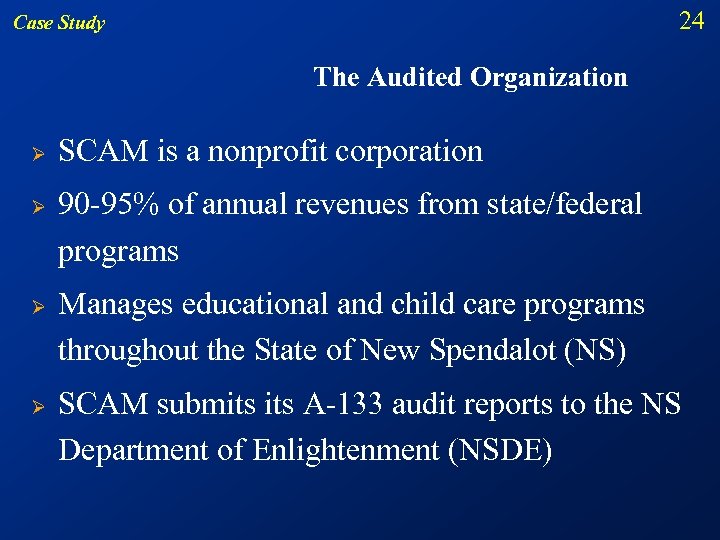
24 Case Study The Audited Organization Ø Ø SCAM is a nonprofit corporation 90 -95% of annual revenues from state/federal programs Manages educational and child care programs throughout the State of New Spendalot (NS) SCAM submits A-133 audit reports to the NS Department of Enlightenment (NSDE)
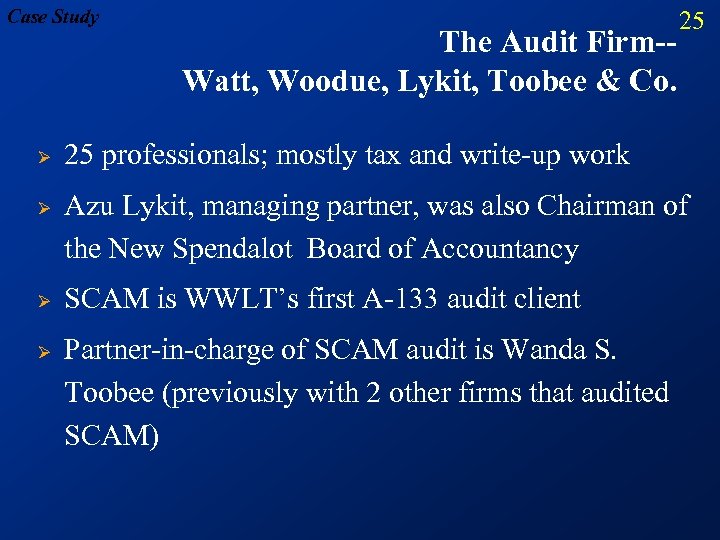
Case Study Ø Ø The Audit Firm-Watt, Woodue, Lykit, Toobee & Co. 25 25 professionals; mostly tax and write-up work Azu Lykit, managing partner, was also Chairman of the New Spendalot Board of Accountancy SCAM is WWLT’s first A-133 audit client Partner-in-charge of SCAM audit is Wanda S. Toobee (previously with 2 other firms that audited SCAM)
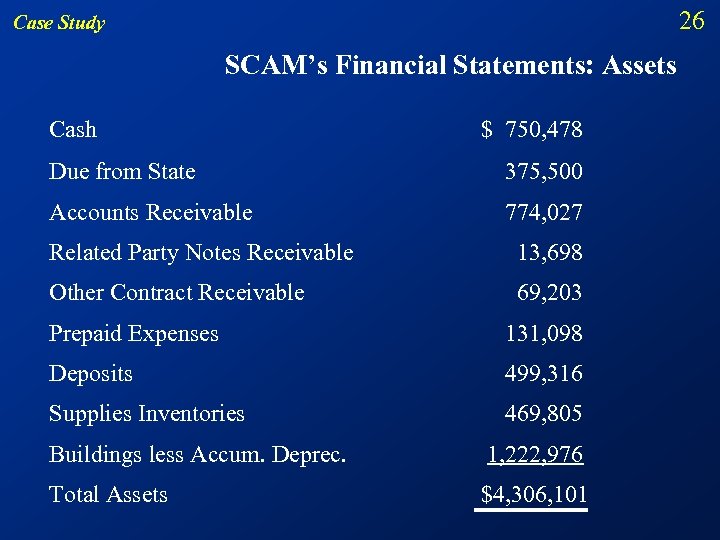
26 Case Study SCAM’s Financial Statements: Assets Cash $ 750, 478 Due from State 375, 500 Accounts Receivable 774, 027 Related Party Notes Receivable 13, 698 Other Contract Receivable 69, 203 Prepaid Expenses 131, 098 Deposits 499, 316 Supplies Inventories 469, 805 Buildings less Accum. Deprec. 1, 222, 976 Total Assets $4, 306, 101
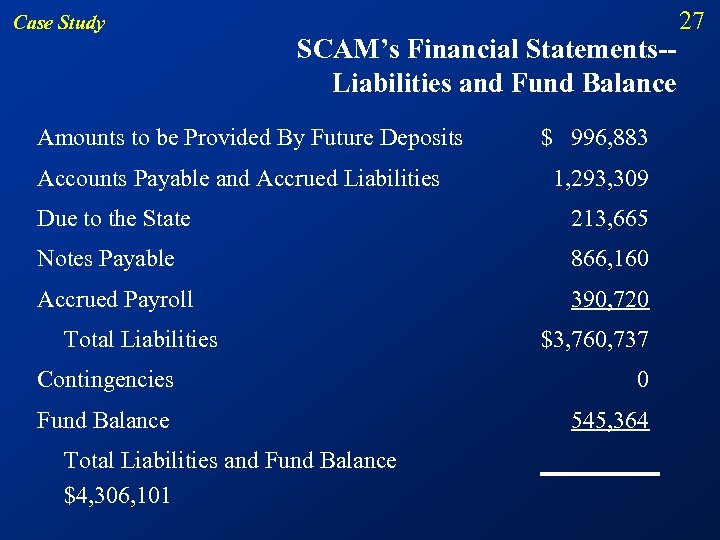
Case Study SCAM’s Financial Statements-Liabilities and Fund Balance Amounts to be Provided By Future Deposits Accounts Payable and Accrued Liabilities $ 996, 883 1, 293, 309 Due to the State 213, 665 Notes Payable 866, 160 Accrued Payroll 390, 720 Total Liabilities $3, 760, 737 Contingencies 0 Fund Balance 545, 364 Total Liabilities and Fund Balance $4, 306, 101 27
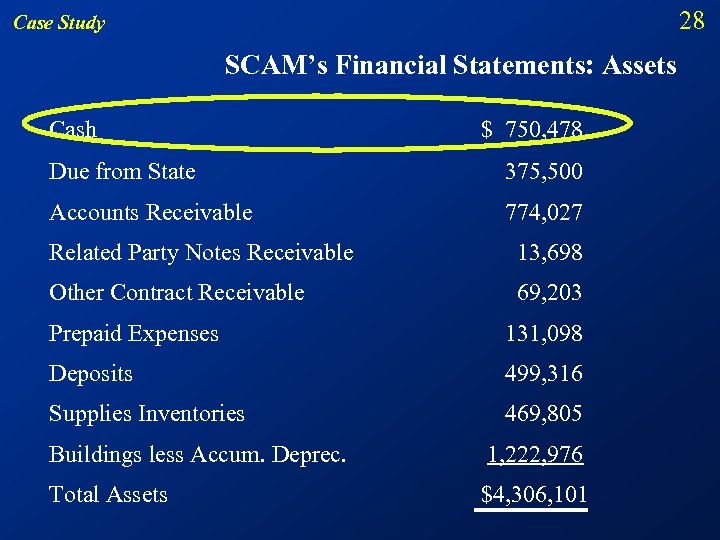
28 Case Study SCAM’s Financial Statements: Assets Cash $ 750, 478 Due from State 375, 500 Accounts Receivable 774, 027 Related Party Notes Receivable 13, 698 Other Contract Receivable 69, 203 Prepaid Expenses 131, 098 Deposits 499, 316 Supplies Inventories 469, 805 Buildings less Accum. Deprec. 1, 222, 976 Total Assets $4, 306, 101
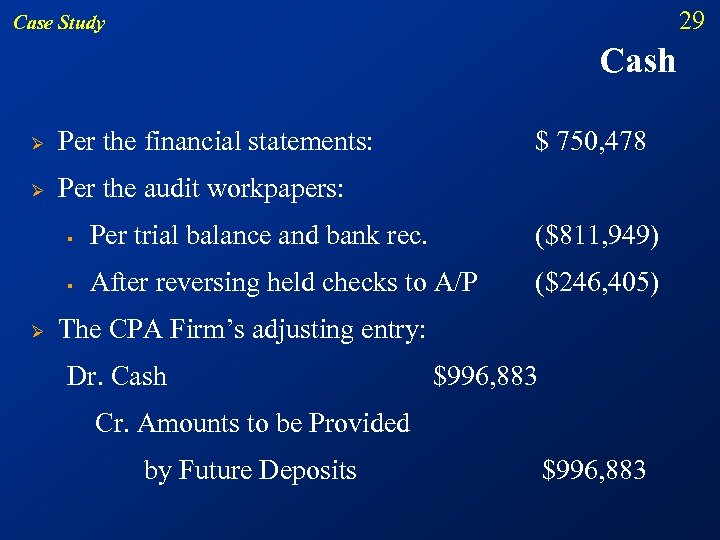
29 Case Study Cash Ø Per the financial statements: Ø $ 750, 478 Per the audit workpapers: § ($811, 949) § Ø Per trial balance and bank rec. After reversing held checks to A/P ($246, 405) The CPA Firm’s adjusting entry: Dr. Cash $996, 883 Cr. Amounts to be Provided by Future Deposits $996, 883
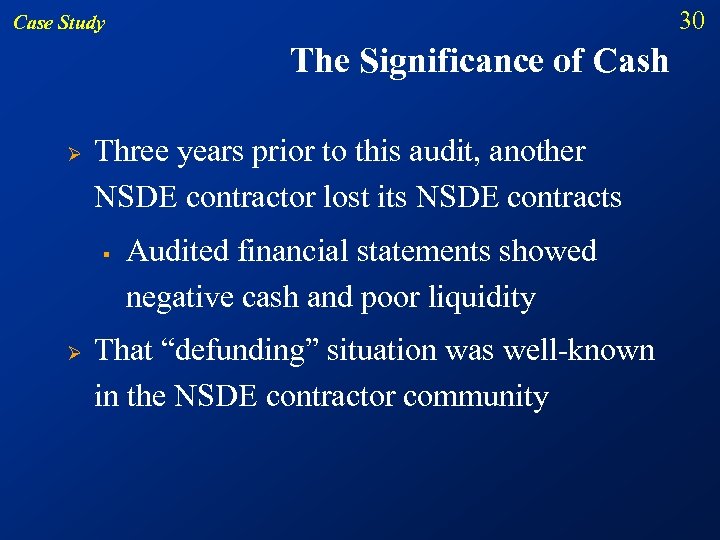
30 Case Study The Significance of Cash Ø Three years prior to this audit, another NSDE contractor lost its NSDE contracts § Ø Audited financial statements showed negative cash and poor liquidity That “defunding” situation was well-known in the NSDE contractor community
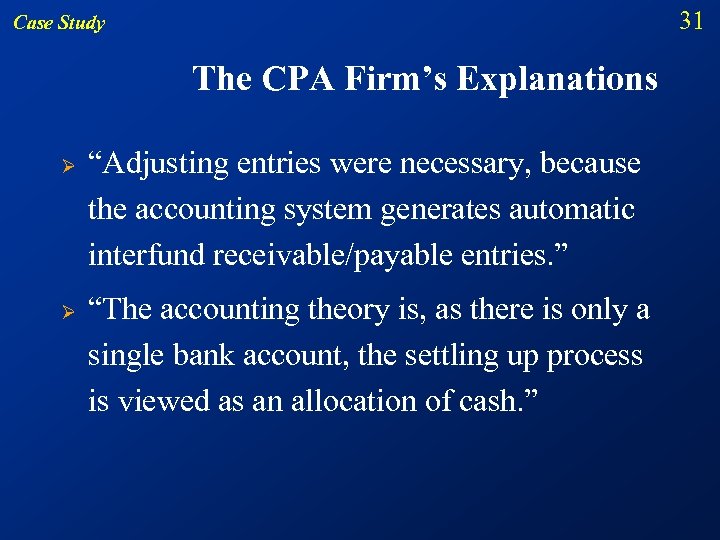
31 Case Study The CPA Firm’s Explanations Ø Ø “Adjusting entries were necessary, because the accounting system generates automatic interfund receivable/payable entries. ” “The accounting theory is, as there is only a single bank account, the settling up process is viewed as an allocation of cash. ”
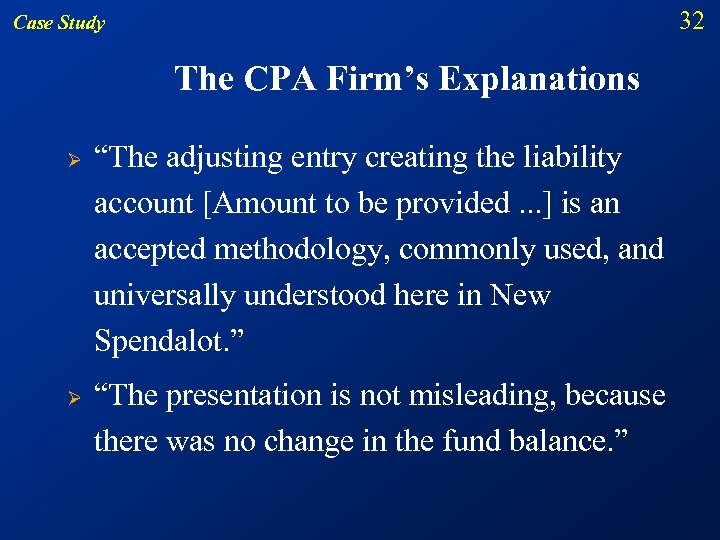
32 Case Study The CPA Firm’s Explanations Ø Ø “The adjusting entry creating the liability account [Amount to be provided. . . ] is an accepted methodology, commonly used, and universally understood here in New Spendalot. ” “The presentation is not misleading, because there was no change in the fund balance. ”
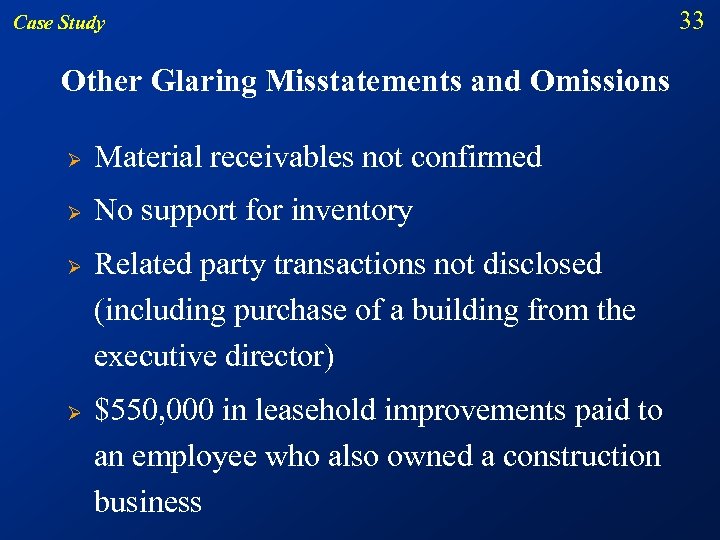
Case Study Other Glaring Misstatements and Omissions Ø Material receivables not confirmed Ø No support for inventory Ø Ø Related party transactions not disclosed (including purchase of a building from the executive director) $550, 000 in leasehold improvements paid to an employee who also owned a construction business 33
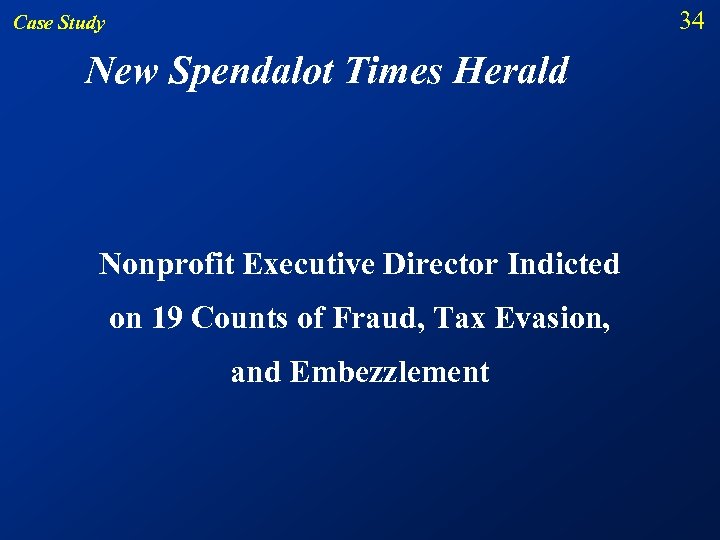
34 Case Study New Spendalot Times Herald Nonprofit Executive Director Indicted on 19 Counts of Fraud, Tax Evasion, and Embezzlement
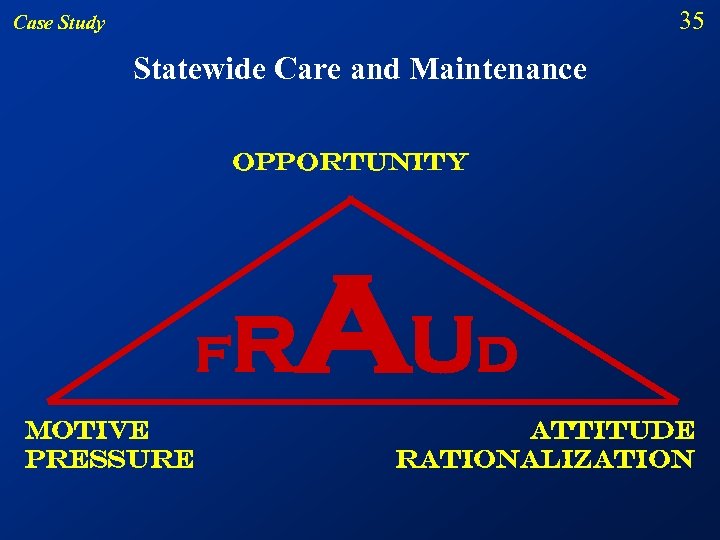
35 Case Study Statewide Care and Maintenance opportunity F Motive Pressure R AU D Attitude rationalization
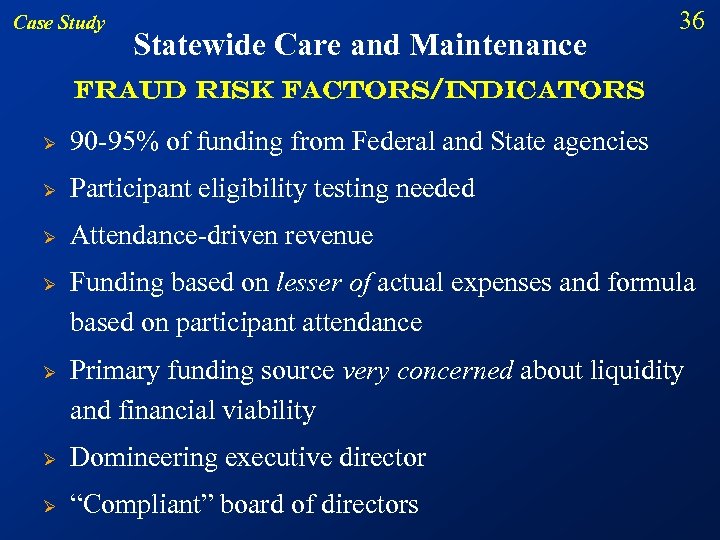
Case Study Statewide Care and Maintenance 36 Fraud risk factors/indicators Ø 90 -95% of funding from Federal and State agencies Ø Participant eligibility testing needed Ø Attendance-driven revenue Ø Ø Funding based on lesser of actual expenses and formula based on participant attendance Primary funding source very concerned about liquidity and financial viability Ø Domineering executive director Ø “Compliant” board of directors
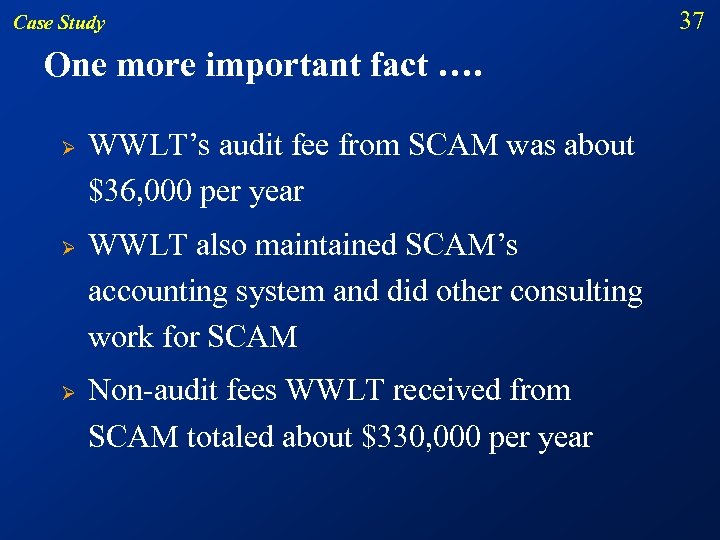
Case Study One more important fact …. Ø Ø Ø WWLT’s audit fee from SCAM was about $36, 000 per year WWLT also maintained SCAM’s accounting system and did other consulting work for SCAM Non-audit fees WWLT received from SCAM totaled about $330, 000 per year 37
38 Case Study IRS = J. R. Stevens
39 Case Study IRS = J. R. Stevens Ø Ø Ø J. R. Stevens was an IRS official in the collections division of the IRS Maryland Delaware district office He embezzled $77, 218 by altering 13 checks made payable to “IRS” to be payable to “JRStevens” After depositing each check into his personal account, he recorded the taxpayer’s debt satisfied
40 Case Study IRS = J. R. Stevens Ø Ø Stevens was caught because he diverted a check for $6, 578. 66 but then failed to record the debt as satisfied The IRS then garnished the wages of the taxpayer’s wife
41 Case Study IRS = J. R. Stevens Ø Ø Stevens was clever enough to only divert treasurer’s and cashier’s checks, which are not routinely returned to check writers Similar cases § § An IRS officer changed “IRS” to his initials “ARS” An IRS employee changed “IRS” to “MRS” followed by her last name
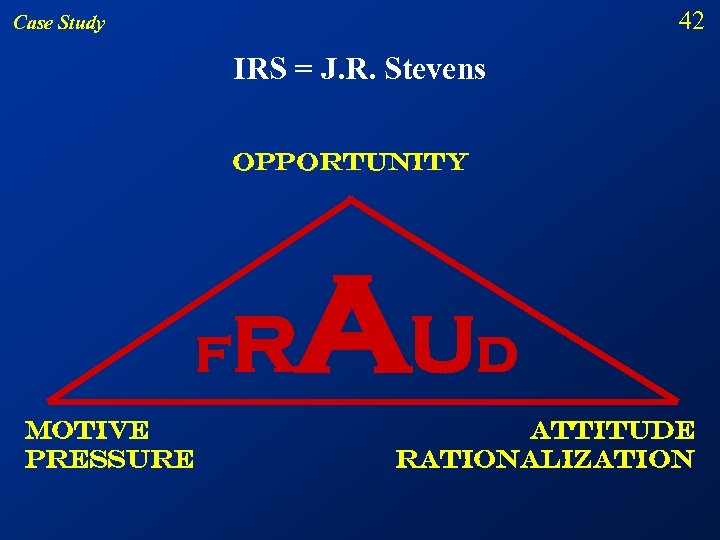
42 Case Study IRS = J. R. Stevens opportunity F Motive Pressure R AU D Attitude rationalization
Case Study IRS = J. R. Stevens Fraud risk factors/indicators Ø Poor duties segregation 43
44 End Thoughts … Ø Ø Ø Auditors are responsible for finding (material) misstatements, whether caused by fraud or error Auditors will almost never actually find fraud during a routine audit BUT, auditors should be alert for Fraud Risk Factors, i. e. indicia of fraud; and should make referrals for further investigation (or arrange to commence a fraud examination)
Remember: Four words have preceded EVERY fraud that has ever been committed … It can’t happen here 45
Remember: Seven words have followed EVERY fraud that has ever been discovered … We didn’t think it could happen here 46
47 It could happen to you … Maybe it already has.
Скачать презентацию 1 Audio Conference December 12 2007 Anatomy of Fraud
645724e2170d383a55d0b57d8c4ab62d.ppt