


 Скачать презентацию 1 Architecture and Parameters of Capacity Development Lessons
00cb32cd4b39808f334409a515e6c0ab.ppt
- Количество слайдов: 34
 1 Architecture and Parameters of Capacity Development: Lessons and Practices from the Business and Institutional Sectors Robert N. Le. Blanc Paul Beaulieu July 5, 2011
 2 Objective of the Presentation This presentation seeks to: • Identify the essential logic, approaches and strategies that are used by business and institutional sectors in the pursuit of capability and capacity; • Contextualise them with respect to the approaches used in TC and CD, and • Propose avenues for further research and policy development by the EC with a view to adapt business sector/institutional approaches and practices to TC.
 3 Fundamental Pillars of Business CD Related to Investment Processes 1 of 4 • Business Ecosystem Approach: the organisation and its objectives in relation to its internal and external organisational inter-dependencies. • CD is done to reach “performance and business development targets”: CD is not “potential”, but dynamic (“kinetic”). • Hierarchy of Interconnected Capacities: alignment, “supply-chain of capacity” and seamless inter-relationship integration. •
 4 Fundamental Pillars of Business CD Related to Investment Processes 2 of 4 • CD required depends on your development approach and business case/strategy: Isomorphic mimicry is therefore nonsense. Premium on adaptation and evidence-based management at all stages of CD. • Capabilities, as with products, transform and evolve along a lifecycle • Each capacity rests on specific groups of foundations: developing only a part of a capacity “meta-system” is counterproductive. • Capacity requires continuous adaptation to environment and maintenance
 5 Fundamental Pillars of Business Investment Decisions (All, including CD) 3 of 4 • CD is specific to the “FOR WHAT”: There is no such thing as a generic capacity. Mapping and evaluation capacities are critical. • Soft capacities are enablers: they are not ends unto themselves (ex: leadership) • Detailed Transformation Strategy prepared. • Strategic and Operational capabilities are defined very differently, but together.
 6 Fundamental Pillars of Business Investment Decisions (All, including CD) 4 of 4 • CD investment is very closely monitored and constantly adjusted to meet targets. • “In your face” accountability. • Redundancy and diversification as a guarantee against capacity erosion and (strategic) risk. • Both short-term and long-term needs (i. e. performance and strategy) require the acquisition of capacity.
 7 HOWEVER: Business Sector Still Learning • The business and institutional sectors are still looking for better ways to design and implement CD • The dynamic capacity approach to business development (explained later) is driven by globalisation and competition. • Under conditions of equal technological levels, operational capacity does not determine comparative advantage. Advantage is defined through the ability to quickly and strategically adjust “dynamic capacity”. • Learning how to better incorporate social responsibility (ex. ethical investment, environmental stewardship)
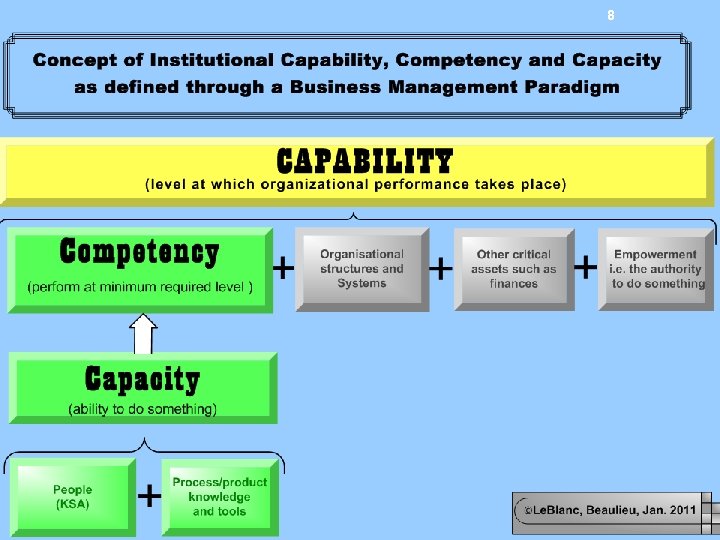 8
8
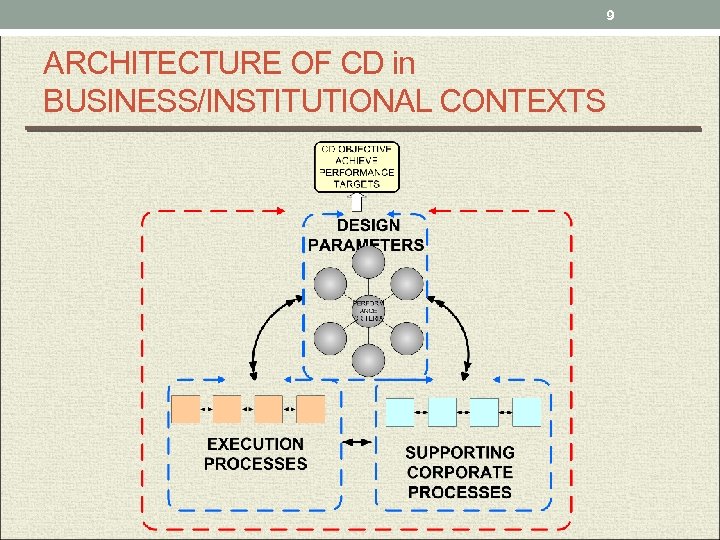 9 ARCHITECTURE OF CD in BUSINESS/INSTITUTIONAL CONTEXTS
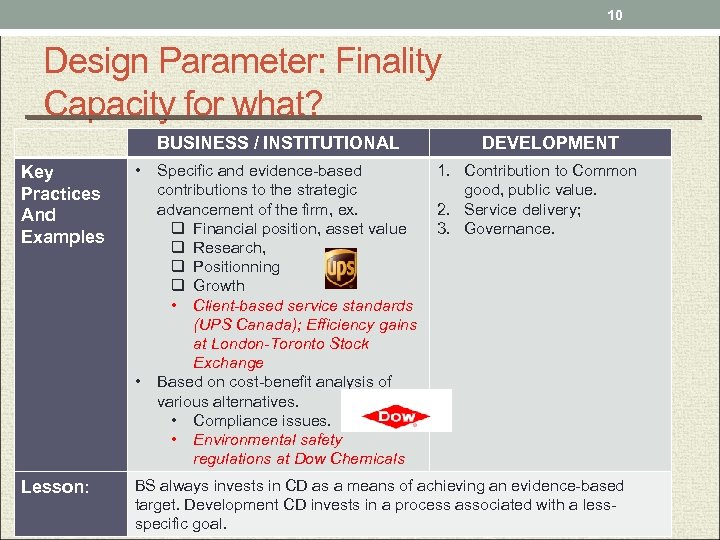 10 Design Parameter: Finality Capacity for what? BUSINESS / INSTITUTIONAL Key Practices And Examples • • Lesson: Specific and evidence-based contributions to the strategic advancement of the firm, ex. q Financial position, asset value q Research, q Positionning q Growth • Client-based service standards (UPS Canada); Efficiency gains at London-Toronto Stock Exchange Based on cost-benefit analysis of various alternatives. • Compliance issues. • Environmental safety regulations at Dow Chemicals DEVELOPMENT 1. Contribution to Common good, public value. 2. Service delivery; 3. Governance. BS always invests in CD as a means of achieving an evidence-based target. Development CD invests in a process associated with a lessspecific goal.
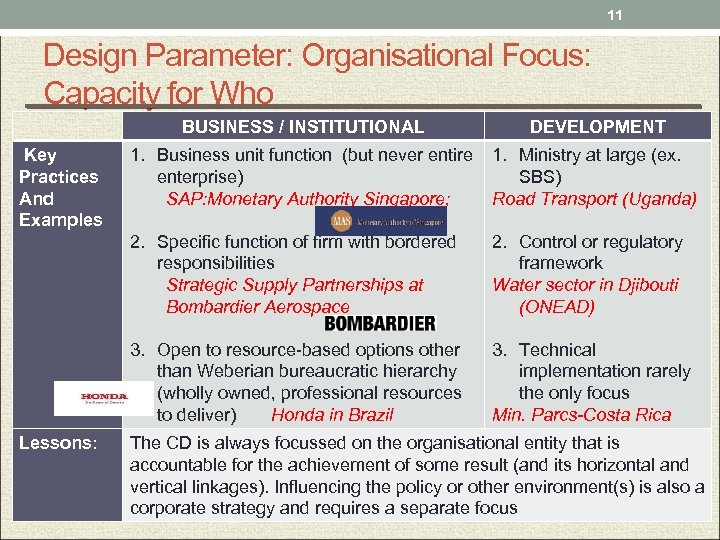 11 Design Parameter: Organisational Focus: Capacity for Who BUSINESS / INSTITUTIONAL 1. Ministry at large (ex. SBS) Road Transport (Uganda) 2. Control or regulatory framework Water sector in Djibouti (ONEAD) 3. Open to resource-based options other than Weberian bureaucratic hierarchy (wholly owned, professional resources to deliver) Honda in Brazil Lessons: 1. Business unit function (but never entire enterprise) SAP: Monetary Authority Singapore; 2. Specific function of firm with bordered responsibilities Strategic Supply Partnerships at Bombardier Aerospace Key Practices And Examples DEVELOPMENT 3. Technical implementation rarely the only focus Min. Parcs-Costa Rica The CD is always focussed on the organisational entity that is accountable for the achievement of some result (and its horizontal and vertical linkages). Influencing the policy or other environment(s) is also a corporate strategy and requires a separate focus
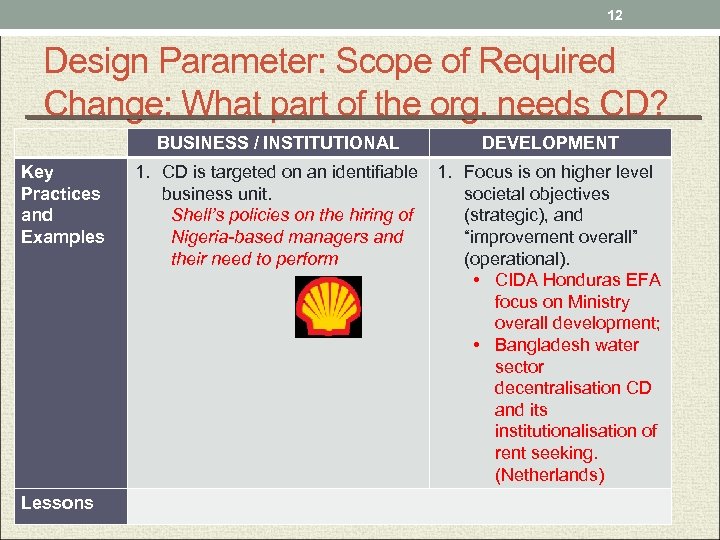 12 Design Parameter: Scope of Required Change: What part of the org. needs CD? BUSINESS / INSTITUTIONAL Key Practices and Examples Lessons DEVELOPMENT 1. CD is targeted on an identifiable business unit. Shell’s policies on the hiring of Nigeria-based managers and their need to perform 1. Focus is on higher level societal objectives (strategic), and “improvement overall” (operational). • CIDA Honduras EFA focus on Ministry overall development; • Bangladesh water sector decentralisation CD and its institutionalisation of rent seeking. (Netherlands)
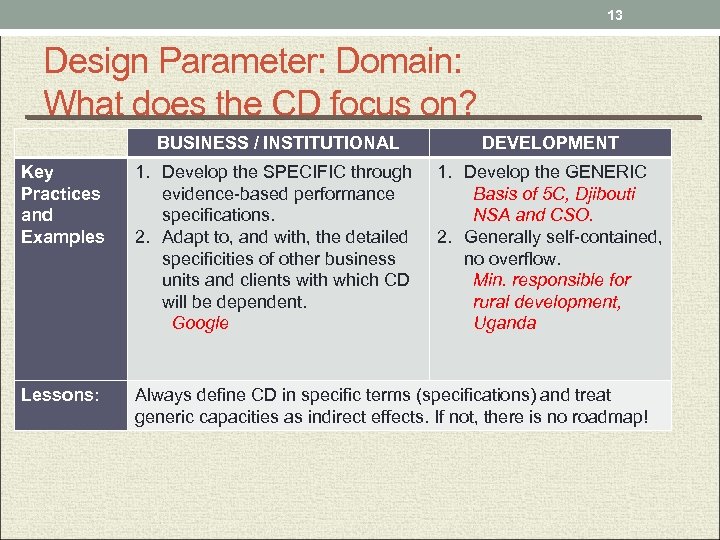 13 Design Parameter: Domain: What does the CD focus on? BUSINESS / INSTITUTIONAL DEVELOPMENT Key Practices and Examples 1. Develop the SPECIFIC through evidence-based performance specifications. 2. Adapt to, and with, the detailed specificities of other business units and clients with which CD will be dependent. Google 1. Develop the GENERIC Basis of 5 C, Djibouti NSA and CSO. 2. Generally self-contained, no overflow. Min. responsible for rural development, Uganda Lessons: Always define CD in specific terms (specifications) and treat generic capacities as indirect effects. If not, there is no roadmap!
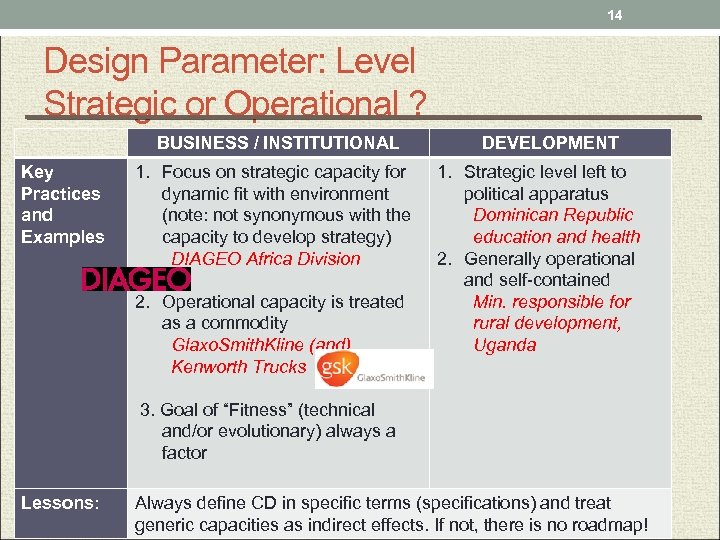 14 Design Parameter: Level Strategic or Operational ? BUSINESS / INSTITUTIONAL Key Practices and Examples 1. Focus on strategic capacity for dynamic fit with environment (note: not synonymous with the capacity to develop strategy) DIAGEO Africa Division 2. Operational capacity is treated as a commodity Glaxo. Smith. Kline (and) Kenworth Trucks DEVELOPMENT 1. Strategic level left to political apparatus Dominican Republic education and health 2. Generally operational and self-contained Min. responsible for rural development, Uganda 3. Goal of “Fitness” (technical and/or evolutionary) always a factor Lessons: Always define CD in specific terms (specifications) and treat generic capacities as indirect effects. If not, there is no roadmap!
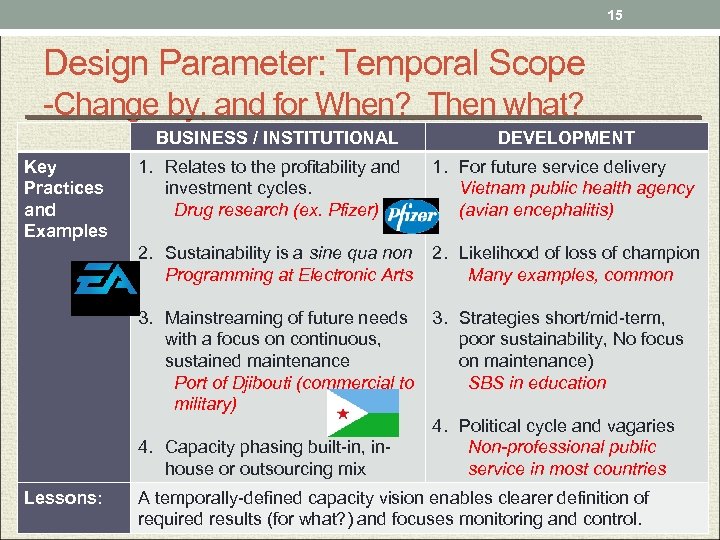 15 Design Parameter: Temporal Scope -Change by, and for When? Then what? BUSINESS / INSTITUTIONAL DEVELOPMENT 1. Relates to the profitability and investment cycles. Drug research (ex. Pfizer) 1. For future service delivery Vietnam public health agency (avian encephalitis) 2. Sustainability is a sine qua non Programming at Electronic Arts Key Practices and Examples 2. Likelihood of loss of champion Many examples, common 3. Mainstreaming of future needs 3. Strategies short/mid-term, with a focus on continuous, poor sustainability, No focus sustained maintenance on maintenance) Port of Djibouti (commercial to SBS in education military) 4. Political cycle and vagaries 4. Capacity phasing built-in, in. Non-professional public house or outsourcing mix service in most countries Lessons: A temporally-defined capacity vision enables clearer definition of required results (for what? ) and focuses monitoring and control.
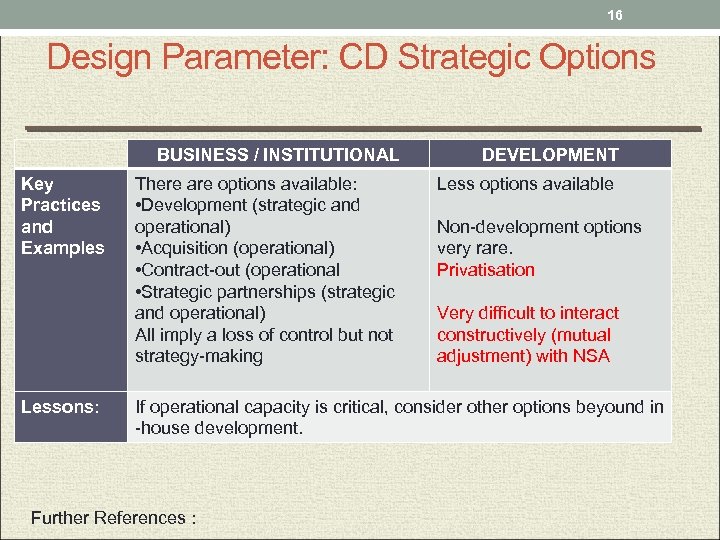 16 Design Parameter: CD Strategic Options BUSINESS / INSTITUTIONAL Key Practices and Examples Lessons: DEVELOPMENT There are options available: • Development (strategic and operational) • Acquisition (operational) • Contract-out (operational • Strategic partnerships (strategic and operational) All imply a loss of control but not strategy-making Less options available Non-development options very rare. Privatisation Very difficult to interact constructively (mutual adjustment) with NSA If operational capacity is critical, consider other options beyound in -house development. Further References :
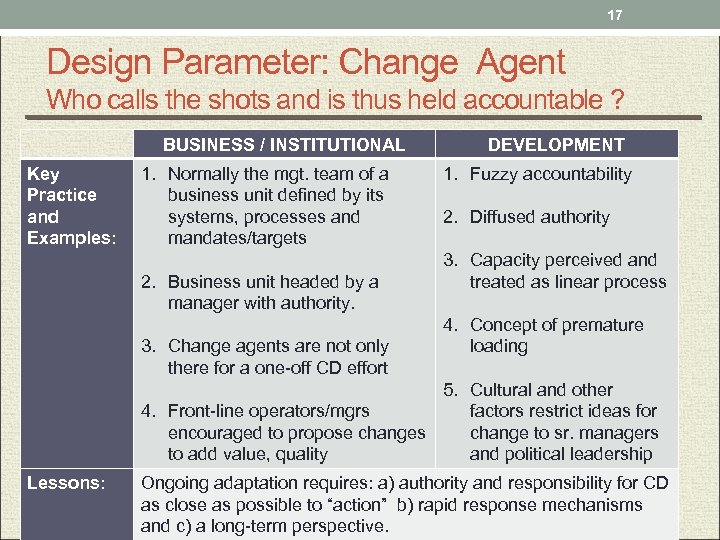 17 Design Parameter: Change Agent Who calls the shots and is thus held accountable ? BUSINESS / INSTITUTIONAL Key Practice and Examples: 1. Normally the mgt. team of a business unit defined by its systems, processes and mandates/targets 2. Business unit headed by a manager with authority. 3. Change agents are not only there for a one-off CD effort DEVELOPMENT 1. Fuzzy accountability 2. Diffused authority 3. Capacity perceived and treated as linear process 4. Concept of premature loading 5. Cultural and other 4. Front-line operators/mgrs factors restrict ideas for encouraged to propose changes change to sr. managers to add value, quality and political leadership Lessons: Ongoing adaptation requires: a) authority and responsibility for CD as close as possible to “action” b) rapid response mechanisms and c) a long-term perspective.
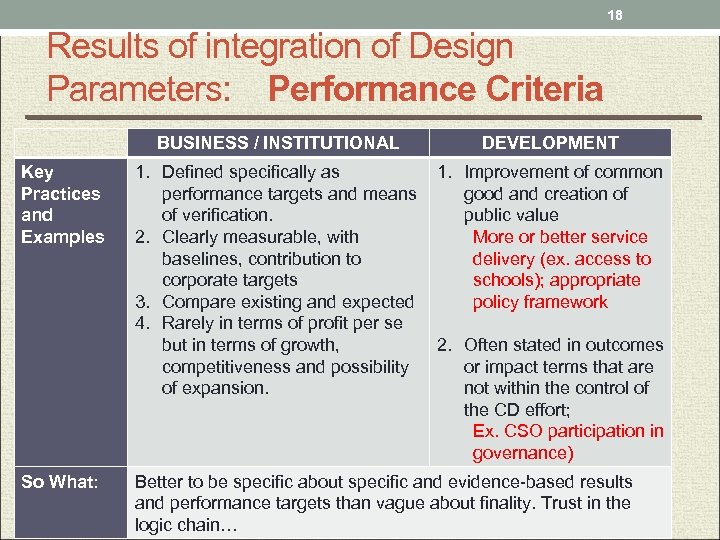 18 Results of integration of Design Parameters: Performance Criteria BUSINESS / INSTITUTIONAL Key Practices and Examples So What: DEVELOPMENT 1. Defined specifically as performance targets and means of verification. 2. Clearly measurable, with baselines, contribution to corporate targets 3. Compare existing and expected 4. Rarely in terms of profit per se but in terms of growth, competitiveness and possibility of expansion. 1. Improvement of common good and creation of public value More or better service delivery (ex. access to schools); appropriate policy framework 2. Often stated in outcomes or impact terms that are not within the control of the CD effort; Ex. CSO participation in governance) Better to be specific about specific and evidence-based results and performance targets than vague about finality. Trust in the logic chain…
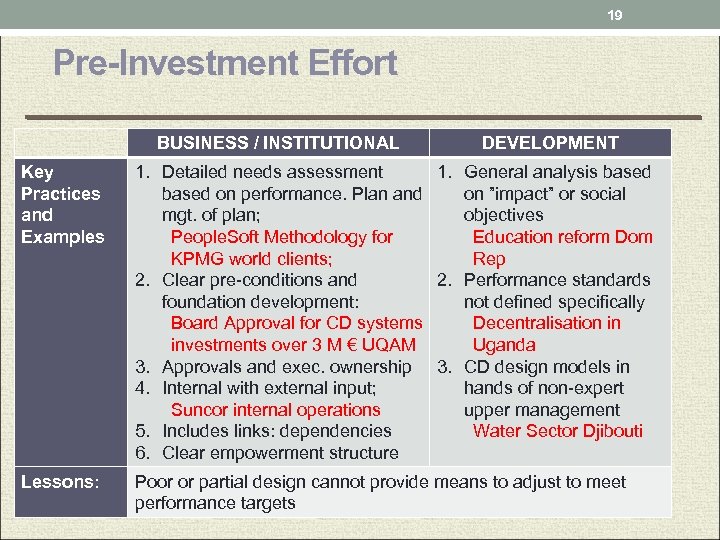 19 Pre-Investment Effort BUSINESS / INSTITUTIONAL DEVELOPMENT Key Practices and Examples 1. Detailed needs assessment 1. General analysis based on performance. Plan and on ”impact” or social mgt. of plan; objectives People. Soft Methodology for Education reform Dom KPMG world clients; Rep 2. Clear pre-conditions and 2. Performance standards foundation development: not defined specifically Board Approval for CD systems Decentralisation in investments over 3 M € UQAM Uganda 3. Approvals and exec. ownership 3. CD design models in 4. Internal with external input; hands of non-expert Suncor internal operations upper management 5. Includes links: dependencies Water Sector Djibouti 6. Clear empowerment structure Lessons: Poor or partial design cannot provide means to adjust to meet performance targets
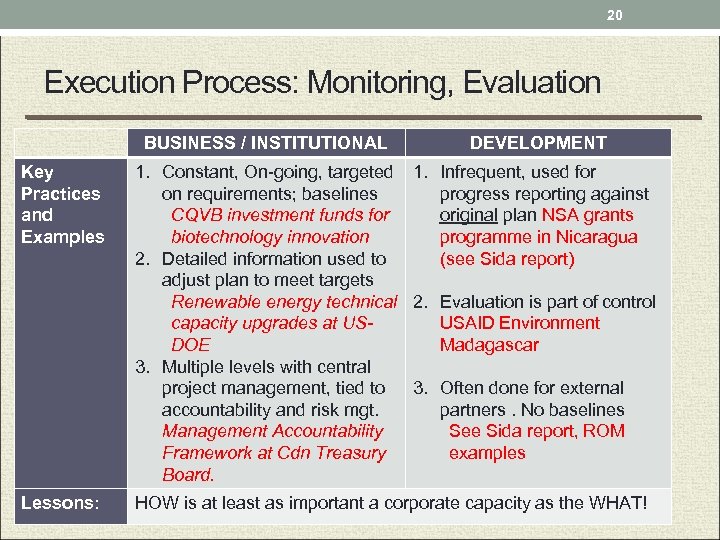 20 Execution Process: Monitoring, Evaluation BUSINESS / INSTITUTIONAL DEVELOPMENT Key Practices and Examples 1. Constant, On-going, targeted 1. Infrequent, used for on requirements; baselines progress reporting against CQVB investment funds for original plan NSA grants biotechnology innovation programme in Nicaragua 2. Detailed information used to (see Sida report) adjust plan to meet targets Renewable energy technical 2. Evaluation is part of control capacity upgrades at USUSAID Environment DOE Madagascar 3. Multiple levels with central project management, tied to 3. Often done for external accountability and risk mgt. partners. No baselines Management Accountability See Sida report, ROM Framework at Cdn Treasury examples Board. Lessons: HOW is at least as important a corporate capacity as the WHAT!
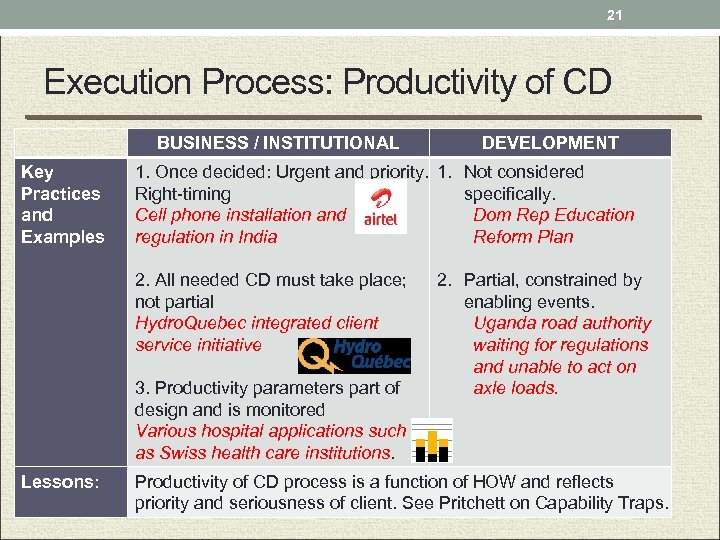 21 Execution Process: Productivity of CD BUSINESS / INSTITUTIONAL Key Practices and Examples 1. Once decided: Urgent and priority. 1. Not considered Right-timing specifically. Cell phone installation and Dom Rep Education regulation in India Reform Plan 2. All needed CD must take place; not partial Hydro. Quebec integrated client service initiative 3. Productivity parameters part of design and is monitored Various hospital applications such as Swiss health care institutions. Lessons: DEVELOPMENT 2. Partial, constrained by enabling events. Uganda road authority waiting for regulations and unable to act on axle loads. Productivity of CD process is a function of HOW and reflects priority and seriousness of client. See Pritchett on Capability Traps.
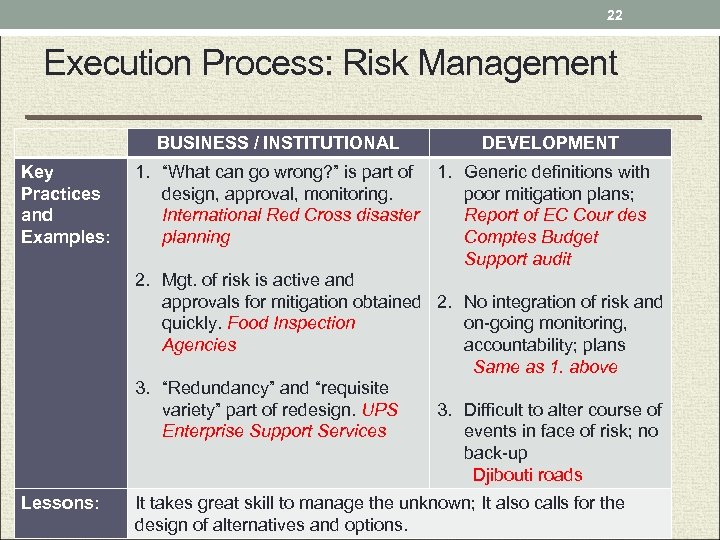 22 Execution Process: Risk Management BUSINESS / INSTITUTIONAL DEVELOPMENT Key Practices and Examples: 1. “What can go wrong? ” is part of 1. Generic definitions with design, approval, monitoring. poor mitigation plans; International Red Cross disaster Report of EC Cour des planning Comptes Budget Support audit 2. Mgt. of risk is active and approvals for mitigation obtained 2. No integration of risk and quickly. Food Inspection on-going monitoring, Agencies accountability; plans Same as 1. above 3. “Redundancy” and “requisite variety” part of redesign. UPS 3. Difficult to alter course of Enterprise Support Services events in face of risk; no back-up Djibouti roads Lessons: It takes great skill to manage the unknown; It also calls for the design of alternatives and options.
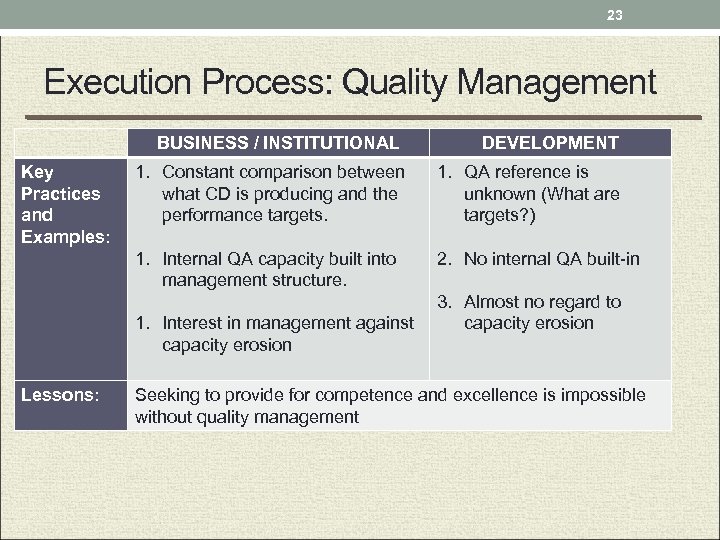 23 Execution Process: Quality Management BUSINESS / INSTITUTIONAL 1. Constant comparison between what CD is producing and the performance targets. 1. QA reference is unknown (What are targets? ) 1. Internal QA capacity built into management structure. Key Practices and Examples: DEVELOPMENT 2. No internal QA built-in 1. Interest in management against capacity erosion Lessons: 3. Almost no regard to capacity erosion Seeking to provide for competence and excellence is impossible without quality management
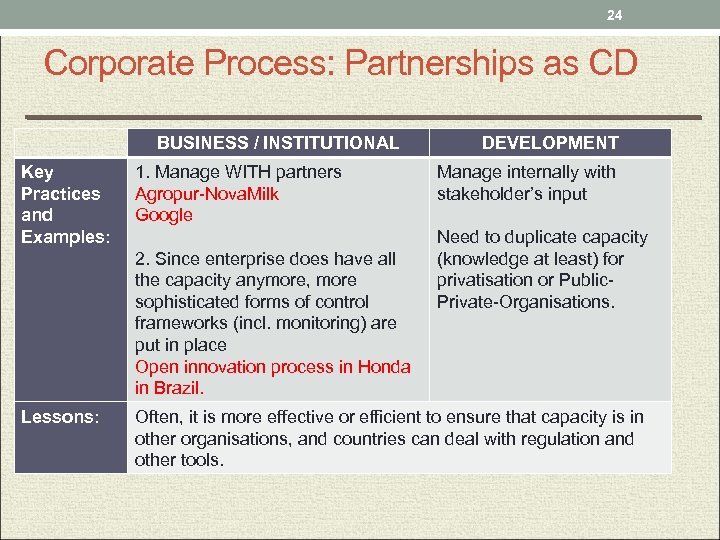 24 Corporate Process: Partnerships as CD BUSINESS / INSTITUTIONAL Key Practices and Examples: 1. Manage WITH partners Agropur-Nova. Milk Google 2. Since enterprise does have all the capacity anymore, more sophisticated forms of control frameworks (incl. monitoring) are put in place Open innovation process in Honda in Brazil. Lessons: DEVELOPMENT Manage internally with stakeholder’s input Need to duplicate capacity (knowledge at least) for privatisation or Public. Private-Organisations. Often, it is more effective or efficient to ensure that capacity is in other organisations, and countries can deal with regulation and other tools.
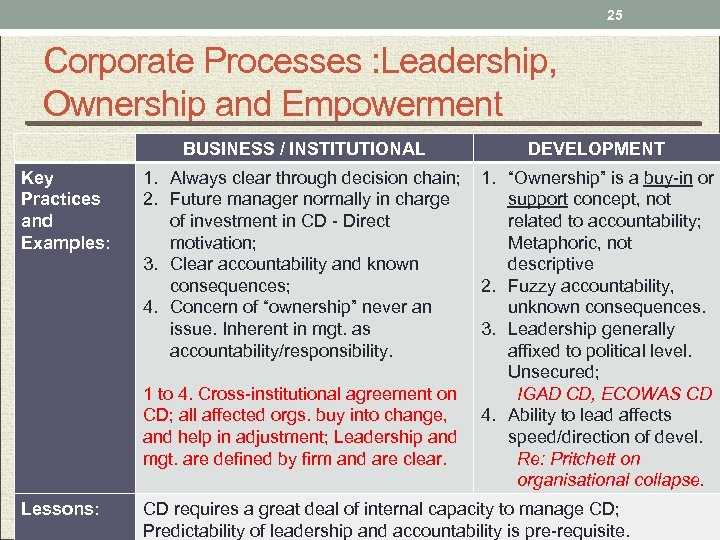 25 Corporate Processes : Leadership, Ownership and Empowerment BUSINESS / INSTITUTIONAL Key Practices and Examples: DEVELOPMENT 1. Always clear through decision chain; 2. Future manager normally in charge of investment in CD - Direct motivation; 3. Clear accountability and known consequences; 4. Concern of “ownership” never an issue. Inherent in mgt. as accountability/responsibility. 1. “Ownership” is a buy-in or support concept, not related to accountability; Metaphoric, not descriptive 2. Fuzzy accountability, unknown consequences. 3. Leadership generally affixed to political level. Unsecured; IGAD CD, ECOWAS CD 4. Ability to lead affects speed/direction of devel. Re: Pritchett on organisational collapse. 1 to 4. Cross-institutional agreement on CD; all affected orgs. buy into change, and help in adjustment; Leadership and mgt. are defined by firm and are clear. Lessons: CD requires a great deal of internal capacity to manage CD; Predictability of leadership and accountability is pre-requisite.
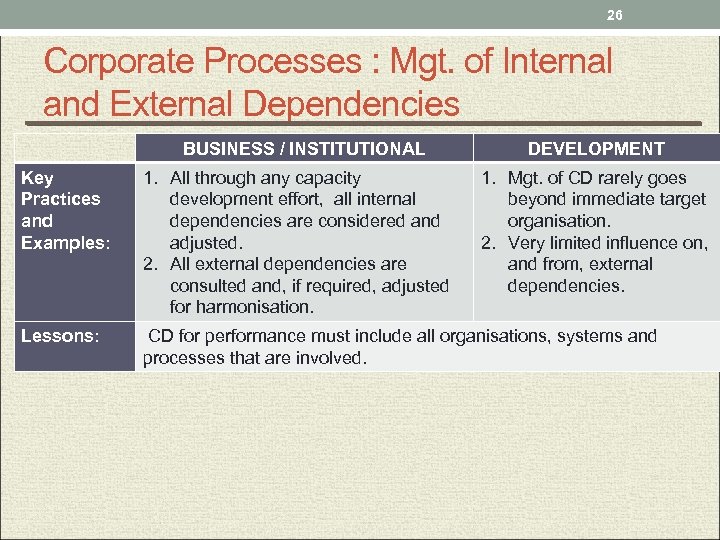 26 Corporate Processes : Mgt. of Internal and External Dependencies BUSINESS / INSTITUTIONAL DEVELOPMENT Key Practices and Examples: 1. All through any capacity development effort, all internal dependencies are considered and adjusted. 2. All external dependencies are consulted and, if required, adjusted for harmonisation. 1. Mgt. of CD rarely goes beyond immediate target organisation. 2. Very limited influence on, and from, external dependencies. Lessons: CD for performance must include all organisations, systems and processes that are involved.
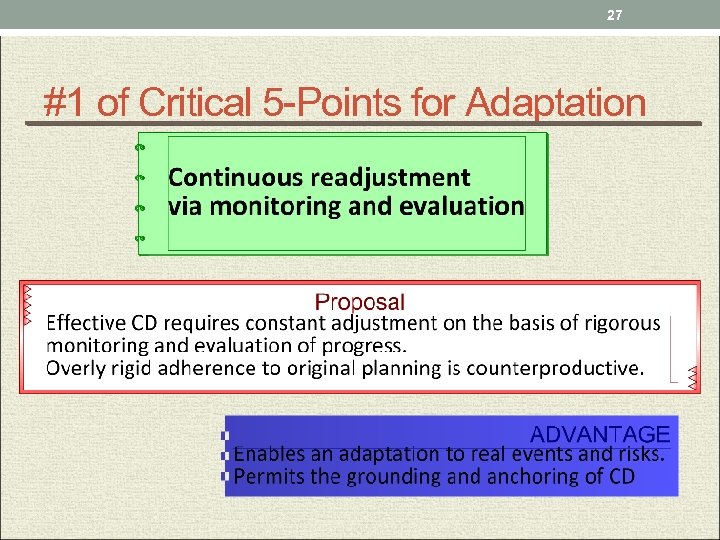 27 #1 of Critical 5 -Points for Adaptation
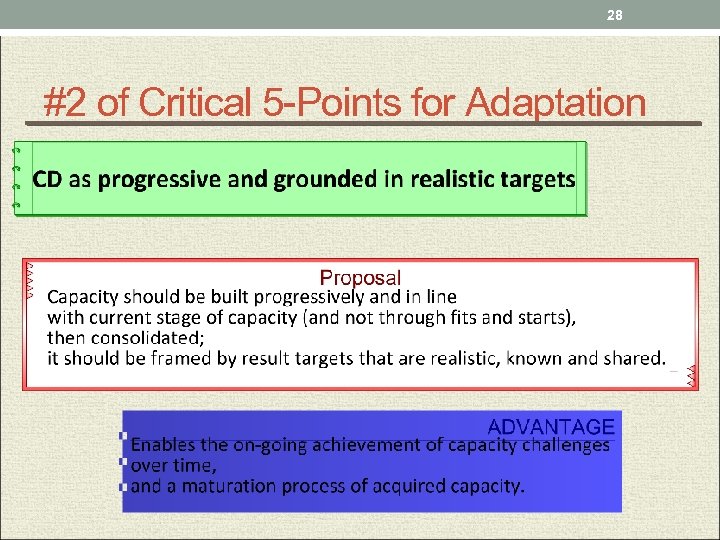 28 #2 of Critical 5 -Points for Adaptation
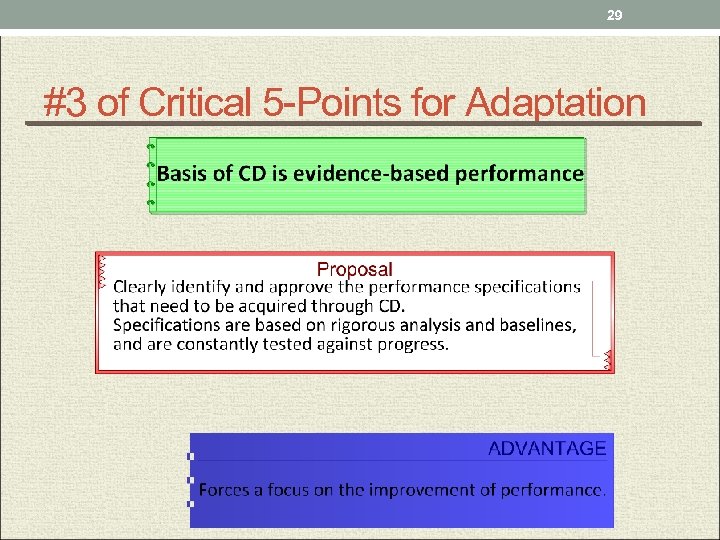 29 #3 of Critical 5 -Points for Adaptation
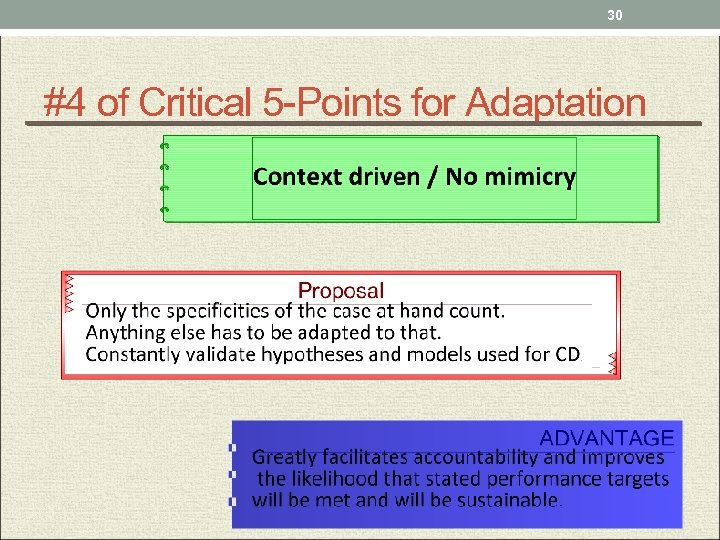 30 #4 of Critical 5 -Points for Adaptation
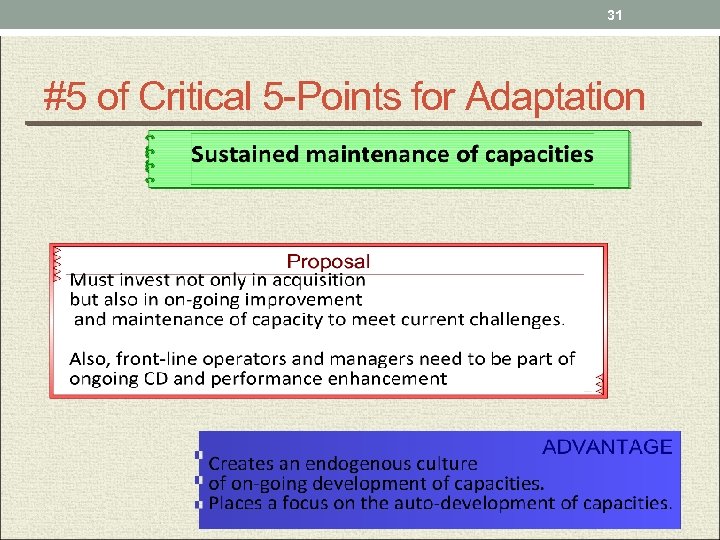 31 #5 of Critical 5 -Points for Adaptation
 32 Four Priorities (steps) for EC action 1. Put into place clear policies and protocols for supporting evidence and performance-based CD. Develop and invest in performance-based management systems (not the same focus as ROM). 2. Rigorous and continuous monitoring and on-going evaluation for CD. Place accountability squarely in hands of DP, but get DEVCO operations manager much more involved. 3. Establish (content) quality review mechanisms for CD design (ex ante); Gatekeeping function But mostly. . .
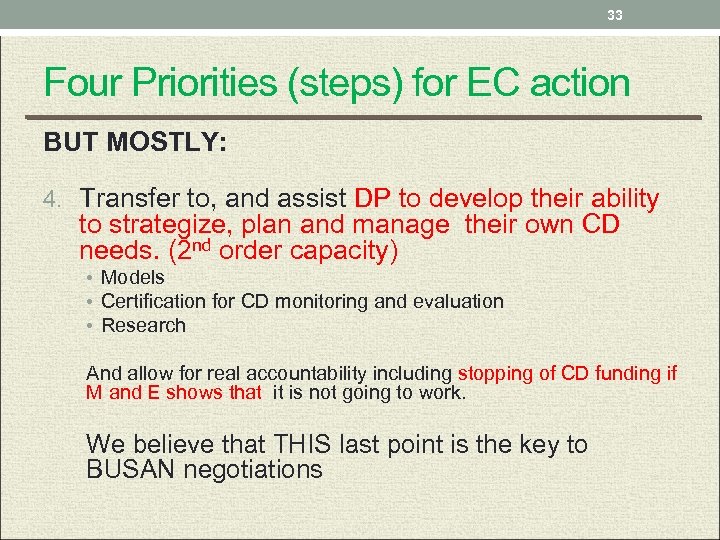 33 Four Priorities (steps) for EC action BUT MOSTLY: 4. Transfer to, and assist DP to develop their ability to strategize, plan and manage their own CD needs. (2 nd order capacity) • Models • Certification for CD monitoring and evaluation • Research And allow for real accountability including stopping of CD funding if M and E shows that it is not going to work. We believe that THIS last point is the key to BUSAN negotiations
 34 The End? - - - or the Beginning?